
Minor Compositions · firefly frequencies
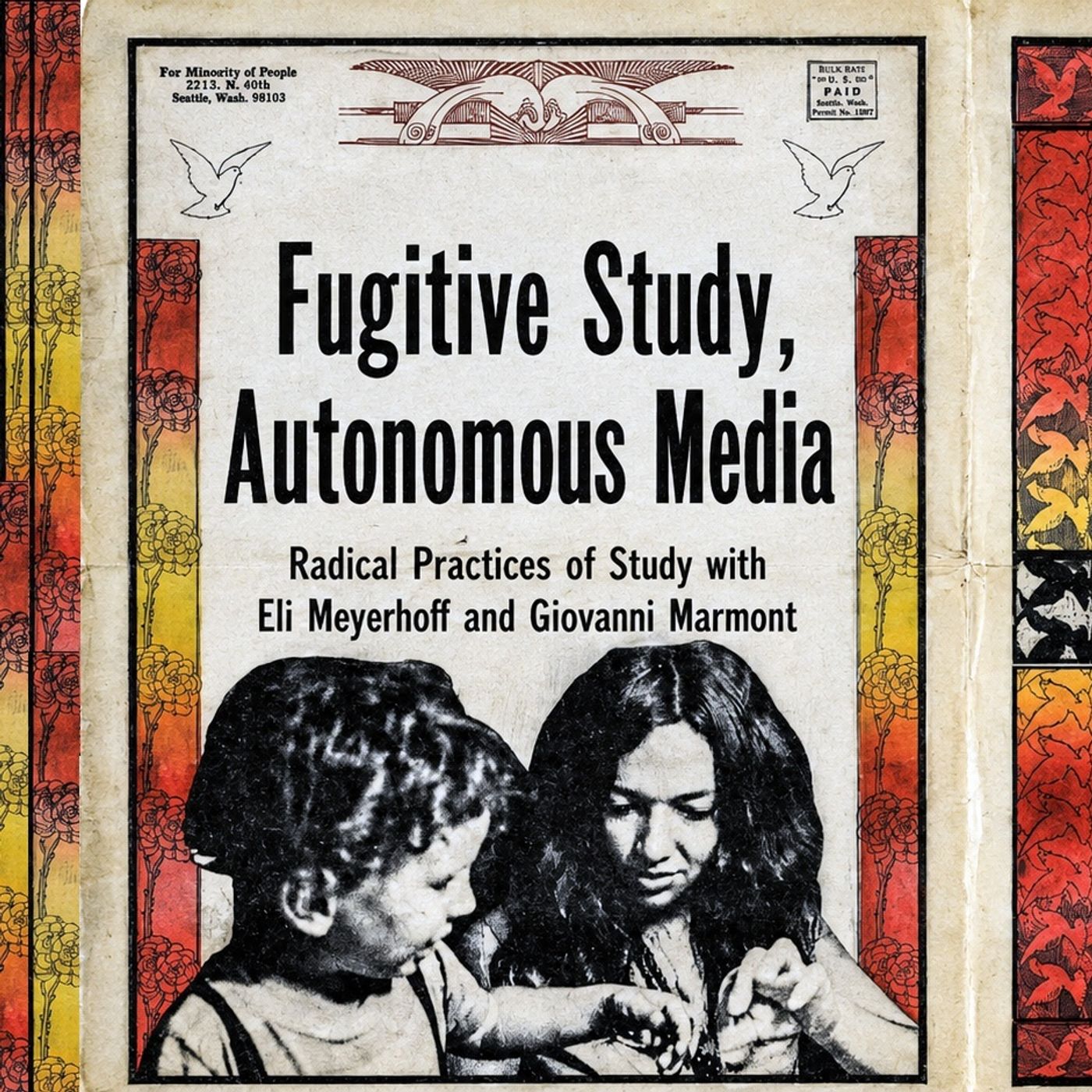
What becomes possible when study is detached from education, accreditation and the demand for individual improvement? And what kinds of social relations emerge when study is approached not as preparation for a qualification or career, but as something worth doing in itself? Here are are joined by Eli Meyerhoff, author of Beyond Education: Radical Studying for Another World, and Giovanni Marmont, author of A Studious Use: Designing from the Undercommons. Together they explore study as a collective and intrinsically motivated practice, distinct from the institutional forms that usually organise, measure and give credit for it. Meyerhoff discusses his concept of “modes of study” as a way of historicising education and making its dominant forms appear less inevitable. Drawing on experiences including the Experimental College of the Twin Cities and Abolitionist University Studies, the conversation considers what happens when grades, credits and other external rewards are removed, and when relationships among participants become central to sustaining study. Marmont develops this through his account of study as attentive engagement, collective tuning and shared indebtedness: less a matter of acquiring something for oneself than of becoming increasingly responsive to how our actions are entangled with those of others. The discussion also considers the difficulties involved in creating alternatives. Projects outside universities can easily carry academic assumptions, hierarchies and habits with them, reproducing the very forms they hoped to escape. Free universities, para-academic publishing and other autonomous initiatives therefore raise questions not only about where study happens, but about the social forms through which it is organised. From there, the conversation turns toward media and publishing. Rather than beginning with a predetermined output – a book, podcast or journal – the participants ask what forms of media might grow from the kinds of relationships and practices of study being created. Publications can become points of entry into further encounters rather than finished products: occasions for extending conversations, making connections and sustaining collective inquiry. The episode also introduces Minor Compositions’ emerging formulation Fugitive Study, Autonomous Media: an attempt to think of publishing less as the production of content than as the creation of spaces, relationships and infrastructures through which study can continue to happen. More On Beyond Education: Radical Studying for Another World A Studious Use. Designing from the Undercommons Intro / Outro Music: DNA – Taking Kid To School
0:20Speaker 1Okay. Hello and welcome to Minor Compositions.
0:49Speaker 2For today, we have an interesting conversation planned with two
0:55Speaker 2friends I've known a long time who I didn't realize
0:57Speaker 2until now hadn't actually met each other until now. So
1:02Speaker 2thanks for coming along, Giovanni.
1:04Speaker 1Hello. Hi, good to be here. Thanks for being here, Eli.
1:10Speaker 3Thanks for bringing us together.
1:13Speaker 2And so the idea for this week is to have
1:16Speaker 2a bit of a conversation about... that thing which we're
1:19Speaker 2not apparently able to do in universities anymore, which, of course,
1:22Speaker 2is study. And what we're going to do is have
1:25Speaker 2a conversation about what if we thought about study not
1:30Speaker 2organized around education or around accreditation or individual improvement or achievement?
1:37Speaker 2What if study was, you know, and this is very
1:39Speaker 2much in the ongoing sort of, you know, sense of