
Minimum Competence · Andrew and Gina Leahey
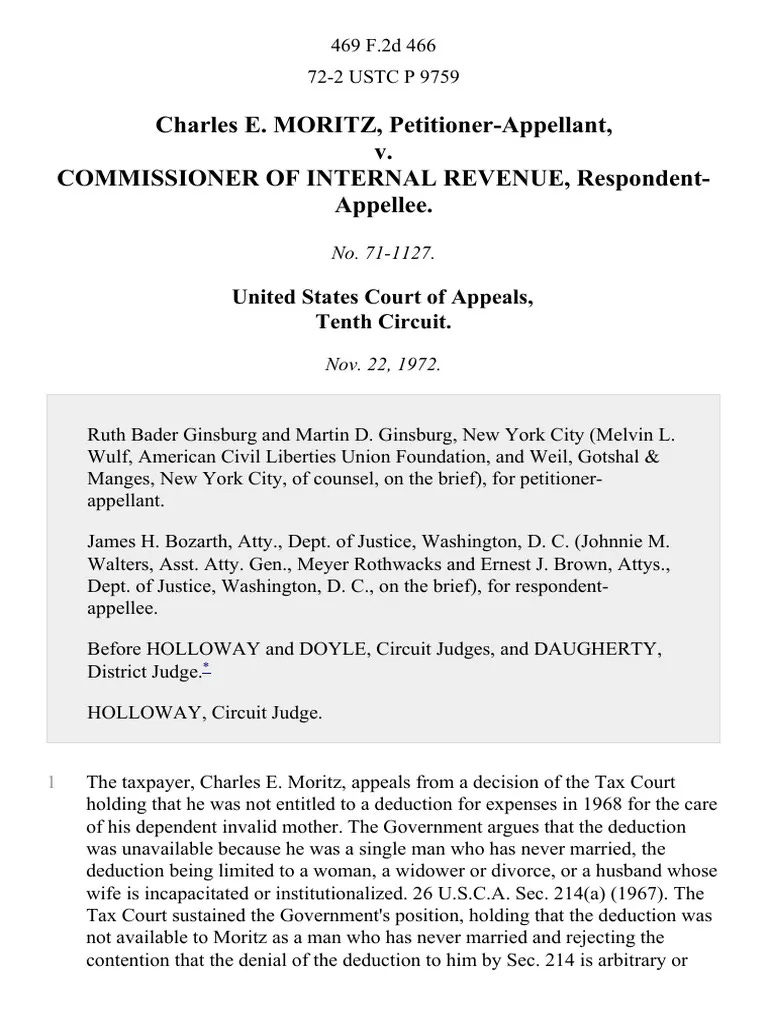
This Day in Legal History: Moritz v. Commissioner On October 22, 1970, the U.S. Tax Court denied a deduction claimed by Charles Moritz, a never-married man from Denver who worked as a book editor and paid a caregiver to look after his elderly mother so he could keep working. The tax code at the time allowed a deduction for those caregiving costs to women, widowers, divorced men, and men whose wives were incapacitated. A man who had never married didn’t qualify. Moritz, representing himself, argued that the rule was unfair. The Tax Court said the statute was clear and rejected his constitutional argument. The case came across the desk of Martin Ginsburg, a tax lawyer, who showed it to his wife, Ruth Bader Ginsburg, then a law professor at Rutgers. The Ginsburgs took the appeal together. In 1972, the Tenth Circuit ruled for Moritz, holding that denying the deduction based solely on sex violated equal protection. Their brief in Moritz became the template for Ruth Bader Ginsburg’s brief in Reed v. Reed, where the Supreme Court for the first time struck down a law for discriminating on the basis of sex. The significance of October 22, 1970 is that one of the most important lines of constitutional law in the twentieth century started with a small tax deduction and a self-represented taxpayer. As a tax professor, I’ll admit I love that. It’s a reminder that the tax code isn’t just about revenue; how it defines families, workers, and caregivers reflects and shapes who the law treats as equal. The administration has asked the Supreme Court to let it resume building border barriers across the Big Bend region of Texas. On October 2, U.S. District Judge Kathleen Cardone halted construction across the roughly 500-mile Big Bend project area, along with the use of legal waivers for the project, while a lawsuit by environmental groups, including the Center for Biological Diversity, moves forward. Here’s the legal background. A 1996 law lets the Secretary of Homeland Security waive environmental and other laws to speed construction of barriers in areas of high illegal entry. Past administrations have used those waivers to bypass dozens of laws, and courts have generally upheld them. The challengers here argue the waiver authority doesn’t fit Big Bend, a remote, rugged region that includes a national park and has relatively few crossings. Judge Cardone found that construction on this scale required clear authorization from Congress, an argument related to the major questions doctrine, which says courts expect Congress to speak clearly before agencies take actions of vast economic or political significance. Solicitor General D. John Sauer called the injunction “baseless” and argued that the government’s border security interests outweigh what he described as aesthetic, recreational, and cultural harms. The administration also says leaving a gap in Big Bend could funnel crossings into the region once the rest of the border is walled off, and it says it won’t...
0:00SPEAKER_00Hi, a quick note before we get started.
0:02SPEAKER_00Minimum Competence now offers CLE courses.
0:04SPEAKER_00Our first course is live and it's completely free.
0:06SPEAKER_00It covers researching federal tax issues after the Supreme Court's decision
0:09SPEAKER_00in Loper Bright,
0:11SPEAKER_00including how the end of Chevron deference changes
0:13SPEAKER_00the way lawyers should approach Treasury regulations,
0:15SPEAKER_00IRS guidance and tax research more generally.
0:18SPEAKER_00I think it's interesting for a more broad audience.
0:20SPEAKER_00And if you need CLE credit or you're just interested in the topic,
0:22SPEAKER_00head over to CLE.minimumcomp.com.
0:25SPEAKER_00Again, the course is free and you can find it at CLE.minimumcomp.com.
0:30SPEAKER_00All right, on to today's episode.
0:32SPEAKER_00Hello and welcome to the Minimum Competence episode for Thursday, October 22, 2026.
0:36SPEAKER_00I'm your host for today,