
Minimum Competence · Andrew and Gina Leahey
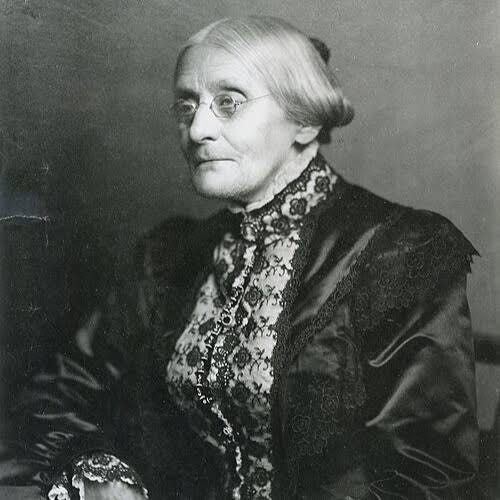
This Day in Legal History: Susan B. Anthony Votes On November 5, 1872, Susan B. Anthony walked into a polling place in Rochester, New York, and cast a ballot in the presidential election, along with fourteen other women from her ward. This was a deliberate legal test. Anthony and other suffragists argued that the Fourteenth Amendment, ratified four years earlier, made women citizens, and that voting was one of the privileges of citizenship that no state could deny. Two weeks later, a deputy federal marshal arrested her at her home for voting illegally. She refused to post bail. At her trial in June 1873, before Justice Ward Hunt of the Supreme Court, sitting as a trial judge, she wasn’t allowed to testify, and at the close of evidence the judge directed the all-male jury to return a guilty verdict, without letting them deliberate. When asked if she had anything to say before sentencing, Anthony delivered a famous speech condemning the proceedings. She was fined $100 and never paid it. Two years later, in Minor v. Happersett, the Supreme Court rejected the argument outright, holding that citizenship didn’t automatically include the right to vote. The significance of November 5, 1872 is that Anthony used the law itself, a vote, an arrest, and a trial, to expose the gap between constitutional promises and how they were applied. It took until 1920 and the Nineteenth Amendment to close it. Her case is a reminder that legal change often begins with someone willing to test the boundaries of what they’re allowed to say and do, and that’s exactly the question in our first story. A federal judge in Kentucky will hold a hearing later this month on whether the University of Kentucky violated the First Amendment by suspending a tenured law professor over his comments about Israel. The professor, Ramsi Woodcock, has made statements describing Israel as a “colonization project” and calling for the world to wage war against it. The university barred him from teaching and opened an investigation, which Woodcock says was driven by political pressure from state lawmakers seeking tougher action against antisemitism. Reports indicate the judge declined to give Woodcock an immediate order returning him to the classroom but set a hearing on his broader request for a preliminary injunction. Reports differ on some details of the procedural history, so I’ll keep this at the level of the legal framework. Here’s how courts analyze this. Woodcock works for a public university, so the First Amendment applies. When a public employer disciplines an employee for speech, courts use a balancing test from Pickering v. Board of Education and later cases. If the employee spoke as a private citizen on a matter of public concern, which commentary on Israel and the war in Gaza plainly is, the court weighs the employee’s free-speech interest against the employer’s interest in running its operations effectively, including avoiding disruption. Speech that’s offensive, even deeply...
0:00SPEAKER_00Hi, a quick note before we get started.
0:02SPEAKER_00Minimum Competence now offers CLE courses.
0:04SPEAKER_00Our first course is live and it's completely free.
0:06SPEAKER_00It covers researching federal tax issues after the Supreme Court's decision
0:09SPEAKER_00in Loper Bright, including how the end of Chevron deference changes
0:13SPEAKER_00the way lawyers should approach Treasury regulations,
0:15SPEAKER_00IRS guidance and tax research more generally.
0:18SPEAKER_00I think it's interesting for a more broad audience.
0:20SPEAKER_00And if you need CLE credit or you're just interested in the topic,
0:22SPEAKER_00head over to CLE.minimumcomp.com.
0:25SPEAKER_00Again, the course is free and you can find it at CLE.minimumcomp.com.
0:30SPEAKER_00All right, on to today's episode.
0:32SPEAKER_00Hello and welcome to the Minimum Competence episode for Thursday, November 5th, 2026.
0:36SPEAKER_00I'm your host for today, Andrew Leahy,
0:38SPEAKER_00an assistant teaching professor of law at Drexel Klein School of Law.