
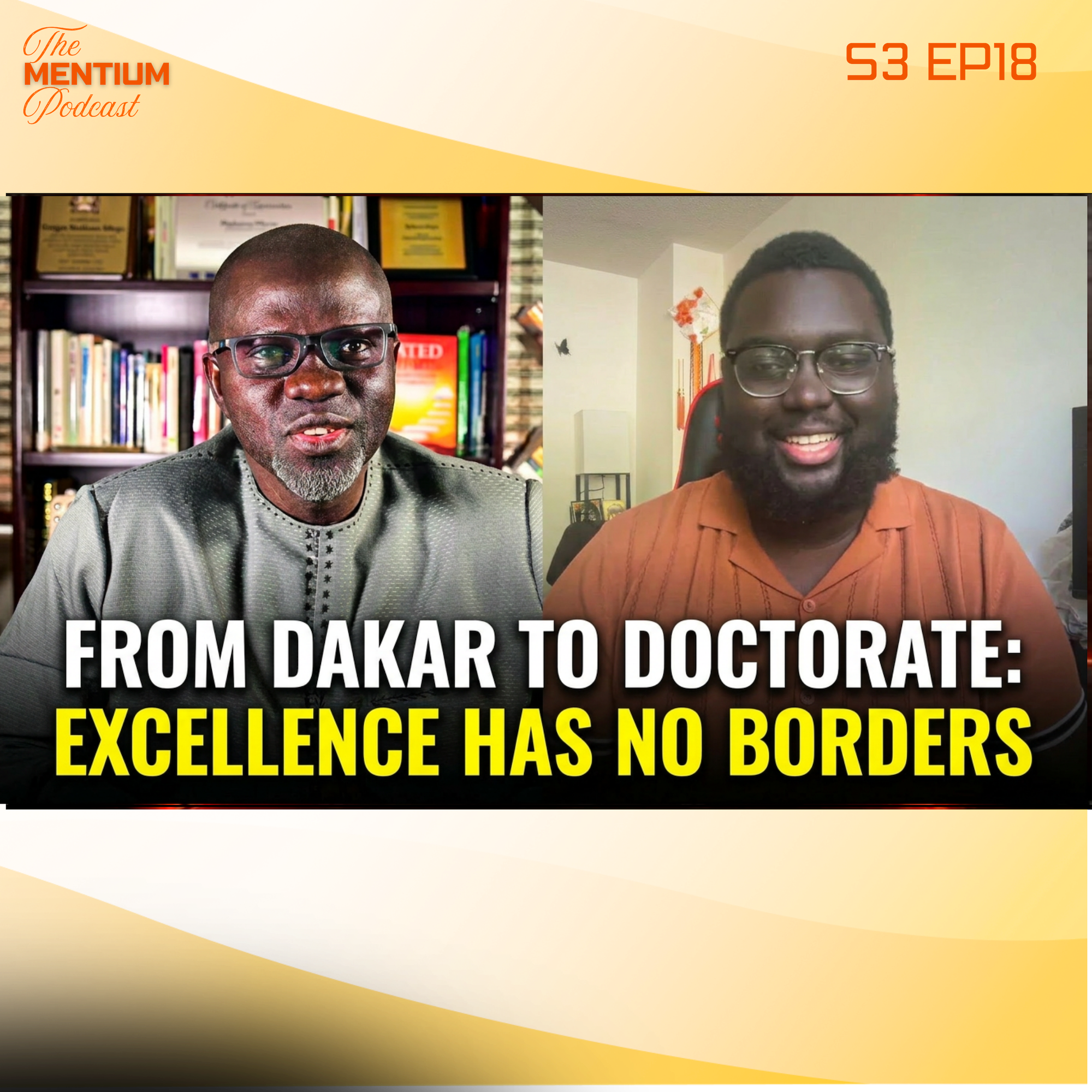
Mentium · Madiama Mbaye
What does it take for a young immigrant to arrive in America with limited English and, within twelve years, earn a PhD from one of the nation’s most prestigious historically Black universities? In this inspiring episode of the Mentium Podcast, Madiama Mbaye sits down with Dr. Salim Hoyeck—a microbiologist, researcher, educator, and mentor—to discuss the mindset, discipline, faith, and resilience behind his remarkable journey. Born and raised in Dakar, Senegal, Dr. Salim shares how his mother’s values shaped his character, how Islamic teachings became the foundation of his leadership, and why developing yourself is the greatest investment you can ever make. Together they explore: Growing up between Senegalese and Lebanese heritage Building identity before building success The immigrant experience in America Why reading changes lives The difference between knowledge and wisdom Leadership through service Why behavior matters more than titles The importance of acquiring skills instead of chasing shortcuts Mentoring the next generation of African youth This episode is a masterclass for students, immigrants, parents, educators, and anyone committed to lifelong growth. Key Takeaways • Identity is your foundation before achievement. • Faith gives direction when circumstances become difficult. • Discipline is choosing long-term success over short-term comfort. • Growth begins the moment you believe you can learn anything. • Skills create opportunities. • Leadership starts with listening. • Reading expands your world before your circumstances do. • Success means lifting others as you climb. • Education is one of the greatest forms of service. • Your purpose is always bigger than yourself. Memorable Quotes “Reading allows you to live a thousand lives before living your own.” “Don’t let language become an excuse. Let it become your next victory.” “You don’t have to fit in to make an impact.” “Skills open doors. Character keeps them open.” “Leadership begins long before anyone gives you a title.” About Dr. Salim Hoyeck Dr. Salim Hoyeck is a microbiologist, researcher, educator, and mentor. Originally from Dakar, Senegal, he earned degrees from Valencia College, the University of Florida, and Howard University, where he completed his doctoral research investigating the relationship between ferroportin mutations and HIV infection. His work spans microbiology, epidemiology, public health, and biomedical research. Beyond science, he dedicates himself to mentoring young African immigrants and encouraging students to pursue higher education while remaining grounded in faith, integrity, and service. Connect with Mentium Follow Mentium for more conversations that inspire leadership, purpose, and meaningful success.
speaker-0: Welcome back to the Mentium Podcast. One of my greatest joys is introducing you to people whose stories deserve to be heard. Not because they are famous, but because they are faithful. Today's guest is one of those people, Dr. Salim Hoyek. Dr. Salim Hoyek represents a generation of young African leaders who are proving that excellence has no borders. Born and raised in Dakar, Senegal. He arrived in the US just over a decade ago with a dream, determination, and a willingness to learn. Since then, he has earned multiple degrees, completed groundbreaking wishes in microbiology, served on the front lines during the COVID-19 pandemic, mentored young people in the Senegalese community in the DC area, and now has completed his PhD at Howard University. This conversation is about much more than academic success. It's about identity. It's about faith. It's about discipline. It is about what happens when a young man refuses to let circumstances define his future. Throughout this conversation, Dr. Salim shares the lessons his parents instilled in him, how he overcame language barrier, why reading transformed his life, and why every young immigrant Has far greater potential than they realize. If you are a student, if you are raising children, if you are recently immigrated, or if you were just simply searching for purpose, this conversation is for you. Let's dive in. This is my conversation with Dr. Salim Hoyer. Dr. Salim, welcome to the show. It is a pleasure to have you around. But first, can you tell us a little bit about yourself, your background, your upbringing, everything that is relevant for people to understand who you are, but most of all your identity, the identity that you carry with you. Who is Dr. Salim Hoyer? speaker-1: ⁓ thank you, Mr. Majama. allow me to ⁓ express my gratitude first ⁓ for stepping into your platform and being able to ⁓ just exchange some words that may inspire ⁓ others one day. And ⁓ you are someone that I look up to. And ⁓ your work is very remarkable in the community. So I definitely thank you for that work and for choosing me, even though you can have ⁓ people who are well ⁓ more rounded in into leadership than ⁓ the young ⁓ scholar that I am. ⁓ so just like you said, my name is Salim, ⁓ officially known as Papa Salim ⁓ Oyek. And just from my name you can tell there is ⁓ some ⁓ leadership into that choice of name coming from my father when he named me because in Senegal it is custom to ⁓ name children after our father figures and that was the case for me. I was named after my grandfather, my f ⁓ my dad's father and ⁓ he did that because his father was ⁓ a man that he looked up to and ⁓ that was his leader growing up. So the biggest ⁓ Homage that he could give him was ⁓ name or son after him. So that was a true privilege and honor for me. I was born and raised in Dakar, Senegal. ⁓ a big part of my childhood was spent in ⁓ the inner cities of Dakar, so particularly Parcel Asenie. And it is an environment where a child can have different life experiences. ⁓ and I remember ⁓ one of my earliest memories. ⁓ I must have been like five or six years old when we moved into the neighborhood that shaped who I am today. ⁓ my mother would just not let us go out, my brother and I, because he she was afraid that ⁓ we may have trouble in the streets or just not survive that environment very well. ⁓ and there is this ⁓ lady in our neighborhood who told her that. ⁓ if you really want them to strive in life, you must let them have experiences outside. So that's where leadership started in in ⁓ in in my life with my brother. ⁓ we were ⁓ exposed ⁓ to the neighborhood at a very young age who just go and ⁓ play soccer, football. You know, it it is of actuality ⁓ right now in the US with the World Cup, but I think everybody that was born and raised in Senegal had some experience with that. And that's how we were ⁓ shaped to be resilient from a very young age. Because you you would meet see people who have different experiences, who have different upbringings, who may or may not align with your own values, but you just adapt in that environment. And that's where you truly choose to be who you are as a kid. So the there was two ways. I could either go left ⁓ with the kids that chose the wrong path or I could just try to do well in school and become someone today. And thank God I chose the ⁓ the the ladder which is going to school and try to make something out of myself and ⁓ that also was an emulation of our parents who were leaders. My mother was ⁓ very remarkable ⁓ woman and she always always made sure that her children were ⁓ set to ⁓ just strive in life. She she did everything she could. We didn't have much, but you wouldn't feel that you didn't have much. So that's something that ⁓ leaves ⁓ it plants a seed in in in a in a in a in a child's soul and they carry that ⁓ and bloom when they ⁓ when they grow up. And yes, I did my studies at ⁓ a private school in Parcel. Now it's closed. It's called Maduso. And I had my high school diploma or baccalaureate, as we call it in Senegal in the S one series, which is like mathematics and ⁓ science, yeah, f like physics physics pretty much in mathematics. So that's what I did my ⁓ high schooling in and once I My high school diploma. Unfortunately, that coincided with ⁓ the passing of my mother just a few months after that. So my dad, yeah, no, no, no, no, no problem. And this was 12 years ago. So my dad, ⁓ who was in the US at the time, ⁓ he said, Yes, I have all the paperwork ready for you guys if you feel like you want to come here and just start fresh ⁓ and ⁓ go to school. That could be an option for you. So I chose that option with my brothers and we all moved here. And from then, that's when leadership really started setting in. Because I'm the third youngest of a family of six. But our ⁓ older sister, she she was living in a different state. She's much older than us. And ⁓ my brother and I, who we're just three years, two and a half years apart. We had to step in and take care of our younger siblings at that age because my dad was already pushing 65. So we had to be there further figures for our ⁓ younger brothers. ⁓ I had to learn how to cook, ⁓ how to take care of a household for these kids because they were very young. The oldest among them after me was 15 years old, and me, I was at least 18, 19. So we had to just show them the path. And ⁓ we came to the US not knowing a single word of English. but regardless, we we learned, we watched TV shows, we ⁓ tried to put ourselves in uncomfortable situations. We would just go like at the grocery store without knowing how to communicate, but just that was something that forced us to understand the language. And ⁓ eventually we started school and from there, wow. Twelve years later, it just like it was just like yesterday. I went to school for a degree in microbiology ⁓ during my undergrad. And ⁓ after that I went for a master's of public health. Again, I'm I'm I'm I'm a community server, I'm a everlasting ⁓ scholar. So ⁓ choosing public health was just ⁓ to see how populations ⁓ how populations evolve. i when it comes to a health care ⁓ standpoint and that was a very it was a very beautiful experience that I had and after that ⁓ I obtained that degree in twenty twenty and that was when COVID nineteen started. So it's like everything just aligned for me. I learned this degree. I didn't know how to use it and then there's the biggest pandemic known to recent history that happened right then. So I was ⁓ fortunate enough to work in a setting of public health right in the middle of the pandemic when nobody knew exactly what to do. ⁓ we were doing like contact tracing, contacting people who who had the virus recently and then asked them about their experience ⁓ with the virus and how we could accommodate them to overcome it. And it was a a a a beautiful ⁓ experience on my part because I got to talk to It was like a population sampling. You get to talk to anyone if when you're in public health, like the young people, the older ones that really are closer to the next life than this one. And I think that just adds a lot of value in your in your life. And then after that I decided to join Harvard University ⁓ to do my PhD in microbiology as well because I just wanted to tie the epidemiology experience in public health with infectious diseases in microbiology. And overall that's how I got here today. And yes, shout out to my university, University of Florida, where I did my undergrad and my master's degree. I think they were the ones that that laid the path for me to to get here today. And I think that that that is it for me ⁓ in a nutshell. speaker-0: Wow. Look, ⁓ it was it was so beautiful to to hear you lay out the background. You know, for a lot of people watching they might be saying, Wow, I didn't know this about Italy. But now that you laid out there and it is so beautiful to to now see that it only twelve years you've been able to overcome a language barrier, been able to go to school. Get your degrees and top of all, get a PhD in microbiology. What a remarkable journey. But you know, for me, when I do this, something always stands out and it is identity, like who you are. And when you there's there's a lot to a name. Your last name is Hoyek. And I think that's the first time that I've heard it in you. In Senegal, you don't you don't hear such a name. Can you talk to us a little bit about where that name came from? speaker-1: Yeah, thank you very much. ⁓ that's an excellent question actually, because not a lot of people ⁓ ask that. And ⁓ it's interesting because every single last name in the world carries a history with them. Absolutely. So my last name is definitely not Senegalese or even African. ⁓ it comes from this ⁓ Lebanese immigrant who came from Lebanon when ⁓ there was war, like time of war and oppression. And ⁓ My grandfather he fled ⁓ Lebanon ⁓ full of hope, seeking a new life and ⁓ refuge, and it happens to be in Senegal, and that's where he found my grandmother and then founded his family. So it is a Lebanese ⁓ last name, and though the thus my name also, Salim is a Arabic name that comes from him. Yes. ⁓ speaker-0: ⁓ my goodness. ⁓ Look, I was I was always curious about that. And and to tell you the truth, I didn't know the last name. I always known you, I've always known you as Pap Salim. That's all. ⁓ no last name was ever written. So I left it at that. But when you get the PhD, I think I I I saw a Facebook post from Surinima Morambake of DC. That he wrote your full name over there and I said, Wow, okay. Maybe someday I'll get a chance to to ask. ⁓ but look, the reason why that is so important is that it ties everything together to who you are. So you are not this Senegalese, you are also Lebanese. So you get that heritage and I am sure it is something you were so proud of. It it shapes the person you are today. You know, but you mentioned something very powerful. That the lady told your mom that if you want them to thrive in life, you have to let them get out there. I am sure before your mom did, she must have inculcated in you some value. Some values that will serve as as a guide post, like for you to really speaker-1: Yeah. Right. speaker-0: ⁓ measure everything by or for you to live by. Can you talk to me about those values? What kept you together as whole? Because I know where you grew up. When you say Parcel Asini, I said, wow, okay, we were so close because I lived in Parcel Asini for I don't know, over like 15 years. So I know the area. When you say Mari Biso, I'm like, wow, okay. So I know I know the area you How tough it was. Tell me a little bit about the values that guided you through all those years. That you, as you mentioned, you had two paths to to choose from. One could have been with the children who were going nowhere, doing bad things, but you chose the one that was leading you to this path right now. It must have come because my understanding is your dad was here and your mom was there. So your mom really did most of the work of upbringing. Talk to me a little bit about those values that she put in you. speaker-1: Right, so those values were fundamentally Islamic values, ⁓ and the the the biggest one that I can recall is to always tell the truth and only the truth. And ⁓ I remember growing up, there was something in me that couldn't disappoint my mom. So Let's say I was in school and I didn't do so well in a test. So I wouldn't lie about it. I would definitely tell my mother that I failed this test or I didn't do so well. But that's what propelled me that I couldn't just fail a test because I I know I I would have to tell her the truth about it. And that's that's that's from an early age what she always what she always put in us. always tell the truth no matter how bad the situation is. But I just couldn't deal with her disappointment if I do something that would disappoint her. And I would have to tell her because I I would just have to tell her the truth. So that's one thing that I can ⁓ remember that really shaped ⁓ my my childhood. And ⁓ another thing was discipline. Like I remember growing up we had like discipline. Like my father th who you mentioned that lived in the US he at some point ⁓ bought us ⁓ like these electronics like PlayStation and things like that. But at some point you would think that those are just decor, not not for everyday use. Because definitely you're not gonna be using it ⁓ on a weekday ⁓ in the middle of the ⁓ school year. So you would either use it some weekends, not even every weekend, but maybe in the summer for some time. And my mother always, always put an accent on on on that, on discipline. There was a time to go to bed. Nowadays I see children, they don't really have a bedtime. But definitely we did have a strict bedtime ⁓ in our in our house. On the on a weekend, even if you're not doing anything, there's a time to wake up and then eat breakfast with everything, everybody at the table. And ⁓ those are values that I carry with me. Like just having everyone around, ⁓ which is which are family values and discipline and then always telling the truth. I think those are the best things that my mother ⁓ put on the table for us. speaker-0: Wow. Look, in your values, I'm hearing faith because that's the first thing you mentioned, Islamic values, but also ⁓ you talked about integrity. Because telling the truth is really what it is. Like doing the right thing when nobody is watching. ⁓ is the definition of integrity. When you say truth mattered to you, I know that goes along with with With that as well. But also you said discipline. How did that value of discipline guide you through school? First, through like when you lost your mom, it must have been very, very hard. May ⁓ her soul rest in peace. ⁓ but it must have shaped who you are. Then when you came here, even though she's no longer around, you could hear her voice guiding you through whatever. that you were doing in school, in the community, everywhere. Couldn't you talk to me a little bit about that and how you live there? speaker-1: Yes, absolutely. So for for ⁓ for the discipline part, where it started was for example, when I misbehaved, for example, as a child, ⁓ and I was grounded, my mother would just not let me go out because going out was the best thing that we could do back then. So I what I would do, even though I cannot go out, I wouldn't let speaker-0: Yeah. speaker-1: ⁓ I wouldn't let that those events prevent me from just going out. Because I would then there was like a huge d dictionary that we had at home and like encyclopedia that had like Atlas maps or things like that. So I would just go out there and then learn about countries, look at these maps, look at mountains, rivers, all kinds of geographic, geographic ⁓ like landscapes. So what I would do was try to escape. But at the same time I'm building on my discipline because even though I was grounded not to go out, I could just go some do something that's not really productive for me. But I was constantly learning. Constantly learning. And then that just carried on throughout my ⁓ educational journey. When I came back ⁓ when I came to the US and ⁓ started into higher education, it was it it just never got that hard until later on. Because you are when you're disciplined you you just see that that carries you very far in life. It carries you very, very, very far in life. And ⁓ and and and with with that I saw some people struggle in certain ⁓ subjects or certain classes that I n didn't necessarily have to struggle with because that discipline just paid off for me. speaker-0: Wow. Look, I am I am really truly enjoying this, you know, but but this is the time where I would move to our next segment, which is ⁓ beliefs. You know, you growing up in West Africa in Senegal did all your early schooling there until you get your high school diploma. And you came to a brand new country to you. Language that you didn't speak. But that didn't stop you. You said, look, if anybody can make it, I can. That's the mindset that I want us that that I want us to explore. But what types of beliefs did you have to really carry you and and and and move you forward, knowing that hey, this is different. I don't even speak the language. The subjects might seem like Chinese to me. even though I know you know them, but because they were in a different language they must have been very, very challenging. So what type of mindset, what type of beliefs did you have to carry you along from the University of Florida till ⁓ graduating with a PhD in Harvard? speaker-1: Alright, so this is absolutely one of the things that I discovered ⁓ in my lifetime. So when I was in ⁓ high school, you would call it eleventh grade, ⁓ we call it in Senegal Premier. That's I think when I discovered who Shea Ahmed Ubambo was. And ⁓ this man was ⁓ a historical figure. known to mankind. He is ha he had accomplished a lot of things. ⁓ but one of the biggest things that I align with right now was that he managed to become one of the greatest writers in a language that he did not he didn't that that's not his maternal language. That's Arabic. Right. So he managed to just produce intellectual and poetic ⁓ scripture that just speaker-0: Yeah. speaker-1: transcends this word. And seeing that, I knew automatically that us Africans we can accomplish anything. Because from the get go, I was forced to learn a language that wasn't my maternal language. Yes. Which is the the the the the French that we ⁓ inherited from colonialism. So if I could do that, I also have a religion that Forces me to know a language to an extent at least. Maybe at least ⁓ know how to read it in order to ⁓ learn the Quran. So those things are just what shaped who I became today. When I came to the US, even though I didn't learn I I didn't know any English, I was like, wow. I was born to parents speaking Wolof. And then I started school. Started hearing this new language that's French my whole life and I was able to learn that. When I started going to Islamic school for some time on and off, I had to learn Arabic, how to read it. And even though it's more complicated than even French, so I'm like, this is just a language then. I'm just gonna have to do the same. But the only difference was that this one was not something that I was sat and taught. Like French, I didn't have a choice. I had to learn it because I was in school, had no free will over there. You have to follow everything they tet they ask you to. And same thing with Islamic ⁓ school. If you have to learn Arabic that way, you just have to sit and learn it. But this one, the belief that I had with it was that this is my life and now I have it in my hands. If I want to move forward, I have to sit and learn this language. Without it, I cannot accomplish much in this country. speaker-0: Very soon. speaker-1: So that's the that's the belief that I that I that I went with. The the belief was that I have my life into my hands now and I have to I have to learn that language no matter what. speaker-0: Yeah. Salim, I think this is ⁓ Dr. Salim, I I think this is really the the best part for me because we can set this as an example to so many young people who are just embarking on this journey ⁓ of be of starting a new life in America. What I heard you said was you had growth mindset, not fixed mindset. Because mindset would have said speaker-1: Exactly. speaker-0: Look, you cannot do this. You already struggle with French, you struggle with ⁓ Arabic, and now you are starting all over again. Just know know your spot somewhere. This is not for you. You already know everything that you needed to know, just deal with it. But a growth mindset would tell you that hey, the sky is the limit, or even there is no limit, because you know. When you were created, everything that you needed to do to make it through this life, God already put within you. But sometimes that's the problem that we don't understand. We always try to go out looking for things that are already within us. But that growth mindset really propelled you then into, you know, ⁓ dealing with difficult situations like learning a new language. But as you be beautifully laid out. For you it was not an issue because you did it before and you can do it again. But now, like ⁓ you know, this is one of the reasons why I really wanted to have you on the podcast because I know what you represent in the community. I came to DC or Baltimore last year and I had the honor and the privilege of of of talking to the phone cup youth over there and I saw How they looked up to you, but also what you do for them. If you had a message to tell them, either the one who were born here or the one who came here at an early age, what message would you give them? A message of hope, a message of, hey, you guys can do this or whatever your experiences were growing up here, because look, if you say 12 years ago, It seems like yesterday, as you mentioned, but yet when I hear you speak, it's like you were born here, or at least you came here at a very, very early ⁓ early age. So how important is it for them to pay attention to English right now if they want to make it later on or build a life here in America? speaker-1: Right. So my first advice is that language is your first impression of anyone that you aspire to meet or work with. I think even when you apply for a job, some of them ask you for a cover letter and from that cover letter they can tell what ⁓ kind of person you are or what your language is. So there is two things there is speaking English. ⁓ just regular English, ⁓ like the the like the like informal English that you would ⁓ speak with people in the street. And ⁓ there is the language that tells who you are really. And I think even being born here, you could be very fluent in English, but you could do so much to ⁓ in order to improve your language. It's not about grammar or you know, formal rules and things, but it's just something that gives a a great ⁓ first impression when you talk to when you talk to someone, they can know that wow, this person is full of ⁓ life experiences. I I wanna know more about this person. So I think ⁓ the best advice I could give them is to not limit themselves when it comes to knowledge and maybe embark into like a reading journey. Like you c you can read any type of ⁓ writings, but just find yourself, find what sparks your interest and then that can take you very far in life. Because reading is like silent learning. And that's what really develops leadership into you. And I think some sometimes people think that being a leader Is just being like up front, being at the very beginning of the line, always being shown. But leaders are among us that are not really shown on the outside. And I would love to give this example. It's like a like a vehicle, a car. So when you want to handle a car, there is this thing called the steering wheel that you hold, and that's what people see you. use and they think that that's what drives the car. Yes, it gives the directions if you want to go left or right. But there's something very important that without it, the car wouldn't have any value. And that's the engine. It's what propels. It's what moves the car. But the engine is not shown. You cannot see it. So that leader can be hidden somewhere, but you're still a leader, even if you're in the leadership of someone. So I wanted to relate that to them. speaker-0: What a beautiful analogy, man. What a beautiful analogy. But look, you said something so powerful that I wanted to touch on. And I have I have heard this from Les Brown, who once said that when you open your mouth or when you speak, you tell the world who you are. I think the experience that I had with this, and this is for the people who were born here, yes, they have a commander of the language. But if they don't develop it, they might speak somewhere and nobody would even consider them for anything. When I was teaching high school here, my experience were was that the lot of kids that I had in class, you know, yes, they were American. Yes, they were born in speaking English, but they had trouble understanding the basic things. Cause I was teaching them French and in order for me like to teach them speaker-1: Laga. speaker-0: friends, they have to have the understanding first in English. For instance, when I said what is the infinitive form of ⁓ words, they were like, What are you talking about? Speak English. That's not I said, look, I might speak English with an accent, but I I I I can teach you English. You know, so we started with that. So and one thing interesting happened happened back then is the English Teacher came up to me one time and said, What are you doing in your classroom? I said, What do you mean? He said, Because all of a sudden, everybody who's taking French is now good at English. And I I was like, I don't know. But then I thought about it. I said, Well, it's maybe because I spent like half of my time teaching them English. Because the things that I'm saying to them in French were not resonating at all. So then I had to break it down to them in English first for them to grab it in French. So what you were telling me is yes, you might have ⁓ been born here. You might have have ⁓ had the command of the language, but if you don't read, you don't grow. What you were telling me ⁓ like leaders, you said the hidden leader. Look, you've given a very beautiful definition or analogy of Leadership with the car thing. So yes, leaders then are readers. You don't have to commend the stage to be around ⁓ to be a leader, but you are an internal leader. I had a podcast series that I did in self-leadership, where I was saying that really leadership starts with yourself. So if you couldn't lead yourself, you couldn't lead others. And if you don't read You don't expand your horizon. So then younger people, Dr. Salim is talking to you. Read, read and read. Because look, you mentioned something powerful earlier when you talked about Shia Ahmad Bamba having all this command of writing and poetry and all of this stuff in a language that was not his. What he taught us is hey. We can do this. We can do and and you beautifully mentioned it. There is absolutely nothing we cannot do, be or have if we put our mind into it. I think then having that figure in front of us is guiding all of us. Yesterday or well, the the latest podcast in interview that I had earlier, that's ex the exact the same thing that Dr. Mbuk was also telling me. That everything that he did was guided by Shay Ahmed Bamba. So I know we could spend a lot of time on that, but maybe there will be another time that I would have you on the show that we just like talk about his teaching, how people can use it. Because in that show we were talking about Kunkatiman. You know, how Sirin Chuba Shah Ahmed Bamba is really guiding the young people. Like if you want to get knowledge, this is what you need to give out. Right. You cannot acquire knowledge while pursuing money. You know, your time has to be used in a certain way. All those beautiful lessons I want people, young people to really learn from that. And who's a better person than you? Because look, you've done tremendously well in this country and now you are leading younger people. Tell me a little bit about the hardships that you might encounter. You know, ⁓ guiding them or leading them. Like w how is it easy or how is it difficult for you to relate with young people in this country and and and and guide them forward? speaker-1: ⁓ I think yes. l younger people in this country, let's say from the Senegalese diaspora, ⁓ can be classified into two groups. There there's those that were not born here and then later on in life came to the US and there is another group that were born here. And I think ⁓ sometimes if we truly want to help them, the ones especially that were born in here, we need to understand one thing and accept it is that even though they're Senegalese, their American identity comes into play. So I could it's easy for me to assume that ⁓ it's you you just need to be this way. But I wouldn't know because I was born and raised in Senegal. I I I would never know what it truly is to be a teenager in America. So I think if we try to understand that we can help them a lot. And it's up to them to believe that they can accomplish anything. ⁓ especially the ones that came here. speaker-0: Yes. speaker-1: Take this example and ⁓ see how we can take you very far. when we when when when we came, like my brother and I, we took like English courses first. Like ⁓ it was called EAP, English for academic purposes. We took that for a couple of semesters and then embarked on the the regular track to take classes. I remember our first English comp one class, which is the English class with everybody, like the native speakers. Something very remarkable happened in that class because we would have essays. ⁓ like our ⁓ our professor, she was very she was a writer, so she she really wanted us to be creative and be able to write pieces that could be ⁓ used for something. So she would ask us to write these essays about just like a a a short novel, pretty much. And I remember when she gave us a prompt Let's say the prompt was, ⁓ just write something about an argument between a couple in a public setting. So it was worth it for me to go in a park or at a restaurant, like sitting there and then write the scene in the setting, describing everything that I'm seeing around me, and ⁓ make it as realistic as possible. And the reward for that was when we came. Every every time the best essay was ⁓ read in front of the whole class. So if you have the best essay, the teacher will call and then have you read it in front of everybody and then just show how good it is of a masterpiece and that it could inspire the others. And what what happened was that every time it was me or my brother, and we were the only two. kids that were not native native speakers in that class. ⁓ the thing the funny thing was that I would even struggle to read the paper because like the pronunciation wasn't quite there. So I would struggle to read clearly, but just to be to to know that I was able to produce this and it was presented in front of native speakers and I had to go ⁓ over all these challenges to get there. So that that was that was the reward. Like there there's challenges, like the language barrier, the cultural shock. ⁓ like just not feeling at home. Like going, you know, to college, away from your family, discovering a new environment, if you have different religious values, it's hard. Like my brother had to tell his roommate in college, hey, listen, every five a.m. or six you might see me doing something resembling yoga. But that's just me praying to my God. Just under just so you don't freak out. Pretty much. We have to give give them those those heads ups. People have a different lifestyle. That that that is a huge, huge, huge, huge setback when you when you when you're in ⁓ at at a university in in in in in in America. Like you find yourself not being the same with people. But there is a reward if you just keep pushing. There is something that's yes. I think those moments right there when I had my paper ⁓ paper read in front of the class was one of the most rewarding things. Even graduating didn't feel as sweet as that. Because I knew I accomplished something, even though I was very different from people. Yeah. speaker-0: Look, you were saying this and my heart is smiling. And the reason being you said something so powerful that you guys can be so different with people here. But let me tell you this. I don't believe being different is a crime. I don't believe being different is a bad thing. Because you are not meant to fit in when you were born to be different. speaker-1: Right. speaker-0: You know, look, ⁓ my goodness, this is this is this is so powerful. And I think you mentioned something that I want every young people who are w listening or watching to this to pay attention to. When you were given an essay to write about a disagreement between a couple in a public setting, yes, maybe most people would sit down and try to imagine it and write it down. But you did not do that. You went to the setting itself and tried to see how it will feel like to experience something like that. I cannot capture this into a word that I want them to take away. But I know this. When you were given a job, don't just deal with it, with the first idea that comes to mind. You know, try to be creative. try to reproduce things as they would seem if it was reality. And that's the reason why you went to that setting, the park or the restaurant to really get that. And yes, it might be easier for you to write than it is for you to speak. But it doesn't mean that you didn't produce that piece of writing. And I want people to understand that. When I'm teaching public s speaking, one of the things because The way we started here really was just helping the newly arrived immigrant to be comfortable talking in front of people. So what started as that is now something even more powerful where I would have more Americans in the class than I would have Africans. But this is one thing that I will always tell the Africans. It is okay to speak with an accent. But just make sure that you make sense when you speak. Exactly. Because if you make sense, people will pay attention. People will listen. So don't worry about speaking with an accent. I always say this. I think I was even speaking English better when I was in Senegal than when I came here. Because back home when I was in college, my major was English. So I was always trying to sound like America. And I was very good at it. There were so many people, like so many Fulbright Professors who will come and teach over there, they would always notice me with my American accent. But when I came here, it was the reverse that's being true. Because I didn't want to lose my identity. I didn't want to lose who I am trying to be somebody that I will never be. Because it doesn't matter how long you lived in this country, if you were not born here, or if you didn't come here at the very early age, when you open your mouth, no matter how good of English you speak, people will know. That you are not native. So then you are trying to aspire to something that you will never reach. But also, you are eliminating who you were before. And I want to share this line from Ralph Waldo Emerson who said that envy is ignorance and imitation is suicide. So I'm telling everybody, you don't have to imitate an accent. Speak how you are. with your beautiful rich African accent and people would appreciate it even more. So it doesn't matter whether you speak with an accent or not. What matters is you make sense when you talk. So Dr. Salim, this is so beautiful to have you just express because to me this is the first time that I'm having that I'm hearing these experiences from somebody who lived it. You know, you growing up almost here because when you came certainly you must have been like around eighteen or nineteen, somewhere around there. But also like this doing everything that you did. And something that you mentioned that caught my attention is us parents or us who are from the Siliglies diaspora to understand more our daughters who were born here, our nieces who were ⁓ born here and our nephews as well. You know, to understand that they are living a double identity. Right. When they're home, we impose the African identity on them or they embrace it, whatever the case may be. But when they go out, they must wear the American identity to belong. Right. You know, for me, it is up to us to make them feel home, but also to make them understand. That yes, both of them are possible. They're not opposites. It's not like you have to be a Senegalese or you have to be an American. You can be a Sen Senegalese American. So I want people to understand that parents and everything, and this is more to parents that mu most of it the mistake that we make is to try to raise our children here as we were raised back home or even anywhere. Because look. The times have changed. You know, growing up, we didn't know what a computer is. Over here, your two-year-old son or daughter would play with a computer. So you couldn't raise them the same way they were you were raised back there. I just wanted that to ⁓ to stick. You know, thank you so much again. I mean, this is so beautiful. We're halfway there, but we are not done yet because this is so rich. Now I want to move to the section where we talked about skills and competence. You mentioned some of it earlier that you studied public health in 2020. You got your degree, and all of a sudden the pandemic hit. You were able to navigate those, not just like the regular person. Like for you, it was now time for you to apply your skills, to apply your competence. speaker-1: Right. speaker-0: Talk to me about that. How did it feel, you know, to really be able to navigate life at ease because you have skills, because you have a competence, and how important it is also for the young people that you were leading to understand that they need to do whatever it is possible, whatever it is necessary for them to acquire the skills and the competence they need to move on in this life. speaker-1: Okay. Absolutely. I think the biggest test for ⁓ for your competence or skills in is in the times of ⁓ chaos. And that was a perfect timeline for me to embrace ⁓ my identity as a public health worker, but to be put on the test. And this was a time where covet nineteen was not really understood at all. ⁓ even healthcare workers, ⁓ physicians, nurses didn't really ⁓ acquire the proper sets of ⁓ guidelines of how to overcome it or how to live with it. So we would receive ⁓ these phone calls from doctors at their doctor's office, ⁓ mentioning that ⁓ a patient that came here this morning called back, said that there were ⁓ they were diagnosed with COVID-19 and they would ask if we need to close our practice. They didn't really know what the procedure was. And I think that's where we had to step in as public health workers. I would like to I like to ⁓ use this analogy. Like a public health worker is what a doctor is is to the population, what a doctor is to the individual. So doctors can heal a person. But if you work in public health, your focus is the population. Like you you're healing millions or hundreds of thousands of people at the same time. So we would ⁓ just find like a ⁓ like we would be like the catalyst or the balance between the chaos and ⁓ what was like the peace pretty much. We would just give them guidelines, bring them back. Even at times where I didn't really know what to do because it was sometimes just a case that we haven't been exposed to yet. But even though I didn't really know what the proper procedure might have been, I always use like my human interaction skills on how to just ⁓ de escalate like situations. when when when a when a person is like facing something that they have never been exposed to and we know that every day there were ⁓ giving data about this ⁓ this pandemic ⁓ on the news, how many people lost their lives. ⁓ so people were really in shock ⁓ that this could have affected them in that way. So we you have to be very, very, very, very, very mindful of that while while communicating with both the patients and the healthcare workers. And I think one of the values there were ⁓ Patience, ⁓ like patience is ⁓ I think is a skill. and once you master patience, I think you can master anything. Because it's it's like time. Patience requires time. Some yeah, so that's that was ⁓ w one of the things that I had to really test myself with and ⁓ just having a decent human interaction. speaker-0: Absolutely. speaker-1: With someone who's just trying to live a better life, right at that point. speaker-0: That is again, look, you can tell I'm enjoying this, you know, but this is what I want you to to do now. Like talk to the young people in America, in and particularly in the African diaspora, of how important it is for them to acquire skills and competence in any in any area. Because Mentioning about Shahmubamba earlier, he was the first one to tell us that we should go anywhere to acquire knowledge, as far as China, you know, then then then he knew how important it is, you know, for us to be educated. So somebody who's about to settle on something very small, like I'm not downgrading or ⁓ looking down at any job, but For somebody who were born here, would they have to settle at working at a ⁓ fast food joint, whatever it is? ⁓ because that might not take them to the level that they aspire to. So how important it is for them to acquire skills and competence here if they want to move forward? speaker-1: Yeah, so the the the the thing with trying to acquire skills is that no matter what skill that you're trying to gain, there is ⁓ there's like and there's other skills that you will you will you'll pick up along the way. And I can explain, like let's say you're learning to become a plumber, you definitely will Know a little bit about physics, let's say, because it's it's the mechanisms that come with ⁓ the plumbing system. You will you will definitely learn something else. So let's say this guy is working at a ⁓ fast food restaurant and they want to move further in life. Just choose to learn something. It can be the most basic thing. It could be martial arts, for example. But through learning martial arts, you will learn discipline. speaker-0: Absolutely. speaker-1: You will ⁓ yes, you will learn patience, you will learn you will acquire other other skills and competencies. So just pick something and try to learn it. Just one thing. It can it can take you very, very far. Yeah, very far. Because I I know it can be overwhelming trying to move from one place to another and then trying to be at the top right there, and then it can be very difficult. But once you choose to learn something. The other things that come along with it can move you very far. So I would just give them this one advice. No matter what it is, don't don't don't underestimate any any sets of skills. Just try to look around and choose one thing that you're very passionate about and try to learn about it. If you learn how to read, you will know how to communicate, for example. If you learn how to play music, you will know how to coordinate your your your your body and your mind. You know if you learn if you learn Arabic, you you you're feeding your brain, like you're feeding your frontal lobe to have more critical thinking because you're concentrating in so something so difficult and so ⁓ foreign to you that it would just it's like going to the gym and working out. You you're working out your your brain and then giving it more power. So just choose to learn something, one thing. speaker-0: I would say now that's the scholar talking. That was really, really deep and powerful. Thank you so much. I hope they will pick this up and and and use it in their own lives. Look, this is so beautiful, you know. But now let's move on to my next segment here, and which is behavior. You know, how important it is after acquiring all of those stuff. ⁓ you know who you are, you know what values to to ⁓ ⁓ stand for, but also you have a growth mindset, beliefs that will propel you forward. ⁓ you acquire the skills and the competence. Now it is time to put them in practice. Basically, like how you behave out there. What would or how did you manage it yourself? Like when somebody sees you in public, They would have something in mind. Hey, this is Salim. He meant what he says, and he says what what ⁓ what he means. You know, just knowing that that that you act according to your words. Because I'm always saying that people do not experience your intentions. Salim might be a great person with beautiful intentions. But he if he's acting not according to those intentions, people will never experience that. So, like first for you, how do you behave around your workplace, around the community, but also what do you want young people under your leadership to know about behaviors and taking actions? speaker-1: Right, that's an excellent question. And I think one thing that ⁓ moves me is that I'm a great listener. So ⁓ one of the ⁓ yes, so I listen much more than I than I speak. Even though it might not look like that today, ⁓ because I'm on the ⁓ under the spotlight. But listening will take you very far. When you listen speaker-0: ⁓ no. Not to cut you off but there is a saying that says ⁓ God gave us two ears and one mouth for a reason that we listen to exactly listen more than we speak because we have two ears. Yes. Exactly. speaker-1: Exactly. So yeah, when you listen, when you listen, the the the the very least the very least you can gain from it is more knowledge. Because when you listen, you'll definitely learn something new. No matter where. So That's the very least you can gain. So imagine if we try to upscale it. So there's much more that we can get from just listening. So and I think that's very valuable. If the the the the the smallest thing I can get from something is more knowledge, and knowledge can take you very far. So I would definitely encourage ⁓ people to listen more. And especially when you're a leader, for example, in the workforce at your workplace, ⁓ let your actions ⁓ guide those that are behind you. So giving directions, all of that is great, but I think acting upon it and have people look up to you and emulate that is something out of this world and it is beautiful. So I think that there is a saying in Wolof that says Wach de Gubbahn Torup why Jeff Dagumokogan. So s telling the truth is very important, but acting upon it is what Is is way, way, way, way, way above that. Yeah. speaker-0: Look, when you said when you were a leader, make your actions speak louder than your words, or at least that's how I that's what I heard. And you talked about how important yes, how important ⁓ how important listening is. You know, to me, to me, this is such a powerful lesson for everybody to Picked on because you just right there by saying those words actually talked about the difference between a manager and a leader. You know, the manager will tell people what to do, and a leader will show them how to do it. You cannot show people how to do it in your if if you are not in action. So basically that's that's exactly what you were telling me and and and whoever is. watching that as a leader you need to act more than you speak and you need to listen more because without listening you not you might not get the right cues from the people that you would lead it with. You know in in leadership in the classes that that that I I am involved here there is a line that I would always share and I think I shared it in the last episode but Let me just share it here again. And it is you have to love people to lead them. And that love is an acronym. That love is an acronym. It is not just and it is true that you have to love people to lead them. You cannot lead people that you hate, but this love is an acronym that is L-O-V-E. The L stands for listen. And that's why I want to share it in this section because you mentioning the L is listen. You know, you have to listen to the people that you are leading. The O is overlook. You have to overlook their shortcomings. The V is voice. You have to voice your appreciation on them. But the E is effort. You have to make the effort to be there when they need you. So nothing about leadership is random. And I know you know this because you've been explaining these things to me in a such a beautiful way that I'm like, wow, you know, having you on the show is a blessing. Because I can talk all I want about all of this stuff. But when young people look at me, they might say, Well, he's a a senior citizen talking or he's an old guy talking. What does he know about our own lives? But you, when you speak to them, they get it. They know like well well you know, he's he's there. with us. So to conclude this, we are going to talk about purpose and connectedness. Why purpose? Because you know, to me, our lives will always mean more if it is about something bigger than us. Because I'm sure what you were doing, you could have said, look, I have my master's in public health. Now is the time for me to find a job and then just like make money. But what pushed you to go even further? What I mean by that is is there something bigger than you that you know like you want to leave an impact, you want to leave a legacy when you pass on? What is that bigger thing to you that is pushing you forward? You know, to climb the ladders, like upper and upper to discover. More stuff, what is that big thing? speaker-1: Yeah, so ⁓ as I kind of mentioned earlier, I've been a student of knowledge for as far as I can remember in my life. So growing up, I always knew I wouldn't just limit myself to one thing. I I I I always knew that when it comes to education, I'll definitely go all the way to the end and maybe one maybe add another doctorate at some time. ⁓ it it is all possible, but I just knew from a from a very young age and I'm glad that you mentioned it. Then it it must be something bigger than me. It must be something that just ⁓ drove me. It i it's like intrinsic to my being to just like be a student of knowledge and learn and discover new things. That's that's that's what I do on a daily ⁓ basis. When you go on my YouTube is probably some random videos about Things that I don't know and I I would like to learn about. it's just like I just have ⁓ that desire to feed my curiosity on a daily basis. I think that's that's what my calling is and that I hope that I can give it to the generations that come after me because I think that's that's the only way we can build on ⁓ knowledge. We've had parents, grandparents that laid ⁓ the foundation. Let's just assume that we're trying to build a palace and they laid the foundation. So the least I can do is maybe put the pillars on on the building or maybe the walls, and then one day somebody can put the roof on. Other days they can install the doors and windows, the painting job and all of that. So I just wanna be part of that that that building process. I know I cannot finish it for sure, but I just wanna be part of it. And the only way I know how is seeking knowledge, pretty much. Yeah. speaker-0: Look, I Your wisdom is just blowing me away because like you just don't answer a question. You always like bring these parables, these anecdotes that that would make it seem like, ⁓ my goodness, look, I wasn't wrong to get you here. You know, we've tried, we've tried a ⁓ multiple times to get this going. Because of scheduling it was always ⁓ exactly you know not happening. But I said, you know what? I will make this happen. I I'll keep pushing until we find a day or a time to get this done. Because look, ⁓ people will appreciate you on this. People will appreciate you for many reasons. Like for the older, they might be so proud of you, what you have accomplished and what you were doing for for the young people, but also for the younger. As I said in the beginning, you are a role model in the community for the ones who were born here, for the one who came here at an early age, or for the ones who just arrived. Because this is what I'm always saying about studying. You mentioned earlier that you want to go till the end of like seeking knowledge. And and I know what you mean, but you also know that there is no end. Even if you get a another doctorate in another field, there is always something to learn. There is always something to learn. Prior to recording, I was sharing this with you that there is a lady ⁓ in my class right now who's doing her PhD at the end ⁓ at the age of 70. So that right there tells you that hey, there is no time to say I'm done. You just keep going until your days are done. But you as a person, you know, you need to keep impacting people, you need to keep acquiring. Knowledge because that's who we are. That's who we are. We are not just beings that will lay to rest because we reach a certain edge. No. At least for me, that is not true. I'm a knowledge seeker. As you said, like that's what I do. I read, I communicate, I I I ⁓ interview, I I because throughout these interviews, I am learning so much. The gift, one gift that I just realized is your ability to explain things, make it so, you know, basic that people can get it right away. Even though you're a scholar, you can talk the scholar language, but you break it down in a so i easy way for people to pick up what you're putting down. Doctor Saline. I think that's been yes, go ahead. speaker-1: Yeah, yeah, I'll say that that that probably ⁓ stems from the PhD journey because ⁓ one thing our advisors always tell us is that when you defend your PhD, for example, just assume that no one knows anything about what you're ⁓ researching about. So the goal was always to describe it to a five-year-old. Like no matter how complicated the subject might be. So speaker-0: Look at me talking. I didn't even know that that's how they put it to you, but like that's how you came across to me throughout this whole thing. You know, whenever I ask something, you have the ability to break it down to like just as you said, maybe to ⁓ for a five year old to pick it up. This is so beautiful. This is so beautiful. Dr. Salim, is there any any anything that you wanted to talk about that I didn't have a chance to To ask you. speaker-1: ⁓ I think this was incredible interview. I discovered things about myself just by recalling events in my lifetime that probably refreshed who I am today and ⁓ to remind me that I have very big shoes to fill. And it's very humbling that you see me as a role model to ⁓ my younger brothers and sisters. It's it's very humbling and it just ⁓ shows that I have no room for. for for for for for for mistakes. I have to I have to lay the path for them and I'd have to do my best for them to ⁓ to leave them a track they can they can follow and hopefully even go further that I that I've made it this far. ⁓ And one thing I would just like to let them to reflect upon is what Shahmubamba said that ⁓ for young people to only only Only preoccupy themselves with with ⁓ piety and ⁓ the seeking of knowledge. So no matter where you go in life, just try to be pious, try to be among the righteous, but also always seek knowledge. In any field is that it can be is is okay, but always ⁓ seek knowledge. speaker-0: What a beautiful way to lend the plan, my friend. This is ⁓ wow, those those last two words. You know, I don't want to expand on it because it might even make it blurry. Let's just leave it there. Dr. Salim, thank you so much. Not only for accepting this invitation, but also, you know, for participating in it with your full heart. Because sometimes you might get people who are not ready, you might get people who don't want to share everything, but you I think you let everything out. I think you've you've done a tremendous job of just like laying it out there for your younger brothers and sisters to follow. So thank you. Thank you so very much. For everybody else who's been watching or listening, thank you so much to you. for spending this beautiful time with us. Because I know you guys are busy. You could have been doing a lot of other stuff, but you chose to give us your time today. So thank you so much. As I would always end, take care of yourself and your loved ones. I am Majama and this is Mentium. Peace.