
Making Change with your Money · Laura Rotter, CFA, CFP® | Financial Advisor for Women in Midlife Transitions
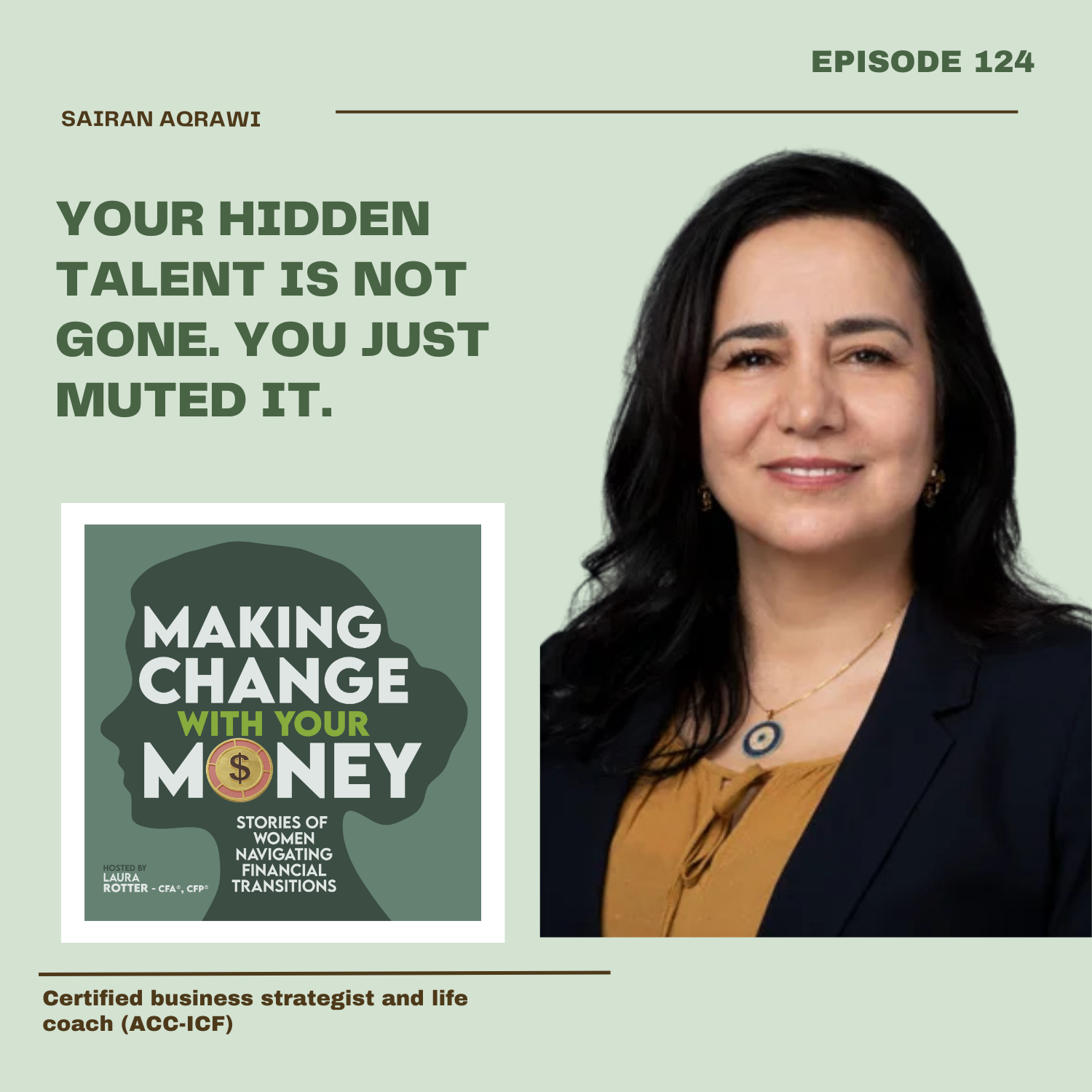
Imagine growing up as one of seven children, watching your mother stretch every dollar until it couldn't stretch any further—and still somehow never making you feel poor. She would hand down clothes to the next sibling and simply say, "If it's still good, you wear it." No apology. No shame. Just wisdom. At some point you've probably asked yourself: What is my money actually for? Am I working to build wealth—or to build a life that matters? And what happened to the talents and passions I convinced myself I didn't have time to pursue? Those are the questions Sairan Aqrawi helps women answer. Born and raised in Iraq, Sairan learned from her mother that joy, generosity, and dignity aren't determined by income. She also grew up hearing one lesson that shaped her future: "Education is a weapon. No one can take it away from you." When she moved to the United States nearly 30 years ago with an engineering degree, she quickly realized education was a foundation—not a guarantee. She built a successful engineering career, earned advanced degrees, and even started a doctoral program before one unexpected question changed everything. After speaking to young female engineers, someone asked, "Are you a coach?" She laughed. She thought coaching was only for athletes. But after discovering business coaching, she found her calling. She became certified and never looked back—while intentionally keeping her engineering career. "I always tell my clients I'll never ask them to leave their day job," she says. "When your business creates enough income, you'll quit without telling me." Today, through her Gem Thrive Academy, Sairan helps professional women in midlife uncover the talents they've been hiding and build purpose-driven businesses alongside their careers. Her philosophy is simple: stop dismissing the gifts other people consistently see in you. For Sairan, success isn't measured by your bank account or job title. "Success is the relentless energy to progress," she says. Money should create freedom, opportunities, and a meaningful life—not become the goal itself. Her advice is simple: don't wait. Don't let your dreams stay buried until retirement. The hidden talent inside you isn't gone. It's just been waiting for you to use it. Guest Sairan Aqrawi is a certified business strategist and life coach (ACC-ICF) who helps professional women in midlife discover their hidden talents and build purpose-driven businesses alongside their existing careers. A practicing engineer with a master's degree and nearly three decades of experience in the United States, Sairan brings a uniquely precise, systems-oriented mindset to business coaching. She is the founder of the Gem Thrive Academy, a 28-day clarity and strategy program, and is a sought-after speaker, writer, and mentor to women navigating career pivots and entrepreneurship. Resources Website LinkedIn Instagram Free 15-minute LinkedIn profile consultation — mention Making Change with Your Money podcast when...
Laura Rotter: Imagine you grew up as one of seven children where money was always tight, but your mother made sure you never felt poor. She stretched every dollar. She passed clothes down the line. And she still took you on picnics to other cities and celebrated your birthdays with cake. You probably heard yourself asking at some point or another, what is my money actually for? Am I just adding zeros to a bank account? Or is it a tool to build something that truly matters? You've done everything right. You have a good job, a good degree, responsible choices you've made, but somewhere along the way you quietly muted a talent, a passion, a dream, because life got busy and the nine to five felt like enough. My guest today, Siren Akrawi, knows that feeling well. She came to the US from Iraq 29 years ago with an engineering degree and a drive to be independent. She built a career in engineering. She got her master's. She was deep in her doctoral program until one speaking opportunity changed everything and she discovered the world of coaching. Today she's a certified business strategist. Who helps professional women in midlife stop muting their hidden talents and start building the business they were always meant to build? She still kept her engineering job and she'll tell you exactly why. And her coaching style, she'll warn you up front you might hate her in the first session, but you will love her by the end. Listen. Welcome to Making Change with Your Money, a podcast that highlights the stories and strategies of women who experienced a big life transition and overcame challenges as they redefined financial success for themselves. Now here's your host, certified financial planner, Laura Rodder. Welcome, Sayrun, to the Making Change with Your Money podcast. Thank you, Laura. Thank you for having me. Looking forward to our conversation. I will start with the question, Seyran, what was money like in your family growing up? So the money was not there all the time because my father was working full time and my mom was stay-home mom. She raised seven siblings. Imagine, yeah, seven. Four ⁓ four girls and three three boys. So my mom never worked a day in her life because she got married very early. And from day one I know that the money is limited. It's not something that I ha I will have a wish list every parade or I have a wish list every end of the year. My mom was very wise on spending money and she was able, like we said, we stretch the dollar. She was stretching everything she can and I still remember she would say, If that piece of cloth is still good, four of you have to wear it. Those pieces belong to my older sister. If it's still in good shape, you are obligated to wear it during school time. So she was very wise spending money. But on the same time, I still remember ⁓ my parents, especially ⁓ my mom, she never make us feel that, you know, or act that we are poor, we cannot enjoy life. We cannot go to picnic, we cannot visit other cities, or we don't celebrate paradise with cake or with our friend. So she was able to still maintain those healthy activities in order for us to feel, you know, healthy and and part of the community and feeling alive. Thank you. So it sounds like she was a good role model. She was, yeah. I'm I'm curious before we go on, how did that impact you? Did that make you feel more responsible to earn what what impact did it have? Yeah, I mean growing up seeing her not working, that was not something against her because this is back in nineteen fifty five when she married my dad and he was older than her, like ten, twelve years. So she decided to stay home and having all those kids, which is not normal now nowadays. I only have two. I don't know how I even handled two. Right? I mean, it's different world, it's more expensive, it's more deminding. more competition. ⁓ the world is changing with technology and the things that used to be easy for you and me back then. It's very difficult to teach our kids to get used to it. What is teach me actually when I got married, I mean I I I mean with degree I never I never had that in my mind that I was stay home mom even if my husband was a basketball player making million dollars. My mentality. I mean, even if he's filthy rich, I'm still gonna work. I have this in my mind that I want to be independent. I want to have my own ⁓ source of income that I can help others. I can donate to organization, I can give away to poor people or people who are misfortunate, you know, not having ⁓ you know, source of living or housing or they cannot pay for like basic things in life. I want to have that My I own my own money so I can give away what God bless me with. So ⁓ yeah, I I decide to have my own income. And even again, I always tease my husband, I said, your money is your money. I know we share raising the two kids, but I would never be depending on you ⁓ giving me, you know, money in order to help others. I want the help to come from my source of income. Hmm, thank you. So of course it's coming through that you recognize the privilege that you've built in your own life and that it's important to you to share that. And I can't help but think that the sense that you want the security of knowing you can support yourself may have come from watching your mom rely on someone else, even if it was more culturally appropriate ⁓ at that time. So Yeah, of course. We live in different worlds now, right? I mean, ⁓ there's so much demind that is so many changes in the blink of eyes. I mean we open our eyes and things change so quickly. So we have to adopt those changes, but on at the same time we have to be independent in a way. If anything happened to you, y you have to have that ability to take care of yourself. I don't want to be those kind of, you know, mother or woman ⁓ thinking that ⁓ because I raised my son so well and I pay for his classes or his college, ⁓ him and his sister, my daughter, are obligated to to take care of me. There is no such thing. I mean they they if they are good kids they are they're gonna be good kids regardless because I raised them well. But I should not put that pressure on them to to give me money or pay for my, you know, housing or pay for my food or pay for my medicine. ⁓ this is why I decided even when I start a business that I'm keeping my day job because I knew that the day job will pay the big bills and my business will be something that will become my my job when I retire from technology. So yeah, it's very important to have your own source of income. Yes. And clearly education was also very important. Was that true about you and your siblings or were you unique? Yeah, I always ⁓ say that like ⁓ my mom was a stay-home mom, but ⁓ I think she had ⁓ in my opinion, she she earns seven Ph degree because she raised seven great children. ⁓ all my sibling brother and sister, they have good jobs, good degree, they establish very good family. ⁓ they have their own inner source of income, they help others. So that doesn't mean when my mom was not an employee herself or she didn't go to college that she failed to raise good kids. And that's all go to the way how you've been raised, the principal, the the core value. She would always tell us, you know, education is like a weapon. No one can take that away from you. And I never understood, I mean it's why she's saying that. And I realize Later on when I finish my college, that when you earn education, when you earn self-development, certification, anything that improves you as a human being, those assets is yours. No one can take those away from you. You earn it your time, you sweat about it. This is your value, right? No one can take those away from you. But it should not be ⁓ stop in a certain point. This is an endless journey. My mom used to say, don't expect anything from no one. Do good and leave. And I was like, why is she saying that? What does that mean? I never even understand her, you know, quote. Sometimes I ask my sister, what does she mean about that? Meaning that if you are a good person and you have, you know, good value, do the good things without expecting others to pay you back. Because the the reason for doing good and world should not be waiting for the reward, waiting how they're gonna reply, waiting to give me the favor back. That should not be the the reason why you are, you know, planting good seeds in the world. It should be from the source of belonging and being part of the community and say, if God bless me with the money, if God bless me with the source of income, I should not have all the money for myself, right? And and and as you know, you are money expert, let's say, money coach, money expert. We we get scared when we talk about money because we think if we spend it for things that does not belong to us, we are wasting it. And that's not true because if I give the hundred dollars for a a a single mom who are struggling to raise her two kids, that's not wasting. That's gonna come back to me triple ten times because I helped her on a time that's really, really, really important to her for raising her kids. So money scares us. Talking about money always scares people. ⁓ my God, I don't have money, I'm poor. You are poor if you don't know how to use that money wisely. And you are also poor if you think you are rich only by having money. There is a lot of people are filthy rich, but they are very poor for the world. They they are stingy even to giving you a compliment. They have so much money, but they they they will never even tell you a good good statement or feedback because they keep it all for themselves. So I can s I consider those people are very poor, regardless of their millions. I love that thought, Sairan. that money is energy. Money is meant to be in flow. It's not meant to sit in your bank account so you could keep looking at it and making sure you have enough zeros. It is a medium of exchange that is meant to be shared with others in the world. And that is what creates growth and You know, what contributes to community. So I love your thoughts. It's a tools to use wisely. It's not meant to be like I like you said, adding the zero and putting on my saving and feel good about it. Because if I if my intention and my goal, working in my day job and having a side business just to add more zero, I turn around, I become eighty and I lost I I I lost all the time that enjoying the process because my intention was just adding zero and making it a big, you know, ⁓ big amount of money and in and in in the bank account. But have I enjoyed? Have I enjoyed doing that money? If the answer is no, that's mean I I I I I was I was not successful to put that money in a place that didn't go, like you said, flaw. didn't make an impact, it didn't change somebody's life. And again, people get scared from talking about money. Because they think that, okay, I'm failing because I didn't make certain amount that I planned when I opened the business. And I know that from being a business coach, when I talk with the women, they tell me, ⁓ I fail in my business because I haven't I have not ⁓ made a lot of money the first three months or the first six months. Or maybe that niche was not aligned for you. That's not meant to be your niche. Maybe you need to pivot, maybe you need to change. The money is a it should not be the the the let's say the skill that's determined if you s you are successful or not. Because you might made a lot of impact and changes without even making the money, without you even feeling it. After six months, people see you in a speaking event. they see you in other events, they said, ⁓ my God, in your podcast, you've helped me a lot in your coaching, you know, and for bono or when you did, you know, giving back to community, you were source of help. Even though that they didn't pay you, but you make a difference. You make a change. So that's worth to me, it's worth million, especially when I do it, when I do it to let's say the student at the university, when I coach a veteran and stand beside them. When they come back after a couple of months telling me the amount of the impact and I change I made in their life, that's worth million. Beautiful. So, Seyran, this is a podcast for women who are in a life transition and you've started to talk about it. But can you please share how you work with women who are going through a big change, perhaps a career change? ⁓ perhaps thinking ⁓ as you do of going out working on their own. tell us about what you do, ⁓ how you came to be doing this ⁓ as an engineer and and some of your work. Yeah, so I'm still in engineering field. I'm still working full time as an engineer. I graduated many, many years ago. So I I thought that just being an engineer, solving complex, you know, equation and making good money, that's called success. Until I finished my master degree in two thousand seventeen and I was all pumped up. I was like, Yay, so I'm smart, I'm good in math, less less I made a mistake and I decide to pursue my doctoral. And while I was in my first semester doing my doctoral engineering, I had an opportunity to speak with a group of younger engineers at the same university. And the head of the woman engineering department called me and she said, Thank you very much for giving us away that's an hour and a half. All the girls loved you. You happen to be a coach. And I was like, What what do you mean a coach? She said, Are you a coach? Or I know you mentor at work, but are you a coach? And in my mind, being an engineer, I thought coach is just for athlete, right? I mean you are a coach athlete because I used to be a swimming coach in Iraq and I coach teenage, then I coach adult swimming. So she said, No, no, I'm talking about business and life coach. I said, What is this? I never, you know. She make me curious and I end up searching the ⁓ International Coaching Federation ICF. I fall in love with their mission and I study the exam and the training and I become a certified ⁓ coach ACC with them. And I never complete my doctoral. Because ⁓ the the pivot came me asking myself with all respect to all engineers in the world that yes, you are good at math, you're making money, you are a successful engineer, but if you see and feel Inside, you know, yourself for sure, you have the belief that you have something else that you can give, another impact, another change that you can make in the world. It's okay not to finish your doctoral. Do what's really matter, do what's have more meaning to you. So when the answer was yes to me, and I was like, I love this. I'm gonna do mentoring and coaching and and never complete my doctoral. And that's what's happened. I start a business. ⁓ first I had a different niche. I used to be transition expert. I was helping women who moved to United States and have an engineering degree who they were seeking the American dream because they were just like me when I moved 29 years ago, thinking by having engineering degree, it's enough. The the the road is paved, people are welcoming you. There is validation, you're gonna land the best job, you're gonna land the best company. And that's not the reality. Because you have to really work hard in order to get what you want. So I did that for four or five years. Then my mentor asked me if I am ready to change my niche. And I was I had the courage enough to tell me I What do you mean? He said, Why you don't become a business, you know, strategist and helping others to find their niche or their niche and their business. And I loved it. And I think it was yes, September 2023. I changed my platform, so I become a business strategist. Now I help women to navigate, especially professional women in their midlife. I'm a midlife, so I know how. become a scary face of your life saying, ⁓ I hit my 50, I am old, the society calling me old, ⁓ the the the belief that I have in you know for a long time that 50 is old, then it's late to change, then it's late to pivot, then it's late to start a side business. All these beliefs are outdated. They are expire because we have those beliefs for a long time. And now, as you know, Laura, we live in a a different world. We should not keep the same belief we have in the sixty and seventy with the ageism and women should stay home, raising kids, cook the meal. That's all. Women leaders are making huge difference in the world now. They are making big impact and you should be one of those women leaders. I'm curious, Sarah, what your mentor saw in you to suggest a change in niche. Yeah. I asked that question. Actually I asked him that question. I said I'm feeling well with the transition expert and why you want me to to because business strategies is very competitive and I'm competing with people who've been doing business you know coaching for 25 years. He said, because I see more in you. I see that you can add more. You limited yourself with international women who moved to United States, but I can see you can use your strategy and your engineering mindset in order to be a business strategist. You are very precise, you are very organized, which I am one of my I'll say strength. It's I'm very organized and and I'm ⁓ like I'm very thorough. Like even when I look at a plan. And if I just glance over, I can find a mistake in the design, like in no time. Maybe that's come with aging too, with doing it. So when I did the business strategies, I knew that I'm hitting a difficult platform, that I'm competing with men and women who's been doing this for a long time. But again, the competition should not be with others. The competition in your field should be with your version. with my version three years ago, with my version last year. You're doing a podcast, you comparing yourself today's episode with your first episode. And when you see the the progress, when you see the ⁓ how you thrive through those ⁓ you know many ⁓ you know episodes you have done, that's a success. You're not comparing yourself yourself with someone who done podcasts for four years. Right. Haven't done it for four years. But you comparing your version, your previous version. And if you see it as getting better, that's mean a success. Thank you. And I'm curious now from your point of view, not so much from your mentor or what do you enjoy about working with this newer population, ⁓ versus the population you worked for before? Very good question. When I was a transition expert, ⁓ ninety-nine point nine nine nine clients, there were women engineers who moved to United States. So the struggle and the narrative was the same. There's a culture conflict, there is a language barrier, I'm not fitting, I have accent, it's a male dominate, you know, field. How you want me to thrive in this platform? So like the obstacle and the problem was kind of the same. When you become a business strategist and you help others to find their hidden talent or their skills or monetize their you know, their their passion to a business, each one is a different story. I'm a business strategist for a lawyer who want to be a a writer, I'm a business strategist for an IT guy who want to be a speaker, I'm a business strategist for ⁓ a coach who want who want to bake. on ⁓ at the side. So I have a unique story, but the enjoyment to answer your question, the joy that I have, how they see themselves, how they get so excited when they finally gain the clarity about their hidden talent. Because we we we we as human we meant to take the nine to five thinking that's all what we can do. We brush off people compliment about us. People come to you and they say, ⁓ Laura, ⁓ my God, we love the way how you spoke. ⁓ we saw the blocks you write. And so, ⁓ that's nothing. You brush it off. You take their compliment and just being nice. They be nice to you without thinking, let me think, maybe this is a skill that I can monetize. Maybe this is something that I can I can thrive in an Instagram or in LinkedIn. We tend to brush off people compliment because we tend to ⁓ not from the humble side but we feel like ⁓ just they are just being nice to me. But if you think about it Yeah, but if you think about it, yes they be nice to you, but they saw something in you that you really need to value more. Because we tend, especially women, especially women, we don't value the other skill we have. If we are in finance and we happen to be very good in finance, we determine, ⁓ I'm just good in that field. And we forgot what we have done in our 20, we were good in sport in the teen, we were doing other things in the 20. But when we get to that job in finance, we decided this is all what I can do. But if you really, really sit down and and you Think deeply about other things that you can do, you will find that you have a lot of hidden talent and hidden gem that you have not bring it to service yet. Hmm, so beautifully said. I feel moved to ask the question since you brought up for yourself how you've kept your day job as you've, you know, built this business around other strengths you have. ⁓ so clearly money. is something you think about. Is money part of the conversation as you help your clients evolve? It should be. It's very important. I cannot I cannot come and make my clients dream on the sky on the ⁓ you are an IT, quit your job and start writing a book. That's not logic, Laura, because I will not be paying their bills. They have, you know, elderly parents, in-laws, they have kids in college. You cannot suggest that as a coach telling them, ⁓ you are an IT, you made good money, but you want to be a writer or speaker, just quit your day job. Money is important. Again, if anyone comes to you and telling you, ⁓ money is accessory, is not. I need money to pay the mortgage, I need money to pay the car payment, I need money in order to start the business. It's not everything, but it's an important tool. So I tell my client. Is the same with me. I'm still enjoying engineering. I'm not dreaming saying, ⁓ I'm very good in speaking and coaching. Let me let me just quit my engineering. That's not logic. You have to really think about then who's gonna pay the bills? Yes. At the end of the day, I am dreaming, I am loving the podcast, I'm loving writing book, but at the end of the day, those bills keep coming. Who's gonna pay those though? And I remember ⁓ there was a book, I forgot the author, ⁓ she's female. ⁓ I think magic, something around that. I don't want to quote it wrong. She said something about her passion. I mean, she was I think she was a waitress. She was doing like two, three jobs in order to make a living. She was living in one bedroom apartment in New York. And she was telling her story in the book, saying she loved to write. She always loved to write and she was very talented. When her books start making millions, then she quit the job. She didn't quit her job while she was writing her first book because she was still, you know, finding her way to be a good writer. So with my client, I telling them, Yes, start your side business. I'm your business strategist, but I will never ask you to leave your day job. ⁓ when your side business, if you become a speaker if you become a writer, if you become ⁓ whatever s profession or passion you have, if those side business will create a big income to you, you're gonna quit without telling me you're nine to five. And and that's my my goal with my client. I just want them not to put their their hidden talent into sleep again because they already muted it. When they f when y they start a family and they graduate from college thinking that's the only thing they can do the nine to five, they already muted that hidden talent a couple of times. When they hid their midlife, I tell them stop muting it. Don't brush it off. It's there. It's just sleep, right? Bring it, celebrate it, and share it with the with the world. So I think you were quoting Elizabeth Gilbert who wrote a book, Big Yes, Elizabeth. Yes, yes. She wrote several books before her big break, eat pray love. Yes, Elizabeth, yeah, Elizabeth Government. Yes, exactly. I forgot her name. Yes, her book's wonderful. Yeah. And that's what she talked about. Yeah. So please share how you work with coaching clients. And I'm thinking I know that in general coaches try to bring out what you have inside and what your solutions are rather than dictating. And is that the way you you work? And how do you help people discover their inner passions and move towards them? Yes. So for ⁓ when we ⁓ took the training ⁓ you know per ICF you know ⁓ competence and and and ethic and all the practices they telling us always remember you are Coach, you are not a consultant, you are not really a mentor, and you are not a therapist. Although sometimes you kind of put those hats a little bit, you know, back and forth, you become a mentor, then they talk a little bit about, you know, a little bit therapy because they talk about when they were teenage, but the main frame should be all around coaching principle. You should not forget that you are coaching the client to go from A to B, meaning. You're taking them there at their ⁓ current situation. Let's say the client come to you and they said, Right now I work a full-time, but I always love to write. So they want to be nine to five job, but they want to have their writing, you know, as a side things, and you as a coach, you become their accountability partner, helping them to move from A to B. So when you come to the complimentary, like this is what I do on the complimentary session, 30 minutes, I have to admit to you, I had to apologize to so many of them because you could tell after so many, so many people that I talk with, you can tell some are not coachable at all. They come to those coaching sessions or you know, you know, complementary and they talk about past. Which is nothing wrong with that. If you come to the call and say, ⁓ my God, it's took me one hour to get here, the traffic was on the highway, that's a pass because it took you an hour to get here. But if that mentality and that ⁓ let's say tone will be in every session, you telling me about the past, your victim, you had a bad husband, your kids don't love you, your boss is you know, he's he's he's treating you badly. You are not coachable. I'm not a therapist. I cannot cure. I'm not ⁓ actually not just not authorized, I am not qualified to to to fix the stuff that happened to you when you were 15. That's not part of the coaching, right? That's not part of what I'm trying to do here. I am talking about your current situation, how I can take you from A to B. So going back to your question and the example we have, if the person has a nine to five jobs and they want to be a writer or a speaker, as a coach, you require them to take action because you hold them accountable on the second session or the third session, you will ask them, what do you have done from the homework or the strategy things that we establish together towards your goal? If the answer is I haven't done anything, that's mean they are not committed. And that's what I tell my client all the time. Are you willing and wishing or are you committed? And they all sometimes they say it's the same. I'm wishing to be a writer. No, I don't want you to be wishing to be a writer. I want to be committed to be a writer. It's a big difference. You wish, you wish, you wish. Talk is cheap, right? I wished for a long time to be a speaker until my mentor said, Seron, are you doing any speaking? I was like, I'm listening to Les Brown. I took ⁓ Brian, you know, Tracy's training. I listened to them. He said, Have you done any speaking? We changed the subject. It's totally different because I am wishing I'm not doing. So that's what coach do. They make you take action and like bold, solid steps. Towards what you're trying to accomplish. And without those actions, I I tell the client, if you are not serious about this, I I'm willing to give you the money back. Just don't waste my time and energy. Because this is, and you are a coach, you know that very well. You're a professional businesswoman, you know that. If you are not making ⁓ a real result with your client, you're jeopardizing your reputation as a businesswoman. Because that client will not you there will be no word of mouth telling other other client, ⁓ she's very good, hire her. It's all worth it. Because they didn't see any result. So you are obligated to ask your client, have you done anything? Otherwise, this is not going right. Because you are the accountability partner. And for me, being an engineer, I'm my mind is always. like equation one plus one. Is he better? Am I seeing any different? And I get very excited when the client change within two months or one month and I see that in a better form or better steps towards their goal. So that's a difference between coaching and I used to have ⁓ on my other niche because they were international comers, so some of them need three months other need six months. Now with my business strategies, I only have the Gem Thrive Academy. I opened that Academy enrollment in January. Then I and I open it again in mid mid ⁓ year in June, and it's twenty eight days. It's not 30 days. ⁓ wow. Yeah, it's only twenty eight days because you need that clarity in twenty eight days. And I always tell the client the reason why it's twenty eight days is not very, because the last two days you're gonna be celebrating. because you're gonna be so clear about your path. I'm gonna guide you towards a blueprint. It's gonna be a strategy towards where you want to go. So that's exactly what I'm doing. ⁓ that's great. Thank you. And I'm thinking of when I have had clients who've signed up with me and then they don't follow up at all. That it really reminds you of, you know, Jan come January first, everyone who buys a gym membership. And so that was their to-do. That was their task. They and then they never walk into the gym. And so I feel like they're paying me, but they're not scheduling calls. They're not following up the tasks and like you said. Yeah, there's no commitment. It's the same thing with smoking and doing diet. Like when you say someone, I'm gonna quit smoking next month, why next month? Why is not now? If you're really serious, you're gonna quit right now. If I If I'm committed to lose ten pounds, why I'm saying, ⁓ I'm gonna do it on my parade. Why isn't your parade? Where's those rules come from? Right. Right? If you really want to lose those extra pounds, you better to start now. And it's come from it's it's the the the belief that you have in yourself that you really want it so bad or not. Right. This is not a wish list. If this is a wish thing, then you don't need to talk to me. I'm the wrong coach for you because I'm so bold in my session. Like sometimes I come across kind of not rude, but kind of harsh. And that's for your own benefit. And then I tell my client, you're gonna hate me the very first session. You're gonna love me towards the end because I know where I'm taking you. I learn more, Laura, from those mentors who were hard on me. I will never learn much. You f if you are my coach, you come every time, you high five, you hug me, you said I'm beautiful, I'm smart. What I have learned, nothing. You just soothe me. You make me feel good, which is okay. But it's not okay if this is gonna be your strategy for me, because what I need, I need the transformation. I don't need a coach who make me feel good. I can look at the mirror, I can tell what he's seeing. On the appearance. I want you to challenge me as a coach to bring the best out of me in order to take me from A to B. Well, those coaches who challenge are the best coaches. Yeah. Yes, because you have expectations of the people you work with. You respect them enough to have expectations and to not waste their time and money. Totally. Yeah, totally. So Seyron, you addressed this a bit at the beginning, but we're getting to the end of our conversation. I always like to ask, how has your definition of success shifted? And perhaps even your definition of financial success. Good question. I think I have it in my NSIGram many times. I posted, ⁓ I I like to write short quote and I love writing. This is one of my hidden gem, I guess. region that I want to do ⁓ to continue doing it. Success to me is never change, Nora. The definition of success is the relentless energy to progress. If you have energy to keep going, that's a success. It's the energy. You are not successful if you have a lot of money in the bank. It's good. I love money. Everybody loves money. But that's not success only. Success is progressing in many ways. You might have the money, but you lost your soul. You might have the money, but you lost part of your family. You are not enjoying time with the partner and the kids, but you have a lot of money. That's not a complete joy. You got the zero, but you are not feeling ⁓ as a human, you are part of that family because you are not spending time with them. So success to me, it's the progress as a human being. Not your LinkedIn page, not your bank account, not the certification, not your title, not your Instagram page showing that you have the most expensive brand clothes, but you are broken inside. That's not a success. Success is finding the joy in small things. Having a cup of coffee with your friend, with your partner. That's a success because you make the best out of your day. It's not that you make a dramatic you know, ⁓ contract win or ten thousand dollars, but you are totally broken and depressed inside. Which kind of success if I'm making money and I'm on pills, right? For depression? Is that a success? That's not a success. When it's come to financial success, it's again is a progress part. If I look at the quality of my living, I used to be in one bedroom apartment when I met at my husband. We didn't have any money. I remember the very first job I got, it was seven dollars. And I was so happy when they promote me and they gave me twelve dollars. Actually through a party. Me and my husband were like, twelve dollars, right? Success is that twelve dollars doesn't apply now. Because the world changed, right? I'm not gonna get excited if my salary increased four dollars every year, right? If I stayed in the one bedroom apartment with all respect to the people who cannot afford a single house, success is that I improve, I make the transformation from someone who was not brave to start a business, only work nine to five, now dare to side have a side business bes beside the job. That's a success. So financial success might not be an a lot of money in your banking account, but is the quality of your living is better. You are able to go to vacation, you are able to go and see your sister in Europe, you are able to to donate money, you are able to help someone at the grocery who are and you know fortunate to to pay, you know, the the the bills and you are that's a success. That's a financial success. So, not necessarily the financial success will apply to you, but if that's gonna make you a more effective human being helping others, that's a financial success. Yes, and like you said earlier, and I hear you saying it again, it's not about comparison to others or having a number that you've achieved or are hoping to achieve. It's continuous improvement ⁓ and change in your life towards what brings you fulfillment, what gives you a sense of purpose. Totally. Yes, hundred percent. I think it was ⁓ Pablo Picasso, ⁓ I don't want to quote him wrong, he said, the meaning of ⁓ the per ⁓ the meaning of life is to find your gift. The purpose is to give it away. So if you if you if you want to be so rich And you keep all that money until w what is the meaning? What is the purpose here? You are not making any impact. It's beautiful you make a lot of money, but are you giving it away a little bit? Are you helping people who are really in need for a hundred dollars? And I'm not suggesting that you stay hangry in order to feed others, but if you are able at least to feed one family in Thanksgiving, that's that's a financial success because you are making a difference in impact. So as we're coming to the end, I'm of course gonna post your contact information. but I'm wondering is there something you want to make sure you share with our listeners, Seyran? Yes, thank you, Laura. So ⁓ my last last things I ⁓ I can tell your your audience is if they're really clear about what they want to do, they should just start now. Not tomorrow, not next month, not next year. Because you don't want to take those hopes and dreams with you when you are 75 and 80. It's gonna be too late and you're gonna keep saying, I wish if, I wish if. You don't want to take that wish and if with you. Take that sentence from your dictionary and just do it right now. And I am very motivated when when I see other women they starting their own business for the sake of your platform and your audience. I'll give away 15 minutes complimentary for anyone who mention your name or your podcast platform. I will give them 15 minutes complimentary for their LinkedIn page, making the LinkedIn more appealing, more attractive. They want to highlight on their skills or they are looking for another job or even pivot or change their job. I'll be able to ⁓ you know ⁓ enhance and helping them to improve their LinkedIn page. And also another 15 minutes complimentary for those who want to start a business in Instagram, if they want to have a page about their, you know, hidden talent or hidden gem, if they want the exposure to podcasts or be a better speaker or a better better communicator, I'm gonna give them 15 minutes as well complimentary. ⁓ that's so generous of you. Thank you so much. I will make sure to post that as well in the show notes. Thank you so much for being my guest, Say Ron. I really enjoyed our conversation. Thank you, Laura. Thank you for having me. Thanks for listening to Making Change with Your Money. Certified financial planner, Laura Rodder specializes in helping people just like you organize, clarify, and invest their money in order to support a life of purpose and meaning. Go to www.truabundanceadvisors.com forward slash workbook. For a free resource to help you on your journey. Disclaimer: please remember that the information shared by this podcast does not constitute accounting, legal, tax, investment, or financial advice. It's for information purposes only. You should seek appropriate professional advice for your specific information.