
Making Change with your Money · Laura Rotter, CFA, CFP® | Financial Advisor for Women in Midlife Transitions
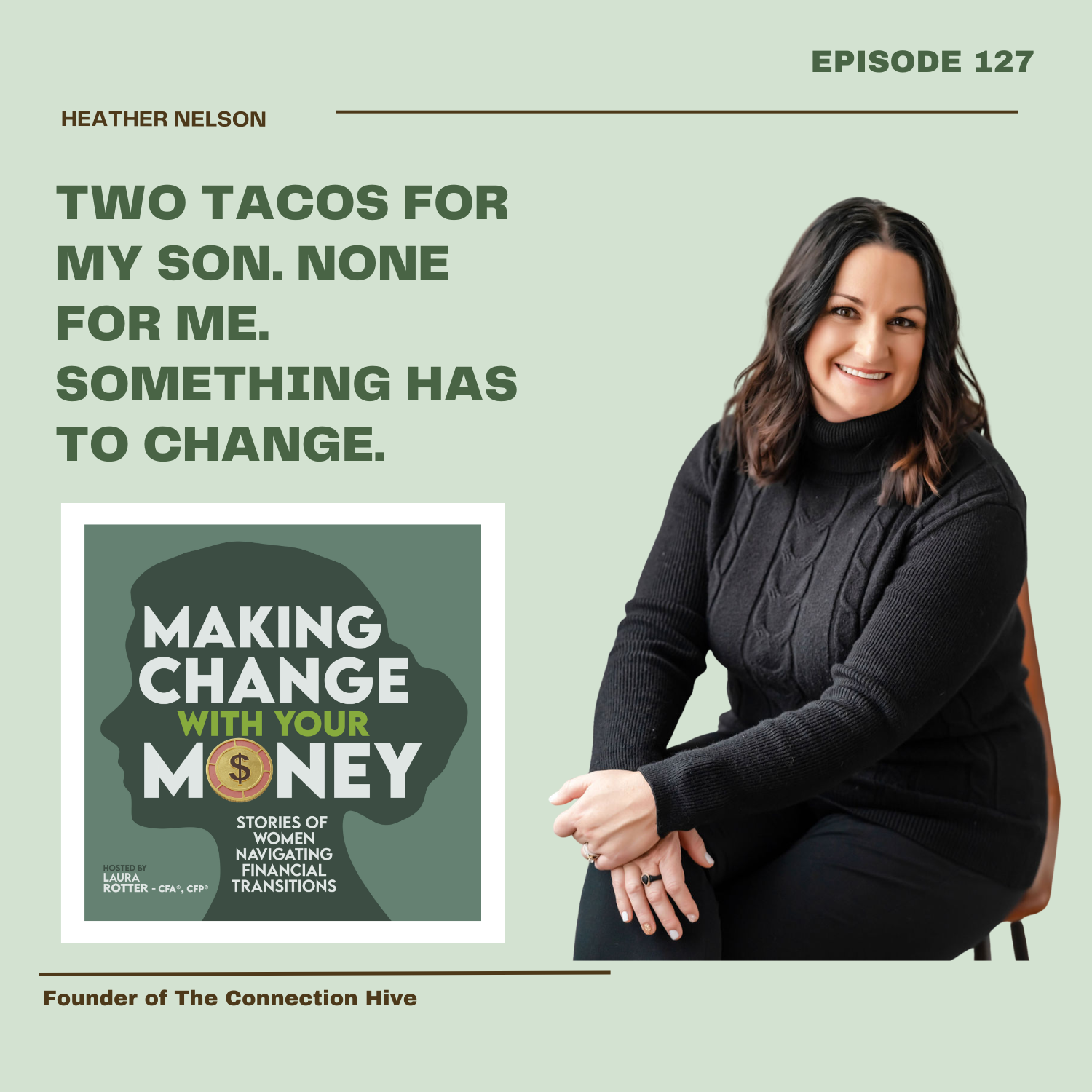
Imagine standing in a Taco Bell with your young son, counting the change in your pocket, and realizing you can afford two tacos for him — but nothing for yourself. You've always worked. You've always hustled. And somehow you've still ended up here. At some point you've probably asked: How did I get here? I've worked my whole life — so why does it still feel like the ground can disappear at any moment? And what does it take to finally feel financially secure, not just financially surviving? Heather Nelson grew up in a household where her dad worked in construction and never stopped — no vacations, no splurges, just hustle. That ethic became her inheritance. By fifteen she had her first job. She's never stopped working since. But hard work alone, she would learn, doesn't protect you from life's curveballs. Her first marriage ended with a clean break: she walked away from the house, the furniture, the kitchen stuff — everything — to avoid conflict. She moved into her dad's four-bedroom home with her two young kids and rebuilt from scratch over two to three years. Then she met her current husband, who was coming out of his own divorce. They started over together. Just as things stabilized, she quit a job that felt wrong — without another one lined up. Money dried up. That Taco Bell moment hit. It became her turning point. She launched The Connection Hive, her hospitality consulting business. Then co-founded a labor company with her husband. The businesses grew. And then — her husband was badly injured at work. Two years out of commission. She became the sole breadwinner for a family of six, carrying it all while building two companies from the ground up. Her definition of success is simple and hard-won: security without scraping. Vacations with her kids. A car repair that doesn't spiral into a crisis. Living in a million-dollar rental she doesn't own — and feeling proud of the journey that got her there. "I don't own it," she says, "but I get to live in it. And that makes me proud." Her closing message: you are in the driver's seat. If you want a different life, go get it. It won't appear on its own. But if you believe you can — and you put in the effort — the opportunities will open up in ways you can't yet imagine. Guest Heather Nelson is the founder of The Connection Hive, a business consulting firm helping companies grow through strategy, sales outreach, and relationship-building. With over 25 years in hospitality and events, she is a leading voice in Sonoma County's business community. She also co-owns a labor company serving the events industry, hosts the podcast Life Conversations with a Twist, and curates women's empowerment retreats. Connect with Heather Website: https://www.theconnectionhive.co Instagram: https://www.instagram.com/heathernelson.life Facebook: https://www.facebook.com/heather.nelson.7587 LinkedIn: https://www.linkedin.com/in/heathercelestenelson/ Resources The Connection Hive (business consulting):...
speaker-0: Imagine standing in a Taco Bell with your young son, counting the change in your pocket. You can afford two tacos for him, nothing for yourself. You've worked since you were fifteen, you've always hustled, and somehow you've still ended up here. At some point or another, you've probably heard yourself asking, How did I get here? I've done everything right, so why does it feel like the ground can disappear at any moment? My guest today. Heather Nelson has lived through that moment. She walked away from her first marriage with almost nothing, two kids, a room at her dad's house, and a hustle mentality that refused to quit. She rebuilt. Then she quit a job without another lined up, hit rock bottom again, and built two businesses from scratch. And then her husband was injured and couldn't work for two years. She carried it all. Today Heather runs the Connection Hive, a hospitality consulting firm in Sonoma County. She co-owns a labor company. She hosts the podcast Life Conversations with a Twist and runs women's empowerment retreats. She is a wife, mother of four, and recent surrogate. This is a conversation about hustle, resilience, financial rock bottom. And what it really means to feel proud of where you've landed. Listen in. Welcome to Making Change with Your Money, a podcast that highlights the stories and strategies of women who experienced a big life transition and overcame challenges as they redefined financial success for themselves. Now here's your host, certified financial planner, Laura Rodder. Welcome, Heather, to the Making Change with Your Money podcast. speaker-1: Thank you so much. I'm excited to be here. speaker-0: Yeah, I'm looking forward to our conversation. I'll start as I always do with the question, Heather, what was money like in your family growing up? ⁓ speaker-1: This conversation. I know I had you on my podcast, and I just love talking about money. And I'm so intrigued by the conversation of how people think of it, where it comes from. I know it comes a lot from our childhood. So great question to answer ⁓ to start. So when I think back about that question, I grew up, I have a sister who's five years younger than me. And then ⁓ I have a ⁓ obviously my parents were together. My dad was definitely the The working. well, I my mom did work a little bit, but definitely my dad was the hustler. He worked in construction and he lived and breathed working. I mean, we never took vacations together. It was because he l like loved working, which is definitely where my work ethic comes from, I believe. From him. And my mom worked. speaker-0: Yeah. speaker-1: But my mom was like a banker. She worked here and there. And then as like my, you know, my kid or me and my sister were growing up, she was kind of more home for us. So we never lived extravagantly. We never, like I said, we never really went on vacations. We lived in the suburbs, ⁓ you know, in our town. And we didn't splurge a lot of money. We, you know, we didn't live, we didn't buy like brand name things, you know, we lived very basic. in my eyes of ⁓ you know, now that I have a little bit more idea around money and kind of like where everyone sits now. ⁓ definitely like we live very bare minimal. ⁓ we didn't even really go out to eat very much when I think back we went like, you know, I think I feel like we went out to fast food a lot. So I wouldn't say we were like a rich class, but we got by. speaker-0: Yeah, it sounds like a lot of people I speak with, right? Which is you had enough. You're certainly not describing a childhood of scarcity. but it wasn't over the top. There wasn't a lot of spending ⁓ that was very noticeable. I'm wondering how that affected you. Was there a sense of That you didn't even pay attention to money or that you wanted things to be different when you grew up? speaker-1: It's interesting. And I think you and I talked about this a little bit on your on when you were on my podcast. I think I grew up with like the work ethic of you had to, or the thought around money is like you had to work for it. You know, so I remember when I could work, which was 15 years old, I worked. Wow. I had a job out of like a little talkeria. And then ever since then, I've always had to have multiple jobs. Like making money was important to me, and not because I didn't have it, but I knew that I had to work. Hard for it. It didn't, it wasn't just coming to me. You know, my parents didn't just, you know, take care of me, send me to college, anything like that. I did go to the JC, like our local junior college. And my grandma, instead of my grandma giving us gifts, she always put money into our account. So she like had a little savings account that she come, you know, for our birthdays and holidays, she would put money in it. So when we did graduate, my sister and I, We gotta be able to use that money. And so I just use it to go to the JC. So I didn't go away for college, ⁓ you know, move away or anything like that. So again, I felt like we live very minimalist, but I always had that mindset that if you want money, you've got to work for it. And so I did, and I still am hustling to this day. speaker-0: I love that word. You used it ⁓ to describe your father's work ethic and it's got a feeling of movement and energy to it. ⁓ so I I I I really like saying that versus maybe some heavier, like pushing oriented, like striving, but like hustling. Yeah. speaker-1: ⁓ and it was like fun jobs. Like I never thought working was a you know annoyance. I always thought it was fun. And I'm like, what other what other little, you know, what other jobs can I get or what can I get my hands into or what can I learn? I mean, I've done all kinds of random jobs from like working in retail. I worked for bail bonds, like doing, you know, like I mailed like invoices to people. And I've kind of done everything. I worked at a little talkeria, ⁓ I worked at a restaurant, and so I really was. kind of in this space of wanting to learn what else was out there, but also made money. and no one bought me a car. You know, most people like parents buy buy you a car. No one bought me a car. ⁓ I worked to save money to buy my car. So I've always again I think everything that I have now I feel very proud of because it's stuff that I've worked for and nobody, you know, just gave it to me. speaker-0: Thank you. I can hear that in your voice, Heather. The sense first of all, there clearly was a message communicated by your family, a very strong work ethic. And there is a pride involved in knowing that you've had the energy and had the drive and the determination to accomplish what you set your mind to. speaker-1: Yeah. And it's very interesting now when I when I sit where I'm at now in my life. Like I look at my dad who is now retired but still works. Like he's still he's still building. Like unfortunately, he lost his house in one of our ⁓ California fires. And so they're rebuilding, but like he's doing it himself. You know, like he he could pay someone to do it, but like he takes value and you know, pride into building it himself. So they have money. But they buy the things that they want, but obviously not, you know, living in an extravagant house or, you know, so I think his mind money set mindset is still similar. My mom, however, she lives near me and she's very, like I would say very frugal. Like she works, but she doesn't spend out of her means. You know, like what comes in is exactly for bills. ⁓ she I think has a very different mindset of I have what I have and I'm good with it. I don't need to find another job or I need I don't need to have a second job to make more money. I think she's just content with what she has and it's very, you know, minimal and she's okay with that. So where we, her and I struggle a lot is she's like, you spend your money on crazy things like you buy expensive cars now, or ⁓ you know, you're constantly going on vacation and it's so interesting because My mindset has changed, but again, it comes from I've had to work so hard for it that I'm okay spending the money on a nice car or taking my kids on vacation or, you know, so it's interesting how like our money, I guess, mindset is so different, even though they're the ones who raised me. speaker-0: Yes, it is. And I was actually talking about this with a group yesterday when we were going into money scripts, right? Stories, as you and I said, that you grew up with. And that we can even have a similar money script, but where we are in the continuum. So if someone is money vigilant is one of the scripts, which is what your Describing to a certain extent, this is what's coming in, this is what's going out. But you could take it to an extreme, to a sense of like real frugality, or you can be what you're describing, I think, Heather, about yourself, which is you're very aware of your money and you want to spend a portion of it towards experiences. That's why you earn the money. Money is meant to be a flow. And not just something that we keep ⁓ like, you know, squirrels with acorns and keep on the side and and you know, just admire it and don't touch it. So yeah, thanks so much for describing that. speaker-1: Yeah, it is so interesting now that I'm married. So I've been divorced and remarried. And so me and my ex-husband definitely had a similar mindset of money. ⁓ like we were okay spending money on this, you know, the same things. Like we never really there was never any kind of friction. But my current husband, ⁓ he grew up very, you know, kind of poor. And so he didn't have a lot of money. So when he buys things, like he really wants to take care of it. You know, like I'm like, ⁓ we'll just buy another one, you know? And he's like, No, like just take care of what you have. Like, why should we spend more money on something if we just take care of it? And so he's very his mindset is so much different when it comes to money. Like, even the other day we were talking about something, he's like, ⁓ it's really expensive. And I was like, Well, how much is it? And he's like, and in my head, expensive on this certain item was like thousands of dollars. And he's like, ⁓ no, it's only like $200. And I'm like, ⁓ no, that's not expensive. So it's interesting like when when your spouse and you and you see each other on different like levels of what's expensive and what's not, be just based on like your history or your background or your, you know, your childhood. speaker-0: Yes, so very, very true. I may have shared with you that my husband and I grew up with very, very different parents, so very different money stories. And ⁓ just noticing that and understanding each other's, you know, you prefaced it by saying how your husband grew up poor. And so there is a level of understanding necessary to Help ease whatever friction may come up when you're sharing a life with someone with, you know, certainly a different money background, if nothing else. speaker-1: Do you think that's why I feel like, you know, when people say spouses fight, it's I forget, it's like ⁓ I know money's one of ⁓ money, sex and something else. But do you think that's the reason why most marriages have conflict when it comes to money is because of their mindset and how they were raised and you know what how they feel like how how money is important to them. speaker-0: It's a great question. I think that's one variable. The harder you know, there's two things people say, right? That money is one of the greatest ⁓ conflict or tension points in relationships, and that people are more likely to discuss their sex life than to discuss money. So when you put the two together, you know, ideally when one is dating and considering sharing a life. Want to sit down and have a conversation. You know, do you carry credit card debt? Do you have student loan debt? Well, how do you think about money? How do you spend? But that's the last thing you want to talk about, right? It's just not a comfortable conversation. So it's not surprising that communication skills around money are poor because it they're not practiced. We don't see our parents do it. It's just not something. we're used to. So I think conflicts are inevitable in any relationship. And if there's not an ability, if there's no ability to communicate and then couple that with judgment, right? You grow up with a certain money story and that person is wrong. That person isn't ⁓ it's it can be I'm I'm hearing the word combustion. It can It can blow things up, and that's sometimes why working with a third party, if you know, one is at the point of considering if not necessarily combining finances entirely, but sharing a household together, having a non-judgmental third party come in to sort of normalize, look at the situation and normalize it. Ask questions and open channels of communication can be so helpful with money as well as, you know, other things. speaker-1: It's yeah, absolutely. Yeah, I just think about that so much of like how different we see things. and we we don't fight a lot about money, I would say, but there I mean there's definitely tensions about certain things, but it's like even just like simple conversations like that, and like we have very different views of like money and what what you'd be willing to spend money on. speaker-0: So what I'm hearing though, Heather, is that you are talking about it, which is so important to go forward together. So Heather, you did mention divorce. This is a a show for women and listened to by women who are in some sort of life transition or who have come through, as you certainly have. So I know there's been a number of transitions in your life. Is there one in particular that ⁓ comes up for you when I ask you to talk about it and and how you came through it? speaker-1: I think there's two. I mean, you definitely touched on divorce. I think there's been like ⁓ there's actually three. So my first experience around like something hard was again g going through divorce. I was lucky enough that because I was I had the hustle mentality, I've always had a job, I've always had a a very good career. So I've always known that If the time came up and I needed to get a divorce, I could make it on my own. Would I be would I struggle? Yes. Would it be hard? Yes. But I knew that I wasn't in a situation where I didn't have anything to fall back on. ⁓ and so when I left my first my first marriage, ⁓ we owned a house together, but it was like his family's home. Like we we purchased it from his family. And so I didn't want to take that away from him. I didn't want to. go to court and try and fight for it. And so I I let him I walked away from the house and I literally started over. Wow. ⁓ at the time my ha my dad lived here ⁓ in our area and ⁓ he was living, you know, in a four bedroom house by himself. And so you know I said, Hey dad, can I come live with you with my two kids? And yeah, because I my kids were ⁓ five and two, so little. And speaker-0: ⁓ wow. speaker-1: We just up and moved to my dad's and it was rough. We we shared a room together for a little bit and you know, we slowly rebuilt. We you know, we had to slowly rebuy things. I walked away with, you know, my stuff, but then like a little bit of the kids' stuff. But I literally walked away from furniture, kitchen stuff. ⁓ and not because it was a bad breakup, but I I honestly knew that there would be more conflict if we tried to figure out, you know, who's gonna do what. We wanted to make it a clean and easy divorce. So we just were like, you keep all this, I'll take what I need, and then we move on. I took my car, obviously. And so that's what I did. Like I spent two to three years just rebuilding, just living at home. You know, I was lucky enough that my dad let me live there and just saved money. And then it was finally time to buy my to rent a little condo. And so I was able to move out. And by that time, I had met my current husband. So ⁓ he also ⁓ was going through a divorce at the same time when we got together. So we both had very interesting divorce stories, ⁓ but really started over from nothing. And so we both rebuilt our lives together, and so that's why I'm so appreciative of everything I have now, because Again, I worked for this, and this was only like six or seven years ago when this happened. So I'm very proud of where we've come from having nothing to where we are now. So that would say that's probably my biggest overcoming of money, I think, and like knowing that I could you could be okay. Then there was a moment, it was probably like three, no, it was before my son. speaker-0: Yeah. speaker-1: It was probably about three years ago. I ⁓ had a me and my husband, we got married and then we had a another child. He is now four. ⁓ and I was in a in a job transition. I had left a business in a company that I worked for for 12 years. I went to a new company, but it it just didn't feel right. It was like one of those jobs where you're like you felt icky, it didn't feel great, ⁓ and I just knew I needed to get out. And so I just quit my job without any like finan like without another job. And I'm like, what am I doing? speaker-0: Must have been hard for you, given how you described yourself earlier. speaker-1: It was like one of those things where I'm like, I either take this risk and leave and this is my chance to start a business, which is something that I've always been thinking about. or you stay miserable in a job until you find something new. And I was like, I had a I have a really good friend of mine who also owned her own business and I knew that she needed support. And I said, Hey, I really want to leave this job. I think it's time for me to start my business. And she said, Come work for me. I'll take you under my wings until you get your business going. And so financially, she obviously supported us, you know, for what we needed at that time. But there was definitely, I wasn't making the same income that I had always had. ⁓ and at the time my husband was working, but he I've always been the breadwinner. And he's always like, he's always, of course, had a job, but definitely I'm the one that supported. the the home financially. And there were I just remember there was a time it was in that transition and money wasn't coming in and there was all these unexpected bills that came up. And there was one day I'll never forget, I went to Taco Bell with my son. Like I picked him up from school and I'm like we're gonna go to Taco Bell. And I had my there was no money in my bank account. I didn't even have cash sitting in my car. Like I think I had like two dollars. And I remember walking into Taco Bell and being like to my son, you can have Two tacos and mommy's gonna have none. And I just remember that moment of being like, something's gotta change. Like this can't be where where we sit. We worked too hard to get here. And since then that was like my motivation to continue to push my businesses forward. ⁓ fast forward and I have a consulting business now. My husband and I own a labor business and now we're thriving. But it it was that moment in time where I knew I needed to take control of my life and be able to Really work hard to not ever be in that situation again. speaker-0: Wow, thanks for sharing that story with me. Again, knowing your beginning, your hustle culture that you grew up in and that you've taken on, that must have been very hard and very brave, frankly, to leave one job without another one set up. speaker-1: Think it's also one of the things that I've learned through the those experiences is that my husband worries a lot. He's definitely a worry wart. And I'll tell you the third situation that has come up since then. But I'm like, it's gonna be okay. So we might be in a little bit of debt for a minute. We might, you know, have to take a little bit of money out of our savings just to get by. But I'm like, this is not this is not where we're gonna sit forever. It's just where we are now. ⁓ and being okay with that. sometimes it's not always rainbows and sunshines that it's hard. And sometimes, you know, we might have to you know free ⁓ frozen fruit food for a while. We can't go out to eat anymore, you know, and I think you have to make some sacrifices when the time is right. But I knew in that moment that I'm like, we are we're never going back here. There's I don't ever want to feel that way again. And so since then we've been obviously building, building, building And now my husband, ⁓ he got hurt back in twenty twenty at work. And so it was a whole process for him to, you know, try to figure out does he need surgery. They were trying to, you know, do all the therapies. So he didn't have to, but he finally had to have surgery. It'll be two years in December. So he's been out of work for two for two years. speaker-0: Wow. speaker-1: So that's been another thing like that we're overcoming. Obviously, we get a little bit of money from, you know, workers compensate disability and stuff. But like I've really had to carry the weight in this time because he can't work. He can't even, you know, go Uber drive anywhere. He can't do anything. And so I've been really the one that's having to make sure we pay the bills, make sure there's money and savings, you know, make sure we have jobs on the books to have money coming in. And so I would say over the last couple two years have been really stressful financially for me. It's just making sure like we're good. The family's good. We still, you know, get by. And I'm like just I feel very proud of where we've come. you know, even since then to have all that and to have two successful businesses. Like I ⁓ I always feel like things happen for a reason and you just have to kind of keep pushing through it, even when it's hard. speaker-0: You are not the sum of your earnings. You are the sum of your yearnings. If you're ready to use wealth to create more freedom and flexibility, let's align your finances with what matters most. Together, we'll build a plan that balances your scarce resources of energy, time, and money so you move forward with clarity, confidence, and less stress towards a life of true abundance. Learn more at www.truabundanceadvisors.com and schedule a short conversation. Right. And and asking yourself, I'm I mean, I'm I'm sorry to hear this, but or and asking yourself, what are you learning from this? You know, I don't know if you come from this place of sort of faith and trust, but like that the universe wants you to learn something from this. speaker-1: Agreed. I d I believe everything happens for a reason. There's always a learning lesson in it. We've been through a lot, you know, between divorces and starting over and, you know, the the work thing. And but I'm like, we just we figure it out. I'm like, and so my husband's always the worry word. He's always like stressing out about it. He's like losing sleep. And I'm like, we're gonna be okay. Like we have money and savings now. You know, we we have jobs on the books, and I'm never gonna let us get to that point. And I know that he feels the same way, but he just physically can't right now. But once that's like done and settled, like I'm ⁓ we will continue to thrive. And if something hits us in the face again, then we'll figure it out. But that's, you know, like you said, it's it's part of the learning. speaker-0: Yes, and I do think Heather that there's always one person in the relationship that takes on the worrying and one person that maybe because you know your husband's like got that part that takes on the optimism and the belief that everything will be okay. ⁓ I often wonder about that myself because my husband does tend to be more of a worrier. Yeah. And I wonder if he didn't play that role, if I would worry more. But it, you know, it's not worth asking the questions, you're of partnership and y you play a different role. Heather, can you please share with our listeners, you know, so what you mentioned two businesses. It sounds like one in particular is yours. Can you share what, you know, what it is that you're doing? speaker-1: Yeah, absolutely. So my consulting business is called the Connection Hive. ⁓ my background has been in hospitality and sales and marketing and ⁓ business development. And so when I told you about that little transition in my job, I would that's what I was doing for a company. I was business development for them. And I'm like, how can I have a business where I can do this for multiple businesses and just one? Because I felt A lot of the businesses I've supported, it's not necessarily meant for like a full-time position. So I was like, okay, maybe this is like what I lean into. So now businesses hire me to either help grow their business by ⁓ doing sales outreaches, you know, connecting them to the right partners, ⁓ really helping them understand how important relationships are and how you should be taking care of your clients and like how they engage with them and how frequent. And so That's kind of like what I support ⁓ those businesses with. And so that's my consulting business. speaker-0: And say I'm sorry to interrupt, but yeah, solopreneurs like what you know, and sizes or I am speaker-1: Actually, still trying to figure out what my target market is, to be really honest, because I always I be with my podcasts and I do women's retreats, like I've always wanted to really support women. And so that's what I thought most of my clients would be. But funny enough, it's been men. Most of my clients have been men. speaker-0: Interesting. Yeah. speaker-1: So it's been kind of like small to medium sized businesses, I would say, where they're making anywhere from gosh, like 500K to like five mil, like kind of sitting in that in that business bucket. And it's mostly been in the hospitality industry. So like caters and venues, ⁓ really anybody who who is doing good work but wants to continue to grow or they want to get into a new market or a new area in our industry. ⁓ I help them kind of like figure out what that looks like. ⁓ so that's kind of the people I support. ⁓ I'm about to take a course where I really dial in what that business looks like because I've been doing projects that I some I love and some I don't love. And so how do I make that a little more consistent? So that one's kind of in transition, but that's what it's been the last couple of years. speaker-0: Thank you. And I interrupted you as you were about speaker-1: Totally good. ⁓ my other our ⁓ other business. So ⁓ I like I said, I come from hospitality ⁓ in in the events industry. And my last job, I was a business development for a rental company. So they provided rentals for events, so like your tables, chairs, tents, you know, anything, any hard goods for an event. ⁓ and so I coming out of COVID, I was like, there was such a need for labor. So rental companies could go deliver, but nobody had any labor as we were, you know, rebuilding ⁓ our industry, nobody had the labor to like go set up the tables and chairs, to move the furniture, to support ⁓ people in that space. And so I was like, hmm, maybe this is a company that we could build knowing like knowing the relationships that I had in the industry. And then my husband and I met actually through this company. And so he knew like the operation side. He knew where we could get labor. He knew, you know, he knew how to do that side of it. And so we're like, let's do this together. And so ⁓ here we are. I'm kind of like sales, I do sales. I'm like kind of the admin. I'm HR. I'm marketing. I do, I do all that. And he helps support with like finding helping to find the labor. Because that he is not able to work right now, obviously he's not on site or doing any of that, but just kind of helping me to support the business as we're continuing to grow. And every year we've like doubled in size. So it's been really great. We just actually got back today from a really big ⁓ project. It'll be probably our biggest project we've done. And so I'm really excited for that. So again, it's finding the next thing that's gonna continue to push us forward and grow our business. ⁓ that's kind of where we're sitting right now. And ⁓ how we move our businesses forward. speaker-0: Is there a particular geographic area that that second business you described worked in? Because the first one, the consulting sounds like it can be done on Zoom. For sure about the speaker-1: Yeah. I could yeah, I could definitely reach to other I mean, I'm very well versed and have a lot of knowledge here in Sonoma County, which is ⁓ we're about an hour north of ⁓ San Francisco in California. ⁓ so our labor company is mostly here in Sonoma, Napa County. It's kind of where most of our jobs are. But I have been told people think that I should kind of franchise it out or help people grow the like develop this business in other areas that host a lot of events, which there are, you know, like Chicago and there's certain air parts of the country that have a lot more events. And so helping them helping others like create a business like this 'cause it's it's been very lucrative for us. So I can't complain. speaker-0: ⁓ that's great. Though I'm listening to you and I know you have a podcast. I mean, it sounds like you are quite busy. speaker-1: ⁓ and I have four kids too. speaker-0: ⁓ my God, right. So you're definitely a hustler. speaker-1: I am and it's so hard because I love doing all of it. You know, I love both of my companies. That's why I struggle so hard. Is that the our labor company, which is set in strike, that's obviously where our most of our income is coming in. So that's I want to continue to support that because it's thriving. The consulting business is what I'm passionate about as far as like my what my experience is. And so that's what I bring to the table for that business. But I love my podcast. Honestly. If I can get paid every day to interview amazing women like you and like just do that all the time and empower and inspire women, like that's what I want to do. And so I really am trying to focus more on that and how do I grow that and how do I get the a bigger audience around that. speaker-0: I love it. And I think that I mean, that that may be something you and I sort of have in common in that I really just love getting to know new people. I I am, I guess, lucky enough to have a business where when I meet people I can work with them for years and generally do and get to know them and see the changes taking place in their lives. And it's always fun to meet new people and part of Having a podcast lets me have these conversations with women like you and get to, you know, be a part of someone's life for a sh short period of time and and see the differences and the similarities. So I feel I often feel privileged to be in this seat. speaker-1: Or it's just so cool to watch where people's journeys take them, you know? And all of my guests, which I need to like actually figure out the number. I know I'm at like two hundred episodes, but I would say a handful of those are my own solo ones. So I would say probably at least a hundred and fifty women. And I l I follow all of them on social media and I just love what they're all doing. And You know, continuing to support them and they support me is what it's all about. And so again, that's why I'm like this is why I love doing it. I've done it for four years and I want to continue to do it. Yeah. So every week for four years. speaker-0: Wow, I'm every other week and I just just got past a hundred ⁓ published podcast interviews and probably have altogether like another 20 that I'm will be publishing over time. And yes, it is really wonderful to have these relationships with so many different women. My husband often says, I don't even meet all these people and I don't even know, right? speaker-1: That's so true. I was ⁓ writing a list because I get asked. I mean, you know, when you're a podcaster, when you get to a certain level, people reach out to you to be guests on the show, which is lovely because I don't have to do the research to find the people. ⁓ but I have a list of people I just need to follow up on, like whether they've inquired and I've sent them the link and they didn't re-book. And I probably have a list of like 25. My husband's like, that could take you into like next year, all the way into next year. I'm like, I know. ⁓ but yeah, I feel privileged to be at that point where, you know, people want to be on the show. And so I think that's that's fun and exciting too. speaker-0: So Heather, as we're getting towards the end of our conversation, I do like to pose another question, which is, how has your definition of success shifted over time? If it has, maybe even your definition of financial success? speaker-1: I know I have more to go. That's ⁓ that's something I do know. I know that I'm not where I'm at today is where I want to be. ⁓ and I don't want to be a billionaire or sit if you know in this massive house. For me, I think wealth is all about having money to do things like experiences or to go on vacation, to feel secure if something happens, if ⁓ you know someone gets sick and You know, you know you have the money, or ⁓ your dog gets sick, or you need your car breaks down and you're able to fix it because you don't have to scrape by. I would love to get to a point where I'm very comfortable, like in that space. And I'm almost there. I feel like we're like we're getting to the brink of that. ⁓ I know. I love and I'm I just moved, so where I'm at now, we ⁓ just re two years ago we moved to Windsor because that's where my kids ⁓ speaker-0: ⁓ speaker-1: Went to school. So I was commuting all the time when we just moved here. We moved into like an okay house, but then we had this opportunity to rent the house literally right behind us. And I mean, it's like a million dollar house. And that's, you know, I feel really special. I don't own it, but I get to live in it. And it feels it feel it makes me proud of the journey that I've taken to get to where we are today. And I'm so proud of that. And my family loves it and I feel great here. And it just feels, you know, in a great space. But for me, I just I want to continue to move the needle again to just be secure ⁓ and take more vacations. I would love to be able to take more vacations and gain more experiences with my kids. And so that's something I want to continue to strive. I didn't have that growing up. My d my parents never took me on vacation. ⁓ And so I want to change that narrative for me. ⁓ I think what's what's been interesting though is how we raise our kids because my two kids, my two kids with my ex-husband, I mean, they get everything they want. Even my four-year-old. You know, you go to the store and he's like, I want this and I want that. And like we just give, give, give. And I'm like, I hope I'm not ruining that ruining that for later. But I also think that they they get all get to see both of their parents working really hard to have the things that they have and that they appreciate it and that they will continue to work hard to get what they want ⁓ and to thrive. So ⁓ I think that's always something that's top of mind for me is like what ⁓ what am I instilling in my kids that they're gonna be able to take through their life. speaker-0: I love that you think about it ⁓ and that through thinking about it are conscious about modeling ⁓ responsible behavior. And and I know it's not easy to do, I'm not saying that I did it, but actually talking to your kids about, you know, how much things cost versus how much you earn even if you don't give them exact numbers, but so that they start to have a sense, I still remember when my kids were young adults, now they're all, you know, either side of 30, ⁓ asking like, how much does this house cost? Like and I had no idea about money growing up, really, very little. I still ⁓ my husband told me when we first met, I said like, ⁓ if I could just earn twenty five thousand dollars. Like I just had, I just It was never discussed. And so I just didn't really know what things cost or what income should be or are. And so I think it's important, even if you don't have very detailed conversations when your kids are still young, to just give them a sense. Like if I buy you, you know, that that phone, that's equivalent to working for a month or w or whatever the numbers are. So they have a sense that it's not. You know, so so easy. speaker-1: They're definitely asking more questions. Like they'll ask me, sometimes they'll ask me how much our jobs are or how much we chart we pay our guys. And, you know, you tell them and they're like, well, that's not very much money. And I was like, that's actually really good money for this area. You know, I'm like, I remember minimum wage was like six dollars when I back in the day when I was working for a restaurant. Now it's I don't know, 20 or something. ⁓ but it was just so funny because now they're starting to ask the questions. And I'm ⁓ I'm like, yes, I would love to talk talk to you about it or you know, teach you about it. And ⁓ but they do, they understand like if they want things, they have to earn it. And my daughter's now at a stage, she just started high school, you know. Like, I'm like, ⁓ do have money for this? And she's like, No, I got it. So she knows that like saving her money or when she gets money, that she can put it aside and not have to ask five dollars, ten dollars, twenty dollars, you know, every time she needs money. ⁓ and so she definitely has a more handle on it, but my my other my little guys are still learning through that. So speaker-0: Yes. And you will find ⁓ that they will all have different money personalities. Yeah. ⁓ I have three kids. My daughter was she never spent on expensive things, but like, you know, when you're going to the cashier and there's all the little cheap things, she always like wanted everything. And if you gave her allowance, she'd spend it on like fun pencils and you know, and could never hold on to it. my youngest son was the opposite. Like, if you gave him allowance, I remember being on vacation, we'd say, like, you can sp you can use your allowance, like everybody gets this much money to buy souvenirs. And if it was his money. He wouldn't buy anything. But if it was like, ⁓ you're buying each of us a souvenir, then he would pick like the most expensive thing. But his money and he's still like that. He he will spend at this point as a soon to be thirty one year old. He definitely spends on experiences. But we laugh when he got his first job, which was a well paying job, and we went to visit. His ⁓ living room furniture was Folding soccer chairs from Dick's sporting goods. Like that was what he bought. But see, that's I speaker-1: ⁓ I'm always willing to spend money on like going out to dinner and going I love going out to eat, you know, and doing experiences like that. I will spend money on that. But I would never buy myself a two hundred dollar pair of jeans. Absolutely not. But I would buy a dinner for two hundred dollars, you know? So it's like speaker-0: Right. So you know what's important to you and what's important to you is relaxing and not having to be responsible for the cooking. ⁓ I know whenever you go out to a restaurant you spend more time than when you eat at home in two seconds you've like eaten and put the dishes away. So ⁓ I totally get it. ⁓ Heather, before we wrap up our conversation, is there anything else you wanna be sure you share with our listeners? speaker-1: I don't know. I feel like we dialed in a lot. ⁓ I would just say nothing like that we didn't talk about because I feel like I probably brought up too much that I didn't need to, but ⁓ I think what I've mentioned is just knowing that if you're in a in a hard situation that you're gonna get through it. And again, it's a hard time and sometimes you gotta be scrappy for a little bit or you know, you ⁓ got to dig into savings or, you know, put yourself into debt a little bit. But like knowing that it's just a moment and that you you can get out of it. ⁓ and I also believe that like everything that I have is because I've worked for it. No one gave it to me. I've worked for it. And I have sometimes I have a hard time when people are like, ⁓ I wish I had that, or, you know, I wish I had a better paying job. But then I'm like, then go do it. You know, like we have control. to continue to push ourselves or get that new job or to leave the husband or, you know, to have a second job to save for. So I think we're really in the driver's seat. And I think people kind of forget that sometimes. And so just a reminder that you can have the life you l you want, but you've got to put the effort in. It's not going to just magically appear. I mean, some people do, but most of us have to work for it. speaker-0: I love that and I'm gonna continue to slightly reframe that because I'm also hearing the self-belief, the and the trust that between your energy and frankly the universe's energy, it will work out. There's ⁓ I think it's in a commercial now, and a friend of mine recently said, ⁓ Whether you believe you can or you believe you can't, you are right. And so there is the self-belief that perhaps in a way we can't even understand leads things to work out. Maybe not exactly as we want, but that they will work out. And on the other hand, if you treat your life like you're a victim of it, speaker-1: Mm-hmm. speaker-0: There is gonna be less energy towards the universe conspiring with you. speaker-1: It's so true. The more that I've really have changed my mindset around that, I do, like I mentioned, I go we put on women's retreats. And even just being in the room and and ⁓ manifesting and dreaming, and I have vision boards, it really truly works. Yes. It truly does. And I'm a big believer in that. And so I continue to put that in the forefront of. what I believe and it's crazy the things and the opportunities that open up for you. speaker-0: I love that. And what a great note to end on. Thank you so much for being my guest, Heather. I will have your contact information, your website, your ⁓ social media handles ⁓ in the show notes. And so nice to continue to get to know you. speaker-1: Thank you so much. I had so much fun having this conversation with you. So thanks for having me. speaker-0: Thanks for listening to Making Change with Your Money. Certified financial planner, Laura Rodder specializes in helping people just like you organize, clarify, and invest their money in order to support a life of purpose and meaning. Go to www.truabundanceadvisors.com forward slash workbook for a free resource to help you on your journey. Disclaimer. Please remember that the information shared by this podcast does not constitute accounting, legal, tax, investment, or financial advice. It's for information purposes only. You should seek appropriate professional advice for your specific information.