
Making Change with your Money · Laura Rotter, CFA, CFP® | Financial Advisor for Women in Midlife Transitions
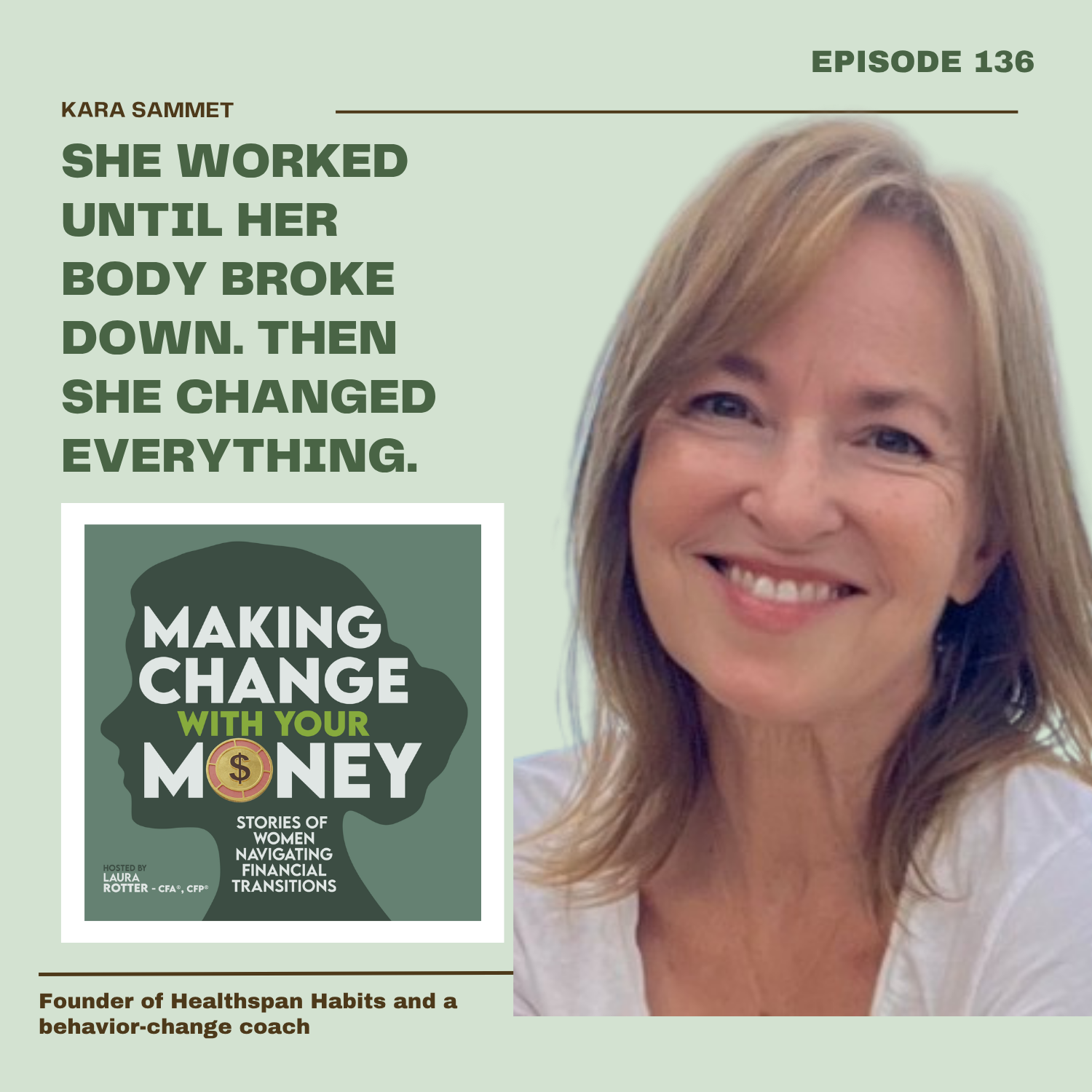
Imagine lying in bed, laptop open, typing an apology to a client because your body has completely given out — a full allergic reaction on top of a car accident on top of a shoulder that can't lift above your head. You're 48. A UC Berkeley researcher. A mother. And for the first time in your life, you're turning down work. Kara Sammet grew up with one foot in two very different worlds. Her mother — a single mom on public assistance — stretched every dollar, chose between bus fare and macaroni and cheese, and built herself into a CPA with a 4.0 the same year Kara graduated middle school. Her father's family, meanwhile, skied in Aspen. The message Kara absorbed was sharp and clear: your safety depends on your ability to earn. Work hard, save everything, never go into debt. And never make too much money — because people with money think they're better than you. She carried that drive all the way to a PhD in educational statistics, a research post at UC Berkeley, and a seat at the table with tenured faculty from Harvard. She was doing important work — helping tech companies like Google, Snap, and Cisco bring more women into leadership. But it was soft-money contract work. And she was running herself into the ground. At 48, her body staged a revolt. Shoulder injury. Constant illness. Nearly 50 extra pounds. A doctor who shrugged and said: "You're almost 50. That's just what happens." A yoga teacher who said: that's not true — go find a physical therapist. So Kara did. She paid that yoga teacher to walk a mile with her while she rehabbed her shoulder. She set a goal: run three miles around the lake by her 50th birthday. She did it. Then kept going — to triathlons, to 100-mile bike rides, to half Ironmans. When the pandemic hit and her academic contracts dried up, she made the pivot. The colleagues asking "how are you doing what you're doing?" became her first clients. The behavior-change research she'd spent a career studying became the method. And Healthspan Habits was born — coaching high-achieving adults, especially women, from couch to consistency using neuroscience, community, and compassion. Her definition of success hasn't changed at its core: do work that matters, and trust that financial stability follows. What has shifted is where she believes safety comes from. Not from external circumstances. From within. Guest Kara Sammet is the founder of Healthspan Habits and a behavior-change coach helping high-achieving adults build sustainable, active lifestyles for long-term health and longevity. A former global tech consultant (Google, Snap, UN Women) with a PhD from UC Berkeley, Kara blends neuroscience, identity-based habit design, and community to move people from knowing what to do to actually doing it. Connect with Kara Website: https://www.karasammet.com Instagram: https://www.instagram.com/kara.sammet LinkedIn: https://www.linkedin.com/in/karasammet/ Facebook: https://www.facebook.com/karasammet Resources Healthspan Habits — coaching...
speaker-0: Imagine lying in bed with your laptop open, typing an email to your clients telling them a project is going to be late. Not because of a deadline, but because your body has completely given out a full allergic reaction following a car accident, following months of injuries that your doctor told you you were just aging. You're 48, a researcher at UC Berkeley, a mother. And for the very first time in your life, you are turning down work. That was the moment that changed everything for my guest today. Cara Samet grew up between two worlds: a mother on public assistance who built herself into a CPA, and a father's family who skied in aspen. The message she absorbed: work hard, save everything. Your safety is your paycheck, and whatever you do, don't slow down. She didn't. She got the PhD. She got the Berkeley Post. She consulted Google and Snap and UN Women on how to bring more women into tech. And she ran herself completely into the ground. At 48, she weighed nearly 50 pounds more than she does now, couldn't lift her arm above her head. And had a doctor who told her, This is just what 50 looks like. A yoga teacher told her otherwise. And what followed was one of the most remarkable reinventions I've heard, from completely sedentary to half Iron Man's, from academic researcher to behavior change coach, from the external source of safety to trusting herself. Tara Samet is the founder of HealthSpan Habits, and this is a story about money, identity, and what it really means to take care of yourself. Listen in. Welcome to Making Change with Your Money, a podcast that highlights the stories and strategies of women who experienced a big life transition and overcame challenges as they redefined financial success for themselves. Now here's your host, certified financial planner, Laura Rodder. speaker-1: Thank you. Delighted to be here. speaker-0: Looking forward to our conversation, I'll start as I always do with the question, Cara, what was money like in your family growing up? speaker-1: Yeah, money in my family growing up was interesting. It was, I think, probably different than a lot of people because it ranged all the way from very early on being on public assistance to having grandparents who were upper class and I was kind of going back and forth between both worlds and you know where I was growing up with a mom who was on public assistance while she was a single mom. And then, but with my biological father's family, we went skiing in aspen every year. So it was this you know, it was a strange, it was a strange foot in both worlds that has for better or for worse served me and completely shaped. Who I am and the work that I do. speaker-0: Wow, can you share with us like quickly? Obviously we'll have a we're ha about to have a longer conversation, but can you use an example of how you know that shaped who you are? speaker-1: Sure, sure. The essential thing to share is that the work that I do now and the career that I chose, I know was very much shaped by my mother's experiences around financial trauma, where she grew up in a family where both of her parents had grown up on farms in Kansas. Her father's father, her grandfather, had died when sh he was very young and he's He sold tomatoes in the market from the time he was eight, right? To help the family survive, her father, and then went into the Marines. And that through going on the GI Bill, was able to become an engineer, go on to become a vice president at you know, an engineering, an international engineering firm. And that her family of origin, and then she got married and was pregnant with me at 19. And she married a man who was very charming and who came from a well-to-do family, but who ended up being incredibly financially irresponsible. So once so my mom was kind of I just know that my childhood was very much shaped by my father's financial irresponsibility. He was a cross-country truck driver. And kind of like the story in our family is she left him when he took their last $5 and spent it on a walnut burl stick shift handle for his car. So then I don't have any memories of kind of food stress or housing stress, but I know I've heard the stories of my mom having to choose between Do I spend this dollar on bus fare to get to work? Or do I buy a box of macaroni and cheese for the kids? And at the same time, my father says so then my father was out of the picture. Like I said, my grandparents, my grandfather was a very busy, prosperous doctor. And so, you know, I think kind of I went back and forth between those two worlds. My grandparents were on the north side of Chicago in a very wealthy suburb where I was born. And then I lived in this very blue-collar town when my mom remarried when I was six, seven to a steel worker. So I grew up, my mom went back to school. You know, when you have that kind of early financial trauma that she did, I think it really shaped. So the message I received around money and work was your life. Depends on your ability to earn enough money for you and your children to keep your children fed and keep a roof over your your children's head. And you will not ever go into debt. You will save every penny. And you always must be able to support yourself and your children. That was kind of the primary thing that drove everything. And then the secondary part was. A lot of what I would say being made to feel inadequate, not intentionally, but my mother kind of like the story kind of was inadequate around that you must make money, but don't make too much money because people who have money are bad. People who make money and have a lot of money think that they're better than you because they have money. And so make sure you make enough money and that money is the source of your safety, but don't make too much money that you think you're better than anyone else. So that has really and and that you know, school. So my mom went back to school. She graduated from college with a 4.0 Sumu Kumlade, the same year that I graduated from middle school. And She became a CPA and it in every just all sides of my family, everything I heard was work hard, make money, save money. Right. And then there were differences in how how it's okay to spend your money. But then the piece that really connects with what I do now is if you are working so hard to put food on the table and a roof over your mouth, doing something like exercise or fitness. And self-care is something that is it really does become a luxury at some level, and or it looks like a luxury. And if you also are exposed to people who have enough money for whom they are able to spend enough money to do those things in a way that you know, that they're able to spend a lot of resources on self-care. It can look shallow and frivolous. And also, especially for someone like my mother and for myself, that you're really navigating the corporate work world. And the idea is your value is on how smart you are, not how pretty you are or how how healthy you are. It's how much do you produce? How hard do you work? How smart are you? Right. And so there was something about not having the time for self-care, not valuing self-care, not understanding the link between self-care and productivity and longevity. But that's I think a kind of a trauma response of just I have to work. I have to work and make money. Right. There's no time for self-care. and there's no resources for self-care, including time or you know, time and money. So and There's no permission for it. It's shameful. Like, you know, if you're growing up on a farm and you're selling tomatoes in the marketplace when you're eight years old to feed your family, there's there's no time for that. Like that's that's a different life. So yeah, that that has really shaped who I am and my evolution of my career and what I do now that all started in midlife. Yeah. speaker-0: thank you for, you know, explaining all that to us, Cara. It's so clear that I mean, this is something that you've thought a lot. Yeah, the mixed messages. I mean, we all receive mixed messages growing up. Yeah. speaker-1: Yes. speaker-0: as you were speaking, I was thinking about how I grew up in a rent control apartment in New York City, found out later in life about financial difficulties my parents had. But but the message was that we were better than people because we didn't own a home. It was like that there's I found out again older that there was a lot of shame in my father's part, but how I imbibed it was that, people with the house, they have to take care of everything themselves. We can call the super and they fix things that break. It was like that we were better than people who had more money than us. speaker-1: That is so fascinating, Laura, because I'm still working through my personal story that I am not safe unless I own a house. speaker-0: Mm. Yeah. It's interesting. And speaker-1: It is fascinating. speaker-0: And as you described your story, so I'm so curious to hear your journey about how you've ultimately chosen to do something that that could categorize you as someone that's being or working with people who are just, you know, being wasteful with their money or putting their values in the wrong place. So Please share with our listeners what that journey was when you 'cause I know you started in a traditional kind of career role and what were the catalysts for your shift? speaker-1: Sure, sure. So the catalyst really was as I was heading into my late 40s, my body was just completely falling apart. I was constantly sick, constantly injured. And I had this shoulder injury. I could barely put on my own bra, right? Like I couldn't like always say I couldn't sleep with my arm up. I couldn't raise my arm up over my head, right? You know, like my body was just falling apart and Because I was a desk jockey. I was a very, very sedentary desk jockey. I had never been athletic, had never played a sport, didn't exercise. I had been outdoorsy and I'd had some injuries in my late twenties and thirties. And I just stopped moving basically. Once I had my kids and my career, I was an academic, I was a researcher at UC Berkeley. And my body was falling apart. And I like I said, I had these serious injuries about when I was 48 and I went to the doctor and she was like, yeah, you're sorry, you're getting old. And she was like, you know, you're almost 50. That's what happens. You just have degenerative stuff. But I couldn't lift my arm up over my head. And very fortunately, I I know, I I was falling apart and I was like, okay, I I felt like I wasn't living anymore. I felt like I was dying already at 48. And so I thought, what? What can I do to begin to take care of myself here? And I remembered that I had gone and done yoga when I was in my early 20s when I had first moved to San Francisco after my undergrad had finished undergrad, moved to San Francisco, and I went to yoga and I thought, let me try going to yoga again. And then I had all these shoulder palms and I couldn't do it. And the yoga teacher said, you know. I think you have something wrong with your shoulder. She said, go get an x-ray. That's when I went to the doctor, and the doctor's like, yeah, there's nothing you can do about that. And the y I went back to the yoga teacher and I said, My doctor says it's just this way forever. And she said, That's not true. Go. I know, right? it is crazy. And I believed my doctor also, even as an educated woman, right? I believed her that this was just normal age degeneration that I just had to live with for my life. And very fortunately, This yoga teacher was a former nurse. And she said, find a physical therapist who specializes in sports rehabilitation injuries and get him to help you fix your shoulder. And through that, so I stopped going to the yoga. I started working with a physical therapist to strengthen the shoulder. And at the same time, I was I weighed almost 50 pounds more than I do now. And so This yoga teacher, she said, you know, I know you can't come to the classes. And I I was like, what can I do? And we made this agreement where I paid her to walk with me. I was really sedent, like I said, I was sedentary. I could barely manage to have enough energy to walk with my kids from our house a couple of blocks to the park. And so I paid her to walk with me for a mile. While I started rehabbing my shoulder, and I set a goal to be able to run three miles around the lake by my house by my 50th birthday. And that happened, and it just kind of snowballed to where I fell in love with movement and exercise and everything that it was doing for my body. And I was simultaneously losing all of this weight. And then the pandemic hit, and through a variety of things. I was ready to transition out of what I had been doing as a researcher. I'd I had studied behavior change as part of my PhD. and then I was kind of applying what I knew, what had brought me to grad school in the first place. I was applying to myself. And then my colleagues kind of started asking, like, how are you doing what you're doing? Because I went from completely sedentary to hitting this. 50th birthday milestone achievement to now, you know, training for half ironmans and competing in all sorts of, you know, regularly doing triathlons and hundred-mile bike rides. And it's just a part of my life, right? From nothing to this is my life now, right? So the it took a lot from that financial background. Of what I grew up with, I worked myself so hard that my body broke down, right? Because I really just felt like my body was secondary to my brain. It was all about my brain. That was the only thing that mattered was how smart am I? And how can I keep my brain going? And there was a part of me that embraced exercise. just so that I could think better because the research is very clear on that, right? That like we are more productive for longer and we have more creative ideas and we retain our intellectual capacities longer when we exercise. So right? So I was like all right, I guess I will start, you know, I did what a lot of us do, which I know this is not your story, but for a lot of People who were never athletic, like who hated physical education, who were ashamed education. speaker-0: That was For the teams, I was always the last person. I hated Jim yeah. speaker-1: Yes, me too. Me too. Hated. Like so much social shame. So much shame around my body. just feeling like I'm not an athletic person. I'm a smart person. And I'm gonna get a PhD, right? So like I don't need my body, I just need my brain, not realizing like they're interconnected, they're part of the same, they're on the same team. Right. So and allowing myself, giving myself permission. To take the time. I was really embarrassed about taking the time to take care of myself. And it was a real struggle for me. And I work with a lot of people that have to overcome that same sense of shame for both wanting to take care of themselves, for wanting to look better, because that is a driver also for a lot of people. wanting to exercise is that we all want to look better, but there's we get shamed about it. Like if you are someone who's career focused, especially a woman, there can be some shame around like, yeah, I want, I want to be successful in my career and I want to look good. So that that's really that's really my origin story there. And I I'm grateful for that because there are so many people in the same boat, right? So many people. And I think having gone through that, it's You know, I'm not a fitness instructor. What I do is I help people begin to exercise and then sustain it over time. And having had that, you know, I I I call myself a habit change coach, basically. I I kind of I think of it as helping people go from couch to consistency with their physical, speaker-0: Yeah. speaker-1: right? So they can live the active life that they want as we go into the next seasons of our lives. And The fitness industry is full of people who have always exercised, who have always been fit. I think you are a little bit of an anomaly where you had that kind of negative experience in physical education, but I know you've had a longstanding love of exercise and fitness, right? Yes. So like for like for most people, if you have Don't have a background in athletics. Exercise is the first thing to go when anything in your life gets rough. But what I have found as I have transitioned from someone who doesn't exercise, who's completely sedentary, to like now I build my life around my exercise and fitness, right? What I have found is now the exercise and the fitness and the active lifestyle is the foundation. that keeps everything else moving, right? It's the fitness and the mindfulness together. speaker-0: And Kara, everything you're saying very much resonates with me. I'm trying to because it's begging the question, which I'm gonna ask in a moment, of but what was what was your why that had you asked the yoga teacher to make herself an accountability partner? And and what's what are the various whys you see with women you work with? I'm trying to think what my why was. I really became an exerciser. I put on the obligatory tw you know, freshman twenty pounds and I remember coming home and that was when running was a craze and my father took me shopping and bought me running shoes and we went running together, so I mean the story was it about my relationship with my father. But however I started, I found that I liked it, which I'm sort of hearing from you and I'm not sure why, but like I was drawn to it. speaker-1: Yeah. speaker-0: and there are so many people that get those running shoes and do the three miles and then like, I'm done, I hate this. So what are the persistent threads that you see and and can you identify yours? speaker-1: Yeah, yeah, yeah. So you mentioned a couple of things. One is the why, and there's the why that's your motivation that you can dig into to either get you to get your started. And sometimes that why will help sustain. and then there's what is it that actually sustains? So the Why for me was my body was falling apart. And I truly I have this moment. I can remember this moment of I'd had a bunch of injuries, illnesses, accidents, and it was the first time that I ever had to send an email to a client to say, I'm sorry, this project's gonna be late. I'm I'm in bed and completely incapacitated because I've had this full body allergic reaction to a tetanus shot after I had a car accident and had stitches and blah blah blah. Right. Like I was I had to be like the universe had like had been throwing lots of pebbles at me. Right. And it wasn't until the universe was like, here, here's a big boulder for you to get the message. It's time to start taking care of yourself. Right. And so I was laying in bed. I can remember I had my computer in bed. I was so ashamed to send a message to my clients. And I sent a message to clients saying, I'm sorry, this project's gonna be late. And then I turned down a potential contract. And that was the first time I ever said no to work. And at the same time, I given, or around then, I had given a talk. At the at a UC Berkeley business school leadership conference. And I saw a picture of myself. And like I said, I weighed 50 pounds more than I do now. And I was talking about women's leadership and our val our the values that we are encouraging our clients to embody. And I just felt like such a fraud because I felt I was not embodying personal leadership. And I felt like, everyone is just gonna see right through me. not that I like I knew a lot about women's leadership and about leadership, but I just felt like the way I was leading my life personally was out of alignment with my professional values. And at the same time I had two children, two small children, and I was like, what am I role modeling for my kids? That how you're supposed to live your life and work is you work and you work and you work until you break down. And then you start to take care of yourself like that. All that kind of came together. And I was like, okay, something has to change. And there was also this timing of I was coming up to my 50th birthday, which for a lot of people, there are these big inciting incidents that like you had this thing where your father got you your shoes, right? That was basically your inciting incident. And but for the rest of us, it's we get a major health scare. Or we have a big milestone coming up, like a 50th birthday. Or I find a lot of people who I work with, something shifts in their schedules. So all of a sudden they've gotten to a place in their career where they have a little bit more time and autonomy in their professional life. And they're like, okay, now I'm gonna do this. You know, there's something that happens that really changes. And everyone has that why. But then what sustains it? And this is, I think, part of what you had is the social connection. And people do not realize how important that is for sustaining a consistent movement habit, usually. Like you may have it wired in that you don't need other people. And like for me, I can go out the door and I prefer to run by myself, right? Like I don't run with other people now. But What is sustaining is like I had that yoga teacher to walk with me, I had my strength trainer to help me rehab my shoulder. And my physical therapist said, Okay, we're building team Kara here. And he was amazing, changed my life, right? Those two people like putting those pieces in place, and you had your father, and I wouldn't be surprised if you have other people in your life. who well I'm curious if you do have other people in your life like do you surround yourself with other people who have the same ideas around living an active lifestyle. speaker-0: Yeah, I certainly am married to someone who does and my kids are. But I'm really trying to think. It's just such an interesting thought that I think I first started to exercise. I had Jane Fonda like exercise tape. I almost classes and then I like joined the Y and went to classes at my why. So there was something about that, about the music, whatever that that speaker-1: Absolutely. Absolutely. And the thing about that is that for instance, a lot of the people who want to exercise but can't get themselves to exercise consistently, what happens is they're not ready for classes yet. Because one of the issues is when people are starting to exercise, there's a few things. If you are a very competent professional and you go to an exercise class and you don't know what you're doing or you want to go to the gym and lift. Say, you know, a lot of women as they're facing middle age and dealing with osteopenia, osteoporosis, or potentially diabetes or other things like that, they want to do it, but there's this real sense of fear of social shame and looking incompetent. And the other thing that happens is when people are new to exercise and fitness, they don't know what they don't know. And what happens is that people set these really big goals and they know they want to go to a class or whatever, but those classes are designed to distract you from the distress of your body in some ways, right? Like it's actually meant to take your attention away from how hard you're working and they really make it, try to make it very fun. But when you are first starting to exercise, what often happens is People will get to those classes, they go to the classes right away, and they don't know how to self-monitor their intensity. And then they overdo it in the first class or the second class. And then they're like zombies because they are they worked out way over where they are capable. Like the intensity threshold was too high for them. And the amount of time that they worked out was too long for them. And so then they think, I hate exercise, right? And they get sore. speaker-0: Yes. speaker-1: And they think, I hate to exercise, I can't exercise, because they want to go to the class, but the classes, they're just, they're, they're not ready for the class. So that's kind of where the work that I do comes in is to help people make that transition from that seed desire of, okay, I know what my why is. And sometimes I I work with people to help them find their why because there a lot of people come to me and they say, I know I have to. exercise and I kind of want to, but I don't really want to. I actually hate it. It makes me sore. It makes me tired. I don't have time. Like I want to, but I don't want to. And we really work together around like what's your why and what is gonna sustain you? And those two things are essential. speaker-0: Yeah. I mean, even in the work I do in the financial planning work, I mean you might think like, I wanna live within my means and I wanna s save a little bit more, but I don't really want to. Like it yeah, it you have to get to even if you do it because you have some energy when you first start the financial planning relationship, but don't really tap into the why it's an overused word, but it's true. speaker-1: It's true. speaker-0: It's hard to sustain if if it doesn't feel right. You are not the sum of your earnings. You are the sum of your yearnings. If you're ready to use wealth to create more freedom and flexibility, let's align your finances with what matters most. Together, we'll build a plan that balances your scarce resources of energy, time, and money so you move forward with clarity, confidence, and less stress towards a life of true abundance. Learn more at www.truabundanceadvisors.com and schedule a short conversation. Cara, given the introduction we went through and the financial trauma that you live with, can you just, you know, talk about what that transition was from what I assume was a steady paycheck as an academic to deciding to do this work that really calls to you? speaker-1: Yeah. You know, so I was at the time, this was at the beginning of the pandemic, and I was a visiting scholar in the computer science and engineering departments at UC Berkeley. with within a certain there was an initiative called the Women in Tech Initiative, and it was about how do we bring more women into the tech workforce. So how do we recruit, retain, advance? Women in leadership and tech and underrepresented people of color. But my specific position there, I was like liaison to a UN women's research group on women in technology, and then I was consulting with different technology groups like Google and Snap and Cisco and different big tech players, right? On women, how do we get more women in tech? And I was at the table. I did not have a tenure track position, which is the financial security, right? I had different appointments and then it was kind of like soft money, it was contract money that I was bringing in with this umbrella position at the university. And one day I was at the table with a group of advisors to a tech company, and the other people at the table, they were all tenured faculty at Harvard. and different UCs and different universities, some of whom were my heroes. Like I had their books that I kept on my desk for reference, right? But I knew that they all were tenure track and full time. And I just thought this is not sustained. This is not working for me. Like the amount of hours that I'm putting in, the amount of time and passion. And it was a time, you know, a lot of what I was doing the The this was right when Me Too happened and Black Lives Matter. And what happened is I had been doing this, you know, what we would call diversity, equity, inclusion work for a long time. And then the field started to swell, and there were enough people there that I was like, okay, there are other people stepping in here who can do this work now. Like I'm I don't I'm not by myself doing this anymore. And the financial Things weren't working for me. And I had colleagues saying, How are you doing what you're doing around your weight loss and your fitness? And I'll pay you to help me. Yeah. speaker-0: Wow. Yeah. speaker-1: So the pandemic hit, we were all at home, right? And a lot of contracts that I was in the process of getting or that I had, they just shut down. And at the same time, people wanted to exercise at the beginning of the pandemic, right? And I thought, okay, this is the time. This is the time. So it was a very difficult shift for me because I had a lot tied up in my own sense of status around being an academic. And I was thinking, like, am I am I Becoming a weight loss coach here? Like, what is this? Right? Like, what is going on? And it took me a minute to wrap my head around. This is just an extension of the of what brought me to graduate school in the first place. I had been an instructor at Outward Bound. And yeah. So I'd been a backcountry wilderness leader. And why in my early 20s. And while I was there, I was just fascinated with. What are the conditions and what are what is the programming that happens, like the interventions that we can provide to help people bring out the best in themselves, like realize their potential and be who they want, become who they want to be. So that's what brought me to grad school and what I studied for my dissertation. And when I really thought About when I really realized because the approach that I took to helping people begin to exercise and sustain an active lifestyle where they also were losing weight and retain and maintaining that weight loss pretty easily, it's not based on traditional dieting and it's not based on boot camps. It's based on the neuroscience of behavior change, which is what I was trained in. So once I was able to wrap my head around that, and I could see what a difference the work that I was doing made in the lives of the same women that I had been working with before, just in a different capacity, right? Like these same women in tech who I was supporting before, these same executive women corporate leaders. Now I was helping them, like, okay, why don't I help you do the same thing that I just did? Which was like, let's round out this other part of your like of your life and take care of yourself so that you can really be all of who you want to be for yourself and for your family and your community. Because that's what they wanted to do. And it's just it's a new avenue of doing it. speaker-0: love that, the reframing in a way that helped you keep your identity. speaker-1: Yes. speaker-0: I also like it reminds me of, frankly, more of my Wall Street career than what I do now, though sort of the gratification. Like you come up with an investment idea. I was what was called an event-driven investor. So I wasn't buying an investment for three to five years. It was like there were going to be catalysts that would either play out the way I thought or not. And there was something very gratifying about Making an investment and seeing it worked out work out. And when you work with your clients it's it's similar. You you speaker-1: That's right. It's a long term investment, right. speaker-0: Yes. So you see the change that that they're making. So Kara, as we're getting t to the end of our conversation, I guess as I made that comment, I'm thinking, well, that's success, like feeling that you really see the difference you make in your lives. I'd like to know how your definition of success might have shifted and even perhaps given how you grew up financial success. speaker-1: Yeah. Yeah. How my own sense of success has shifted. For me, I know since I was very young, I always have wanted to help a lot of people. Like I saw myself as a helper. And frankly, I wanted to help millions of women. That was my goal from the time I was very young. And it remains my goal, is to have an impact that Is big enough to impact millions of women to help really change women's lives. And the success, like the marker of success, you know, I thought I would do that through academia and publishing and that kind of thing. But what I have found is that my success, my feeling of success is still how can I be of service and help individuals, not just women, now I work with men and women, to Be who they want to be. And just the way that I deliver that has changed because, you know, I have found that, you know, for instance, I am, it's not that I'm so great at research. What I'm actually great at doing is taking the research and putting it into an applied format to help people do what they want to do. Help people do what they already want to do, right? Take the best evidence based practices and do that. And so Before I was doing that in the corporate world, and now I'm doing that in these different ways, you know, with my clients, however, clients are working with me. And so now when I look at success for myself and in relation to the, I think you asked about money, like your question was, how does success relate to money? speaker-0: Well, how are you d redefining maybe even financial success for yourself as opposed to speaker-1: Well, you know, I think the bar was set for me. You must always be able to take care of yourself and your children, right? And that hasn't changed. And I never had a drive to be say to have financial success for material to have a lot of material things. I have believed that that type of success is a byproduct of. For me, I always chose a path of yes, financial, like with the aim of financial stability, but doing work that you love, that I love. And that feels rewarding for me. I just I've never had the ability to do work that I don't like just to make money. Right. Yeah, yeah, yeah. So the success, my definition of success really. Has not changed. I really believe, like for me, that when I show up and do the work that I was put on this earth to do, that the financial success follows. I will say that one thing that has shifted is believing that the source of financial safety is external. To the source of financial safety is internal. speaker-0: That's great. speaker-1: Yeah. speaker-0: I agree. So Kara, I'm sure there are women listening to this saying, I need to get in touch with her. So can you talk about how you work with people? And of course, you know, the best way to contact you, but I'll put that in the show notes as well. speaker-1: Yeah, yeah, yeah. So I work with people in a few different formats. I work with people one-to-one. I work with people in small groups, what I call masterminds. So it's kind of like a mastermind that you would instead of having a professional mastermind, it's a let me build an active lifestyle mastermind where these the small group is all women, so anywhere from eight to twelve women, where we are supporting each other. To do the movement to build the active lives that we want. And that's what I talked about. It's this these small, this small safe container, this becomes Team Cara or Team Laura, right? Or whoever we're working with. And that is what helps people go from that initial kernel of motivation to long term consistency and sustaining motivation because. That social connection really it provides this space of warm accountability and support, which is really what people need when they are feeling very vulnerable in the beginning of this journey. And then there's a larger group container program that I run that is both for it's men and women. And I really I work with people in all three ways. Some people who want to work one-to-one is because they just are not ready to be in that social setting. But I and so I provide that, then I'm their social container, right? But I really think that the group model is a wonderful and the most and the research shows it's actually the most effective way to maintain long-term consistency. Because you think about it as a species, we we evolved to move. Together, right? Whether you're hunting or gathering, we evolved to move together. And then what do you do? You celebrate the harvest, you celebrate the hunt through movement rituals, dance rituals, right? And those are social. So today it's so easy for us to be isolated and just think, I just want to put on my shoes and go out by myself because we don't want that social shame or embarrassment when we're just starting to move. But what I really do is work with people to create a safe container so that that social connection instead of shutting people down is what's actually building them up over time. Yeah. So that's that's how people can work with me. And they can find me on my website, Kara Samet.com, K-A-R-A-S-A-M-M-E-T dot com, and look for how they want to reach out to me there. speaker-0: I love like as you talk about it, you you're shining, you're glowing. I think how you refer to it, Carol, like that you it's important for you to do like you're mission driven. And it sounds like from when you were an academic to today, you've really been drawn to things. You don't just like speaker-1: Absolutely. Pick it. No. I don't do things lightly. I'm definitely not a person who does things halfway. It's kind of all or nothing, for better or for worse, right? Like there's no moderation. I I'm not like a really and I'm I'm grateful for like podcasts and things where other people are like, yeah, I I can't do things like balance. What is balance, right? I mean, like, yes, I am trying to balance because I have learned the hard way that when you go from couch to half Iron Man, like wow, there's a learning curve there, right? And like in anything, but that's that's just how I roll. And having that having that self compassion for myself also I think makes it just so much easier for me to extend that to the people that I'm working with because it's that that is actually one of the biggest things that holds people back from this from being more active and starting to exercise and being able to do consistency. Consistently is that voice inside their their head that is that critical voice saying, you look fat, you look dumb, you look stupid, don't Don't wear those clothes. Like, you know, it's the it's that voice that comes from broader society in general. And a lot of times they've heard it in the past when they were kids, either from peers or coaches or family members, right? Or significant others. It's hard. It can be really hard. So the work is not just how do you do XYZ activity, but how do you Work through these mental loops in your head that are keeping you from doing what you want to do. And so yeah, the I think my excitement about that and my having lived that's a long way in speaker-0: The experience. speaker-1: supporting people to do what they wanna do. Yeah. speaker-0: Change the voice in your head and change your life in so many things. speaker-1: Completely. Completely. Hundred percent. speaker-0: Thank you so much, Cara, for being my guest. speaker-1: Thank you for having me, Laura. I really appreciate it. speaker-0: Thanks for listening to Making Change with Your Money. Certified financial planner, Laura Rodder specializes in helping people just like you organize, clarify, and invest their money in order to support a life of purpose and meaning. Go to www.truabundanceadvisors.com forward slash workbook for a free resource to help you on your journey. Disclaimer. Please remember that the information shared by this podcast does not constitute accounting, legal, tax, investment, or financial advice. It's for information purposes only. You should seek appropriate professional advice for your specific information.