
Making Change with your Money · Laura Rotter, CFA, CFP® | Financial Advisor for Women in Midlife Transitions
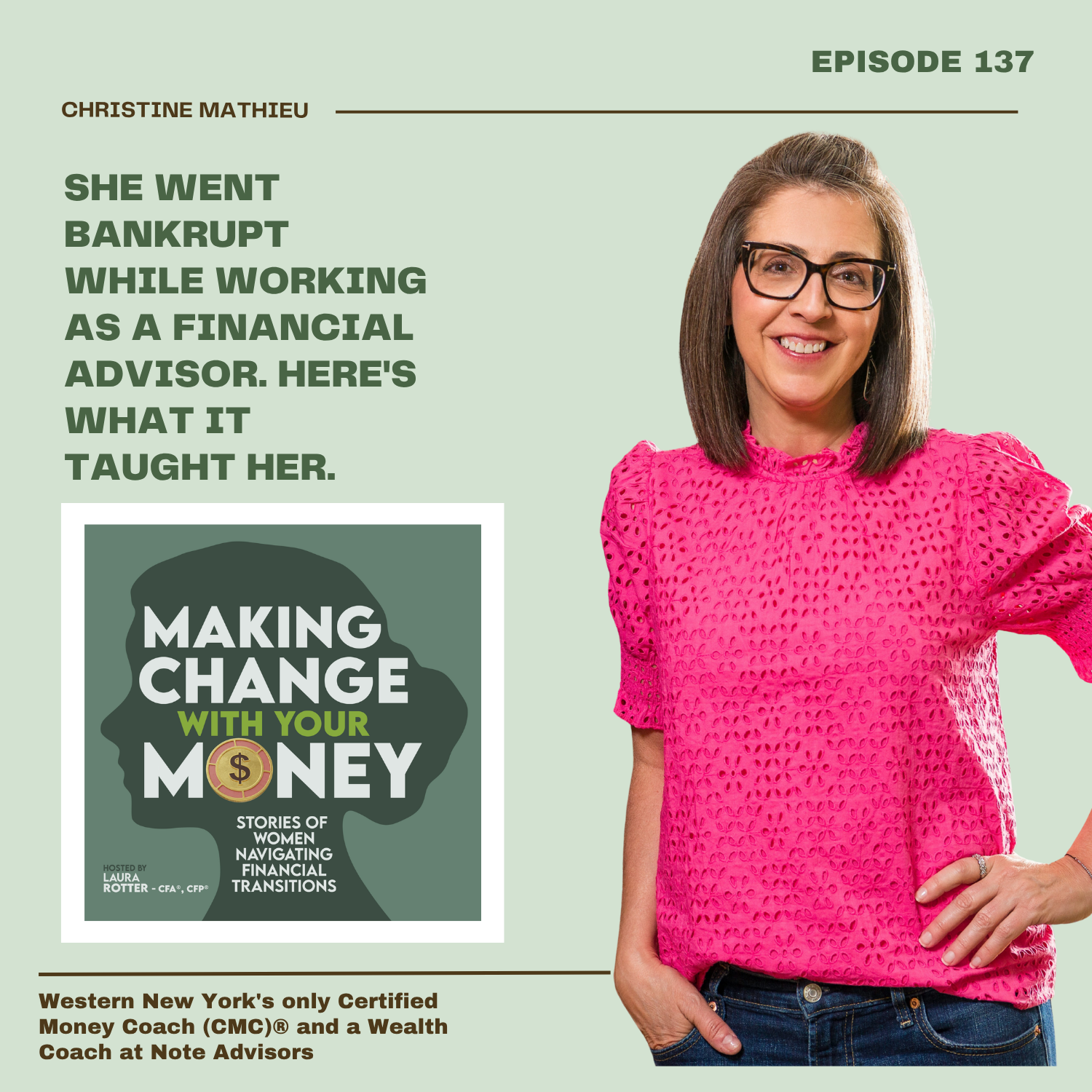
Christine Mathieu grew up with champagne taste on a beer budget — her mother's words, repeated so often they became a wound. From a gifted dancer whose knee injury ended her performing arts career, to a financial advisor who quietly filed for bankruptcy while serving clients, Christine has lived through upheaval that would break most people. In this conversation, she shares how divorce, financial collapse, and a life rebuilt through Buddhism, metaphysics, and money coaching taught her that real wealth begins with your inner world — and that the question she lives by, "Says who?", is the most liberating thing anyone can ask themselves. IN THIS EPISODE, YOU'LL DISCOVER Why hearing "you have champagne taste on a beer budget" as a little girl shaped Christine's financial struggles for decades How a knee injury at 19 derailed a dance career — and led her to art history, writing, and eventually wealth coaching What Christine noticed during the 2008 recession that made her realize financial advice alone was never enough The hidden financial abuse inside one of her marriages — and how she used money strategically to protect her children Why she became a Metaphysical Minister, a practicing Buddhist, and a certified money coach — and how they all connect The difference between "follow the push" and "follow the pull" — and why Christine now lives entirely by the latter How she helps clients facing retirement or divorce reconnect to their values, identity, and core desired feelings ABOUT CHRISTINE MATHIEU Christine Mathieu is Western New York's only Certified Money Coach (CMC)® and a Wealth Coach at Note Advisors. A former financial advisor and current Metaphysical Minister, she blends spiritual insight with grounded financial wisdom to support women navigating midlife transitions. Having personally experienced divorce, bankruptcy, cancer, and reinvention, Christine understands that true change begins within. Through compassionate inquiry and her signature question, "Says who?", she helps women release fear-based beliefs, reclaim self-trust, and redefine wealth as a state of peace, purpose, and possibility — creating meaningful change from the inside out. CONNECT WITH CHRISTINE 🌐 Website: www.noteadvisor.com/wealth-coaching/ 💼 LinkedIn: linkedin.com/in/christineamathieu 📸 Instagram: @christine.mathieu | @sayswho.whatfor 🎯 Take the Money Types Quiz: www.noteadvisor.com/the-money-types-quiz/ 📅 Book a Money Confidence & Clarity Audit: calendly.com/christine-wealthcoach/finding-peace-clarity-after-divorce
speaker-0: Today I'm joined by a remarkable guest, someone who has lived through bankruptcy, multiple divorces, a career-ending injury, and a profound reinvention, and who now helps other women do the same. Christine Matthew is Western New York's only certified money coach and a wealth coach at Note Advisors. A former financial advisor who spent nearly two decades in the industry. Christine had a front row seat to the 2008 financial crisis, and what she witnessed and her clients changed everything. She realized that practical financial advice could only go so far, and that what most people actually needed was to understand the relationship with money from the inside out. So she went deep. She became a practicing Buddhist, earned a degree in metaphysics. Became an ordained metaphysical minister, and got certified through the Money Coaching Institute, where she was introduced to neuroscience as yet another lens for self-understanding. Today she works one-on-one with individuals and couples, guiding them through their money biography, uncovering subconscious patterns, and helping them reconnect with their values and core desired feelings. Her signature question, says who? Is an invitation to challenge every limiting belief that's ever kept someone playing small. Listen in. Welcome to Making Change with Your Money, a podcast that highlights the stories and strategies of women who experienced a big life transition and overcame challenges as they redefined financial success for themselves. Now here's your host, Certified Financial Planner. Laura Rodder. Welcome, Christine, to the Making Change with Your Money podcast. I'm gonna start with the question I always start with, Christine, what was money like in your family growing up? speaker-1: Such a great question. and it's a familiar question. gosh, let's see. You know, you know what the funny thing is, growing up when I was young, right? Younger, I don't know that I actually had an awareness of it, right? Specifically in terms of dollars and cents. speaker-0: Yeah. speaker-1: What I do remember is when When my parents would say yes to something that I wanted, when they would say no to something that I wanted, right? And and in response to however they chose to respond or whatever their answer was, I remember how how I felt. Right. So yeah, so it wasn't anything specific to dollars and cents, but absolutely there are certain things that I remember. based on what what what it was that I wanted and what I was asking for and whether I received it or not. speaker-0: curious if you have a memory of asking for something and what it was that they said no to. Well speaker-1: remember yes very clearly and then and then some and then I'll give you a no. But the yes that really stands out for me is that from a very young age, when I was four years old, I I started dance lessons when I was four years old. And it didn't take me very long to know that I had a love of it and that it was something that I knew At four years old, I knew that it was gonna be a part of my life for a long time. And my parents somehow could see that. Because I I don't know how I mean, how does the conversation go with the four-year-old and and their dance lessons, right? I I guess, you know, they're they're there, they see the lessons, they pick me up, they drop you off, and then of course the recitals. so they could see they could I guess, right? You could see that Yes, our this is really making our daughter happy and she seems to be thriving in this environment. So I loved it. I wanted to continue with it. And they said yes. And they supported me all the way through, including my first year of college. I actually went to a performing arts college in Pittsburgh, Pennsylvania, Point Park College. I got a scholarship. speaker-0: Wow. speaker-1: yeah, I and even just to get myself there, I was I was a dancer with the David D. Murray Dance Studio, which is very well known in this area. I competed a lot. won, yeah, did really well. And that's what got me into this performing arts school. So they saw me all the way through that. They really believed in me. And I think just putting the money behind their belief in me, it was a way for them to express their love for me. Right. now some of the nose were more I think relative to clothing, fashion. You know, it was just that kind of thing. And I was a little spoiled with reg with respect to the on the fashion end of things with the on the clothing, because my great aunt, my auntie Kay, owned, she was co owner in the Beacon Garment factory in Fall River, Massachusetts. So back then, we're talking 50s and 60s. Yeah. That was unheard of, right, for a woman back then to own her own business. Now, of course, she was in partnership with a man. She was married, so she was able to get funding and so forth. but my grandmother was a master seamstress and worked for her sister, my auntie Kay. So when we would go to visit the garment factory, we were our first stop in the factory was we got to go visit the huge back closet where all of the samples were hanging, right? So these were your first. runoffs of whatever they were sewing. So my my Auntie Kay, they sewed for Talbotz, Susan Bristle, David Brooks, Rugger. So a lot of these names may not be very familiar today, except for except for Telbits. Telbits is still around. But for those of us in our generation, we remember David Bristol, Rugger. Like these are top brands. And I was getting them all for free. So So I think my expectation was a little skewed. speaker-0: I'm totally so. speaker-1: Of what we could afford, sure, who can't everybody can afford free, but if we were to go shop in Telbitz and and you know, buy a r a rugger shirt or a David Bristle pair of pants or a Susan Bristle pair of pants, no, we would not have been able to afford it. Right. So sometimes that was difficult for me to make that that connection, right? It was like, what do you mean? What do you mean we don't have the money for that? speaker-0: So interesting. And it stuck with you, obviously. speaker-1: It did. It did. And my mother used to tell me, Christine, you have champagne taste on a beer budget. speaker-0: I love it. It's a great quote. speaker-1: That Laura, that statement from a young hearing that as a young girl, and repeatedly, right? She re that was like a reminder for her. Like I it was like I had to be reminded. Christine, you have champagne taste on a bare budget. And I interpreted that as there's something wrong with me. Or and and that something wrong with me then meant champagne taste. What I I don't deserve the good things in life. Right. So it set the stage for what was to come later, which was a fair amount of financial struggle, whether it was in the s realm of business, right? To get business going, I was I you know, I I ended up in com you know, in commission based platform. Yeah, speaker-0: Yes. speaker-1: you name it. So So what we're told when we're growing up, it has a way of staying with us and it imprints on us. It it absolutely influences our own decision mak right, what we believe about ourselves and what we think is possible. speaker-0: Yes, I know you've thought a lot about this and clearly there was a scarcity money story and your mother was communicating it to you, but it was her story. It was speaker-1: Her story for sure. speaker-0: Yeah. speaker-1: Absolutely. Absolutely. My my mother is one who would give, give, give to everyone else and go without. Right? Yes. And go and go without. and I remember even her mother, my nanny, would speak to her in certain ways that my mother interpreted as I'm not good enough. Right. From how she looked, right? The sh the the shape, her body shape, her weight, how she carried herself, the clothes that you know that she wore, you know, that type of thing. Yeah, so I can I can see the generational patterning. speaker-0: Thank you for sharing that, Christine. And I'm curious, you were a dancer. Were you a ballet dancer? Modern? What kind of dance? speaker-1: I did it all. So we so when I trained, it was foundational. We had to do ballet. Ballet was foundational. now I never got into tow. I was never on point. I I didn't really have the interest in it. But the but ballet, you know, we had to do ballet I I think at least twice a week. but jazz and back then it was a little bit of modern, but More jazz in the sense of I don't even know what they call it these days, more Broadway style. think of if you're familiar with any with Bob Fossey and his choreography, right? Chicago. yeah, Gwen Verden, that style of jazz. That was my favorite. And tap. Loved tap. I did a lot of tap. speaker-0: Cool. So as we're having this financial life conversation, obviously becoming a dancer is not a lucrative career. Was were you a serious enough dancer that you didn't make a decision to veer away for financial reasons, or it just didn't evolve? speaker-1: Well, it was kind of decided for me. So when I was studying at Point Park, it was in the beginning of the second semester, right? Yeah, it was sometime in February, March. So the beginning towards the beginning of the second semester, my freshman year, I injured my knee. So it it to the degree where I needed major surgery, major reconstructive surgery. Yes. So that ended that ended my career, but interestingly enough, so that summer obviously I had to have the surgery and and I had to go through physical therapy and so forth. But my parents also said there's no time for you to sit back and kind of figure things out. Right. I mean for 15 plus years I I had always identified myself as as a dancer and that was going to be my career path and I wanted to get into choreography. I wanted to become a choreographer. and that just you know wasn't wasn't gonna happen. But they didn't give me time to just kick back and and figure out, gosh, what do I want now? What can I do, you know, now? so I had to make a very quick decision in terms of what school and I had to go to school. That that too was not that you know that that was a must. speaker-0: Thankfully. speaker-1: Yes, yeah. So I had to go so I had to make a quick decision. So I stayed local and I went to the University of Buffalo and it was interesting because my thought process was not about it was it had nothing to do with money. My decision making had nothing to do with how am I gonna earn a paycheck or the greatest, you know, paycheck. I was heart led. I I was heart forward, right? So so my line of thinking was Okay, well if I can't dance, what's the next thing that I can do really well? That was my thought process. Right? speaker-0: I'm right. speaker-1: That I can do really well and love the work that I'm doing. That's how I thought about it. So I went into the arts program. So I I started with the fine arts, because I I can draw and I can paint. speaker-0: You have such an artistic creative side to you, as I know you as a money person. So it's so interesting. speaker-1: Yeah. well I'll tell you it yeah, it and it it it it actually works, right? So the the artistic side and the and the money side, eventually I figured out that it does correlate, it does connect, and it works it works really well. but in any case, yeah, so I could draw and I could paint. I was like, well, I love it, so I gotta be able to do something, you know, with it. I did end up with a degree in art history, however. Because Because again, I I fell in love with the stories and the history behind these pieces and what they said about our culture and the way that people lived and the way that people thought and what they valued. And I also realized that I had a love of writing because there's a tremendous amount of research and then you have to write papers. So I did discover through that that I had a love of writing. And I am published, nothing wicked famous, but you know, I have been published in print and and in digital, you know, format from articles to even just sh little, you know, a book. yeah, so I have a love of w of of writing and I'm good at it. So that that came through as well, which certainly helps when it comes time to write a blog article about this the coaching, right? And and that I that I do, or even write curriculum, right? Or presentations. So it's funny how things happen, right? So money was never in the forefront of my thinking. It was always what was going to feed my soul. That was first and foremost. speaker-0: I love that. I mean, I just have to share, Christine, and we've spoken before how much what you're saying resonates with me. I was a l English literature major and just what you described with art history, I love that everything, every book you read come in contact with you're learning about the political context, the historical context, about how people think. And when I started to then work as an analyst on Wall Street analyzing companies Sort of the same thing, like what's going on with the industry? How is it being affected by what's going on politically? What's how is it being affected by what's going on historically? How did different management teams impact how the business is run? So I I've always found a through line and I've always been a good writer. I I sometimes think I'm a better editor than writer, but You know, I'm I'm good with words and it sounds like we're sort of kindred spirits in that way. And Absolutely. for whatever message you got from your parents growing up, it certainly wasn't that you had to make decisions on the basis of money. I mean, my I watched my father go from career to career and the message that I got from that was that you choose what you're doing based on what's gonna bring you joy and what I don't think he ever achieved it, but that was the message I took away. And it sounds like similar. This is a podcast for women in a life transition. You've already shared one big life transition that took place when you were relatively young. So please share with our listeners. I know you've had several a transition That you wanna talk about maybe specifically in your career choices, but whatever comes up for you. speaker-1: my goodness. I I I I have I laugh at myself gently. I have so I gosh, you name it. I have probably experienced it. So I I have I have been through more than one divorce. I have I've been through four divorce and and even even yep, even divorce, I look at divorce in and of itself as as having served as a classroom for me, right? In terms of self-discovery and what it and and what the true purpose behind each of those marriages and divorces were meant were meant to teach me, right? What I was really supposed to walk away with. I have also experienced a financial bankruptcy, which came on the heels of my hold on, I have to think now, which came on the heels of my third divorce. and and I was a f I was a financial advisor at the time. So that was before I got into coaching. And it was during the time where you might remember this, where gosh, I and I don't remember what they called it, but there was some type of disclosure. Like they were, they were it was mandated that we have to be that as advisors, we had to be more transparent and in terms of what was going on in our own financial lives. So there I was going through a financial bankruptcy and I had to disclose that to my clients. Wow. Right. I mean it it had to be documented. Yes. So it was just a very interesting time, you know, to to move through that. And then my most step speaker-0: Take a step back since you have so many. What speaker-1: I I have something. speaker-0: what brought you to become a financial advisor, right? We just talked about how you're drawn to the arts, you're very creative. So how did that happen? speaker-1: Yeah. So back so I was a financial advisor for about twenty years. So roughly two decades. And I've been coaching now for fifteen. I can't even don't even add those two numbers together. I can't believe I've been speaker-0: And you're only thirty five years old. It's crazy. speaker-1: Right now, how do we how does that math even work? but but what I realized, speaker-0: Yeah. speaker-1: and this was back in 2008, 09, right? The Great Recession. So I'm not even gonna go into detail, you know, around what that what that period of time was like, you know, for everyone. But I remember back then as an advisor, what I was noticing with with my clients, and their impulsivity, their decision making was horrible. It was really getting in themselves, they were really getting themselves into into trouble. And it wasn't their fault, right? They they were just reacting to the extreme volatility and the intense fear of those times. So this is when I realized as an advisor that practical financial advice can only go so far. Right. We were we I I knew that as an advisor, I was missing a really important piece. And as I dug into that, the important piece was really it had everything to do with our relationship with money. Yeah. Right. So it wasn't so much about the numbers and the math. It was about the money. And money is rarely just about the numbers, right? It's more about the meaning. It it touches upon how we see ourselves. Money touches on on our sense of security and safety, our identity, right? Our sense of agency, and what what we think is possible for ourselves, right? Even what we think we're we're worthy of. That's what money touches on. Love that. Right? Yes. And when I got when I began to wrap my arms around that, I said, My God, this is this is the work I'm supposed to be doing. We got more than enough financial advisors out there doing really good math, right? Doing really good work. But there's a problem when I'm showing proof, right? When I'm showing proof to an individual or a couple, where I'm showing them where I'm saying, stay the course and you're going to be okay. Right. I'm I'm running every scenario, even worst case scenarios. And if you stay the course, you're going to be okay. But even if the number when the numbers give them, like it, even when they see it in black and white. A lot of times it's not enough. People are still afraid. Right? speaker-0: Yes. speaker-1: And then that says we need to do the work to get underneath the fear, to come to understand what's driving that fear. Right? Bring it, allow it to come to light so that it can be addressed. speaker-0: Yeah. Right. I'm curious, did you do your own personal work during this period of time? speaker-1: Absolutely. Yes. Yes. Absolutely. And what and and there were a number of things like when we talk about inner work, for me, it was a number of different things that that I was that I was how do I put this? disciplines or what have you that that I was using to to facilitate that inner work. So for quite some time I was a practicing Buddhist. So even with Buddhism, it's a lot of it's it's so much about understanding that what's going on internally is what is what is ha is what you're seeing outside of you. Right. So it's that outward projection of an inward condition. And that's that's what Buddhism really helped bring to light, you know, for me. It's just it's so important to understand what's going on on the inside, right? So that we can become better decision makers. And be the authority of our lives. Right. So instead of being a victim of our circumstances, no, if we tend to what it is that we really want, and if we pay attention to the fears that sabotage, if we do that, then we're in a much better position position of living life in a way that is truly fulfilling. Right? So Buddhism helped. I ended up getting a degree in metaphysics and becoming an ordained metaphysical minister. So metaphysics, it is a branch of philosophy, but it also integrates psychology and spirituality. let's see, what else? And then of course the money coaching institute, you know, becoming certified through the money coaching institute. that was that was fun because that's when I was introduced to neuroscience, right? And yeah, just you know. Just another lens with which to understand yourself. So yes, so as I'm learning, I was always implementing, I was always practicing and taking it in and making it a part of of my own life. Because I certainly I certainly had my own issues. We all do, right? I mean, you know, we don't we don't there's no finan whether you're financial planner, advisor, analyst, coach, it doesn't mean that we that we escape being human human. Yeah, we're human. Exactly. I mean we're gonna trip, we're gonna fall, we're gonna make mistakes, like sometimes even big ones. Yeah. Right. But it's it's what we choose to do with that. speaker-0: And myself being on a spiritual path, having studied Buddhism and studied yoga and being a daily meditator, I hear in your reframing of these transitions like the divorces in your life, Christine, where what have they come to teach you? And speaker-1: Exactly. speaker-0: so can you speak to I guess to the extent that you're comfortable, the bankruptcy? What what happened to you financially? How did you decide ultimately that you had enough and to continue on a path that was calling to you? speaker-1: Yes. my gosh. So the bankruptcy I don't get to talk about the bankruptcy too often. So thank you for this one for this opportunity. There's there's there's some really good nuggets there. But the yeah, so the bankruptcy occurred at a time where I was a practicing Buddhist, right? So so I was studying it and I was practicing it you know, daily. and what so what was going on at the time? So I was married to a man who I did not know was an alcoholic, but then it became more more evident that that he was. And he also became abusive on multiple fronts. And part of that abuse was financial. The big a big part of that abuse was financial. So so these were things that were occurring that I was not aware of. So these were things that that were that were happening without my knowledge. interesting. he was actually stealing from me. Yeah, so it's and yeah, so all of that, right? So so the hiding, he actually he ended up gambling, falling into gambling. It was yeah, it he it was unfortunate because this was a really brilliant human being. Right? An incredibly smart, talented, accomplished human being. And The sad part is he allowed his demons, right? He had inner demons and he allowed those demons to get to get the better of him. And then of course I bore, you know, the brunt, the brunt of it, in that, in that physical and financial way. And the last straw was when we went to file our income taxes, and we ended up owing, which sometimes that happens, right? So it's okay. But that's that's when my eyes were opened to what he had been taking gambling away to find out that we had nothing, like there there was nothing to satisfy this, you know, debt. and I had to make a decision, right? Because I I had a very small child at the time. I was also pregnant at the speaker-0: my god. speaker-1: time. Yep. And because of the love and support that I had of my family, not that they were going to step in and rescue me financially, but they would provide support in terms of helping out with the kids and and things like that. but because of their support, I was able to just make that decision and say, you know what? I'm done. I'm out. Because of my faith, where there's a will, there is a way. I will find it. I trust. Right, that that I will find it and be provided for. But in order for me to be provided for, I also knew that this that the relationship had to end. speaker-0: How old were you at the time? I'm curious. speaker-1: gosh how old was I? speaker-0: Thirty, forty, like where somewhere speaker-1: Early thirties, like maybe thirty four. speaker-0: Got it. Thank you. speaker-1: Yeah, yeah, something like that. Probably around thirty-four. speaker-0: And you were working as a financial advisor at that point? speaker-1: Yes, sure was. speaker-0: Wow. You are not the sum of your earnings. You are the sum of your yearnings. If you're ready to use wealth to create more freedom and flexibility, let's align your finances with what matters most. Together, we'll build a plan that balances your scarce resources of energy, time, and money so you move forward with clarity, confidence, and less stress towards a life of true abundance. Learn more at www dot truabundance advisors dot com and schedule a short conversation. I assume because of the kids you've you've kept a relationship with. speaker-1: Not with that one. speaker-0: okay. speaker-1: No. No. So here's here's the benefit. When you when you come back to your awareness, right? You come back into your awareness and when you take your power back. It's amazing. The now I'm gonna call it I'm gonna call it divine guidance. I I I am I'm just gonna call it what I believe that it is. I honestly believe that I was guided in that way in terms of how to handle that divorce so that this abusive individual would no longer have to be a part of our lives. And you're gonna appreciate this because I knew I knew exactly what to do. And it was play the money card. Because he, because of his gambling, because of his habits and the and the drinking. He ended up getting fired. He had no job, no work. And I knew that if I played the money card, if I said disappear, because I did not give my son his last name either. I had to get a restraining order. He was not present at my son's birth. yeah, we had to I had to get a DNA test, you know, to prove that it was still his son. But in any case, there was no way that that I was going to allow him to be a part of his life the way that he the way that he was. And I played the money card. So the way that I made that happen was I said, if you disagree to disappear and no longer, this means zero contact with either one of us, I will absolve you of all financial obligation as a father. I will absolve you of all financial obligation. But if the moment you decide to reappear, you will have to pay every penny back from day one, including interest. speaker-0: Wow, I hear so much strength in you, Christine. I feel like asking what you attribute that to. Were you just born with that sense of centeredness or it's from all the work you've done? speaker-1: Well, honestly, I believe we are all born with that strength. Right. it's it's a matter of identifying the blocks and barriers that that right, that get in the way of it, that undermine it from coming forward. We all have it. Every single one of us. We were we were born with the very same strength. Right. But again, because of the work that I was doing. Myself, that strength was allowed, that natural innate strength was allowed to come forward with clarity, right? speaker-0: So Christine then can you please share? I can see why you're drawn to being a coach, because I think we all are drawn to teach what we ourselves continue to learn. So can you share how you work with clients to let's say bring out that strength that perhaps they're not aware that they have? speaker-1: Yeah, so s I I would say the the bulk of it is exploratory. Right. It's it's the initial well, for the most part I work with individuals and couples one on one. Okay. So these are one on one engagements. I really don't do small small group coaching. it doesn't it's okay, right? It's not that I haven't done it in the past, but it doesn't go as deep as it can. Right. speaker-0: It's hard to get people. I've thought about, you know, running groups so I could serve people with lesser means. And I feel like we started this conversation. Money is such a sensitive subject that speaker-1: Exactly. speaker-0: deep people are not open to sharing in groups. speaker-1: Exactly. Absolutely. Absolutely. And it's like I t I share with my colleagues, right? Because I'm surrounded by certified financial planners. And as I tell them, I said 'cause sometimes they'll they'll they've asked in the past, you know, why why do some people say no or why why do they resist this work? And I said, they're just not ready. Right? Because they can see, right? My colleagues can see that It's relevant. It would help everyone. Right. The work you do, it would help everyone. But we're not all ready and willing. speaker-0: Exactly. speaker-1: Right. But so when the readiness and the willingness is there, that's when they engage, right? That's when they engage. So I do work mostly on that one on one private, private type of engagement. And the first part is really focused on building greater self awareness. So it's it's so if we're if we're referring to one's relationship with money, which is typically the one relationship that we're working with first and foremost. so with with respect to the relationship with money, we learn to treat money as a symbol or the classroom for self discovery. Right? So we look at, so that first question you asked me. That's why I said, this is a very familiar question because it's it's it's very similar to the line of questionings that I take my own clients through. So we we go back and we look at the money history, right? We look at their money biography. What was it like, you know, growing up? What were your parents like? Right. And and how can you connect that to how you are and who you are today? Right. So it's looking at the history and making the connections to now. speaker-0: Yes. speaker-1: Right. So there's a lot of work around that because we want to be able to identify the subconscious or unconscious patterns that are self limiting in nature, right? That are getting in the way, that are undermining our best efforts and intentions around yes, financial security, but honestly. That are undermining a life well lived. Right? and then just as important as those identifying those patterns that are self-limiting in nature, we also want to bring into our awareness the our strengths. Right? What do we do? What is it about my relationship with money that I do really well? And not just from not just from a behavioral standpoint. I want to know about. how you feel about it as well, right? What speaker-0: what speaker-1: are those positive emotions, right, around money that help facilitate healthy decision making? speaker-0: So pointing out the positive aspects that have. speaker-1: Absolutely, absolutely. Right? 'Cause 'cause if you think about it, we pay more attention to what's not working than what is working. Well, I do want to shed light on what is working, right? So we so we spend an awful lot of time around that and then we put a face to these patterns, right? Did did these patterns were they modeled by mom or dad or someone else that was of significant influence when you were growing up? Right. Or perhaps it wasn't modeled by someone and it was it was in a a reaction of yours to something that's that you noticed in them. Yes. Right? Because it could be that as well. So knowing the origin of the pattern, it's not so much the importance isn't so much having a face. Having the face helps because when we can identify that pattern, and then we have a face. Now we can just simply look at that pattern, look at that face, and say, Well, they were only doing the best that they could with what they had at that time. So I'm not gonna hold them accountable anymore. I'm not going to blame them. Instead, I'm going to forgive, right? I'm going to forgive. I'm going to find a way to release this pattern. I'm going to find a way to release the attachment that I have to them. So that I am now in a position to make a different decision, a better decision, a healthier one, one that's in alignment with who I really am, what I really want, and what I value and what matters most. Right. So it's shedding a light. Yeah, shedding a light, understanding the origin, and then deciding what to do with that pattern. Right. Then the work begins in terms of tr of the transformation itself. Right. And there's various exercises and practices and processes that I'll move put people through to help facilitate that transformation. speaker-0: Thank you so much. And what's coming up for me also, Christine, and I know given our similarities, also s like saying to your inner child, perhaps, like, thank you so much for trying to protect me. I appre as opposed to like making yourself bad for having these patterns, but appreciating that it comes from a place of love, a place of you know, wanting security. And not beating up yours yourself about it. And then obviously the transformational part is, you know, is difficult. I'm thinking of a story that I've heard a Buddhist teacher, Tara Brack, tell several times about I think a a lion in a zoo that had, you know, a ten foot cage that they would pace back and forth. And so the zoo keepers got together and said, We're gonna build this lion a habitat. So they can roam. And of course, as you're shaking your head, they built this huge, beautiful, natural habitat. And the lion just for the rest of its life paced back and forth the same ten feet because we learn these patterns. And they're very hard to unlearn. Right. And I found in my own practice with people, it's it's I've, you know, started to do something called financial life planning where I attempt to build a vision that's so compelling. so not like I should spend more money because I have the money to spend. It can't come from shoulds. It can it needs to come from I wanna travel with my grandchildren or, you know, whatever draws you into the vision I'm gonna tear up to get you to break strongly held patterns. And it's not an easy speaker-1: do. Yeah, exactly. Exactly. It's funny you just said financial life planning. Are you talking about money quotient? speaker-0: money quotient and George Kinder. I am both a money quotient speaker-1: Kinder, yes. Okay, okay, yes, because I actually went when I first decided to get into coaching, I actually went through the money quotient program. Yes, I did with Amy Mullinder. speaker-0: And I just decided to become a financial advisor. speaker-1: Yeah, so gosh, it provided the a wonderful, you know, foundation. So what you're saying is absolutely gosh, so so true and so relevant. I mean a a lot of the work even that that I do at the firm and then and then my colleagues kind of mirror it, because it ends up getting reflected in the actual financial plan itself. But all the work around values, right? Identifying core values and even core desired feelings is so important. Right. Because that's all about the vision. Yes. You have to right and and this isn't you know, I always find it interesting when people like let's take retirement. I work with an awful lot of of individuals on the precipice of retirement. And a lot of them stall. Right? They just keep postponing retirement. Kid they just keep kicking it down the road. And and part of it, right, part of it has to do with them trusting the numbers. Like, are you sure I have enough? Well the planner said you have enough. The planner has given you permission. They put has signed off on your permission slip to start spending and enjoying your money. But they can't bring themselves to do it. So part of it is they're still operating in that lack and scarcity mindset. Do I really have enough? Will I really have enough? What happens if? But the other piece of it is the whole vision piece and the values and the and the core desired feelings, right? Because when you have worked your entire life, that work, whatever it may have been, had become your identity. Even your paycheck symbolized it. So when we s so when that paycheck stops and you no longer have to show up at the office or or a zoom, you know, thing or a zoom session, right? All of a sudden, you know, you're looking at yourself in the mirror mirror and you're saying well who are you now? Who am I now? What's next, you know, for me? So I do a lot of work around that. And that's where what matters most, like reminding ourselves of what's really important. Right. So those core desired val or core core yeah, core values and and those core desired feelings, that work is so important and relevant to a transition like retirement, even to a transition like going through you know, once you're on the other side of a divorce, you're entering a new world. speaker-0: Yeah. speaker-1: You're on your own Yeah, speaker-0: Yeah. speaker-1: a whole exactly. Exactly. And there are absolutely fears associated with that transition. And then of course there's there's a little bit of wanting to be excited about it. Like, gosh, now I get to create this, I get to decide who I am now. Right. So that can feel very daunting, but it can also be pretty liberating. But most individuals don't know what to do with that. They don't know how to navigate that. speaker-0: Yeah. speaker-1: Right? So that's that's a big piece, you know, to the work I feel as well. speaker-0: Hear in your voice that I don't I was about to say you enjoyed the tr I think you got to a point where you could embrace the transition and give it meaning. I think, you know, as I'm taking in our conversation, Christine, we are meaning-making machines. And we are we can either choose to just experience everything from a deficit point of view. Or we choose to give it a positive meaning. so as I listen to you, please share, I guess, how your choices of creating positive meaning are now playing in your life today. Like what how are you defining success for yourself that may have been different from, you know, when you first started this business? Grown up. speaker-1: Yeah, so the first it's so funny. So the first thing that came to mind, I am actu I actually just finished writing this speech. So I j I joined Toastmasters back in November. Yeah, I mean I've been speaking for a long time, but you know what? There I there's always I would like to do more with it, right? And there's always room for improvement. And of course it gives me the opportunity to do some more writing and then of course more speaking and just ho, you know, honing in on that craft. And the the speech that I'm writing that I'm supposed to be giving what's today? Wednesday, Friday morning. I'm supposed to be giving the speech Friday morning. But the title of it is Follow the Pull. So that That's my approach now in life, and it's very different than how I once was, right? Where I was more follow the push versus follow the pull. You use the word shoulds, right? I should do this, I should be that, I should, I should have this, right? There's a whole lot of that's a whole lot of pushing. Yes. Right? Where we're getting pushed. From the behind, right? We're being pushed from behind versus being pulled forward or drawn to something. So now I I intentionally feel more into the direction of h like where I'm being led and how I'm being led. Right. Am I being led in such a way to d where I have where it's all about meeting other people's expectation, right? Where where I'm Perhaps being asked to compromise my voice, my energy, the things that that matter to me, right? Or am I truly being pulled right into doing something or what it it could be any activity, whether it's work-related or something else. Am I truly being pulled in a way where I know, this is an alignment, this this right, this is aligned with Everything everything that that that matters most to me, I can make an impact here, I can have influence here, and and the most important thing is this can be a joyful experience. This could be fun, right? That's third speaker-0: So speaker-1: stick now. speaker-0: So I'm gonna share two things. First of all, I'm always I've been an ardent exerciser my whole life. I ex I do some form of exercise every day. And people would say to me, non-exercisers, how do you do that? And I said, I am being pulled to I wanna break a sweat, I wanna go for a run. I wanna, I'm not pushing myself out of bed. You should exercise. And I've always felt that's a blessing that I enjoy it as opposed to having to push myself. And then I'm going to share because I feel like you'd understand it. I didn't have time to ask you about this, but I am rethinking the podcast and what I want to do with it because I am being pulled to integrate a little bit of astrology, to ask my podcast guests for when they were born and where they were born and perhaps at what ages transitions took place. Sort of why I asked you. what age. looking at different transits that might have been taking place or different planets in parts of one's birth chart that are about resources and money. And because it brings me joy, I'm a continuous learner and I have always found it to be in, you know, an an interesting and insightful piece of information. So I'm saying out loud on my podcast 'cause that's where I am being pulled to go. So interesting. speaker-1: think that there's something to to be learned, you know, if when we're open to it. i it doesn't matter what what the what the platform is, right? there's always something to be gained. There's and I think something like whether it's whether it's astrology or archetypes or what else speaker-0: It's what astrology is, is it? speaker-1: archetypes or human design, right? They there's so many different ways. They're they're just different tools with which that that are available to us that we can learn more about ourselves, that we could understand ourselves better. speaker-0: Yes, I found it's much more acceptable to use Myers Brig or Disc, but human design, Enneogram, astrology, all different archetypes that help us better understand our speaker-1: Exist. speaker-0: relationships in our lives. speaker-1: Exactly. I use archetypes in my work all the time. It it's part of it's it's one of the tools. It's part of the methodology. speaker-0: Yes. So as we're getting to the end of our conversation and I love this, Christine, is there anything you want to make sure you share? I know you shared two resources with me that I'll be sure to include a money types quiz and money confidence and clarity audit, but anything else you'd like our listeners to know? speaker-1: Gosh, that is such a great question. Yeah, you know, I I guess that you know we t when we talk about money, right, because I d I don't want to slight the importance of tending to the numbers, you know, themselves, right? It's it's very important that you that you're paying attention to the numbers, to the math, that you're doing work on that end, and that you have a reputable advisor. Or CFP, right? Certain certified certified financial planner. It's really, really important. But it's also important. I would even dare say, maybe a little bit more important, to have a full understanding of your relationship with money, right? Because your relationship with money, the dynamics, those inner dynamics that are driving the decisions you make around money and the That you take about that you take with money. Right? Because most of those decisions and most of those actions are occurring at that subconscious or passive level. We're not aware as we think we are. We're really not. So that's why it's imperative that you understand and have a handle on your relationship with money because that absolutely will impact the success or failure of. of your financial plan, your financial strategy, right? Having both, that's really the best thing, you know, for you, right? Is is to have is to have that financial plan, the structure, right? Having a structure that supports your resources, but then also having the self-awareness to use them in a way that supports the life that you truly want. speaker-0: So beautifully said as as a CFP who integrates the touchy feelies into the numbers. And the numbers, I so agree. It's important. It gives you it it's the basis for the security to have the clarity, to have the organization. That is the first step. But as you said, Christine, it's not the only step and it's not even necessarily the most important step. They're both they're both integral. To living a life that that has meaning for you. speaker-1: Right. So fine. speaker-0: you so much for being my guest. I thank you for me this conversation, Christine. speaker-1: Thank you. Thank you so much, Laura, for having me. I enjoyed this conversation as well. speaker-0: Thanks for listening to Making Change with Your Money. Certified financial planner, Laura Rodder specializes in helping people just like you organize, clarify, and invest their money in order to support a life of purpose and meaning. Go to www.truabundanceadvisors.com forward slash workbook for a free resource to help you on your journey. Disclaimer. Please remember that the information shared by this podcast does not constitute accounting, legal, tax, investment, or financial advice. It's for information purposes only. You should seek appropriate professional advice for your specific information.