
Making Change with your Money · Laura Rotter, CFA, CFP® | Financial Advisor for Women in Midlife Transitions
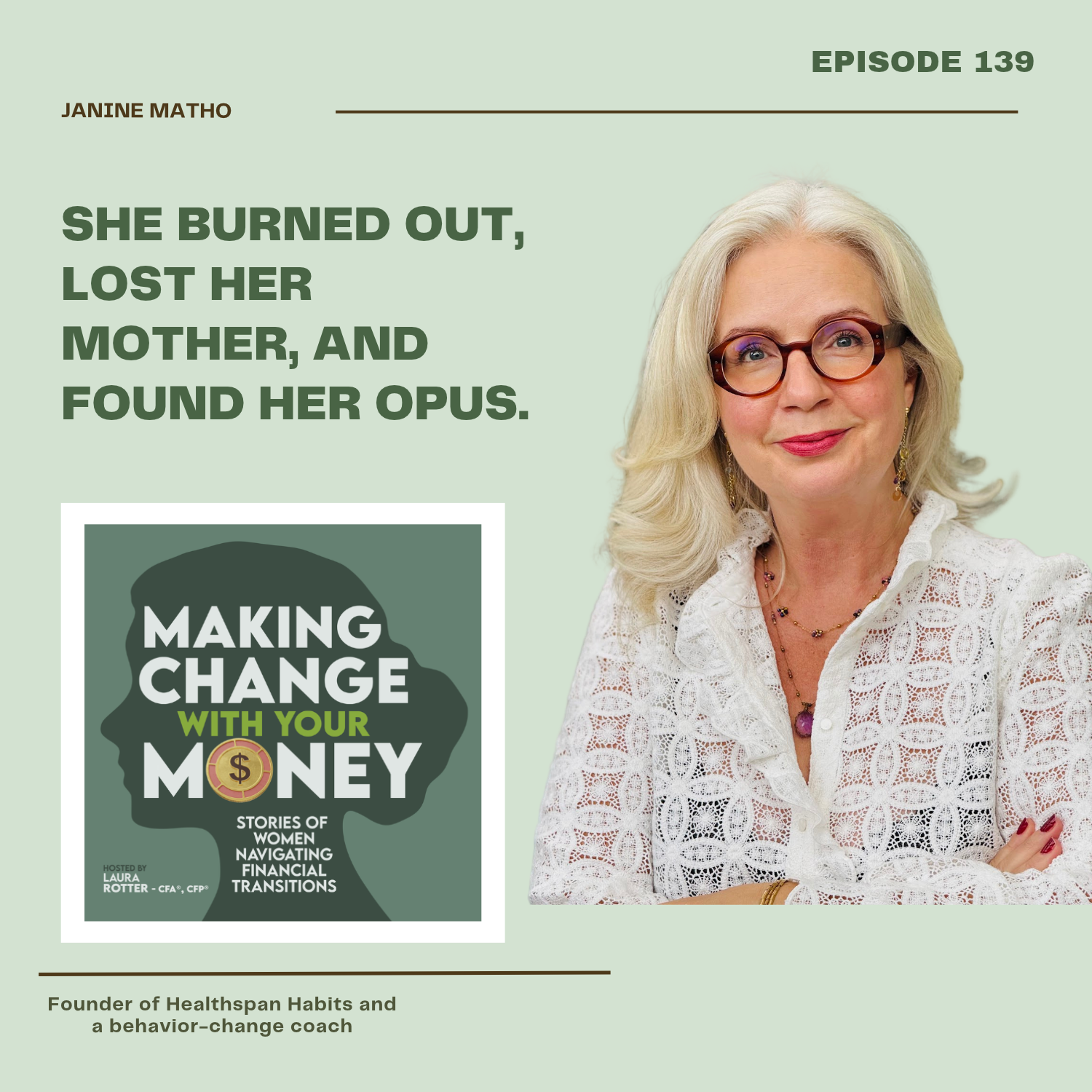
EPISODE SUMMARY Janine Mathó was by every traditional measure a success — a rising executive with a high-powered career, a family, and a life that looked exactly the way it was supposed to. Then in 2019, her mother was killed in a car crash. She took five days of bereavement leave. And then she broke. What came next — severe burnout, a medical leave, a move to France, the dissolution of old identities, and the slow, difficult building of a new one — became the foundation of her book, Live Your Opus. In this conversation, Janine shares what it really looks like to rebuild from the inside out, why ambition without alignment is a trap, and what it means to finally define success for yourself. IN THIS EPISODE, YOU'LL DISCOVER The earliest money memories that shaped Janine — from parents fighting about money to getting paid for good grades How her parents' divorce at 18 left her financially on her own at university — and why she worked 50 hours a week while carrying a full course load The pattern of overwork that followed her from college all the way into a C-suite career — and what it ultimately cost her What severe burnout and grief actually felt like, and why five days of bereavement leave was never going to be enough How she used her savings and a move to France to buy herself the space she never had in her 20s The four-stage framework at the heart of Live Your Opus: Connect, Dream, Compose, Embark Why she now defines success as living aligned to what she believes she's here to do — and what had to fall away first ABOUT JANINE MATHÓ Janine Mathó is a future-of-learning expert and advisor focused on how individuals and organizations develop the capabilities required to live, perform, and adapt in a rapidly changing world. A former executive at Harvard and Pearson, she has spent over 25 years working across education, global organizations, and policy. She is the author of Live Your Opus (Amplify, 2026) and co-author of Raising Humans for a World That's Already Arrived (HarperCollins, 2026). She is also the host of the upcoming podcast The Lifelong Leap. CONNECT WITH JANINE 🌐 Website: www.janinematho.com 💼 LinkedIn: linkedin.com/in/jmmatho 📸 Instagram: @janinematho 📚 Book: Live Your Opus: Reclaim Your Energy, Redefine Success, and Create a Life That Truly Matters
speaker-0: Today's guest is someone whose story I find both humbling and deeply inspiring. A woman who spent decades climbing to the top of her field and then had to learn the hard way that climbing isn't the same as living. Janine Matho is a future of learning expert, advisor, and author, a former executive at both Harvard and Pearson. She spent over 25 years at the intersection of education, global organizations, and policy, always achieving, always building, always going for more. Until 2020, when burnout and bereavement brought everything to a standstill. What followed was a medical leave, a move to France, and a years-long reckoning with a question she'd never thought to ask herself. What does success actually mean to me? That question became the foundation of her book, Live Your Opus: A 12-week journey for ambitious people who are feeling depleted, overwhelmed, or out of alignment, and who want to find their way back to a life that feels truly theirs. She's also co-author of Raising Humans for a World That's Already Arrived. And the host of the Substack and Podcast, The Lifelong Leap. Listen in. Welcome to Making Change with Your Money, a podcast that highlights the stories and strategies of women who experienced a big life transition and overcame challenges as they redefined financial success for themselves. Now here's your host, certified financial planner, Laura Rodder. Welcome, Janine, to the Making Change with Your Money podcast. So excited to have you here. And as I speaker-1: Thanks for having me, Laura. speaker-0: as I just shared before starting, I'm gonna try a different question than I usually start with. And that question is Janine, what is your earliest money memory? Can be a happy one. Yeah. Uh-huh. speaker-1: That's a great question. to be honest, my earliest mem money memory, I think there I would say there are two. One is well, money was a s a source source source of conversation in my house. So maybe like many people, my parents fought about money. And it wasn't necessarily because we didn't have enough, but just because that's what they did. and I think so that one of my earliest memories about money is people fighting about money and the conflict that money can cause within a marriage and within a household, and the sort of extreme feelings that it can cause. I think a second memory around money is that I used to get paid for my good grades. I had consequences for bad grades, but I got I got paid for good grades and I had consequences for bad grades. these are not these are not good things, but this was true. and I think a third memory about money was just how great it felt when I had my first job at age fourteen. My parents had signed my working papers. I lived in New Jersey and my first job was at Barnes and Noble for the summer. And I was you know, to get my own first paycheck was very different than say getting allowance or babysitting money or something like that was very exciting. speaker-0: I'm curious, briefly, do you remember what you did with your first paycheck? Like did you save it? speaker-1: I don't remember. I'm sure I did not save it. I don't remember what I do remember getting it because it was very official, you know. And I think at that time I was making whatever minimum wage was, which was probably about four twenty five an hour. way back then. So and no, I just remember it being really exciting to be able to go to Thomas's suites and get my own Pay for my own ice cream and, you know, just feel like I had some money to put in the bank. That and it was different than babysitting, right? it just felt more official. speaker-0: Yeah, it came in an official paycheck where they took a lot of taxes out, I'm sure. You were like, wait, wait a minute, what is this? speaker-1: Yeah. Exactly. I mean, it's not like it bought that much, but it still was it still was exciting. speaker-0: Yeah, thank you for sharing those memories. Luckily, there was one positive one that you shared and two slightly less positive. So, Janine, this is a podcast about and for women who've been through or are going through a life transition. And I know you to have b had sort of a a big break relatively recently. So Can you share with us, you know, what that break was? and what you know, what led you to reconsider what you want out of life? Which is a big statement. Sure. speaker-1: Yeah, but I can answer it. so you know, I was always your I I guess typical overachiever in the sense that, you know, I always wanted more, so better more, better grades, you know, better scores, better job, better pay, better everything. And I always went for it. And I I think obviously like many of us in my generation raised to sort of follow that ladder. So, you know, you get Get the one job and you do really well and you're expecting that next and the promotion, and if you're not, you seek it. So to keep kind of climbing that ladder, right? Whether it's from one organization or many, which was my case. And yeah, I mean, I took on a lot. but I always figured the more you climbed, the higher you climbed, the more stress came with the job. And that's just the way things were. And there was sort of a trade off in a sense, right? Your pay and your benefits got bigger and your responsibilities got bigger and the stress got more. Okay. You know, as stress got heavier. And I think for me I was quite surprised when in twenty twenty I f ended up burning out. So the context is that I'd led multiple reorgs for the previous six months. I had a new boss in the C suite. Things were really stressful, a little bit maybe more stressful than usual. and then my mom was killed in a car crash in November twenty nineteen and obviously coming out of the blue. And for me what I now know is I just didn't have any space, you know, so I was maxed out on capacity. You know, I have I had three kids, I had a busy busy big job and a and a healthy marriage and I didn't have any more space for something like that. And obviously that came and that happened and I went took the five days of of leave and speaker-0: Why is it three months? Sorry. speaker-1: Five days of bereavement leave to fly from Europe to the US to bury my mom and and grieve and came back to work and then and then went into Christmas and whatnot. And in January twenty twenty I woke up and I just I couldn't do anything else. Like I hadn't slept in weeks. I hadn't eaten really properly in a while, I was just not sleep you know, I was just n really, really unwell. And I didn't have words for that then, but I now know that that was severe burnout. And bereavement, so a little bit of both. but those two things came came crashing. And I think I often say that the universe probably gave me science beforehand, but I wasn't gonna listen. The universe was like, We're really gonna have to take you out because you're not getting it. you know, and and that forced a pause, because I just physically and emotionally mentally couldn't take it anymore. So I took a break. I took a medical leave. actually and got a brief counseling, of course, and and had support. But it was the most difficult time because medical leave was supposed to be recovery, right? But all I was doing was like, how fast can I hurry up and get back to work? Because being at home brought all these questions about who I was without work and who I was without an affiliation and what in the world am I gonna do with all this time all day, every day? Like what is how do you recover? Like you just sit here? speaker-0: Yeah. speaker-1: You know, the therapy's not every day. You know. So it was really difficult and a really difficult time. Many, many questions came out of that time and ultimately I didn't go back to corporate. Ultimately I I've moved into doing my own my own business and and that has taken many different forms and turns. But I I did realize through the recovery time and probably within the first four months that I'd never really thought about what my own definition of success was, that I was definitely working with inherited definitions of success, which I now know, passed down through my parents. And, you know, my mom was first generation Cuban American immigrant, my dad was first gen to go to college. So lots of expectations, lots of focus on achievement and success, quote unquote, in the traditional sense. But for me, I don't think I'd ever thought about well, what does that mean for me specifically? What matters to me and I think I'm closer to that answer now. and living in a in a definition of success that is closer. But it's not easy because I think most of us if we've inherited some definitions of success or we're dealing with that sort of mainstream versions, it's not easy when you decide you're gonna do something different. you come up against you come up against that truth all the time. speaker-0: Yeah, wow, so much to unpack there, Janine. First of all, the the story at the beginning of being paid for good grades really sort of crystallizes what many of us grew up with, which is success by metrics, by grades, by income, by you know by position within firms is part of your makeup. And toys. And and you know, we've spoken before. The first step is recognition, which you're now articulating. That doesn't take away, you know, how you feel. You know, on some level, we carry these stories and imprints our whole lives. And we hope that we grow so that we recognize and can be less reactive and and work with our internal feelings rather than just react to our internal feelings. And I also shared with you before our conversation that I find archetypal systems, specifically astrology, to be helpful in understanding Our makeups and so you did share with me before this conversation your birth chart. haven't figured out on at this platform how to share it with you visually and with our listeners. but I came to see, I will show it just quickly to you, the top of your chart, the eighth, what's known as the eighth house, if you can see here, has a lot of planets in it, including Your son. Your son is your core identity, how you see yourself. And the eighth house is a house of transformation, rebirth. It it actually deals with death and crises and letting go of the past. So in many ways, it is not surprising that the death of a parent was for you. an identity defining experience that it really led to a reevaluation of who you are, what your identity is, what your role is in the world, which having had this conversation always sort of blows my mind that you that that I then see it in your chart. And that loss for you is an an is an initiation and really has been, which is interesting. speaker-1: That's that's so interesting. I think I I have yet to have the right words to explain that when my mom passed away and we had a very difficult relationship, but when she passed away, it's literally like something within me shifted. And it's not something I can actually explain, right? And it's but l litch I I don't know if that was sort of the last straw of saying, Well, I don't actually need to perform anymore. Not that she ever really it her opinion of my success didn't matter. So I I don't I don't know. I don't know what the I don't know what the flipping of the switch was, but I do know it was a big one. Yeah. speaker-0: And one other thing I just want to note, you were about forty-eight years old when you left. I mean, right? You were born in forty-eight is also a significant time in people's lives. astrologically, there's a planet of expansion, of study, of travel. That planet is Jupiter, and every twelve years it returns to where it was when you were born. In the sky. And so at 48, you're having what's known as a Jupiter return, which is a time of growth, of expansion, of and often brings actually career redirection, among other things. I mean, it's not I often think that these things do rhyme with life transitions, right? Late 40s, you're sort of like, I've got. a mortgage and a career and is that all there is kind of thing. So so that was happening for you also at the same time. speaker-1: That's really interesting. I like this. This is gonna be a a really fun we're only at the beginning of this conversation, so this is gonna be very fun. I think that's really interesting that that it returns to where it was when you were born. I think that's very interesting. speaker-0: Yeah, so I'm curious you mentioned this about sort of feeling like there was a calling to change, to to maybe live your mission differently. Can you s say more about speaker-1: Yeah. I mean, there was a there were so many questions that flooded me when I was on the first three months of my medical leave. I mean, just flooded me. But I remember when when I was coming to the end of the first three months of the medical leave, which at that time any the whole world was going into COVID, like just going into lockdown. So it was just like ended up being a really crazy time and most of us ended up at home. But but I do remember there was this time where I I knew that the first twelve weeks was coming to an end and I thought, okay, I need to I'm excited to go back. I need to go back. And all of a sudden I was like, what does it mean to go back? Like, how am I gonna not do the same thing again? How is it not gonna happen again? What what am I missing here? Cause even though I was feeling better from a bereavement point of view, and and and the counseling had just full disclosure, and it's okay for me to say to this to your audience, 'cause I'm quite transparent and I've written quite a bit in my book. It's just that for me, my mom's death also opened up Pandora's box of sort of trauma from childhood. So it just was taking longer to get through. But at the end of the first three months when I thought I was gonna return to work, I was wondering, like, how am I gonna not do this again? How am I gonna like go back and thrive? And how what what like, what did I do wrong in the first place? I didn't quite get I didn't quite get how the pieces fit back together. which is Part of what started to drive me and became a quest and this question that sat with me, which which stayed with me for for several years and is the reason why I wrote Live Your Opus, is how can ambitious people live healthy, meaningful lives and careers with success that lasts without losing what matters most to them, losing themselves and what matters most to them? So, how are ambitious people supposed to essentially handle their ambition, be healthy? you know, ha have meaning, have success at last without losing themselves and what matters most to them. And that really became a quest for me. and that became a sense of purpose and a sense of mission. And I'm I'm still on that mission in a slightly different way because I now have some answers as to how. And now I want to make sure that folks can adopt them, you know, not just through that book, but, you know, most of us are not We're preparing people at every stage of our systems of learning, whether that's school or higher ed or even in leadership development, with with ways that no longer match. And so they don't match the world that we're in anymore. And so what are this what is sort of the the different capabilities that we need to succeed and to thrive in this world, especially ambitious people? speaker-0: I love how you're articulating that. We're certainly gonna get to a little bit more discussion about your book, Janine. going back briefly to astrology, your second house. speaker-1: Please. I really want to hear the I want the intertwining. I love it. speaker-0: so do I. Thank you. your second house is a house of resources, financial resources, as well as just personal feeling of self-worth. And your second house has is governed by two different forces that I feel like you just articulated, which is one force is that of the planet Saturn, and that is the the planet of Hard work, discipline. This is how I get ahead, and it's important for me to get ahead. so that's part of your self-worth. And on the other hand, it's also governed by Uranus, which is sort of like this out there electric, unpredictable energy that it's not traditional. It's more transformation and even creativity. So that I I don't know much about your financial life, and I would like to pivot a little bit to a discussion of how money informed your choices. But that your financial life and your sense of self-worth has sort of been almost repeatedly disrupted and rebuilt like that. There's these two separate, very different energies that define your resources and you sort of said that as you introduced your book. So speaker-1: Yeah, it's interesting 'cause I actually have we you wouldn't know this, but I have re had sort of I forget you just said this in a beautiful way, something about rebuilding your financials multiple times or something. speaker-0: Building speaker-1: Yeah. So the disruption and rebuilding, excuse me, is is a pattern for me. And the first major disruption came when I was heading to university and I was in my first year of university and my parents divorced. And when they divorced, I was just over eighteen, so I actually wasn't part of the divorce settlement. And I was left at university without any financial support. And yeah, you wouldn't have known that. And that was my first major disrup disruption because I was sitting at Franklin Marshall College in Lancaster, Pennsylvania, wondering how the heck am I gonna stay in school? And you know, this is all pre internet. This is in, you know, in the in the late nineties and in the early nineties rather. And you know, my mother's side of the family was saying, You just need to come home and come and take care of your mom and that kind of thing, and you can go to a school locally and The high achieving part of me said, Absolutely no way. Absolutely not. I have no idea how I'm gonna do this, but I'm gonna work really, really hard and I'm staying here. And I I did. I worked 50 hours a week through undergrad and yeah, and graduated on time and did well. And and it was very difficult. And and I had nothing. I mean, I had I had I just had the money I earned in the university. was great in terms of grants and in terms of helping me declare myself financially independent. But that was the first major disruption. There were others, but that is the first disruption. And it was the Saturn side, the hard work discipline side that I think probably stepped in and was like, nope, here we go. I think the challenge for me, and and I know this from going through my experience with burnout is that that set a pattern for me of overwork. Because to take a full course load and finish in four years and work fifty hours a week is insane. And and you are working all the time, your self care is not there. You are socially ostr ostracized, frankly, because nobody else is is going through undergrad in that way at the time. And and that pattern of overwork I just carried that right with with the into my first job and my second job and from there and from there, you know. So you wouldn't have known that, but that was the first major disruption and that pattern has played out numerous times. and I guess the only thing I'd say is I'm not afraid of rebuilding. speaker-0: Mm-hmm. You are not the sum of your earnings. You are the sum of your yearnings. If you're ready to use wealth to create more freedom and flexibility, let's align your finances with what matters most. Together, we'll build a plan that balances your scarce resources of energy, time, and money so you move forward with clarity, confidence, and less stress towards a life of true abundance. Learn more at WWW dot trueabundance advisors dot com and schedule a short conversation. And I'm just sitting here in awe, like you are a force to be reckoned with. I can't even imagine going through school and working 50 hours. and especially at that age, taking on that level of responsibility, owning it, and just doing it. and I'm sorry you had to go through that. And it also made you stronger and built you into. who you are today. So you described that that created a pattern of overwork. How did that inform your relationship with money and as you made the decision in two thousand twenty to reinvent? speaker-1: It's an interesting question to ask. How did that overwork affect my relationship with money? I mean I guess speaker-0: And the question actually is also how did money suddenly disappearing and not being there and not being something you could rely upon? I guess that that could be some people could be traumatized by that and have a lot of difficulty working with money, and other people could be like, I'm right, Saturn, I'm in control, I have the resources, I can do this. So which one was speaker-1: Yeah. I mean, I think it's a mixed bag. I think I've never enjoyed dealing with money because of that. I've learned to I it was actually always easy in the context of a job if I had responsibility for budget. That's different, right? But in my own life, i I never really enjoyed dealing with money, and that's gotten better with my second husband and you know, and being a part of that. But it it gets better as you shift away from scarcity mindset. into more of an abundance mindset also because of course that time was a a particular time of scarcity. I mean, I remember, literally remember not having enough money to buy pizza, you know, that kind of thing. And so, and so it also makes me incredibly appreciative for where I am now, in the sense that that me never would have thought that I would have had a career the way I did and never would think that I am where I am. now. And so I do feel like at least I do feel like the last six years has been a wonderful gift from the universe back for the time that I spent working so hard. most of my life, but in particular that time. speaker-0: So that can I understand that you had the savings and you know therefore you had the cushion to reinvent? speaker-1: Hmm. Yeah. when I left in twenty twenty, I mean I I planned to go back. So that was the first thing. I didn't plan to not be there. And and I I did have savings. I also still had at the time two s two children in university in the US. So I mean I had still two out three. So I still had financial obligations. So I found it when I decided I wasn't going back, I found it really, really frightening. actually. but there was I did I did have a cushion and it was what I used. And most people would say, you don't don't do that, you go back to work and don't use your savings and don't use your cushion. But if there was ever a time to use a cushion, it was when I was trying to figure out who I was and and where I was going. And and to be honest, that period of time was probably because I spent quite a lot of time once I sort of figured out, okay, well the where I was wasn't a good match for my definition of success, because my definition of success also includes being somewhat healthy or being as healthy as one can be. and and it it although overwork is still a like a very embedded pattern in me, it is also something I now understand how to work with and use and modulate and and steward my energy and so forth. But I do feel like that period of time I was sort of gifting myself because I I sort of looked at it like the universe has gifted me something, which is I never had time right out of college to explore anything. I just ran into a job because I had to work. You know, I left the my biggest worry leaving university was I didn't have time to go to any of the career services things that everybody else went to. So I had to get a job immediately because I wouldn't eat if not and I have anywhere to live. So so I think for me it felt like this was my gifted time. And my my mom passed away only five years into retirement. So I also had that. And I felt like, you know, this is the time that I now have finally to explore. It coincides with empty nesting. It's it's it's a it's a gift. And I took I d I I let myself accept that gift, but it not at first. Definitely not for the first s almost six months. I was sort of kicking and screaming. Hurry up, I wanna go back to the way things I want to get back to normal. Then I realized well, normal's not really healthy, actually. So yeah. So then I accepted it as a gift, actually. speaker-0: I love that reframing, thanking you. Thank you so much, Janine, for sharing that language because I sit here and feel like I hope you recognize how brave that decision was and others might not have had the strength to give themselves that gift to to reframe to reframe it as a gift. and so thank you for sharing that. I'm I'm curious if there were any Changes I know I know you to be living in France now. Like were there changes that were made to accommodate the fact that you were gonna earn less? speaker-1: Absolutely. Yeah. So when when I first went out on medical leave, I was living in London. That is a very expensive city to live in if you're not with a big income. We were living very centrally. So we had previously per when we sold our house in the US, I had I had purchased a home in France and as a as a vacation home, to be honest. and then I thought, well, if I go live there, then I'm not you know, then it's an economical place. It's an economical choice, you know. And that gives me a little bit of space. and it is it's a great quality of life at a very good cost of living. So maybe I could not have done this if I had stayed in London. and I could not have done it had I returned to live full time, say in in Massachusetts or something like that. so for me, this was the place for me to come. speaker-0: Which is speaker-1: And and it was a it was a d I mean, it's double I mean, it was wonderful because It's also where I learned to live in a much different way. You know, really to to to live in a healthy way, which is also part of my you know, all the sort of things that I I share now. But you you know, you don't have to live here to implement those things. You can actually live anywhere. But for me to learn them, I learn them here. speaker-0: Thank you. So please share about your book. Opus and and and w what what drew you to write it and you know what you what you're drawn to share, what you're speaker-1: Yeah, I will. And then I do want to hear more about this chart because I think it's fascinating. That it's really fascinating that that's the second house thing with the two forces. And I think that's really very interesting how that's coded in a sense. You know, if you if you accept astrology, then you you would accept that that is something that's a bit c coded, right? As sort of like kind of sitting within who I am and it it definitely resonates. yeah. I mean I've 'cause I've also gone through divorce and So I mean I I I I am I am understanding that sometimes you have to go through hardship to get to what's better. and financial finances are often a piece of that. And that's the scariest part, actually. Especially w when I told you my earliest memory, the first one was of parents fighting. So for me it's always scary. No matter what, even if I know I have plenty, it's still scary. you know, it's still a worry. But it is that tension because then the other side of me says, No, y on the other side of this, if you if you leap on the other side of this is so much more. And that has never failed me. so speaker-0: There's someone that's gonna catch you when you make the leap or something. speaker-1: Same thing, yeah. So Live Your Opus is a book for people who are feeling depleted or lacking in energy or questioning what success is, or maybe they're feeling overwhelmed at work all the time or feeling pressure or feeling like they've done everything correctly or gotten to the sort of place that they thought they were gonna get to, but it isn't actually what they thought it was all gonna be. It's not all it all it's cut out to be. And it's for people who want more energy and more vibrancy and and more living the way, living aligned to what matters most to them. and it includes it includes a number of frameworks and tools. It's set out over 12 weeks. So it gives you time because those kinds of things, boosting your energy, defining success differently, and bringing meaning back to the fore. Those are not things that can be fixed overnight, right? Those are not sort of issues that you say, I'm gonna make this one choice and that's gonna change everything. Sure. But it's a but it's a new it's a new way of living really. If you're feeling overwhelmed, the capabilities that you need to develop within yourself are new and they take time to take root. So it's set out over 12 weeks and there's four stages. So there's connect, dream, compose, and embark. speaker-0: Love that. speaker-1: They have four stages, yeah. And I've got my notes so I don't forget anything. But in connect, you know, and I think this is w the first step is what where many books like mine don't start. so I start with with the person, with you, the reader. and it's a very reader-driven book. And people often ask me why I wrote such a reader-driven work book instead of big ideas. And I think it's because when we're in the midst of what like I went through. or even just chronic stress, we don't want a big idea. Like speaker-0: Yeah. speaker-1: you want someone to hold your hand and say, here's here's where we're gonna go. And so it's written like that. Like let me take you by the hand and let's let's walk through this. And so in in connect, you you c reconnect with yourself and understand who you are now and who you might have been in the past, but who you are now and really and really take a moment to get back in touch with yourself and then eventually with others who support you. in dream you think about what still matters to you and what's waiting to be revealed. So you're dreaming about what's possible. not in a way that is like, anything can happen, you can live your dream life, but in the sense it's like based on what matters to you, based on your values, let's dream and let's think about what's possible. And for some people that ends up being a bigger shift, and for other people that's just like a little shift in their life. and compose is then designing that. So designing how your life reflects that dream and experimenting. Experimenting with you know, if if someone says, Well, I've always wanted to try this other type of role or I've always wanted to try this country or taking baby steps, right? And experimenting in different ways and lays out sort of different ways you can do that. And then embark is about starting to step in and live into it. And the and the overarching idea is that our life is an opus. And that it's opus comes from musical terms, right? So it's our it's our masterpiece to create. It's something that takes time to create. So there's a sense of time and space, but also agency and not pressure like masterpiece, but this is this is your one life that you get to shape in any way you want, and that's should give you a sense of agency. that actually regardless of all the other things that we can't control in our lives, we can control this. And and so this is a path for that. It includes lots of frameworks and tools and support to bring your energy back, to help you navigate change. speaker-0: I love it and it so resonates for me. First, Jeannie, when you shared that I thought of a book that was accura actually recommended to me by another woman that belongs to the recognized expert community as we do, by Rick Rubin about creativity, because I can be one of those people that says, Well, I'm not visually creative, you know, and and the point of the book is your life is your creation. Your life is your art. We are you know everything. speaker-1: Absolutely. I don't know. speaker-0: I I'll I'll give you the name after. And then and then of course, as I've shared it in my own life and and and taking a leap and trying different things. This is the first time I have shared astrology in a podcast, and it feels frightening and it's also exhilarating in that what I've shared has you shaking your head and and f and feeling a resonance and and I do feel like We're never s we're never stuck if we can reframe, see the gifts, and always be challenging ourselves and learning. speaker-1: yeah, absolutely. I'm I'm curious about this eighth house piece because you said transformation and rebirth. And I I always feel like so I I used to call myself like a change donkey from the beginning. This is a long time ago. And I mean like I I literally used to even move furniture around so you know the whole room would be different by the time my husband got home. But just that change is something change is something I've never found. horribly difficult. and I don't know if it's because of my formative experience, the one that we talked about, or whether it's just encoded, you know, but and change is incredibly hard for others. And so people have often come to me for support with change. And of course, n now that's sort of where well, that is where my work sits. in general, in terms of that here we are with this future that's already arrived and here, and most of us don't feel prepared. So how are we going to grow? and develop ourselves and change as the world is changing. How do we change with it? speaker-0: to be continued. I do want to ask. So as we're we're getting towards the end of our conversation, I love you had mentioned before the word success, which is a big word and means different things to different people. So I'd love to hear how your definition of success has shifted at the same time. You talked about you being someone that helps others who are going through change because you yourself seem to be wired as we've discussed for it. So if you also want to share how you're working with people now and what it is that you're doing. So two questions. speaker-1: Sure. gosh, we all define success differently, don't we? speaker-0: Over time. speaker-1: It really does shift over time. I mean, I couldn't give you my definition of success in one sentence, but I think for me, success is is living a life and doing work that feels truly, truly aligned with what I think I'm here to do. And that is not my definition of success before. I think I think before you know, doing work that was aligned and purpose driven was always part of that. But it wasn't the only thing. I definitely I mean, because of my upbringing, I definitely felt like, and I need a product bag, and like and I need a nice car, and I need a big house, and I need and I need and I need. And and it turns out, you know, those are those are still nice things, but you don't it you don't need them. because without that other piece that I said, without that living in alignment, none of that matters. It doesn't it doesn't fix the way you feel when you're living out of alignment. So that's for me success now. and how I work with people. So I have done lots and lots of executive coaching. but right now I am trying to focus on working with folks if if they desire coaching, but more in the context of their organization, because I am very interested in bringing change about across organization. and helping people to develop the inner capabilities to stay calm and clear under pressure in leadership roles. and not simply by sort of boosting their knowledge or boosting their skills by actually boosting the inner capabilities that they have to to do that. So you can work with me if you are interested in bringing me to your team or to your organization to either speak, do a workshop, do more complex work, do some advising. And I'm working with all kinds of organizations, including schools, university and companies, actually. Cause that my work falls across the arc of of ages and standards. speaker-0: And your background was in education, right? I mean I knew you to be speaker-1: Yeah, it's my backgrounds in learning. Yeah, absolutely. speaker-0: This has been an enlightening conversation to me, Jenny, not only because your story is inspirational, I believe, but also it was fun to do the astrology and I did not know a lot coming in and you know and and when I shared it really did resonate, which for me is sort of thrilling. speaker-1: Me too. I got speaker-0: So is there something you wanna be sure you tell our audience before we leave? speaker-1: I think it's I know that the podcast is about your podcast is about relationship with money and I think whether money is in abundance or money is in scarcity, find a way to live your opus. Like find a way to live the life that you are here to live now. and don't wait. speaker-0: Yes, and I will echo that. My this podcast is for women about our age who are going through a life change. And as you articulate it, it could be scary and you can choose to see it as a gift or you can choose to see it as a crisis, perhaps it's both. And we always have speaker-1: So speaker-0: a Our choice is not necessarily our circumstances, but how we react to our circumstances. So thank you for sharing your story, Janine. speaker-1: Thank you for having me, Laura. speaker-0: Thanks for listening to Making Change with Your Money. Certified financial planner, Laura Rodder specializes in helping people just like you organize, clarify, and invest their money in order to support a life of purpose and meaning. Go to www.truabundanceadvisors.com forward slash workbook for a free resource to help you on your journey. Disclaimer. Please remember that the information shared by this podcast does not constitute accounting, legal, tax, investment, or financial advice. It's for information purposes only. You should seek appropriate professional advice for your specific information.