
Making Change with your Money · Laura Rotter, CFA, CFP® | Financial Advisor for Women in Midlife Transitions
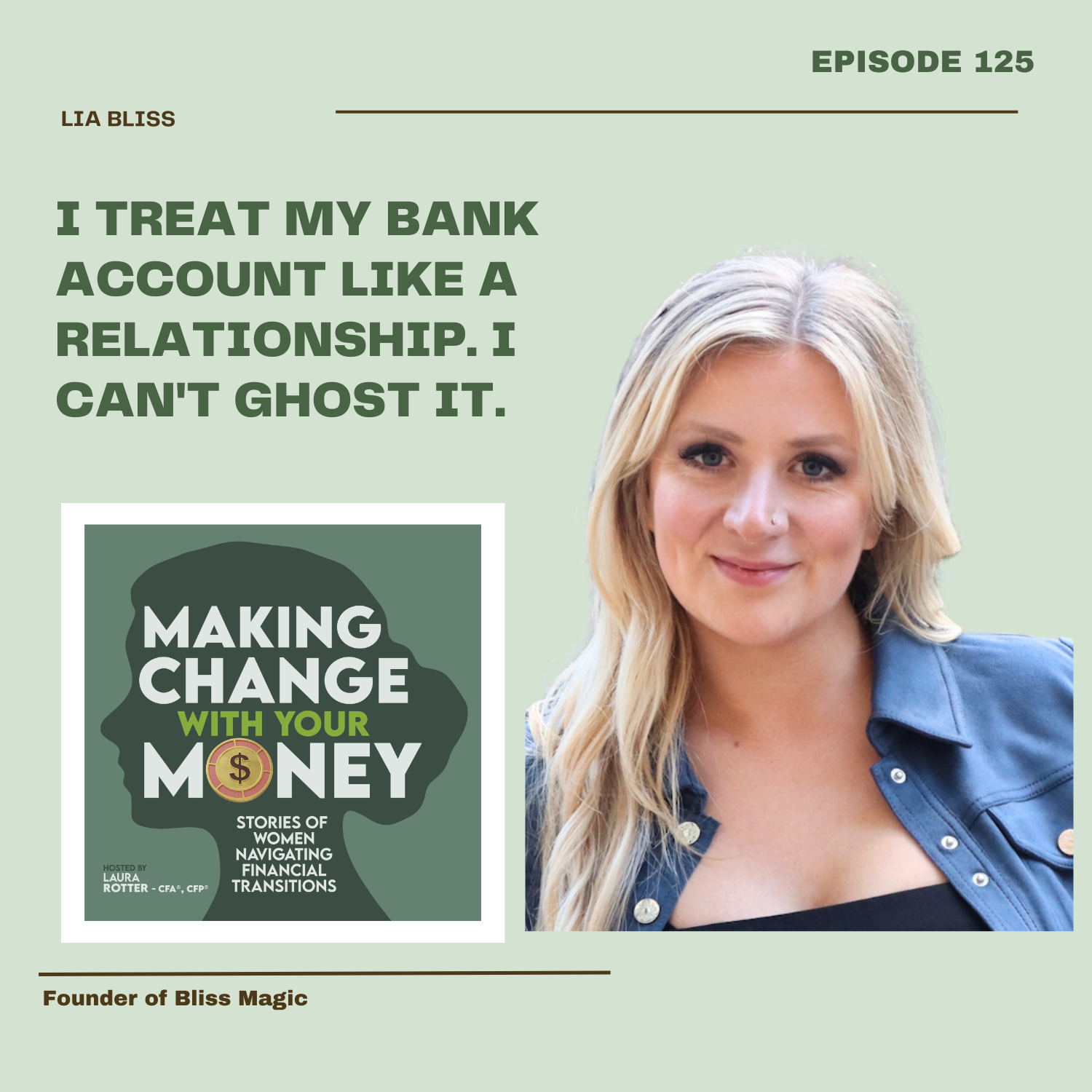
Imagine going from "we're poor, we can't afford groceries" to a million-dollar payout—and back again—all before you're fifteen. Now imagine carrying that financial whiplash into adulthood, through single motherhood, through a tripled income, through a broken engagement, and two layoffs on the same day. At some point you've probably asked: Why does money still feel so chaotic even when I'm making good money? Lia Bliss grew up watching money arrive in floods and disappear overnight. Her father's dot-com startup paid out millions—then her parents split, child support came in bursts, and her mother swung between "we can't afford groceries" and spending a thousand dollars at Walmart in one fell swoop. Money, for Lia, was never neutral. It was fear, then avoidance, then chaos again. The wake-up came in stages. Becoming a single mother pushed her out of scarcity. Then a cold call from her stepmother landed her a job training 10,000 salespeople on LinkedIn during COVID—and her income tripled overnight, from $40K to $120K. She and her then-fiancé spent every dollar. When he stopped working and the relationship collapsed, and then both her jobs were cut on the same day, she was back at zero. But this time, she knew better. "I decided to treat my finances like a relationship," she says. "If I'm trying to date somebody, I cannot ghost them for months." She started checking her bank account every single day—not from fear, but from love. That daily practice changed everything. She launched Bliss Magic, her LinkedIn strategy consultancy, built it into a six-figure business, and now helps executives and entrepreneurs do what she learned the hard way: show up consistently, build trust over time, and never confuse activity with strategy. Her definition of success? Freedom. Not survival finances—freedom finances. The ability to make decisions from a place of empowerment, not constraint. And her closing message for anyone in transition: the most important thing you can do is just start. Accept the help. Admit what you don't know. The community of women who show up for each other is real. Guest Lia Bliss is the founder of Bliss Magic, where she helps ambitious leaders and growing companies master LinkedIn strategy and executive thought leadership. Her signature keynote, "LinkedIn Mastery: Adapting to the Digital Age," has helped countless executives build meaningful connections and expand their influence. Based in Salt Lake City, Utah, she is a sought-after speaker, sales trainer, and strategist for organizations ranging from nationwide financial firms to solo entrepreneurs just getting started. Connect with Lia Website: https://theblissmagic.com LinkedIn: https://www.linkedin.com/in/liabliss/ Resources Free 30-minute consultation with Lia: https://app.usemotion.com/meet/lia-bliss/meeting?d=30 (mention Making Change with Your Money podcast) VIP Day — LinkedIn profile + 10 posts + sales infrastructure ($1,000 / 4 hours): theblissmagic.com Done-for-you LinkedIn...
speaker-0: Imagine going from we can't afford groceries to a million-dollar payout and then back again, all before you're 15 years old. You've probably heard yourself asking, why does money still feel so out of control, even when I'm earning well? Why do I keep repeating the same financial patterns no matter how much I know better? Maybe you've tried budgeting apps, savings goals. But if the emotional pattern underneath hasn't shifted, the numbers don't either. My guest today, Leah Bliss, lived this. She grew up in extreme financial swings, rich neighborhood, then poor school, then child support chaos, and then her income tripled overnight through LinkedIn training during COVID. And she spent every dollar. Because having more money doesn't automatically make you better at managing it. It wasn't until she lost two jobs on the same day, yes, the same day, that she finally built the financial relationship she'd been avoiding her whole life. She started treating her bank account like a person she was dating. She stopped ghosting it. Today Leah runs Bliss Magic, a LinkedIn strategy and thought leadership company. But what she really teaches, whether it's LinkedIn or money, is this. Consistency, trust, and showing up even when it's uncomfortable. That's true for relationships and it's true for your finances. Listen in. speaker-1: Welcome to Making Change with Your Money, a podcast that highlights the stories and strategies of women who experienced a big life transition and overcame challenges as they redefined financial success for themselves. Now here's your host, Certified Financial Planner, Laura Rodder. speaker-0: So welcome Leah to the Making Change With Your Money podcast. speaker-1: Thank you. ⁓ my gosh, Laura, I am so excited to be here. speaker-0: Yeah, this is gonna be fun. So I'm gonna start with the same question I always do, Leah, which is what was money like in your family growing up? speaker-1: Wow, such a weighty question for so many people. It for me existed in extremes. So my parents, so my father was a marketing executive during the dot-com boom. And I remember we moved to a small town in Ohio when I was about 10 years old, and we had Five of us living in a two-bedroom apartment. And my dad had joined a startup, and we were in the poor neighborhood, we were in the poor schools, and I was a ⁓ majority minority. And then his company got sold for tens of millions of dollars. All of a sudden, we have this million-dollar payout. buy a giant house in the suburbs and have this full gift in what money was. And so I don't think at 10 years old I had a lot of concept. It was just like we live here. ⁓ now we live here. Five years later, when my parents split up, my mom, who had been a full-time stay-at-home mom, went back to work. We were getting, as you can imagine, ample child support for the family, but there wasn't a lot of educational background for finances. There was not a lot of money knowledge that existed for both my parents. And I think, and I think that they would agree to that. And so I remember very specifically having times when my mom would be like, We're poor, we can't afford groceries. To the next, you know, 10 days later when child support checks would come in, it would be, let's go spend a thousand dollars at Walmart in one fell swoop. Wow. And so I really existed so many times in these extreme places with money. And I always saw money as something I guess the first layer of my relationship was the fear and the lack mentality. Well, I don't have enough money. As a young adult, it was ⁓ you know, pinching pennies, doing what I can. I lived without a car for many years. I lived downtown, so I could walk everywhere. But the next iteration was I'm comfortable enough, I'm not even gonna think about money. Which is also extremely detrimental. I'm just not gonna manage my finances. I don't need to budget. I don't need to do retirement planning. I don't need a safety net. I'm just gonna go off sunshine and good vibes. And so I think starting off in such extremes, finding a middle ground of a great money relationship has been a lifelong learning curve for me. speaker-0: What it sounds like. speaker-1: It was a lot. speaker-0: And was there anything in particular that woke you up to the fact that like, wow, scarcity mentality isn't working, money avoidance isn't working? speaker-1: Was there speaker-0: Some wake up moment? speaker-1: ⁓ there were two. So each level had its own wake up moment. When I ⁓ when I found myself as a single mother, that's when scarcity couldn't really exist. Like and I think that's a I think it happens for a lot of women in our nature. It is to be those providers and caretakers and nurturers. Once there was somebody besides me who was dependent on me. The the goal and the focus came to let's get some security. Let's move out of scarcity into a little bit more of security. Then, and and I'm sure we'll get into this whole story, but due to a wild series of events, I found myself pretty much overnight making more money than I'd ever made in my whole life. Tripled my income overnight. And the I was engaged at the time, and through that. Collapse of the relationship, realized that like I didn't pay attention to w the advantage that was being taken of me, to where I was just hemorrhaging money because all of a sudden my lifestyle shot up drastically to match my new income level. And I I wasn't very good at managing money when I didn't have any money. Just because I all of a sudden had a bunch of money didn't mean I was good at managing a bunch of money. It was just then a far greater impact. Yeah. Great just bigger dollar amounts at that point. So broke up, learned my lesson. speaker-0: Yeah. So So now of course I'm fascinated. So I'm looking forward to learning about your journey. And and part of what I'm looking forward to is when you say that you had the wake up calls, you know, what you then did to start to be more responsible. speaker-1: The do the doing, right? There's something about learning, and learning and knowing something is so pointless unless you do something with that learning. A couple of things. So this the story begins, I guess my to it. Because I know the audience here is really focused on these big life changes moments. And I've had a couple of pretty pivotal life moments. speaker-0: Right or speaker-1: Changing moments when so I started my career in fashion. And I remember being first year out of university, kind of on my own. And I had this vision for my life that I was going to because because I still felt kind of like a country bumpkin a little bit. I grew up in the country, and I had this vision of me think like the devil wears Prada, very much. speaker-0: Yeah. speaker-1: Showing up to the office, the f the outfits, with right, the walkable city. I just really wanted to live this very metropolitan life. And I got a job working with a brand called White House Black Market, you might be familiar, one of my favorite companies. In my mind from where I was at that time, it was the quite a luxury. speaker-0: It was a clothing company, right? Yeah, at a mall near me there was there was a store. speaker-1: Clothing brick. Yep. So we had in Salt Lake City the brand new downtown mall. You know, multi-billion dollar project, gorgeous, sparkling, clean, walkable. It felt as though I had hit every level of luxury that I wanted to. Show up with my coffee and my all black outfit and work work right, work with high net worth women towards building their wardrobes. And it was so fulfilling and so fun. And I loved it, loved it, loved it. Then I got pregnant, had my son, and as a single mom, I was like, ⁓ these nights and weekends aren't really cutting it for my brand new lifestyle. ⁓ so but I did this for years, and I remember having to scramble for child care services nearly every week. And then much previous in my life, I had gone through some fairly traumatic events that. really helped me become extremely confident in the person that I was and who I was building. And I felt as though I had a unique enough story and the skills to help other women who had gone through domestic abuse and other things like that. So 2019, well, much earlier, probably about 2015, I called up my son's father and I said, Hey, I really want to hire a business coach. I really want to start a business. And he said, I will withhold child support if you do that. I absolutely will not support you. That's a terrible idea. Entrepreneurship is too risky. You can't do it. And I didn't know what my rights were. I didn't know that you actually can't do that. Right. But I lived in that kind of ⁓ guess I can't. That's for other people. That's a dream. So in 2019, I hired a business coach. I was like, I'm gonna do something to help support women. And so I hired this woman and she taught me the basics, and I mean like the ABCs of running a business. I had no idea how to do any of it, how to instigate a sales conversation, how to do packaging for any kind of coaching programs. So we worked together from October to January of 2020. And I was like, okay, I'm I'm armed with this new knowledge. I've got some ideas about what I want to do. But I was still working full-time, still full-time single mom. And then COVID happened. And all of a sudden, overnight, I had an unlimited amount of time. And I was because of like the government payouts or whatever it was, like my my finances were subsidized. And I had all the time in the world. And I thought, well, if this isn't the opportunity that I have been praying for, I don't know what is. So I started putting out YouTube videos. Do not look them up. So bad. YouTube videos every day, like a 20-minute video I would make every single day about, you know, the importance of boundaries, how the speaker-0: Yeah. speaker-1: manage your schedule better, different, just anything I could think of that I thought was a value add to a a community of women. And it lit me up. It made me happy. My friends would call me and be like, I love your video. So I felt I felt really connected to purpose at that point. But I wasn't making money off of it. I had like three subscribers. That's not so speaker-0: Ha ha ha. Ha ha ha. speaker-1: I I did that and I was posting it all over and I was really consistent for four months. And then a woman calls me out of the blue and she's like, Hey, I've been seeing your videos. You have incredible on-camera presence, and your consistency is really admirable. Like you did this for a long time, longer than most people. She's like, I'd love for you to talk to my husband. He runs a LinkedIn training company in Silicon Valley. And because of COVID, all of these tech companies are, they've got a whole bunch of budget that needs to get spent that they had previously allocated for events that can no longer be spent on events. So we need to put it somewhere and we need to figure out how to use LinkedIn. So we're hiring this company, but We're so busy, we need more people to do the trainings. Would you be interested in getting hired at this job? Coincidentally, it was also my stepmom. And so she was trying to hire me for my dad's company. She was like, You need to go work for your dad. My dad was like, I don't know what I'm gonna pay you. I don't know what's gonna happen. My father is a visionary, but his ⁓ ability to execute the mundane. speaker-0: Okay. speaker-1: Is fairly lacking and he'll be the first to tell you that. So they were like, come and do this. So I spent an entire year sitting in front of the computer speaking to probably 10,000 salespeople across the world, training them how to do LinkedIn. I was getting paid like $250 per training. I went from making a retail manager's salary. of forty thousand dollars a year to easily into the hundred and twenty thousand dollars that first year just showing up on Zoom. blew my mind. Did man did we do my I was engaged at the time. My son was five or six. And man, we sure did party. We anything and everything we wanted to buy, we bought. Those those lack of money management skills still existed. Right. And then ⁓ due to another series of events, speaker-0: Wow. ⁓ speaker-1: I ended up working with the engagement. It just because I had been doing so well financially, my fiance at the time decided that he was going to just stop working. He also was making six figures, ⁓ doing more blue collar ⁓ engineering kind of things, and was like, I don't want to work anymore. You got this, babe. Not great. So he's out of the picture. Kick him out. I'm working for my dad. I also got an another job because the business trickled down, right? COVID, we all everything re-equalized in the finances. I got another part-time job training professional motivational speakers how to run CRM systems. Because as a professional speaker, Running a business is different than being on stage. And those are two skills you have to have in equal parts. Most of them are really good on stage and really terrible in their business. So here I am trying to teach people how to run their business through technology. On the same day, I get a call from my boss at the CRM company. They're like, hey, we've bitten off more than we can chew. We're downsizing. Everyone's being let go. Thank you so much for your time. Have a good one. You've been great. Here's your two-month severance, whatever. I'm like, ⁓ my gosh, that sucks. ⁓ no. Then ring ring. It's my dad. Hey Leah, you know the business has slowed down a lot. It's been great working with you. We're gonna downsize. I'm letting everybody go. Here's two months severance. speaker-0: Wow. speaker-1: It was a really bad day at this house. There was lots of crying, there was drinking. Say again. speaker-0: Remember the date? speaker-1: I don't remember the date. No. speaker-0: wasn't that traumatic. speaker-1: It wasn't that traumatic. I probably forgot a lot because there was some heavy drinking involved. I was it was it was a bad day. I was very stressed out. So all of a sudden, I needed to I was an entrepreneur because I had all these skill sets how to help entrepreneurs manage their business through technology, how to do sales on LinkedIn. And I was like, well. speaker-0: Ha ha ha. speaker-1: It's not proprietary information. I'm just gonna start doing it. So luckily, my dad was able, I he sent one client with me. I started with one client, and it's this gorgeous company that run by two incredible women. And the doing that had to be done was was saying, Yeah, I I'm a LinkedIn expert, I'm a globally recognized LinkedIn expert. And I have no idea how to set up an LLC. speaker-0: Ha ha ha ⁓ speaker-1: I have no idea how to how to set up a business bank account. I've never sent an invoice in my life. And so this these women that were my clients, I'm so grateful, forever grateful to them, because there was enough safety that I said, hey, can I have a call with you guys? Can you can you show me how to do this? And they so patient, so loving, but truly this is like women for women. speaker-0: Mm. speaker-1: And and was it and so I got supported, set up the business, did the whole thing. Another woman showed up for me and and truly had to really put all of the ego aside and say, Yes, I might be the oldest daughter, yes, I might be hyper independent, yes, strong independent woman, don't need no man. speaker-0: Ha ha ha. speaker-1: Do you need a community of women? And so another woman I knew was hosting a conference. She said, Well, come speak at this conference. I'll give you $2,500. And I was like, 80 people at this conference for the it was for financial services industry. I don't know anything about financial services. I couldn't have I could barely spell 401k. I had no idea. But I presented at this conference right when my severance was running out. And so I presented at this conference and I immediately booked three or four more speaking engagements for ten thousand dollars apiece. speaker-0: Wow. speaker-1: And I thought I thought, like, okay, Leah, you love learning lessons the hard way. You learned that if no matter how much money you have, you have to manage that money. So I made a promise to myself that I was going to look at my finances like a relationship. If I'm trying to date somebody, I cannot ghost them for several months. speaker-0: Ha ha ha. speaker-1: I am trying to build a loving companionship with somebody. I can't just swipe my debit card and hope everything works out. So I started every day looking at my bank account. No matter how much scary emotion showed up. And it was scary emotion sometimes. Because we know with the entrepreneurial journey, it's not. speaker-0: Yeah. Yeah. speaker-1: Every two weeks the paycheck shows up, but all of a sudden, hey, you've got forty thousand dollars in your business account. ⁓ but you're not gonna get paid again for six months. Every day we're gonna look at it, every day we're gonna assess the value, not with the energy of, ⁓ my god, I don't have enough money, what do I do? What do I do? But the hey, this is a relationship that I'm trying to invest in. I'm gonna put time and energy. So I would Review my credit card statements. I would pay off my credit card balances. speaker-0: Ha ha ha speaker-1: I bought a new car and did so and I negotiated the APR. And I was like, ⁓ great. Look at me. I'm a big kid. I did like adulting. So I've been running this business for the past two years, consulting everyone from you know, nationwide insurance and fidelity financials all the way down to the brand new business owners who ask. You know, how do I set up an LLC? It's that, you know, a lot of paying it forward, creating those safe spaces for people to come and be like, I don't even know. And many, I don't know how a LinkedIn works. I know I should be on LinkedIn. I have no idea how it works. Well, let me break down the algorithm. I know more about the algorithm. I know more about how to get your content out there. I know more about sales on LinkedIn than anyone you'll ever. speaker-0: No. speaker-1: Let me help you. So now I split my days between, you know, traveling for keynote speaking, doing sales training, and meeting with entrepreneurs to help them with their efforts. But it really came down to being vulnerable enough to accept the help and admit what I didn't know. And then being intentional with that relationship with money to say, like, okay. What's the reality? I'm not looking at you every day because I'm in fear. I'm looking at you every day because I love you. speaker-0: I love that. So Leah, a number of questions come up, which I do also want to comment that I I use something called Tiller to track my expenses and I recommend it to my clients. It's sort of crowd-sourced spreadsheets that one can link one's accounts to. And I get a daily email from Tiller. speaker-1: Mm-hmm. speaker-0: Going, you know, naming the transactions that have taken place and my balances. And it is really exactly as you said, sort of my work to not approach that email, right? Like, okay, I'm going to open the email. And with a sense of gratitude and not a sense of fear or scarcity, like, ⁓ no, what you know what's gonna what hit my credit card and what's the balance now but how grateful am I to have the resources that I can pay for this and that you know as I I said to someone yesterday money is meant to be a flow it's not meant to just sit and gather dust our bank accounts and and be looked at so thanks for sharing you have a bit of a Portfolio career, right? You speak, you consult on LinkedIn and you consult on, you know, business systems. So Lee, I'm gonna ask you, what's the through line between all of them in terms of who you are, what your strength is and what you're bringing to each of these facets of your professional life? speaker-1: You That's a great question. ⁓ I don't know if I've ever thought about it that way. One of the through lines is that I mean, several things come to mind. I I thrive in with people, the on-stage consulting, right? Being on stage in front of 10,000 people wouldn't break a sweat. Sitting down one-on-one. speaker-0: Well Is that always true? speaker-1: Yeah, I gave my first keynote when I was five years old. So and then I ⁓ studied opera in college. So I l grew up on stage, lived on stage, always knew that I was meant meant for the stage, but there's no money in the arts. So there so that invigorates me. That's really my zone of genius, if you will. speaker-0: ⁓ wow. I love that. speaker-1: But through through especially working with my dad, because he is such a visionary, and I share that trait with him, the ability to really zoom out and not get bogged down in the details, but to see what is the overall strategy? What's the big goal? What do we want to accomplish? Let's look at three to five years down the road. But I also have developed a very unique skill of being able to zoom into the micro to say, okay, if this is our mosaic and we want to build this picture, where does this tile need to go? What does this set of actions and execution come down to in a day-to-day basis? If my goal is X, What why do I need to accomplish every single day in the smallest of tasks to build to that space? And so being able to see both and understand the relationship that both have to each other, I think is fairly unique, but does lend to kind of this one woman show of so you want to have build a brand on LinkedIn. Here's what you do every single day to make that help. speaker-0: Mm-hmm. You are not the sum of your earnings. You are the sum of your yearnings. If you're ready to use wealth to create more freedom and flexibility, let's align your finances with what matters most. Together, we'll build a plan that balances your scarce resources of energy, time, and money so you move forward with clarity, confidence, and less stress towards a life of true abundance. Learn more at www.truabundanceadvisors.com and schedule a short conversation. I would say that really is unique. I I go through communication preferences when I first get to know a client. And one of the questions is: are you a big picture person or do you like to look at the details? And of course I ask that question because most people are either or you even described your father as being. the big picture idea person, but not necessarily the executor. You think of yourself as someone who does both. speaker-1: Yes, yes. Storytelling, big picture thinking with execution. Now, do I love the small execution? Prefer. I think I I'm really good at seeing what to do. I'm a really I'm really bossy, right? I'm the oldest sister. I'm really good at being like, okay, this is what needs to happen. Here's the tasks that we need to accomplish today. Somebody else go do it. speaker-0: Ha ha ha speaker-1: So God love my assistant. She is I I knowing that in myself, I was like, okay, my time is better spent in in some of these actions versus like one thing I tell people always the most important thing you can do on LinkedIn for visibility is to comment. Commenting on LinkedIn, both algorithmically and the way that it impacts your ability to have relationships with other people. The best thing you can do is comment. With the way that I have my business set up, my goal is 100 comments per day. For everyone else, I suggest three. Three comments a day. We need to start. But I've been doing this for a long time. I should probably up the ante. ⁓ it is not in, it is not worth my time. My time is not best served. Doing those 100 comments. So I have trained my assistant on how to do that. And she does it fantastically. But when it comes to client relations or one on one communications, I 100% need to be the one executing on those things. We tried, we tried to automate some email systems for some pseudo mass outreach for past and current clients. It was a disaster. It was awful. It was so embarrassing. speaker-0: In that it didn't have your voice. speaker-1: J just that it was so obviously not personalized. It was so obviously it, you know, it was my voice and my messaging, but it was like what are you doing, Leah? Like most of my clients, most of my contacts are my friends, or I at least have a friendly relationship with them, a personal relationship. And so to send a mass sterile whitewashed email was like so outside of the brand that I have built for myself and the expectation that my clients and customers have. It was just look I just I I put it from my mind. It's so embarrassing to think about. speaker-0: I mean, for anyone who's just listening to this and not watching the look on Leah's face of disgust as she described what that experience was like. I'm curious, ⁓ when you say a hundred comments a day, this is your to your personal network or that you're doing for your clients? speaker-1: ⁓ great question. So I think about LinkedIn in two different ways. Posting content is your marketing. Most people stop there. But most people are hoping that that marketing will drive inbound leads. It does not. In six years, I have had one inbound lead directly tied to a post that I did. One. Doesn't work. speaker-0: Ha ha speaker-1: But you must ha you must have it. You must market your products and services. You must market yourself. And we could rabbit hole down into like best practices about posts and things. But at the end of the day, reposting is the worst thing you can do on LinkedIn. speaker-0: Interesting. speaker-1: It will only go to one percent of your followers if you click the repost button. Why deep dive rabbit hole reasons? The best posts on LinkedIn have between one and two hundred words of text, immediately call out who the audience is they're trying to speak to, what the value they're providing to them is, and why this audience should care about this value. There should be a piece of media, whether a less than 30-second video. Which not my preference, or a personal photo. Anything that's got graphics or words on it is going to drive your engagement down. Because LinkedIn is truly a never-ending networking event and not a job posting board or an announcement billboard that you can just stick your flyer on and say, come to my webinar. speaker-0: Right. speaker-1: So, relationship building, what conversations are you starting with your audience? That's what LinkedIn looks for. But 100 comments a day is because when you make a post on LinkedIn, that post goes to 10% of the people that follow you until the algorithm can decide if that post has generated a conversation through comments. If you don't get At least 10 comments in the first day, LinkedIn will not continue to promote your post in the feed. When you comment on someone else's post on LinkedIn, however, that post plus your comment is shared to 30% of your audience. And there's no limit to the number of comments you can leave at any given time with that visibility. So I have two lists that I operate off of, sometimes three. One list, and this goes back to my days working with CRMs. One list is my list of leads. People that I don't have a relationship with, I've never met in person, they've never heard me speak, we've never had a consultation, they don't know me. That list, my goal is 11 touch points every three months. Whether that's a LinkedIn comment, a connection request, a direct message, an email, whatever. The rule is when cold outreaching, you have to leave two comments on two separate LinkedIn posts over a period of time before you send the connection request. Because we've all had the experience. Someone connects with you, you accept it, they immediately spam you. It sucks. We got nobody wants it. speaker-0: Right. Sometimes I don't accept from people I don't know. speaker-1: Exactly. But Laura, if you had been posting content on LinkedIn once a week, and for the last two weeks, I left a a lengthy and thoughtful comment on your posts and then sent you a connection request. Laura, I love what you had to say. I just listened to the last episode of the podcast. I think the work you're doing is incredible. I'd like to add you to my network. Well that's that's a no brainer. speaker-0: Right. speaker-1: Easy. It's a 96% likelihood that they will accept your connection. When someone accepts your connection request, they are 100% likely to see all of your posts for the next 10 days. As long as you're only posting once every 24 hours. Any more than that, and it gets buried. But I like to post once a week. All my new connections are seeing my new posts. speaker-0: Yeah. speaker-1: And I'm keeping fresh content flowing. So I'm commenting on people who don't know me, who've never seen me, with the goal of building a foundation of trust over time so that after 11 touch points, I have deposited enough into this relationship that I can make a withdrawal. And I'm gonna ask them for a meeting. Hey, I'd love to talk to you about your LinkedIn strategy. Let's have a call. works most of the time. Now whether they become buyers or not, that's neither here nor there. Right. But the opportunity is created. My second list are my contacts. People who I have met at conferences, people who I know have seen me speak, people I've had consultations with who maybe weren't ready to buy right then. Those people get four touch points every three months. So far fewer because I'm not trying, they already know me, they know what my offers are, they know how to hire me. I just need to stay top of mind. We're already connected. I just need to make sure I'm maintaining those relationships. The human brain cannot manage more than a couple of dozen relationships. And so I track all of this to make sure. ⁓ the 300 people that have hired me in the past. I need to make sure that they hire me about every three years for repeat business. I just need to make sure I stay on their radar, keep showing up. Maybe they change jobs and their new company needs to hire me. Keep the wheels of opportunity open. And then if I do attend a conference, I tend to get the attendee list beforehand so that I can comment and engage with attendees before I meet them in person. That way people walk up to me. It happens every single time I speak at a conference. ⁓ my gosh, Leah, it's so great to finally meet you in person. speaker-0: ⁓ 'cause you've been in front of them. speaker-1: Yes, already on LinkedIn. So that's why personally I do a hundred comments a day. Everybody else, stick to three. Start with three. speaker-0: Ha ha ha. speaker-1: Three is good. You'll if you do three comments a day, you'll see between a 100 and 800% increase in the number of people viewing your profile. speaker-0: And do you have a recommendation for what kind of people's post, you know, whose post to comment on? Obviously it's gonna be in your feed, so that's already curated by LinkedIn's algorithm, I guess. But speaker-1: No, quite quite the opposite, in fact. ⁓ I never scroll through the feed. I only go to my list. So for for an entrepreneur or for a woman who is looking to maybe shift careers, who is in a transition period, especially career-wise, put together a list of the top 10 people most likely to refer you. Put together a list of the top 10 people that you would love to have as a dream client. And start with that list of twenty. Go out and see if you can find one to three comments to leave per day on those individuals staying top of mind. And that's a great way just to start practicing going out there and leaving comments because you don't have to be connected to someone to leave a comment on one of their posts. But their posts will not show up in your feed unless you're connected in some way. speaker-0: Hmm. speaker-1: So I am I rarely ever s I don't scroll on LinkedIn 'cause I don't see it as social media. speaker-0: Right. So what I'm hearing you say is if someone was to dedicate time to LinkedIn, it's more important to dedicate time to commenting on others' posts than to put your own post together if you're gonna use speaker-1: Choose one. Yes. But the the comments should be more than great posts. Thanks for sharing. Yes. I see that a lot. I see that a lot. Because essentially the structure is acknowledge the author. Hey Laura. Restate some of the key points because your audience may not read the post. Hey Laura, I loved what you had to say in your speaker-0: Ha ha ha. speaker-1: Podcast, especially about the impact of scarcity mindset on women in who were getting divorced. Right? Summary. Then add my own insights. I remember that during my divorce, it was so scary and the lack mentality was real. A lot of my girlfriends, whether in their 20s, 30s, or 40s, struggle with this kind of mindset. I think what you had to say here was truly fantastic. And I hope to share it with a broader audience. Well, that's lengthy, but gosh, does it really make an impact? speaker-0: Right. And it's a true comment, not like great to see your post or a lot of things that I see that people have. speaker-1: Yes. Congrats on your promotion. Yeah. speaker-0: So Leah, if people are listening to this and thinking, that sounds like a lot of work, how do you help business owners with LinkedIn? speaker-1: Great question. So there's two main things that I can do to help entrepreneurs. The first one, and it's truly my favorite offer, it's called a VIP day. You hire me, we sit together, it's a VIP day. Generally, I like to split it up over two days because it's four hours of work. We hang out for four hours, two hours on one day, two hours on the next day. And I set up your LinkedIn profile. We get your banner image. We make sure we pick the best profile picture. We rewrite your about section. We go through on best practices for your posts. Then, but before this, you fill out a bit of a questionnaire. I work with you to really investigate your story. Who are you? Who do you serve? What's your value? What's the best go-to-market strategy that High level thinking, big picture. Who are you going to help? What are your products and services? What's the audience that's going to be best impacted by you? How come hiring you is different than hiring somebody else? And I glean all of this information. And then I dump it all into an AI. And with that, I write for you 10 LinkedIn posts to have for the next 10 weeks based on. ⁓ several iterations of your ideal client persona and several iterations of your go-to-market messaging. That's the first day. The second day, we go into my sales navigator tool. This is a very expensive tool for business owners, salespeople to use on LinkedIn. And we get to access mine and we figure out based on these iterations of your ideal client persona. Very specifically who you're going to talk to. We bill out a list of 100 people. People that are going to refer you, people that are your ideal clients, people that fit into that wheelhouse of who you could work with, who you want to have influence over. I give you all of my spreadsheets and all of my tracking systems and all of the infrastructure for execution on your own. At the very end. you get a seven to ten page super prompt. It's ten pages that you copy and paste into an AI, pretty much anyone you want. speaker-0: Mm-hmm. That's the same. speaker-1: This is everything about me, my business, my I'll do clients, my writing style, my voice, best practices for creating content, best practices for commenting. And now you've got an AI thread trained on you. Right? It's the LoRa bot. It's the whatever it is. So that you can now go look up someone on your list. drop in their LinkedIn post and say, please write a comment for this post. The comment gets generated. You you edit however you see fit, right? I don't want emojis or change this word. And then you comment and you track it in the tracker. And then we we go our separate ways and then I wish you the best of luck and I comment on your posts whenever I see them. And now you've got the infrastructure built for LinkedIn success. The other version, so that Is a thousand dollars. Four hours, a thousand dollars. The infrastructure's built, you execute the rest of it. For those a little bit further along in their businesses who are like, Yes, Leah, I think that you're right. LinkedIn's important. I'm not doing it. This needs to be priority. I don't have time for that. I need you to execute for me. It's everything the same, except You give me access to your LinkedIn. I post for you, I comment for you, I do all of the execution to make sure that that process keeps running. It's like having, it's like hiring a fractional social media marketing and sales development rep all combined into one. And so that's $2,500 a month for. you know, three, six, nine, twelve months. speaker-0: Which do you prefer doing? I'm just curious. speaker-1: Love the VIP days. Honestly, I get to meet some of the coolest people. For me, the joy of interviewing someone for four hours of their life to understand the passion and expertise that they have in their business. I've learned, I'll tell you, I've learned more about money because there's a lot of 401k specialists that I've helped out, a lot of financial planners that I've worked with. And I'm like, man, I I didn't even I didn't even know these words. speaker-0: Ha ha ha. speaker-1: Did you know that you have to do a 401k audit every single year? Learn so much. Met with a guy and his team yesterday, and I learned all about data management and data infrastructure and how it impacts cup companies that are trying to migrate to AI solutions and a data analyst. I'm like, wow, this is fascinating. So I do love that because I just love learning about people. speaker-0: Yeah, I w I would think so. I mean speaker-1: Sharing revenue is nice, but it is more fun for the VIP days. speaker-0: I could see that. I mean I do I love my ongoing clients who I work with for years. It's nice to see an impact you're having, like you said, when you have your ongoing relationships and it's always fun to meet someone new and find out, you know, about, you know, from my in in my industry, like how they're living their financial lives, what choices they have to make, what's changing. So so I can see how both how both you know, or are helpful for your business. And you and when you're speaking, are those those tend to be again speaking about using LinkedIn or speaking about entrepreneurship? So it's it's speaker-1: Mostly. So my keynote is LinkedIn mastery adapting to the digital age. Generally, the audiences are sales, marketing, or executive professionals, either for like association conferences, groups of professionals. Every once in a while I'll do a company, like a single company. Will have me come and speak. ⁓ but more so, I do sales training for large organizations. So it's how LinkedIn works and then how to do the sales portion on LinkedIn. That is a three hour workshop that I do. And that pays a lot of money, but they are few and far between. speaker-0: And that sounds like sort of what you were doing for your father's company. ⁓ yeah. It's been an expertise of yours for a while. speaker-1: Yeah. Yes, yes. And I like it. It's fun. The traveling is fun. I did a conference in South America last year. And as a gift to the speakers, they gave us a ten day Amazon jungle excursion. ⁓ my God. It was I'm in I'm in a canoe in the middle of the Amazon rainforest. How did I get here? That's speaker-0: ⁓ So Leah, as we're getting towards the end of our conversation, I always like to ask, how has your definition of success shifted over time? speaker-1: Before I remember I was living in a dugout basement apartment. I don't think that it was to code for anything. It had like it had like six-foot ceilings. It was horrible. And I remember then my definition of success was like, hey, rent, buy new clothes. The end. Do I look good? Do I feel good? Now Especially as a business owner, it's shifted so much. The success is in the longevity. Right? Is this a flash in the pan, or do I have products and offers that are relevant and sustainable as someone managing their finances for sustainability over long periods of time? Success is I I so I recently started investing. That's been really fun. It's been incredible to just like check on my stocks. But to have the freedom to to make decisions from a place of financial empowerment and not be forced into a decision because of the financial constraint. That to me is speaker-0: I love it. So I'm hearing that it is still tied up with finances, but it's not survival finances, it's freedom, if you will. speaker-1: Yes. That's such a great way to put it. Yes. Success is freedom and finances are a big part of that. speaker-0: Yeah. So before we go, is there anything you wanna make sure you share with our listeners? Any free resources you like to offer? speaker-1: Yes, actually. ⁓ I talked about my consultations that I do. Free so free 30-minute consultations. I would love to offer that for the listeners. We'll make sure we get a link or a QR code or something that we can link over. But if nothing else, you can come and find me on LinkedIn and just send me a message. Hey Leah, saw you on the podcast, looking for the consultation, whether it's You're looking to shift in your career, you need a new job, you want to promote your business, or you just want to build a stronger personal brand that exists in the corporate space. I would love to talk. I just want to talk to cool people and cool ladies, especially. Let's just hang out and talk about you. speaker-0: Yes, and I have had a consultation with Leah and learned so much and have learned so much from this conversation. And what's very clear to me that nowadays, whether like you said, you're in a corporate role, ⁓ you're building a brand or externally running a business, you have to be on LinkedIn. You someone gets your name, that's one of the first places they're going to look. speaker-1: ⁓ a hundred percent. speaker-0: You really exist. so it's not something that you can ignore. You know, when you show up on someone's page and you either know they're not looking or, you know, when there's just the outline of an avatar and, you know, connected to three people. speaker-1: that that speaks as much volumes as a personal brand does, but only you now have no control over it. Exactly. Exactly So take control, show up on LinkedIn. speaker-0: Thank you so much for being my guest, Leah. I appreciated our conversation. speaker-1: ⁓ my gosh, Laura, thank you. This has been really fun. I don't get to tell these stories very often. So I truly appreciate the opportunity. Thanks for listening to Making Change with Your Money. Certified financial planner. Laura Rodder specializes in helping people just like you organize, clarify, and invest their money in order to support a life of purpose and meaning. Go to www.truabundanceadvisors.com forward slash workbook. For a free resource to help you on your journey. Disclaimer: please remember that the information shared by this podcast does not constitute accounting, legal, tax, investment, or financial advice. It's for information purposes only. You should seek appropriate professional advice for your specific information.