
Making Change with your Money · Laura Rotter, CFA, CFP® | Financial Advisor for Women in Midlife Transitions
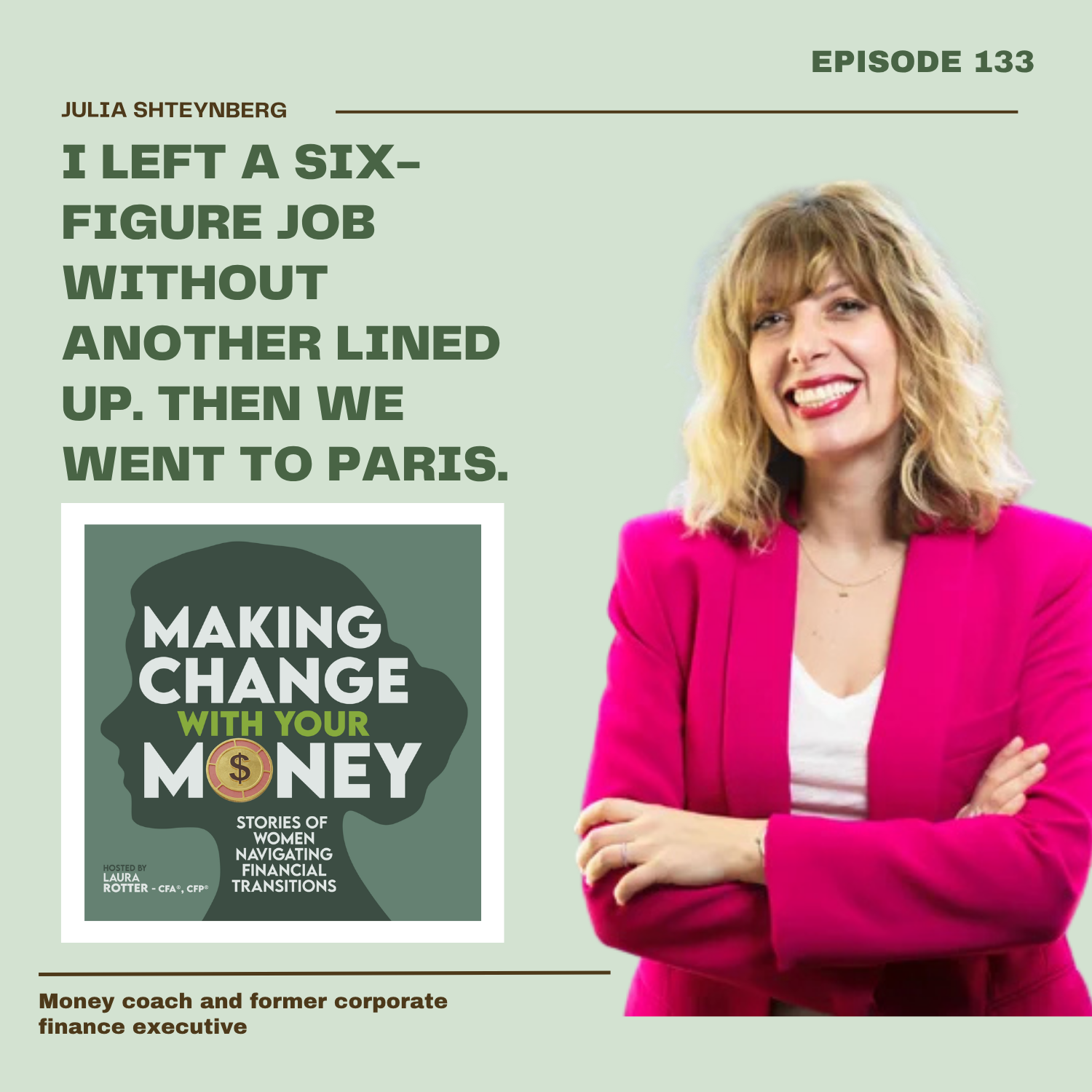
Imagine sitting on the couch after the second failed fertility treatment, not knowing what's next — and your husband looks at you and says: "Let's just go to Paris for three months." And you go. At some point you've probably asked: What would it take to actually walk away from something that's destroying me? And what happens to the life I imagined when the plan stops working — career, family, all of it? Julia Shteynberg grew up in an immigrant household where money was talked about openly, practically, and without drama. Her parents encouraged saving, explained trade-offs, and gave her an early foundation most people never get. She absorbed it all — and built it into a career in corporate finance, climbing to director of FP&A at a startup, manifesting the executive life she'd imagined in college. Then the blood, sweat, and tears of it caught up with her. The pressure, the hours, the startup chaos — she hit a wall so hard she couldn't even look at other finance jobs. So in late 2021, she did the thing responsible immigrant Julia had never done: she quit without another job lined up. They had been living on one salary and saving the other, so the 40% income cut didn't faze the household finances. But it freed her up for what came next. After the fertility treatments didn't work, Paris happened. Three months. Unexpected. And in a Parisian café, a connection her husband made led to a job offer in Europe. In early 2023, they moved to Madrid. Julia had already started her money coaching business. Now she was running it from Spain. Her coaching style is built on the same values she grew up with: intention over impulse, trade-offs made consciously, systems that fit your real life. She works with high-earning women — entrepreneurs, doctors, lawyers, CPAs — who have piles of money but no plan for it. She helps them build one. And her closing message is simple: you can make more money. You can never get time back. Build a life worth protecting first. Guest Julia Shteynberg is a money coach and former corporate finance executive who helps high-earning women design a custom money system aligned with their values and built for wealth growth. Through her Money Makeover program, she empowers women to manage their finances with confidence and ease. Based in Madrid, she works with clients across the US via Zoom. Connect with Julia Website: https://www.moneycoachjulia.com Instagram: https://www.instagram.com/juliashteynberg/ LinkedIn: https://www.linkedin.com/in/juliashteynberg/ Facebook: https://www.facebook.com/julia.shteynberg Resources Free resources + email list: https://www.moneycoachjulia.com/email Money Makeover coaching program (6 months to 1 year, flat fee) — book a consult at https://www.moneycoachjulia.com
speaker-0: Imagine sitting on the couch after the second failed fertility treatment, not knowing what's next, and your husband looks at you and says, Let's just go to Paris for three months. And you go. What would it actually take to walk away from something that's destroying you and what happens to the life you imagined when the plan stops working? My guest today, Julia Steinberg, was a corporate finance director at a startup. Living the executive life she'd manifested since college. Then the pressure, the burnout, the hours caught up with her, she quit without another job lined up. And then the fertility treatments didn't work. And then Paris happened. And then Madrid. Today, Julia runs her money coaching business from Spain, helping high earning women in the US build a money system that actually fits their life. Her approach Intention over impulse, trade-offs made consciously, and a plan that's so easy to maintain you actually stick to it. This is a conversation about burnout, brave financial decisions, the cost of time, and how clarity about money can become the foundation for everything else. Listen in. Welcome to Making Change with Your Money, a podcast that highlights the stories and strategies of women who experienced a big life transition and overcame challenges as they redefined financial success for themselves. Now here's your host, certified financial planner, Laura Rodder. So welcome, Julia, to the Making Change with Your Money podcast. speaker-1: Thank you, Laura. I'm so excited to be here. Thank you for having me. speaker-0: You're welcome. Looking forward to our conversation. Thank you. I'll start as I always do with the question, Julia, what was money like in your family growing up? speaker-1: Good question. ⁓ money and my family growing up. you know, it was never a thing one way or another. Like, you know, we were ⁓ immigrants, so my parents always like worked hard and we talked about money. Like it wasn't a big secret, yet at the same time, it wasn't like ⁓ we can't afford this. Right. I actually thought it's very practical, ⁓ very grounded. I started working at an early age and my parents are right away like, give us that money, we will save that for you. That's yeah, you know what? That's true. That's true. That's a message. God, it's like these things you talk about, you don't really realize. And like speaker-0: That's a speaker-1: You know, I would get like birthday gifts from my grandparents and ⁓ my my parents would be like, Well, you could either buy, you know, these Nike hundred dollar shoes, or you can save half and buy a less expensive version, right? So just lots of like open, nonjudgmental kind of conversation about it. Yeah. Yeah. speaker-0: Thank you. I think most of us don't grow up with direct money messages. And Julia, what you just shared were pretty overt messages, like you should save that it's important to think about what you're spending money on. And that there are different choices for perhaps the same physical goods, like speaker-1: Yeah. Yeah. speaker-0: Expensive sneakers or sneakers that let you save. So I think your parents did pass well, I'm assuming you took on those values. I d I did. speaker-1: I did. I did. Very much so. Yeah. And the other thing, as I'm thinking about this, it's like the concept of trade-offs, right? Like, like, and and just kind of like the decisions around it. And, you know, for lack of I wouldn't, I don't like the use the word consequences because I feel like that's got like a negative connotation, but kind of like, this is what it means if you choose this, and this is what it means if you choose this. And neither is bad or good, you know? But yes, I have I have absorbed those and the that goes into my, you know, kind of like teachings as well when I work with clients. Yeah. Yeah. speaker-0: I'm I'm excited to you know, hear how this translated into your life. And I'm thinking of the trade offs that we are always making, both the big trade-offs that, you know, you and I have made in our lives, time versus money. and the smaller trade offs. Do I wanna spend money on a nice sweater or do I wanna save my money for a nice vacation? ⁓ do I want things? Do I want experiences? So we are always making trade-offs in our lives, and ⁓ it's just being conscious of those trade-offs that we're making is what can make a difference. speaker-1: I agree. Like the intention, right, behind those trade offs. It's like if you step back and think about, and that's like why I think it's so important to have like a goal, right? Like an idea, a vision of kind of what you want your life to be, because then you can make those choices, those trade offs with intention. Cause I feel like if you're just kind of on the hamster wheel, not being intentional. Money slips through, time slips through, you don't know what to say yes to, you don't know what to say no to, right? All of that just like slips through without intention. so yeah. Yes. speaker-0: Great. So I'm gonna leapfrog off that idea of intention. This is a podcast for women who are either in a life transition or are going through a life transition ⁓ to help them be more intentional as they make these kind of decisions. And I know we're both people who work with money, and I know you two have had. speaker-1: Okay. speaker-0: Some big intentional changes in your life. So please share what's important to you, to our listeners. speaker-1: Yeah, thank you. I feel like in the past, I don't know, it's like been like I guess four years at this point, lots of big life transitions ⁓ that I, you know, probably don't give myself enough credit for, you know. We never do. We never do. it started with me like leaving my corporate identity and corporate life behind and it was so much burnout. that just finally kind of caught up with me and ⁓ I decided to leave without another job. ⁓ and that was n it's not something that, you know, responsible immigrant Julia has ever done before. But it was just like it was it was kind of a necessity. speaker-0: Stop you there. I was just on a call this morning where we're talking about how you don't really make big changes like that unless you're in enough pain. So could you just speak a little bit to what was going on with now? But what is that? speaker-1: Yeah. Yeah. it's it's a great way to describe. ⁓ or a great question. I I was just I was I was working so much, so many hours, because it was like r right after COVID. So we were still working from home and the pressure of my job, I was a a director of FPA for a you know, a a startup company. speaker-0: What's that C and A? I'm sorry. speaker-1: Sorry, right. Forecasting, planning, and analysis. Yes. In finance. Yes, yes, yes. Thank you for asking. and you know, it's it's a lot of pressure. It was a startup company. They, you know, weren't always doing so great. So just kind of a lot of pressure on the finance person. And I just kind of got to a point where it wasn't satisfying. It wasn't what I thought it was. I always had this vision of myself when I was like in college. I was like, I want to be this like corporate executive and like make all this money. And I got there. Like you would say, like you could say you managed, you know, I manifested like what I wanted. ⁓ I didn't realize the blood, sweat, and tears and the pressure and all of that that would come with it. And You know, and and the the trade-offs became too much. Like too much of my time w was put into this and it just I wasn't getting the satisfaction anymore of the way that I used to. ⁓ and I was trying to look for other jobs and nothing really at that point I was so like poisoned by even like being in in finance, like it just none of it like was interesting to me. I was like, I couldn't, I literally couldn't, I was in so much pain. And like, and I was like, I had to go. And I remember like I was thinking this for like a year. And I remember talking to like some family members about it. And they were like, Well, gosh, no. I mean, just like find a job first, right? Nobody knows the amount of pain that you're actually in, right? Like you, you're the one living with it, which is why it's so important to really value your own experiences and like your own perspective. ⁓ and it just got to a point where I was like, I I cannot. do this anymore. Like it was really affect affecting me mentally. And I was like, I'm just gonna do it. ⁓ and there was, it was kind of like death by a thousand cuts of my company. And there was kind of like one thing that just like I was like, I'm done. That's it. I I can't. I can't. And speaker-0: And as a money person, what kind of inquiry did you do into your own finances to have an idea of the runway you had? speaker-1: Yeah. Yeah. That's a great question. You know, at that point, like I me my husband like had several conversations about married. Yeah. So ⁓ it was gonna cut our whole how if I left, it was gonna cut our household income by 40%. Like that's no joke, right? but we had so many conversations and my husband's like, you need to take care of yourself. He's like, we will figure it out. speaker-0: Yeah. speaker-1: It doesn't matter. We will make it work. So it's one, you have a supportive like support system, right? speaker-0: emotional, not by no. speaker-1: Emotional. and we do share our money. So it's not like his account, my account, like it was all a mix together. but separate to that, I mean, we were set up, we've set ourselves up financially that like taking that 40% pay cut did not impact us at all. Like we were living on one salary and saving. Like, so we were saving my salary, saving a lot of his salary. And it's not like we were living. very frugally. Like we took vacations, we lived in a very nice apartment, right? We had like a house, like I like, I very much like nice things, right? and and so I think the two things there that were it was like the support from him and the fact that we did set ourselves up financially. And I think that's a huge piece of the equation that like, yes, I was scared to leave without a job, but like at least I wasn't worried about the money piece of it. Yeah. speaker-0: I mean what I'm hearing, Julia, is perhaps all those or or for sure, those messages from childhood of being thoughtful as you made different choices. How much house or apartment, I'm not sure to take on, how much overhead take on. So you you were in a good position. I've certainly shared in other conversations on this podcast that I you know, I was most of our income and speaker-1: Yeah. speaker-0: and had to make decisions to lower my overhead because I had lived into my income that I was no longer going to have. So speaker-1: Yeah, the lifestyle creep. That is that is real. Yeah. Yeah, absolutely. speaker-0: So please go on. So when that's what you left? speaker-1: That was at the end of twenty twenty one. Okay. ⁓ so twenty twenty one. And so I took some time off, tried to figure out what I wanted to do with my life. you know, and and part of that, I will be very frank, I'm happy to share this. We we tried fertility treatments because we we don't have kids. ⁓ this was the second time we tried it. We tried it when I was in my early thirties and it didn't work. ⁓ and then I stopped for a very long time. I just couldn't and and Then I, you know, I was like, I have this space, those, those things came up for me again. I was like, I really need to try this again. And we did. And I'm glad I I'm glad we did. ⁓ you know, I I it didn't work. It didn't work, which in another transition and another identity kind of, you know, piece. and then I remember my husband was saying was said to me one day, I was like sitting on the couch. This was like after like the second attempt didn't work. And he's like, you know what? He's like, let's go to Paris for three months. He's like, let's just go. Let's just go. He's like, I'm gonna work from from from you know the apartment. He's like, I'll tell them, I don't know, I'll I'll tell them something. He's like, let's just go. Like, cause he was like, and we talked about it later. He's like, you were in such a place. He's like, I like we needed to do something. and we went. And it was incredible. That's ⁓ like we we love, like I love Paris. We love You know, was something so amazing and so wild to do, you know, like so unexpected. And in Paris is where kind of the next opportunity for like life transition kind of came up because my husband met with an old colleague that ended up offering him a role ⁓ in Europe. So yeah. So then we came back from Paris and my husband accepted a role, and then in Early twenty twenty three, we moved to Spain, to Madrid. speaker-0: Wow. I am divity. I mean really like how our lives unfold which you just can't predict. speaker-1: can't. You can't. And I feel like looking back on it, I feel like I had to let go of my corporate job in order for something like this to be able to come into my life. Yeah. You know? So that was a big transition. And then also in the midst of that, like when we were in Paris at the end of like 22, I started my own money coaching business. ⁓ because I was like, I don't want to go into corporate. I really wanna, I realized the impact that like my money stories and my money lessons had on me. And that I was able to, you know, create this cushion and this ability for me to leave, which opens up so many opportunities that people don't have without that. and ⁓ and and so I decided, you know, I want to help women really elevate their life, help them find a way to manage their money, feel confident, give them opportunities, choices. So that you don't feel stuck, so that you don't have to do what you don't wanna do, and you can really just create a life that you love. speaker-0: Yeah, you know, so much of what you say resonates with me because I I too started this business after going through my own financial reckoning of, ⁓ so like what's coming in and what's going out and what can I afford? So my catalyst was the change in my life and knowing that it was an expertise that I had of a comfort level with numbers that, you know, frankly, you and I know so many women don't have. They could be so bright, you know, even scientists, but the sense of like, I don't get the numbers is a message that a lot of us have imbibed. So can you speak specifically to what your catalyst was? Because as a matter of fact, as you as you shared, you didn't really have to do a financial reckoning because your expense structure was, you know, appropriate. Did you, you know, Did people approach you with questions? Just how did you have this idea? speaker-1: Yeah. ⁓ know, I didn't I had no idea what money coaching was. Like I didn't know that was a thing. I knew about life coaching and executive coaching. I had a c actually a career coach that helped kind of through this process the whole. Yeah. Yeah. Helped me ⁓ kind of get clarity on that. ⁓ and I just remember one time I was chatting with like my husband's cousin and she was like, God, she's like, you should be a money coach. And I was like, What what are you talking about? She's like, You're so good with personal finance. Like You're so good with people. She's just like, you could really like help a lot of people. And I was like, okay, I really don't know what this is. And then I started like researching it. And as I, you know, kind of started reading more about it and understanding like the connection with like the emotional component of it and just the whole kind of helping people understand their ins and outs and you know, thinking about the concept of lifestyle creep and how to manage around that, right? I was like, ⁓ my God. I was like, I felt like I was. aligned, I was like made for this, right? That I could really, really like this just knowledge that I feel like ⁓ I was very lucky to be able to have kind of growing up and then cultivate on my, you know, kind of additionally, like I can share that and I can literally help improve women's lives, like grow their wealth, elevate their life, figure out, get clarity on their values. I mean, that's life changing. So that was that was really the catalyst. And then ⁓ and then I went to ⁓ my hairdresser. Right there. Yeah, yeah. My s yeah. And I was like, Yeah, I'm kind of thinking about this. She's like, ⁓ my God, I would love, like, I would I've been thinking about getting a money coach. Like, I would totally like work with you. It didn't end up happening, but that would like also spread me. I'm like, okay. So then I got a I really got got serious about structuring it. Yeah. speaker-0: I love that. You are not the sum of your earnings. You are the sum of your yearnings. If you're ready to use wealth to create more freedom and flexibility, let's align your finances with what matters most. Together, we'll build a plan that balances your scarce resources of energy, time, and money so you move forward with clarity, confidence, and less stress towards a life of true abundance. Learn more at WWW dot trueabundanceadvisors dot com and schedule a short conversation. speaker-1: Yeah. speaker-0: You can you speak specifically? You said you were good with personal finance. So both share what that looked like in your own life. You were the money person in your family. I mean, can you share a bit of that and then how that translated into the work you're doing now with other speaker-1: Yeah. ⁓ yeah, it's just, you know, I I just remember, I mean, I started, I I I don't even know kind of like where it started, where it stopped. It all just like flows so naturally, I feel like just like through my life. Like I started work at 15, early age, and all that money. I know, started just going to savings and I kept working. And when I went to college. speaker-0: Red sheet, did you I mean No, just say speaker-1: No. No, no, nothing. Just savings. Yeah. My my parents were like, that's going to savings. I was like, all right. You know. I didn't argue. I'm like, that's because I also didn't want for anything. I didn't never felt like I lacked anything. Right. Like, so I was like, Yeah, okay, that's fine. That makes sense. so I worked my way through college. So through college, I actually ⁓ I don't have any college debt. I it was a combination of like my parents, ⁓ I worked my way through and then I got a scholarship. So I left without debt, which is, I think, very lucky. ⁓ and just from my first job, I was like, okay, I need to put a put away 401k. I just know that I need savings. Like I just, I don't know, innately just knew this. ⁓ and so that's just kind of how I went. And then when I met my husband, he would say, he's like, he would say that I was ⁓ that he was my very first client because we had a different ⁓ perspective on money management. So that was interesting for us to kind of navigate through, especially being young and trying to kind of figure out the push pull and, you know, how much do we save, how much do we not, all of that kind of stuff. So yeah, and and and I was able to, I don't know, we we were able to agree on our vision, right? Like I think that doesn't happen with a lot of couples. They they constantly stay in that push pull state. ⁓ and we would have to talk to him as to why he finally, you know, he was like, you know, I trust you. But he did. He he totally trusted me. We like merged our money together right away. ⁓ so and then right away kind of had a vision about kind of not spending everything that we make. Like it wasn't, I don't even realize, I don't even know if it was like a conversation. It was more like, okay, well, so this is how much we make now. Like this is gonna go to savings and then we're gonna live on this. I was just I just told him how it was. And he was like, it's my And and that's just kind of like, you know, maintained. But then as we both got older, you know, both started making more, started making decisions together. And but really excited, like we saw it worked, right? So we were excited to continue that, like to continue to grow our w wealth and have it and be able to, you know, realize this and give us opportunities later in life. ⁓ and that's just kind of like the the thread, I think, through. You know, that that ended me that that got me to kind of like the money coaching space and wanting to help others create that for themselves. Yeah. speaker-0: I mean what I'm hearing, Julia, is that you had a good communication about money with your with your husband, which not everyone has. We all have different money stories. Totally. I my husband grew up in a home where his parents lived during the depression. They were young, but they had the resonance from their parents about the depression. And so very frugal and And fearful, a scarcity mindset. And my parents were more parents of the 60s who you know, I got a very different message about money that it's more important to be happy to. And so, you know, reconciling those money stories and similar to you, I think in many couples, the wife ultimately is the one who does the day to day, who's like paying the bills and Husband often says he married me so I would balance the checkbook. speaker-1: But speaker-0: I think getting to a point where you can talk about money with each other, as you said, it's not always easy for people to do that. speaker-1: No. No. And I mean, it wasn't always easy for us. Like we would argue and disagree. but ultimately I I think I think the key is also just in general good communication. Like, you know, yes, yes, money brings things up, but like in general communication, like we ha we have it very good and we we've been ab done a very good job. And money is just another piece. I also think the thing for us was like Both we both have ⁓ came from parents that kept their money together. So it was n and like neither one of us saw our parents really fight about money. so I I think that was probably kind of somewhere in the background as well. Like we knew we'd just put it together and we would kind of figure it out, right? We would compromise. Like we were big on making sure we compromised. Yeah. Yeah. speaker-0: Think a big part of it also, which you must find with your clients, is just sharing basic values. So, I mean, when I work with couples, I will often ask when I first meet them, how do you make big spending decisions? You know, about ⁓ vacations and other relatively big ticket items, how do you decide on that together? And that will give me a sense of. You know, whether they're arguing often about things or whether they're in agreement. speaker-1: Yeah, it's true. That's that's a good point. I think about that too. I'm like, how do we make big decisions? I we we talk about like it's so important to talk about everything. And like especially the stuff where you think it's no big deal. Like those things where you're like, I'm not, I'm just not gonna say like you've gotta say everything. You gotta say everything. You gotta be really, really, really honest with yourself and with your partner. And I think that's the key. It's like you have to, yeah. ⁓ yeah. ⁓ yeah. And then and then the compromise part, right? Like I wanna spend less here. He wants to spend a little bit more here. Like, okay, fine, I'll give here and then you'll give here. Right. Yeah. Yeah. Love that. Yeah. speaker-0: So Julia, how do you work with your clients? Let's say I'm a hairdresser or I'm and I come to you. So what does the process look like? speaker-1: Yeah, yeah. Thank you for asking. So the process is you know, we first will have a well initial consultation to just make sure that ⁓ I can help them that I understand what it is that they're looking to to achieve. typically like the people that I work with are high earning, super ambitious women that are, you know, so focused on their career and their personal finances or just something that have just kind of slipped through the cracks. And it's not necessarily they have like a ton of debt, maybe they have some, maybe they don't. It just, you know, they law they don't have the focus to be intentional with it, right? So so so you know, we'll go through a consult, understand kind of like what it is. It's usually like, God, I just need a system. Like I, you know, I'm like literally like I have a pile of money and I'm just kind of like pulling from it. Like I really love something a bit more systemized so I can really see wealth growth and really be intentional with my money and like where is it going and aligning with my values. So we'll have that conversation. And then assuming it's a fit and they're ready to go, ⁓ we we go into, you know, kind of the I have a coaching package. It's really, really simple. It's a flat fee and it's a certain number of sessions. And it'll go anywhere from six months and I allow up to a year because I really believe that everybody's growth is really different. ⁓ and it's never one size fits all. And some people need a bit more accountability more often. And some people don't. So we'll create, like, we'll get an understanding, we'll get really clear on what's important to them, their values. We do start looking at like the ins and outs of their cash. Where is it going? You know, kind of to get a better understanding of like where is the slippage and is this intentional? Do you really want it to go there? Do you not? And then we get clear on like, well, what do they actually want for their life? Do they want wealth growth? Do they want to buy a house? Do they want to, you know, retire early? All of that stuff. And so we'll then architect. A plan to get there. ⁓ and also like part of that is like an emotional plan too, because it's like being able to let go of things, giving themselves space, permission, getting rid of any kind of shame, guilt, fear of disappointing people, saying no to things, right? Making those trade-offs, all of that. And we work through all that. And at the end, I mean they just they have a system that they're so happy with, they can easily maintain it. Like I'm all about ease, right? Like if you if spreadsheet is spread you know, like spreadsheet, I'm not gonna make you do an app. If you like an app, do I'm not gonna make you do a spreadsheet, right? It's like you've gotta really work with like their life and what flows naturally for them. And I think that's a big part of creating something that's sustainable and intentional. Yeah. speaker-0: So you you say you have a coaching package, it can range from six months to a year. During that period of time, how often are you meeting? speaker-1: Yeah. So we first, for the first four to six weeks, we meet weekly. You've got to create momentum. You've got to create a cadence. You've got to start kind of grounding in like new mindset, new thoughts, new beliefs, all of that. ⁓ and then also start, you know, kind of creating a system and making sure you understand what's going in and out, you know, of your bank. ⁓ and then after that, it's that's where I call it kind of like my non one size fits all plan. We can switch to, yeah, I know. Like we'll switch to twice a month. And then eventually the goal is to like once a month and then slowly kind of like, you know, for lack of a better word, wean off. But some people really love the accountability and they just want the monthly touch basis. We will literally be on a Zoom call and we'll open up their, you know, document, be like, okay, paid this, paid this. This is what it looks like this month. Like, and I will go through their monthly cash flow with them. And they just love that. Like, you know, they they know that they have a space for it, right? They don't have to like find time. They know if they have their appointment with me and they're gonna do it. And other people don't need that. Other people that's like check ins like once a month, like this is what we're doing, this is working, this is not working, so we tweak things. So yeah. And they can go anywhere, I give let give the flexibility anywhere up to a year. speaker-0: ⁓ love that. Are are there favorite people you did a broad category of, you know, ambitious, high earning women, but are there favorite, you know, psychographics that you have to work with? speaker-1: Yeah. you know, it's hard to to nail that down. usually it's it's either like, you know, super successful ⁓ entrepreneurs, right, where money is kind of like fluctuating. So they really don't know. They don't have anything consistent, they don't know how to create a plan for that. or it's ⁓ professional like doctors, lawyers, you've CPAs. Right, advisors even that ⁓ just are so focused on their career, on you know, kind of their own business that this has just kind of like not been a priority for them. So it's n salespeople, ⁓ real estate agents, they all kind of like fall into like, you know, that the bucket of like entrepreneurs too that kind of have a an up and down cash flow. Yeah. speaker-0: curious being in Europe, how how has that shifted the schedule and how you work? Are you working with expats? ⁓ how is that speaker-1: It's a great question. ⁓ I I don't have any expat clients right now, but you know, absolutely open to working with expats. ⁓ it would probably be easier because we're in the same time zone. Most of my clients are in the US. So it's their mornings, it's my afternoons. Right. yeah. And we'll work through Zoom and they can access me via email and via WhatsApp. ⁓ and it's just very kind of like Simple and easy and uncomplicated. speaker-0: Yeah. I I I've been in a ⁓ a short coaching program. ⁓ and during this ⁓ program we coach others in the program and one of the people is in Ireland, so indeed, yes, you know, ⁓ meeting 3 30 my time, it's 8 30. speaker-1: His speaker-0: You know, we we're making it work, but ⁓ the time zone is definitely something ⁓ to consider. speaker-1: Yeah. It's tricky. It's tricky. Especially when the time zone changes. So there's one week in October where our time zone changes and the US doesn't and it just it's just not a strength of mine. I'll be really honest. Like it my whole calendar is messed up. speaker-0: I was and and there was the end of right, we just here in ⁓ the States or certainly in New York changed our time. ⁓ beginning of November, we fell back and this gentleman ⁓ like missed the beginning of the class. speaker-1: Yes. Yes. speaker-0: A different time zone, very confusing. speaker-1: Yeah. ⁓ speaker-0: So Julia, as we get towards the end of our conversation, I do like to ask, how has your definition of success shifted? speaker-1: Yeah, that's a great question. I think my definition of success, I think initi like before, and I don't know what before means, but maybe you know, it's like where we're like Yeah, but yeah. ⁓ probably during my corporate time, ⁓ my definition of success was definitely money-based. It's kind of solely probably money-based. Or maybe not not solely, not solely, but like heavily, heavily, like income, you know, kind of like next level, like career growth, all that stuff. And I think what it has evolved to and what it continue, it's going to continue to evolve because our next stage is we want to buy businesses. So I have my own business and then we want to buy businesses too. So it's gonna be a whole different thing. ⁓ and success means to me, you know, being able to also manage your time and Be able be able to say yes and no to things that really are important to you, light your light you up, make you happy, and at the same time having a career or having some type of impact on the world, it doesn't have to be a c you know, kind of whatever, ⁓ that fulfills you. So it's definitely there's more of a flow there. And the money is still important to me. Like I'll be real honest. Like, I want to make lots and lots and lots of money. I am not done. Like it, I love it. I'm excited about it. But it's not necessarily, you know, at the expense of one thing or another. I think that all those things can coexist. Yeah. speaker-0: Thanks. I'm hearing you say, you know, that purpose is important or mission, if you will. I'm also hearing you say something that I've thought a lot about, which is being in control of your time. Because when I think about my previous career and well You're working for someone else, even when I loved it. You know, I wasn't in control of my time. I had to be in the office a certain time. You were aware that we're always aware of FaceTime. I'm sure that continues as crazy as that is. So even if you feel like you're ready to go, but you wanna be sitting at the desk until a certain time, and it's just you're beholden to someone else. And even, you know, people like us, we're service businesses, we have clients. And yet, you know, I had someone just reach out. I have an assistant at this point, and she's like, Well, so-and-so wants to meet the Monday before Thanksgiving. And I said, I don't meet on Mondays. I do not meet on Mondays and Fridays. That's time to work, you know, on my business, you know, not with clients. And that's a non-negotiable and speaker-1: And even I know. speaker-0: You know, when we have our own businesses we have the ability to set up non negotiables. speaker-1: I agree. I agree. And I didn't realize how important and how valuable that was to me. It's interesting that you say that because I think one of the triggers for me also was like leaving corporate when I was working with my career coach. She's like, like, what do you want to do? Cause I'm like, I don't feel like I have time for myself. And I was like, I would just love to have like 30 minutes in the morning to just like have coffee. Not in front of email, not right and she was like, So just like do that. And I was like, What what do you what do you what do you mean? Just Like she totally gave me the permission. She said, just do that. I was like, ⁓ right. So now it's like I do that. I structure my day with so much intention and there's so much enjoyment. Cause like that's the thing. Like time, I realized this too. Like you will never, ever, ever, ever, ever, ever get time back. But you can always make more money. Yeah. Right. Yeah. So that's a big one. Mm-hmm. speaker-0: That's great. I'm I was laughing because I had a similar experience. I still remember this meeting with my coach. I do send a calendar link to out to both prospects and clients. And I was bitching to her that like I hate when people like pop into my calendar at nine o'clock in the morning. And she said, wait, how does that happen? And I said, Well, I send a link. She says, Can't you control the hours that's available to them? And It was like this big aha moment. And now I will certainly, you know, flex if needed for a client one time, but my calendar allows people to book between 11 a.m. and 5 p.m. So nobody's popping into my calendar times. And it was like this aha moment that I'm allowed to control. speaker-1: Good for you. speaker-0: all like isn't there some rule that you have to start so yeah. speaker-1: Yeah. I love that. That's so funny. And I think another kind of takeaway for this, like for people like listening that are in corporate, like you, you know, this assumption that like all of your time is owned by the person that you work for, I think I like I'm giving them permission to be like, it's not. Like block your calendar, have your morning coffee, you know, nine to nine thirty, and then make your calendar available. Cause I feel like a lot of times people are just like so scared. No, no, I can't, I can't, I can't. But like that's a mindset thing, right? speaker-0: Julia, is there anything else you would like to share with our listeners that you haven't shared yet? speaker-1: Mm, I don't think so. I just think, you know, if anyone's on the fence about trying to figure out like, ⁓ what's what's next for me, I really need help with my money, like do it. It's the best decision that you will ever make and it's gonna lay the foundation for the next chapter of your life. ⁓ I think it is one of the most important decisions that you can make is to kind of get your finances in order. Yeah. speaker-0: So agree, it's amazing how that clarity can be a stepping stone for so many other things. speaker-1: Absolutely. For the rest of your life, really. I mean yeah. speaker-0: Mm-hmm. So thank you for the work you do and thank you for being my guest. This has been a great conversation. speaker-1: Thank you so much. I'm so honored. I really appreciate it. I loved our conversation. You're such a great host. So thank you, thank you, thank you. speaker-0: Thanks for listening to Making Change with Your Money. Certified Financial Planner Laura Rodder specializes in helping people just like you organize, clarify, and invest their money in order to support a life of purpose and meaning. Go to www.truabundanceadvisors.com forward slash workbook for a free resource to help you on your journey. Disclaimer. Please remember that the information shared by this podcast does not constitute accounting, legal, tax, investment, or financial advice. It's for information purposes only. You should seek appropriate professional advice for your specific information.