
Making Change with your Money · Laura Rotter, CFA, CFP® | Financial Advisor for Women in Midlife Transitions
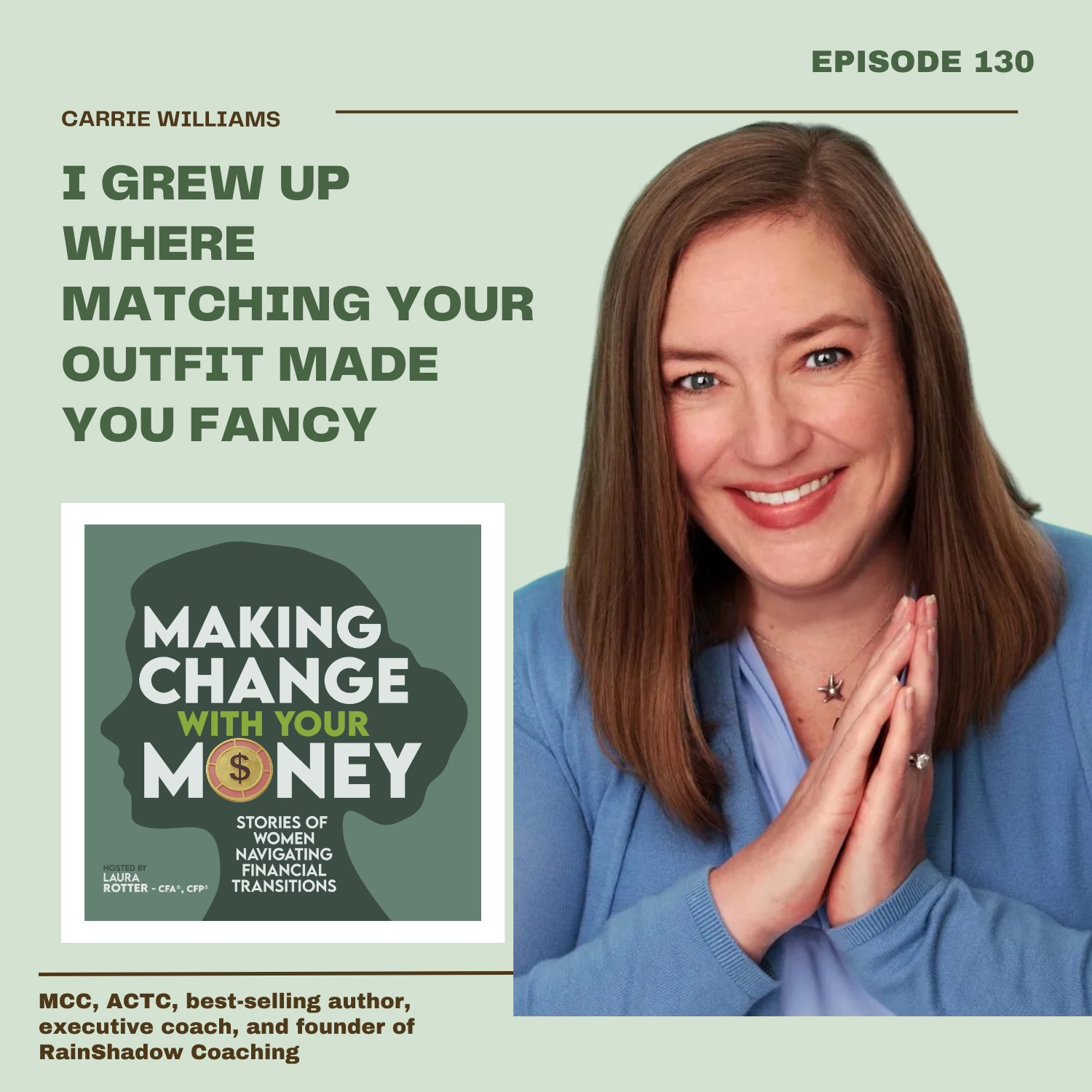
Imagine growing up on a remote island in rural Alaska — where if your outfit matched, people thought you were showing off. Where survival wasn't a metaphor. Where your grandfather lived on a floathouse and float planes brought food twice a year. And where the lesson you absorbed before you even had words for it was this: money is for survival, not ego. At some point you've probably asked: What does it mean to be truly successful — not just financially, but as a person? And what do you do when the career you spent twelve years building starts to feel like it's slowly hollowing you out? Carrie Williams grew up in Ketchikan, Alaska — a town of twenty thousand where everyone knew everyone and resilience wasn't a buzzword, it was the baseline. She graduated on a full academic scholarship, moved to Los Angeles to become an actor, and quickly discovered that someone had to pay the rent. So she pivoted to casting — spending twelve years watching hundreds of actors audition, saying no without explanation, and slowly realizing that the part of her work she loved most wasn't finding talent. It was unlocking it. She began mentoring actors who had stopped booking. Then freelancers who wanted to start businesses. Then she asked herself the obvious question: Is this a job? It turns out it was. It was called coaching. So she went back to school — full time, while still working full time — got her evidence-based ICF certification, and eventually became one of fewer than 35 coaches in the U.S. to hold both the MCC and ACTC credentials. The financial transition was real. She took a significant pay cut leaving casting. She was honest about it: she had a husband with a steady income who believed in her, and that runway made the difference. Today, when she works with business owners making the same leap, the first question she asks is: What's your runway? Not just financial — but emotional. How long can you go without immediate gratification? Because in business, it doesn't come fast. Her definition of success has shifted completely. It used to be the finish line — the title, the award, the letters after her name. Now it's the ripple effect. "Success to me is not just how far I lift myself up," she says. "It is how uplifted people feel because of their connection with me." And the final piece, she adds, is integrity — doing what you say you'll do, and cleaning up honestly when you can't. Guest Carrie Williams, MCC, ACTC is a best-selling author, executive coach, and founder of RainShadow Coaching. One of fewer than 35 coaches in the U.S. with both ICF's MCC and ACTC credentials, Carrie's ALL IN Mindset™ and Spectrum of Willingness™ frameworks equip leaders to reduce stress, build resilience, and drive results. Former ICF LA president and dynamic keynote speaker. Connect with Carrie Website: https://www.rainshadowcoaching.com LinkedIn: https://www.linkedin.com/in/carriewilliamscoach Facebook: https://www.facebook.com/carrie.r.williams Resources Free 30-minute...
speaker-0: Imagine growing up on a remote island in Alaska where if your outfit matched, people thought you were showing off. Where survival wasn't a metaphor, where float planes brought food twice a year, and resilience was the baseline, not a buzzword. My guest today, Carrie Williams, grew up in Ketchikan, Alaska, moved to Los Angeles to become an actor. Ended up spending 12 years in casting, saying no to hundreds of people every day, and slowly realized the part she loved most wasn't finding talent. It was unlocking it. She retrained as a coach while working full-time, took a significant financial hit to start her own firm. And is now one of fewer than 35 coaches in the United States to hold both the MCC and ACTC credentials from the International Coaching Federation. She founded Rain Shadow Coaching and works with leaders and entrepreneurs on mindset, resilience, and the courage to actually take the lead. This is a conversation about transitions, financial runway, cortisol, and what it means to measure success by ripple effect instead of money. Listen in. speaker-1: Welcome to Making Change with Your Money, a podcast that highlights the stories and strategies of women who experienced a big life transition and overcame challenges as they redefined financial success for themselves. Now here's your host, Certified Financial Planner, Laura Rodder. speaker-0: Welcome Carrie to the Making Change with Your Money podcast. speaker-1: Thank you so much for having me. I'm excited to be here. speaker-0: And I'm excited to have you where our conversation takes us. Gonna start like I always do with the question, Carrie, what was money like in your family growing up? ⁓ speaker-1: Hmm, that's an interesting question. I grew up on a small island in rural Alaska. Wow. And so resources in general were limited and also not flaunted. So if you had enough to get you through the winter, then you shared with those around you. If you had enough to share with those around you and you had access, you didn't flaunt it and rub it in people's face. So we were very open about money. but money was survival based and not ego based, if that makes sense. And to this day, I will go back home to my little island in Alaska and they'll go, Carrie, you're so fancy. And I'm like, what what do you what why am I fancy? And they're like, your outfit matches. And I was like, I got this at Gap Factory, but thank you. speaker-0: Yes. Ha ha ha. speaker-1: So it's all perspective, right? speaker-0: Yes. Yes. I'm always noting that when when guests answer this question because we are comparing beings. And ⁓ so it's very hard not to see yourself in comparison with others. And so many of us grew up without seeing the kind of dramatic wealth that that is flaunted, as you said. Now speaker-1: So here's the interesting take I have from that now. I see money myself as security and stability and freedom. And then I feel an abundance of money means that you have the privilege of having impact and serving in a way that you're not allowed to if you don't have that abundance. And so that's my personal perspective on money. speaker-0: Thank you. I I I just have to ask, what was your family doing in a small island in rural Alaska? speaker-1: Well, so my grandfather moved up after the war and he was a logger. And they have this term called a jippo logging company, which is where your family goes out into the middle of nowhere, lives on a floathouse, logs in in the woods, gathers all their logs, and like twice a year they will come and collect the logs and take them away. And so you're living so remotely that the only access you have to other people's float plane or boat. So the float plane will come and bring you food, you know, every couple of months. It's really isolating and remote and it's a hard, hard life. And so that's why my family moved up there. ⁓ where I grew up was a small town called Ketchkan, Alaska, which is the southernmost city in Alaska. And it when I grew up was very based ⁓ wood industry. We had a pulp mill that employed about a third of our city and tourism and salmon. So it's an interesting combination of speaker-0: On speaker-1: Living off the land and also sharing the beauty of the land with others. speaker-0: must have been beautiful. So how big when you go back, like how many people live there? speaker-1: ⁓ my goodness. I want to say now it's somewhere between twelve and fifteen thousand people. There were about twenty thousand when I grew up. My graduating class had a hundred and ten people. So and it's an island. So you kind of know everybody, even if you're not friends with everyone, you know everyone and everybody knows everybody's business and speaker-0: That's a very different way of growing up than most people I interview or meet and ⁓ and must give you a very different perspective on on things. speaker-1: I think it does. And I think I take it a little bit for granted. I I like to joke and say, you know, I will survive a zombie apocalypse because I have some skills. I can bait a hook, catch a fish, gut the fish, fillet the fish, build a fire, and smoke the fish over the fire. And where I grew up, that's like the bare minimum. So they look at me and they're like, Really? That's all you can do? And in Los Angeles, where I live now, they're like, ⁓ my goodness. So Again, it's perspective. ⁓ I grew up in a land where resilience and survival was fundamental and it was the basis that you started from. And I live in a place where it's I I live in Los Angeles. It's filled with beautiful, glittery, fabulous things because the foundation is already solid. The survival is a given here. speaker-0: Yes. That's really fascinating. As a New Yorker, I could ask you so many questions about it and even so how old were you when you show when you arrived in Los Angeles? 'Cause that must be a very big culture shock. speaker-1: It was I went to college from from Alaska. I went to college in New Mexico because I got a full right academic academic scholarship because I was going into the arts at the time and I knew I couldn't afford school debt. And my parents told me, Well, we didn't save for school, so you'll have to get a scholarship. Good luck. So I got a scholarship. ⁓ and so I managed to graduate with no debt and I wasn't ready for Los Angeles then. I went and lived in Seattle. Which to me felt like a big city. And I lived there for I think a year and a half. And I'm so grateful I did because that's where I met my now husband. I was, you know, twenty-two twenty-four when we started dating. Met him said, I'm planning on moving to Los Angeles. I'd love for you to come. And if you don't, that's okay too. Because I was gonna do it anyway. Someone And came to Los Angeles. And it took me it took me honestly a few months before I was even okay driving here. The island I grew up on had thirty miles of road. I remember when they put the first stoplight in. And and not to age myself, but when I moved here, we still had the ⁓ what was the book of maps? It was like a novel. speaker-0: Ha ha. Of like Mc McNeal, McNeil with something like that. speaker-1: remember but that's what you had so it wasn't Yahoo and it wasn't map quest and it wasn't on your phone there was no GPS you literally had this like textbook full of maps to navigate around the city so it took me a while but now now I'm thriving. I love it. I it is amazing how resilient we are and how quickly we adapt. speaker-0: Yes, I'm hearing a theme. So to continue the theme of resilience and adaptation, this podcast is a podcast for women who have either been through a life transition or are going through one. And so Carrie, can you share with our listeners ⁓ perhaps a life transition that really had an impact on you? speaker-1: Absolutely. And I would like to say before I start that I think life is just a series of transitions. That's the point. Like a book is a series of chapters. If we only if we make it through life with no transitions, we're not growing, we're not expanding, we're not improving. ⁓ I think when you ask this question, the transition that stands out is the transition that I made from being an artist and working in the entertainment world, which is what I did previously, to being a coach and working to help people develop their confidence in their skills and up-level themselves. ⁓ I went to school originally to become an actor, got a Bachelor's of Fine Arts, moved to Los Angeles to become an actor, realized I had to pay rent. What? So I got a job in casting. So my job was to help other actors get work. Which was amazing and so frustrating for myself personally. So my job every day was to literally watch hundreds of actors audition and just go, No, no, no, you're not good enough. And not tell them why, not tell them how close they got, not tell them what they could do to improve because that wasn't the job. The job was just to find the person who was already ready. And so at some point I started mentoring people that I was working with. ⁓ I mentored actors who had booked a lot and then stopped booking. It didn't do didn't know why, or they made it to a callback, which in corporate world's like a second interview, but they didn't get the job and they didn't know why. Because I knew having watched all of these that at that point it's not skills. You have the skills, it's the mindset, it's the goals you have when you walk in that room, the energy you're carrying in, and your intention. Are you trying to prove yourself or are you showing? What you would do if you fully own this role and got to play with it. Cause there's a very big difference in how it lands and how it resonates with the people watching. And so I started mentoring people and then I started mentoring our freelance folks and I helped three of them start businesses from the ground floor and get them going, just just being a thought partner and listening deeply and giving advice. And I thought this is pretty amazing. This is really fulfilling watching people get past a no into a yes. Is this a job? And it turns out it is. And it's called coaching. And so while I've still worked in casting, I did my research. I went back to school and I got an evidence-based certification in coaching from Fielding Graduate University, which was also ICF credentialed. For those of you familiar with coaches, ICF is the International Coaching Federation, which is the most widely recognized credentialing for coaches in the world. And I love them because I knew that if I was going to be a coach, I wanted to be as legitimate as possible. I wanted to have the credentials I would look for in a coach. And I love that ICF coaches have to abide by a code of ethics. I think that's incredibly important. It's like with what you do, like having a governing body that holds you accountable beyond just your word to the client, which should be enough. But often isn't in this world. I think there's extra safety in that. And so I became a coach. And also at that time, if I'm fully transparent and honest, I was struggling. I was overworking myself. I was saying yes to everything because I didn't know what to say no to. I was overextended. I was exhausted. I was probably 80 pounds overweight. speaker-0: Yeah. Wow. And I didn't speaker-1: No, I didn't know what was next for me. I just knew that I wanted it to be more and I wanted to have an impact and I wanted to make a difference. All I knew is where I was, I wasn't doing any of those things. And so that transition for me was really moving towards a career that aligns with my values and how I want to show up and serve the world and away from things that felt disempowering. And disappointing. speaker-0: Thanks for sharing that, Carrie. When you said that you were overworked and burnt out, was that towards the end of your career as casting director or was that after you left and started your own co speaker-1: Towards the end of the career and carried through when I was in my training for coaching, right? Cause because I was going full time to school while working full time. Right. It it comes from a place of I got really good at putting other people first. And when I wasn't sure what I wanted or needed, the easy default was to please the people around me and give them what they knew they wanted and needed because I could serve in that way. So what happened was over the course of time, I just unwittingly and unknowingly sacrificed myself because I wasn't certain what I needed or what my values were or what my purpose was. And I'm not alone in that. I think so many powerful women have been in that place at some point in their life. speaker-0: Yes. w we're sort of indoctrinated, if you will, in putting others' people's needs before our own and frankly, even taking the time to slow down to tap into what our needs truly are, is a privilege that not many women give to themselves. I am very eager to explore speaker-1: Yeah. speaker-0: more of the emotional issues of this transition and I'm curious w were there any financial questions or what financial questions came up as you made a transition? Did you hold both your new coaching practice and salaried employment? How did you do what can be very a very scary change? speaker-1: Well, so interestingly enough, even though I worked in casting for twelve years, the position I held was technically a freelance role. ⁓ So if the casting company did not have enough work, even though I was the right hand person, they could just go, Yeah, we don't have work this week and I would have an unpaid vacation. speaker-0: Interesting. speaker-1: Because I'd been there 12 years, I had managed to negotiate insurance for myself, which was brilliant. So even if we didn't have work for a few weeks, my insurance was covered and paid for, which felt very grown up and very adult and was very much an anomaly in this industry. ⁓ But when I left casting, full disclosure and transparency, I I took a huge financial hit because I was going from speaker-0: ⁓ speaker-1: not a great living in Los Angeles, but it was enough to pay my bills to building my own business and not knowing where my next client was coming from. And the only way I was able to do it was because I had a husband who had a very steady and secure job. And he believed in me as well. And he allowed me to have that runway. Now I think if it was just me, I could have done it as well. It just would have looked very different. It would have taken a lot more stockpiling of resources before I could feel safe enough, right? It's a very different thing when you have to create your own runway versus when you are in a community or a situation where someone is supporting your runway. speaker-0: Yes. And thanks. That's an important share because these are the kind of considerations that we all have as we go through certainly a career. speaker-1: Well, and the interesting thing now is I work with a lot of business owners who are building their business, and that's one of the first questions I ask is what's your runway? And when I ask that question, I mean what's your financial runway? Like, how long do you have where you are safe and secure before you have to have a day job paying you steadily? And what's your emotional runway? Like, What's the capacity of your mental resilience and your connections in your team and your mindset and your outlook? And how good are you at working without immediate gratification? Because when you're starting a business, there's not a lot of immediate gratification. And so I think those two questions are really eye-opening for people who are going into this world. I just had a conversation. I spoke la a couple of weeks ago at the small business expo of Los Angeles and I had a conversation after with this lovely girl who was starting her own business. And when I asked her the runway question, she didn't know what I was talking about. She was like, what do you mean? I said, well how much how much security do you have saved before you have to have a day job? She's like, ⁓ no, I have to have a day job right now. So she had no runway. Some people, Laura, think that they will work better with no runway. speaker-0: Right. speaker-1: Like I work with people who quit their jobs and then come to me and say, Carrie, help me build this business. I've quit my job. I have to make it work. So I'm going to make it work because I put myself in this situation. And then there are some people who recognize that they need to build the runway before they can take off. And then there's some people who just constantly plan and never get to execution. speaker-0: Yes. Yes. I need I need the perfect website. I need the perfect this. I need the perfect that. I'm gonna wait till the beginning of next year. So yes, it's definitely a balance at some point. ⁓ the plane has to take off. And speaker-1: Right. And I think we need to stop fibbing to ourselves because, and I used to do this, I was like, I'm planning. That's action. Planning is the preparation for action. And it's very easy to get stuck in planning mode because so many of us want to be really prepared. So many of us want to land the first time, then we want to stick it like a gymnast. And so many of us are closet perfectionists or not closet perfectionists. And we don't want to do it unless we can do it really well. and right the first time. But that means we never experiment or take the chance or take the risk unless we're feel over prepared. And a lot of times by the time we've overprepared, the opportunity is past. speaker-0: So you've said a number of things that gonna ask you about. Obviously, the word resilience continues to stay with me, and I think that's part of where we're talking about because life, as you said in the introduction to your life transition, life is a constant series of transitions, and and how well do you or or a another. question or comment, what practices do you have in place to help you engage with these transitions? So as a coach, I will ask you that as well as I just wrote down the words you used about people who, you know, actors who are ⁓ auditioning, and that at some point you've got the skills And there's also energy and intention and it's resonating with me. I'm actually taking a coaching class called Holding Space ⁓ and coming to realize how important that the energy that I hold and the intention that I enter the space with is in actually impacting the work. that I do with clients. So ⁓ you know, comment on any or all of what I speaker-1: That was so many things, I'm gonna miss some of them. speaker-0: Over that. speaker-1: I want to come back to resilience because it's a really important one, but I want to start with intention, I think, because what I heard you saying is so many of us are focused on the action and achieving things. And it is my personal philosophy, and it's okay if listeners, you don't agree with me, you don't have to. This is my personal philosophy, that we as individuals and as a culture really focus on having first, doing second, and being last. Because we tell ourselves, if I have that outfit, if I have that car, if I have that house, then I'll be able to do this. And if I do those things, then I will be this. And that is how society has trained us. They've trained us to be consumers. Like watch car ads. If you buy a car, did you know that your entire life gets better? News flash, it doesn't. That was sarcasm, but that's what we believe, right? speaker-0: Ha ha ha. speaker-1: And so we focus on let me have the things, let me have the degree, let me have the education, let me have the job, let me have the spouse, let me have the house, let me have the children. And then when I have those things, I'll have to do all of these things. And when I've done all of these things, then I will be, and it's usually a title or part of our identity that is backwards. We need to focus on being first. Because if we are being that person, then we will take those actions that that person would take. And when we take those actions, we will accumulate the having that that person has, but we're not distracted by the having first. So I think a lot of our energy is wasted trying to get to the being part when we should focus on the being first. I had a colleague tell me once, and I love the way she says it, we need to focus equally on the goal line, which are the things we want to accomplish and do, and on the soul line, which is who we want to be as we're doing it. And who we want to be once we've achieved it. speaker-0: That's great. speaker-1: And that gives me goosebumps. It still gives me goosebumps. And so I think that that's really important for us to remember. Put being in front of having. Be the good, do good things, focus more on that than having the goods. And I know that it's counterintuitive, particularly since I'm on a financial podcast. But what I'm saying is you can have all of the money in the world and still not love yourself and be the person you want to be. And if you love yourself and you are the person you want to be, it is so much easier to make that money. speaker-0: Yeah, I always remember an anecdote told of there's ⁓ you know, there's a yacht and there's a gentleman lying on a chase lounge in the yacht and someone is bringing him a drink as there's a sunset, and the question is who's actually enjoying the sunset and who is worrying about the to do list and what has to get done and and it's not clear. Right. It's not necessarily one versus the other. It's it's who you're what your presence is and what you're bringing. And you did reference, of course, that you know, this is perhaps a financial, I say perhaps a financial question back to you, Carrie, is as a coach, because I've been thinking about this in this class I'm taking, people come to you and it is A transactional relationship, like I'm paying you, I want you to make my life better, you know. ⁓ whereas you know, what I hear you say and what I understand is that really no one can do it for you. speaker-1: No. speaker-0: And so how do you work with expectations of people who come to you with your philosophy and your knowledge? speaker-1: Well, I think it's really important to set the agreements in the beginning and to set those expectations. Because Laura, if it were as easy as me telling people what to do and they do it, we would all be multimillionaire supermodels. But it's not that easy. The shift comes from the being part, which is internal. So my job is to help you discover that shift, help highlight it when I see sparks of that shift. speaker-0: Ha ha. speaker-1: Help you embrace that shift and live that shift and change habits and according to that shift. ⁓ but I can't do it for you. So I look for clients who want to be better themselves, want to make the world a better place, and are willing to get messy and do the hard work to make that happen. I really I work with CEOs and I work with brand new emerging leaders. I don't care about the title. What I care about is the intention and the willingness. To show up open and honest and with a growth mindset. Because I think that's a sweet spot. And that brings us back to resilience because I think that's what resilience is. The fact of the matter is the world is chaotic and we cannot control circumstances. We can't control things that are happening around us. That's very evident, particularly right now. After the pandemic, I watched. I watched my clients through the pandemic and I started paying really deep attention to those that thrived in that uncertainty versus those that just crumbled and lost everything. And what I recognized was those that thrived were those that really flexed their resilience muscle, that flexed, that shifted their beliefs to a place of empowerment, that really felt capable. And even if they didn't always feel confident, they were willing to do the work to get through it. They were honest and transparent. And they were willing to do the hard thing because it was the right thing. So for me, that's what resilience is. It's like an all-in mindset is really a combination of mental resilience and momentum versus motivation, because motivation's fleeting. It's based on feelings. Momentum is something you can build on. And mindset shifts, shifting your perspection, your perspective or your attitude or your level of willingness so that it helps you on the journey instead of hinders you on the journey. And I think those are ⁓ an intentional, intentional being, which we just talked about, right? The people that mastered those four things were the ones that really thrived in the chaos and and navigation of change. They thrived through transition. If you don't have those four pillars, when transition happens, you get uncertain, you get hesitant, you get scared. I like to think of transition, swimming across a really rapidly flowing river, right? And you're a good swimmer and you're capable and you want to get to the other side, but at some point in the middle of the swim, you go, ⁓ man. speaker-0: Like you're s speaker-1: This is really hard and I'm getting cold and I'm getting tired and maybe I don't really want what's on the other side. So the question is, do you trust yourself? Do you change your swim stroke? Do you keep going? Or do you turn back around and go back to what was safe and what you know? So many of us turn back around and give up. speaker-0: Yeah. I'm curious, Carrie, are there or what are practices you might recommend people use? ⁓ 'cause I'm assuming you're not saying that you're either inherently better able to deal with change or not. No. speaker-1: I I think I think there are people who are raised so that they have greater capacity for change, but it is a learned. It's a learned cue. Like an IQ or an EQ. IQ is what you're given. EQ, emotional intelligence, you can grow. I think this is a learned. You can learn to be great with transition. I think it comes down to first focusing on mindset. And so speaker-0: ⁓ speaker-1: It is being very self aware, recognizing when you're really willing and open and and Willing to do the hard work and take the risk and when you kind of contract and pull back. Right. Being aware of that and then challenging yourself to lean forward instead of back when it's necessary and needed. There's some amazing books that I'm sure you've read. ⁓ there's Positivity by Barbara Frederickson. She's like the queen of positive psychology. I love that book because it keeps you in a positive frame of mindset. It keeps you in those positive emotions instead of the negative ones, which, you know, there's so many negative emotions in this world. Let's get as many happy hormones from the positive emotions as we can. There's a book called Mindset by Carol Dweck, which I also really love. Right. And if you read that book, you're gonna learn some techniques to how to put yourself in a growth mindset perspective, which I think is incredibly important. speaker-0: I love that. speaker-1: Because if you put yourself in a growth mindset, what you recognize is this is a muscle you can flex, this resilience muscle, you can get better at it. And that if you try and fail, it is not a failure. You just learn from it and you're going to try again and be better the next time. So I'm a big one for education. I'm a big one for mindfulness and somatic practices, which I used to not be. Full disclosure, I thought those were very woo-woo when I started as a coach, and I was like, where's the science to back that up? And I don't know about this. And now there's the science to back it up. So making sure that your emotions are aligned with your intentions and that you're listening to your body and taking in all the data that you can, that's somatic work. mindfulness and presence work, you can do it in meditation, you could do it in yoga, there's so many tai chi. even just some deep breathing or there's a methodology of coaching called positive intelligence you could do they call it PQ you could do PQ reps it's all things that are trying to ground you to this moment into the present so that you stop worrying about the past and stressing out about the future and take ownership of the only moment you can control which is this moment you're in right now and nobody is perfect at that. Let me just say, even if you're a guru, you're going to have missteps. You're going to start worrying about the future or stressing about the past or vice versa. It's how quickly can you bring yourself back to this moment and to what you can own and control with calm and with confidence and with some joy or love. speaker-0: Yes, I was gonna say some self-compassion because as you said, nobody's perfect. And the first step is just noticing when you're triggered, because we're we'll we're all triggered. And and just starting to be aware and starting to be aware in a kind way of when we're speaker-1: Right here. Yeah. speaker-0: And you're also reminding me, I've listened to his podcast with his son, ⁓ Dr. Rick Hansen, who's a Buddhist psychologist, who talks about the fact that negative emotions are like velcro. Like you'll end your day and you'll remember that interaction with a client where you said something that, like, ⁓ you're so embarrassed about, or or when you were triggered and you lost it, and yet, you know, as I sit here in the office and sun starts streaming through, I'm not gonna hold on to that, right? Like, ⁓ there was that moment where the sun came out and and to consciously spend a couple of extra seconds to take in the good, the positive interactions, the walk in nature, because we're automatically gonna hold on to the bad and the shame. speaker-1: Yeah. I mean, when we think about it at a fundamental level, all emotions are our hormone hits. We've got the positive emotions that give us happy hormone hits like dopamine and serotonin and oxytocin. And we've got the negative emotions, which usually bring up cortisol and sometimes adrenaline, right? And so here's the tricky thing about emotions. We feel those happy hormones or stress hormones when we feel the emotion. But then every time we replay the situation in our head or get angry about it and think about it or share it at the water cooler and gossip about it, every time we relive a negative emotion, we are flooding our body again with the cortisol. And so that's what happens. Not only are they they're sticky in the fact that we keep reliving them. We keep revisiting them. And every time we visit it, speaker-0: No speaker-1: It gives us the same intensity of hormone surge as it did the first time. So we're subconsciously flooding ourselves with stressful cortisol and stressful hormones. And it's really hard to be proactive and to think positively and to have optimism if we're flooded with stress. speaker-0: Yeah. speaker-1: So I think you're right. The trick is to savor, to really savor the good things. Relive those too, right? Like if you're gonna have a lovely glass of wine, really savor that glass of wine. Make it worth it. Relive it three times. If you get an interaction with a lovely person that you love, your best girlfriend, savor that moment and relive it in your memory and revisit it. That's why gratitude and appreciation are great positive emotions because they're savory. So it's reliving of something. And then you give yourself time to reflect on it and relive it again and have that same oxytocin surge from it. speaker-0: Great word, Saber. I it's one of my favorite. I have a gratitude app that goes off. It buzzes me on my wrist and reminds me to write down something I'm grateful for in the moment. And then it's on my phone and you can shake it and it'll just randomly come up with a gratitude that you've written over time to remind you. speaker-1: Favorites? speaker-0: of things that you're grateful for. ⁓ being human, nine times out of ten it'll go off and I'll ignore it at so you're reminding me that it's it's nice and it doesn't have to be big things you're grateful for, like for my cat sleeping in the corner of the office or speaker-1: Here's the other interesting thing, Laura, that has come up. Positive emotions usually need space. To feel love and express love, you need to make time for people you love and for yourself, right? To feel gratitude or appreciation, you need to make space to relive and reflect on something so you could feel that positive emotion. To feel awe, you have to see something amazing, let it impact you, and then reflect and resonate. And so a lot of us are so stinkin' busy. speaker-0: Mm. speaker-1: We don't give ourselves space for positive emotions. And then we don't understand why we're exhausted and we're stressed out and we're negative. Positive emotions take a little bit of extra time and cushion, unfortunately. And that that comes back to the giving yourself some grace and space. speaker-0: Yeah. So Carrie, as we get towards the end of our conversation, I like to ask, how has your definition of success shifted? speaker-1: ⁓ well, listen, I am not fully reformed high achiever. I at times I was a hyperachiever. I like finish lines and I like achieving things, but my motivation has shifted. It used to be about crossing the finish line, getting the title, getting the award, getting the letters. And now what I care about is how does crossing that finish line help me serve and impact others? Right. How does it make me better able to help my clients grow and develop? Or in a better position to be more visible and share things that should be talked about. ⁓ so it's really more about the purpose and intent. And if I'm completely honest, when I started my business, all I measured was money because that's an easy thing. It's easy to measure your bank account and go, well, I must be successful. I made a million dollars this year. speaker-0: Half a million speaker-1: But that's not what success is because I know plenty of people that make half a million dollars and they don't have a single positive impact in this world. There's no ripple effect to their life. And so I really look at the ripple effect now. I look at the connections. ⁓ success to me is not just how far I lift myself up. It is how uplifted people feel because of their connection and association with me. And if I am at the top of the pack, that doesn't mean I succeeded. Unless everybody is right there beside me because they were successful. And that's a big shift. speaker-0: Yes. And I do think I mean we both we met through being in a group that defines itself as fifty plus sisterhood. So 'cause I do think that's a shift that comes with age. speaker-1: Yeah, I do. I think, look, I think that there is a point in our life where we stop worrying about proving ourselves and we accept that we have impact, we have a gift to give the world. And it doesn't matter if every single person appreciates that gift and values that gift. It just doesn't. So before, when I would give a gift, I would want it to be the perfect gift and like change their life and they'd love it so much. It was the best gift they ever got. And now I know how amazing the gift I'm sharing is. And if you don't love the gift, that's okay. It's okay. It doesn't mean I love the gift any less. So my role has shifted to where I search for people that love the gift that I am sharing, that it lands to. Instead of convincing somebody, no, this is the best gift ever. Why don't you love this? Everyone else loves this. You're crazy for not loving this. I find the people that love it. Because those are my kindred spirits. speaker-0: Yeah. And what you just said, ⁓ Carrie, is bringing me back to the words that I highlighted, which is energy and intention in that I sense that your energy is coming from wanting to contribute to the people who are open to it and not wanting to prove to others your value or some other Not that this should be a horrible thing, but some other sort of egoic intention, if you will, like that you're entering a space with your clients of grace and not of like proving. ⁓ and maybe I'm projecting onto you, so speaker-1: No, I I think that's exactly right. And I think the word that keeps coming into my head right now, too, that I think is the last final important piece, and we haven't really talked on it very much today, is integrity. Right. I think being willing to do the hard thing because it is the right thing. I think showing up when your words and your actions and your values align consistently, that is such a valuable gift. yourself into the world when you are a person who can keep your promises to yourself and to others and build that bond of trust. I love there's a professor from the Harvard Business School named Michael Jensen and I love his definition of integrity. It is you do what you say you're going to do when you say you're going to do it. And if for any reason you cannot, you acknowledge it as quickly as possible, apologize if necessary, and clean up any mess it made. And then I like to add And learn from it so you do better next time. What I love about that definition is it acknowledges that we are human, that we will make missteps, we'll overextend ourselves, we'll make a promise that in the moment we think we can keep. And then the reality of the world will come in and we we can't keep that promise. But we can still show up with integrity and deepen the trust in the relationship, even if we broke a promise. And I think that's powerful. And so I think that's the final big shift. And maybe this is a shift that happens as we age. Integrity is really important. How I show up to myself and others and how others consistently show up is incredibly important to me. I think it matters. speaker-0: Thank you. So before we ⁓ end our conversation, Carrie, is there something you want to make sure that you share? speaker-1: ⁓ there are so many things that I want to make sure I share. So I would like to offer any of your listeners, if any of this resonated and they just want to have a deeper conversation with me about any of those things, ⁓ I am happy to give 30 minutes of my time. I'll give you a link. They can hop on my calendar, they can schedule time. I trust them to use it wisely. And I want to be really clear that this is not client creation time or conversion or pitch time for me. This is really you tell me what you want from these thirty minutes and that's what we're gonna talk about. I just wanna meet people who are excited about making themselves better and the world a better place. speaker-0: That's very generous offer. Thank you. speaker-1: I might get to meet some amazing people. So it's also it's a gift to myself as well as to others. So speaker-0: totally get it. I mean, first of all, what a gift to have had this time with you. I one of the things I love about this podcast is my, you know, ability to meet, you know, people from all over. And I agree. I I love my exploratory conversations. I I speak I don't speak that much. I'm really there to hold the space and to listen and you know and suggest and it's People are interesting. speaker-1: They are. And it's our connections that make a difference, right? I like to meet new people and listen, listen to their needs and see if there's a way that I can serve. And sometimes there's not. Right. And I think that's the wisdom of maturity as well as recognizing that I cannot meet everybody's needs, but I probably know somebody that can. speaker-0: Great point. Well, thank you, Carrie, for being my guest. speaker-1: Thank you so much for having me. This was a ton of fun. Thanks for listening to Making Change with Your Money. Certified financial planner, Laura Rodder specializes in helping people just like you organize, clarify, and invest their money in order to support a life of purpose and meaning. Go to www.truabundanceadvisors.com forward slash workbook for a free resource to help you on your journey. Disclaimer. Please remember that the information shared by this podcast does not constitute accounting, legal, tax, investment, or financial advice. It's for information purposes only. You should seek appropriate professional advice for your specific information.