
Making Change with your Money · Laura Rotter, CFA, CFP® | Financial Advisor for Women in Midlife Transitions
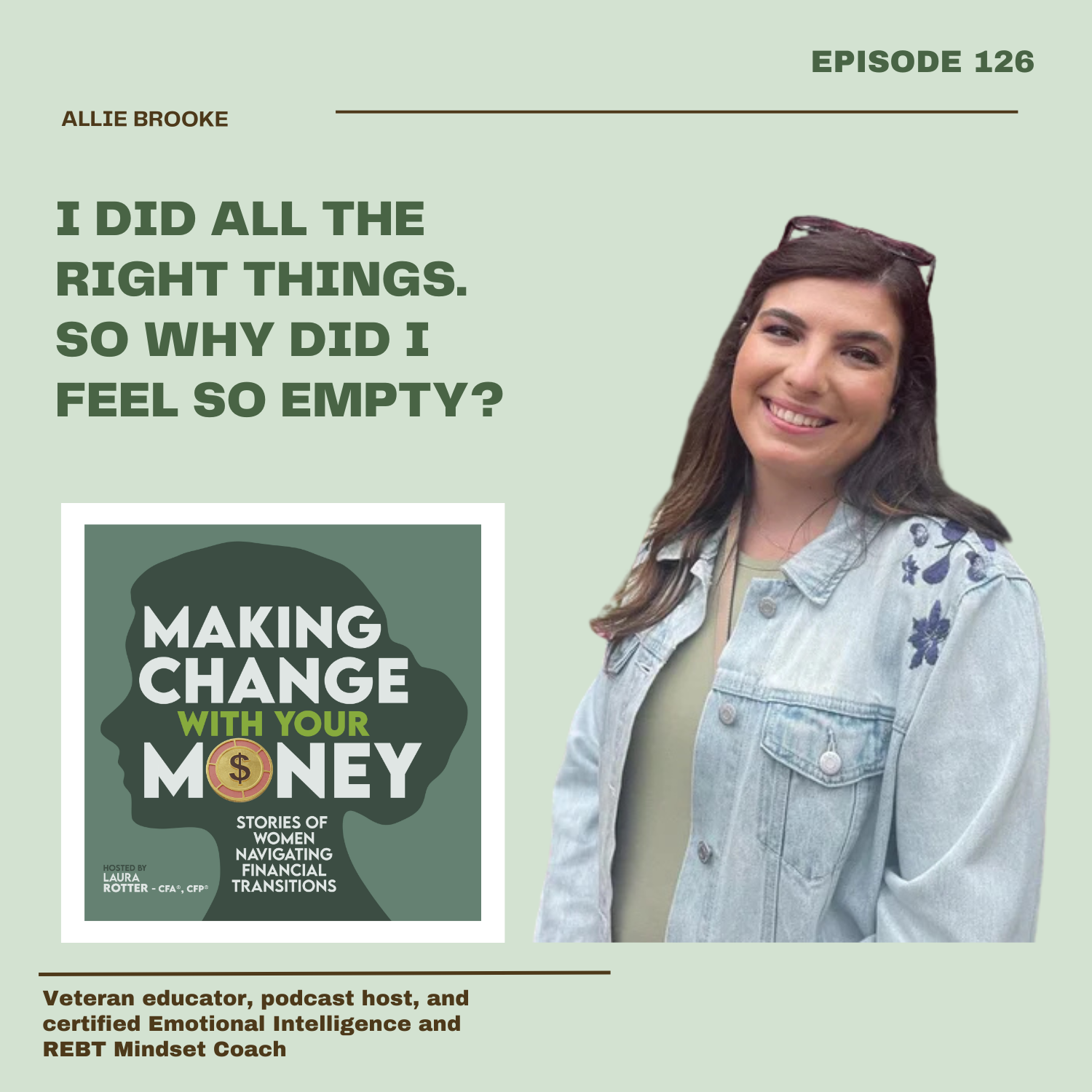
Imagine you've done everything right. Good grades, good job, good friend, good daughter. You followed every rule, checked every box, never gave anyone a reason to worry. And then one day you wake up in the middle of a global pandemic and realize: I feel completely empty. At some point you've probably heard yourself asking: Is this it? I worked so hard for this life — so why doesn't it feel like enough? And what do you do when the anxiety and perfectionism you've been running on finally runs out? Allie Brooke grew up with a father who was an accountant — money was always handled, never discussed. No allowances, no financial education, just a clean household where the adults took care of everything. It was comfortable. And it left her completely unprepared for adulthood. The only lesson that stuck: make sure you have good credit. By her mid-twenties she had the career, the commute, the New York City life. She was also burning out quietly, running on perfectionism and people-pleasing with no idea how empty she'd become. COVID stopped everything — and in that stillness, she finally heard the whisper she'd been drowning out: you are made for more. She bought a microphone off Amazon and started talking. Not to an audience — just to herself, processing what she was learning in therapy, from self-development books, from her own life. The Growth Mindset Gal podcast was born from a woman who needed to heal out loud. Then came a harder decision: leave New York City, take a pay cut, and move three and a half hours upstate to a slower life near her fiancé's family. Her therapist's verdict after the first session post-move: "You are a completely different person." Her commute went from ninety minutes to twelve. Her therapy sessions went from weekly to monthly. She never looked back. Her two lessons for anyone in transition: everything is temporary — emotions, seasons, relationships, the hard stuff — so stop holding on so tightly. And be open to joy, even when fear of judgment tries to talk you out of it. Whether it's a hot yoga class or a cross-country move, little steps toward what lights you up are never wasted. Guest Allie Brooke is a veteran educator, podcast host, and certified Emotional Intelligence and REBT Mindset Coach dedicated to empowering women to overcome anxiety and build resilient mindsets. Having navigated chronic anxiety and burnout firsthand, she transformed her experience into a mission: creating a supportive community where women can connect, heal, and thrive. She is the host of The Growth Mindset Gal podcast. Connect with Allie Website: https://thegrowthmindsetgal.com Instagram: https://www.instagram.com/thegrowthmindsetgal/ LinkedIn: https://www.linkedin.com/in/allie-brooke-a4798031b Resources The Growth Mindset Gal Podcast (Laura's guest episode) The Growth Method — Free Community: join at thegrowthmindsetgal.com The Growth Method — Premium Community: $20/month (use code GROWTHMINDSETGAL for 50% off your first month)
Laura Rotter: Imagine you've done everything right. Good grades, great job, good friends, you followed every rule, you never gave anyone a reason to worry. And then you wake up in the middle of a global pandemic and realize, I feel completely empty. I did all the right things. So why does none of this feel right? At some point or another, you've probably heard yourself asking, is this it? When did my anxiety become the thing running my life? And what happens when the perfectionism you've been running on finally runs out? My guest today, Allie Brooke, knows that moment well. A former New York City teacher with a 90-minute commute and a quiet burnout she didn't have a name for, COVID stopped her life long enough to finally hear the whisper she'd been drowning out. She was made for more. She bought a microphone, started talking, built a podcast and a coaching practice around the exact tools that helped her heal, and then she made a decision that terrified her financially. She took a pay cut, left Long Island, moved upstate, and never looked back. Allie now is a certified emotional intelligence and mindset coach. She's a veteran educator and host of the Growth Mindset Gal podcast. This is a conversation about anxiety, perfectionism, quarter life crises, and the money decisions that come when you finally choose your life over your comfort zone. Listen in. Welcome to Making Change with Your Money, a podcast that highlights the stories and strategies of women who experienced a big life transition and overcame challenges as they redefined financial success for themselves. Now here's your host, certified financial planner, Laura Rodder. Welcome, Allie, to the Making Change with Your Money podcast. Thanks, Laura. I'm so excited to be here. I'm ready for having a wonderful conversation with you again. Yes, exactly. I was just a guest on your podcast. It was just such a fun conversation. So I'll start as I always do with the question. Allie, what was money like in your family growing up? ⁓ what was money like? Well, you know, funny enough, my dad was an accountant and like head of payroll at his job. So, you know, when I was growing up, my parents kind of took care of money. Like they did the finances, they handled everything. Like my sister and I, because I have an older sister, we didn't even like get an allowance. So we never like had ac like direct access to money. It was just like, hey, back to school shopping. All right, we're gonna go with mom. And she goes, this is what you're gonna get. This might be your budget sometimes. But other than that, we really had like no, you know, direct access to money or ways to earn money until we eventually maybe got our own jobs. But we were also never pressured to make our own money until like obviously we're teens and adults and things like that. ⁓ it was kind of always Taken care of, which as a kid you love. You're like, yay, I don't have to worry about money. This is so fun. But actually now, because now my sister are adults, the irony is, is because they took care of us so much. Now we're in adulthood and we're like, what are finances? You know, like how do I how do I budget? You know, how do I make sure I have a good credit score? That's my parents, the only thing they really told me was just make sure you have good credit. Like that was their big thing. So you can get a car and you can get a house. But other than that, I think because my dad was an accountant and was always in finances, he was always like, I'll handle it. Don't worry. He even does my taxes, like I that ever was taken care of, which was, yeah, which is so great and so nice. But now when as an adult, I had to kind of teach myself and think that I also had my wonderful fiancee. He he's also with finances and he's helped me get better, you know, financial education and literacy, if you will. That's great. I I'm curious, Allie, was there a sense you're not reflecting back that there was any s scarcity mindset in the family or any anxiety around money? It was just ⁓ I don't want to put words in your mouth, but it was just yeah. Like now that I think about not really the only scarcity mindset, if you will, was kind of more just like save, save, save, save, save. Like not ever talking about. you know, learning about investments or using money to make more money. It was like, you have money, we're gonna put it in the savings count, and then you're not gonna touch it until you wanna buy a house or you have to pay off student loans. It was kind of always like that save, save, save, save, save. So God forbid anything happened, you would always have money and be prepared. But it was, yeah, it was never taught to be a It was always on the defense of money rather than like the offense of money of investing and like using money to build a life and and things like that. Thank you. That's a great way to put it. The defense of money. So so definitely a sense of responsibility about money. Know your credit score. Be responsible. Save. Yeah. ⁓ which is frankly more messages than many people receive than their parents. Most people look back and say, My parents didn't say. Anything about money. So clearly it was important to them. Yes. Yeah. So Allie, this is a show ⁓ for women in a life transition. Our listeners may be going through a big change in their lives, anticipating a big change, maybe just came out. So what was that big, that big transition in your life? The big transition in my life happened about, which is crazier not to even say it, that it was five years ago. Well now over five years ago is when we were going through the COVID-19 pandemic. That was like the big like awakening breakthrough moment. Before the world shutting down, a global pandemic, I was very much in this anxiety-driven, fear-driven perfectionism, always have to be. Doing everything all the time, having to be perfect. I was always trying to be the good girl and follow the rules all the time and just being just absolutely perfect. No one had to worry about me, no one had to pend on anything. Like I was always ready to go. Then all of a sudden, the COVID-19 pandemic happened, and life has to look very different for a lot of people. And, you know, I do my own podcast, but I'm also an educator as well. So then I switched from you know, going into work every single day and teaching in person to then also remote learning and teaching also looked very different for that time as well for obvious reasons. And so seeing how much things that I thought really mattered, especially in my profession as a teacher, just fell to the wayside during a global pandemic, I was like, wow, the things I used to worry about and like hone in on really were not that big of a deal in the grand scheme of things. You know, It also gave me because I was remote teaching, I didn't have an hour and a half commute into the city anymore. So once I was done remote teaching, I just closed my laptop and now I'm home. And it gave me so much more free time to really do a lot of inward work, reflection. I started reading because I had so much time on my hands. I started to read self development books, listen to podcasts, and really start to shift into, I'm feeling really Burnt out. And was probably like 25, 26 at the time. And I was starting to feel like already burnt out in my life and kind of unfulfilled, where I was like, I did all the right things, right? And I was perfect. And I got the good grades and I did all the things. And I'm a good friend, a good daughter, like a good girlfriend. Like I was all the good things. But why do I still feel super empty and just unfulfilled? And I kept having this whisper that I was made for more and I can. Have an impact on people that were probably going through the same thing. And because teaching obviously was not feeling fulfilling and it was up it was a huge pandemic and things were kind of all over the place. I was like, how can I use my teaching wheelhouse, my teaching skills, but maybe in a different modality? So I was listening to podcasts and I started to think. You know what, maybe this could be another outlet that I could do that, yes, I'm an educator, but maybe I can educate people on other things rather than being a school teacher for the time since I also had so much time on my hands. Yes. So I started to think of, okay, the best way I always learned and you know started to heal in my own way and healing from anxiety, perfectionism, and people pleasing was sharing stories. So I bought a mic off Amazon. I started Making episodes, just me and the mic, and I just start started sharing things that I've learned from my own life experiences. And also like right before the world shut down, the pandemic, I actually started going to therapy for my anxiety because I was feeling all these things. And then like I went to therapy and then the world shut down. So I think I went to maybe one or two like in-person sessions and then it went right to Zoom. And so I just took the things that I was learning from, like I said, life experiences, maybe things I I read about in the self-development books, things I learned from my own therapy sessions. So that way, you know, women who are my age or maybe even a little bit younger, like were tuning in and listening to if they were going through the same things and to help them in any way and to realize that they weren't alone. I love that, that that was an outlet for you, right? there's ⁓ nowadays everybody talks about free journaling, like just open your journal. ⁓ you were free videoing, it sounds I was. I was free recording, it was just like me and the mic, and I was like, all right, I'm just gonna kind of share because you know, I one of the first steps to kind of get reconnected with myself again and to kind of heal through my own anxiety was to get my to know myself better. And one of the things I did was I started journaling. That was one of the things like my therapist, like, ⁓ let's start doing this. And I would sit down and I would kind of do like a free write for maybe five to 10 minutes every Saturday just to kind of build an inner dialogue with myself. And then because I did it so much, I started having inner dialogues with myself. If I was like out and about in the world and anxiety would come up, and I'd be like, all right, we I know my anxiety is coming up because it's trying to protect me from something. But I'm safe right now. Yeah, I'm safe right now. It's okay. We're gonna we're gonna be okay. I appreciate you. I know what you're doing, but we're okay right now. And then once I started going through those motions and also talking about it right through therapy, I would then hop on the mic and be like, hey, this was something new that I started doing. This was a gratitude practice. This was a journaling prompt that worked for me. This was a major takeaway that I learned from therapy. And start creating episodes from it and then also bring in on amazing guests, right? Like yourself, to also share their stories as well to help, you know, women heal and grow in any way, shape, or form, whatever path that they're on. That's so beautifully said, Allie. So I'm I have to reflect back. ⁓ I guess I've seen it in my own kids, and we're talking about it now. I think there's a lot of discussion about midlife crisis. There isn't that much discussion about Quarter life crisis. Between like the ages of 25 and 30, you're suddenly adulting, and you're like, is that all there is? Like this is it? I've pushed myself and worked. And then you wake up and you're like, this doesn't feel right. Something off. Yeah. And ⁓ So it doesn't sound like you changed your profession, though obviously but your profession changed a lot during COVID. I'm curious how old your students were. During COVID, ⁓ they were in eighth grade, so they were 13 years old. Okay, so they were old enough to understand, you know, new technology. ⁓ still very different to engage online on Zoom rather than in a classroom. And you said during COVID. So in COVID, you were you were teaching in the New York City area? Yes. Mm-hmm. And then I know you two have shifted geographically. So how did that change? Yeah. So ⁓ it was after the pandemic and the world was, you know, opening up again. And my fiance and I were talking about, you know, maybe the environment that we're living in, because we were both feeling burnt out. We both kind knew that. There we are meant for more and maybe we need to make a change in our life. And we kind of sat together. And my family lives in Long Island, but his family lives in the Albany area of the Capitol District in upstate New York. And we sat down and had a discussion where it's like, where do we want to be in order to live our best life? What environment's gonna serve us better? Because we both want to be either by his family or my family. And we were kind of just in that, like all New Yorkers now, like that hustle and bustle of life and that constant go, go, go was such a had such an impact on my anxiety and having to rush everywhere and be in traffic and depend on the trains to get home and getting home later and having a long commute. And I remember telling my fiance, I was like, man, I th I'm in public for like 12 hours straight because I would get on the train, you're in public, right? Then you're teaching, you're at your job. And I'd get back on the train, you're in public. And so from like 5 a.m. to 5 p.m., I was like overstimulated the whole entire day. And so, you know, we sat down, we had a conversation, and he was like, okay, would an option be to move to upstate New York? Now, him and I, we love being outdoors, we love going on hikes and bike riding. So we were, we would come upstate all the time to visit his parents, and we'd be like, ⁓ we love it up here. It's so nice and Slow and it's calming. It's still like New York, you know, but it's a slower version of New York. And so we made the decision to move from Long Island and to move three and a half hours upstate into the Albany Capital District area. And we never looked back. And pe people they ask me all the time, because I go to Long Island a lot to visit friends and family. And they're like, man, do like you regret it? Do you do you miss Long Island? And I was like, and I was born and raised Long Island. And I go, no, I love you guys. I love everyone down there. But the minute I cross over that Throg's Neck Bridge onto the Cross Island, I'm like my white knuckle in and we're in traffic. And I can feel I can feel that the angry New Yorker ⁓ coming back. And so I was like, I love the people that are there. Do I miss them? Obviously. But Just the environment change. I it had such an impact on my anxiety that I would go ⁓ to see my therapist. ⁓ I would say either once a week or then it was every two weeks. Once I I moved up here, I now see her once a month. And she even told me when I made the decision to move up here, like after the first, you know, one or two sessions, she goes. You are a completely different person. You move differently, you talk differently, and you just like upbeat, brighter, more excited, like you feel also like more relaxed and you don't feel as tension, as anxious anymore. And she was she goes, We're gonna I just we can go once a month just to do little check-ins, you know, here and there. But she could see just the difference of me simply changing my environment that would serve my life better. Rather than maybe staying in a place that was more comfortable, it's well known. I had a good job. All my friends and family were there. But it was a life that wasn't serving me anymore. And if I wanted to build the life that I know inside would make me happy and thrive, I took the risk, because that's always a risk. I took the risk of moving to upstate New York and I haven't looked back. I actually enjoy the ride back home after I visit everyone and I have a good time. I'm like, ⁓ the I cross over it's called the Mario Cuomo Bridge, but it's in my brain. Once I cross over the Tappensee and you see like the big Albany sign and you're on the throughway, I'm like, ⁓ yeah, no more traffic. I love it. And you know, I t truly enjoy where I live and just going on hikes and being outside and just having a slower pace of life. You are not the sum of your earnings. You are the sum of your yearnings. If you're ready to use wealth to create more freedom and flexibility, let's align your finances with what matters most. Together, we'll build a plan that balances your scarce resources of energy, time, and money so you move forward with clarity, confidence, and less stress towards a life of true abundance. Learn more at www.truabundanceadvisors.com and schedule a short conversation. I love hearing you go through the decision-making process, Allie. Certainly as a financial advisor, conversations about moving are often motivated by financial. ⁓ variables and certainly living in the Albany area has got to be cheaper than living. That was also finance we were like, well, Long Island is super expensive to live in. ⁓ and the upstate New York, it's still, you know, a good decent amount of money, but it is a lot cheaper to move up here and, you know, eventually buy a house. And I also kind of had to make a financial decision where In my New York City public school job, which I loved. It was just not the lifestyle just wasn't for me anymore. I made a whole lot of money. And then so coming up here and working up here, I was gonna make less money, but I had to then make the ⁓ decision like financially, but also just like lifestyle wise. Yeah. Is the is the risk, right, of making less money, is that worth The lifestyle change that's going to uplift your life and help you feel better and reduce your anxiety and help you heal. And so I had to toggle with that conversation. Am I gonna be okay if I make less money? And also I'm all I am in wedding planning mode too now. So that you know, I'm gonna get the apartment, wedding planning. I knew those big plans were gonna be coming up. And so I had to sit with myself and be like, hey, is It's worth taking a huge pay cut in order to live a more aligned life for the lifestyle that I wanted to live. And at the end of the day, I thought about and I was like, you know, when I'm older and I'm sitting wherever I'm sitting, if wherever I chose to live, am I gonna be so happy that my present self made the decision, or am I going to regret it? And I sat with myself and I was like, you know what? There's more to life than making money. And if I'm gonna be okay with taking that pay cut, but I'm gonna be healed and I'm gonna be feeling better and even going to therapy less, is that gonna be worth the financial decline a little bit from the pay cut? And for me at least, it I was like, yeah, let's see. I was like, you know what, I feel good about it. I wanna see it. And I always s told myself, if I move upstate and I don't like it or somet something goes awry, then we make the next plan. Because I learned from the pandemic was you can make a five year plan, but hey, you never know what's gonna throw at you. A global pandemic was not in my five year plan. And that was that, you know, anxiety of control, and I want to control every aspect of my life. And what I've learned from the pandemic was, you know what, what's gonna work right now? Okay. Is this you moving upstate and you feeling better and healing? Is that going to feel good for you? And you have the finances to do so. Yes, you took the pay cut, but you're still gonna be okay. Then let's try it out, let's see what happens. And if it doesn't work out, you know, we crow it's like that we cross the bridge when we get there rather than trying to project so much into the future that you a lot of the times if people project themselves too much into the future. That's where we get stuck and we limit ourselves too much because there's too many what ifs that come up if you're trying to project five, ten years ahead of time because you just never know. Yes. And I'm I'm hearing my inner alley, you know, talking and saying, thank you so much for worrying so far into the future. You're trying to protect me. I appreciate it. I'm good. Exactly. Like we're gonna be okay. And if we're not okay, we'll figure it out to be okay. Yes. And I love how ⁓ I often say that we have several scarce resources, of course, money, but also time and energy. And I hear you talk about the decision making process and how you knew that, you know, spending twelve hours, as you said, public facing was draining your life energy. And not only and of course taking a tremendous amount of time. And that you knew that those resources needed to be balanced against the financial resources. and that you haven't looked back and you made a great decision. Mm-hmm. So, Ali, can you share in addition to teaching? And I assume you're teaching a different age now, not thirteen? No, I'm still teaching middle school. So I'm teaching currently grades five, six, and seven. So I'm still in the same age range, yeah. So you're teaching, you've got a podcast. What else are you doing with your energy and talent? ⁓ you know, that's such a good question because when I made the decision to come up here, I was it was that like I want more free time to do things that, you know, Allie likes to do as a person. A lot of the times, you know, whatever job that you have, right? You you identify so much with that job. And even if you love it, that's fantastic. But then I was like, ooh, I'm gonna have more time to see, like, you know, beyond being teacher Allie, what is Allie like to do with her spare time, with her free time, with her having more energy too, because you would come home and I'd be exhausted. I couldn't talk to my fiance for like 30 minutes. I was like, listen, I need to be in the couch and I need to be horizontal for 30 minutes in silence and then we can chat. I don't have to do that anymore. And so with that free time, I realized now I have more time to read. I sit on my balcony. And I love to read for about 30 minutes. I also love movement is a big part of my day too. So with my free time, I love doing movement that also heals me, makes me feel better. I go on walks all the time outside to go get some fresh air. And it's so nice that I have the time to decide on the day, like what feels good for me. Where when I had that commute, I had to be so structured in the time. Because I was like, all right, I get off the train at this end. Okay, it's gonna take me five minutes to drive to the gym. It's gonna be crowded at the gym by the time that I get there. God wanted to do this workout. I gotta figure out it's gonna make sense. I gotta get home and make dinner. Like it was like no, no time to like breathe with that kind of lifestyle. Here I get to come home and I go, What feels good for me right now? Do I wanna go move my body? Do I want to read? Do I wanna do maybe podcast content? Do I wanna do my Instagram content? Like what's gonna feel good. And then also I started stepping into I have all this free time, especially in the summer, that I was like, ⁓ you know what? Another step of my teaching wheel is then going into emotional intelligence and mindset coaching. So since I had so much more free time, I was like, ooh, maybe I can also use this time to educate myself, right? And so I started taking online courses and getting certified in emotional intelligence and mindset. And in my brain, I always love being a lifelong learner. So I'm always like, when I have free time, I was like, how can I use this time either maybe for creativity or education? And so I started taking online courses and I would be there with my little notebook and I had my headphones in, and I'd be listening and enjoying it. And I've learned so many things from this side of my life where With teaching and like podcasting and coaching, they intertwine so much. But there are times where like when I'm in the like in the summer, I'm very much in the podcast and mindset coaching space and you know that self-development space where it feels good to have that dichotomy of, you know, during the school year, it's very much teacher alley and I love it and I enjoy it. And then the summertime, I could have that space to have the opposite, you know, side of me. Or not even the opposite, but more just another side of me. As I always think it's funny because I am a Gemini, so we always had like that two sided business going on. ⁓ and I definitely kind of live that the beautiful duality of life where, you know, you can do both things and still be true to yourself and live the best version of yourself and build the life that you enjoy. I loved that. Allie, I just have to ask us I'm curious, how long is your commute now? ⁓ it is ⁓ twelve minutes instead of an hour and a half. It's on nice side roads, like not not even like the highways. And it's, you know, when I get to drive to work now too, because in upstate New York it's beautiful in the fall. You get the fall foliage. And when it snows up here, it's actually pretty because when it snows on Long Island, it gets to slush and it's just like gray and and not fun. But up here I get to drive to work, it's beautiful and it's like snowing. And then in the summer it's so green up here. That was like one of the things I noticed. And it's so beautiful and green and open. So even driving to work, yeah, it's 12 minutes, but it's a beautiful drive and I get to like take in that 12 minutes before the day starts and also take in that 12 minutes, you know, and that's the best thing too. It's 12 minutes for the ride home. So I instead of getting home between like five or five thirty, I get home around three forty five. So much more time today. You've made for yourself. Thank you. So, Ali, what are the lessons I know again, you talked about your podcast. That's been your focus this summer. ⁓ what are some of the lessons you think you try to communicate in your podcast episodes? You know, one or two that you might want to share with our listeners. Well, yeah. I have ⁓ two, two lessons that came up for me. ⁓ recently, one being that everything in life is temporary, because I I would always like to hold on to things and take things so seriously and have this like permanence about things. But it was such a freeing feeling to understand that everything in life is temporary. Seasons in life are temporary, emotions are temporary, thoughts are temporary, relationships are even temporary. And so moving through life. Not holding on to things so tightly and being able to be with things presently that serve you and enjoy the time that you have those things. And then also being able to let go of things that don't serve you anymore. So that could be people, that could be a lifestyle, that could be your thoughts, that could ⁓ be just narratives that you have to rewire in your brain that don't serve you anymore. Being able to let go of those things. That's lesson number one. Lesson number two. And this is what I'm trying to go through towards the end of, you know, we're recording this at in 2025. So I'm looking towards the end of 2025. Is that to be open to things, be open to opportunities of fun and joy, because oftentimes we stunt ourselves of joy because we're afraid of like maybe judgment or we're afraid of what people are gonna think. But if it's really going to bring you joy and happiness. It's your own life. And so being open to going to things that you enjoy, because at the end of the day, do you want to look back at yourself, being like, I'm so glad I went to those things and it brought me so much happiness and it brought me so much joy? Or are you going to regret, man, I wish I did those things. I wish I was more open and I wish I didn't care, you know, ⁓ being afraid of what people would think or judge me in, you know, any case. So for example. I started going to ⁓ hot yoga classes because I was like, ⁓ that's like fun. I want to try and do something like that to heal my body and things like that. And at first I was so scared to take like, you know, group classes. I always like working out on my own. And I was afraid of like judgment or anything else. But then I walked into the class, the instructor was so nice. Everyone was just doing their own thing. And you were working out together, but like still within yourself, you know, because you're just on your mat doing your thing. And it's such a beautiful cathartic experience to just kind of do hot yoga together in a room with people. And it's just like a nice healing experience. And I go, man, little Allie would have never done that. She would have like, I'm too scared to do them. I'm I'm afraid of the judgment of people coming in, a social anxiety was coming up. But I was like, you know what? I'm 31 years old. I can go to a hot yoga class and enjoy myself and be open to the fun opportunities of a new way of movement that can help my body. That's lesson number two. Love it. Love it. Thank you. I I I just feel the need to share that I ⁓ I was always a a runner and very like sort of core exerciser. And probably around your age I was introduced to ⁓ bikram yoga and that's how I I ultimately became someone who practices yoga regularly. I practice yoga this morning, but it had to be in this sort of hundred and four degree sweating. ⁓ intense heat for me to be introduced to the movement that now I do in without that much heat. And I also as a as a closet Buddhist, if you will, I I think the first lesson you talked about, non-attachment, is a difficult one. And to the extent that you can practice it, It makes life so much easier. And of course, we're all strivers. And there is that paradox of we're not saying don't strive, but strive and don't be attached to the outcome. I mean, the more we do our work, right, Ali, I'm I'm, you know, older than you, and yet we we are in similar spaces of understanding that it's important to push ourselves beyond our comfort zones. That's how we grow. We have, you know, it's important to try new things and not be attached to the outcome. It's the journey, perhaps an overuse word, but it's the journey. Enjoy the actual experience. And you know, not don't be constantly waiting for like what's gonna happen from the experience. Enjoy the now. Enjoy the now. And when we can and when we can be there. ⁓ like enjoying this moment with you. Our lives are full and ⁓ and we're human, so we're not always gonna be able to be in the present moment. ⁓ Allie, I feel like very full to my soul. I have Me too. This happens every time we chat, Laura. Every time. Can you share how your definition of success has shifted, I guess, over these Last five years. I would say the definition of success back then was definitely like outcome based and like getting the good grades, you know, getting the the striving, you know, things on like the teacher rubric after an observation to say that I'm a good teacher and like all those things, and like getting I I always seeked for external praise all of the time. And I was very externally driven. And then now Shifting from you know five years ago, now the form of success is the internal love and validation that I have for myself. I think success is I know with myself, my whole body, mind, and soul, that no matter what life throws at me, both good and bad, that I'll be able to handle it and I'll be able to move through it and grow and learn and enjoy the human experience and be present in the human experience. Rather than rushing, like you said, for the outcomes all the time and the and the external and really just being okay and present all the time with your internal. That's so great that you discovered this and and have a practice to keep you there. ⁓ so Allie, before we end our conversation, are there any resources you'd like to share with our listeners? Certainly I want to put a link to your podcast in the show notes. Yes. ⁓ so my major hub is on Instagram, so it's at the Growth MindsetGal. And then also I have my podcast, and it's the Growth Mindset Gal podcast, which Laura is on as well. We did a fun podcast collaboration. So that'll be linked as well. And then the last form of resources I have two online membership communities called the growth method. And one is free and one is a premium subscription. It's about $20 a month. But if you use the code Growth MindsetGAL, your first month is 50% off, which is $10. And it's a monthly subscription. You can come and go as you please, but also on the free community, you just join and you can stay as long as you like. And in both communities, there's different types of mindset educational resources and community opportunities to help you in any part of the mindset journey that you're on. We have discussion forums, live master classes, online courses. One of them is about journaling and free writing. ⁓ and also there's video content for guest episodes like Laura's that's gonna be on the free. And so it's just a great space, both of them, in order to just, you know, help yourself and guide yourself with some support of education and community for your mindset journey. So those are gonna be ⁓ the two places for resources. That's great. I will make sure to put all of this in the show notes. Thank you so much for being my guest, Allie. I always enjoy our conversations. Me too, Laura, and thank you so much for having me on your podcast. I love the collaboration and chatting with you. Thanks for listening to Making Change with Your Money. Certified financial planner, Laura Rodder specializes in helping people just like you organize, clarify, and invest their money in order to support a life of purpose and meaning. Go to www.truabundanceadvisors.com forward slash workbook. For a free resource to help you on your journey. Disclaimer: please remember that the information shared by this podcast does not constitute accounting, legal, tax, investment, or financial advice. It's for information purposes only. You should seek appropriate professional advice for your specific information.