
Making Change with your Money · Laura Rotter, CFA, CFP® | Financial Advisor for Women in Midlife Transitions
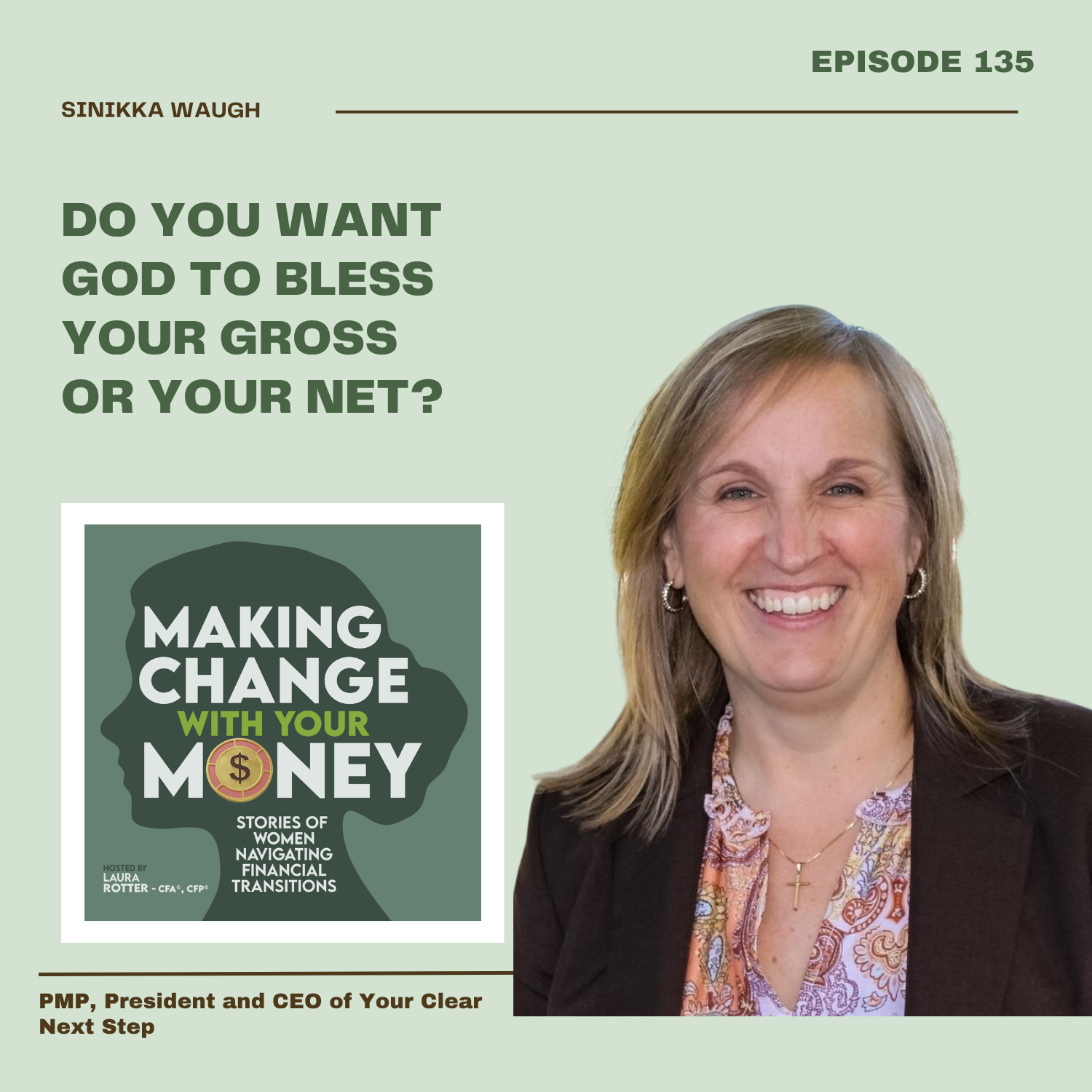
Imagine being a teenager holding your very first paycheck, trying to make sense of the words gross and net — and asking your dad whether you should tithe on the big number or the small one. And your dad grins and says: well, do you want God to bless your gross or your net? At some point you've probably asked: What does it mean to have enough — and to actually feel it? And what happens to the business, the mission, the identity you've spent two decades building when the season changes and the kids leave and the path opens up again? Sinikka Waugh grew up in a household where money wasn't discussed in polite company — but the lessons were everywhere. Her mother managed the family finances while her father was on military deployment. Tithing was non-negotiable. And in elementary school, her mother — a teacher — ran an experiment that Sinikka had completely forgotten until this conversation: if Mom packed your lunch, you paid less from your allowance. If you bought school lunch, you paid more. The kids had a say in how family resources were allocated. Without ever calling it a financial lesson, it was one of the best she ever received. She went to college intending to be a literature professor, discovered she was a project manager at heart, and launched Your Clear Next Step — a training and coaching company — as a woman entering a male-dominated field with no business background and a very big vision. For 18 years she ran the company, became the primary breadwinner for her family, put two daughters through college debt-free, and impacted nearly 60,000 people's workdays. Then 2024 arrived: an election year that froze discretionary spending, her mother's passing that pulled her away from the business for eight months, and a client who chose not to honor their contract. Any one of those would have been hard. All three at once nearly broke the company. Guest Sinikka Waugh, PMP, is President and CEO of Your Clear Next Step, a training and coaching company that has helped nearly 60,000 people have better workdays since 2008. With a background in languages, literature, and project management, Sinikka trains and coaches in three disciplines: returning business value, authentic human connection, and navigating change. She is also the host of the Even Better Podcast. Connect with Sinikka Website: https://www.yourclearnextstep.com LinkedIn: https://www.linkedin.com/in/sinikkawaugh/ Instagram: https://www.instagram.com/yourclearnextstep/ Facebook: https://www.facebook.com/YourClearNextStep/ Resources Even Better Podcast with Sinikka Waugh: https://evenbetterpodcast.libsyn.com/ (also on Apple and Spotify) Your Clear Next Step — training and coaching programs: https://www.yourclearnextstep.com Free resources from Sinikka: https://www.yourclearnextstep.com
speaker-0: Imagine being a teenager holding your first paycheck, trying to understand the difference between gross and net. And you ask your dad, When I tithe, do I use the big number or the small number? And he grins and says, Well, do you want God to bless your gross or your net? My guest today, Seneca Wah, spent 18 years building your clear next step. A training and coaching company that has helped nearly 60,000 people have better work days. She was the primary breadwinner. She put both daughters through college debt-free. She survived the hardest year of her business career in 2024, and now at the edge of a brand new chapter, she's doing something nobody saw coming. Seneca is a certified project management professional. CEO, trainer, coach, and as of this conversation, a candidate for the Iowa Senate. This is a story about mission, money, enough, and what happens when you built the legacy and the world asks, What's next? Listen in. Welcome to Making Change with Your Money, a podcast that highlights the stories and strategies of women who experienced a big life transition and overcame challenges as they redefined financial success for themselves. Now here's your host, certified financial planner, Laura Rodder. So welcome, Seneca, to the Making Change with Your Money podcast. speaker-1: Thank you, Laura. What a joy to be with you today. speaker-0: Yes, it's always nice to spend time together, which we've done before. ⁓ I'm gonna ask you the question I always start with, Seneca, what was money like in your family growing up? speaker-1: That is interesting. So money was one of those things that we didn't talk about. ⁓ it was we when we talked about money, it was only in the context of if you had enough, if you had enough and we had enough, you should share. But it wasn't money per se. It was whatever. So if you had enough blankets, then you should share. If you had enough food at your table, then you should share. If you had enough time. Then you should share. If you had enough joy, then you should share. Whatever it was, if you had enough, then you should share. But we didn't talk about money. Money was a dollars and cents conversation, was not polite to talk about. We didn't we didn't talk about money per se. and mom mom helped ⁓ mom mom manage the finances at home. dad was a military man. And he was off ⁓ on deployment in many cases. And so mom ⁓ was home when the bills were due. And so she managed the family finances and and took care of that. And then there was a season when ⁓ I remember a conversation that he got involved in those and it was uncomfortable ⁓ because mom I think I learned my control freak tendencies from mom and ⁓ she liked to be in charge of that and that was what she did. But we we did not talk about money except ⁓ in our tithing. Tithing we did and we had responsible tithing and and you planned for the bills. ⁓ but in in regular everyday conversations we we did not talk about it wasn't a polite conversation. speaker-0: I imagine you know you're not unique in that money is not often directly talked about and yet it is there are directions that you receive without language from your parents and what you've already shared to me are beautiful directions that, you know, whatever resource you have enough of and even the understanding that there's capacity to have enough. That you should share it is a beautiful message. And also I'm assuming that your family was faith-based and that tithing, therefore, was a big part of what you did. And that's also beautiful. I still remember my husband and I were invited, this was many years ago, when we were sort of the young leadership to a charitable organization that basically said exactly what you're saying. ⁓ identify 10% of your earnings. I chose to that to be 10% of our after-tax earnings. And that gets set aside for charity, independent of do I have enough for vacations and other wants? And that was a big wake-up message that it should be there and not like, well, I didn't take my vacation or buy my third pair of shoes or whatever. The wants were. And so that's a a pretty strong message that your family instilled. speaker-1: Yeah. Well, and I I remember when I brought home my first my first paycheck and I was reading like an after school job and I was reading a the statement and I was looking at the words and trying to understand my gross and my net and and these words and and setting setting aside the the tiding and ⁓ okay dad. So when I set aside the ten percent, ⁓ do I set aside is it is it the ten percent of my gross or my net? And dad looked at me with a a grin on his face and he said, Well, do you want God to bless your gross or your nut? ⁓ okay. ⁓ so that was a fun twinkle, a merry little twinkle in his eye. And so that was ⁓ that was a conversation then. And and now that now that we're thinking about this, I hadn't thought about this in many years, but when back in elementary school, there was a lesson. Mom was an elementary school teacher and There was a a ⁓ lesson that we had early on about our lunch money. And I forget the ins and the outs of this, but that there was a fiscal responsibility lesson that we would we used to have an allowance. And there was an allowance for our ⁓ that included our lunch money. And if mom packed us a lunch, then some portion of our allowance went to mom. For packing our lunch. And if we got school lunch money, it was a larger portion of our allowance that went to the school lunch. So and I I forget quite how it went or or or where the funds came from or how, but we had a say in how that money, the family money went in in the budgeting for school lunches. And if if mom packed a lunch, we used the f this family money. The family resources. Mom packed it and and but if we if we bought school lunch, th then we got less of that. Yeah. But but we still we paid for mom's services to pack the lunch and ⁓ yeah. ⁓ I had forgotten all about that until this very moment. speaker-0: So Seneca, you're telling me that there were actually pretty direct messages about money. It was not ignored. It was not something that you didn't pay attention to. You were quite aware of it. Not in a scarce resource way, but that it was a a resource to be dealt with responsibly. speaker-1: There was a responsibility and there was things were not just handed to us. It was not entitlement and there was fair wages, right? Mom got a fair wage for packing our lunches. speaker-0: I wonder who came up with that, you mom or dad? speaker-1: This is this is really beautiful. It says so much about what I'm doing with my life this very moment. I'm I'm really in awe. Mom, mom, if you're listening right now, man, thank you. speaker-0: So that of course begs the question. ⁓ this is a podcast about women in a life transition. And ⁓ you and I have discussed that you're anticipating a big life transition. ⁓ so can you share a bit about that? speaker-1: So fascinating. So fascinating. Wow. Like the questions that have led up to this. And as I was preparing this, they're just mind-boggling questions. So my journey through college, right? I I went and ⁓ I did the college thing and my parents, I we were in a financial situation that my parents had saved. some money for me for college and I had my grandparents had saved some money for me for college and I had college scholarships. ⁓ my I had scholarships that paid for about three quarters of my college education. And then I had my parents had saved a little which paid a fraction of the other quarter. And then I had some college loans. Right. So I My my parents agreed that they would pay for a portion of my undergrad education and I was responsible for the rest. And I had paid for it through scholarships. So that counted. And then we took out loans for s a portion of the others. And as I as I look at then what happened, my expectation out of that was that I was going to take that college education and go do the things with it that I had studied in college to do. I was going to go be a college professor because I had studied literature. And I had studied languages and literature, and I was gonna go teach college in language and literature, and that is not what I did with my life. And then I got into corporate America and discovered that I was a project manager at heart and I was a business analyst, and I got into corporate America and then shortly thereafter discovered that I was going to run a business. And I ran a business, and I had taken no business classes in undergrad and no business grass classes in graduate school. But here I was starting a business as a woman and doing things that were wildly at the time entrepreneurial and unheard of, starting a business in project management, which was very much a male-dominated field at that time. And in business analysis, which was a more ⁓ there were more women in Iowa anyway, in business analysis at the time. So there was ⁓ a space for women there. But certainly business ownership at that point was not. I I looked around in in my local chamber and in other spaces and hi, my name is Seneca. And ⁓ anyway, so doing these things and I had this intention to go create this long lasting business that would outlast me and and build a build a legacy out of this this business. And when I went in doing this, I think I I I very quickly became the the bread owner, the the breadwinner for our family. And the it was it was in the tech industry at the time. I was an IT project manager and IT business analyst. And I was yeah, I mean I was grateful to be in a space where that was a lucrative career. And my husband was in education, which was less so. He didn't go into education for the money. I mean that's that's not what you did. And so I was the primary breadwinner for our family. And that was Different. And here I provided so we didn't when I started the business, our kids were toddlers. And I created this business and it we I was the primary breadwinner for all of their childhood and their college education. And here we are. The youngest one is ⁓ she'll graduate this spring. speaker-0: Crazy, speaker-1: Right. And my husband worked in education and then he moved to the college level. So he was able to provide through his college relationships, he was able to provide the tuition for their college education, which was something that we knew we were so grateful for that benefit. And here we are, one's in law school now, and she got a full ride scholarship because of her academic abilities. Wow. She right. So she's gonna be able to go to law school with very little debt. Ho housing is will will be expensive, but Very little, no, no tuition debt. And the other one will graduate, undergrad, and they both will have graduated undergrad with no debt. And my job with the business, as my husband looks at it, he went, Okay, that's what you set out to do. And I went, Wait, that's not what I set out to do. What I set out to do was create this legacy in this business and will last out and outlast me. And so we're at this moment that is this a transition? Is this a moment where I Could go reinvent myself where I could go do something different. The world is my oyster. It's an opportunity. I don't know. speaker-0: I just got I have a question 'cause again, that it just strikes me, A, that you had this entrepreneurial spirit in you, as you described, ⁓ and B that it was a big vision, right? A legacy, like building something beyond yourself. Do you have a sense of where that came from in you? speaker-1: Absolutely. The the entrepreneurial spirit comes without a shadow of a doubt from my grandmother. My grandmother on my mother's side was an entrepreneur ⁓ through and through. She came over to this country as a refugee from ⁓ Karelia in the winter war when Russia had attacked Finland and had taken the part of Finland Karelia. And she and her husband came over, my my grandfather. And they had a two-year-old son and eight dollars in their pocket. And they came over with this dream to make a better life for themselves and leave things better than they found them and make a better life for themselves. And that's what they did. And when she got here, he worked for Procter and Gamble. ⁓ he was a career Proctor and Gamble man and a career company man and ⁓ did that. And while he was doing that, she started restaurants and she ⁓ baked br finished breads and ⁓ they had a sign outside their restaurant that said good food and my grandfather my grandfather would always say, We weren't bragging, it just was. She ⁓ had several restaurants and one of them was ⁓ frequented by ⁓ Danny Kay, the actor was a a frequent ⁓ attendee there. And anyone who was anyone on Cape Cod at the time would frequent the ⁓ their the the bacon farm was their restaurant. And there are these legacy stories. The there there's a story that when she was looking for the property speaker-0: And this speaker-1: I don't know if the legend is true, but the the story goes that she met with the realtor and he said she said, How much for the property? And she he said it was 60. And she said, I don't have 60. Would you take 30? In her thick Finnish accent. And he said, ⁓ yes, I'd take 30. And she said, Well, I don't have 30 either, but I'll give it to you at the end of the summer. And he said, Okay. And they shook on it. And at the end of the summer, she paid him all the debt in full because she had made that much money in the restaurant over the summer. And she was entrepreneurial in nature. She knew she could do it and she did. And she made these restaurants and people flocked to them and they loved her food and they loved her spirit and they loved what she did. And ⁓ she worked hard and she d had incredibly high standards. And ⁓ she cooked good food. And I I I think that's and and she believed that you could you could do anything you set your mind to and and you could leave things better than you found them. speaker-0: the the restaurants were on the Cape? Cape Cod. And were you nearby? Like did you have have the experience of this as you got old well when speaker-1: They were on Cape Cod, yep. Okay. As I got as I got older, I got to spend I I know that as a toddler I spent a little bit of time there and as a young ⁓ as a young child and then summers I would spend time with her. By the time they retired, they had properties on Cape Cod and in West Palm Beach and in and in Finland. And I spent a summer with her when I was ten. And we would spend ⁓ when when I was little, I I spent lots of time with her and with my grandparents, ⁓ with both of them, but I she was a deeply, deeply influential in my life. speaker-0: Wow, so what a great experience to watch you, grandmother. And so she also built something. It wasn't just a cute little restaurant that she could work in. She built something beyond herself. So are you s I'm I'm hearing you say that that informed the fact that you didn't think you'd just be a solopreneur, but that you would have a team and something bigger than yourself. Is that am I understanding you correctly? speaker-1: Yep. And that that was my vision. And in in twenty twenty four, we had built it, right? I had twenty-one coaches and trainers working for me. And I had a staff of thirteen. Right. We it we we had we had done it. And it it was we were we were there. It w it was it was really exciting. And then yeah, twenty four was twenty twenty four was hard. ⁓ I think if we look at transformations and and transformational years. I I think we could talk about the the deep pain that would come from twenty twenty four, because in twenty twenty four my ⁓ we had economic loss. ⁓ it was a really painful year ⁓ financially. ⁓ it was an election year and tr we're a training and development company. And ⁓ election years are always hard for that. And ⁓ then it was also the year that my mom passed away. and ⁓ so I spent about eight months of that year at her bedside, ⁓ which was in Massachusetts. And so traveling back and forth was not great for my leadership of the business. It it turns out that businesses don't like it as well when they're head of sales and head of operations at the time and also head delivery person is not at the at the helm for that much of the year. It it was hard on the business and that and the economic times. And then we had a a client do something really unfortunate. So I think any one of those would have been we could have handled one, but we couldn't handle all three. So it was a tough year. And ⁓ then we spent twenty-five building back from that. So if we talk about transformation, the difference between twenty-four and twenty-five are remarkable. Twenty-four was a bad year, twenty-five was a good year, a year of recovery. And so ⁓ in in in numbers, twenty-four ended in the red, twenty-five ended back in the black again. So, like I can talk about transformation. I can say in 18 years of running a business, I had one that was not good and I had tw 17 that were good. So I can talk about the transformation back up again. And I can I can talk about things that were things that were successful. I can talk about the transformation back back up again. But it's also this moment of right sizing of right size. Yeah, that has such icky connotations, but of finding finding the right the right legacy size for us, the right forward for us, the right I think there's there's a wonderful TED talk by the author of ⁓ Eat Pray Love. And she spends time talking about the distance between home and great success and great failure. And it's just ⁓ it's just a beautiful, beautiful story as she puts it, that ⁓ when we have great success and when we have great failure, we're catapulted equidistant from center. And great success can launch us into this the this space where we go, but But I'm not moored anymore. I'm not centered in what I do. I'm not grounded. I'm not doing the things that I should be doing every single day. And when we have great failure, we can also become a bit unmoored. And ⁓ Elizabeth Gilbert, sorry, it took me a second to get there. ⁓ And and when we when we are centered, when we're moored, when we're grounded in who we are and what we're doing and we're centered in home, then even failure and success don't unmoor us. They don't, they they don't rock our boat. They don't They don't take us away from our grounding. And I I think the failure that was 24 and the success that was 22 was which was a phenomenal success, would allow me to recognize that 25, the years 25 would allow me to go, ⁓ this is grounded again. I'm back to grounded. speaker-0: Thank you for sharing that. You are not the sum of your earnings. You are the sum of your yearnings. If you're ready to use wealth to create more freedom and flexibility, let's align your finances with what matters most. Together, we'll build a plan that balances your scarce resources of energy, time, and money so you move forward with clarity, confidence, and less stress towards a life of true abundance. Learn more at www.truabundanceadvisors.com and schedule a short conversation. Cineca, I'm hearing a number of things. First of all, ⁓ I do think business owners have a lot of difficulty. and I don't want to project onto you perhaps what some of my difficulties are, but delegating and having the business able to run without you, ⁓ which sounds like 2024 there were not enough processes in place for you to be able to just disappear and the business to run on its own. I don't know if if you've thought about that challenge, but I'm just as interested in ⁓ this transition you're Participating. ⁓ And to tie that back into money, when you think about the choices you have, what choices you even want to have, ⁓ what financial resources do you consider? And actually, as I asked you that question, I also would love you just to define what your business is, because I'm not 100% clear on why an election year would impact the business. speaker-1: ⁓ yeah, for sure. So thank you for that. I think I can answer that a couple of ways. So, what your clear next step is, your clear next step is a training and coaching company. We've been around for 18 years and we help people have better work days. Our mission is to help people have better workdays so that we can co-create better communities. I have this fervent belief that at the end of a workday, if we've had a crappy workday, we're gonna drive home crappily. But If we have a better workday, then we're gonna drive home safer and we'll be kinder to the people that we've chosen to spend our lives with. And they in turn will have a better night's sleep. And if there are kids involved, they're gonna wake up refreshed and have a better workday, which will be better for the teachers who are teaching them. And by Friday, right, it has a ripple effect. And we're all tipping the pizza guy more generously. And we're volunteering in our communities and you know, planting community gardens and ⁓ coaching little league ball and Singing in church choirs because we had better work days. So this is my why. But what we do is we are ⁓ we do training and we do coaching in three basic disciplines. One is on returning business value. So this is things like project management, ⁓ strategic planning, business analysis, those kinds of things. We teach on that. We have one day and and shorter content and longer content that we do publicly or privately, or that we can bring to you. ⁓ and then we have ⁓ authentic human connection, which is things like ⁓ emotional intelligence, resilience, ⁓ communication skills, presentation skills, ⁓ things leadership at frontline, mid level, and executive coaching. Again, that we can do online, in person, ⁓ we can bring to you, or we have public ⁓ sessions as well. And then the third one, which is probably my favorite, which is ⁓ dealing with change, because we recognize that change is not an event. You don't just say poof, ⁓ but it's a it's a process. It's a process that has to, in an organizational context, it has to be good for the business and it has to deal ⁓ deal with and bring along the people who are part of that change in a in an authentically human way. So those are the three disciplines that we teach, and that's what we do. We've been doing that for about 18 years. And at last count, we are just shy of impacting 60,000 people in the work that we do. Yeah. So we've we've had an impact. I'm super proud of the impact that we've had, and I'm super proud of the work that we've done over the years. ⁓ to your question about why we would not have why why election years are so hard. We've been through multiple election cycles, you know, the presidential as well as the off cycle. in an election year, a lot of times ⁓ training and development is one of the things that people say, ⁓ I'm gonna hold on to my money. As an organization, we're not gonna spend on training and development. It's discretionary funds. They're optional, they're optional, she says in air quotes. We're not going to spend on our people right now. We're going to spend on infrastructure. We're going to spend on things that are absolutely necessary, things that are on fire, but not the people. The people will stay, they're here, they'll be fine. Training falls to the bottom of the heap. It's discretionary. So it usually is one of the lowest things. It's one of the first things cut. Usually in an election year, it comes back right at the ⁓ at the end of the year, once we know. So November, the decision gets made. And then December, it's it's fine. It comes right back. The spending opens up again in December and and January. Or December, November, December and January. In the 24 election year, that did not happen. It did it spending did not open up in November, December, early January. It was a bit before it opened up again. There was a lot of volatility there volatility there. So even though we have a very, very diverse portfolio of clients that we work with, there lots of people were holding on to their money. For a variety of reasons in twenty four. speaker-0: Yeah, 'cause I I mean, it just strikes me as someone who manages people's portfolios that there's often an expectation that there'll be changes that I would make to the portfolios with a new administration in power. And I I guess to me, cycles are so long that I do not make any changes. Like I always tell my clients, I'll make changes when your life changes, but not when you know, something in the external environment is changing. Cause you never really know what your expectation of what the change will do can be very different than how the market reacts. So, you know, I don't pretend to know. So it's interesting that to have, like you just said, a diverse portfolio of clients that somehow are gonna hold back. I can even see the other way around, like maybe infrastructure investments might change, but your people are your people. So and but You know, you've seen the pattern long enough. Yeah. speaker-1: And and I would guess the the clients that so those who are investing and have the funds to invest in a financial portfolio are are making different kinds of d decisions as those who are hiring us, right? Who are frontline out speaker-0: Like they're not making decisions about the portfolio I am. ⁓ yeah. Seneca, your child who's graduating from college, maybe you wanna, you know, you can take less risk or more risk, but I don't really care who the president is or who controls Congress when it comes to how I invest your money. Like, you know, I might think, ⁓ this president is in place, so now we should invest in XYZ. And I'd be completely wrong. So I feel like if I were a business, I would still want to invest. Again, this is a different discussion. I would rather still want to train my people, but I might say, ⁓ I'm not going to build that plant in Russia like I thought I would because politics have changed. You know, and you're saying the opposite, which I don't really I'm sorry. Like how is politics going to shift who how you want to train your clients? But speaker-1: Yeah. speaker-0: ⁓ I guess you have more insight into that than I do. So you've you've talked about this change and how it opens up possibility or doesn't for you. And I'm curious what that means to you. And whenever there's change it impacts money. So share just what's coming up for you. speaker-1: Yeah. Yeah, it's really interesting. So you you made a you made a point earlier about ⁓ s small business owners having less ⁓ be being more needed in their business. it's hard to get around that, right? There there is a reality of that small business owners are needed in their business, but we can set up structures and and policies and that sort of thing. ⁓ one of the things that I've been able to do is bring around me some really top talent and some really wonderful people. they yay, right? So one of the among the things that happened in 24 is my very best and top talent stepped in to keep the business running and they did that super well. unfortunately, those top talent are also the the folks that I put out in the market as my client, you know, on as consultants. for my clients and they I couldn't hire them. They they gave me a reduced rate for me, but I couldn't hire them at an operational rate that I could afford. Right. I could I could hire them at a at a rate that they could they could work for me. ⁓ and then when I had a client that that did something unfortunate like decide not to honor the contract that they had signed, that was when the the money fell through. So that's that that's where we got into a pickle. But what I've done for as I look into what what the the highs and the lows have created is going into the future. What we can do is I've now got the ability to expand and contract and creating ⁓ financial so ha having where does where does money play in my life now? So money doesn't play in a life of having buckets to fill ⁓ runny nose appointments or you know kids medical appointments or the the the vacations that we're taking as families anymore because it's it's different right the kids are out of the house and they're doing kind of their own thing and it it's different. Now money is for the business filling spaces of when I want to step away for a bit. And for the family when ⁓ when Spencer and I want to do things differently, we want to spend our time differently, what does that look like? So it's It's contracting. It's ⁓ it's prioritizing things differently. And and so being able to to use money differently. It's not saving for college anymore. Cause college ended. So okay. It's it's not right. So and and now it's looking ⁓ okay, saving for retirement. It's accelerating and when that retirement happens and ⁓ but but not because I I don't see myself as one of those I'm I'm never going to speaker-0: Yeah. speaker-1: retire and just prop up my feet and do nothing. That's that's not it. So what does that look like and shaping that and Yeah. How will I continue to do all the good that I can in all of the ways that I can for as long as I can? What does that look like? speaker-0: And I mean cynicum, what I'm hearing is that even as you started off by describing your why, that what you do has always been very mission driven, both for helping people, also of course, you know, helping your family. And our missions change over time. I think the core of who we are and what our gifts are doesn't change and what we do with those gifts. Is always evolving. and it's exciting to have in place the financial resources to allow yourself this exploration. ⁓ so I'm excited for you. And so then as we're coming to the end of our conversation, I do like to ask. speaker-1: Yeah. Yeah. speaker-0: And this is all of a piece with what we've been discussing, Seneca. How has your definition of success shifted? Has it shifted? And perhaps your definition of financial success now that you've accomplished you know, getting your kids through college? speaker-1: Yeah. It's really interesting because the it's been a long time coming to this stage. I would have and there's a part of me that's still there there's a there's a little girl in me that's that's putting up her fists and that's that's wanting to fight that's wanting to fight this this conversation and the the voice that I'm about to use here. ⁓ because A piece of me had had defined success as if I built your clear next step and if it lived into perpetuity and if it lasted forever as your clear next step and it continued to grow and if it continued to expand and to multiply and forever and ever your clear next step continued to and there's a part of me that says, Well, that that feels a little bit naive. And then there's a little girl in there that says, Yeah, but hang on, I don't I don't want to let go of that. So success is defined some there somewhere in there, there's still a definition of success that will have your clear next step continuing to last into something. So it's not going away. ⁓ but there's a financial success that says, Financially, I I did do something. I have been successful, right? I don't have to. I was successful. The business was profitable. For all but one year of its existence. That's pretty remarkable as a as an entrepreneur, as a business owner. I just had one bad year out of 18 so far, and it's still running. And we're not going anywhere. Like this is not a farewell mission to your clear next step. There's no sign of it going anywhere on the near horizon, right? So your clear next step is continuing to exist. It's doing very, very well. We only had one dark year out of 18. So it is successful. And financially, for me personally, if I have The ability, I I have been the primary win breadwinner. We got our kids through college. We had very nice vacations along the way. The kids were very well provided for. They were never hurting for anything. We we put money away for retirement. They learned responsibility. They do not feel entitled, but they also like we're fine. They're fine. they both drive on to CRV's dog on it. They're fine. They're fine. speaker-0: Yeah. speaker-1: they and okay, so my money didn't buy them brand name clothes. They learned that they had to earn that or get them for holidays. That's fine. And they anyway, so I tried to instill some of the same values that that were instilled from me. And now what does success look like? Now a success looks like I have enough to share and I have the financial stability and the freedom and flexibility to do ⁓ to pursue a hobby. ⁓ and ⁓ the hobby is not the right word, but there's something I'm doing on the side right now. I've I've just launched a ⁓ a political campaign, which is really, really exciting. ⁓ so I'm doing that in addition to running a business and speaker-0: You're right. You launched your political campaign? Wow. speaker-1: I did. I did. I'm I'm running for Senate for the Iowa Senate here in Iowa for Senate District Eleven, which is really exciting. Yeah. And I have the flexibility. So I I I did this with my hands when I talked about the the flexibility in our business because we have the ability to to stretch, to expand and contract and expand and contract in the in the spaces and the work that we do that we didn't have before. And I'm really excited about that. And and it's this is a continuation of my desire to support the community and to to help make work days better. It's it's the pursuing of my mission. I'm I'm your observation that I'm very mission driven. Yes. It's in my fiber. I can't help it. And and I will continue to pursue this. And I'm I'm super excited. So what does success look like? Success looks like I have I have enough and I have a business that creates gainful and meaningful work. for the people within it and provides value for our customers in my job and that provides an income enough for me that I can continue to pursue this other gifting that I have to to help make things better here in in in my community. speaker-0: Wow. I love that you've used the word, you've started our conversation with the word enough, how your parents said if you have enough resources then you should share. And it strikes me that in our culture that feeling of satiation and ha and enoughness is really absent that You know, we're always encouraged to want and to need. And this weekend, you know, I'm privileged to have enough so that I do like to spend on experiences. I have three children and three significant others attached to those children. So we're a family of eight. And ⁓ we try to take Airbnbs to ski and do other things together. And my son bit tongue in cheek, but not. My middle child said something like, ⁓ we're rich. And it's like important for me that I said, we are not rich, but we have enough. And to I, you know, I think when you're when you're young and you're building your career, there is this sense of like, I want a lot. I want to be rich. I want to and and over time, speaker-1: Yeah. speaker-0: I really embrace that I have enough. And and I will always have enough, even with fluctuations. And I hear from you this same message that you've in some ways always felt that you've had enough and aspire to challenge yourself to, you know, do everything you can do. Seneca's we come Come to the end, is there anything you wanna be sure you share with our listeners? speaker-1: I I I I love that that you honed in on that word enough and ⁓ I I think it is I I think that is so powerful. It is enough and I am grateful. And and I think it is it is that position of gratitude that I come from that makes so much difference. I I I have enough and I am I am grateful and I'm grateful for the the chance to operate from that and and yeah. Thank you. Thank you for the opportunity to share this. Thank you for inviting me. I'm so grateful for the connection that introduced the two of us. And maybe it was Doris that connected us. I'm so grateful for Doris connecting us. speaker-0: I guess twice. And I'm excited to see. I'm gonna, you know, Google the Senate race in District Eleven in Iowa. ⁓ speaker-1: Fantastic. We're just getting started. So ⁓ yep, I I'll reach out. I I will follow up and keep you keep you in the loop. And yeah, we're we're just getting started and it's gonna be fun. speaker-0: Good luck. Takes a lot of resources, both personal energy and conviction, as well as money. So good luck with both, Seneca. speaker-1: Thank you. Thank you, Laura. I appreciate you. Thanks for listening. speaker-0: Listening to Making Change with Your Money. Certified Financial Planner, Laura Rotterd specializes in helping people just like you organize, clarify, and invest their money in order to support a life of purpose and meaning. Go to www.truabundanceadvisors.com forward slash workbook for a free resource to help your journey. Please remember that the this podcast does not constitute accounting, legal, tax, investment, or financial advice. It's for purposes only. You should seek appropriate advice for your specific information. speaker-1: For information appropriate professional