
Making Change with your Money · Laura Rotter, CFA, CFP® | Financial Advisor for Women in Midlife Transitions
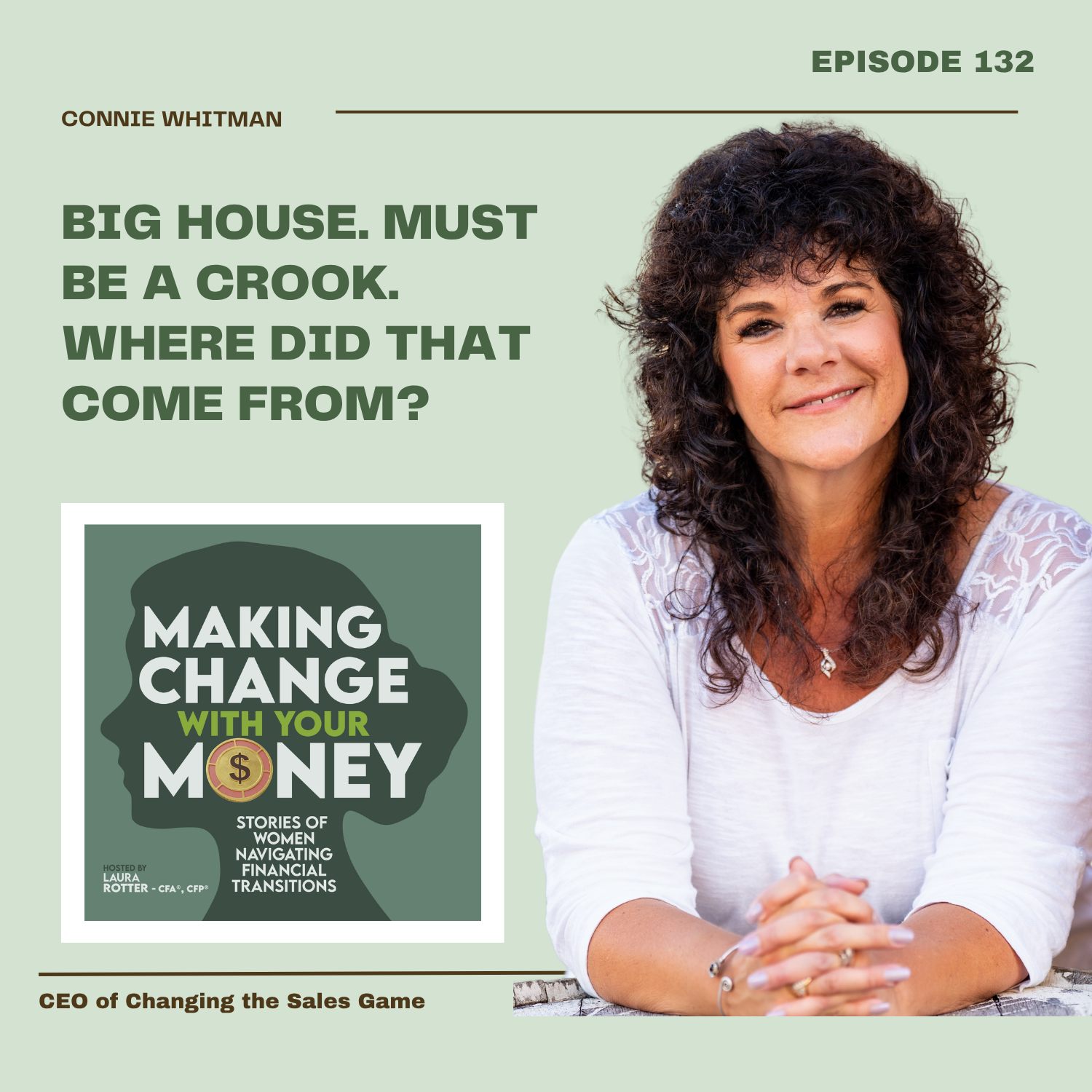
Imagine driving past a beautiful house and the words just come out of your mouth: "I bet he's a crook." You don't even know where it came from. You clap your hand over your mouth. And in that moment, you realize a five-year-old's belief has been quietly running your life — and your business — for decades. At some point you've probably asked: What beliefs am I carrying that I didn't even choose? And how much is an old story — one you absorbed before you had the words to question it — quietly setting the ceiling on what you allow yourself to achieve? Connie Whitman grew up in Newark, New Jersey, the daughter of a Depression-era mother and an Italian immigrant father who worked construction, went to school at night to learn English, and jockeyed cars on weekends. The messages were layered in early: money doesn't grow on trees, hard work is the only way, and — from one unforgettable detour through a wealthy neighborhood during the riots — big houses belong to crooks. Her parents meant the mob. Five-year-old Connie heard: success is dangerous. That belief stayed buried for decades. Then one afternoon, driving past a 10,000-square-foot home under construction, she heard it come out of her own mouth. She was in her late forties. She'd been running a successful sales training business. And an energy healer had just told her she was afraid of success. Now she understood why — she unconsciously believed that if people perceived her as successful, they'd think she was a crook. Working through that belief took over a decade. But it was the foundation for everything that followed — including surviving the hardest financial season of her life. When COVID hit, every client paused. Her husband's company closed simultaneously. Two kids in college. Zero income. She burned through savings, spent tens of thousands on three coaches, and spent seven days a week for months rebuilding her entire business from live to digital — at 59 years old. Guest Connie Whitman is the CEO of Changing the Sales Game, a four-time #1 International Best-Selling author, speaker, and podcast host with over 25 years of experience helping business owners, leaders, and sales teams build powerful organizations. Her signature ESP (Easy Sales Process) framework teaches heart-centered selling through improved communication skills. She hosts the podcasts Changing the Sales Game and Enlightenment of Change. Connect with Connie Website: https://changingthesalesgame.com LinkedIn: https://www.linkedin.com/in/conniewhitman Instagram: https://www.instagram.com/conwhitman/ Facebook: https://www.facebook.com/WhitmanAndAssociates Twitter/X: https://twitter.com/Connie_Whitman Resources Free Communication Style Assessment (gift for listeners): https://changingthesalesgame.mykajabi.com/communication-style-assessment ESP (Easy Sales Process): 7 Steps to Sales Success by Connie Whitman Podcast: Changing the Sales Game — search on your favorite platform Podcast: Enlightenment of Change — search on your...
speaker-0: Imagine driving past a beautiful house and the words just come out of your mouth, I bet he's a crook. You didn't plan it, you didn't know where it came from, and in that moment you realized a belief you absorbed at age five had been quietly running your life and your business for decades. At some point or another, you've heard yourself asking, what old stories am I carrying that I didn't even choose? And how much is a childhood message quietly setting the ceiling on what I allow myself to achieve? My guest today, Connie Whitman, grew up in Newark, New Jersey, daughter of a depression-era mother and an Italian immigrant father who worked three jobs and taught her that hard work is everything. The money beliefs came in early, and one, absorbed at age five during a detour through a wealthy neighborhood, Would take her over a decade to unravel. Connie is the CEO of Changing the Sales Game, a four-time best-selling author, and a sales coach with over 25 years of experience. She rebuilt her entire business from scratch during COVID at age 59 with zero income and two kids in college. This is a conversation about money beliefs, resilience, And what it actually means to sell from a place of love, care, and respect. Listen in. Welcome to Making Change with Your Money, a podcast that highlights the stories of people who experienced a big life transition and overcome changes as they redefined financial success. Now here's your host, Sir. speaker-1: for themselves. speaker-0: Laura Rodder. Welcome Connie to the Making Change with Your Money podcast. speaker-1: Thank you so much, Laura, for having me. I'm excited for our conversation. speaker-0: Me too. I somehow already feel the energy. So Connie, I'll start as I always do with the question, what was money like in your family growing up? speaker-1: So it's so interesting, Lauren. I you probably face this as well as as I think many ⁓ humans on earth have. So my mom was born in 1929, the Great Depression. Wow. So yeah, she she lived a good a good old age of 93, God bless her. But think about being born 29, Great Depression. My, you know, there were five daughters ultimately in the house born in the 20s into the 30s, you know, 1930s. So my grandpa had to work three jobs, odd jobs, there wasn't enough food to go around. I mean, the whole thing, you see these, you know, movies and pictures depicting 29, it was it was bad. So I think that that imprint that my mom had of not enough, right? Because it truly was poverty. Every a lot of people had were facing poverty, even if they weren't prior to 29. So that imprint. Absolutely impacted how we were taught about money. So things like money doesn't grow on trees, you know, we're broke, even though we were never broke. We weren't rich, but we weren't broke, right? So the phraseology that my mom would use was very it it impacted us. Additionally, my dad came here from Italy when he was, I think, 19 or 20. So he came with nothing in his pocket, work construction, went to school at night to learn English. And jockey cars on the weekends ⁓ at a local beach. So he just worked, right? That was that was his whole mission. So the other imprint was: well, to make money, you have to work really hard, nose to the grindstone, this type of phraseology. And my siblings and I, I think to some extent, were imprinted with that. I think of the four of us, I was imprinted the deepest. with those ⁓ for what for whatever reason my personality, my own personal work ethic, ⁓ whatever whatever it was. But the the money journey for me has been long and arduous, I'll tell you. speaker-0: Arduous, hell of a word to you. Connie, where are you in the birth order? Are you the oldest? And so speaker-1: It was just yeah. So my I have a brother, a sister, and then me and then a younger sister. So of the girls, I'm a middle, I guess I have a little bit of a middle child syndrome too. How to stand out, how to fit into the family dynamic. So all of that probably played into, plus the imprinting from my mom and dad, probably impacted how I see saw the saw the world with the money before I became aware and was able to go back and change those beliefs and those different ⁓ perspectives. speaker-0: Hmm. Thanks for sharing that. So before you were able to go back and I really applaud you to the extent that you were able to start to shift your beliefs, that's not an easy thing to do. How did that play out? speaker-1: So it's interesting. ⁓ I was probably about late forties, early fifties, and we have a house on the Jersey Shore. My husband and I were going down for vacation and a new house. I I grew up grew up in Newark, New Jersey, right? After the riots. Yes. After the riots, we moved to Homedale, which was a very affluent town, good school district, the whole thing. So I gr I bought a house in Homedale so my parents could babysit, right? Raise my kids. They went through so the whole thing, the whole family dynamic. Well, we were going down the shore. New house being built up on the hill on this beautiful road in Homedale. It's got had been a 10,000 square foot house. We're driving by and I look over, and there was a little Tykes, ⁓ you know, the little the plastic ⁓ the little sled, the slide, the slide. Yes. I look over, I said to my husband, look at that house. I go, I wonder what he does for a living. I bet he's a crook. Whoa. My husband was like, What? And I have to tell you, Laura, as soon as it came out of my mouth, I literally put my hands over my mouth and said, Whoa, where did that come from? And that was a revolution or a trend. That was the the pivot for me because I real and then I sent love to that household and to whoever that gentleman was. And I said, I hope you're creating the cure for cancer or something amazing. Right. So I sent them love and I said to my hus and that's when I started thinking. Wow, where did that belief come from? Because certainly that is not the truth. Well, fast forward when I was five, coming home from the shore, it's a family house living in Norwork. We we were during the riots, we the the the ⁓ police re redirected us, right? Detoured us from our usual path home. And I see these big, beautiful homes. And I'm five, Laura. So I'm thinking, ⁓ princesses must live there. So I Out loud, ⁓ look at the pretty houses. I wonder who lives there. The same moment my dad and mom say crooks live there, bad people live there. It was the mob. Okay, this was in the 60s, it was the mob. ⁓ so that so what did Connie, five-year-old Connie, hear? Big house equals a crook. What came out of my mouth, right, decades later? Big house, he must be a crook. Here's the key of why I needed to dig in and really work on myself with that one. That was the big aha moment for me, Laura. Here's why it was important, because that belief was holding back my business. So I had met with an energy healer and she's like, You're afraid of success. Why? And I said, So I looked sheepishly and I said, I recently had a ⁓ a revelation. I said, I believe that if people perceive me as successful, They're gonna think I'm a crook. See how it plays out for us? It's it's now taken me over a decade to work through that and realize that no, no, no, because you have a big house or because you have money or because you're successful, all that means is you could do better and greater things in the world. Doesn't make you a crook. Because I'm not a crook, right? I mean, I'm an honest person. So, but isn't that funny how that belief was playing out from when I was five and how it was actually holding me back? Back now as an adult. Crazy. speaker-0: Wow, it is so crazy the messages we take in and how they actually affect the choices we make in our lives. I often think about, given my role, what messages did I receive growing up and how has that impacted me? And I often think about how I grew up in a small junior four rent control apartment, sharing a bunk bed with my sister, and my father. would say it's good not to own a house because we can always call a super when something breaks down. And it was like again, sort of taught me to be disdainful of people who had the money to buy a house, of people it's wasteful, it's and I, you know, I know it must play out in decisions I make. I'm not sure how. I had a great deal of respect for my father who could never put two nickels together. And it's just interesting that I hear his voice imparting a sense of pride that we lived in a tiny rent control. speaker-1: Interesting. See interesting. We all have a story, Lore. We all have a story. speaker-0: Exactly. So Connie, this is a podcast for women who are either in a life transition or have just come out of a life transition. I know you to be an owner of a business. What transition would you look to to describe a big change that took place in your life? speaker-1: You know, this is great question. And I I hope your listeners find value in this. When COVID hit, right? We I did everything live pre-COVID, the Lord. So I networked live, I spoke live on stages, right? I trained live. I meetings were everything was live. And then COVID hit and all of my clients called and said, We have to pause, we have to stop, which meant income stopped. Additionally, my husband's company closed, not because of COVID. We knew it was coming, but he was out of work. We had two kids in college. So the bills kept coming in, Laura. You can picture it. And we were living a life on two pretty good incomes, right? And all of a sudden we have none. Thank goodness. So here's the first the first moral of the story. You have to have money saved for a rainy day because the rainy day does come. And we blew through that ⁓ savings. They didn't have a lot of relief for small businesses from the government. ⁓ this the ⁓ unemployment was a joke, right? So I remember saying to my husband, I'm in trouble. I I don't know what to do. Do I s now nobody was hiring? So looking for a job, that wasn't going to be the answer. So I said to him, Listen, I know I still have business. I had created about 20 programs by then. You know, my think about it, I've been doing this for you know 40 years. Everything I did live, I would go into companies, corporations, mostly banks, and I would teach their employees. Two things. The first main thing was how to communicate effectively and with kindness and respect with their client in order to generate more sales. But to do it through this, for me, sales is love, care, and respect. So that's what I would go in and teach. Okay. So corporations, Connie, we don't need you. You know, we we everything closed. So I said to my husband. I have to rebuild the business and I have to create a digital platform. I don't know what that means. I don't know what it looks like, but I know I have all this content created. I still know how to train. I have to get better at the figure out Zoom and create digital programs. And it was a learning curve. Now I was I was what 50 59? And I said, I I have to learn this. So we spent I spent tens of thousands of dollars. Remember, no income coming in. Tens of thousands of dollars. I hired three coaches, got my programs up, added another. I had been doing podcasting. I did a second podcast. So when I tell you everybody was watching Netflix, I was working 12 hour days, seven days a week, trying to rebuild or take what I had built live and now transition it over to digital. Well, fast forward now, right? We're five years later, ⁓ and I have another successful business, but it does not look like it looked. ⁓ prior to. And the other interesting thing is I feel now being able to do the digital, because I can record video. They could the employees, the students can go back and watch the videos when they're ready for the content. Cause I give all of that to the ⁓ the company, right, to use as a as a resource in the future for learning, coaching, etc. I built this infrastructure and I help my clients now build infrastructures around the sales training. I could And have done that when we did it live. So the ripple effect of that pivot has been tremendous for me, but also for my clients and for the learning. It took them a while to buy into doing the digital versus live. But we like you live. I go, can you give me a shot on digital because on Zoom? Because I think I could still elevate the game, bring the energy, but also have this this ⁓ this infrastructure that we can build on the back end that I just can't do when it's live. So it's been an Interesting journey, challenging journey, frustrating journey, and at the end a very rewarding journey. And my clients now are really excited about the digital platform that I'm helping them build with these resources. So it's kind of cool. Yeah. speaker-0: I guess so much is coming up for me. Obviously, Connie, I hear strong resilience internally to recreate yourself. what other ⁓ I guess internal character traits would you point to that that help you not just, you know, go under a cover and and borrow, but actually step up to the challenge? speaker-1: It's such a good question. And a couple of things. I think this is where, you know, my dad, the nose to the grindstone. But can I tell you it served me because I thought, I got this. I'm smart. I work hard. And no one works harder than me. I c I can I can make this work. It was determination because of how I was raised. So I think that's the first thing. And I think the second ⁓ big piece is my husband had faith in me because I'm like, look, we're I'm spending All this money we have saved, but I'm taking tens of thousands right off the top. Because remember, we didn't know that first week of COVID shutdown, we didn't know how long it was gonna last. He trusted me and said, do it. You know what you're doing. I trust you. So I think having that internal support as well gave me the confidence to think, okay, I'll I'll figure this out. I'm intelligent, I c I can figure this out. So I think that was the other piece of it. And the other one, I don't take no for an answer. Like I will figure it out. Come hell or hot water lore. So sometimes that maybe that's stupidity. I don't know. ⁓ but I think it's that determination. And I think I really did learn that from my dad. So see, even those beliefs that maybe don't serve us as a whole, there's components of it that I do think help us remain resilient and focused and diligent and ⁓ confident and all those other things, even when you don't feel confident, you know? speaker-0: Yeah. I I also sense that Connie, you already had a track record, obviously in different ways of knowing that you could trust yourself, that you are dependable. ⁓ of course to others, but to yourself. speaker-1: Yeah. That speaker-0: If it didn't work in the way you intended, it was gonna work out some other way. speaker-1: That's exactly right. Well, it's interesting because yes, I do believe everything happens for a reason. And I do believe the universe does give you what you need when you need it. You just have to be ready for it. So the whole digital thing, I had known about it. I I had read about it. I thought, ⁓ I should do that. Never did it until I had to do it. So sometimes the universe slips hit you with the two by four and say, guess what time it is? Figure it out, right? speaker-0: Exactly. I mean, we all had to figure out Zoom now. Of course, I I was recently on a call where I wanted someone to share their screen and they couldn't figure out how to do it. And I I didn't say this, but I'm like, Where have you been? Doesn't everyone know how to share their screen on Zoom at this point? so we were all forced into learning digital, but it sounds like given your business you are aware of the ability to transition to goodness. exactly. And I'm also hearing you use the word in describing your husband's attitude towards you and the and you know, your use of money as an example. But use the word faith. ⁓ what role, if any, does faith play in speaker-1: So that's such a good question. So it's funny, you know, raised a good Catholic girl, right? Italian Catholic. Yes, it's nice to meet you. The guilt works on me very well. It doesn't anymore, but used to. It's so funny, but so raised with faith, I think, is important. More importantly though, I don't know that I, and this is just my personal belief. This is not a diss to anyone. I don't believe in religion, ⁓ churches, et cetera. Like I I pray every day. Pray every day several times during the day. I say my prayers at night, right? All of those things. I am more spiritually in my faith that I believe in God. I believe in the universe. I believe that we the universe conspires to give us what we need when we need it, all of those things. So me personally, I don't need to go to church for that connectivity. I do it every day. Wow. times a day. So again, and not that because I have family members and friends that go to church and I honor that. If that's they need that connection for peace and whatever, I think that's a wonderful thing. I find it in other ways through meditation and other spiritual, ⁓ more spiritually driven behaviors or activities for myself. Does that make sense? speaker-0: It does and I I feel like meditation has a way of centering us. Yes. It's really helping us hear the voice inside. You are not the sum of your earnings. You are the sum of your yearnings. If you're ready to use wealth to create more freedom and flexibility, let's align your finances with what matters most. Together, we'll build a plan that balances your scarce resources of energy, time, and money so you move forward with clarity, confidence, and less stress towards a life of true abundance. Learn more at www.truabundanceadvisors.com and schedule a short conversation. Connie, can you share about your business today, who you work with, and advice you give? speaker-1: So interesting. I I still work with my banks, credit unions. Here's the difference. I now do it across the country. It's very easy. Where before, when my kids were little, ⁓ I wouldn't have accepted a job had I, if I needed to get on a plane, for example, it was too much time away from the family. So I was able, which was good for me, I was able to control my business. But now I'm coaching people in Europe. I'm coaching people in California. So it it that's the other thing. The ⁓ opportunity grew with the digital, right? So that was that was kind of a cool ⁓ side effect that I didn't realize. ⁓ and the other thing now I realize and I had never thought about this either. I figured when I retire, I'll just retire. There would all of the curriculum, everything I had built, it would have died with me, so to speak. Now I'm building a whole infrastructure so that somebody could come and either buy the the business itself or my clients could buy licensing to those programs and bring it internally if they so choose or hire another trainer, et cetera. So I'm building where before I had the curriculum, but it wasn't built, if that makes sense. So I think that's another ⁓ you know, another piece of of the puzzle that I'm able to do now with my clients. But again, I come in and and this is another cool thing too, which Which I always did, but it's easier to do digitally because I can help them build that infrastructure because of the technology. ⁓ but I go in and I help them build a sales culture. Now, the people who hire me, Laura, I'm gonna be honest, they believe in love, care, and respect for their clients. They believe in being part of a community and being a partner. They do not believe in the hard sale, the cold calling. That is not my world, that is not what I teach, and that is not how I sell or have I ever sold in 42 years. being in financial sales. So I think that my clients hire me because of the heart that I bring. Also their employees relate to me because it's not the pushy. I make it easier for them to communicate with their client. And then again, we're building this infrastructure and culture that we can impact the entire organization, not just one or two divisions. So it's been a really cool experience. And I think my old clients but my new clients appreciate the robustness of what I could bring to them now where I couldn't when it was live. Isn't that interesting? speaker-0: It is interesting. Because right, people would doubt that, you know, the Connie will come through a screen. And as someone who has a lot of client meetings on screen, I think we really can make eye contact. We can really sense the emotion through the screen, and it is possible to do. The term that's been coming up For me, as you describe your work is consultative selling. Is that a term that you're aware of? I have a memory from a thousand years ago. speaker-1: Yeah, it it's an element of that or a derivative of that. I think it's it's ⁓ so years ago people wanted right information, sharing information so they can make a good decision. And here's the reality, humans and you know this with with money, we are humans make decision based on emotion. Little element of logic, but it's really an emotional connection. So I teach not only the mechanics of sales, right? Because you have to have a process. Everything to me is a has to have a system and a process so we can rinse and repeat, rinse and repeat and know what kind of result we're gonna get, right? So that foundationally has to be there. But I think that when I come in, I'm able to ⁓ help the customer have an experience with them, not just a sharing of information. So consultative sales is really more about sharing information logic, where I think n now, current day, it's more about the emotional and the experiential for the client versus the having information at hand. speaker-0: ⁓ thank you for clarifying that. Yeah. Can you give us a sense? You you referred of course to your curriculum. Not that I wanna know the whole thing, but for our listeners, like describe a piece of the curriculum, what what exactly speaker-1: So my signature class is where we always start and it it's just a zoom out, but we zoom in throughout the program. It's it's a seven-week course. So example would be step one, and I'll just give you real quick what the steps are. This is the process. Everything has to have a system or process. Then we have a bunch of subskills under each of the seven topics, right? ⁓ so step one is preparation. We have to be organized. We have to show up prepared. We have to show up organized and tight how we're dressed, how we present, what what our briefcase looks like, whatever it is. On online, is our backdrop messy or are we showing up clean? So preparation. Step two is building rapport. A lot of people skip that. We get right to let me tell you what I could do for you. No. Shut your mouth, be present, let get to know the client and really feel who they are so that we can. And this is where our we're gonna offer my communication style assessment. It's a free gift that you're gonna put in the show notes. But step two is about what is your communication style? I know my communication style. Well, my job is to pivot or flex so that I'm communicating the way you need to receive the messaging. So that's all that. Building rapport, a lot goes on in that session. Step three is having really good open-ended questions prepared in advance. You know what you're selling, you better know what your questions are. Step four is listening, active listening. Three and four are tethered together, Laura. So if I ask a really good question, which I can prepare, if I'm Actively listening, and for me, listening means 70% of the time I'm listening, not speaking. The client is speaking 70% of the time. What happens is through that active listening, I'm able to ask follow-up questions that you cannot prepare in advance. You have to be very present with the client. And now I'm asking those follow-up questions to dig deeper to fully understand who the client is and what the situation is. Step five is presenting my solutions. which should make sense to the client after this great conversation. And then step six is asking for the business. Step seven is follow up. And then we begin again. Step one, step two, and it goes around and around and around. That's the rinse and repeat process. speaker-0: Thanks for describing that. I'm getting a sense that you are a very organized person. Are you would you describe yourself more forest or trees? I'm hearing trees, but ⁓ speaker-1: Know what's interesting? Yes, I am it myself personally, I am extremely organized. You know, like Christmas totes are in red and green, Halloween totes are in orange or you get it. Okay, I'm ain't all crazy person. But I will tell you, when I'm teaching, I believe I have I feel I have to teach people. First, we have to zoom out to understand the concept. And then we have to zoom in to develop skill, connect with the client, and then be able to action. that big picture. So for me, I think I'm really good at zooming out, zooming in, zooming out, zooming in appropriately and at the right time. And that's what I try to teach because we have personalities that they're always in the minutia. They're always in the detail. But what are you missing? Because you're not lifting your head. And then we have those that are their heads are in the clouds. But what are you missing because you're not digging deeper with your client to really get to know it's not superficial what their situation is. We need to know the the grit, right? So that we could go in and and whatever your solution is, whatever you're selling. So yeah, I think I'm I'm very organized, but I'm also zoom out, zoom in. I've I've developed that skill over the past, you know, four decades. speaker-0: And it's very clear that you enjoy talking and helping to people, that you're energized by the relationships and by the work that you're doing with others, that you're not a sit and stare at your spreadsheets all day long person. speaker-1: Yeah, people fill my soul. Yes for sure. speaker-0: Yeah. speaker-1: Thank you. I love that. Thank you. speaker-0: So Connie, as we're getting towards the end of our conversation, I always like to ask you how has your definition of success shifted? You've been doing this business in different permutations for twenty plus years. speaker-1: question. So I think in my tw it's interesting, Lauren. You probably feel the same way, right? In my twenties, it was all about the money, accumulating money, building skill, right? Being able to buy a house. All of that, right? So you could start a family, get married, all of that. So I was in my 20s, 30s, it was about more money, right? But also more skill development. Because now I had kids and I wanted to be a good role model. And then in my 40s kind of hit my stride, right? Doing what I was doing, 50s, right? Again. didn't really care what people thought of me anymore. It was about I know what I bring to the table. And if you don't want me, I'm okay with that. So when when someone didn't choose me as the vendor of choice for whatever they were trying to build in their organization, didn't phase me. I I I would say they wouldn't have been the right c client for me. So you become a little more discerning. And I'll tell you now, Lauren, in my 60s, really, really success is the legacy we leave behind. Yeah, you want to have the money in the bank. Yeah, I want to be able to retire and not have to. you know, ⁓ live paycheck to paycheck or social security check to social, you know, whatever. ⁓ I wanna be able to spend time with my grandkids. I wanna be able to travel. I want to be able to fill in the blank, right? For you. So I think it's more now I look at it as what's the legacy of my kids? And I don't have grandchildren yet, but when they come, how can how right, what's that legacy for them? And it's not always It's financial to some extent, but it's more of what what do they need to know to become good humans? And I think that's really the true legacy that we have as we age going forward. Does that make sense? I I don't know. That's my definition of success, legacy maybe. speaker-0: Yeah, I'm I'm hearing that ⁓ that kind of you'd like to be modeling a certain not even behavior but behavior that reflects your values. Yes. That you want to model that for your kids and perhaps for others that come into your orbit that speaker-1: But don't you think, don't you think that when you're your authentic true self and you have your core values that you truly believe, what you know, other people don't have to agree with you, but you I know I'm a good person, I know I show up, I know I'm gonna work hard, all those things that that I am, the money comes. And I didn't know that in my 20s and 30s. You see what I'm saying? So I think as each decade goes by, but isn't that the journey? Each decade go goes by, we learn, and then when you look back. I think I needed to work that hard in my twenties and thirties and go to school at night for the MBA and get all the licensing and you know the nose to the I think I had to do that, otherwise I wouldn't be where I am today. So I again I think the journey has the ups and downs. But now as I look back, I think all of those pieces of the puzzle is is the true legacy that we can teach our kids, grandkids, and others and others, not just our kids. Who else have I impacted that I hope through the years? That reflects and say, Connie taught me this. That is really important in my life, you know, now as a mom, as a sister, whatever it might be. Life, it's life. speaker-0: Love that point because sometimes I think I spend too much time. and when you said going for your MBA at night, I also finished my MBA at night, sort of beating up on myself that I had, you know, I think life is a constant balance. I often think as a yogi that when we're doing tree pose and yoga, we're not statically stand balancing, we are constantly. Adjusting and that that's what life is: this constant balance between time, money, energy. And I would beat up on myself that I had spent too long trading off time for money. And I've come to realize, as you've just said, Connie, that speaker-1: Yeah. speaker-0: It was appropriate when I was younger to be trading off time and money, or I wouldn't be where I am today if I didn't have the resources in the bank to give me the balls to go out on my own and try something new and the skills that I learned when, you know, I was an institutional investor. And that when you're younger, it is about creating a s safety net. Yeah. speaker-1: Absolutely. speaker-0: older and that in at each age there's a different trade off that's appropriate. And and so that's what I'm hearing you say that all the trade off speaker-1: give yourself grace right it's hard to give yourself good at beating ourselves up speaker-0: ⁓ so hard. So Connie, is there anything else you wanna be sure that you share with our listeners? speaker-1: I just want everybody to take the community. It's our gift, right? Laura, you're gonna put it's free for everybody. And you'll you will get in my email list. You can unsubscribe. I never feel bad. ⁓ but I do give tips in the emails as well to continue to extend the communication style assessment information because I do believe no matter what transition we're going through, if we can learn to communicate and just breathe and understand who the other person is. We can deal respectfully and work through conflict productively and and respectfully that we understand each other. Sometimes it's r agreeing to disagree, but I think that ability to communicate at the highest level, we create ease in our life using that skill. So I hope everybody downloads it. It's fun assessment. My reports are fun. The the ⁓ the style that I share, like I'm ⁓ for example, I'm a stimulating motivator. ⁓ you'll read it and think, ⁓ yes, she was a stimulating motivator. Totally. Don't it's and then my second one is an innovative organizer. I innovate and I organize for others. That's the CEO mentality, right? That business. ⁓ component. That's who I am. Others are heartfelt advocates. And then I have precise assessors who are engineers. So read it. There are fun ⁓ titles and the information is really cool. So play with it, understand it, honor who you are, understand your blind spots, and then work on it. It's another tool to help us develop better communication skills skills. So I hope everybody downloads that and takes it and has some fun with it. speaker-0: ⁓ it sounds great. I I'm definitely gonna go take it. Thank you so much for taking the time to be a guest, Connie. Really pleasure. speaker-1: Love you, my friend. speaker-0: Thanks for listening to Making Certified Financial. Laura Rotter specializes in helping people like you organize, clarify, and invest their money in order to support a life of purpose and meaning. speaker-1: change with your money. Meaning, go to www. speaker-0: True Abundance Advisors dot com for a free resource to help you. speaker-1: Forward slash workbook help you on your journey. Disclaimer, remember that the information shared by this podcast does not constitute a tax, investment, or financial. It's for information purposes only. You should seek appropriate professional information. speaker-0: Please, legal, advice. Professional advice for your specific