
Making A Runner · Nic Acampora
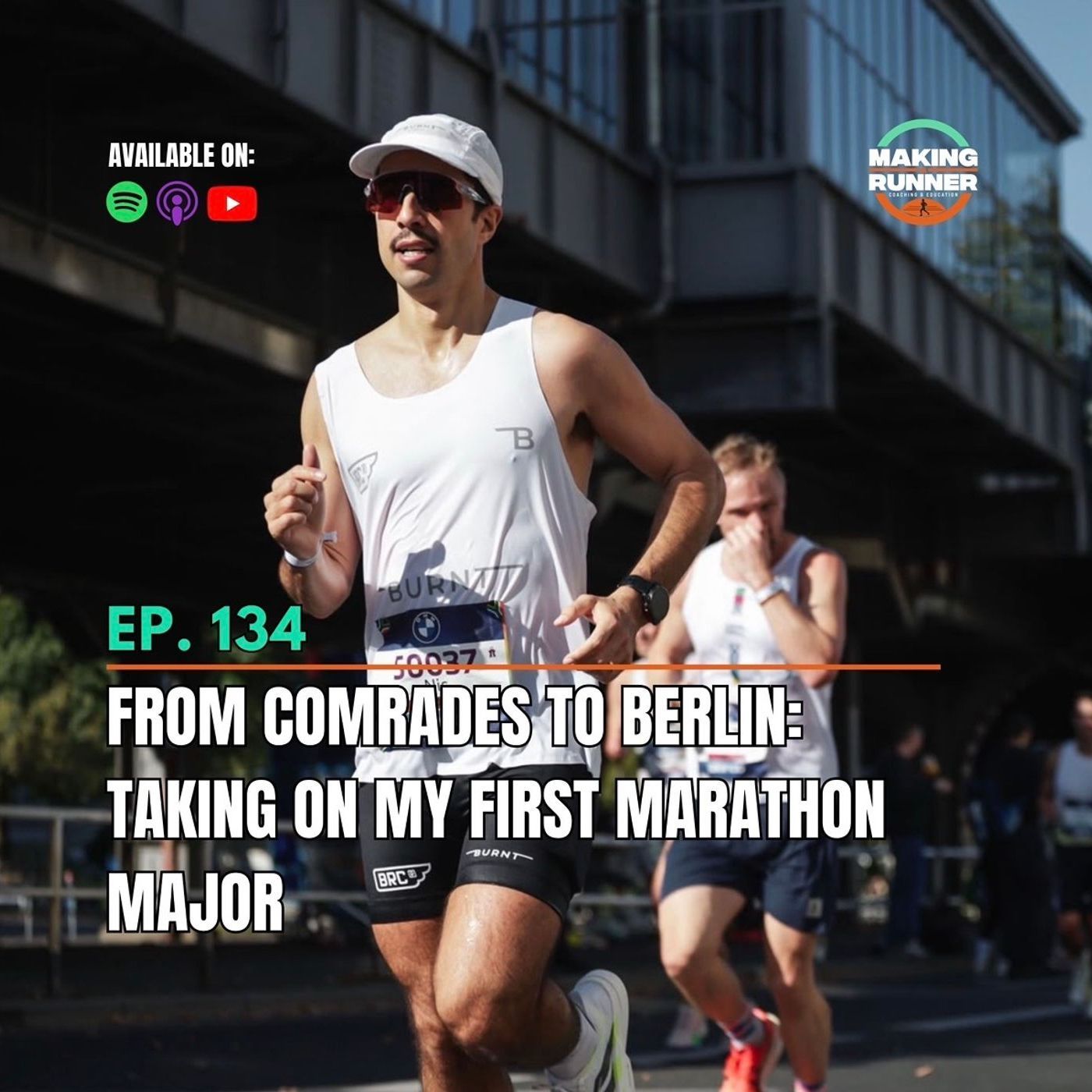
In this solo episode, Nic looks back on his journey from Comrades to the Berlin Marathon, sharing how he recovered after Comrades, found his way back to running at his best and eventually made the spontaneous decision to take on Berlin. From how he secured his entry to adapting his training in a much shorter timeframe than usual, Nic talks through the build-up to his first World Major Marathon and what it was like to experience race day in Berlin. He also reflects on how the race unfolded, supporting his own runners along the way, and the lessons he took away from the experience. In this episode, Nic covers: • Recovering after Comrades and finding his way back to running at his best. • How the decision to run Berlin came about and how he got his entry. • Adapting his training for a marathon with a shorter preparation period • The experience of running his first World Major Marathon. • How race day unfolded and what it was like supporting his runners. • His biggest takeaways from Berlin and what comes next for his running goals. From the unexpected decision to the finish line, this episode is an honest look at taking on a big running goal, adapting when plans change and figuring out what comes next. Whether you’re training for your own marathon or love hearing the stories behind the miles, tune in for Nic’s take on his first World Marathon Major.
Making A Runner: Hello and welcome to another episode of Making a Runner. It's been a while, guys, since I've recorded one of these. And I just needed the time. it's been a hell of a recovery coming back post-comrades, then having to prepare for Berlin in a very short space of time. There's been a lot of changes going on in my life, and it's also just been a very busy work season. But I'm glad to be doing this again. So before I go any further on with this, I just want to say thank you to each and every one of you. But we're here for a reason today. And that real reason is just catching up a little bit on to where my life has been going since comrades. going to touch on a little bit of that post-comrades recovery. I'm sure those of you that have been following my journey know that it wasn't a very easy recovery. It wasn't straightforward. I really pushed my body to its limits on the day. And already suffered in that recovery. I'll then touch base on to how I got into Berlin Marathon last minute and how Berlin Marathon actually went, how I managed to enjoy the day out, run the time that I did in such a short space of time. So there's a lot of insight coming your way from that perspective of training. And then I just want to touch on where I'm going to next. So what are the goals? What am I trying to achieve with my running? And just filling you a little bit on So starting from the beginning. Comrades, guys. It was real. was a hell of a race. I set myself a stiff target of trying to run six and a half hours, which for those of you that don't know, it's it's a really fast pace. It's about 420 a kilometer, 425 a kilometer. And it's been a long term goal of mine to try and get as fast as I can, both on the long distance and the marathon distance. So those have been really my my goals. And living in Durban, comrades is just something that naturally it's a big deal to me. It's a big deal to the members of my club and just the community in general. So inevitably I end up going and running comrades on most years. So this year the goal was six thirty. I ran six twenty nine. It was, let me tell you, a very, very tough day. I had to dig deeper than what ever dug. And I was really proud of myself. But what came next is really something that I couldn't have expected. I did not expect my body feeling the way it did. I am one that usually takes a while to recover from a race, generally speaking. You know, I run a marathon, I am stiff afterwards for a good couple of weeks. I take a good time off. So this is normal to me. some people I know, people that I coach, literally, they can Run a marathon, go run the next day, be absolutely fine, no aches and pains. My body is not like that. So I think everyone is different when it comes to figuring out how you recover post a race. But I feel that because I pushed myself as hard as I did at Comrades, I really didn't anticipate how long that recovery would feel and how tired and fatigued my body would feel for for almost what was two months. So In saying that, time post-a race is different from person to person, but you gotta have the patience, and these tough times don't last. You just gotta have the patience you gotta have the kindness to just remind yourself of how hard you pushed yourself. know some of you out there are still struggling with a post-comrade's recovery, and that's totally okay. I think it's important that after a race of that magnitude. You give yourself as much time as necessary. lot of people already have another goal on the horizon. And now that jeopardizes your recovery because inevitably you have to start training for this other goal. And I see that a lot of the time with the runners that I work with. And I'm always encouraging them to, yes, it's good to have an idea that you would like to do this thing. But you know, sometimes a big race, like a a goal race, like a com race for me, has other ideas for you. And how your body will recover from it. So I think have patience in your recovery, but also have the presence of mind to pick and choose the right types of races and your racing calendar really smartly. But of course, having said that, you know, your your basic principles of recovery, sleep, so, so important. You know, you have to make sure you're getting your seven hours plus of sleep per night. And if you're not doing that, it is going to affect your recovery. It is going to take slightly longer. Nutrition, we know nutrition is such a Key role player in making sure that you recover fully post the race. But also make sure that you, whatever your goals are, you go back to the fun of it. Most of you listening to this podcast are not elite runners. You run because you do it socially, you run because you have your own personal but you know, you don't put bread on the table through running. So a lot of the time we make these big goals and we make it a very black and white situation of whether we succeed or fail. And it can become quite strenuous on the training. So one of my biggest advices to my runners is post-erase is making sure that you go back to what the enjoyment of running is. You know, have a very loose schedule. Focus on elements that you don't often get to focus on when you are in the peak of your training. Because inevitably when you do go back into regimented training and you start building your volume again, you'll be ready for it. If you don't give yourself the time off, you unfortunately will never be ready to really peak. And that's where I see a lot of runners. They find themselves in this lull where they're quite never peaking for a race, but they're never giving themselves the time off. And it's kind of like in a funny way, the same thing as people that struggle to run really slow. So they're kind of always running in that intermediate, kind of hard, but not really hard zone. So they're never really pushing themselves hard. But they're never really recovering properly. And the irony there is that this it's the same when you're picking and choosing your races. You're never getting to peak for these races because you're never giving yourself the time off to get yourself in a position where you can start picking up your volume for these races. So for me, it's always about the balance and and making sure that I give myself enough time. Because, know, the one of the most crucial elements is that your off season is the thing that prepares you for your actual running season. And in running because there's a race every weekend or there's something inevitably on the horizon all the time, we're really, really bad at having off seasons. And we have to normalize an off-season. know, it's not something that we should be trying to always push through. It's not sexy to keep on training and keeping your volume high all the time. It looks good on Strava, it's not really good for your long-term development. So personally, something that I always work on is making sure that my recovery is. The number one thing for me post a big race, whether it takes two weeks, whether it takes two months. And in this particular comrades, it honestly took me two months. Now it doesn't mean that I'm not trying to train, doesn't mean that I'm not trying to in engage in different ways with my running body, trying to work on different things, but you can feel it in your legs, you can feel it in your body. And, know, I know a lot of people that were saying Finished comrades wanted to go and run Berlin Marathon, or finished comrades wanted to already train for Nelson Mandela Marathon. But inevitably, you have to give yourself that time. And even if you have these goals, you have to be very careful with how you build up to them after a race. For me, it wasn't really something that I wanted to go and my next big goal was always going to be Seville, February 2027. I was going to give myself as much time as I could to recover from comrades. So that I could then go and run Seville to the best of my ability next year. But yeah, the running world has funny ways of changing things that you want to do. So Berlin Marathon really came in from left field. I did not expect it. It's not something that I thought I would ever go and run, especially not this year. I did try to get into the ballot at the beginning or at the end of last year or last year, and I didn't get into the regular ballot. So I just said to myself, and you know, I'm entering the ballots for the internationals, especially the world majors all the time. Kind of say to myself that if I get into a world major, well, that's a sign. So I didn't get into Berlin. So that was a sign for me not to do it. But then my friend Davy, as you know him, co-host of the podcast, was telling me that, you know, you should come to Berlin, come come and support me. I'm gonna try and run my race. And, you know, I was almost sold by that by the idea. I had another five or six runners that I coach running Berlin. So I almost said to myself, Hmm, maybe I should I should go and support the race. I should be there on the sidelines. But then the thought of being on the sidelines at one of the world majors and not actually running it, yeah, was something that I really wasn't too keen on. And hence began the search for a Berlin marathon entry. Now, for those of you that know, World major marathon entries are not easy to come by. And this one I really had to scour the internet for. I was looking at any kind of competition that was going on because I knew of a few people that had gotten into competitions. I was looking at your different tour packages that were still available, which were terribly expensive. And then I was looking at charity entries because, you know, my head was if I'm gonna spend this much on a tour package, then I may as well spend a little bit more and give it to charity, you know, don't give it to a hotel. So I really couldn't wrap my head around spending the amount of money that you know, these things were costing me, especially five weeks out of race day. But through searching, I managed to find a tour company that was willing to sell me a a bib only. And I'm not gonna name who did that because I'm not too sure if they're allowed to do it, but they did. They sold me a bib and I managed to get myself an entry to Berlin Marathon, which would be my first world major. Now, my biggest problem here is that's a great story. I got my entry. Now I actually have to go and run a marathon in four weeks' time. I am nowhere near ready to run a marathon. My legs are still recovering from comrades. I can feel them. how am I going to do it? How am I going to prepare for this world major? Now You know, world major that used to be one of the fastest courses. I mean, it still is a really fast course, but it used to be a world record course. now, how do I prepare myself to go there and run a good enough race to actually be proud of myself, to still run a nice pace, but actually enjoy it because that's what it's all about. You know, it's running this world major event and and taking it all in. Now, for those of you that have run a marathon before, unless you're ready to run a marathon. Not going to be very enjoyable. So that was part of my concern. Yes, maybe I wanted to run a certain time, but it was never about the time. I wanted to go and enjoy it. I wanted to go and run the a race that I knew I could look back at and be really proud of. So the the question now became okay, can you train for a marathon in four weeks' time? Now that is a loaded question because I get that quite often from runners, surprisingly often, you'd you'd imagine. You know, people should plan their lives a little bit further ahead than four weeks. But you know, even eight weeks is a short marathon cycle. So how do you build yourself up to run a race of that magnitude in such a short space of time? So I have to say that obviously for me it became a it came a lot more natural. I'm I'm someone that runs a hell of a lot. Having come off of comrades, I had a massive base of fitness. So I knew that I had the fitness and I had the legs. I just I still had the fatigue. So I needed to be very careful with how I would build myself up to it, knowing that my body was still busy recovering. So that was number one. Number two, it was still have this very big goal in February. So whatever I do right now to prepare for this marathon, I don't want to jeopardize that goal of my fastest ever marathon in February next year. So prior to signing up for the marathon at Berlin, the goal was gonna be Go do some short, sharp, fast work, get into my fastest 10K, 5K shape, and then slowly build up half marathon and then marathon eventually. Now I had to shove a marathon training block in the middle of my fastest ever block, which, know, if you know much about running, it's it's two complete opposite ends. It's very hard to build endurance and very hard to build speed at the very same time. So I decided to make sure I wasn't jeopardizing my speed work. I made sure that I was still following my speed plan, you know, short sharp repeats, short sharp hill repeats, a lot of strength and conditioning work. I'd still prioritize that. But all I did is I just started increasing my long run. And I started going from, you know, the 20k long run to 25k to 28k. I think my longest long run before Berlin was around about 34k or so. So not usual for me to do a short run. Well, relatively short to the marathon when I'm going to run a marathon, but I just didn't have enough time. So I built it up really carefully. did no quality work in my long runs. I just spent time on the feet. And it was all really just about spending time on the feet, getting my body prepared for the marathon. And what was really interesting about that is that my body responded really well. within a short space of time of building up the mileage again, doing a couple of longer, more volume intense weeks, I started to feel a lot better. And I think it just coincided with the right timing in terms of the two months post-comrades that my body was just still carrying a bit of fatigue. And then the building in fitness and strength through all the training that I've done for the last eight years of my running journey. So I think because I have been consistent with my running infrastructure for a long period of time, that is probably the reason why I was able to build up to a marathon in four weeks' time. It is definitely not something that I would recommend everybody try do. And it's definitely something that is likely to end up in injury if your body is not physically prepared to it. But what I had to really do is prioritize what was important to me. So number one, the priority was still doing the speed work that's going to be important in the long term goal. And the second priority was getting the long run in. So those were two non-negotiables. I was focusing really on that. The thing that I had to sacrifice was perhaps a little bit of time now post the marathon to recover, whereas right now I'd be really In tip top 10K shape, building up to a half marathon, whereas now I'm having to sacrifice a little bit of time. So that was a a negotiating thing that I had to do and figuring out what I would have to do to get this marathon done. And then the one thing that I had to constantly remind myself of was that you would rather be slightly undercooked getting to race day than overtrained and injured. And it's very easy to overtrain in a short period of time. You might say, Nick, how can I overtrain in four weeks? But What most people do is they end up doing too much too quickly and they end up getting an injury, they end up getting sick. so for me, it was really just finding that fine line, building it up really slowly and making sure that I would get to race day, having done at least a couple of long runs and making sure that my legs were feeling nice, fresh, and fully recovered from comrades. So that was really important. And somehow I managed to do it. it wasn't easy, but I definitely got to race week. feeling like I could have a good day. Now, Berlin Marathon. let me tell you, it was an exceptional event. It was my first world major. It was my third international marathon, having run Paris Marathon in 2018, which was my first one. And then I ran Valencia Marathon last year, which was my last essentially marathon race. Both of them wonderful races. Paris was a beautiful race. It was my first ever marathon. I will never forget it. Valencia was fast. It was incredible. I mean, I ran my personal best and I was surrounded by people running three minutes, 40 a kilometer for the entire event. It is really a wonderful, wonderful event. But neither of those marathons, and having said that, none of the other marathons I've run since then, especially in and around South Africa, had the feeling that you could sense around Berlin in the build-up to that event. you know, we got to Berlin in the days leading up and It really does feel like the whole world is arriving there to run this race. Now, having run major races like your comrades, your two oceans, your Cape Town Marathons, especially in our lovely South African country, those ultras really do take the preference and you get that feeling from the ultras. But a marathon has got just it's just something special. It's something that is so much more achievable for people. And it's this, it's the gold standard when it comes to world stage. You know, in South Africa, it's about how many ultras and how far you can run. But on on the world stage, the marathon is the gold standard. So if you're running one of the best marathons in the world, you bet that it's going to be a wonderful day out there. And and it certainly was. So arriving at Berlin, I felt confident and I felt comfortable with the training that I'd done. I knew that I had no expectations. So it was the first time in a long time that I went into a race with very little expectations, which was so nice. it goes without saying a lot of the time we put so much stress on ourselves. And especially trying to achieve certain goals, that we forget the why. Why are we doing this? And for me, one of the biggest things that I wrote on my arm when I was preparing for the race and putting my splits for the for the race, is just said enjoy. It was a constant reminder that, you know, I've come all this way to run this beautiful race. Now, regardless of the outcome, I must enjoy it. I must take it all in. And so many times we forget about this. We let our times, we let our splits, we let Those around us dictate whether we're having a good day or not. No matter what, I was gonna have a wonderful day there. So when I arrived in Berlin, I had this mindset of, okay, well, if I can run around about 250, I'll be very, very happy with that effort, recovering from comrades. If I can go under 250, that will be really a solid day. If I could go two forty five. then it would be, you know, I would be over the moon with that. It was actually something that I wrote to a friend of mine. He's like, so what are the goals? And those is that's how I broke them down. So I would be over the moon with a 245. I didn't plan to run 245. I planned for a 250. But you know, the event is the event and the marathon sometimes it it gives and sometimes it takes. And in this case it gave. It really just gave me one of the best days out on the course that I could have ever imagined. So I went out trying to run a 250. Now I'm standing at the start line of this world major. Myself and Davey got there super early. We were right on the front line. We were literally standing underneath the starting line for about an hour and a half Watching the elites warm up. We watched the wheelchair races go off. It just felt so surreal. The energy, the buzz, the people around us, you know how it is at the start of a race. And then as that gun went off, it was just, you know, this mass of people all running at such a fantastic pace, but on these broad boulevards. So really it felt like you know these waves after waves of people just taking you. And what I did notice is that everyone was running past me, you know. I was trying to hold back. Pacing was something that I really worked hard on on the day. Throughout the first half of the race, I could feel people constantly catching up to me, running past me, catching up to me, running past me. But I had to keep on telling myself, hold back, Nick. it's very easy to get carried away early in a race. And I know a lot of people get carried away. but for me, I knew that the only way that I would be able to run a good race here would be to be conservative, run a smart race, and build myself up towards the end of that race. And that's that's sort of exactly what I did. I'll chat a little bit more about the splits just now. But the support, guys, the support was just next level. I've felt incredible support in races before, but Berlin, and I've heard you know it's one of the better world majors, but not the best. was insane. there was people throughout the race, even throughout the parts where they said no, it's gonna get quiet over there. It was not quiet. There was at least a row of one person, if not two or three. but also for me, I was just in that happy mindset. You know, I was half-harving kids all day, chatting to those runners around me, getting their stories and made friends on the course. I try to make the most of that day and I was just having fun. I went through halfway in 123 in a bit, which you know that would that would be like a 246 marathon. So I knew that I was running a better race than what I'd anticipated. But my heart rate was well in control. I was enjoying myself. I was managing my effort. I was chatting to people around. And I felt like this day could be a really good day. So, you know, I continued to just pace myself, The goal would be get to 32 kilometers and then really start to push off and see what you've got. So I got to 32Ks. I went through my split. I knew that I was about five minutes at the time or four and a bit minutes ahead of my time, which was a 250 time. So I knew from there if I could finish strong in the last 10Ks, would be on the cards and an over the moon day would be on the cards. So I did. I started pushing myself. I managed to negative split the race. I ran a 122 second half. So it was a perfect split. Really, I managed to run one minute faster on the second half. I can't remember the last time that I managed to negative split a race that well. And again, I went into this race with very little expectation. And I've only ever run faster marathons on two more occasions than this. But this one just felt so comfortable, so easy, and so enjoyable. I didn't feel like I had to dig very deep for it. Don't get me wrong. there were thoughts in my head at a time where I was like, damn, this is getting tough now. Come on, Nick, suck it up. Come on, keep pushing yourself. But it was never that deep, and that really makes me feel super confident going into my next race. But before I get there, again, talking about the support. Talking about the magnitude of the event, talking about the runners around me. Berlin Marathon comes down to this last kilometer stretch where you've got the Brandenburg Gate in the distance. And you just know like the Brandenburg gate is the thing that you think about in your build-up to Berlin. It's a thing that you go and see before the start of your race. It's where you go and grab all your photos. And you know, the Brandenburg Gate is like the center of Berlin. And you know that when you see that gate, You're almost there. So you come around this corner and you can see the gates in the distance. And I'll never forget this moment. I almost got teary eyed because it was just such a beautiful moment to feel like you've achieved this great thing. You've done this incredible race. There's the Brandenburg gate. You know, I've watched it on TV so many times. And now there you are running, pacing yourself over this last kilometer. And support, you know, the expectations all coming to fruition. It just is a wonderful, wonderful finish that. for me one of the best finishes I've ever I've ever had. And of course, then you get to finish. And this is what they give you at the finish line. And it's one of these most beautiful metals. You know, sometimes you have like a a light metal. And for those of you that are not watching the podcast, you won't be able to see it. But I'm holding the medal in my hand. And sometimes you get these little cheap medals, but this is this is major. This is really major. It's got some braille writing on it, which I think is really cool and something quite forward thinking for Berlin Marathon. I don't think many other races have that. And then yeah, it's just got such a nice design. It's heavy. It feels like it's something that matters. It feels like it's something that you've achieved. And there's nothing worse than getting to the finish line of a race and receiving these little medals. I mean, we talk about comrades as little tiny guys, but hopefully this year with the hundredth comrades we'll be getting a slightly better medal. But yeah guys, it was incredible. It was honestly one of the best days on the course that I've ever had. And it's one of those that really build confidence for me. And this is something that I say to my runners quite a lot, you know, go and enjoy the race, go run the race that you'd be proud of. But whatever you do, make sure that it's a race that you can then build up from. It's a race that you can get motivated from. And it's a race that you want to go back to and you want to try and push yourself a little bit more. The worst thing that we can do sometimes is overreach and try to. achieve something that is not quite there yet for us. And in doing that, we burn ourselves and then we break down that confidence. And now all of a sudden we're uncertain whether we can achieve something or we can't achieve it. So for me, the goal was number one, go and enjoy myself. Number two, if I can run a nice time, I'd be very happy with that. But number three, and probably very important, come back from that race feeling motivated and confident that you can run a faster time for my next goal, which is really like, you know, after a couple of beers in Germany is really where I'm at right now. And let me tell you, that was that was one of the nicer things after, you know, they give you a beer at the finish line. And it's a really nice German touch to finish a wonderful, wonderful day of racing. But now where to next? Well, for me, I've now run this race. I'm feeling super motivated, super excited. The body's recovered. I'm two weeks post race. I'm back to you know my running. And I'm feeling very excited for what comes next. I'm gonna really be pushing hard over the next 20 weeks for Seville 2027. Seville, one of the fastest, flattest courses in the world. You know, they say 40 meters of elevation. Berlin was about 80 meters of elevation, and that is absolutely flat. I mean, there was there was a couple of pulls and bridges that you run over, but it for all intents and purposes flat. Seville is gonna be even flatter than that. And Really fast. And let me tell you the thing about these fast races is that they're known for being fast races. So fast runners go and run these races. And in that you end up running in masses of people that run at a really fast pace. To give you an idea and an example, Berlin Marathon with my two forty-five, came one thousand four hundred in a field of fifty-six thousand people. Now, Valencia in December last year. Came around about a thousand four hundred. I ran a two thirty-eight there, but the field was only twenty thousand people. So it just gives you an idea of the depth of the field at these fast races. So Valencia is known for being fast. Seville, well, that's going to be the same thing. So for me, it's really going to be about getting into the best shape possible for this race and trying to go and run a low two thirty, two thirty two, two thirty three. That will be my goal. My lifetime achievement goal would be to try and run under 230, but I just don't think that I can do that in one marathon training block. So the focus is really going to be trying to train through the summer and the heat here in Durban and get myself into the best shape possible to run this winter race in February by the time we get to Spain in Feb, I think it's Feb 20th or so. about 20 weeks to build up from here. The focus is really going to be about getting that speed into the legs, getting that turnover again, and then I'm gonna really be trying to push the volume quite hard on this one. One of the elements that has historically let me down is when I try and push volume, is my strength work. I just let it go by the wayside. So I'm really gonna focus quite hard on making sure that I continue with my strength work throughout this and make the time for the strength work. Cause inevitably when I'm running 120, 140 kilometers a week, I struggle to manage. All of the time that I need to make sure that I get my strength work and all my running in. So that's really going to be the focus for me as I build up to that. And yes, I'll have a couple of tune up races in the build up, maybe a couple of half marathons, but nothing too particular. And then from a training perspective, I'm gonna really be focusing in the beginning, focusing on really my speed and my threshold. And then building up thereafter, I'm gonna be trying to get more threshold type runs into my long runs as well to make sure that my body is capable of handling the speed at the distances. because inevitably that's what happens in the marathon. You know, you see it even watching Chicago marathon this week. you watch these guys running through halfway absolutely on time as they start to get to 28 Ks, 30 Ks, they start to wean a little bit, and then by the time they're on 35 Ks, they've absolutely blown their race. So it's really a fine line, and the ability to try push on late on in the race is something that I'm going to try and really work on in my training block. Something that I've been able to do in my previous races. But yeah, there's no guarantees when it comes to the marathon. So the focus will just be to be as prepared as possible to go and run a wonderful time in Seville next year. And then the focus outside of my running is really for me to bring this podcast to listeners and Grow the podcast as best as I can. I've got some really cool ideas with what I would like to do with it, really cool guests that I want to bring on. So be on the lookout for more podcasts in the coming future. And again, before closing off today's episode, I just have to say thank you again to the community and the support that you've shown me. You've really motivated me to come back and do this recording and come back to continue growing the podcast. And you also motivate me to keep on pushing and achieving my own goals. So it's really wonderful what we've created here since twenty twenty two. And yeah, I thank you for it. But that's it for me now. wish you all the best with the rest of your training year and we'll chat soon.