
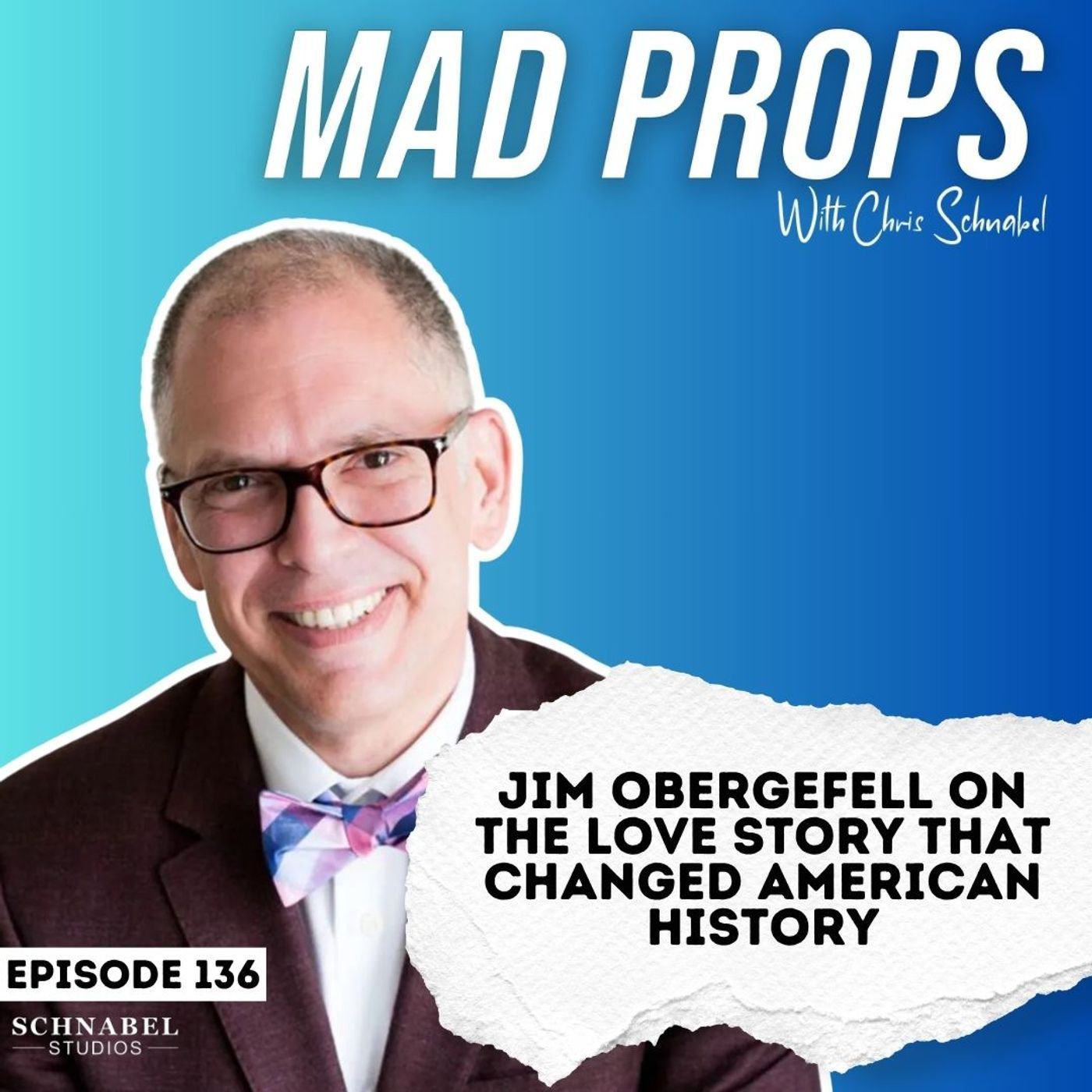
Mad Props with Chris Schnabel · Schnabel Studios
Welcome to Mad Props. Host Chris Schnabel throws it back to March 3, 2021, when civil rights activist Jim Obergefell joined the show to share the deeply personal story behind Obergefell v. Hodges and his unexpected path into civil rights advocacy. Jim takes Chris back to 2013, when his longtime partner, John Arthur, was dying from ALS. After the U.S. Supreme Court struck down part of the Defense of Marriage Act, Jim spontaneously proposed to John after nearly 21 years together. Because they lived in Ohio, where their marriage would not be legally recognized, the couple chartered a medical jet to Maryland and were married aboard the plane on the tarmac at Baltimore-Washington International Airport. They simply wanted to spend John's remaining days as husband and husband. Days later, civil rights attorney Al Gerhardstein explained that Ohio would still list John as unmarried on his death certificate and would not recognize Jim as his surviving spouse. Jim and John decided to fight back. What began as an effort to have their marriage recognized eventually reached the United States Supreme Court as Obergefell v. Hodges. Jim walks Chris through that journey, John's death, the emotions surrounding the Supreme Court case, and how a couple who never considered themselves political became part of a landmark moment in American civil-rights history. The conversation also explores what happened to Jim's life afterward, his transition into activism, his work with Family Equality, Equality Vines, and why he came to view equality as something that cannot apply to only one community. Jim also discusses the power of personal stories to change minds, why his and John's story resonated with people who held very different political and religious beliefs, discrimination in America, and the lessons he learned after unexpectedly becoming an activist. The episode closes with Jim's advice for anyone who finds themselves facing an injustice they never expected to fight: don't automatically shy away from the moment simply because you never imagined yourself becoming an advocate. Originally aired March 3, 2021. Join the Discord - https://discord.gg/dYhnmwQANb Follow Mad Props Instagram: https://www.instagram.com/madpropspod TikTok: https://www.tiktok.com/@madpropspod X: https://www.x.com/madpropspod Facebook: https://www.facebook.com/madpropspod YouTube: @MadPropsPod Follow Chris Schnabel Instagram: https://www.instagram.com/chrisschnabel TikTok: https://www.tiktok.com/@chris.schnabel YouTube: @Chris.Schnabel Mad Props is a Schnabel Studios Production ⏱️ CHAPTERS 00:00 – Welcome & The Story Behind This Throwback 02:22 – Jim Obergefell Joins Mad Props 02:49 – The Love Story Behind Obergefell v. Hodges 05:33 – Taking the Fight to the Supreme Court 10:10 – Becoming an Unexpected Activist 13:43 – Looking Back on the Historic Decision 17:05 – How Jim's Life Changed After the Case 20:20 – Family Equality, Equality Vines & Advocacy 21:27 – Fighting for Equality Beyond One...
Chris Schnabel: Welcome to Mad Props. I'm your host, Chris Schnabel. And today we're gonna be throwing it back to when civil rights activist Jim Obergefell joined the show. I want to thank everybody for being here and thank you for listening. I know we're doing another throwback episode. We've done a couple of these in the last few weeks now. to be completely transparent, it just gets very difficult to record, but at the same time, I want to stay consistent and get episodes out there. and and in this time, this has been the best way for me to do it. I actually think for me it's exciting because there's a lot of these episodes that we're doing as throwbacks that never really got the traction because they came out before you know people really discovered this channel. And we get to kind of bring them back out there. One, you can see the growth in this podcast and What it's come from, you know, years ago to now. Two, you can hear some of these people that we had on when we first started that you may not have never heard, may never have seen, may not have even known. we had a lot of great guests before the show really turned into the show that it is today. So it's fun to go back and kind of rediscover some of these and reshow some of these and be able to reclip them and put them back out there for people to see and all that kind of stuff. So we're gonna be joined by Jerem O'Burgefeld. This one is one of the first interviews we ever did. It's back from two thousand. So about five, six years ago now that this episode came out. It was episode one in the top 15 of episodes that came out. Like I said, it was one of the first ones to ever come out. it was one of the bigger guests we ever got. Jim O'Bergafell. Burgefell vs. Hodges is what legalized same-sex marriage. so he is a civil rights activist and has done a lot to move that movement forward and get us to where we are today. So I'm excited to share this one. If you've never heard it, you're gonna be excited to hear this one. Make sure you follow. on social media at mad props pod. Make sure you subscribe to us on YouTube. Make sure you join the Discord. Everything is in the description. If you want to do all that, let's get right to the interview. Let's get right to the podcast. Let's throw it back. Hope you enjoy. This is Mad Props. speaker-1: today we are honored to have an amazing guest with us, Jim Obergefell. for people that may not know, he was named the plaintiff on the case that legalized same sex marriage in the United States. Jim, how are you doing today? speaker-0: I'm doing well, Chris. Thanks for having me on. speaker-1: course. Thanks for coming on. And I said a little bit in the pre-show. Like I reached out. I was like, maybe he'll come on. It'd be amazing if he comes on. And then here we are. Here we are. And you're here. And you're here. speaker-0: Looking forward to it. speaker-1: so the reason you brought the case to Supreme Court was because you went to court in Ohio and you actually won the case, but then the state took it to another court and overturned the decision. So you brought it to Supreme Court. Now I might have butchered that a little bit. So would you like to go into it a little more for people that might not know as much about the case? speaker-0: No, actually you you had it perfectly right. So on June 26, 2013, when the Supreme Court overturned or struck down the Defense of Marriage Act with their decision in United States versus Windsor, I was standing next to my partner John's bed. He was dying of ALS and he was in at home hospice care and I was his full-time caregiver. And when that decision came out, Without having thought about this or planned it, I just spontaneously proposed to John. We had wanted to get married for years. We were together almost 21 years at that point. But we had agreed that for us, marriage couldn't just be symbolic. So we decided we would never marry because we wanted it to carry legal weight. And we lived in Ohio, that one of those states that had its own version of the Defense of Marriage Act. But when The Supreme Court struck down DOMA. Here was our chance to actually have the federal government recognize our marriage. So we ended up chartering a medical jet and we flew to Baltimore, Washington International Airport, where we landed, parked on the tarmac, and got married inside that medical jet. And that was all we wanted to do. We simply wanted to get married and live out John's remaining days as husband and husband. But five days after we got married, we met a local civil rights attorney, Al Gerhardstein. And he pulled out a blank Ohio death certificate and said, Do you guys get it? Do you understand that when John dies, his last official record as a person will be wrong? Because Ohio will say he's unmarried. And Jim, your name won't be there as his surviving spouse. Well, that broke our hearts, but I think more importantly, it made us angry. And when Al asked if we wanted to do something about it, John and I discussed it and decided, yes, we did. So we filed suit in federal district court. And as you mentioned, we won our first hearing in federal district court 11 days after we got married. John died three months later. And after that, the state appealed to the Sixth Circuit Court of Appeals. And our case was consolidated with other cases from Ohio, Kentucky, Tennessee, and Michigan all around the right to marry. And then we ended up at the Supreme Court. speaker-1: And then and then the rest is l legitimately the rest is history because your case is now gonna go down in history in in law books and stuff like that. Your case is gonna be there. It's one of the most important cases in in American history. Now, going back to Al Gerhardstein, now he was brought to you by a friend or he asked a friend to reach out to you because he wanted to tell you about this, right? speaker-0: Correct. We got married on a Thursday. And on Saturday, a story about us came out online from our local newspaper. And friends of ours, neighbors, were at a party where they ran into their friend Al, the civil rights attorney. And our story came up in conversation. And as they're telling him about us and what we had done by flying to Maryland, Al's mind was running a mile a minute. And he actually left that party. He ditched the party. didn't even tell his wife. He went back to his office and rifled through his file filing cabinets until he found that blank Ohio death certificate. So he reached out, he well, he went to our friends and asked if they would check with us, see if we might be willing to meet him. We had no idea what he wanted to talk about, but we thought, sure, why not? speaker-1: And going I want to go back on your support system really quick. Now you chartered the jet and I was watching one of your public addresses and you said that your friends and family raised thirteen thousand dollars to get that to get that jet for you guys. Now having that support system must have really helped through this whole process and before and after your your husband passed away and through the court cases and everything. Having the support system really must have been a huge help for you. speaker-0: I I can't express truly how important it was and how helpful it was to have the support that we had. Our family and our friends, you know, even before John got ill, they were great. You know, we lived in Cincinnati, which was pretty well known for a long time as one of the most gay, unfriendly cities in the nation. But our family and friends treated us like a married couple. And when John got ill, They were amazing. I mean, people helped us and supported us in so many ways. And when we decided to get married, you know, in a perfect world, I could have just put John in his wheelchair and taken him six blocks to the county courthouse for a marriage license, but we couldn't do that in Ohio. So we had to decide how do we get to another place, to another state. I wasn't going to put him in an ambulance. I wasn't going to put him in our wheelchair minivan. And he certainly couldn't fly commercially. So a chartered medical jet really was our only option. And this is one positive thing I will say about Facebook. You know, we started getting quotes, and it was something we could afford, but I thought, you know what? So many times it's the it's the people who know each other, it's the connections. Maybe somebody we know knows somebody who might help mitigate the cost. Pilot, someone with a chartered jet company. So I went to Facebook and said, Hey, John and I need to charter a jet to get married in Maryland and just curious if anyone has any connections. That was all we were looking for. And our family and friends just started commenting. Jim, we can't help you with the connection, but you and John deserve to get married and we want to help make it happen. So please accept this gift of cash. And they did, they covered the entire cost of that chartered medical jet, which was over thirteen thousand, close to fourteen thousand dollars. speaker-1: Wow. And that's that's amazing. Did they do it as in sending you like stuff through mail or something like that? Or was there a GoFundMe page created? speaker-0: You know, somebody initially said, Jim, Jim, you should create a GoFundMe page or something. I forget exactly what it was. And that just felt so weird to me. It just made me feel uncomfortable, but people kept saying, please, Jim, do something because we want to help and we will we want others to help. So we did do some some site. I don't remember exactly what it was. It was also people would, you know. So many of the banks have the ability to send money electronically. So it was it was a combination of things, checks, you name it. People just dug deep and were incredibly generous. speaker-1: Now you said that you guys weren't political before all of this like at all. But then obviously once you were starting to go to the Supreme Court and stuff, you kind of have to get more versed into it. How much did you study other cases? How much did you study branches of law? Things like that just to get ready for these cases when they were coming up. speaker-0: not at all. To be fair. And that's really driven by, you know, when we filed the case, you know, John was still alive. We had no idea he would die in three months, but that's what it ended up being. But my focus really was on John, was on caring for John, keeping him safe, keeping him comfortable. And for me, I didn't really have the the mental wherewithal or the bandwidth to start doing legal research. So we really relied on Al Gerhardstein in so many ways. He was phenomenal making sure we we understood what was happening, making sure we were able to provide needed information, provide input when necessary. He kept us apprised of what was going on, but he was also really good about not Overwhelming us with all of the myriad of details that are part of a case in federal district court, but things that we probably wouldn't care about or need to know about. So he was really good about that. Now, after John passed away, you know, certainly I started becoming more versed in I think number one, just being able to read legal decisions and Figure that them out, figure them out what it means to me in layman's terms. So I did start doing that. And, you know, I certainly got to know the the Windsor decision pretty well, but a big part of that was becoming really good friends with Edie Windsor. So there was that personal connection where I wanted to understand that more and how that impacted us. Not that I could tell you anything about it at the moment, but I certainly started learning more about the legal process. Much more than individual cases. speaker-1: I was about to that was leads into my next question very nicely. I was actually gonna ask how many people had like the same type of cases as you or the cases that got thrown out reached out to you when they found out that you were taking the Supreme Court? speaker-0: You know, I it's hard for me to poll specific memories related to people who had cases, similar cases that either were no longer in the courts or were in the courts, had won, had lost, regardless. I I don't really specifically remember that many people. I mean, I certainly got to know the the people in the Prop eight case. Chris and Sandy, Edie. But as far as other cases, I know there were time, there were some people, not that I could tell you who it was. I knew I know there were other plaintiffs in other cases, not not the cases that were consolidated with with my case, because we all met during, you know, the Sixth Circuit and other things. So those those other plaintiffs I certainly had more of a relationship with, but there were others who reached out. outside of those six cases, but do I have any recollection of the Absolut. speaker-1: We're talking with Jim O'Burgefell. So what emotions come to you when you think back on this case and the decision that was made? Is there like a feeling or moment that you think back to a lot? speaker-0: Absolutely. When I think back to sitting in in the courtroom on decision day, not surprising, that's probably the day that's foremost in my mind. There there are two emotions I felt that day that I still very strongly recall and think about. And one is once it I figured it out, once you know, listening to Justice Kennedy read the decision, and once I realized He is actually saying we won, bursting into tears, missing John, wishing John had been there to experience it, to know that our marriage could never be erased. But missing John, that that was my not surprising very first gut reaction, very first emotion. But shortly following that came the realization that for the first time in my life as an out gay man, I felt like an equal American. And that was such a surprising feeling. I mean, it isn't surprising that I felt that way, but I guess I was surprised that it was so strong. And maybe I just didn't even think that would happen, but that that was a beautiful realization, that feeling of equality. speaker-1: You said in one of your speeches that the feeling of equality and the knowing that law students for the rest of time will have trouble pronouncing your name when they have to look back at this case. And that made me laugh when I heard that because when I first looked at your name, I was like, I could get this, I can get this. I Burgefell, I got it. I got it. speaker-0: You got it clos speaker-1: I got it close. speaker-0: correct. Not no. the stress is on the O, not the burr, so it's Obergovo. speaker-1: A burger fell. speaker-0: Nope, you're stressed on the burr. but what you're doing is by far the most common. And to be honest, Chris, I don't get worked up about it. You know, I've had this crazy last name from birth. And, you know, from the moment I started in kindergarten, I learned very quickly. It doesn't bother me. It's not an easy name. So I don't get worked up about it. But I do still chuckle that law students for the rest of time will have to learn how to say it somewhat and spell it. speaker-1: Yeah. It it's funny. this is the second straight week now that we've had discussion about last names because we had a player named Jackie Jamelo, she's a WNBA player, and I was talking to her because my last name is Schnabel and it gets pronounced wrong constantly. Every every time someone says it, it's not right. So now we're two straight weeks talking the last names, so this is great. We all we just bring on people with difficult last names. That's the whole point of the show. speaker-0: I love it. That that sounds like a great plan. speaker-1: Yeah, they got tons of viewers just because they want to hear the last names. let's jump back real quick. So what's your life been like after the court decision was made? speaker-0: Well, completely different from what life was before. And you know, it it had started changing after John. Well, John passing away certainly was an enormous change in my life. But after he passed away, I was about ready to go back to work. And I was doing software education consulting at the time. And I just realized I couldn't do it. So I decided, no, I'm not going to go back. And I traveled for a while. So my life started changing from that perspective because I instead of having a nine to five job that I was going to Monday through Friday, I suddenly had more free time. But that free time was also now starting to be filled with speaking engagements, with events, with going to the United States Capitol to listen to. Senators Corey Booker and Sherrod Brown speak in favor of marriage equality and LGBTQ plus equality on the floor of the Senate. Things like that. So all of these things were happening, and I would I was doing things that I just never imagined in my life. So speaking became a big part of what I was doing, becoming much more of an activist, working with a lot of different organizations for LGBTQ plus equality. I Co-founded a wine label that supports equality for all. That certainly wasn't something I ever expected to do. And, you know, for a good what's five years, five years after the decision, I kind of led my own life of doing the things that I was interested in doing, the things that were meaningful to me. But it was just on my own, kind of scattershot. And then in September of last year, I started a new position to be more focused. So I'm actually now working with family equality. It's a national organization that fights for LGBTQ families, trying to create legal and lived equality for them. So I'm now more focused in my activism with family equality. And it's also just really good to now, especially during the pandemic. to wake up Monday through Friday and have something meaningful to do and a team to work with. My life has been very different. speaker-1: Yeah. You know, it's funny, people always say like they always wish that they could just have day the day off like weeks off and stuff like that and have nothing to do. But once you have nothing to do, you realize that's not what you want. You want something to give yourself some meaning and get out there and actually like have a reason to wake up. speaker-0: Exactly. And I I need some routine in my life. So it's it's been a good change for me. And it also just feels really good to be again working with an organiz organization with such an important mission. And for me, I love it because it just feels like the perfect continuation, the perfect segue of my work for marriage equality to now fight for families. speaker-1: And let's go back really quick. what is the name of the wine company and where can people find that? speaker-0: The wine label is called Equality Vines. And we have a tasting room in Sonoma County, California in Guernville. But you can absolutely order our wines online at equalityvines.com. And we're the world's first cause-based wine label. So every wine we release is tied to an organization fighting for equality. So when we sell a bottle of that wine, we donate to that organization. So we have wines that support LGBTQ organizations. We have wines that support women's rights organizations. This summer we released our first wine for immigrants' rights, and we're working on a line of wines for racial equality. speaker-1: That's that's amaz just to see how much you're doing to to help fight for equality for everybody, not just one group or anything like that for everybody is amazing. And and I was gonna save this more towards the end, but this is almost a perfect, perfect transition into it. How can we fight for not only L LGBTQ plus quality, but all equality? How can we do something to fight for that? speaker-0: No, that's that's a great and such an important question, Chris. And you know, I know for me personally, I started off as an LGBTQ plus rights activist. And that's really how I'm known, understandably so. But it was this realization, this learning that I can't ask for society at large to treat me as a gay man with respect and with equality if I'm not demanding that same thing. For every other marginalized community. So, yes, I'm an LGBTQ plus civil rights activist, but to me, I really consider myself more of a civil rights activist now for everybody. Because if someone else doesn't experience or enjoy equality, then I'm not really experiencing equality. So for people who want to be involved and help that fight, I think one of the most important things. You can do is make sure you vote in every single election, not just presidential, but local and state elections. Because by voting for people who value and support and fight for equality, you're helping make equality an ongoing part of our of our nation, of our of our country's DNA. And that's one of the most important things you can do. So vote for your values. Find those organizations that are supporting or fighting for causes you believe in and support them, whether that's volunteering, whether that's financial support, find those organizations and support them in the way that works for you. And I think one of the most powerful things we can do is use our voices and tell stories. Because stories really are how we change hearts and minds. And I Often like to say, you know, John's and my story was a story of love and loss. And people across the nation, regardless of really what they understood or how they felt about marriage equality, I think our story resonated with people because everyone loves someone and everyone loses someone. And that's what our story was about. It was about love and loss. And that helped take that. Abstract idea of marriage equality and make it something relatable to people. I mean, the sheer fact that sitting in the Supreme Court on Oral Arguments Day, the gentleman sitting next to me shook my hand and thanked me for fighting the right fight for marriage equality, and then told me that he was an evangelical Republican. To me, that was one of the clearest indications that stories matter, stories change hearts and minds. And by telling our stories and also speaking up on behalf of or in support of people we know, people we care about, or the values we we care about, equality for all, dignity, respect, that's how we can make that one-on-one interaction actually have an impact. speaker-1: And and I love to hear that, you know, for people that don't know, like you didn't go into this to be a civil rights lead or anything like you did it purely out of love. And and I you know, some people will hear people being civil rights leaders and think that's what they're that's not at all what this is going for. And if you think that is, go read the story or go listen to the story. It's not that at all, it's purely out of love. And that's why I like this story so much. That's why I wanted you on so much because you did it for all the right reasons. And another thing I want to take out that that I really you you might have said this the best way I've ever heard. you said that it's not equality if it's just for you. Equality means everybody. And that's that's what some people just don't get is when you're fighting for equality, you're not just fighting for one group, you're fighting for everybody to be equal, whether that's in the Black Lives Matter movement or LGBTQ plus movement or the women's rights movement, like they're all equality is everybody. And if you're fighting for one, you're fighting for them all. So that was probably one of the best ways I've ever heard that put. So thank you for that. speaker-0: I appreciate that. And it truly is what I believe. You know, I can't ask for for myself, for my rights, for my equality, if I'm not demanding it for everyone else. speaker-1: so it and like I said, that was a question I was gonna have towards the end, but it just was such a good transition. It was such a great answer, and it just was amazing. I just have a couple more here, so we're gonna backtrack a little bit, just just so you know, it's like, we seem like we're backtracking. That's because we we are backtracking a little bit. why do you think there to this day is still so much discrimination towards not just again, not just LGBTQ plus, but like all all groups? Like, why do you think in twenty twenty one? When when you know, everybody's been around forever, we still have to fight so hard to to get equal rights in this country. speaker-0: You know, Chris, I really wish I had a perfect answer for that. Because, you know, I I think of last year and how Black Lives Matter, that movement and racial discrimination, the reckoning for our racist past and present in this country really came to a head. You know, I wish I felt like our country did a good job of teaching history. Because so much so much of what is happening currently, so much of what we've experienced in the LGBTQ plus community, women's rights. If we actually knew our history, things might be different. And the example I give is, you know, during during our case, so many of the arguments used against same-sex marriage were the same exact arguments used against. Interracial marriage in Loving versus Virginia. Well, it didn't work back then. Why should it work now? So it's this refusal to actually read, understand, and learn from history. And I wish, I wish that were different because life would be a whole lot better. For everyone in this nation, if we could actually do that, and if we could actually deal with those horrible things in our past. You know, the fact that we're all sitting on ground, living on ground that didn't belong to us, that was stolen from the indigenous people. And the stain, the the absolute stain, the cancer of slavery that Still reverberates today. I don't know. I wish I had a better answer, Chris. It takes being willing to learn, being willing to question what you thought you knew, question your assumptions, and listen. Listen to other people when they say, This is my experience, this is what happens to me. This is what I feel, this is what. I've experienced throughout my life as a member of this marginalized community. Hear that, listen to it, believe it instead of poo-pooing it, instead of saying, no, that doesn't really happen, instead of discounting their lived experiences. I think if we could get past that hump of thinking that we know exactly what everyone else experiences, what everyone else feels, we'd be a lot better off. speaker-1: I I completely agree. I'm I'm very strong with the Black Lives Matter movement. I have a lot of friends that are black and I've seen the discrimination firsthand in certain ways and it it makes me so angry. And then when you talk to people, I think the most frustrating part, and you probably heard this before too, when you talk to people about it and they say, Well, you know, some people raised that way, it's like, Well, now you can raise them differently. Like let's start let's start to change that. Like I I It's it's like the thing, well that's the way it's always been. It's like, well, if they said that in slavery, we'd still have slaves today. Like you can't you gotta change things. You can't just say that's the way it is, that's the way it's been, that's the way we were raised. You have to to change things, you have you have to be the one to do it. And exactly what you said, you have to read, you have to listen, you have to witness for yourself. Don't don't just take secondhand opinions and make your own. Like make your own opinions. And and I think during the last presidency, we saw a lot of people taking secondhand opinions, but I don't want to get into all that. That's that's a I don't think that's a route. Yeah, I don't think that's a route we want to go down, but but it's it make your own opinion and and and be the change. Don't just don't just want the change or say, well we can't change 'cause this is how it's been because that's why this started. speaker-0: Yeah, saying, well, they were raised that way, or that's the way it's always been, that's so lazy. Yeah. And that is saying, I don't care. I'm not gonna, I I'm not willing to to actually be involved in making things better. That's just excusing things. And that's why why our country is the way it is today. Because for hundreds of years we've been just saying, well, that's the way it is. speaker-1: Yeah, and that's that's exactly. And like I said, there'd still be slavery, there'd still be all this stuff that happened in there seventeen hundreds are much different than today. There was it was a completely different time. Like we need to change from that. You need to evolve. We all evolved to become humans. We can evolve as humans as well, I believe. And and that's what I really hope to see. Like I stand with a lot of these things very strongly and it just It's in some of the areas I've lived in. I lived in the South and I've lived in in areas where you just hear the well, this is the way I was raised. It's like, Well, then change yourself. Then change yourself. You're a person too. Like you don't need to hold on to this opinion because you can change. You can change yourself. And we we talk. speaker-0: You can be better. speaker-1: Yeah, yeah, you can be better. Believe it or not, you can do it. Everyone else has. and we we we talk a lot a lot in sports with with just you you don't see a lot of people come out gay in sports, and I think it's almost the same thing. Well, sports has always been masculine and manly and this and that, and and I think that's a reason you don't see it as much because I actually think there's more closeted players in sports than than people let on. I don't know if you have the same opinion on that. speaker-0: Well, I'm not the biggest sports fan, but I absolutely believe there are many more LGBTQ plus people in the sports world than than we know. Because you're right, it is this hyper masculine. Uber stereotypical world where you have to live up to these false expectations, these false images, these whatever. So yeah, I'm I'm I have no doubt there are a lot more people in the sports world who are LGBTQ plus, but they're not comfortable coming out. And I can understand why. speaker-1: Yeah. And yeah, it's it's tough to see. I mean, there's been two in the last, what, fifteen years or something like that that have actually come out and they've been out of the league. They were out of league almost immediately and I and it's because of that exact thinking. So my last question is if you had any advice for somebody that's really looking to make a change in the world or to start a movement, what kind of advice would you give that person? speaker-0: Know I think my my best advice is don't shy away from those moments when you find yourself in a situation where you have the opportunity to take a stand to say, this is what I value, these are my my beliefs, and this is what I'm willing to fight for. Because honestly, Chris, if John and I hadn't been in that situation. Meeting Al Gerhard Stein when he pulled out that birth that death certificate and that abstract concept, that abstract understanding of Ohio's Defense of Marriage Act became real, became crystal clear how harmful and hurtful it was in that conversation. We could have said, well. But we we realized that was a fight worth starting. It was worth doing something we had never dreamt of, something that was scary, suing the state of Ohio and the city of Cincinnati. That's a scary thing to consider. But it was also such an easy decision because it was the right thing to do. And it was our chance to say, this is who we are, this is what we believe in, this is what we value, and we're going to fight for it for ourselves and for others. So if you find yourself in those situations, and again, it doesn't have to be something as dramatic as suing a state, but when you find yourself in those situations where you have the opportunity to actually verbalize and take a stand on something you believe in, do it. You're gonna feel great doing it, and you don't know what that small action, what that what you say. What you do, you have no idea what impact that can have on other people and honestly, on the whole country or the world. speaker-1: Jim, thank you so much for joining us. It was really an honor to have you on. Thank you all for listening. You can find offstage radio on Instagram, off dot stage. On Twitter, offstage radio, on Facebook, Facebook.com slash offstage radio, and online at Schnabel Productions. That's S C H N A B E L Productions dot com slash offstage radio. We are up everywhere. We're also on YouTube. You can check us out there. Make sure you go check check out his wine collection for racial equality. Thank you so again, Jim, and thank guys for listening. This was off stage radio. Chris Schnabel: Thank you all for listening. Thank you for sticking around. Again, you can follow us at Mad Props Pod wherever you get your social media. You can also subscribe to us on YouTube. You can find clips there as well. If you subscribe to us on YouTube, we put it on our YouTube Shorts page. make sure that you can follow me, not make sure, but you can follow me at Chris Schnovel, S-C-H-N A-B-E-L on all platforms as well. Make sure you come back next week as we'll have another episode next week of Mad. Props again, it's been busy, so I'm trying to get episodes out there. I want to stay consistent. Sometimes we gotta throw it back to do that, but don't worry, we have new episodes coming. We're negotiating a little bit, not financially, but we're negotiating a little bit with some guests to come on. It's more about times and and and dates more than anything else. And then we'll get some new guests on. We have some new other types of podcasts that we want to do to keep it fresh and keep it new and not keep doing these throwbacks. But when I have a limited amount of time, sometimes we got to go with the throwbacks. I hope you enjoyed, hope you liked it. Thank you. again for being here. We'll see you next week. This is Matt Props. Peace out.