
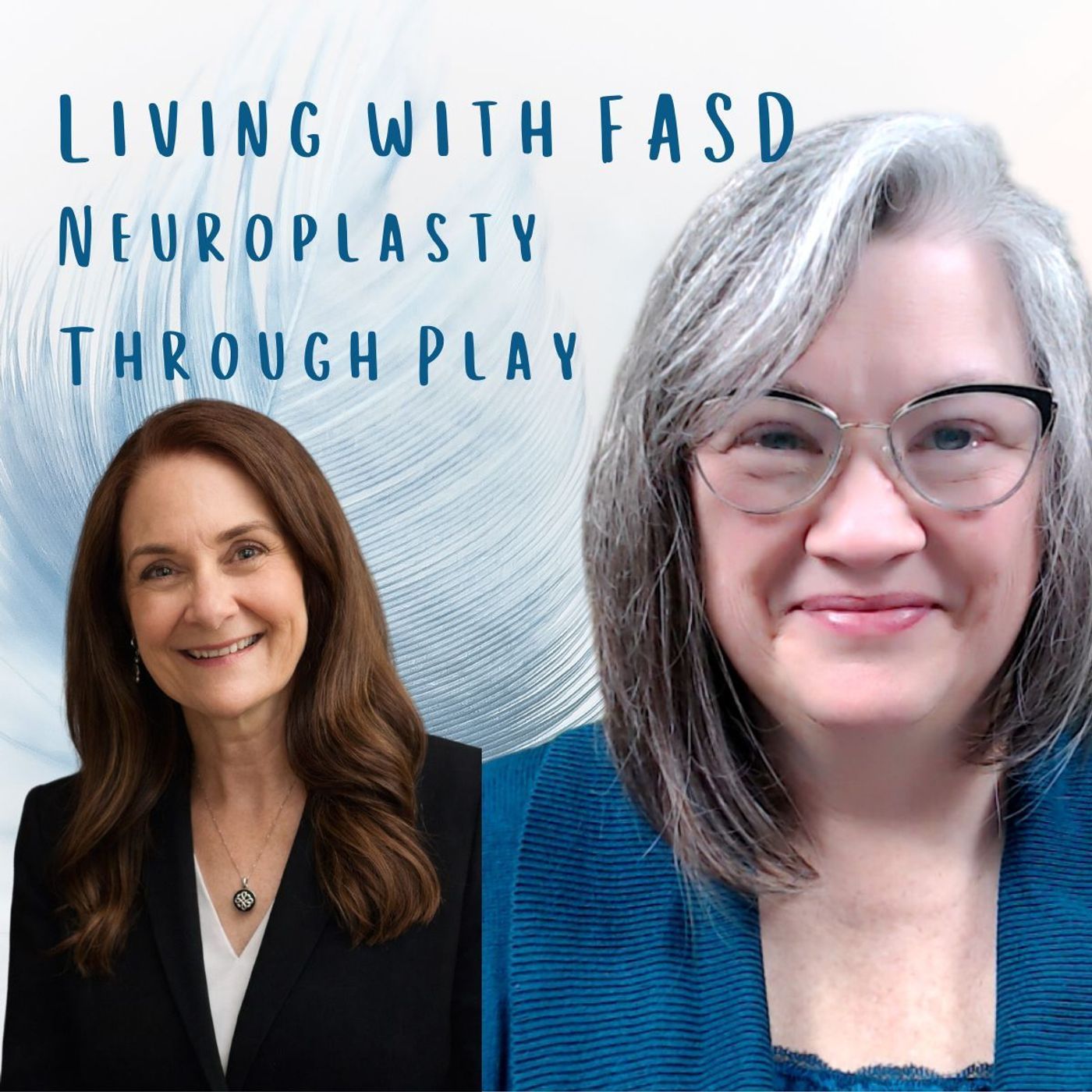
Living with FASD · Patricia Kasper
In this episode of Living with FASD, host Patti Kasper welcomes Dr. Carol Brown, Ed.D., founder of the Equipping Minds Brain Development Center in Kentucky. Drawing on more than four decades of experience across counseling, crisis centers, school administration, and neurodevelopmental intervention, Dr. Brown shares her journey into cognitive training and neuroplasticity. Inspired by her own son’s processing delays and working memory challenges, Dr. Brown created a holistic, play-based curriculum designed to strengthen cognitive pathways across the lifespan—from young children to adults navigating neurodevelopmental conditions, trauma, and cognitive decline. Patti and Dr. Brown explore the profound power of games, multi-layered symbology, and mediated learning to disarm brain defenses, eliminate anxiety, and unlock potential. They also discuss the "Cognitive Bloom," the lifelong reality of FASD, and why the brain remains capable of growth at any age. About Dr. Carol Brown Dr. Carol Brown, Ed.D., is the developer of the Equipping Minds Cognitive Development Curriculum. She has dedicated her career to helping learners who struggle with processing speed, working memory, executive functioning, and attention. Through her clinic, school partnerships, and international outreach, Dr. Brown equips educators, therapists, and parents with affordable, research-backed tools that utilize games, movement, and ancient coding systems to foster genuine cognitive growth. Key Takeaways Play Disarms the Defense System: Fear and anger shut down learning; intentional, joyful games open up neurological pathways and make skill-building sustainable. Ancient Coding & Cognitive Growth: Using shapes, colors, letters, animals, and symbols in layered card games trains working memory, visual processing, and multi-step direction following. Meeting the Brain Where It Is: Cognitive training works best when it builds strictly on what the learner already knows, avoiding overwhelm and frustration. The "I See You" Verbal Visualization: Adapting an instruction technique used by emergency personnel and surgeons—stating and repeating actions aloud—transforms self-perception and executive execution. Lifespan Neuroplasticity & The Cognitive Bloom: Brain development and emotional maturity don’t end in childhood; with the right environmental scaffolding and intentional exercises, growth happens across all ages. Resources & Connect with Dr. Carol Brown Website: equippingminds.com Free Video Content: Check out the Equipping Minds YouTube Channel for over 100 demonstrations and webinars. Curriculum & Materials: Explore the beginner/extreme card decks, teacher workbooks, and the Roses Program online. Exciting Book Announcement! 📚 4D Living with FASD: Shared Wisdom, Clearer Understanding officially launches September 9! Pre-order your copy, explore study resources, and dive into the 4D Framework at books.by/yourfasdcoach. Help Spread the Word! If this episode encouraged or enlightened you,...
Patti Kasper: I'm so glad to have you with me on this week's episode of Living with FASD. I try each week to bring you candid conversations that are meaningful. It has been my highest honor to do so. And collectively, the voices of this podcast offer tremendous wisdom for those of us living with FASD, for caregivers, and for the professionals with whom we interact. Stay tuned to the end of this podcast where I will share with you about my new book featuring our shared wisdom. It's launching on September 9th, so stay tuned to the end and I'll get you those details. Welcome to another episode of Living with FASD. I'm your host, Patti Kasper, and joining me today is Dr. Carol Brown from Kentucky, I believe, equipping minds. And she's got a brain development center. And I am so excited to introduce you to Carol, and we can all sit and learn together about what she has to offer, those of us with FASD. Carol, welcome so much. I'm so glad to have you here. Dr. Carol Brown Ed.D: it. it's an honor to be here, Patti, and to get to connect with you. And we got to visit for a little bit the other day and Patti Kasper: Mm-hmm, mm-hmm. Dr. Carol Brown Ed.D: kind of share our journey. So love the support that you are giving to families. Patti Kasper: Thank you. Thank you. Yeah. So you've been in practice for a while. I think a Dr. Carol Brown Ed.D: Mm-hmm. Patti Kasper: moment ago you said you've been you've offered trainings for 14 years. What and I'm sure your training has evolved over time. That happens to most Dr. Carol Brown Ed.D: It has. Patti Kasper: of us, yeah. so tell me a little bit about what your journey has been. What attracted you Dr. Carol Brown Ed.D: No. Patti Kasper: to FASD? Dr. Carol Brown Ed.D: Right. So the journey began, my word, over 45 years ago, actually, in my undergraduate studies. And so I was at Marshall University studying rehabilitation counseling. And so that also went into many different realms. And then I headed out to Texas. To do my master's in counseling and got a job at a children's home. And at this children's home, the in their profiles, they had been through so much trauma and their behavior was impacted so significantly that they needed to be in a locked facility with an on-campus school and could not be placed for adoption or even in the foster care system. Patti Kasper: That's the setting Dr. Carol Brown Ed.D: A Patti Kasper: I was working in in Chattanooga before I moved to California. So yeah. Yeah. Dr. Carol Brown Ed.D: Yeah, and that it was eye-opening because I would read the case studies and was just heartbroken. And so Patti Kasper: Mm-hmm. Dr. Carol Brown Ed.D: during during that time, that then was in the mid-80s. they actually made me the weekend director of the children's home. And I was probably all of 22 years old. And then I hired recreational therapist who we just celebrated 38 years of marriage and so Patti Kasper: Okay. Dr. Carol Brown Ed.D: but we were working there and one thing that we found in on our treatment team was that if we put in play okay that the number of behavior incidences was reduced significantly. So the relationship Patti Kasper: Wait down. Yeah. Yeah. Dr. Carol Brown Ed.D: aspect, the play aspect. And so because I was the weekend director, like Friday afternoon to Sunday afternoon, we had our critical incidents go down so significantly Patti Kasper: Mm-hmm. Dr. Carol Brown Ed.D: that I was actually accused of not, I must not be reporting them. Because there's no way that during the week Patti Kasper: Yeah. Dr. Carol Brown Ed.D: where their staff had a different kind of way they approached. And then Patti Kasper: Mm-hmm. Approach. Mm-hmm. Dr. Carol Brown Ed.D: I hired my staff and we had a very play-based, I had spent years in, you know, summer camping and different, but with the rec therapy background that my at not at that time my husband, but, you know, Patti Kasper: Mm-hmm. Yeah. Dr. Carol Brown Ed.D: and we were just like, my goodness, the more that we engage with these kids, the more that we play with them. Patti Kasper: Yeah. Yeah. Yeah. Dr. Carol Brown Ed.D: you know, we saw that reduction. And so then we would end up getting married. And then God would take us to North Carolina. And my husband Patti Kasper: Mm-hmm. Dr. Carol Brown Ed.D: was the assistant director of a children's home there in CrossNore, Patti Kasper: Mm-hmm. Dr. Carol Brown Ed.D: North Carolina. And we would be having children. Now I will tell you there was also right before then we were in St. Louis and I Patti Kasper: Mm-hmm. Dr. Carol Brown Ed.D: was the head of the crisis pregnancy center for Missouri Patti Kasper: Okay. Dr. Carol Brown Ed.D: Baptist Children's Homes and so was doing adoption placements and then some Patti Kasper: Mm-hmm. Dr. Carol Brown Ed.D: you know chose to parent their children but Patti Kasper: Yeah. Yeah. Dr. Carol Brown Ed.D: got to be in at that realm as well and Patti Kasper: Yeah. And you really dove into trauma there. Yeah, yeah. Dr. Carol Brown Ed.D: I did. I drove in into trauma, the court system. Patti Kasper: Yeah. Yeah. Dr. Carol Brown Ed.D: and so, but then on this journey, we had you know, we're having our own children, and it was actually Patti Kasper: Mm-hmm. Dr. Carol Brown Ed.D: with our second son that he was premature and born in this little mountain hospital. and his extremities were blue for the first 13 hours. And so that Patti Kasper: my that's terrifying Dr. Carol Brown Ed.D: It was terrifying. finally Patti Kasper: Yeah Dr. Carol Brown Ed.D: got to a NICU in Asheville, North Carolina at Mission Memorial Hospital. And but from the get go, because of my background, I thought, we're gonna see some challenges. So whenever Patti Kasper: Mm-hmm. Dr. Carol Brown Ed.D: he was getting any intervention, I was either in the room or in the observation room so I could learn what to do. Patti Kasper: Mm-hmm. Dr. Carol Brown Ed.D: And so at this time, God would then take us to the Atlanta area. And you know, but on this journey of therapies for him, because then it got really personal with him, Patti Kasper: Yeah. Dr. Carol Brown Ed.D: we kind of moved over to youth and family ministries in the church and then Patti Kasper: Mm-hmm. Mm-hmm. Dr. Carol Brown Ed.D: eventually in private school administration is kind of kind of making it. Patti Kasper: Okay. You've had quite the journey. Yeah. Dr. Carol Brown Ed.D: Quite the journey and then got to we were in Lyon, France for a couple of years. And I was the principal at the American School there. And so, but then we would kind of come back to the States. And then when my son was 16, he came home one day. And this is after tens of thousands of dollars worth of therapies. He said, Mom, I just can't process it as fast as it's coming at me. And so that's when Patti Kasper: What a keen observation. Yeah, yeah. Dr. Carol Brown Ed.D: Yes, it was because he he even said, Mom, I feel like they throw a frisbee on one side of the room and I go to catch it and they throw it on the other. And so what we were seeing Patti Kasper: Yeah. Yeah. Dr. Carol Brown Ed.D: was then he this child who loved learning was now feeling anxious and depressed and Patti Kasper: Yeah. Dr. Carol Brown Ed.D: defeated. And so I pulled out my son from the school. I was headmaster. of course, that's never a popular decision, and hired a friend to homeschool him. And so when Patti Kasper: Mm-hmm. Dr. Carol Brown Ed.D: it was at his pace, he did fine. But then, as we all know, the world isn't gonna slow down for his pace. Patti Kasper: Right. Dr. Carol Brown Ed.D: So, so during that time, we made the decision to leave school administration and Come to Kentucky, where my family was. And so I started pulling out his neuropsych and seeing that processing and working memory, those cognitive skills were greatly impacted. And I thought, you know, we've never truly targeted those. And so Patti Kasper: Yeah. Dr. Carol Brown Ed.D: then I started reading a lot of books. I had had the privilege of training with Dr. Daniel A-man at the A-man clinics back in Patti Kasper: Mm-hmm. Mm-hmm. Dr. Carol Brown Ed.D: 2000 before he was so well known. I think there were maybe 30 of us there at that training. Patti Kasper: Yeah. Yeah. Dr. Carol Brown Ed.D: And and I got to see the spec scans of the brain of Patti Kasper: Mm-hmm. Dr. Carol Brown Ed.D: what it looked like when it was impacted by whether it was different, you know, with alcohol, with traumatic. brain injuries, with with what an ADHD brain looks like, all the Patti Kasper: Yeah. Dr. Carol Brown Ed.D: different types of brain imaging. And then that there were things that could be done to help some healing happen. Okay. Patti Kasper: Mm-hmm. Dr. Carol Brown Ed.D: So that was very inspirational for me. And so that kind of Patti Kasper: Was was that your introduction to neuroplasticity? Yeah. Dr. Carol Brown Ed.D: Really, I feel like it really was. Now, internally did I believe in it? I did. Internally, I believed in it because I saw it when we worked with those kids. I had never heard a term neuroplasticity, Patti Kasper: Mm-hmm. Dr. Carol Brown Ed.D: probably until 2000 when I was at that conference and talking about that. But it wasn't a hard sell for me because I had that belief and I know I knew what I was already seeing with our son when we were intentional and and doing things through play that we were seeing growth that we were told not to expect. Okay. And so we all know there's nothing like you know, parents love, You know, to say, Hey, we're gonna do this. We're not going to accept these limitations. We're we're going, but you have to do it through play. Okay. It's gotta be fun and enjoyable. Patti Kasper: Yeah, yeah. Well, exactly, play disarms the defenses in the brain. Dr. Carol Brown Ed.D: It does. Yeah. Patti Kasper: You cannot be angry and playful at the same time. You cannot be fearful and playful at the same time. Yeah, yeah. Dr. Carol Brown Ed.D: Yeah. You can't. And a smile, we know what the a smile and laughter does to the brain and the Patti Kasper: Mm-hmm. Yeah. Yeah. Dr. Carol Brown Ed.D: power of all that. So so we came to Kentucky. I started developing equipping minds and my son and then my daughter were gonna be our first students. And then he ended up flourishing, being able to go on to college, graduating in three and a half years on the dean's list, which we thought would never happen. But and and Patti Kasper: That's awesome. Dr. Carol Brown Ed.D: keep in mind, we didn't start it with him till he was 17. So there is no closed door. Okay. We all know Patti Kasper: Right, right. Dr. Carol Brown Ed.D: the brain continues to develop till your late 20s, but we can still be increasing, Patti Kasper: Where? Dr. Carol Brown Ed.D: but we have to be intentional. We have to be intentional. Yeah. Patti Kasper: Right, right. And and I I would challenge that just a bit I would stretch it, right? Because it seems to Dr. Carol Brown Ed.D: Yeah. Patti Kasper: me those of us with FASD, it's not our mid-twenties where things solidify and we become adults. It's about a decade later. You know, it's it's early to mid thirties, maybe late thirties before things really settle in. And I've started Referring to that as the cognitive bloom. Right. When things fall into place and we truly step we begin to trust ourselves and and our ability to use workarounds and whatever else, and we really start to blossom like never before. Yeah. Dr. Carol Brown Ed.D: And that is such a psychological, spiritual piece about Patti Kasper: Mm-hmm. Dr. Carol Brown Ed.D: our understanding of who we are. Patti Kasper: Yeah. Dr. Carol Brown Ed.D: And so and that that does take time. You just see that with Patti Kasper: Yeah. Yeah. Dr. Carol Brown Ed.D: people trying to, you know, students in college changing their major, trying to figure out what they, you know, want to do and different things. And you Mm-hmm. Yeah, I did Patti Kasper: That that was me. I started college at 16. That was the yuppie way of running away from home. I could not stand Dr. Carol Brown Ed.D: Yeah. Right. Yeah. Patti Kasper: my stepfather. Ugh and I'm not gonna get into that because that would be a really long story. But Dr. Carol Brown Ed.D: Okay. Patti Kasper: no 16-year-old knows what she wants to do when she grows up. I don't care how deluded she is at the time. And I'm saying that from personal experience. Dr. Carol Brown Ed.D: Absolutely. Patti Kasper: I changed my Dr. Carol Brown Ed.D: My advisor said stop coming in and changing your major. Just stick with something and don't worry about it. So yeah. Yeah. Yeah. Patti Kasper: Right. Stay undeclared for at least two years, right? And and and I would say it's actually very valuable to work for a few years before you start college. because we learn so much about Dr. Carol Brown Ed.D: absolut. Absolutely. Patti Kasper: life through experience, and we really need that before Dr. Carol Brown Ed.D: We do. Patti Kasper: we start filling our heads. but I every Dr. Carol Brown Ed.D: Yeah. Patti Kasper: time I change my major, I also changed my college. Dr. Carol Brown Ed.D: Mm-hmm. Patti Kasper: And so by the time I started my junior year Dr. Carol Brown Ed.D: Yeah. Patti Kasper: at University of Pittsburgh School of Social Work, I already had over 120 credits. Dr. Carol Brown Ed.D: wow. Yeah. Patti Kasper: And so you add another 66 to that, you know, and I've I've had a PhD a couple times over. So just nothing lines up in, you know, because Dr. Carol Brown Ed.D: Hm. Yeah. Yeah, absolutely. Right. Patti Kasper: it's a very well rounded, very well rounded education. Dr. Carol Brown Ed.D: Right. Well, I I was very blessed when I was out in Texas and started my master's in counseling. Patti Kasper: Mm-hmm. Dr. Carol Brown Ed.D: And then I'm working at the children's home, okay, with these children. And I'm seeing things I've never seen before in behaviors and, you know, a three year old saying, I'm gonna get a gun and kill you. And I was like, whoa. Whoa, Patti Kasper: yeah. Dr. Carol Brown Ed.D: okay, where did that come from? And then I go and talk to my counseling professors and they had nothing. They were just nothing. Well, Patti Kasper: Mm-hmm. Yeah. Dr. Carol Brown Ed.D: at the same time, the seminary had a degree in social services. And Patti Kasper: Mm-hmm. Dr. Carol Brown Ed.D: I went and talked to the professors there who had been in social work. And and I ended up switching to the social work and Patti Kasper: Mm-hmm. Dr. Carol Brown Ed.D: and And thankfully, because I was in council, all the credits transferred. So I was good on that one. But but Patti Kasper: Yeah. Yeah. Dr. Carol Brown Ed.D: with my own son, and and then when we saw with him and I started developing this program, I knew it had to be because he was in a classical Christian school. Okay. He had had the academics. Okay. And we just wanted him to do the best. We did that with all our kids. We didn't care about what your grades were. I thought. I've got advanced degrees. Nobody's ever asked me my GPA. It it doesn't, you know, nobody's ever asked. Patti Kasper: Yeah. Dr. Carol Brown Ed.D: So just do your best, right? And so, so when we started you know, doing this with him, seeing his success, then we worked with another little girl who happens to have Down syndrome, and Patti Kasper: Mm-hmm. Dr. Carol Brown Ed.D: she made unprecedented gains. academically in just nine Patti Kasper: Okay. Dr. Carol Brown Ed.D: weeks. And she was 10 years old. And so by it was very fast. And so Patti Kasper: That's very fast. Yeah. Dr. Carol Brown Ed.D: we, and thankfully it wasn't from my testing, it was from the school's testing because in Kentucky they do math testing. It's a measure of Patti Kasper: Uh-huh. Dr. Carol Brown Ed.D: academic performance three times a year. So we'd been Patti Kasper: Okay. Dr. Carol Brown Ed.D: working for nine nine weeks. I went over for Patti Kasper: Mm-hmm. Dr. Carol Brown Ed.D: 45 minutes a day. And I was her intervention and she didn't have any homework. And I get to school at the nine week mark and the principal meets me at the door to share the scores with me. And she said, Carol, she went up 20 points in reading, 11 in math, 16 in science, 17 in language. Sh nobody goes up double digits. She went up higher than any student in the school. And the next Patti Kasper: Yeah. Dr. Carol Brown Ed.D: thing I know, I'm getting called over to the University of Louisville Brain Science Department, and they want to see this. What are you doing? Patti Kasper: Yeah. Yeah. Dr. Carol Brown Ed.D: Telling me that no one in the world has ever done what I've done. And when I did find out about the Foyer Stein Institute in Israel, and they wanted to see my work, I sent it over. They were very affirming. But then they I did say, Have you ever gotten these kinds of gains? And they said, No, not in the amount of time that you did. And so that all of a sudden opened the floodgates. I thought when I developed this. That it was going to be for kids with ADHD, dyslexia, dyscalculea, you Patti Kasper: Yeah. Dr. Carol Brown Ed.D: know, Asperger's. but at the same time, it was interesting because I had not seen the term F A S D until 2000, it was probably, I guess it was 2012, maybe, there the The Ness family, who are good friends with Jodie Culp, were also at our church, started coming to our church. And they had adopted children who Patti Kasper: Mm-hmm. Dr. Carol Brown Ed.D: had FASD. And that's when I got my education, exposure, and everything. And got to meet Jodi and read her work. And but it was all very similar. We were doing Patti Kasper: Mm-hmm. Dr. Carol Brown Ed.D: primitive reflex exercises. We were doing vision exercises. We were looking at trauma and nutrition. We were looking using sound therapy as well. Patti Kasper: Mm-hmm. Dr. Carol Brown Ed.D: So we had a very holistic, but our big difference is the cognitive that I developed. Patti Kasper: Okay. Dr. Carol Brown Ed.D: And doing that play and insisting also on wanting to train parents that to Patti Kasper: Mm-hmm. Dr. Carol Brown Ed.D: be a part of the sessions. And then we started doing training workshops and recording those. So then parents could use this at home because we Patti Kasper: Mm-hmm. Dr. Carol Brown Ed.D: saw with with the FASD in particular, and and it's true with Down syndrome or autism that It wasn't going to be like some of our dyslexic students, who it was gonna be three or four months, you Patti Kasper: Mm-hmm. Dr. Carol Brown Ed.D: know, we connect their processing, working memory, they're good. Okay. Patti Kasper: Yeah. Dr. Carol Brown Ed.D: but we saw that it was going that they were gonna benefit from it for an extended period, okay, to Patti Kasper: Mm-hmm. Dr. Carol Brown Ed.D: keep it like for example, yesterday. I was in Hancock County, Kentucky, training 80 teachers pre-K to high school. Patti Kasper: Mm-hmm. Dr. Carol Brown Ed.D: Okay. And in this method, and they're going to use it in special ed. They're going to use it in the regular classroom. And they're going to do it before it one of the educators who was so excited came up. And she said, this is amazing because with equipping minds, we I developed a code. And within Patti Kasper: Okay. Dr. Carol Brown Ed.D: this code, all the games we play have to do with shapes and colors and animals Patti Kasper: Uh-huh. Dr. Carol Brown Ed.D: and the presidents and vows and letters and months and directions. And Patti Kasper: Okay. Dr. Carol Brown Ed.D: so this is a code. Well, this kind of Coding has been around 3,400 years because ancient Hebrew, ancient Egyptian, Patti Kasper: Mm-hmm. Dr. Carol Brown Ed.D: Ancient Greece, Sanskrit, all Patti Kasper: Mm. Dr. Carol Brown Ed.D: of them used codes that represented sounds and letters Patti Kasper: Mm-hmm. Dr. Carol Brown Ed.D: and numbers. And so even our military does symbology where, for example, blue represents. friendly red is an enemy. Okay. So Patti Kasper: Mm-hmm. Mm-hmm. Dr. Carol Brown Ed.D: colors had meaning, shapes have meanings. And so, so this has been around for for 3,400 years, the c conceptually to train the brain. Well, Patti Kasper: Right. Right. Dr. Carol Brown Ed.D: all of us, I think right now it's, you know, August 13th, 2026. And this summer, the movie The Odyssey came out. And Patti Kasper: Yeah, I guess. Dr. Carol Brown Ed.D: Lot of people are probably ordering it, picking it back up. And but it typically when we pick up the ancient epic poems, people are like, I can't, I can't understand this. You know, it just Patti Kasper: Yeah. Dr. Carol Brown Ed.D: the complexity of epic poetry. Well, y'all, wait a minute. So we're supposed to be so advanced, but we can't understand we struggle to read what they wrote. Patti Kasper: Yeah. Yeah. Dr. Carol Brown Ed.D: Huh. And how they built the pyramids and how they built, you know. Wait a minute, how were their brains brains trained? Symbology, coding, Patti Kasper: Yeah. Yeah. Dr. Carol Brown Ed.D: multi layers, and so Patti Kasper: It's it's very egotistical to assume that nobody ever had intelligence before our generation. Dr. Carol Brown Ed.D: Right. Right. And so I it it's been really fun. That is an advantage of AI because what happened, I didn't discover it. It was a government coder and a Hebrew expert who looked at this who said, that looks like ancient language coding. That actually looks like ancient Hebrew. And so then I started putting in the Hebrew codes. my codes, Aristotle's codes, and saw all the overlap. Now I also studied the work of Caminius, the father of education, who in the 1600s said that the brain could be changed. Okay. And so his work is amazing. And he used a lot of play as well, but he believed that people developed at different stages and some might bloom early and some later. And he just his his work is beautiful and greatly influences mine. Patti Kasper: Mm-hmm. Dr. Carol Brown Ed.D: And and so on this journey I read about what's called the symbol digit test and that was used in 1917 to figure out in the military who would be great at different jobs. And so Patti Kasper: Mm-hmm. Dr. Carol Brown Ed.D: we have a symbol page but Patti Kasper: Yeah. Dr. Carol Brown Ed.D: the the page you just looked at the colorful page when Patti Kasper: Mm-hmm. Dr. Carol Brown Ed.D: you apply it here then they look and they'll say eight black pigs be John Adams left parenthesis you know fish Patti Kasper: Mm-hmm. Dr. Carol Brown Ed.D: Down left, you know, and so they can tell you the number, the color, the animal, Patti Kasper: Yeah. Dr. Carol Brown Ed.D: the letter, the president, the symbol, the Patti Kasper: Yeah. Dr. Carol Brown Ed.D: sound, the month that goes with all these symbols. Well, in the Patti Kasper: Mm-hmm. Dr. Carol Brown Ed.D: symbol digit test, they just have you do numbers. Okay. Patti Kasper: Okay. Dr. Carol Brown Ed.D: And I take it on hyperdrive, but I was like, well, if that was a way to develop and to To be able to look and see who could function cognitively well in the military, Patti Kasper: Mm-hmm. Dr. Carol Brown Ed.D: there must be something to that. And so, and then the work of Dr. Stroop, J. Ridley Stroop, who was also a minister in the late 1920s, early 1930s. And his most famous one that people usually know are the Stroop colored wards, where green is written in green. Patti Kasper: Okay. Yeah. Right. Dr. Carol Brown Ed.D: And then the other ones. Okay. And so, but you have to ignore what's Patti Kasper: Mm. Dr. Carol Brown Ed.D: written and say the color you see. Patti Kasper: Yeah. Dr. Carol Brown Ed.D: Well, I take this and we come over here and they'll tell me the number, the color, the animal, the letter, the president. Patti Kasper: Mm-hmm. Mm-hmm. Dr. Carol Brown Ed.D: And we put those codes in, but we also do that with card games I've developed. And so it's just playing. And so the kids Patti Kasper: Mm-hmm. Dr. Carol Brown Ed.D: And it's so sweet. One of the little boys said to me, I was visiting one of our schools because while we started out in private practice, kind of a as a clinic, then schools were wanting to get trained. And so Patti Kasper: Mm-hmm. Dr. Carol Brown Ed.D: now small groups, whole classrooms, and I'm visiting one of our schools in Alabama. And a little boy said, You know, it's like we know our own secret language. And I'm like, you know what you do. And that's Patti Kasper: Yeah. Dr. Carol Brown Ed.D: just like when you look at the symbols of other ancient languages, the same thing is is true here Patti Kasper: Yeah. Dr. Carol Brown Ed.D: because you can actually make sentences and say George Washington saw two red elephants walking down the hill. And people are like, How did you come up with that from those words? Well, when you apply the code, right? Patti Kasper: Yeah. Dr. Carol Brown Ed.D: And so what was interesting as we're doing all this and this the family, the Ness family, had the four children, but they were while they all had FASD, as you all well know, they were the beautiful example of it impacted all four of them a little differently. Okay. Were Patti Kasper: Right, right. Dr. Carol Brown Ed.D: there some similarities? Yes. But were there some differences? Absolutely. Absolutely. Patti Kasper: Mm-hmm, mm-hmm. Dr. Carol Brown Ed.D: And so so we started working with them, but we did what we did with the little girl with Down syndrome. And this is what was so transformative because I didn't know anything about Down syndrome. Patti Kasper: Mm-hmm. Dr. Carol Brown Ed.D: I and and I use this as an example because we know the brain is impacted, we know the cerebellum is impacted in development. But her mom's looked at me and said, Carol, I need for you to do with Rose exactly what you would do with anyone else. And that's what I did. Now I thought from a marketing perspective initially that the way we applied equipping minds, whether you had Down syndrome or autism or dyslexia or FASD would look differently. It doesn't, not at all. We do the exact same program. Patti Kasper: Okay. Dr. Carol Brown Ed.D: What's different is how they work through it. Patti Kasper: Yeah. Dr. Carol Brown Ed.D: Because on day we had the four family members, and we've got them all in a session simultaneously, but with different therapists. Patti Kasper: Mm-hmm. Dr. Carol Brown Ed.D: And so you could walk in and see all of them playing our card games. All of them doing our colored words, or all of them doing our animals, or all of them doing our special visualization for the Patti Kasper: Uh-huh. Dr. Carol Brown Ed.D: presidents, or all these things, but they were not on the same steps on all of those things. Patti Kasper: Yeah. Yeah. Dr. Carol Brown Ed.D: Okay. They were on different steps and they would be progressing through at different levels, okay? Patti Kasper: Mm-hmm. Paces, yeah. Mm-hmm. Dr. Carol Brown Ed.D: Yes. And so we just celebrate each of those. But what's interesting is you can see all of their memory increase and that ability to follow multiple step directions. So if you can follow me on this one, but you may see someone who had gotten up and in equipping minds, like with our tic-tac-toe games, there are 37 steps. Patti Kasper: Wow. Dr. Carol Brown Ed.D: Okay. Well, you may see the student who got up to twenty steps. Doing great. But let's say the student who got to 10, maybe her memory even got stronger than the one at 20. It wasn't about which step you got to. These are ways that we transform and strengthen, create, strengthen neuropathways. And so, and we typically Now, because we started doing teletherapy in 2013, we have moved to a model of doing it 30 minutes a day, five days a week. And so when people were coming into our clinic, it was typically a 45 or a 60 minute session because people are traveling. And Patti Kasper: Mm-hmm. Right. Dr. Carol Brown Ed.D: so then we started kind of, and a lot of times. Patti Kasper: Doing it virtually. Yeah. Dr. Carol Brown Ed.D: You know, that's 45 minutes or 60 minutes is a long exhausting brain workout. And so Patti Kasper: Yeah. Yeah. Yeah. Dr. Carol Brown Ed.D: when we moved to a 30 minute model, what we found was one, kids love doing it online from the safety of their home. It was easier Patti Kasper: Mm. Dr. Carol Brown Ed.D: to include parents. Patti Kasper: Yeah. Dr. Carol Brown Ed.D: Okay. And and then they You know, at the end of 30 minutes, they're kind of like, wait, we're done. You know. And so, and that's that's Patti Kasper: It's always good to leave them hungry for more. Dr. Carol Brown Ed.D: is and I tell when I was down when I trained teachers, first thing I'm gonna say, I'm like, there is one rule in equipping minds. You have to be having fun. And if you're not having fun and they're not having fun, you need to call me. Okay, you or send me an email because you're either working at a level that is above where they need to be. And so that's frustrating and the brain will shut down. Patti Kasper: Yep. Yep. Dr. Carol Brown Ed.D: And but I also have a theory, okay? And it's it's very simple. It's we can only train the brain with what the brain knows. Okay. So I had an email from a parent who said, Well, you know, I have a high school student, but you're gonna want them to sort cards by number or color or letter or animal. They know all those things. And I'm like, exactly, exactly. Because Patti Kasper: Mm. Mm-hmm. Dr. Carol Brown Ed.D: if they didn't, we would have, and what we do if they don't is we teach one color at a time. And we play games with one color and then two colors and then three colors, right? But I'm like, Patti Kasper: Yeah. Right. Right. Dr. Carol Brown Ed.D: You don't get it. When we're working and doing this with yes, business professionals, yes, college Patti Kasper: Mm-hmm. Dr. Carol Brown Ed.D: students, yes, early onset dementia, yes, traumatic Patti Kasper: Mm-hmm. Dr. Carol Brown Ed.D: brain injuries. No, no, no. I'm like, okay, what do they know? I need to know what they know because I'm gonna use what's known Patti Kasper: Right. Dr. Carol Brown Ed.D: because that code I showed you are all things that we know, but then we start, Patti Kasper: Mm-hmm. Dr. Carol Brown Ed.D: I just train teachers. Okay, by the end of the first day, they're like, whoa, whoa. Patti Kasper: Yeah. Dr. Carol Brown Ed.D: Okay, wait a minute. I think I need this. What are you asking my brain to do? And I'm like, Patti Kasper: Yeah, yeah, yeah. Dr. Carol Brown Ed.D: Yeah. and so it's like, no, no, no, you have to take those things because otherwise the brain shuts down. And Patti Kasper: Mm-hmm. Dr. Carol Brown Ed.D: it was so I had the most amazing privilege. When my son graduated, the one Clayton, I have two sons, but the one Clayton graduated from college, and we're at his college graduation, of course. And the speaker at the very end starts telling a story. And he tells the story of Tom Kramer. And Tom Kramer is the one who brought the Rubik's Cube to the world. Patti Kasper: Mm. Dr. Carol Brown Ed.D: Okay. So Dr. Rubik's was in Hungary and it was under Soviet control and his class had developed it and it was first called the Magic Cube. Well, Patti Kasper: Mm. Dr. Carol Brown Ed.D: Tom Kramer brought that to the world. Well, when I heard this story, I went and looked him up and he was still alive. He was in his 80s and he owned a toy company. Patti Kasper: Mm. Dr. Carol Brown Ed.D: And so there was a contact us. So I sent him an email, Patti. And he calls me. Tom Kramer calls me. And I'm like, he's in his 80s. And I'm like, you know, to my husband, Tom Kramer. I just got off the phone with Tom Kramer. And and so, and I'm like, and so he said, let me tell you my story. He said, I survived the Holocaust. I was a Holocaust survivor. And then after I gra graduated, I went to the UK and I went to work in a school for troubled teenagers and tub or troubled children. And in the interview, they said, these kids come from hard places. Patti Kasper: Mm-hmm. Dr. Carol Brown Ed.D: And he said, so do I. And then they made him the soccer or the football, because it's in the UK coach. Patti Kasper: Right. Dr. Carol Brown Ed.D: And he's and the reading teacher, and he was supposed to be the reading teacher. So he said, I went in there to try to teach reading, and I would pull out letters and these kids would shut down. They would he said, then I took a soccer ball and I wrote words on it. And I would throw out the ball. And whoever, if they could find the word, they got a chalk. Is what he said. He did. And then Patti Kasper: Ha ha ha makes it a game. Dr. Carol Brown Ed.D: he said these words to me that just I will never forget. I just got chills. He said, Carol, no child is so damaged they can't be reached through games. And I was like, my gosh, Tom, that's that's what we do. That's Patti Kasper: Yeah, yeah. Dr. Carol Brown Ed.D: what I do. regardless of how Whether the trauma was physiological, okay, psychological, developmental, you know, it all then and then impacts development at different levels. And just knowing one, that this is a journey. The reality is we're all on a journey, Patti Kasper: Mm-hmm. Yeah. Dr. Carol Brown Ed.D: because equipping mice is used with people with early onset dementia, like cognitive Patti Kasper: Mm-hmm. Dr. Carol Brown Ed.D: impact. mild cognitive Patti Kasper: Mm-hmm. Dr. Carol Brown Ed.D: impairment or structural cognitive impairment. And so we, you know, we don't need to accept that as adults. Okay. Patti Kasper: Mm-hmm. Dr. Carol Brown Ed.D: but the relationships, my goodness, that is one thing with equipping minds. It's the fun, it's when you're doing it, you're always modeling and you're Patti Kasper: Mm-hmm. Dr. Carol Brown Ed.D: always taking turns. It's not about the student being a project or something. No, no, no, no, no. Patti Kasper: Right, right. Dr. Carol Brown Ed.D: We are taking turns. She's gonna go, I'm gonna go, mom's gonna go, we're all gonna have a turn. And we're using mediated language. And that was something Patti Kasper: Mm-hmm. Dr. Carol Brown Ed.D: wonderful that when we did train with the Fourier Stein Institute, that we really embraced we it's the one in Israel and we had Patti Kasper: That's the one in Israel, right? In Israel. Dr. Carol Brown Ed.D: We had been using Socratic questioning because of my classical background and using Aristotle's Patti Kasper: Mm-hmm, mm-hmm. Dr. Carol Brown Ed.D: ten categories because it is. What do you see? How many? What colors? What shapes? Patti Kasper: Yeah. Dr. Carol Brown Ed.D: Where are we going to start? So all and so it just helped even solidify more that we were on the right track and then brought Patti Kasper: Mm-hmm. Yeah. Dr. Carol Brown Ed.D: a couple. other things in that were just fabulous. And so when like when the family who we met, the first family who we started just learning, and then I was like, my gosh, well, then I went back to that first job in the children home in Texas. Patti Kasper: Mm-hmm. Dr. Carol Brown Ed.D: I'm like, my goodness. I bet if I went and read those case files, a lot of the case files focused on The physical abuse that had happened Patti Kasper: Mm. Dr. Carol Brown Ed.D: to these kids. yes, physical, sexual abuse. I mean, it was just awful. But I bet if we had looked deeper, you know, there's a lot of overlap with with different things there, right? But so that's, you know, how it came to be. And and and honestly, because we know, we know. That You know, FASD and another area is post-concussion syndrome. Patti Kasper: Mm-hmm. Dr. Carol Brown Ed.D: Okay. Both of those really go undiagnosed. They are very hard Patti Kasper: Yeah. Yeah. I Dr. Carol Brown Ed.D: because they they can look like Patti Kasper: Mm. Dr. Carol Brown Ed.D: oppositional defiant disorder. They can look like ADHD. Patti Kasper: Yeah. Yeah. Dr. Carol Brown Ed.D: They can look like, they can look like, they can look like and and then on our Yeah. Patti Kasper: Yeah. Right, right. I I often refer to FASD as the zebra. You know, when you hear hoof beats, look for the horses. Well, what do most because horses are so much more common than zebras, at least Dr. Carol Brown Ed.D: Right. Patti Kasper: when you're not in Africa. The horse is the predominant animal. And so, you know, what are our horses? It's ADHD, it's autism, it's optifiant. Dr. Carol Brown Ed.D: It is. Yeah. Patti Kasper: It's this, it's that, it's rad, it's this, it's that, it's the other. But you know, Dr. Carol Brown Ed.D: Right, right. Yeah. Patti Kasper: they sound the same, but they're Dr. Carol Brown Ed.D: They do. Patti Kasper: very different creatures. And while many providers will say, well, we're just going to, you know, because of the overlap of characteristics, we're gonna run with ADHD, or we're gonna run with autism because of easier access to services. Dr. Carol Brown Ed.D: Yeah. Mm-hmm. Patti Kasper: But one of the things about FASD is all the comorbid conditions. And Dr. Carol Brown Ed.D: Right. Patti Kasper: that's the raised risk of all these other physical things, is part of your medical record. It it should be, right? Helping doctors Dr. Carol Brown Ed.D: Mm-hmm. Patti Kasper: down the line, whether it's 10 years later, 20 years later, 30 years later, to be aware of those things because it's going to matter when it comes to differential diagnoses. just as we come into our cognitive bloom, our bodies go into shutdown, they fall apart earlier than most. You know, so it's important information. Dr. Carol Brown Ed.D: No, it is. It's crucial. And I think the other thing we've seen as you heard me share how my son, when he couldn't process, when he couldn't hold on to everything, especially the in in lower grades, you know, the teachers are so multi-sensory. And so sometimes Patti Kasper: Mm-hmm. Dr. Carol Brown Ed.D: things you know, they can either get masked or they just don't interfere as much because of the teaching methods. And then By the time middle school and then especially high school, when you have all the different teachers and and all of that, and you have to hold on to so much more information. and and so when we saw that, we also saw with our son, we were having testing done because it looked like he had digestive problems and it was actually from stress. It was stress, right? Patti Kasper: That's so common. Yeah. Yeah. Dr. Carol Brown Ed.D: And so, and so we saw once we then removed him from that environment, and then we're teaching him at his level. And then when we start doing building the processing and the cognitive, Patti Kasper: Mm-hmm. Dr. Carol Brown Ed.D: then he could go back into a classroom. The anxiety anxiety was gone, the depression was gone, the joy was back to learning. And Patti Kasper: Yeah, yeah. Dr. Carol Brown Ed.D: and so those things. did not present. And then what we have seen with a lot of our students is that once those cognitive areas are strengthened, then Patti Kasper: Mm-hmm. Dr. Carol Brown Ed.D: they can remember the steps of directions, the rules Patti Kasper: Mm-hmm. Dr. Carol Brown Ed.D: to a game on the playground, or what Patti Kasper: Mm-hmm. Dr. Carol Brown Ed.D: their boss is asking them to do, or the steps to a math problem. Patti Kasper: Yeah, yeah. Thank you for that because we do graduate and and have to you know keep functioning in the world. We change teachers for bosses. Yeah. Yeah. Dr. Carol Brown Ed.D: Absolutely. Absolutely. And because I'll tell people all the time, because Equipping Minds is divorced from content. And I'm like, any content, I'm just gonna tell you, can be taught at any age. Okay. you know, one of the high school teachers that does equipping minds in his 10th grade English class, he starts every class with 20 or 30 minutes of equipping minds. And he's like, if I try to teach them for 50 minutes, they cannot, I cannot hold their attention, they're not remembering things, they're not, we're not having great discussions. But if I do equipping minds first, I go in, I'm strengthening those areas, their relationships, they're feeling comfortable because with equipping minds, everybody is talking and thinking out loud and talking about our thought process in a fun way. And and then he said, My classes are so much richer. And that's what was so amazing with the training I was at the last couple of days is the one teacher who came up and said, my gosh, I just have to tell you, this is amazing. I can't wait to apply this in my classroom. And it's gonna help connect this and this and this. And I said, well, what do you what do you teach? And she said, I'm the tenth grade chemistry teacher. I was like, I'm sorry. Okay. I knew the preschool, I knew the elementary, I knew we Patti Kasper: huh. Dr. Carol Brown Ed.D: had some science, you know, I knew we had some science Patti Kasper: Yeah. Dr. Carol Brown Ed.D: teachers, but the 10th grade chemistry teacher saw all the connections, but so did the Patti Kasper: Yeah. Yeah. Dr. Carol Brown Ed.D: teacher who has kids that are non-vocal. Okay. And so Patti Kasper: Mm-hmm. Mm-hmm. Dr. Carol Brown Ed.D: that's, but it also also it's Where our eyes are, our perception, we can either Patti Kasper: Mm-hmm. Mm-hmm. Dr. Carol Brown Ed.D: look at our kids, look at them as children or adults or whoever it is, as as as broken, as looking Patti Kasper: Mm-hmm. Dr. Carol Brown Ed.D: at limitations. well, if you have this, you will always struggle with, you will never do. Well, guess Patti Kasper: Yeah. Right. Right. Dr. Carol Brown Ed.D: what? If you don't go into and it's not about perfection, I could care less about that. No, Patti Kasper: Yeah. Yeah. Yeah. Dr. Carol Brown Ed.D: it's reaching all that God has called us to be. And so it is. Absolutely. It and so he has created us. And he tells us to think Patti Kasper: Which is which is the biblical fr use of the word perfection. Right. It it's reaching your potential. Mm-hmm. Mm-hmm. Dr. Carol Brown Ed.D: on these things, remember these things, to love him with our mind. He created our minds. And I always say so often people will will mishear me, so to speak. You know, am Patti Kasper: Mm-hmm. Mm-hmm. Dr. Carol Brown Ed.D: I about acceptance and inclusion? Well, absolutely. I also believe because we're image bearers and created in his image for his purposes and his glory. Patti Kasper: Mm-hmm. Dr. Carol Brown Ed.D: you know, you know, in you know, why was the boy born blind? Because if Parents sin. No, no, no, for God's glory. And so, but I love it when we get to see children's cognitive abilities. Now they can read and remember what they read. Well, they can do that with God's word. They can you know, go and make a profession of faith. They are and it W the things that I have seen, I mean, we would be here for days and days and days. What we see, but but God, I I'm always because I also want to say to those people, I'm like, so do you believe in neuroplasticity? well, yes, yes, yes. But it's almost like, but not if their IQ's this, or not if, but they won't say it out loud, or Patti Kasper: Yeah. Yeah. Dr. Carol Brown Ed.D: not if this is the diagnosis. And then 'cause I want to say, well, now if you were in a car accident and had a traumatic brain injury, are we just supposed to accept that that's what God allowed to happen to you and we're not gonna do any cognitive rehabilitation? Patti Kasper: Yeah. Yeah. Dr. Carol Brown Ed.D: Because a and and they are like, well no. Why? Because I s I started out, you know, fine. Well well no, but then your brain was impacted. And so it can be Patti Kasper: And that's one of the things that Jody and I, you know, are so alike in is the the belief in habilitation versus rehabilitation. And there's times for both. You know, so Dr. Carol Brown Ed.D: Right. Yeah. Patti Kasper: many people look at FASD and all they see is the negative. You know, and and I go back to thinking about what's one of the in many cultures, what's one of the how is alcohol identified? It's called fire water. Dr. Carol Brown Ed.D: Mm. Patti Kasper: It's called fire water. So have you been by a landscape, whether it's a field or a forest, where a wild flat fire, whether it's a lightning strike or whatever or an arsonist, right? Whatever the cause has swept through. Well, most people see the charred landscape, and all they see is death and destruction and waste. And I think of How it's important that the landscape go through these readjustments from time to time. Maybe it's from living in California where we have the giant sequoias that need fire in order to loose their seeds for the next generation of trees, right? Wild flowers are the first to come back in that charred landscape. Dr. Carol Brown Ed.D: Yeah. Patti Kasper: The flowers are designed in a way to bloom in that altered soil. So for those of us with FASD, fire water has come through the developmental landscape of our developing brains and bodies and lit the match and it's gone. You know, I I often also relate to an IED going off, you know, just scattered deficits. If you want to call them deficits, I focus more on the wildflowers, those surprising, unpredictable pockets of strength and beauty and resilience that we have because of that altered soil. Because of the effects. Yeah. Yeah. Yeah. It's it's Dr. Carol Brown Ed.D: Yeah, no, absolutely. Yeah, I love that. That's a Patti Kasper: our wildflower nature. Dr. Carol Brown Ed.D: No, that's beautiful. That's a wonderful way to look at it. Because Patti Kasper: Yeah. Dr. Carol Brown Ed.D: you will you'll see those. And and then I love as we get to help them find those wildflowers. And as they're sitting there going, wait a minute. Patti Kasper: Yeah. Dr. Carol Brown Ed.D: I'm not I'm not stupid. Wait, I can I can do things. and you see your rewriting that narrative from because a lot of times they're, you know, we'll do this to children and say, well, we just went over that. You know that. You what's wrong with you? Patti Kasper: Mm. Dr. Carol Brown Ed.D: And I'm like, I always like my heart just just breaks. And Patti Kasper: Mm. Mm-hmm. Dr. Carol Brown Ed.D: I'm like, give me that adult for a minute. Let me do some of my cognitive games. And they're gonna, you know, they're gonna go, whoa, whoa, whoa. I'm like, yeah, Patti Kasper: Yeah. Dr. Carol Brown Ed.D: yeah. Patti Kasper: Yeah. Dr. Carol Brown Ed.D: And so they're not doing this intentionally to try to sabotage Patti Kasper: Right. Dr. Carol Brown Ed.D: and understanding. And and we use something, and I love it because I actually St. Augustine talked about this. and then I feel like in scripture, God tells us how He sees us as you are fearfully and wonderfully made. And so our perception, and so in equipping minds. Whenever we give directions, we'll say, I see you, you know, turning in your book to page twenty five. What do you see yourself doing? And they'll say, Patti Kasper: Yeah. Dr. Carol Brown Ed.D: I see myself turning in my book to page twenty five. And one of our students worked with a therapist and and he was here doing his certification training. And he said, Hey, I just gotta tell you, I went through equipping minds when I was 31 and I Patti Kasper: Mm-hmm. Dr. Carol Brown Ed.D: thought saying the I see you was a little silly. And then he said, but then I was reading Augustine's Confessions. And in chapter 10 on memory, he talks about the ability to see himself doing things. Patti Kasper: Mm-hmm. Dr. Carol Brown Ed.D: Okay. So it changes your self perception. Well, and then the other thing we'll talk about is. Because this is one thing, if someone's listening to this and you want a an instant takeaway, what can I go Patti Kasper: Mm-hmm. Dr. Carol Brown Ed.D: and start doing? Well, you can put that I see you, I see you taking the trust up to the curb. What do you see yourself Patti Kasper: Mm-hmm. Dr. Carol Brown Ed.D: doing? I see you. Well, do you know that soldiers, firefighters, any emergency personnel, surgeons, air traffic controllers all use that method? Patti Kasper: Yeah. Yeah. Dr. Carol Brown Ed.D: They have they're given an instruction. They give an instruction, it has to be repeated back accurately, Patti Kasper: Mm-hmm. Dr. Carol Brown Ed.D: and then they can execute it. And so it's not Patti Kasper: Yeah. Dr. Carol Brown Ed.D: a ch a childish method. No, no, no. You can explain, hey, one day if you're a firefighter or EMT or you're in these Patti Kasper: Yeah. Yeah. That's that's the mark of a really good framework when it's actionable across many different Dr. Carol Brown Ed.D: Mm-hmm. Yes. Patti Kasper: types of applications. Yeah. Yeah. Dr. Carol Brown Ed.D: Absolutely. And so we start putting it in and then it starts helping them to follow through with what people are asking them to do because it's not Patti Kasper: Yeah. Dr. Carol Brown Ed.D: a desire of lack of desire. They're not trying to sabotage. They want to do it. And so we start putting this in and then they start being successful at school, at work, Patti Kasper: Yeah. Dr. Carol Brown Ed.D: on this. Now they can remember the coach's plays that he's calling out and different things. And so that's Patti Kasper: Mm-hmm, mm-hmm. Yeah. Dr. Carol Brown Ed.D: like and I will tell you, there is an Equipping Minds YouTube channel because when I finished I finished my doctorate, the research was published, case studies were published. There have been replication studies with college students, with elementary Patti Kasper: Mm-hmm. Dr. Carol Brown Ed.D: students, with senior adults. There's a study being finished now with kids who've been through trauma. Patti Kasper: Mm-hmm. Dr. Carol Brown Ed.D: we've got other replication studies going on. So with different Patti Kasper: Okay. Dr. Carol Brown Ed.D: age groups and diagnosis, but the YouTube channel once everything got done, I was like, Nope, doing a YouTube channel and there are over Patti Kasper: Mm-hmm. Dr. Carol Brown Ed.D: a hundred free videos. So people can kind of see. Patti Kasper: Okay. I will have the link to your channel in the show notes. So but and and this is a really good segue, Carol, into how can people benefit from your program? So the training Dr. Carol Brown Ed.D: Mm-hmm. Patti Kasper: you give is to organizations, whether it be schools or mental health or all these different other systems. Dr. Carol Brown Ed.D: Mm-hmm. Patti Kasper: Do you train parent you train parents directly also? What are all the ways Dr. Carol Brown Ed.D: We do, we do. Mm-hmm. Patti Kasper: that people can connect with your material and what can they expect from that? Dr. Carol Brown Ed.D: Right. So it is amazing to me, everyone we get to train. When we do our Patti Kasper: Mm-hmm. Dr. Carol Brown Ed.D: annual conference, it's once a year, but it's also recorded. People can either do the three day or the five day. and so they we will have practitioners from occupational therapists, speech therapists, psychologists. school administrators, Patti Kasper: Mm-hmm. Dr. Carol Brown Ed.D: educators, any kind of interventionists, but parents also as well. Because Patti Kasper: Mm-hmm. Mm-hmm. Dr. Carol Brown Ed.D: especially if you have children with multiple challenges or with long-term, it's going Patti Kasper: Mm-hmm. Dr. Carol Brown Ed.D: to be a long-term journey. That's where parents are like, no, no, no, I want to go to the deepest level training. Now Patti Kasper: Mm-hmm. Dr. Carol Brown Ed.D: all the training we do, we actually record it. Patti Kasper: Okay. Dr. Carol Brown Ed.D: So if someone's like, seriously, I just missed the June training. Well, you did and you didn't. Because Patti Kasper: Yeah. Dr. Carol Brown Ed.D: when we did it, we had almost 95 people there. However, Patti Kasper: Mm-hmm. Dr. Carol Brown Ed.D: 90% of them were online. Okay. So then you can go in and watch the training, go through it. And then if someone, everybody can take it and turn around and use it. Patti Kasper: Mm-hmm. Dr. Carol Brown Ed.D: If someone wants to go through their certification, which a lot of professionals then like to say, I'm certified Patti Kasper: Uh-huh. Dr. Carol Brown Ed.D: in Equipping Minds, then they take that test with me. And it takes about Patti Kasper: Okay. Dr. Carol Brown Ed.D: an hour and a half and they demonstrate that they know how to do it. Well, the other Patti Kasper: Mm-hmm, mm-hmm. Dr. Carol Brown Ed.D: thing that we did is we have class just for teachers. So there's a Patti Kasper: Mm-hmm. Dr. Carol Brown Ed.D: course you'll see on our under our shop that says equipping minds in the classroom. And it's Patti Kasper: Okay. Dr. Carol Brown Ed.D: a two-day training that is used by homeschool parents, public school, Patti Kasper: Mm-hmm. Dr. Carol Brown Ed.D: private school. When I just did an in-person training the last two days, Patti Kasper: Mm-hmm. Yeah. Dr. Carol Brown Ed.D: but they also got the recording of when I had done it a couple weeks ago just online. We Patti Kasper: Okay. Dr. Carol Brown Ed.D: also just did our first one only for dyslexia therapists. Okay. For two days. I'll Patti Kasper: okay. Mm-hmm. Dr. Carol Brown Ed.D: be in Alabama in October as the keynote speaker doing four workshops for the state dyslexia conference. Okay. So Patti Kasper: wow, that's wonderful. Dr. Carol Brown Ed.D: so so you may see specialized options for Patti Kasper: Mm-hmm. Dr. Carol Brown Ed.D: just the classroom, for professional certification. There's Patti Kasper: Mm-hmm. Dr. Carol Brown Ed.D: even a just a three-hour. One on our shop for dementia. There's a three-hour equipping mines in your homeschool day. I just on so I'm jumping all over the place. And Saturday I was in Dayton, Ohio at a special needs homeschool conference. As I said, the last two days, Patti Kasper: Mm-hmm. Dr. Carol Brown Ed.D: public school. And then Saturday I'll be in Johnson City, Tennessee. Tennessee is now granting CEU credits for their occupational therapist Patti Kasper: Okay. Dr. Carol Brown Ed.D: because a real weakness is on executive functioning. And Patti Kasper: Mm-hmm. Dr. Carol Brown Ed.D: so we have been training a lot of OTs and they're like, my gosh, we have got to get this in to Patti Kasper: Yeah, yeah. Dr. Carol Brown Ed.D: OTs because we're not able to do our job like. We would like to because executive functioning skills, working memory, cognitive flexibility, inhibitory control, it's not been in that. And so when Patti Kasper: has not been part of their curriculum. Yeah. Yeah. Dr. Carol Brown Ed.D: they put equipping minds in their practice, and it's the same thing speech therapists will tell me. And so they'll do that. The other thing, our most popular, okay, you could say there's the whole free YouTube channel that people could. Patti Kasper: Mm-hmm. Dr. Carol Brown Ed.D: glean a lot from experience a lot of Patti Kasper: Mm-hmm. Dr. Carol Brown Ed.D: it. we now have, like I said, we have our own playing cards. We have beginner cards, extreme cards, and they Patti Kasper: Mm-hmm. Dr. Carol Brown Ed.D: have instructions with them, but we also have video courses. And they are Patti Kasper: Mm-hmm. Dr. Carol Brown Ed.D: designed to increase focus and memory and processing. Patti Kasper: Mm-hmm. Mm-hmm. Dr. Carol Brown Ed.D: And then I mentioned the little girl roses and in our teach your book and it's a cognitive development curriculum. It's 252 Patti Kasper: Mm-hmm. Dr. Carol Brown Ed.D: pages. Nobody and the last the first 84 pages are how you're going to implement the history, the science, the research behind it. Then the Patti Kasper: Mm. Dr. Carol Brown Ed.D: next hundred pages are focused on this is how you play the different games. And Patti Kasper: Okay. Dr. Carol Brown Ed.D: then the last half is the connection to the classroom is is Patti Kasper: Mm, mm. Dr. Carol Brown Ed.D: what Is how it's divided up. And then but we are doing a lot of movement with it. So we're activating Patti Kasper: Mm-hmm. Dr. Carol Brown Ed.D: the cerebellum. And so Patti Kasper: Right. Dr. Carol Brown Ed.D: so much is going on. because I am very much into the science of Patti Kasper: Mm-hmm. Dr. Carol Brown Ed.D: the neuroscience of everything, but Patti Kasper: Mm-hmm. Dr. Carol Brown Ed.D: within this, there are different plans, like if a clinician This is your plan. If you're a classroom teacher, here's your plan. If you Patti Kasper: Mm. Dr. Carol Brown Ed.D: are doing this in a group, whether it's a group of adults or students, or we did Patti Kasper: Mm-hmm. Dr. Carol Brown Ed.D: a veterans boot camp, is one thing we did this last spring. But then we have a kind of a sheet that has there are four pages, and these Patti Kasper: Mm-hmm. Dr. Carol Brown Ed.D: are the 600 steps of equipping minds. Well Patti Kasper: Okay. Dr. Carol Brown Ed.D: We did a special program called the Roses program, named after Rose, the little girl who Patti Kasper: Mm-hmm. Dr. Carol Brown Ed.D: happens to have down syndrome. I mentioned she went on, graduated from high school, is in college now, has a job, in a relationship, beautiful. Patti Kasper: That's so awesome. Yeah. Dr. Carol Brown Ed.D: She's an amazing dancer, helps, you know, has her own coffee blend. It's just it's just amazing, amazing. Well, the program is named after her, and it in it. You got 600 step-by-step videos where you get to watch myself working with a student or another therapist. And so parents can get it. And it's actually they get their teacher book, a student book, their reflex exercises, 600 step-by-step videos, our older professional development training that's 20 hours. And It's only $720. And it's so cheap. Patti Kasper: That's so cheap for all that content. Dr. Carol Brown Ed.D: All that content. And if that's too much at one time, we let people do a 12 month no interest payment plan. Patti Kasper: Mm-hmm. Dr. Carol Brown Ed.D: So it's $60 a month for 12 months. That's it. And then if someone Patti Kasper: Yeah. That's very affordable. Dr. Carol Brown Ed.D: very affordable, and then if somebody wants to do, The option where you start out with a therapist and we work with you about three times a week for a month, Patti Kasper: Mm-hmm. Dr. Carol Brown Ed.D: and then we're showing you what to do on the other days, and you do the roses program, then it's only a thousand and eighty dollars and you get everything up front. Okay. And that Patti Kasper: Mm-hmm, mm-hmm. Dr. Carol Brown Ed.D: one is only ninety dollars a month for 12 months. Okay. Patti Kasper: Yeah, yeah. Dr. Carol Brown Ed.D: So the add-ons. are and some people could start there. You'll see the cards. It's called the ultimate bundle, and you get the five hours of instructions. Okay. Patti Kasper: Mm-hmm. Dr. Carol Brown Ed.D: Videos. And then your beginner cards, your extreme cards. And when you get these cards, and y'all, if there's five hours of Patti Kasper: Do you have one handy you can show us? Dr. Carol Brown Ed.D: you know, let me I actually did that training and took A lot of things out. You know what? I I know how I can show you because it's there's pictures of them in the workbook here. So let me do that. Patti Kasper: Okay. Dr. Carol Brown Ed.D: My cars, my car is still packed because I'm turning around and leaving tomorrow. I'm Patti Kasper: And leaving again, yeah. Dr. Carol Brown Ed.D: leaving again. And so, but but there's pictures in here, so I'll show them to you in our workbook. So with our beginner cards, here we go. So they are on houses. Patti Kasper: Okay. Dr. Carol Brown Ed.D: Okay. And so in the greenhouse there lives a bearer. and you know what? I do have the I do have these. Hold on. These were the proofs. When they sent me the proofs, I cut them out. Here we go. Patti Kasper: okay. Dr. Carol Brown Ed.D: Here we go. So here we go. Cause these are fabulous. Okay. So here it is. And this is the greenhouse. So in the Patti Kasper: Mm-hmm. Dr. Carol Brown Ed.D: deck, there are 90 cards, but there's 180 because you can do it front and back. Patti Kasper: Right. Dr. Carol Brown Ed.D: And so you can take the cards and you are going. To have you've got this one with the one green bear, okay? Patti Kasper: Mm-hmm. Dr. Carol Brown Ed.D: And then within that deck, there are also cards where you actually have a card with one green bear. Okay. And so then you'll have your cards and you will have, we'll go on up. And you'll have two. And it's got two in the book. And this is the code that I showed y'all at the beginning. And there's Patti Kasper: Mm-hmm. Right. Dr. Carol Brown Ed.D: two blue fish, the word two written twice, and you flip it over. And so, but you can sort these cards and you can sort them and say, I see blue on blue or two on two or axe on Patti Kasper: Mm-hmm. Dr. Carol Brown Ed.D: X or turn them out. I see fish on fish. Or you alternate telling me the number five. The color blue, the animal, elephant. Okay. Patti Kasper: Mm-hmm. Dr. Carol Brown Ed.D: So we do all these games, all these memory games. and then on the different cards, that's where you'll see, here's a card with three red snakes. Here's the three card. So there are eight Patti Kasper: Mm-hmm. Mm-hmm. Dr. Carol Brown Ed.D: of these cards in the deck. And so they're having so much fun. There's your threes, your fours, your fives, and we Patti Kasper: Mm-hmm. Dr. Carol Brown Ed.D: Remember the code I showed you at the very beginning. Patti Kasper: Yeah. Dr. Carol Brown Ed.D: These are all the things. And these are our own special animals, our six orange horses. So, so that then they also see, six orange horses. Patti Kasper: Yeah. Dr. Carol Brown Ed.D: And then when you turn this over, you can say, so tell me, what number do we see? Patti Kasper: Mm-hmm. Dr. Carol Brown Ed.D: six. What animal? a horse. What symbol? A slash, you know. So, but then. These are the beginner cards, but then they believe me, they're not so so so beginner. And like I said, when you get them, there are directions and there's a QR code, but then there's the courses, the video courses. Patti Kasper: Mm-hmm. Dr. Carol Brown Ed.D: Well, once you can, once you do the beginner cards, then you also get to go up to what are called the extreme cards. So here's our beginner card. It's a five bedroom house. Here's the extreme card, it's a nine Patti Kasper: Okay. Dr. Carol Brown Ed.D: bedroom. Patti Kasper: Mm-hmm. Dr. Carol Brown Ed.D: So see how it still has the one and the circle and the bear Patti Kasper: Yeah. Dr. Carol Brown Ed.D: and the A, but we added the word green, January, Patti Kasper: Mm-hmm. Dr. Carol Brown Ed.D: the word bear, and an up arrow. Okay. And so that happens for all of those, but then the cards get complex. Then we mix Patti Kasper: Mm-hmm. Dr. Carol Brown Ed.D: it up. So you have green and blue and C and an elephant and the word turtle and the word six and a seven. Parentheses and a right arrow. And people are like, my gosh, there's so much on this card. Yes. Patti Kasper: Mm-hmm. Dr. Carol Brown Ed.D: Because we are trying to teach focus and processing Patti Kasper: Mm-hmm. Dr. Carol Brown Ed.D: so that you're taking these cards and you're laying down your code cards, but then you have to take these and sort. And so, I see green under green. Okay. And then if you had This up at the top. I see purple under purple. Patti Kasper: Mm-hmm. Dr. Carol Brown Ed.D: Okay. and you're matching them and playing, and there's so much. I mean, the course is three and a half hours. There's a lot to do with them. But Patti Kasper: Yeah. Yeah. Dr. Carol Brown Ed.D: they, so the kids don't think, or the adults don't feel like this is childish at all. So whether it was our military veterans Patti Kasper: Mm-hmm. Dr. Carol Brown Ed.D: starting with the beginner cards. Because it was still a lot to process. And then going up to the extreme cards. So someone could literally start with the cards and doing the video courses if they wanted to spend like, you know, 10 or 15 minutes I you know, 15 minutes, you can easily spend 15 minutes playing with the cards and all the different ways and how engaging that is. It's a great place to start and everybody is absolutely loving them. yeah, so they've been out. Patti Kasper: Good. Good. So how can they find you? Dr. Carol Brown Ed.D: Equippy Minds, the Equippy Minds website. and equippy minds dot com. Patti Kasper: Is that dot com dot org? Okay. Dr. Carol Brown Ed.D: And then there, like we mentioned, there's the Equippy Minds YouTube channel. Patti Kasper: Mm-hmm. Dr. Carol Brown Ed.D: Because we were the parents that spent tens of thousands of dollars on our k Patti Kasper: Mm. Dr. Carol Brown Ed.D: our son's therapy. That's why when we meet with some, we've never raised prices in for our sessions. They've been a dollar a minute since we started. And and we're pro we are profit and nonprofit. We're we have a presence in 60 countries. We work with a lot of missionaries, numerous sending agencies, but we work with international groups of all faces Patti Kasper: Okay. Dr. Carol Brown Ed.D: of all faiths throughout the world anyone who is out there serving children and adults who have any kind of struggles we're gonna come alongside of them Patti Kasper: Mm-hmm. Dr. Carol Brown Ed.D: and help equip them and so if they don't have the resources to cover costs then we're still gonna make it available Patti Kasper: Yeah. Yeah. Dr. Carol Brown Ed.D: Okay, because we just don't deny services. so that's important for us, and that's why the YouTube is there. And now, now with our new cards, you could literally have your teacher book. And for our international families, you get the download. So you can download Patti Kasper: Mm-hmm. Dr. Carol Brown Ed.D: it, and there's a teacher book and student book. Now all the student pages are also included in the teacher book. Okay. Patti Kasper: Okay. Dr. Carol Brown Ed.D: and then you could get the cards. And if for some reason we were not able to ship to you in a different country, sometimes people have people from the states that are coming over and we can Patti Kasper: Mm-hmm. Dr. Carol Brown Ed.D: send it to them and they bring it over. Or or we will share the file because the other thing we do let you do is when you get the cards, everybody gets the free file to print Patti Kasper: Mm-hmm. Dr. Carol Brown Ed.D: these in giant sizes. And so then you get the file and you can print them, laminate them. And Patti Kasper: Right. Dr. Carol Brown Ed.D: so you're if someone has visual impairments or Patti Kasper: Mm-hmm. Dr. Carol Brown Ed.D: you're doing it in a small group or a large classroom, Patti Kasper: Yeah. Dr. Carol Brown Ed.D: the teachers have the cards. Yes. And so we love Patti Kasper: Right. Flexibility. Mm-hmm. Yeah. Yeah. Dr. Carol Brown Ed.D: that. We love, love, love that. but that's where you just I I wish Yeah, you could get to see all the things that we get to Patti Kasper: Yeah. Well Dr. Carol Brown Ed.D: see. But if on this journey we we love to partner with with you and with parents and Patti Kasper: Okay. Well, I hope that a lot of our folks will reach out to you. and you know, get your training or get your cards or you know, whatever it looks like for each viewer or listener. I'm excited to always I'm excited to bring new approaches and novel ways of of blessing our peeps in in our community. So Thank you for joining me today, Carol. It has been it has been an honor and a delight. Dr. Carol Brown Ed.D: No, thank you. Thank you. I'm so glad Jody connected us and to hear about hear about Patti Kasper: I am too. I am too. Dr. Carol Brown Ed.D: your passion and your work. And this is so exciting and look forward to continue to talk. Patti Kasper: Yeah. I I hope that my 4D framework takes off the way your equipping mines has. So that that can be Dr. Carol Brown Ed.D: Yeah. Patti Kasper: that can be my wish list. But all right. Dr. Carol Brown Ed.D: Mm-hmm. Absolutely. I'm sure it will. Patti Kasper: Well thank you so much and I look forward to staying in touch with you as well. Dr. Carol Brown Ed.D: Okay. Thank you, Patti. Patti Kasper: All right, everybody. Thank you, and we'll see you again next week for another episode of Living with FASD. I hope you enjoyed this episode of FASD. Please remember to like, subscribe, and share this podcast so that others can find it more easily and learn more about FASD for themselves. While you're at it, leave a comment on whatever platform you found this podcast. Let me know what you especially enjoyed about today's episode. Or you can email me at living with FASD podcast at gmail.com. Now I want to share some really exciting news with you. I hinted at it at the very beginning. If you followed this show for very long, you may recall some episodes where I talked about my 3D spectrum model, which I came up with, to explain the scattered findings that show up when we do go through testing in the assessment process. Well, over the past year, I have really refined this and I created a new framework through which to understand fatal alcohol spectrum disorders. So you can learn more about this new framework in my new book, 4D Living with FASD, Shared Voices, Clearer Understanding, and also the Companion Study Guide, which is called Discover Your 4D Life. The FASD Living Experience. Both will be available on September 9th. You can order them online at my bookstore, which is books.by/your FASD coach. It'll also be on Amazon. so thank you again for joining us this week. And I I hope you have a wonderful week ahead, and we'll see you next time on Living with FASD.