
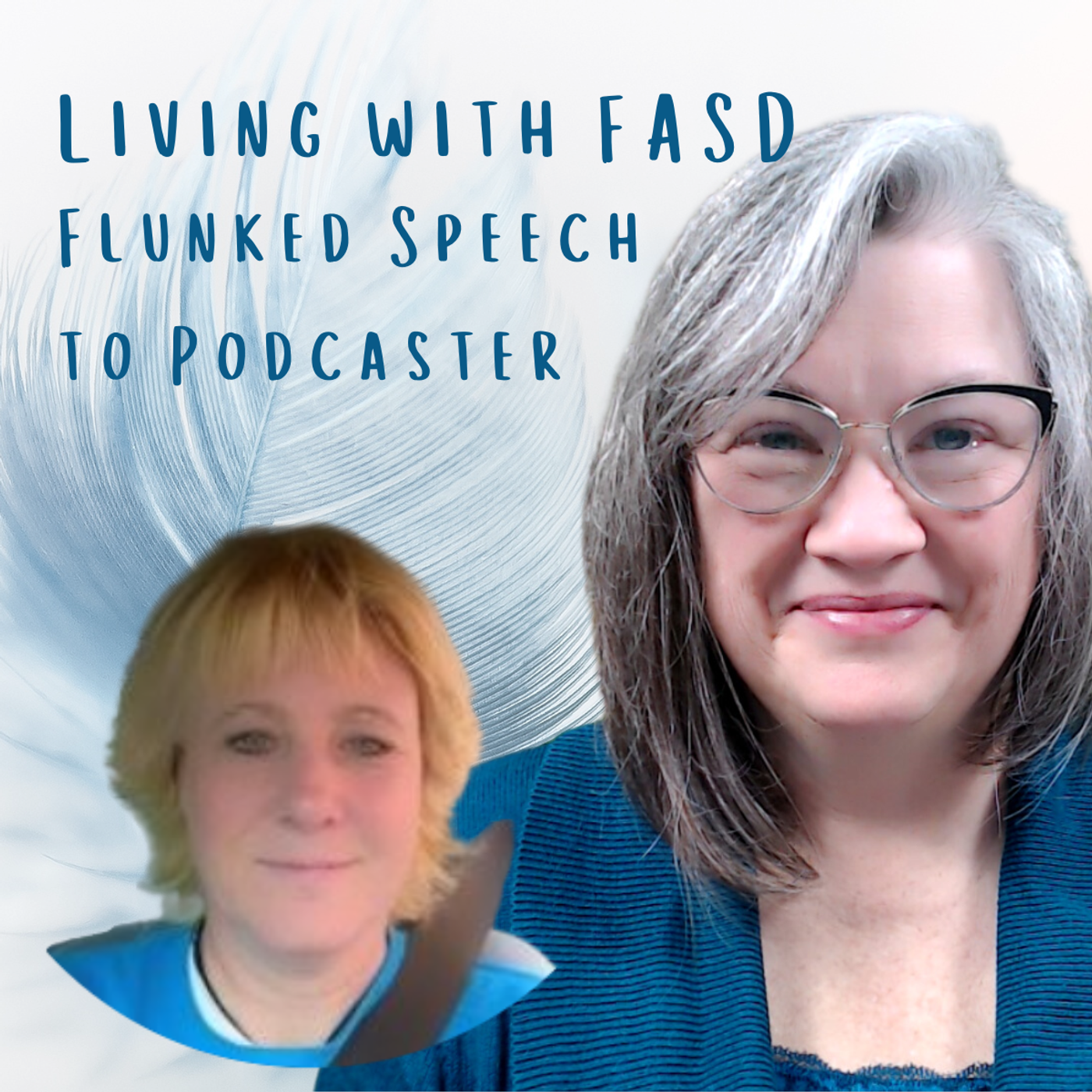
Living with FASD · Patricia Kasper
What does it take to move from walking out of college speech class to hosting a popular podcast, earning a master's degree, and writing award-winning stories? For author, podcaster, and advocate Ann Kagarise, it took an unstoppable force of nature: turning stubbornness into pure, life-affirming tenacity. In this warm, candid, and deeply validating conversation, host Patti Kasper sits down with fellow adult on the spectrum Ann Kagarise (host of Real Talk with Tina and Ann). Sharing the realities of navigating life with an FASD—from visual tracking issues and lack of depth perception to adopting five children (three with FASD)—Ann unpacks the journey of shedding systemic stigma. Together, Patti and Ann discuss moving past internalized shame, standing up to fast-talking institutional workers, the difference between IQ and adaptive skills, and the powerful visual of peeling away life's heavy layers to finally meet your authentic self. Meet Ann Kagarise Ann Kagarise is an author, speaker, journalist, and co-host of the podcast Real Talk with Tina and Ann. Holding an undergraduate degree in social work and a master's in counseling, Ann spent decades working in journalism, the justice system, and specialized education. She is an adoptive mother of five and a passionate advocate for neurodivergent individuals and families navigating trauma, prenatal exposure, and invisible disabilities. Key Discussion Takeaways Visual Processing & Cortical Vision: How ocular convergence issues, depth perception challenges, and reading breakdowns are frequently neurological rather than physical—and why they get mislabeled as ADHD or behavioral resistance. Turning Stubbornness into Tenacity: From being told she wouldn't graduate high school, drive, or ride a bike to hitting home runs, driving mail trucks, and riding a unicycle in a parade through sheer determination. Dismantling Internalized Shame: How adopting and raising children on the spectrum taught Ann to stop viewing herself through a deficit lens: "How can I look at my kids and see shame? Seeing them helped me see myself." Self-Advocacy in Real Time: A masterclass in setting boundaries with fast-talking caseworkers and asserting your right to accessible, paced communication: "I'm not processing too slow; you need to slow down." IQ vs. Adaptive Functioning: Navigating the wide gap between splinter intellect and daily life skills, honoring both genius abilities and the need for sensory comfort. Peeling Back the Layers: The unforgettable visual exercise of stripping away shame, grief, loss, and trauma to reveal the resilient person underneath. Featured Books & Resources Connect with Ann Kagarise: Podcast: Listen to Real Talk with Tina and Ann on major podcast platforms. Books on Amazon: Loving Differently by Ann Kagarise (Memoir) The Little Bird Who Flew Differently by Ann Kagarise (Children's Book) The Sinful Woman by Ann Kagarise Read Patti's New Book: 4D Living with FASD: Shared Voices, Clearer Understanding by...
Ann Kagarise: And Patti: never do. Ann Kagarise: S so what I ended up doing was I had a tape recorder, if you know, I'm giving my age, but I had a little Patti: Yeah. Ann Kagarise: tape recorder and I would read into it because I didn't understand anything that I read. So I taught myself how to learn. So I read into it and then I would listen back. And then I would write down notes so I would include all the things, you know, all the ways in order Patti: All the learning styles. Yup. Ann Kagarise: for me to at least retain it for short periods of time. And like you talk about in your book, your 4D book, I often don't retain the information for very long, or maybe I do on one day, maybe I don't remember it on another day. What I learned was that I am very smart. I just needed to figure out how to access it. And it did have everything to do with my day, my environment, you know, all the things in order for all the synapses to connect for me to be able to be my best, which still was not the best of the people around me, the peers in my classroom. Yeah. So I always Patti: But it sounds like it was a lot better than they expected. Ann Kagarise: Yeah, well, because of my determination, they were not wrong. They weren't wrong. I mean, I recently just was at a neuropsychologist and yeah, they're not wrong. I just have developed the tools to be able to do it. And I got a master's degree. Patti: Welcome back to another episode of Living with FASD Candid Conversations with Patti Kasper. I'm your host. Joining me today, I'm so excited to be talking with a fellow peep on the spectrum and FASD podcaster and Kerese. Keris. Sorry. Ann Kagarise: Y yeah, you know what? People will know who you mean. It doesn't matter either way. Patti: I okay. So Anne, thank you for joining me today. And I I am told to expect a delightful conversation with you based on the the input of a dear friend of mine who you just interviewed for your podcast. So yeah, why why don't we start at the beginning? Tell please share with my viewers and my listeners, you know. Who you are, you know, what your your FASD story is in a nutshell, like how long have you known you were on the spectrum and all that Ann Kagarise: Mm-hmm. Patti: kind of jazz. Ann Kagarise: Well, first of all, thank you for having me. I really appreciate Patti: Of course, Ann Kagarise: you having me on. And yes, Jody Culp connected us and I'm really thrilled that I was able to interview her, another wildflower, if you may. And Patti: Yeah. Yes. Ann Kagarise: so you know, I guess that we just are all flowers in the field and we're meant to meet. Patti: Yeah, yeah. Ann Kagarise: So you know, I've always known that I had differences. Always. I mean, I was neurodivergent from the get-go. And you know, us older people, we didn't get the diagnoses the way that people do now. And honestly, well, my kindergarten teacher, she was like, wait, something's wrong. I mean I was not really talking to very many people. I was very my the way that I would do things on the paper was different than everybody else. She would ask me to do a diamond and it would have ears on it. Every single thing that I did, she was like, she is not able to execute the things that I am asking her to do. And it was everything that I would try. the words were scrambled on the page, like ever everything was just mixed up for me. and everything li in my life, everything that I have tried to execute has always come out like a mess. So, you know, I I kind of laugh about that, but one of the things is that people with FESD, we have A toolbox like no other. And Patti: Mm-hmm. Ann Kagarise: we know, and I knew, even in kindergarten and first grade, when there were I was different, I figured out workarounds. I ended up at a neuropsychologist in kindergarten. And they said, Patti: Wow. Ann Kagarise: You're not, they told my parents that, I was my eyes were not converging. I because you know, my left and right eye don't work together. And Patti: Okay. Ann Kagarise: so my left eye is really kind and it shuts itself off unless I'm really tired or something. So I normally just use my right eye. It kind of looked like a lazy eye, but really it was just my brain not really using it. And then Patti: Yeah. Yeah. I I'm the opposite. My left eye is is the one that is on most often and my right eye shuts off. Ann Kagarise: Really, really. Patti: If if I'm tired or not feeling well, my my right eye just cuts out. Mm-hmm. Ann Kagarise: Isn't that interesting? S so you have the same thing. my gosh. That needs to be listed under things that possibly could fall under with FASD, I think, because it's Patti: Yeah. Yeah. There there's a lot of visual stuff in. have you heard of cortical visual impairment? Ann Kagarise: What is that exactly? Patti: So it's it it's kind of related to what we're talking about, but the eyes don't track well. And so Ann Kagarise: Okay. Patti: reading is next to impossible for especially for kids. And so what do kids do when they can't focus on the books in front of them in school or focus on the blackboard? They fidget and they get labeled ADHD. Ann Kagarise: Right. Yes. Patti: And it's not, it's their eyes. Ann Kagarise: Yes. I was labeled so many things before I actually everything kind of fell under the umbrella of FASD, I think. So one of the things that you're talking about eyes, you know, I was not able to see the words on the page like you're talking about. And they were telling me that it was a neurological issue. It didn't really have anything to do with my eyes. So glasses wouldn't fix it, you know, all nothing really would. So it ended up that as I got older, because I wasn't able to retain information, I wasn't able to really Comprehend the information. So it got to the point where they actually said, you know, this girl, she's really not gonna graduate high school the traditional route. Her her needs are too great. So I ended up, they didn't factor in how determined I was. And Patti: They never do. Ann Kagarise: S so what I ended up doing was I had a tape recorder, if you know, I'm giving my age, but I had a little Patti: Yeah. Ann Kagarise: tape recorder and I would read into it because I didn't understand anything that I read. So I taught myself how to learn. So I read into it and then I would listen back. And then I would write down notes so I would include all the things, you know, all the ways in order Patti: All the learning styles. Yup. Ann Kagarise: for me to at least retain it for short periods of time. And like you talk about in your book, your 4D book, I often don't retain the information for very long, or maybe I do on one day, maybe I don't remember it on another day. What I learned was that I am very smart. I just needed to figure out how to access it. And it did have everything to do with my day, my environment, you know, all the things in order for all the synapses to connect for me to be able to be my best, which still was not the best of the people around me, the peers in my classroom. Yeah. So I always Patti: But it sounds like it was a lot better than they expected. Ann Kagarise: Yeah, well, because of my determination, they were not wrong. They weren't wrong. I mean, I recently just was at a neuropsychologist and yeah, they're not wrong. I just have developed the tools to be able to do it. And I got a master's degree. So, I mean, I really did work hard to figure it out. And I just take everything with me that wherever I go, and I have scripts and I have go-to's and I have external brains. That's what I call them. people that travel with me wherever I go to help me interpret the world around me, and I have just made workarounds around my workarounds to be able to figure out the world. world. So I have you know they told me I wouldn't be able to hit a a a be a ball because of my depth perception. I have no depth perception. Zero. So they said, well you won't be able to do this. I worked until I hit a home run. They told me I wouldn't be able to drive. I even ended up driving a mail truck on the opposite side when I was in college. I mean, I was determined to tell everybody, you know, they told me I wouldn't be able because my balance and everything, my spatial sense is really bad. And they said that, you know, bike riding would be rough and I ended up riding a unicycle in a parade. So that's just my life. Patti: You Ann Kagarise: Yeah. Patti: You know what what people complain about us and and label perseveration, right? Ann Kagarise: Mm-hmm. Patti: The flip side of that same coin is tenacity. Ann Kagarise: Right. It is. Yeah. I ended up doing Yes. Patti: If we channel it right, our stubbornness is tenacity. Ann Kagarise: Yes. Yeah. I mean, I don't give up no matter what it takes. Patti: Yeah. Yeah. Ann Kagarise: I am determined. And so you know what's really funny is because when I was younger, I wasn't really able to talk very well. communication was, you know, writing was my thing. I c went to writing, even though I had trouble writing, I did end up going to writing a lot of times when I wanted people to understand what I wanted to say. I have worked and worked and worked this muscle my communication in or you know, when I went to college, I got a D minus in speech because they would ask me to y do the speech and I would just walk out the room. I just said, Nope, I'm out. and I would get an F on my speeches, but I got a D minus because of the work that I did, the papers that I turned in. But you know that but I I have worked it and worked it to be able to use the platform that I have now on the podcast. So I just really think Patti: What wouldn't your speech teachers be amazed? Ann Kagarise: I think so. They there's people, there's teachers, there's teachers that I know that would not even believe that I'm doing what I'm able to do now. Patti: Yeah. Yeah. Fr from walking out of class to avoid public speaking to having your own podcast. Ann Kagarise: Yes. Absolutely. Yeah, and it's Patti: That's amazing. Ann Kagarise: yeah. I'm very proud of myself. You know? I mean, shame Patti: Yeah. Ann Kagarise: does not enter the room and it used to. It used to. I mean Patti: Yeah. You know, that tell me, tell me more about that because that shame binds so many of us. And Ann Kagarise: It did. Patti: and and we all have different ways of overcoming it and moving, you know, it kind of like when I first self-identified, I was at a conference breakout room with Justin Shepherd. And I said, How now that I know How do I determine who to tell what how much to share, you know, why to share, that kind of thing. And and he Ann Kagarise: Right. Patti: said the only way past the shame or past the stigma is straight through it. And and we have to have that same approach with with the shame that is kind of put on us because of the stigma of FASD. Ann Kagarise: Yeah. Yeah. And Patti: And and the and the stigma of being different. Ann Kagarise: Different I have had all my life. Patti: Me too. Ann Kagarise: So I mean that is something that I have just grown with. And honestly, my kids that I have adopted, I've adopted five, three for sure, I know are fetal alcohol. They've had the diagnosis. We go to the FASD clinic in our area, and so it is a spectrum, and I love them each where they need to be. the best thing that we can do for people with FASD is to love them where their brain is, and that's what we try to do every single day, and we never know where it's going to be. But going back to the shame, the reason that I have grown to where I have is how can I look at my kids and see shame. I can't. With myself, I did I allowed the diagnosis to enter the room before I did. I allowed my ex employer, I guess you could say, who when I worked at a school for kids with autism, to convince me that it was just autism. It was just autism. Even though they say if it's FASD. No. And I really think it was the stigma behind it why that happened. And n I'd never really believed her. What I mean is that I allowed her to take that narrative and take, you know, and that wasn't okay on my part but I think that I did that because just it for one thing it was all new to me. And Patti: Mm-hmm. Ann Kagarise: when you get the diagnosis of FASD At first I think shame does enter. And you do feel as if, you know, wait a second. So my mom drank. Okay. and you know, I d I am okay with that now, especially with the fact that back then, many, many years ago, Patti: Yeah. Yeah. Ann Kagarise: And after reading parts of your book, I've learned especially that in the seventies, and I just read this last night, in the seventies in your book, it's really amazing that they said that alcohol was actually good for the baby. So Patti: And some doctors still do. Ann Kagarise: that I that's just crazy to me. Patti: Because they focus on maternal stress. So whatever's gonna keep mama's stress level down is gonna be better than having her, you know, freaked out on stress and and the impact of chronic cortisol exposure on the baby. But it they can only say that if they willingly deny all the harm from alcohol. Ann Kagarise: But what's crazy is that once they're born, they can't drink until they're eighteen. So if if it was good for them, why we're not gonna put alcohol in their bottle. So Patti: Yeah. Well, but if moms are breastfeeding, that's what they're doing. Yeah. Ann Kagarise: that that is what they're doing and they don't understand that if what goes in their body is coming out of their breast and and Patti: Yeah. My mom used to wonder why I would fall asleep while she was feeding me. Yeah. Ann Kagarise: Yeah. You know, my Patti: They just didn't know any better in the sixties. They just they didn't know. They didn't know. Ann Kagarise: No, they really didn't. They didn't. And there are so many of us that are walking around un undiagnosed. Patti: Yeah. Yeah. Ann Kagarise: But my kids, going back to shame for a second, my kids, honest to goodness, are they are the reason that I looked at FASD completely differently. Because I wake up and I look in their smile, their eyes, and at their smiles, and I see these faces and their determination and everything that's behind what they're doing in their days, their struggles and everything. And I don't see FASD when I'm looking at them. see my child. And that helped me see me, yes, completely differently. To not just Patti: Differently. Yeah. Yeah. Ann Kagarise: see the diagnosis, but to see myself. Patti: Yeah. Yeah. And to see your tenacity. Yeah, that that's that's what led me to with this reframe of wildflower nature and wildflower intelligence that I introduced the community to, gosh, I don't know, maybe two months ago, three months ago. in fact, like the t shirt. Ann Kagarise: yeah, yeah. That's cool. Patti: Yeah. So I'm gonna be selling them on my website. But Ann Kagarise: Okay. Nice. Patti: anyway, you know, i they used to call alcohol fire water. And if you look at a landscape that that fire has torched, what comes back first? But the wildflowers. And they grow in soil that has been altered. You know, not just a not just a you know five minute alteration, but it stays altered. The the nutrients change, the composition of the soil changes. And wildflowers are tenacious. They're, you know, they they spring up in unexpected places. They are far more beautiful than a manicured garden. And you know, it's just such a positive reframe. You know, not to say that we're flowers, but you know, Ann Kagarise: Mm. Patti: that we we are tenacious. We we bloom and thrive where others cannot. You know, all those qualities, all those positive qualities that we with FASD have. No, so yeah. Ann Kagarise: Yeah. Yeah. I mean I see it in my kids every single day. The three Patti: Mm-hmm. Ann Kagarise: of them, one he's got a pretty low IQ and he really struggles in everyday life and I Patti: Mm-hmm. Ann Kagarise: just really feel for him, but he has such a big smile and he greets everybody with love and joy and he is the first one to see somebody hurting and to go up to the them and offer a hand. And he is the most organized kid when it comes to certain things that he wants Patti: Mm-hmm. Ann Kagarise: to, like when I go get my hair done and he starts organizing all of their shelves. or Walmart and we've had to tell him we just did this with the FASD doctor, because we're like, you know, we we try to coach him on things and we're like, you need to learn to ask when you go into the store or into the wall Walmart or wherever, can I organize your entire shelf? Patti: Mm-hmm. Ann Kagarise: so he just gets a little O C D sometimes and he sees something he doesn't like and he ends up Patti: Bring to my house. Ann Kagarise: So you know Patti: Use that touch. Ann Kagarise: Yeah, well yeah, I'm not the most organized in some ways and in some ways I am, it depends. Patti: Yeah. Ann Kagarise: but Yeah, but in school he really struggles. He's like at a second, third grade level, even though he's in seventh grade, and they have been fantastic at meeting him where he is. My one son I have to homeschool because he really struggles in traditional school and the teacher talking about shame, he was only in first grade, and his teacher who three kids and I I know of have left her classroom, one left the district because of it, Patti: Wow. Ann Kagarise: and he never went back after the way that she treated him. kids know, kids know that you're not being nice to me, and she wouldn't even apologize when we asked if she would apologize, and she didn't even have to Patti: Wow. Ann Kagarise: say, you know, that she did it. All she had to do we asked her to say, I'm sorry that you feel that I hurt you. And she wouldn't do that either. So Patti: Wow. Ann Kagarise: yeah, you know, my kids, even though, I mean they're F-A-S D, but they are so polite and they they can pick up on things. If they can do it, why can't an adult teacher do it? Patti: Yeah. Ann Kagarise: So Patti: Well I think that speaks to her own issues and her own differences, you know, if sh yeah. Ann Kagarise: But he's he's Patti: Yeah. Ann Kagarise: now he is a genius on one end. I mean he's so s you want to talk about splinter skills, like in one way he's super super smart, and in another, you know, he still has to have his green blanket all the time, he still have to has to sleep really close to me. and you know, yeah. So even though he's ten, we have both going on. Patti: Well our our system just cannot seem to to marry those, you know, the reality that IQ and adaptive skills may or may not line up. In fact they don't usually line up. Ann Kagarise: Right. Patti: So Ann Kagarise: Yeah, very much so. Patti: Yeah. Ann Kagarise: we have a I guess smorgasboard of varieties of different things that go on here. But our our our house is never boring. Patti: It sounds like it's full of love. Ann Kagarise: It's very interesting. Patti: Yeah. Ann Kagarise: And yes, I would say it is very much full of love, but it is very interesting. And what I've learned is how to love myself more. And how to tackle life even better. You know, advocacy is one of the biggest things. One of the things that I always fell short at was self-advocating. And and I would just allow all these things to happen and I wouldn't stand up for myself. I was very vulnerable. And I allowed abuse to happen where it shouldn't have happened because I just wasn't able to speak up and I would freeze. I allowed so many so many things that I wish now I would have stood up against. But my kids with me having to advocate for them all the time has help really helped me have a voice that I didn't have before. than has transferred to myself. And we just had this incident just a couple weeks ago. We have so many workers in our house to help with the kids. And we had a state worker that was in our house and she was she helps she's like a wraparound and helps us get all these services. And so she actually she was talking so fast, she was doing all of these things so much at me. Did you do this? Did you do this? Or is this happening? And I said, You are talking so fast right now. That I'm not able to really process what you're saying. So if you could slow down. And she said, I'm not talking too fast. You're processing too slow. Yeah. So I went to her su Patti: Wow. Ann Kagarise: I went to her supervisor and I said, I'm not meeting with her unless, you know, something happens here. So the supervisor came with her next time. We ironed things out. And then, you know, she's really good. She she's better. she's not acting like that anymore. But there Patti: Good. Good. Ann Kagarise: would have been a time where I just would have sat there and allowed her to talk to me like that and not say anything for myself. But now I do Patti: Yeah. Ann Kagarise: have a voice. Patti: And and not processed everything that she needed you to process or act upon. And Ann Kagarise: Right. Patti: then she would have judged you negatively for it. Yeah. Yeah. And Ann Kagarise: Yeah, yeah, she absolutely was. for sure. Patti: and as a former social worker, she was just trying to get all her agenda items done in the minimal amount of time because she's got a lot of crap on her plate. Yeah. I get it, but that's not an excuse. Ann Kagarise: No, because Patti: Yeah. Ann Kagarise: what would it have hurt for you to just talk a little slower? Because Patti: Yeah. Ann Kagarise: we will get it accomplished a lot better, a lot more efficient if you just tackle one thing at a time versus throw five things at me at one time. Patti: Yeah. It's kinda like when you're in a hurry to get to someplace, so you speed, but then you get pulled over for a traffic ticket, and you end up getting to your destination much later than you would have if you had just done the speed limit. Ann Kagarise: That's very true. Patti: You know, and that that's something that drivers have to remind themselves of when they're tempted to get a lead foot. Yeah. Ann Kagarise: Yeah. Very, very true. Patti: Yeah. Efficiency. It's about efficiency. Yeah. Yeah. Ann Kagarise: And we just want to be our best. And she knows that I have these differences, that I'm neurodivergent. She a hundred percent knows. She's not new to the table. Patti: Pants. Ann Kagarise: So Patti: Hang on one second. he just left. No, I didn't. I need pants. Is it okay come here? Hang I gotta cut this out. Hang on. You don't know which ones to grab. Okay. Well you're gonna be on Okay, you go. Ann Kagarise: I'm gonna since I'm taking this opportunity, can you hear me right now? Okay. Patti: Yeah. Yeah. Ann Kagarise: because for some reason I'm having trouble with my mic. So I Patti: I can hear you just fine. Ann Kagarise: yeah, I think it's on my end. I don't think it's on your. Because I think what's happening is that it went from my mic to my my computer microphone. So you're still getting it. I just think it's my microphone. Patti: Okay. Yeah, no, I I I don't see a problem on this end at all with Ann Kagarise: Okay. Patti: your recording level. So okay. So where were Ann Kagarise: That is good. Patti: we? We have about 20 minutes left, by the way. Ann Kagarise: Okay. Patti: So we we might end up having to do two parts. Ann Kagarise: Yeah, I mean that's what I did with Jody. I we just went Patti: Yeah. Ann Kagarise: we we went for two hours, so yeah. But Patti: Yeah. Yeah. Ann Kagarise: I knew that we would have a lot to talk about. And we you and I, you will be on mine. So Patti: Yeah. Yeah. Yeah. So what how long have you been doing your podcast? Ann Kagarise: Five years. It's it's coming Patti: Okay. Ann Kagarise: up on five years. I used to be a journalist. And you Patti: Okay. Ann Kagarise: know what? There are there's stepping stones. Everything in life, I believe, is a step to where we're going. And I wrote a book. decades ago and there was a a a newspaper, I'm trying to what's the word? she was the editor. Okay. Newspaper Patti: Okay. Ann Kagarise: editor. She read my book. Somehow it ended up in her hands and she gave me a call and she said, You are a writer and we would like to have you on staff. And I'm no Patti: Wow. Ann Kagarise: no. And she said, yes, yes. Patti: Ha Ann Kagarise: So she took me on. And that's how it started. I ended up being features, hard news, interviewing people. And this is what gave me the skills to have reciprocal conversations, have interest in other people, and I always did, but it gave me the skills to be able to access, you know, other people's stories. Patti: Yeah. Ann Kagarise: And that, you know, I just would take a microphone around with me everywhere I went, my my tape recorder, and I would ask some questions. Yeah, yeah. And Patti: You're dating yourself again. Ann Kagarise: so but well it and as a journalist, well, i you know, I didn't have my phone to do that with or what back then. We didn't do that Patti: Right right. Ann Kagarise: back then. But yeah, and then I would listen to everything and I would type it all out and then Patti: Yeah. Ann Kagarise: you know I would put these stories together and I even won journalism awards. I loved it. I just loved it. I was on a hard Patti: That's awesome. Yeah. Ann Kagarise: news story in the courts for a a capital murder trial. I was assigned this capital murder murder case and there was another girl from a local station and she was brand new. We just connected and that's Tina. And Patti: Okay. Ann Kagarise: now it's Real Talk with Tina and Anne. And she doesn't get to do it very often because she did, she used to, but now her three kids are very active in sports and she's also on three radio stations in the Patti: wow. Ann Kagarise: she is Patti: Yeah. Ann Kagarise: very thin, you know, pulled in so many different directions that she does get to be on once in a while, but I still keep the name. but she is, Patti: Yeah. Yeah. Ann Kagarise: you know, the two of us just connected and it gave me again these skills to be able to be up on a platform like this because print died, you know, it just died. And we no Patti: Yeah. Yeah. Ann Kagarise: longer really take our skills to newspapers anymore. People hold them and read them. So when I had Patti: Right. Right. Ann Kagarise: this opportunity, I took my journalism skills and I have a master's in counseling with social work degree in my undergrad, and I just put it all together and I said, you Patti: Yeah. Yeah. Ann Kagarise: know, we have to talk about trauma, we have to talk about neurodivergence, we have to talk about overcoming. Patti: Yeah. Ann Kagarise: And the whole purpose of the podcast is pain to purpose. We take Patti: Mm-hmm. Ann Kagarise: people's stories. And it's whatever they've gone through to purpose. Patti: Yeah, yeah. Yeah, so I will more than happily share my story with you when we flip the script. What Ann Kagarise: Yes. Yes. Patti: was that first book that you wrote? Ann Kagarise: it was called the Sinful Woman. I used to work in the jail system when I came out of my master's degree, one of the things I wanted to do, I had the opportunity to work in the jail system with the women as a counselor type figure, in the chapel. And I felt led to write this book because of things that I had gone through, shame, trauma, and how the women in the In the jail system, they would introduce themselves as hi, I'm so and so and I'm a murderer. Hi, I'm so and so and I'm a prostitute. I'm this. Patti: Like it's a twelve step group. Ann Kagarise: And I was like, wait, wait a second. Don't lead with your sin. Don't lead with how you what you did that you Patti: Yes, yes. Ann Kagarise: think, you know, we'll call it we'll put it under sin. Patti: Yeah. Ann Kagarise: You were a person, you were a woman. I want to know who you are. And so Patti: Mm-hmm. Mm-hmm. Ann Kagarise: it it started like that. And then it I wrote the sinful woman from Luke in the Bible, how Jesus said, I'm looking, you know, at her heart and the Pharisees Patti: Mm-hmm. Ann Kagarise: were looking at her actions and judging her Patti: Mm-hmm. Ann Kagarise: if they if he you know, he's hanging out with Yeah, Patti: Let he who cast the the first stone. Mm-hmm. Ann Kagarise: he's hanging out with her. I mean, really? You know? So Patti: yes, yeah. Ann Kagarise: I was like, of course, he hangs out with the Patti: Yeah. Ann Kagarise: stick and the hurting and and everybody and Patti: Yeah, yeah. Ann Kagarise: so yeah, that's Patti: I love it. I love it. So podcast for five years. I, you know, our our paths are are parallel in so many ways. My undergrad is social work. My master's is psych. Ann Kagarise: Yeah. Yeah. Patti: I I didn't get into this from journalism. However, I did do a lot of radio interviews and a few TV, but it's not a medium I was very comfortable with when I was fundraising to get my service dog. Ann Kagarise: Okay. Patti: which was a very and I loved it. I loved I loved doing that. And yeah, from radio to podcasting, it's easy breezy. So yeah. Ann Kagarise: Yeah, yeah. Yeah. This w this just happened naturally. and that's why I believe that Patti: Yeah. Yeah. Ann Kagarise: it was supposed to be Patti: Yeah. And what's your current book? It it's a memoir, right? Okay. Ann Kagarise: Okay. Yes. It I I just wrote a children's book actually and I also yeah it it's called the the bird who l flew differently, learned to fly differently. I I Patti: Okay. Ann Kagarise: it's it's there. I I can't pull it out of my head exactly, but it's it anyway, yeah, it's just about a little bird and it's really cute. His name is Wren and he learns to fly differently because he doesn't fly like the other birds and yeah so it's really a fun little children's book and then I also wrote my memoir which is loving differently and that it was it was just I needed to write this book. I really needed to write it and it I'm actually writing a companion workbook right now so it will come out when I'm finished. Patti: Mm-hmm. Ann Kagarise: it's all about the tools that go in the tool belt for Patti: Okay. Ann Kagarise: those of us or who are living with these differences, FASD Patti: Yeah. Ann Kagarise: and trauma and things like that, and for us to be able to access the tools and be able to Patti: Mm-hmm. Mm-hmm. Ann Kagarise: execute them. So yeah, I I I take a lot of the trauma that I went through, a lot of the difficulties. Patti: Mm-hmm. Ann Kagarise: And every single chapter I am talking about pain to purpose. Patti: Yeah. Yeah. I have always found that finding a a purpose in the pain. I I used to call it the silver lining, you know, in in the the clouds that come with various traumas. Ann Kagarise: Mm. Patti: you know, and as long as I could identify what that positive was that comes out of a situation, no matter how hard, it made it so much easier to to work through and move through and heal from. Ann Kagarise: Mhm. Well, I was adopted and a there's a lot that comes with that. And Patti: Mm-hmm. Ann Kagarise: so there's grief and there's loss and there's finding yourself, your identity, along with my feeling different in the schools and with my peers and not understanding the world around me and having to figure out communication. And I mean everything was a struggle. Every single thing was a struggle. And then you layer it with my dad died when I was eleven years old. You layer it with my sister was given to this system. And And you know, just one thing after another. And the more that goes on top of somebody who is FASD and they're dealing with this, all these different layers, it it quiets, it quieted me more. It made my abilities that were very much inside of me harder to access. So it it has been, and this is a visual for you, and this was one of the things that started to help me heal. I was at the jail helping with the women, and I went in completely layered up, completely, and this is actually in my book. I have like 10 layers of clothes on. And every single layer, I just peel one off and peel another one, you know. Here's shame, here's grief, here's loss, here's hurt, here's you know, abandonment, here's whatever. And then as I got more and more to the where it was just like a shirt and it says, Me, here's me. Patti: I love that. Ann Kagarise: Yeah. So I mean it's a that's what my Yeah. And it was for the women to do that. Patti: That's a powerful exercise. Very powerful. Yeah. Yeah. Ann Kagarise: But in the book, you know, it was stripping down those layers and getting to know myself again. And I think that that's finally where we can meet ourselves and be okay with who we are. Patti: Mm-hmm. Mm-hmm. Well, this has been such a joy and to get to know you. And I definitely want to have you back so we can Ann Kagarise: That sounds great. Patti: hear more of your story. And gosh, I look forward to our next conversation. Unfortunately, I've got to go record another one. So but yeah. Yeah. Yeah. Ann Kagarise: And and you're going to be on my podcast. So a little plug there, you know, for you to you know, you're gonna be on my podcast soon. Patti: Yeah. And I I thank you for picking up a copy of 4D, Living with FASD. Ann Kagarise: for sure. Patti: I'm glad you're enjoying it so far. So yeah. Ann Kagarise: I am. Yeah. I just keep underlining and underlining and taking notes. I'm like, yes, yes. Patti: Well, the study guide is hopefully just a few weeks from being released. Ann Kagarise: Okay. Patti: And so that will be out soon. And Ann Kagarise: Well, I've already got a list of people that I'm telling about it, you know. Patti: Goodness, thank you. Ann Kagarise: From the FAST doctors for my kids, I'm like, they need to read this. They really do. the educators Patti: Thank thank you. Ann Kagarise: that are working with my kids. I mean, you're Patti: Yeah, yeah. Ann Kagarise: right. We look at it and we still use the skills under the 3D model or even the two D model. And Patti: The Tutie. Mm-hmm. Ann Kagarise: we are way past that. We need Patti: Yeah. Ann Kagarise: to start looking at it where all systems are involved. Yes. Patti: Holistically. Yep. Well, with that, my new friend, I've got to run. But I look forward to Ann Kagarise: Okay. Sounds really good. Thank you so much. Patti: the next one. And that's it for today. Thanks, everybody. See you next time on Living with FASD.