
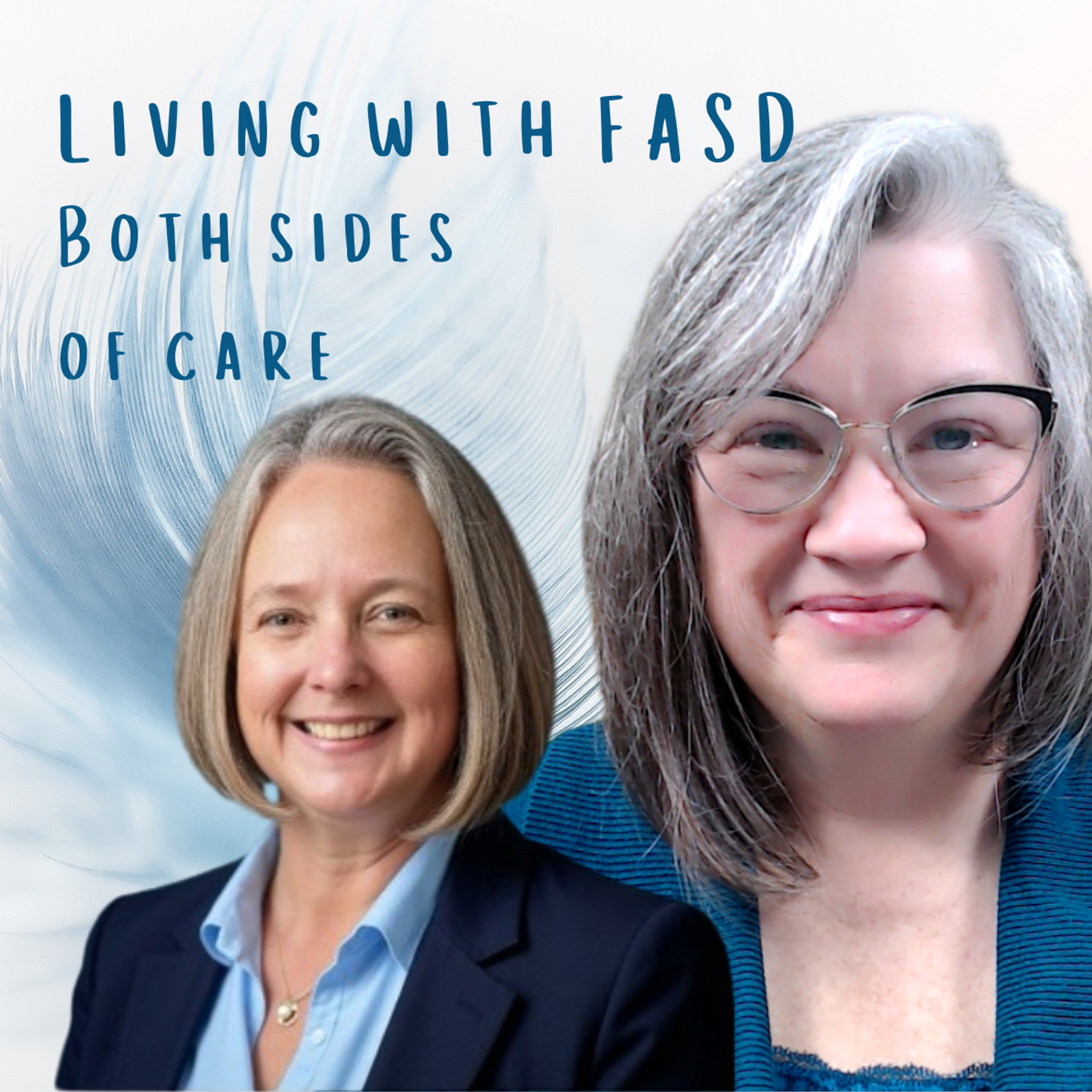
Living with FASD · Patricia Kasper
What happens when you are an adult living with Fetal Alcohol Spectrum Disorder who is also navigating the intense demands of caregiving? In this candid and deeply personal episode, Mary Byrnes—author of the newly released book Everything Clicks—joins Patti Kasper to unpack the raw realities of "blocked care," caregiver burnout, and the profound shift that happens when you view life through a dual lens: as someone with neurodivergent needs and as a caregiver to others. Both navigating recent severe foot injuries on knee scooters, Patti and Mary delve into the physical realities of aging with FASD—including proprioceptive stability challenges, an unusually high tolerance for physical pain that leads to ignoring serious injuries, and the uphill battle of self-advocacy in emergency medical systems. From navigating the guilt of caregiver exhaustion to learning how to receive support when you are wired to give it, this conversation offers validation, laughter, and hard-won self-awareness for adults living anywhere on the spectrum. Key Takeaways & Discussion Highlights The Dual Lens of Blocked Care: Exploring "blocked care" (compassion fatigue and burnout) not just from the perspective of supporting someone else, but recognizing how our own neurodivergent needs and sensory demands impact those around us. High Pain Tolerance & Delayed Care: How altered pain perception causes individuals with FASD to second-guess physical trauma, write off severe stress fractures as hypochondria, and delay urgent medical treatment. Proprioception & Physical Stability: Why vestibular and proprioceptive differences make falls, lateral foot instability, and ankle fractures common vulnerabilities as adults with FASD age. Medical Self-Advocacy: Overcoming the instinct to "suck it up and go home," learning to advocate for hospital admissions when pain is unmanageable, and navigating adverse gut sensitivities to standard opioid pain medications. Givers vs. Receivers of Care: Why adults on the spectrum are often fierce, dedicated caregivers to parents and children, but struggle intensely when placed in the vulnerable position of being the care receiver. Harrison’s Regulated Response: The powerful account of Mary’s son, Harrison (who lives with FASD), remaining calm, collected, dialing 911, and comforting his mother during a severe basement staircase fall. When Everything Clicks: Mary's journey of discovering her own FASD diagnosis in adulthood while attending coaching calls and reading Patti Kasper's Sip by Sip, transforming confusion into radical self-awareness and healing relationships. Upcoming Work: A preview of Mary's forthcoming second book, Voices of the Vulnerable: FASD and the Broken Systems that Fail to Support. Please like & share the episode, as well as remember to subscribe to the show. These actions help more people find it. Mary's book is available at: https://a.co/d/0j5ryIpi Patti's book is available at: books.by/yourfasdcoach The 4D Wildflower Apparel line is...
Mary Byrnes: I often see a lot of comparisons between my son living with FASD and dementia. And I can now see it in myself. And blocked care allows me to have a an open, honest conversation with fellow caregivers about the fact Patti: Yeah, yeah, yeah. Mary Byrnes: that I can now see both sides of the coin. I can see where my demands and my needs as an individual on the spectrum can be a little exhausting. and it's through no fault Patti: Yeah. Mary Byrnes: of our own. Patti: Yeah. Mary Byrnes: And I can also see the incredible desperate need for caregivers to build their community of support. And it doesn't Patti: Yeah, for sure. Mary Byrnes: have to be immediate family. It doesn't have to be a relative. And it Patti: Yeah, exactly. Right. Mary Byrnes: doesn't have to look the same from one caregiver to another. Patti: Welcome to another episode of Living with FASD. I'm your host Patti Kasper and joining me again today is Mary Byrnes and we're going to be talking about her new book. Everything clicks, you can see it there on her screen, and it is a marvelous book. Mary, I am so glad you could join us today. Mary Byrnes: Well, thank you first of all for having me back. And second of all, I know you took the time to read the book, and that means the absolute world to me. Patti: Yes. Yeah. Yeah. Mary Byrnes: this has been a long journey. I never thought in a million years I'd publish a book. and it's it's been a whirlwind in a really good way. Patti: Mm, mm. So Mary Byrnes: so I'm curious what you think. Patti: So, you know, the first thing that made me really stop what I was doing and write something in response was almost the halfway point, you used a phrase called blocked care. And that really struck a chord. And what I did not r initially recognize, although I'm really surprised that I didn't, is that It's a synonym for compassion fatigue and burnout. Mary Byrnes: Yes. Patti: And you know the reason it really struck a chord with me is if I must confess, I'm at I'm there. I am so there dealing with my mom and her dementia. Mary Byrnes: And it's it's Patti: It's Mary Byrnes: a very difficult thing, first of all, to recognize in yourself. I and it's a Patti: Yeah. Yeah. Yeah. Mary Byrnes: very difficult thing to pull yourself out of. and when when I talk twice weekly with the caregiver support groups that I moderate at Harrisons Hope, it's a topic that often comes out without the label. And there's a lot of I really don't like. what my loved ones doing, and I still love them. And we talk. We talk about the grief and loss of not having what we expected happen. you know, in our daily lives with our loved ones and and in how we feel about that in particular. And, you know, a lot of them struggle to separate the exhaustion that is physical and mental. From the exhaustion that is emotional. Patti: Yeah, yeah. And you know, Mary Byrnes: Yeah Patti: and it's also difficult to admit to in the sense that when we have all these shoulds in our minds, hang on, I'm gonna shut my office door, which will take me longer since I have to navigate. Can you hear the dogs? Yeah. So they only do this when Mary Byrnes: It's Russell. Patti: I get on the phone or get on the camera. Mary Byrnes: So I I struggle with the same thing since this Patti: Mm-hmm. Mary Byrnes: has been seven and a half weeks now since I fell down. Patti: Yeah, for for the audience, we both have broken feet. Mary Byrnes: We are both using knee scooters to get around. Patti: That bloom versus burnout dichotomy that we've talked about before. Mary Byrnes: exactly. I you know, when we were talking about that caregiver burnout, my my heart aches for how deep it goes. a lot of a lot of caregivers will ask me on their call, you know, how do you get over it and what do you do about it? And is it ever gonna go away? And I share well, I kind of Patti: Your answers? Mary Byrnes: share my own perspective that Patti: Mm-hmm. Mary Byrnes: you know you can be at a job that you dislike, but you know you still have to show up because you want and need the paycheck. And I like to tell caregivers that caregiving the most complex disability on the planet is very similar. You know, you want your loved one. Patti: Yeah. Except there's no paycheck. Mary Byrnes: There's just no paycheck. You just you just continue showing up. And they asked me if it's okay to have those negative feelings. And I said, well, what would happen if you didn't? If you didn't identify how you were actually feeling, I would be more concerned that it would become verbal and physical in expressing itself. But I do believe that honestly acknowledging it is the beginning of healing it. Patti: I had been spiral spiraling into that even before I broke my foot. But you know, with dementia, she cannot remember the directive. I can't get up willy nilly and come do things for you. I just can't. and she doesn't remember it. So she keeps calling my name. to the point where I think once she's passed I may change my name. Mary Byrnes: Patti having lost my mother just this past March. I felt that I felt that way quite a b quite often. However, Patti: Yeah. Yeah. Mary Byrnes: you do recover from that, Yes. Yes. And it gets used in joy instead of anger and frustration and annoyance. Patti: Right? Yeah. And and it by the same token, for caregivers of kids, it's mom, mom, mom. Yeah. But Mary Byrnes: And it's you know, it's we have to understand where it's coming from. Right? Patti: Mm-hmm. Yeah. Mary Byrnes: I think when someone calls our name, it's because we are their trusted, safe, secure place. And if we can remind ourselves of Patti: Mm-hmm. Yeah. Yeah. And and they've I done and they've said, this is where I go to get my needs met. Mary Byrnes: Yeah, that's right. Yeah. And it's I can I can relate to it with both of my parents. My father had Alzheimer's, and it was the long goodbye of about 10 years. And mom's dementia came, I would say, the probably the final five years of her time with us. and I I often see a lot of comparisons between my son living with FASD and dementia. And I can now see it in myself. And blocked care allows me to have a an open, honest conversation with fellow caregivers about the fact Patti: Yeah, yeah, yeah. Mary Byrnes: that I can now see both sides of the coin. I can see where my demands and my needs as an individual on the spectrum can be a little exhausting. and it's through no fault Patti: Yeah. Mary Byrnes: of our own. Patti: Yeah. Mary Byrnes: And I can also see the incredible desperate need for caregivers to build their community of support. And it doesn't Patti: Yeah, for sure. Mary Byrnes: have to be immediate family. It doesn't have to be a relative. And it Patti: Yeah, exactly. Right. Mary Byrnes: doesn't have to look the same from one caregiver to another. I don't know how many times I've heard caregivers say, Well, I don't, I don't do bubble baths and candles. And I said, That's okay. Patti: Calgon, take me away! Mary Byrnes: exactly. But it's remembering Patti: Yeah. Mary Byrnes: what what used to bring you joy and making time for it. And that that's Patti: Yeah, yeah, yeah. And Doug Gonnet, this was the week I was gonna start walking the lazy river again. Mary Byrnes: Well, I was on a path to weight loss and I had set up with a really great wellness institute a program for exercising Patti: Mm-hmm. Mary Byrnes: as well as the balanced nutrition diet kind of thing. And I had my follow-up appointment a week ago. And I shared with him, I'm sorry the exercise end of it is kibbutz because Patti: Yeah. Mary Byrnes: I fell and broke my ankle. They were very supportive, but in sharing that with that particular practitioner who is learning about FASD, he was very surprised to understand that many of us suffer from properception issues. And Patti: Yeah. Yeah. Yeah. Mary Byrnes: stability is a big part of the equation when it comes to injuring ourselves. Patti: Yeah. Yes. And and there's one bone in your foot that is used particularly for lateral balance, and Mary Byrnes: Yes. Patti: it's like it's this one here. And that's the Mary Byrnes: Yep. Patti: one I broke. Mary Byrnes: Good job. We are nothing if not thorough, Patti. Right. And I think the other thing that folks may not know especially about foot and ankle injuries is it's one of the longest heel times for broken bones. that particular bone that you broke and my tib fibula, which is the tiny narrow bone that connects into your ankle, both of them can take quite some time to heal. Patti: and that was alarming when I read that this one is the worst one. And they it tied to having less circulation in that part of the foot. And so for me with type 1 diabetes, that's scary. Mary Byrnes: It's alarming. It's alarming. Well, much like in the book, Everything Clicks, Patti, Patti: Hmm. Mary Byrnes: awareness is what makes the difference. Awareness is what makes things a little easier. Awareness is what can remove the fear. and for me, I am a go, go, go, go until I drop. I think I think falling down Patti: Mm, me too. Mary Byrnes: the stairs and breaking my ankle to the degree that I did. was a wake up call for me to slow down. Patti: Yeah. And to not try and walk on the tops of your foot? Mary Byrnes: Yes, most definitely. Not recommended. Patti: Yeah. Mary Byrnes: our feet aren't designed that way, sadly. and Patti: Yeah. I can't even imagine rolling my ankle that much. I just Mary Byrnes: Yeah, it's not fun. Patti: I cringe thinking about it. Mary Byrnes: Yeah, very recently and we actually decided that we would put a trigger warning on it. just because I was very descriptive. I was very tired Patti: Yeah. Mary Byrnes: that particular day, go figure. and I was really relieved that they did because it is Patti: Yeah. Yeah. Mary Byrnes: it is upsetting. It's upsetting to our caregivers who want us to be over it because they're tired of caregiving for is ad nauseum now. Patti: Yeah. Yeah. Mary Byrnes: but I have to say, the incident did demonstrate something to me that gave me tremendous hope. And Patti: Yeah. Mary Byrnes: that's the fact that my son was on the second floor of our home Patti: Mm-hmm. Mary Byrnes: as I was in a heap at the bottom of the stairs in the basement, and my yelling and high-pitched scream. Patti: So he heard you from two floors up. Mary Byrnes: He came running. He came running. Patti: Yeah. Yeah. Mary Byrnes: And I expected him to be escalated and really, really struggling with helping me through the situation. And he was the exact opposite. He was calm, he was collected. Patti: Calm, cool and collected. Mary Byrnes: I have never been so grateful. he did need some distractions because it was almost an hour away for an ambulance, because I was. breathing and conscious and no blood was flowing from my body. Others Patti: Right. Mary Byrnes: that were in more urgent need had the EMS attention while I waited. and, you know, I distracted him by asking him to get me a sock with grippies on the bottom for my other foot that I would need Patti: Mm-hmm. Mary Byrnes: something to go to the hospital with. And, you Patti: Yeah. Mary Byrnes: know, I asked him to get my phone and take a picture of the stairs and just Patti: Yeah. Yeah. Mary Byrnes: fun little things. and he was just so pulled together and you know concerned Patti: That's awesome. Mm-hmm. Mary Byrnes: but really really good. He dialed 911, he stayed on the line, he opened the garage door for the EMS to arrive. He'd go up and look for them. He brought the dog Patti: Good for him, said Mary Byrnes: yeah he brought the dog downstairs to comfort me and comfort her and I was really, really proud of him. Patti: Yeah. Yeah. Mary Byrnes: and we have a an a friend who is also living with FASD Patti: Mm-hmm. Mary Byrnes: and she's a PSW worker personal support worker. So she works with individuals that have been recently released from hospital to help them with just the chores of daily living and as you're recovering. Patti: Adapting to get back to life. Yeah. Mary Byrnes: Right. So she's actually been supporting Harrison Patti: Okay. Mary Byrnes: and explaining to him, you know, first of all, how exhausting the healing is, and that, Patti: Mm-hmm. Mary Byrnes: you know, I might be a little more moody and grumpy than normal, and that Patti: Yeah. Yeah. Mary Byrnes: it's, you know, not at him, it's not about him. It's just coming out of me profusely at times. And I've been so grateful for her ability to share that with him and for him to be able to ask her questions flat out, like, you know, is this gonna get better? What's coming next? You know, when will mom start Patti: Yeah. Yeah. That's awesome. Mary Byrnes: driving me back to school again instead of dad and Ubers? So I I'm grateful that I have a broad circle of friends in my village. Patti: Yeah. Yeah. Yeah. Mary Byrnes: that are able to help out. So I'm hoping you are doing the same for yourself. Patti: Well, you know, I I the the doctor at the urgent care was she really told me nothing other than it's called a Jones fracture. I didn't know what that meant till I looked it up on, you know, with Dr. Google, Mary Byrnes: Yes. Patti: who told me it was this bone, right? And yeah, and it was doctor Google that said six to eight weeks non-weight bearing. Meanwhile, I left urgent care with nothing because I knew I had this walking boot at home. Mary Byrnes: Okay. Patti: So they wheeled me to the car and I just got in the driver's seat and came home. Mary Byrnes: Wow. Patti: I so here's a little bit of the backstory on that, right? So Mary Byrnes: Linked. Patti: people with FASD often have a really good pain tolerance. Mary Byrnes: Yes, we do. Patti: Right? And I've had stress fractures in my feet in the past, like I don't know, 15, 20 years ago. but not on that particular bone. It was more like in the arch itself. And you know, and I had the walking cast for like six weeks each time, but it really was no big deal. I would take the walking cast off to drive to work, put it on, and then you know, do the same thing going Mary Byrnes: Here we are. Patti: home. So I If I could do that over again, the ER the urgent care visit, I would say take the crutches. Or get a prescription for the kneeling cart, right? No, I assumed the walking boot would be it. But I had Mary Byrnes: No Patti: not, and I've been suspecting a stress fracture for probably close to two months. Mary Byrnes: Uh-oh. Patti: But it was not it was not hurting consistently. And so it's easy, and when you have a lot of things to do on your plate, which between writing the book, now I'm writing the study guide that goes with the book, trying to rebuild the my web page. I put together the interactive game kit that will be out I have to sell enough other things in order to pay for a better version. I've adapted a dozen card games and six dice games in a way that's gonna reinforce, teach and reinforce the principles of my forty framework. Mary Byrnes: I love it. Patti: Yeah, yeah, absolutely. And but you know, that idea was one of those rabbit trails. Mary Byrnes: We have them, don't we? Patti: Within twenty four hours I had a game kit. Mary Byrnes: Well Patti: So I'm used to going at that speed, right? and caregiving on top of it. And then we have a lot of animals that I take care of and the house, blah, blah, blah, blah, blah. So all that to say, without the consistent pain, you know, I was limping more days than not each week, but not all the time. So it's very easy with all that on my plate, juggling all those balls, to say, maybe I do have hypochondria. Mary Byrnes: yeah, I've questioned that my entire life. Patti: Right? We do that because of the high pain tolerance. Mary Byrnes: Yep. Yep. Yep. Patti: So when I'm reading what Dr. Google has to say about Jones fractures, it says it can either be from high impact, like sports or dance, Mary Byrnes: Or repetitive. Patti: or repetitive from blowing off my suspicions of a stress fracture. So my mom was calling me on Sunday and it she cut and I usually just ignore her because she doesn't even know when she's calling me. Mary Byrnes: Yes. Patti: she's sitting down at the table. And so I will look that way. I can see her place at the table from my office, from my desk. She's just looking, doing her own thing. So I was like, okay, that was a the boy that cried wolf, right? Mary Byrnes: Yes. Patti: But this time it was escalating in volume and in pitch, so I thought I better go check on her. Three steps away from my desk I heard as well as felt a snap. Mary Byrnes: Yeah, it's an awful sound and a terrible feeling. Patti: feet don't have wishbones in them we should not hear that noise. Mary Byrnes: But that is very much what the sound is. And Patti, I don't know if this has happened to you, but I can tell you that I still am having waking trauma. I Patti: Mm. Mary Byrnes: still hear the sound, I still feel. and it's almost eight weeks later. Patti: Wow. Mary Byrnes: Yeah. So we have to listen to our bodies better than we do. And sometimes Patti: Yeah, yeah, yeah. Mary Byrnes: I'm disappointed to hear your experience at the hospital you should have had that foot supported before you left. But I the similar situation here. I went in on a Sunday, the only pain medication I had was given to me. By the EMS attendant to rid the pain immediately. and he was gonna dose me up once we arrived at the hospital, and it just never happened. I got sent home with Tylenol 3 for pain medication, for pain management, But they didn't they didn't understand that even when I shared I live with FASD. and they told me, they said, Well, it's Sunday. We don't have any orthopedic surgeons in the hospital. They're not even on call. so we're sending you home. And they put me in a plot a temporary plaster cast right up to my kneecap. I felt like I was dragging a boat anchor around. It was I was just gobsmacked. And I realize now as a patient, I should have advocated to be admitted and stayed. instead, I waited for the fracture appointment call to come on Monday. I went in Tuesday, and as soon as they saw my x-rays, the orthopedic surgeon said. Yeah, I'm not doing you today. I'm scheduling you in our main surgical theater for this. And but he said it's going to be tomorrow. And I said, I'm not leaving the hospital. I said, I have FASD and I said I have a child living with it as well. And I said, I can't manage at home. Patti: Yeah. Mary Byrnes: the pain is too much. So they admitted me. and Even his staff, the team there that was supporting him said, We've never done this before. We don't admit from the fracture clinic. So, you know, I'm getting better at advocating for myself in ways that in the past I never would have. I just would have sucked it up and gone home. But the the Patti: Mm-hmm. Mm-hmm. Mary Byrnes: pain that Sunday night was so intense. Patti: Mm-hmm. Yeah. Mary Byrnes: my husband had broken his ankle back in his twenties. So he could relate. Patti: Mm-hmm. Mary Byrnes: and I don't think he realized just how painful this was because it wasn't Patti: Yeah. Yeah. Mary Byrnes: just a fracture, but it was also a massive dislocation because all the ligaments got destroyed in the fall. and and you know, he said to me, the first night'll be the worst, it'll get better after that. no. No. No, it didn't Patti: So Mary Byrnes: it didn't really. it didn't get better until the pain meds were put in me via IV. and Patti: Yeah. Yeah. Mary Byrnes: I have never in my life slept so much. even COVID, I don't think, knocked me out the way this has. So I I think we have to get better, especially as we're aging with FASD. in advocating for ourselves and asking for things that normally would j we would just go, No, I'll be all right. I'll be fine. Patti: Yeah. Yeah, and and we tend to get in our own way in that regard, right? 'Cause Mary Byrnes: definitely. Yes. Patti: for sure I had gotten in my own way by disregarding Mary Byrnes: Yes. Patti: the suspicions that I had stress fractures. And yeah. And Mary Byrnes: Because we know it's gonna slow us down. Patti: drive myself to urgent care. Mary Byrnes: Howdy. Patti: And drove myself home again. And they were amazed. They were like, you are one tough chick. You know, but they also knew that the pain would catch up with me, which it Mary Byrnes: yeah, I'm sure. Patti: did because Sunday night was straight from Hades. It was, Mary Byrnes: I'm Patti: I didn't fall asleep until like five o'clock Monday morning. And I slept for four hours. Mary Byrnes: but those first few days after surgery and I was released and sent home I actually allowed myself permission to take them and I just fired up like So Patti, I had a nerve block done. knee down. Patti: Mm-hmm. Mary Byrnes: And I chose the nerve block and I do not regret Patti: Mm-hmm. Mary Byrnes: it for a minute. My only Patti: Mm-hmm. Mary Byrnes: concern is if I ever need another nerve block down the road, it is Patti: Mm-hmm. Mary Byrnes: likely to be less effective. But I will tell you I was grateful for it post-surgery because that's what made the difference be Patti: Yeah. Yeah. Yeah. Mary Byrnes: between me being in agony and not being in agony. So, Patti: Yeah. Yeah. Mary Byrnes: I will say though, if we follow doctor's orders and you keep your foot highly elevated, Patti: Mm-hmm. Mary Byrnes: highly, not just with one cushion, but several. it does make the swelling go down and it does Patti: Yeah. Mary Byrnes: make for a better, faster recovery. I Patti: Yeah. Yeah. Mary Byrnes: am truly hoping that next week I am told that I can start occupational therapy and get walking again. Patti: Yeah. Mary Byrnes: with the air boot on. Patti: Yeah. Mary Byrnes: I'm loving the fact that I can take it off at nighttime. And Patti: Yeah. Mary Byrnes: I've only woken myself up a handful of times each night just by turning my foot the wrong way. Patti: Right? Yeah. yeah, Mary Byrnes: Yes, it does happen, but Patti: I've I know it happens. Even with the boot on. Mary Byrnes: Yes. Yes. So I'm thinking that there needs to be a future book to talk about you know, the injuries as we age with FASD and Patti: Yeah. We could let's we could do that three authors, you, me and Carl. Mary Byrnes: Absolutely. Well, and actually talk about pain management and talk about Patti: Yeah. Yeah. Mary Byrnes: you know, advocating for ourselves for extended stays in a hospital when typically that's not what they want to do. I learned a lot through the experience. Patti: Right. Yeah. Yeah. Mary Byrnes: you know, it's lovely to have a personal support worker come in and help you, but when they're only gonna do it for an hour every three days, And they can't do housework, they can't do anything but support the physical body of the patient. it's not always the help we need. Right? It all landed squarely on my husband and he works full time. Patti: Mm. Yeah. Mary Byrnes: several family and friends were quite shocked to find out that, you know, on the days of medical appointments, he was there with me. But since I've been home, he stayed home the one day. post surgery and that I Patti: Mm-hmm. Mary Byrnes: got home and that's it. I think he needed the break for me. He won't tell me that, but I'm pretty sure he what it's like in your household, Patti, but I can tell you that Don't bring me flowers, honey. Just, you know, clean underwear and the shirt and pants I asked for but I'm also realizing that we're much better caregivers than care receivers. So I do Patti: Yes, yeah. Mary Byrnes: I do see the potential for some material there, for some written material to help caregivers support us through Patti: Yeah, yeah, yeah, yeah. Mary Byrnes: significant. illnesses and injuries. which is funny because I think I'm up to about four or five book topics now. When the bug bit me and I was to write, it was about journaling and processing, you know, our son's diagnosis and what the future was going to look like. And it was easy to put it away and go, I, you know, I don't write. This is just for me. But when Patti: Yeah. And I remember you saying that I'm not a writer. I'm not like you, Patti. I'm not, Mary Byrnes: No, I'm not. Patti: bull crap. You Mary Byrnes: Well Patti: you bring me right into your life. Mary Byrnes: That was the idea. Patti: You are a writer and Mary Byrnes: Well, thank you. Patti: a good one. Mary Byrnes: Thank you. It was important to me for people that didn't know me to be able to pick up the book and read it like an audiobook listens. That it's just Patti: Mm-hmm. Mary Byrnes: me talking, like on a caregiver support call or in a workshop, having a conversation like you and I do often. Patti: Yeah. And the beauty of that, Mary, is that since I've heard your voice, right, from doing the podcasts, when I read the book, I hear you reading it to me. Mary Byrnes: That's amazing. I've actually had folks say that I need to do an audiobook with it. And I don't know about you, Patti, but I rehearse what I'm gonna say so many times in my head that I get to the point that I've convinced myself I've said it. So I'm not sure how well that'll work with Patti: Ha ha. Mary Byrnes: doing an audio book. it might be a lot more, a lot shorter in content than the actual paperback or Kindle. Patti: I Mary, let me ask you this. How confident are you with your with your tech skills? Because there are voice there are voice clone products out there. Mary Byrnes: I may have to do that. I may have to do that. Patti: That so Jody Jody's my publisher, right? Because Mary Byrnes: Yes. Patti: she has a publishing company, Better Endings, New Beginnings. And she was working with another client and she cloned his voice and then made the audiobook out of that program, but it was a projects. Yeah, a beta. It was it was a beta product. Now it Mary Byrnes: okay. Well I'll have to talk to her about it Patti: it is out now, but it only does Mary Byrnes: Interesting. Patti: short sections. So it won't do an entire chapter at once. But Mary Byrnes: Okay. Well Patti: I mean, based on reading just one long paragraph with a couple several times using different inflections. It nails your voice Mary Byrnes: Wow. Patti: and but it requires because it's short sections of text at a time, a lot of stitching together. Mary Byrnes: Interesting. I'll have to talk to Jody about it. That's fascinating. There well, thank Patti: But that's another project on my plate. Mary Byrnes: you. Thank you for adding another one. I I think what shocked me most about everything clicks, there's two things about it. One that you know, I had decided I wouldn't publish it or even attempt to try to get it published until after my mother had passed. And literally it was less than a month. after she passed when a publisher in the UK approached me and asked me if I'd be interested in writing a book that they had been following me Patti: Mm-hmm. Mary Byrnes: and found our work at Harrison's Hope fascinating and would I would I entertain it? And how does that happen? How does one door close and another opens? it has happened so many times, Patti. Patti: God thing. Mary Byrnes: Yeah. Yeah. It is. Patti: God thing. Yeah. Mary Byrnes: the experience with the whole team at Booksport was just amazing. Patti: Mm-hmm. Mary Byrnes: and I felt I don't think I felt managed, I felt supported. And yeah. Yeah. Patti: That's a huge difference. Yeah. Mary Byrnes: it was just an amazing experience. And seeing the final draft and the cover and I just I will never, ever forget it. Patti: And then when it arrives on your doorstep and you hold what used to be a dream in your hand, it's Mary Byrnes: Yeah. And you smell it and you turn the pages. I yeah, I am blown away. Absolutely blown away. Patti: So surreal. Yeah. Yeah. Mary Byrnes: the other thing that has shocked me is in the very first I want to say week, we sold a hundred copies. And that was without Patti: That's awesome. Mary Byrnes: any marketing, no promo nothing. It was just organic. Patti: That is awesome. Mary Byrnes: There's already reviews on Amazon that made me cry. Patti: Yeah. Mary Byrnes: So my only hope with it is that it gets in as many hands as possible. Right? I think it's a story that people can hopefully find places that they relate to. And I also Patti: I Mary Byrnes: hope there's jarring moments in it too. Patti: I love how you weave education in very subtly. It's you're Mary Byrnes: Thank you. Patti: not you're not force feeding the audience, right? So Mary Byrnes: No, no, and stories work better, right? But Patti: Mm-hmm. Yeah. Yeah. Mary Byrnes: stories are more powerful when there's research behind it that validates it. Patti: Right. Right. Mary Byrnes: the next book, because the publisher actually asked for another one, Patti: Okay. Mary Byrnes: it'll be out for Easter. Patti: Okay. So what is this next one about? Mary Byrnes: So the next one is voices of the vulnerable, FASD, Patti: love the title. Mary Byrnes: FASD and the broken systems that fail to support. So over time, I have with permission from both caregivers and individuals, I have their most vulnerable experiences that they've agreed to share. And I'm weaving in my own experiences Patti: Yeah. Yeah. Mary Byrnes: and there will be full anonymity. So you won't Patti: Mm-hmm. Mary Byrnes: know who the characters are. you Patti: Right, right. Mary Byrnes: know, that the confidentiality is all maintained. And I for those of us in the field, in the world of FASD, none of it will be a surprise. But I think to others outside our immediate community, there may be a bit of shock and awe. And I'm doing the same thing with the second book. I'm storytelling. And then drawing together the commonalities in in each experience and then sharing the research that we have to date and the costs of broken systems not supporting those of us living with FASD. Patti: wait to get that, Mary. So I I would Mary Byrnes: Yeah. I'm not expecting Patti: love to be one of your previewers if you want to send me the manuscript when you have it together Mary Byrnes: Patti, That would mean the world to me. So, Patti: yeah, my pleasure. I you know, and I had that same thing when Carl reviewed it and he had said I'll do the forward for you. His forward made me cry. Yeah. Mary Byrnes: It was beautiful. And it was Carl. Patti: Yeah. Yeah. Mary Byrnes: Carl's the most genuine human being I've ever met. So it was it was beautifully written and beautifully stated, exactly as it is. So Patti: Yeah. Yeah. Yeah. Yeah. Mary Byrnes: I'm I thank you. That's a real honor, Patti. I appreciate that. but Patti: Yeah. Yeah. I'd I would love to do that for you. Mary Byrnes: neither book will be a Hallmark movie, and I'm okay with that. But what I really want to do is just spread awareness further and farther. you know, I keep hearing in all of our conferences and in our gatherings, awareness is great, but let's take action, let's take action. And I can't go down and stand on Parliament Hill. I that's not my place. That's not my comfort zone. But I have found my tool for action. And it's gonna be sharing sharing Patti: Yeah. Yeah. Mary Byrnes: stories. Patti: and and I think that's one of the challenges that we face, right? Because no one's going to advocate unless they first have the awareness. And with FASD in particular, once you learn it, there's no unringing that bell. You are you are forever Mary Byrnes: one hundred percent. Patti: changed. Mary Byrnes: Yes. Patti: it's just a and and that was the challenge I had with my first book, Sip by Sip, which you can see on the table on my screenshot. Mary Byrnes: Yeah. Patti: Sip by Sip was written to be a mirror, to hold up to people who never understood why they were the way they were, why life was harder for them than for other people. But how do you market? To people that they don't know need your book. Mary Byrnes: Exactly. Patti: So in the first month of 4D Living with FASD, I sold as many copies as I had the entire time Sip by Sip has been out. Mary Byrnes: Yep. I'm not surprised. Patti: Which is not nearly as many as everything clicks, but we'll get there. Mary Byrnes: I'm gonna share my perspective on sip by sip because when I first got in I absolutely did. Patti: Okay. you did read that, didn't you? Mary Byrnes: but what's interesting is I actually read it twice Patti: Okay. Mary Byrnes: and I had very different learnings in each reading. Patti: Speech. Okay. Mary Byrnes: when I first picked it up, I was just learning about FASD. So like I barely had my toes in the water. I was doing some online learning and I was doing some coaching, but it was like in the very early, early months of it. And I I think I was on a coaching call and someone actually, another caregiver recommended your book. Patti: Okay. Mary Byrnes: And I picked it up and I read it and I found it fascinating in the sense that I couldn't put it down. Patti: I hoped it would have that effect. Mary Byrnes: But I don't think I took in the depth of wisdom in it, the first read, because I was so taken in with each section. and it was much like the rest of my learning about FASD. I was just, I was compelled to read it. I was drawn Patti: Yeah. Yeah. Mary Byrnes: into it. I read it very, very quickly. I've recommended it countless times since Patti: Mm-hmm. Mary Byrnes: then. but I went back and I reread it less than a month after I started the process of getting my adult diagnosis. That's when I took in far more of that book. Patti: Yeah, there there's a lot Mary Byrnes: Than I did in the first read. Patti: of gems in it. So tell us, you know, my myself and the audience, when did it click? I'm not just parenting someone with FASD, but this is also my life. When did that Mary Byrnes: Me. Patti: click for you? Mary Byrnes: So for me, it was sitting on a coaching call, and a coach would be explaining a concept like confabulation. And I would be sitting there like the cheerleader, going, Yes! my god, yes, that's my kid. my god, yes. But at the same time, it was resonating with me. Patti: Mm-hmm. Mm-hmm. Mary Byrnes: On a deeper level, on a different note than the other caregivers on the call who are sometimes scratching their head and doing the yeah buts, and I don't think I Patti: Yeah. Mary Byrnes: it just all rang true with me. And Patti: Yeah, yeah. Mary Byrnes: I had my husband sitting there on the same calls and like he's seeing me get all energized and excited about this, and he's looking at me going, like, would you stop? You're being annoying. Patti: You're very dramatic, Mary. Mary Byrnes: A little bit. A little bit. So you know, I would take the learning from that coaching call or the online session that we did together and I found myself seeing myself. Just like step by step. Patti: And that's that was one difference between voices of the vulnerable and sit-by-sip, because with sit by sip there's no anonymity. The people that I interviewed knew that their name would be out there. They got to edit the transcript of our interview Mary Byrnes: Yes. Patti: to make sure there was nothing that would go out that they weren't okay with. Almost all of them are fellow advocates in the space. Mary Byrnes: Yes. Patti: And so they're used to being public with their stories. And so that that's the nature of that. And then with 4D living with FASD, when I have a new guest on the podcast, they sign a release. I can pull quotes. Mary Byrnes: Absolutely. Well Patti: And and that will continue because this this is actually only the first half. the other half is the application part. And it goes into like for instance, one of the topics is marriage or you know, one-on-one relationships with or without the paper. You know, how is that impacted? And so the interviews that touch on that will be in that chapter, but that's a little too specific for this first book, which was the theory. Mary Byrnes: Yes, well, Patti: You know. Mary Byrnes: marriage and my relationships are a big part of what Everything Clicks is about. Because Patti: Yes. Yeah. Mary Byrnes: as I became FASD informed and I parented from that perspective and then began advocating, you know, it did give me time when people would ask me to sit on a stage and share our story and what worked and what didn't work. And as Harrison's hope began to formulate in my brain. I was pulling examples from my own life going, I think I get this because this is what I did. This is what I still do. and as I started journaling and and making my past come back to life again, it untied the knot. Patti: Everything clicked. Mary Byrnes: It untied the knot. Everything clicked. and Patti: Yeah. Yeah. Mary Byrnes: I knew I knew before I was diagnosed, I knew before mom told me she was six months pregnant before she fell. I just I knew. And Patti: Yeah. Mary Byrnes: it the relief that it gave me then allowed the self-awareness to help me heal myself and and my relationship with my husband. and even looking back now, since the book has come out, you know, he he's not a book reader, but he did sit and read the book. and he said to me, he said, Well, you know, your recall is a little bit different than mine on a few things. And I said, Well, it's all about perspective. Right? It's all Patti: That's to that's to be exactly Mary Byrnes: about perspective. But he did say to me, he said, I've I read more self-awareness in that book. Than I saw in you in 25 out of 30 plus years together. And he said, in the last five years, the self-awareness in you has just grown exponentially. And he said, I know why caregivers are drawn to you. Because you're open and you're honest, and often you don't even realize. that you're just sharing your lived experience from both perspectives. So that's what Everything Clicks did for me, was it allowed me to open the door on my own self-awareness. Patti: Yeah, it's such a wonderful book. It truly is. Mary Byrnes: Thank you. Thank you. Patti: with that though, Mary, I we have to bid each other adieu Mary Byrnes: No. Patti: for now because I have an another recording in fifteen minutes Mary Byrnes: I wanna thank you, Patti. As always, it's great chatting. You and I can talk all afternoon, no problem. So maybe thank you. Thank you. Patti: I'm so proud of you, Mary. Everything that you do, I just you know, God's hand is upon you. Mary Byrnes: I I'm feeling it. Patti: Yeah. Mary Byrnes: I haven't for a long time, but I will say these days I am definitely feeling it. Thank you so much. Patti: Yeah, yeah. And I'm I'm so so pleased to call you my friend. So yeah. All right. You two. Mary Byrnes: Right back at ya. All right. You take good care and rest, please. Yes. Patti: Keep keep that foot up and and no more going down steps on the tops of your feet. Mary Byrnes: Yeah, no, thank you. Take care. Patti: Thank you for joining me today for another candid conversation on Living with FASD. If you enjoyed today's episode, then please like and share the episode as well as subscribe to the show. Those steps are how more people find this program. Now, if you have spent any time at all with my latest book, 4D Living with FASD, then you know how close the wildflower metaphor is to my heart. Wildflowers don't thrive because their conditions are manicured or predictable. They thrive because they are resilient, distinctive, and rooted in environments that let them grow on their own terms. We are not built for the greenhouse. To carry that reminder with you into the world, I've just launched my official 4D wildflower apparel line. From my buttery soft tees and cozy hoodies to a canvas everyday tote or a ball cap, each piece features my signature botanical designs and intentional statements like Wildflower Intelligence. You can grab your favorites right now through the direct link in the episode show notes. You'll find the link to the book there. Wear a shirt or a sweatshirt as a conversation starter, wear it as your armor in the world, and remember you don't have to force yourself into someone else's mold in order to bloom. Until next time, be gentle with your nervous system, honor your wiring, and take good care.