
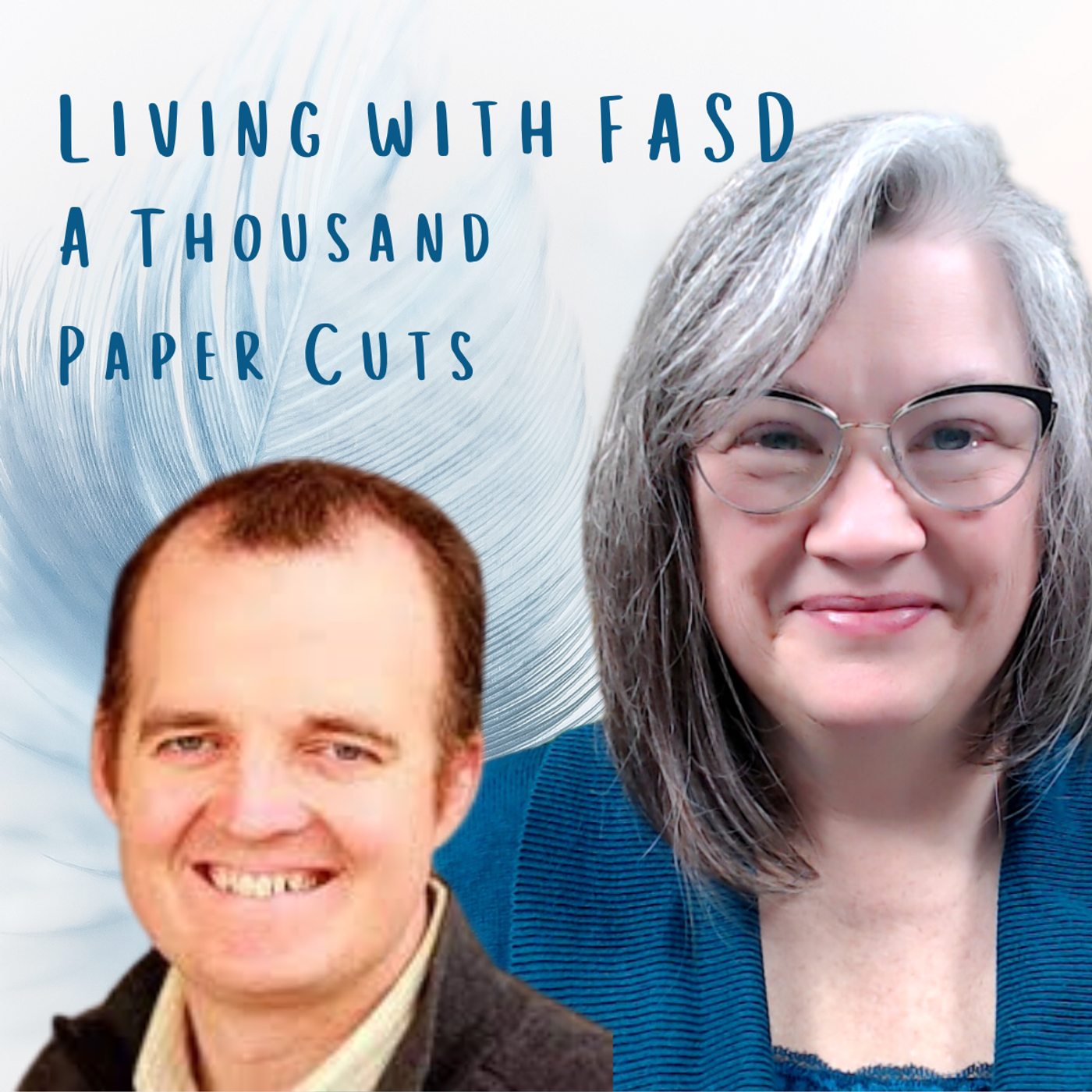
Living with FASD · Patricia Kasper
Suicidality in neurodivergent populations is a heavy, critical topic that demands our attention, sensitivity, and clinical nuance. Research indicates that individuals with Fetal Alcohol Spectrum Disorders (FASD) experience significantly higher rates of suicidal ideation and attempts than the general population. But what drives this elevated risk, and how can caregivers, clinicians, and support teams step in effectively? In this episode of Living with FASD, Dr. Jerrod Brown returns to explore the complex, biopsychosocial realities of suicidality in FASD. Patti and Dr. Brown unpack how neurobiology, trauma, and executive dysfunction intersect—highlighting the critical distinction between intentional despair and impulsive acts fueled by high suggestibility and impaired cause-and-effect thinking. From the compounding trauma of chronic invalidation to the protective power of late-in-life diagnosis and social belonging, this conversation replaces stigma with understanding, practical safeguards, and hope. Key Takeaways & Discussion Highlights A Biopsychosocial Phenomenon: Why suicide risk cannot be reduced to a single cause, but is shaped by the interplay of biochemistry (nervous system, hormones, immune response), psychology, and environment. Research Statistics & Neurodivergence: What the literature reveals about elevated rates of suicidal ideation (up to 43%) and attempts (up to 23%) in FASD, with comparable patterns across autism, ADHD, and traumatic brain injury (TBI). The Role of Suggestibility & Contagion: Real-world case insights into how high suggestibility, gullibility, and exposure to peers in crisis can introduce suicidal behaviors in individuals who had no prior ideation. Impulsive Acts vs. Intentional Suicidality: How abstract reasoning deficits and executive function impairment can prevent an individual from connecting actions to permanent consequences in moments of intense distress. Digital Risks & Emerging AI Vulnerabilities: The dangers of unmonitored screen time, isolating chatbot interactions that create false attachments, and the need for structural boundaries around technology. Chronic Invalidation as "Paper Cuts": Understanding how thousands of everyday invalidations ("you're lazy," "try harder") accumulate into significant emotional trauma and shame. Alexithymia & Somatic Buildup: What happens when an individual cannot identify or verbalize emotions, causing distress to build physically into panic, gut issues, or explosive self-harm. Protective Factors & The Healing Power of Diagnosis: How receiving an accurate diagnosis—at any age—fosters self-compassion, dissolves decades of shame, and opens the door to supportive, trauma-informed accommodations. Resources & References Mentioned 988 Suicide & Crisis Lifeline: Call or text 988 (Available 24/7 across the US and Canada) The Connected Child and TBRI (Trust-Based Relational Intervention) Principles 4D Living with FASD: Shared Voices, Clearer Understanding by Patti Kasper Adverse...
Jerrod Brown: But equally scary is yes, it could be a factor. In some of these cases, and another another variable is what happens if it's an impulsive-based suicidal act where the person has absolutely no intent to end their life, but because of their high level of suggestibility and because of the profound executive function impairment. their brain goes so fast, they're not connecting the dots that suicide unfortunately is permanent. Their brain is just not connecting the dots and thinking beyond the moment. So impulsive based situations, we have to consider that as well. Patti: Welcome to another episode of Living with FASD Candid Conversations with Patti Kasper. I am your host, and joining me again today is Dr. Jared Brown. Every time we have him on, he brings another topic of research that just is so important. Things we need to be aware of that we may or may not think about, and some subjects have been more scary than others and this is one of those. So today we're going talk about the suicidality. You know, we recently had Suicide Awareness Month. It was the same month as FASD Awareness Month. And so a lot of us didn't pay much attention to it because we were so focused on the effects of prenatal exposure to alcohol. And Now we need to circle back and talk about suicidality and what the research has to say about it. Is it something we need to to have heightened awareness about and what does that look like? What do we need to really be paying attention to? So with that lengthy introduction, Jared, welcome back. Jerrod Brown: Patti, thank you. Hi everyone. Hope all of you are doing well. I I wanna be very sensitive about this topic. And it's a topic that's near and dear to my heart. I have worked with many folks over the years that have had histories of suicidal thinking. I've known people in my own Professional life who have dealt with things that we're gonna be talking about today. And we're gonna talk about this from the research angle and not here to diagnose, we're not here to treat, just raise awareness and talk to professionals, reach out. There's lots of resources usually in every community. If you're working with someone that has a history of suicidal thinking, and Patti, you mentioned is this something we need to be aware of or be more mindful of? Absolutely, with every every population, but particularly too with the folks that have FASD. There, there's no way around this. At least the available research, and there's not a ton, but there's there's enough that does indicate. folks with fetal alcohol spectrum disorder, according to these studies, and a lot of the cases I've consulted on over the years where the individual may have had some thoughts of suicide or unfortunately have maybe had an attempt on their life at some point. So there's a lot of reasons for that. It's not just the FASD, of course. I never want to say someone has FASD and they're going to have suicidal thinking. It's not just that. Patti: Exactly. The it's not a guarantee. We're not necessarily Jerrod Brown: Absolutely. Patti: doomed to a life of depression or a life of hopelessness. Jerrod Brown: Course. every human being, it depends on family factors and social and sometimes genetic and biochemistry and what kind of supports are in place. What is the diagnosis? Is there no diagnosis? It's someone is someone being marginalized or minimized and invalidated. there's so many factors and we'll cover a lot of factors. We won't be able to get to all of them because there's just so much out there. But when you study this topic in General. This is just the suicide literature in general. You want to be aware of the term suicidality and basically what that is, think of it as that that spectrum, and then under the spectrum of suicidality, you have a lot of different terms. Suicidal ideation. So I'm sure most of you know what that is. That would be more when someone is thinking about or maybe planning suicide, unfortunately. You have maybe suicidal related communication. That is talked about under the umbrella of suicidality. Maybe you have someone that's actually made an attempt on their life, so you have a suicide attempt. And death by suicide, unfortunately, that is when someone does end their life. And there's other terms that fall under that umbrella, but those are a few terms you definitely want to be aware of. And this is a really complex topic, like all topics we talk about. Obviously this is at the extreme end of the spectrum of topics you and I have covered, Patti. So again, I want to be very, very sensitive, very mindful. And I can't imagine if you have lost someone to suicide. I I cannot imagine that how terrible. And hopefully this helps raise awareness and just know how complex this is, because if you dig into the general suicide literature. It seems straightforward, maybe if you think, well, someone's depressed and they're they're they're lonely and self-esteem issues, they've had trauma and substance misuse. Yes, those are all factors, but why does it get really, really complicated? Well, it does indicate in the suicide literature it's a complex biopsychosocial phenomenon. What might that mean? Well, if we look at this in terms of biochemical abnormalities, there's a lot of interesting Interesting research out there where studies have looked at what could be going on in the person's body biochemically. And there's studies that have shown in some cases, again, every study's different, there's limitations, there's small sample sizes. Most of these studies haven't been done with folks with fetaloccoil spectrum disorder. But some studies have looked at, okay, what role does the nervous system play? Or the endocrine system and our hormones or our immune system, our neurotransmitters. There is research. Patti: And we know that those are all affected by it by prenatal alcohol exposure. Yeah. Jerrod Brown: They sure are, yes. So definitely that is definitely something to be aware of. And everyone is different, wired differently genetically and biochemically and neurologically we have differences, every human being. But some studies have found, yeah, maybe we could look at hormones. We could look at what's going on in the immune system. The more you can correct someone's biochemical abnormalities, and that can be caused by all kinds of things, poor gut health. Chronic sleep issues, bad diet, lack of exercise, lack of sunlight exposure. We've talked about those topics many, many times over. But just know it's complex and it is a biopsychosocial kind of issue we really need to dig into. If you now look at what does the research literature say specifically about suicide risk among folks who have FASD? And you you can find older studies, you can find some newer studies, and these are smaller sample sizes. So as the nerdy professor I am, you know every study you look at, there's limitations. Can we take what this one study says and apply it to the whole FASD population? Definitely not. But some of the studies indicate that maybe as many as 43% of folks with FASD may have a history of suicidal ideation as that person gets older. And there's a study too that does talk about maybe as high as 23% of folks with FASD may have a history of suicide attempts. Now, I don't know if that's going to apply to everybody, but that's one study of many. And then the question comes up: well, why are those rates so much higher than the general population? Which those rates are much, much higher than the general population. And you have Patti: for the general public. Jerrod Brown: I I honestly do not know because there's so many different studies out there, and it is mu it's significantly higher. And I do a lot of work in this area when we look at autism, brain injuries, ADHD, and FASD. And collectively, if you look at those four groups, and those four groups all are neurodivergent conditions. Basically, the rates are s multiple times higher than the general population. So when you study this topic. I found it helpful. Let's take a deep dive into what the autism literature says, the ADHD and the TBI, not the same as FASD, but it can definitely shed some light in terms of other factors. But there's a really good article that was published specific to FASD and suicidality. And the question was: well, what factors are at play? Well, it's not just the prenatal alcohol exposure. Was the person dealing with co-occurring mental health problems that are untreated? Was the person also dealing with substance use problems? What was that person's level of emotional dysregulation like? Did that person have extreme difficulty managing tough stuff? Did they have a lot of impulse control problems? Were they highly irritable? Did they lack patience? Did that person on top of the prenatal alcohol exposure also have a history of childhood trauma and fractured attachment patterns? Those are variables. But the question always comes up: well, I know plenty of people that have had childhood trauma and fractured attachment patterns, and they never grow up to have suicidal thinking. So any one of these variables does not indicate the Person is going to have suicidal thinking. But if you lay out all the puzzle pieces on the table and this person has so many of these puzzle pieces going on, yeah, it's going to increase the risk. Another variable that is talked about in the FASD literature, what about financial stress? Is that person under a great deal of financial pressure? Are they facing homelessness? Poverty? Are they unemployed? Do they have a hard time keeping a job? That is another piece of the puzzle. And then looking at the social and family support system. Did that person with FASD live in a home environment where there was love and attunement and validation and empathy and the person felt safe or did that person grow up in a home they didn't feel safe? They didn't feel loved. They they just felt like they didn't matter. Did that family system get FASB? Go ahead, sorry, Panny. Patti: Yeah. And Jared, I think that's a very important piece of this because so many of the secondary disabilities that we deal with, the depression, the anxiety, the low self-esteem, the self-condemnation, all those things come from being s chronically surrounded by people that do not understand neurodivergence, that do not understand that. We under we see things differently, we understand things differently, we respond differently, and we're constantly subjected, and we're belittled. You're you're stupid, you're dumb, you're bad, you're wrong, you're this, that, and the other. Well, gee, I wonder why there's depression. I wonder why Jerrod Brown: Course. Patti: there's anxiety, especially if we've got sporadic mastery where one day we can do things and another day we can't, and that's not predictable. how often can we wake up in the morning wondering if we're going to be disappointing everyone again or frustrating everyone again? And those kinds of things make so much sense. But you know, as I thought about the conversation we would be having today, one thing that did not cross my mind that did as I listened to you speak a few moments ago. One factor that we need to consider, you you and I have talked about suggestibility before, and you know, doing as others have done, right? What about those of us who have, you know, maybe we're struggling with depression or anxiety or you know, rejection and isolation. If we've had someone in the family. Or a close friend or someone who used to be a supportive person for us, if they have attempted or committed suicide, how much more likely might we be then? You know, because of those suggestibility factors piled on top of the the mental health struggles that we we may well have. Jerrod Brown: Thanks for bringing that. I can talk at length because there are two cases I actually consulted on in years past where that was an absolute factor. A little different than what you said, but on the spectrum. So both these cases, they were adult females who had confirmed FAST. They both lived in a group home. They never had a history of suicide, but when they moved to the group home, There was somebody in the group home that did have a history of suicide and started talking about it and actually had an attempt. So then all of a sudden, and these are two people that didn't know each other, two separate cases, both things happen. Both of these people with FASD now started reporting suicidal thinking. They started to give the impression they were going to attempt suicide. I believe with without a doubt, those were both related to suggestibility and gullibility and naivete, where they didn't even think about it, but now it's right in their face. Sure enough, they thought about it. they they their mind was, okay, yeah, well, if she's gonna do it, absolutely. Patti: Yeah, like it or not, suicide is one of those things that has the a a contagion aspect to it. Jerrod Brown: Absolutely, it does. So s thank you for bringing that up, because yeah, suggestibility is another piece of the puzzle. And we you and I have talked about suggestibility within the context of like law enforcement and false confessions, all of those very important and scary topics. But equally scary is yes, it could be a factor. In some of these cases, and another another variable is what happens if it's an impulsive-based suicidal act where the person has absolutely no intent to end their life, but because of their high level of suggestibility and because of the profound executive function impairment. their brain goes so fast, they're not connecting the dots that suicide unfortunately is permanent. Their brain is just not connecting the dots and thinking beyond the moment. So impulsive based situations, we have to consider that as well. Patti: Yeah. And you know that that is that is actually a very important piece another element of this is is the in the interacting with chatbots, you know, that are programmed to, you know, AI safety, chatbots are programmed to affirm. our state of mind. Whatever that state of mind is, affirm it and and and run with it and keep the conversation going because they're they're above anything else. They're programmed to keep conversation going. And and we've seen case after case after case in the media of people committing, you know, especially younger people committing suicide because of the of a conversation with a chat bot. And with when you add the suggestibility that is at play for so many of us, that that is a very huge concern. Jerrod Brown: I'm actually giving a free training coming up on that very topic. If you want to share with your audience, I can share you the link. It's not an FESD training, but it is. How does AI contribute to poor mental health? How might it push people into addiction? Impulse control issues, attachment problems, and suicidality. There's no FASD literature out there that I am aware of that looked at that specific topic yet, but in the general artificial intelligence literature, it is being talked about more and more where yes, if you have some folks with certain conditions They're lonely, they're isolated, their only outlet is the online world, and they start getting into a chat bot, that chat bot is always going to affirm them, probably not ever going to challenge them. It's not real. And it's gonna give them that false sense of attachment. And if that chatbot starts encouraging not so good things. And here's the other thing with that literature. What happens if that person's technology all of a sudden goes out, they don't have internet access anymore, or that chatbot whatever platform goes down. There's some interesting emerging literature that indicates that could be a triggering event for extreme mental health problems and the person may feel like they're being extremely rejec yeah, rejected. So scary stuff. Yes, more to come on that, definitely be on the lookout. Patti: Because their friend is gone. Their friend is gone. Yeah. Yeah. So I definitely want to have the information about the date and time of this talk and also the link, and it'll all be in the show notes. But I I Jerrod Brown: So they Patti: remember when I did an episode earlier this year on AI safety. The AI agent I was interacting with to gather information on the topic did say that, our external brain, quote unquote, I hate that term, but you know, someone who a human support person can install controls onto the computer so that the only way a chatbot can function is like an encyclopedia. can provide answers to questions without being conversational. And that is I think that would go a long way to tamping down this potential risk. Jerrod Brown: Safety around the use of the internet is is such a big deal. I can't count how many folks have reached out to me who've seen me on different podcasts stating, I have a loved one with FASD or autism or ADHD, and they're they're just thrusting themselves into the internet and they've changed. They're they're not getting sleep anymore, they're their hygiene's going up, they're more depressed, anxious. I don't know what to do about it. So that is a big part of prevention, intervention too. just being mindful of screen time usage. Not just being on AI, but even excessive screen time exposure. What does that do? Well sedentary behaviors, poor eating habits in a lot of cases, throws off for cortisol and melatonin and We're just not getting natural sunlight and we're throwing off sleep. A big driver for some of these situations is chronic sleep issues as well. That just makes everything worse, including depression, anxiety, and loneliness, self-esteem issues as well. One other thing, too, that we don't think about in terms of another potential risk factor is a learning disability that might be undiagnosed. look at some of the dyslexia literature as well. That's a whole nother topic your audience would want to be aware of because if your loved one has an undiagnosed learning disability and no one picks up on that, what happens in a lot of cases? When the person is going through a K through twelve environment, they might get mislabeled as being lazy or just not that intelligent when that is not the case. If we get the right diagnosis, the right support, that person can thrive. But without that, to the unsuspected eye. Yeah. And when you you talk Patti: Yeah. It's just more shame. It's more shame. Jerrod Brown: you talked about like invalidation, and if you look at that through a trauma lens, The trauma literature says invalidation is a simple T trauma, which basically means and I don't want to minimize it, it might be on the milder form of trauma, but what happens if someone is invalidated thousands of times Patti: Great today. Jerrod Brown: over, over and over? And I've heard in the literature it it think of it as a little paper. Yeah, it's Patti: It compounds. It's like interest on a credit card bill. It just Jerrod Brown: a big s it's it's a paper cut. One paper cut, ouch, ooh, that hurts. But what happens if you have a thousand paper cuts? yeah, bad, bad news. Chronic invalidation, very, very bad over the long haul. So there's a really interesting Australian study that looked at FASD and suicidality in younger individuals. And there's a lot more to this study, but this this particular study found that The population had higher rates of justice involvement, attachment disorders, some had conduct disorder, some had substance use disorder, and depression. Those were big factors as well that you'd really want to dig into. So justice involvement, big factor, because if that person's facing a lot of jail or prison time. That's scary for anybody. So that's another variable we really want to dig into and obviously come around that individual and do what we can. Not a lot of research on this one, but here's another another variable that you might want to consider. Is the person involved in the child welfare arena? So termination of parental rights. They're not raised by birth parents. And that's Patti: Okay. Jerrod Brown: that's common among a lot of folks with FASD. So it has a lot. that's a biological separation, which is attachment. We need to be aware of attachment theory. But if that person's thrusted into foster care or adoption, a lot has to do with what the placement's like as well. Are they placed in a kind Patti: Mm-hmm. Jerrod Brown: loving home? Or they bouncing around from foster care home to foster care home to foster care home as well. Patti: And and the bouncing is because the the family is not adequately prepared to understand Jerrod Brown: Absolutely. Patti: the child, to understand their needs, their behaviors. They don't feel trained, they f they feel squashed as much as the child does, and and the family just dissolves, gives up. And every time a child is moved, those traumas, the this separation trauma happens all over again. leads to inability to form healthy trusting attachments. Yeah, the it's a perfect storm. Jerrod Brown: Yeah. And I see you have a l I see you have a loved one with you right now and animals play a huge protective Patti: I do. Jerrod Brown: role as well. a great way to support attachment in all kids and it helps is a loving animal. And there's Patti: Yeah. Jerrod Brown: have been a couple cases I've consulted on too over the years where the person with FASD really found benefit of going to equine therapy or animal assisted therapy as well. So Patti: Mm-hmm. Yeah. Jerrod Brown: Tapping into other kinds of resources, art, music, playtherapy, and doing it as a team as well is so, so important. If you here's a couple other variables too, Patti, your audience may you probably are aware of, folks, but this is not FASD specific. If you look in the general suicide risk literature, it it talks about being very mindful. Does that person live with a chronic pain condition? So chronic pain issues, big factor. Alexithymia, we've talked about that in the past. If somebody has alexithymia, That has been shown to be a risk factor for suicidal thinking in some cases. Maybe you've never heard that term before. Patti: Let's let's define that real quick. Jerrod Brown: You bet so it's emotional blindness. So if you know somebody that struggles with naming and labeling and making sense of emotions. That's on the spectrum of Alexodyomy, and how might that be a risk factor for suicidal thinking? Well, it makes perfect sense if you know that literature. So you have a loved one. They get really angry all the time. They're stressed. They're depressed. But they can't come to you and name it. They can't tell you, I'm scared, I'm sad, I'm anxious. Where does that energy go? It goes into their body and it builds and builds and builds. And then what happens? Well, it comes out as gut health issues, sleep problems, skin problems. back pain, headaches, panic attacks, so then they just explode emotionally. And that could be a triggering event for alcohol use, drug use, self-indest behavior, so alexithymia, another big topic. Patti: And they when when you bring out the drug and alcohol use as a way of coping with with that buildup and trying to you know needing a relief valve or a blanket to cover it over, right? To numb it a little bit. there I wonder how many of the overdoses you know are are accidental. No intent at all to you know purposeful. overdose right and that that's another yeah that's Jerrod Brown: Absolutely. Intentional versus unintentional. Yeah. Patti: a another area that we really need to be aware of how many and I'm curious maybe maybe you can tease this out at a future time maybe you already have and know the answer but I'm curious about the statistics how many of the suicide cases are just not just as in to minimize it, but I wonder how many are accidental deaths. But because they're self-inflicted, they get classified as suicide. For instance, you know, if if you don't if you can't process cause and effect and you have no way of knowing that playing with a rope could, you know, have permanent harmful outcomes. You know, or there was another contagion factor, contagion event of the strangulation. That was that was a rage thing a while ago, you know, that but how many how many of the kids that tried that accidentally succeeded? in in suicide. But when when our judgment is off or when we can't connect cause and effect, how much more vulnerable are we to accidental death? Jerrod Brown: My gut tells me it plays a role in a lot of cases. How many? I d I don't think we will ever know with certainty. But because of the cause and effect and the impulsivity, and when you mention cause and effect deficits, basically what that is is abstract reasoning deficits, which Patti: Mm-hmm. Yeah. Jerrod Brown: is human beings' ultimate kind of cognitive functioning. So Abstract reasoning basically is our ability as humans to plan for the future, see the force through the trees, connect the hows and whys and connect the dots and how my actions right now could impact me or somebody else tomorrow. And most folks with FASD absolutely have abstract reasoning deficits. I love your other companions, Patti: I'm popular today. Jerrod Brown: beautiful Patti: It was Sar, and now it's George. Jerrod Brown: George, welcome. I love animals. I can't say enough about animals. We have a dog, English lab. So Patti: So little Saar, if he were a person, would be diagnosed with Ellers Downlow syndrome. So yeah. Yeah. His he's seven years Jerrod Brown: Really, really, really. Okay. I unfortunately know way too much about that. Patti: old. Seven years old has no idea that he is disabled. Jerrod Brown: Sorry. Patti: you know, like right now see George is standing on all fours. Saar can't do that. He can straighten his spine Jerrod Brown: So connective tissue issue. Patti: if he's lying down. But he cannot stand on all fours. He can only hold extend his front legs with weight. So yeah. He can scamper Jerrod Brown: He's a precious soul. Couple other variables. Patti: so fast. And I don't know if you Jerrod Brown: Here's some Patti: heard the commotion, but yeah, two of the dogs were going after him. Moving target. Jerrod Brown: Yeah, got a lot going on over there, my front. Yes. Couple other things, folks, you just want to be aware of in the general suicidality literature is histories of bullying and teasing is very important to be aware of. Histories of being humiliated. Looking at sleep issues. even food insecurity and diet. Now I'm not aware of in the FASD literature they've looked at these variables per se, but in the general suicide literature, food insecurity could be a factor and what that person eats. So if that person's eating a bunch of junk food all the time. Some studies have found that could be another piece of the puzzle. It's not it doesn't explain everything. But if you're eating junk food day in and day out, what happens? Well, it's probably throwing up your hormones, your gut health. It could could impact your your mood, your energy level, your sleep, all of North. Patti: And and your sugar levels are like an EKG? Jerrod Brown: Without a doubt. Without a doubt. And even and I I I don't want to open up too much of a can of worms, but there's other literature out there that has they've done work and they found maybe omega-3 fatty acid deficiencies could be a piece of the puzzle. Yep, there's studies out there. Patti: Really? Interesting. Jerrod Brown: Air pollution exposure now, they're looking at that. And this is not FASD specific, but it it none of these explain it. That it's not a direct cause, but it it may be a a a contributor along with other risk factors. So That's why again this is just so so complicated and there's so many different variables to take into account. So and those are not all the variables, but those are some of the bigger ones you'd want to be aware of. But The question is too in terms of interventions, like what can we do about this too from an intervention prevention standpoint? Well, there's all kinds of things you want to be aware of, but again, we want to be aware of the terms. We want to be aware of the risk factors and potential contributors too. So that those are variables that you want to consider. So the more you can be aware of all of these puzzle pieces, then you're more equipped to work with the right providers to dig into those areas. Whatever you can do to build resilience, the research literature in the resilience literature does indicate. Anytime you can build resilience in someone, that's a good thing for anybody. Higher levels of resilience is like a force field, it's a protective shield. So if you have higher levels of resilience to get knocked down emotionally, you can get back up, you can you can be more adaptable, more flexible. And interestingly, higher levels of resilience may be a protective factor. against depression, anxiety, even aggression and sleep issues, to name a few. In the general literature too, self-compassion is a really good intervention. The more you can practice self-compassion, where you can be nicer to yourself and Be able to let things go. none of us are perfect. We all make mistakes. And what better way, Patti, to combat shame is self-compassion. There's there's lots of good stuff out there on that as well. Patti: Yeah. Yeah. And Jared, I think that is probably one of the most important reasons to pursue diagnosis in adulthood. a lot of people say, well, they're not a child anymore, it's too late, who cares? But what I have found, and so many of the people that I have gotten to know these past four, five, six years, is that The no matter what age you're diagnosed at, whether it's 20s, 30s, 40s, 50s, 60s, it's all of a sudden understanding the whys. Why did I make those kinds of judgments? Why did I always do this? Why did I struggle with that? That allows for the self-compassion and the grace that we can extend to ourselves. And so does diagnosis change any of the facts of our history? No. But it changes the way we view ourselves. And that change makes all the difference in the world. Jerrod Brown: I've heard that from a lot of people of yes, adults who got diagnosed eventually. It really allowed them to release some of that that shame. So thank you. Yeah. Patti: Yeah. And and not just an FASD diagnosis, but also late later in life diagnosis of autism and ADHD also. Jerrod Brown: Huge, yep. Other things you might want, social belonging is a major protective factor. If somebody feels like they belong and matter to a group, support groups can be helpful. A group who understands the person. Social isolation, loneliness, not good. Social belonging, very good. If you belong to the right group, you don't want to belong to a group that's not healthy, of course. We talk a lot about the ACES research, the adverse childhood experiences literature, and a very high percentage of folks with FASD weren't just exposed to alcohol and uterine. They had a lot of tough things happen to them early on in life in a lot of cases. How do you combat adverse childhood experiences? Positive childhood experiences is that line of literature that's talked about. So it's it's just common sense, but positive childhood experiences. Basically means You're in a a supportive connective family, you're connected to a good community group, maybe it's church, sports events, you have good connections in school. So you're combating that. And there's plenty of literature in the positive childhood experiences literature that does indicate it is a protective factor against poor mental health as you get older and even a way to reduce suicidal thinking as well. So positive childhood experiences would be Very, very important. There's an FASD-specific study that looked at suicide prevention support, and basically it's common sense, but this study found the more that person can be raised in a very stable, safe, and loving home environment and have very good, healthy relationships with caregivers and friends and family, that is going to be important. As that person gets older, getting connected to an FASD-informed therapist who really understands FASD, that was found to be helpful in this particular study. They also found that social belonging was very helpful. Teaching the Patti: Mm-hmm. Jerrod Brown: client good healthy coping strategies, developing that sense of hope that things are going to get better. If that person has no sense of hope, that is a scary risk factor. If you have hope, that's a major protective factor. So very, very important. And then this study also found the more we can early identify if that client had a history of trauma. substance misuse, mental health problems and and you alluded to it, getting that accurate FASD diagnosis if it fits, that's gonna be very, very helpful as well. Patti: And I think the the mechanism of that being helpful is simply that people understand the person living with it better and understand that it's not all about choice or willfulness. It's it's can't versus won't, and and are more likely to have those supports in place and have that compassionate lens. are more likely to be, the people in the that person's life are more likely to be curious than judgmental. And that makes a huge difference. Jerrod Brown: Trauma informed care is so important too and in in the suicide literature it does say. Really consider that trauma-informed lens and really understand trauma, the impact trauma has on the person, doing things to help the person feel safe and do things too that don't re-traumatize the individual. So trauma-informed care is going to be very helpful. This is not in the FESD literature, but I'm a big fan of like lifestyle medicine, lifestyle behaviors. In the the general suicide literature, too, it says the more you can be mindful of how that person lives their lifestyle. If that person doesn't eat well, if they live a sedentary lifestyle, if they smoke cigarettes, they're obese or underweight, they're dealing with all kinds of stressors in school or workplace stressors, they seem to have an internet addiction. Combat those lifestyle behaviors too. The more you can help a person live a healthy lifestyle, by default, that's probably going to help the client's brain and body work better, too. And if someone's out there they're eating junk food all day long and energy drinks and they're up all night, they never get exercise. That's bad for anybody's health. And that puts the person in greater vulnerability for all kinds of bad things. Patti: Yeah, our diet affects our sleep and our sleep affects everything. So yeah. Yeah, there's so much interconnectedness. Yeah. Jerrod Brown: Absolutely. So there's a lot more we could get into. There is. That's why this is a complex bio-psychosocial phenomenon because you can't separate our biology Patti: Yeah. Jerrod Brown: from our mental health, from our neuroscience components in the brain. So Patti: Which yeah, and and that was one of my central points in in writing four D Living with FASD is how interconnected everything is. Jerrod Brown: Thank you, my friend. And Patti: But I'm so glad you were able to carve the time out for me today. Jerrod Brown: Thanks for having me back and thank you everyone for listening Patti: Yeah. Jerrod Brown: to this. And share my email if people have questions. Reach out anytime. Patti: Yeah, send send me the information on that training and I will get the the date and the time and the link into the show notes. Jerrod Brown: I sure will. Thanks again, my friend.