
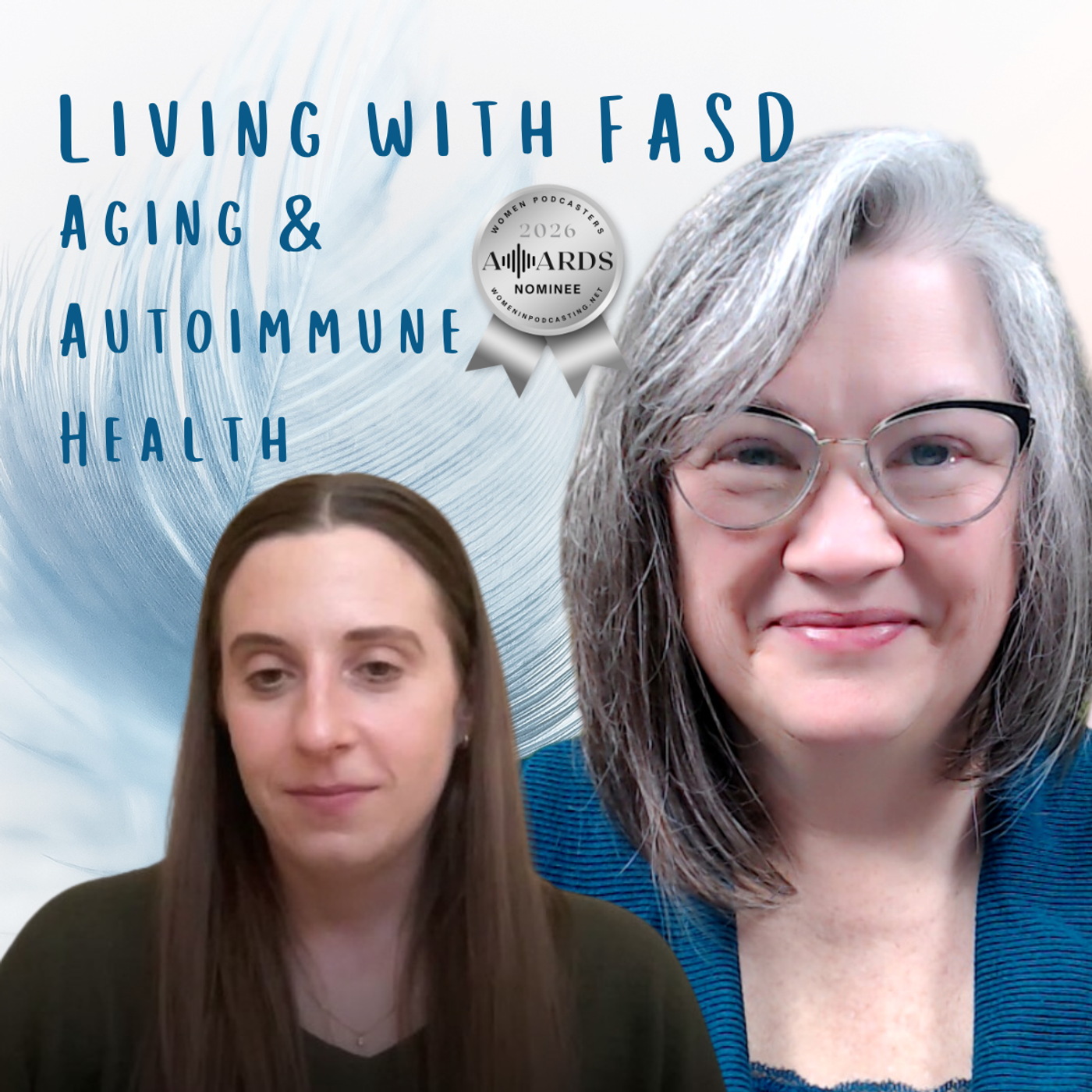
Living with FASD · Patricia Kasper
When we talk about Fetal Alcohol Spectrum Disorder (FASD), the conversation often centers around childhood behaviors or brain function. But what happens as we age with FASD? How does early exposure impact the rest of the body, from our immune system to our joints and digestive health? In this episode, Patti Kasper sits down with Dr. Tamara Bodner, Associate Professor at the University of Calgary, to break down the latest research on adult FASD outcomes, whole-body health, and aging. From her early preclinical work with legendary FASD researcher Dr. Joanne Weinberg to her current clinical studies in Calgary, Dr. Bodner shares crucial insights into how FASD manifests across the lifespan. In This Episode, You’ll Discover: From the Lab to the Lived Experience: How a simple question at a conference shifted Dr. Bodner’s focus from animal models to human clinical health. The Prevalence Gap: Why FASD remains underdiagnosed and misunderstood despite impacting 1 in 12 to 1 in 20 people across North America. Autoimmune & Inflammation: The connection between FASD, elevated inflammatory markers (cytokines), and early symptoms of autoimmune challenges. Aging & Dementia Questions: What the data actually reveals about brain biomarkers, cognitive decline, and why one-size-fits-all diagnostic tools don't always fit FASD. The Gut-Brain-Immune Axis: Emerging research on the gut microbiome in FASD and how modifiable lifestyle factors (diet, sleep, mobility) foster resilience. Participating in Research: How adults with lived experience in both the U.S. and Canada can get involved in ongoing studies. Resources Mentioned in This Episode: Dr. Tamara Bodner’s Lab (University of Calgary): Search Tamara Bodner University of Calgary to explore active studies and research updates. Books Mentioned: Sip by Sip by Patti Kasper (https://books.by/yourfasdcoach) Connect & Follow: Website: patriciakasper.com Work With Patti: https://calendly.com/kaspertrainingandcoaching/introductory-chat-with-patti . Email her at [email protected] Subscribe & Share: If this episode gave you clarity or hope, please leave a review on Apple Podcasts, Spotify, or share this video with a friend or colleague!
Tamara: Like topics, research topics, Patti Kasper, Your FASD Coach: Mm-hmm. Tamara: I do. Yeah. Yeah. So I've done a whole bunch of different stuff. Like I said, I started in preclinical animal models. So looking at how alcohol exposure impacts brain development and things like that. But it for me, what was really kind of a life-changing experience was going to one of those FASD Vancouver meetings and I Patti Kasper, Your FASD Coach: Mm-hmm. Tamara: had a whole study looking at arthritis outcomes in an animal model. And I got a great question from somebody, you know, in the audience basically being like, this is cool, this is interesting, but like, what about me? What about others with FASD? Do Patti Kasper, Your FASD Coach: Mm-hmm. Tamara: we actually know about autoimmune conditions or arthritis in in us humans? And I Patti Kasper, Your FASD Coach: Yeah. Tamara: had to kind of be like, well, we we haven't really been able to look at that yet. And I think that was that moment when I realized like I need to be doing more clinical research because, you Patti Kasper, Your FASD Coach: Mm-hmm. Tamara: know, you know, I'm not saying the the animal model stuff isn't important and it allows us to ask really specific questions. But there's just such a lack of understanding in Patti Kasper, Your FASD Coach: Yeah. Patti Kasper: I'm so glad to have you with me on this week's episode of Living with FASD. I try each week to bring you candid conversations that are meaningful. It has been my highest honor to do so. And collectively, the voices of this podcast offer tremendous wisdom for those of us living with FASD, for caregivers, and for the professionals with whom we interact. Stay tuned to the end of this podcast where I will share with you about my new book featuring our shared wisdom. It's launching on September 9th, so stay tuned to the end and I'll get you those details. Patti Kasper, Your FASD Coach: Welcome to another episode of Living with FASD Candid Conversations with Patty Casper, and I'm your host. And today I am so excited to bring to you Miss Tamara Bodner from she's an associate professor at the University of Calgary to our north and has been a speaker for several several sessions at the Seattle Conference this past spring. And I'm just so excited. Tamara, thank you so much for taking the time out of your busy schedule to to come and talk to us. Tamara: Yeah, thanks for having me. Patti Kasper, Your FASD Coach: Yeah. So what one thing that I love to ask people who are either studying or teaching, what brought you into the field of FASD? Tamara: That's a great question. so I started my PhD in Vancouver with Dr. Joanne Weinberg, and she's been in the FASD space, you know, basically since it began. and Patti Kasper, Your FASD Coach: Mm-hmm. Tamara: she was my mentor, and she really, you know, basically sort of brought me into this place. And I think, you know, at that point I was doing preclinical animal model research. Patti Kasper, Your FASD Coach: Mm-hmm. Tamara: but she like her sort of training environment really involved you know, working with individuals with FASD, being part of the at that point with that was the Vancouver meeting, you know, predating the Seattle FASD meeting. Patti Kasper, Your FASD Coach: Mm-hmm. Tamara: so really just recognizing, you know, the importance of studying FASD. And I think, you know, in the context of like I'm a neuroscientist by training, so I'm really, you know, always been interested in the brain, but learning Patti Kasper, Your FASD Coach: Okay. Tamara: more about, you know, brain based conditions and recognizing that FASD is just so understudied. Patti Kasper, Your FASD Coach: Mm-hmm. Tamara: really wanting to like sort of move that needle as much as possible and sort of bring also along along with it sort of bringing attention and decreasing stigma around FAST. Patti Kasper, Your FASD Coach: Mm-hmm. Tamara: That's sort of always been the driving force. so even sort of extending beyond my time in in Joanne's lab and now in my own lab, that's really kind of the main goal is like you know bringing more research into this space, but also alongside Patti Kasper, Your FASD Coach: Yeah. Tamara: really decreasing stigma. Patti Kasper, Your FASD Coach: Okay. And what it did you seek her out when you were deciding, what do I want to get my dissertation in? Or I mean what what what led you to FASD? D is there a personal connection? Tamara: Yeah, I mean, for me it was all about having a great mentor. So, you know, to be perfectly honest, I didn't necessarily know that that was gonna be like FASD or what, you know, in this Patti Kasper, Your FASD Coach: Okay. Tamara: research space. But, you know, having a mentor who, you know, especially like a really strong woman who's a really big advocate and just like a Patti Kasper, Your FASD Coach: Mm-hmm. Tamara: a leader in in research, but also really Patti Kasper, Your FASD Coach: Okay. Tamara: passionate about what she does. And I think I think that's pretty infectious. Like when you work with somebody who's excited about what they do Patti Kasper, Your FASD Coach: Okay. Yes, it is. Yeah. Tamara: and why they do it and why it's important. Patti Kasper, Your FASD Coach: Yeah. Tamara: it it's pretty easy to then sort of feel that same way. Patti Kasper, Your FASD Coach: Okay. All right. Now, you know, one one I don't know, maybe this is this might be too revealing. I don't know. With the with the stats what they are, like one in twenty if you listen to the CDC, one in twelve if you listen to the folks at CanFast. That's a lot of people. So, you know, when I when I do presentations, I will say, How many people do you know? You know, do you know more than more than a hundred people? Do you know 200 people? You know, well, how many is that? Divided by 20, right? That's how many people with FASD you know. And it's so have after the more that you have studied this, do you recognize it in people that you know? Tamara: mean I think you I do similar things like when I'm teaching I Patti Kasper, Your FASD Coach: Mm-hmm. Tamara: for example like I'll I I I think for me it's more recognizing that how prevalent it is, but also how Patti Kasper, Your FASD Coach: Mm-hmm. Tamara: not understood and even misunderstood it it is. Patti Kasper, Your FASD Coach: Mm-hmm. Tamara: So like when I'm teaching in big classrooms, you know, I can bring it into any classroom, no matter what the topic, I always bring it in in some capacity. Patti Kasper, Your FASD Coach: Yeah. Tamara: and we'll ask students like how many have heard of FACD, how many know what it means and just like getting at some of those like myths, etc. Patti Kasper, Your FASD Coach: Mm-hmm. Tamara: And really realizing that there is such a lack of knowledge despite the fact that it is so prevalent. So I think that that's where Patti Kasper, Your FASD Coach: Yeah. Yeah. Tamara: that's where I kind of see it. And so like doing my part to try to like, you know, teaching a lot of med students and nursing students and just general Patti Kasper, Your FASD Coach: Mm-hmm. Tamara: science students to try to sort of move that needle as well. But Patti Kasper, Your FASD Coach: Mm-hmm. Tamara: I think that is one of the most surprising things because everybody knows about autism, everybody knows about Down, Patti Kasper, Your FASD Coach: Yeah. Tamara: for example, but you know, we don't necessarily have Patti Kasper, Your FASD Coach: Yeah. Tamara: that same understanding and Sort of public acknowledgement of FASD. Patti Kasper, Your FASD Coach: Right. Right. Even though our s our prevalence rates dwarf theirs. So Tamara: Exactly. Yep. Patti Kasper, Your FASD Coach: not that two to one is dwarfing, but I mean when you look at the scale, yeah. Yeah. Tamara: And then from a research side, like we, you know, there it's a more prevalent condition than than many others, but also we know so much less about it. So like it those two Patti Kasper, Your FASD Coach: Mm-hmm. Tamara: pieces going together, I think, you know, is one of the reasons that I've really stayed in this space is to try to add to that. Patti Kasper, Your FASD Coach: Okay. Now what what are what are the the subjects of the studies that you've done so far? Tamara: Like topics, research topics, I Patti Kasper, Your FASD Coach: Mm-hmm. Tamara: do. Yeah. Yeah. So I've done a whole bunch of different stuff. Like I said, I started in preclinical animal models. So looking at how alcohol exposure impacts brain development and things like that. But it for me, what was really kind of a life-changing experience was going to one of those FASD Vancouver meetings and I had Patti Kasper, Your FASD Coach: Mm-hmm. Tamara: a whole study looking at arthritis outcomes in an animal model. And I got a great question from somebody, you know, in the audience basically being like, this is cool, this is interesting, but like, what about me? What about others with FASD? Do Patti Kasper, Your FASD Coach: Mm-hmm. Tamara: we actually know about autoimmune conditions or arthritis in in us humans? And I Patti Kasper, Your FASD Coach: Yeah. Tamara: had to kind of be like, well, we we haven't really been able to look at that yet. And I think that was that moment when I realized like I need to be doing more clinical research because, you Patti Kasper, Your FASD Coach: Mm-hmm. Tamara: know, you know, I'm not saying the the animal model stuff isn't important and it allows us to ask really specific questions. But there's just such a lack of understanding in people with FASD, and that part should come first. So from Patti Kasper, Your FASD Coach: Yeah. Yeah. Yeah. Tamara: that, I had a cool opportunity to as part of a grant with Joanne Weinberg, and then now that I've carried here, look at adult outcomes. So adult health related outcomes in individuals with Patti Kasper, Your FASD Coach: Okay. Okay. Tamara: FASD. but taking that whole body approach. So again, I'm a neuroscientist, like fundamentally Patti Kasper, Your FASD Coach: Mm-hmm. Tamara: I'm really excited about the brain. But recognizing that no body system, you know, works by itself. So really looking at sort of whole body health and how, you know, Patti Kasper, Your FASD Coach: Right. Right. Mm-hmm. Tamara: various factors sort of across body systems impact the brain in ethics. Patti Kasper, Your FASD Coach: Okay. So what what are what are your findings when it comes to you know well let's just take the arthritis. Have have you looked more at that in terms of people? Tamara: Totally. So yeah, so from that rodent study, we saw sort of like increased severity and de impaired recovery from this arthritis like condition, but then translating that into the clinical setting. We started out by looking at basically diagnosis of autoimmune conditions. So for everybody that's Patti Kasper, Your FASD Coach: Mm-hmm. Tamara: come into our study, we we asked and also looked at medical records to look at whether, you know, the the number of folks that have been diagnosed with an autoimmune condition. And we didn't really see all that much, but that basically comes down to know what we're what we're hearing from from individuals is that you know they may be experiencing some symptoms but they're not when they're going to their family doctors or maybe not even getting referrals to like rheumatology or you know basically Patti Kasper, Your FASD Coach: Mm-hmm. Tamara: not understanding those symptoms or getting told they're they're too young to be experiencing some of these conditions. So we quickly pivoted from just you Patti Kasper, Your FASD Coach: Yeah. Tamara: know getting these diagnos diagnoses. and now we are looking at we're calling look basically like a preclinical symptoms of autoimmune conditions. So Patti Kasper, Your FASD Coach: Mm-hmm. Tamara: It doesn't require a diagnosis. It just requires, we just ask basic questions like do you have skin that bruises easily, unexpected skin Patti Kasper, Your FASD Coach: Mm-hmm. Tamara: rashes, a set of questions that are pretty tied to autoimmune conditions. And what we're Patti Kasper, Your FASD Coach: Mm-hmm. Tamara: finding is that sort of the the average level of these symptoms when we sort of tally them all up is elevated in individuals with FASD and adults. so really suggestive of at least early symptoms of autoimmune Patti Kasper, Your FASD Coach: Mm-hmm. Tamara: conditions. in some folks probably, you know, ongoing autoimmune conditions. But we also see Patti Kasper, Your FASD Coach: Mm-hmm. Mm-hmm. Tamara: a lot of variability. So something we do in our work is try not to think of, you know, what is FASD doing in general, but also looking at individual differences. So that kind of risk resilient idea. So, you know, Patti Kasper, Your FASD Coach: Mm-hmm. Okay. Tamara: in in some individuals they're experiencing higher symptoms and that could, you know, indicate sort of further follow up and looking at the immune system. But then there are others that are, you know, showing resilience and that's also equally Patti Kasper, Your FASD Coach: Mm-hmm. Tamara: important in the research setting and for people. Patti Kasper, Your FASD Coach: Mm-hmm. Yeah, are immune disorders, I mean, is that an area that you are expert in compared to many other researchers or Tamara: Yeah, so we've been looking at, yeah, immune related changes for, you know, probably past the past 10 years and Patti Kasper, Your FASD Coach: Mm-hmm. Tamara: in different ways. So one of the first studies we looked at was you know, does alcohol exposure change the maternal immune system and what are the consequences for neurodevelopment of of kids? And then subsequently, is are those children, are their immune systems differently di working different? Because something we Patti Kasper, Your FASD Coach: Mm-hmm. Tamara: know a lot about now is that. We think of our immune system when we think of like, you know, getting the common cold or a virus, but our immune Patti Kasper, Your FASD Coach: Yeah. Tamara: system is really critical for brain development in utero and also postnatally. So we think about it kind of in both ways as like protecting the body, but also supporting healthy brain development. And we s we Patti Kasper, Your FASD Coach: Mm-hmm. Tamara: do see changes in immune function that are tied to neurodevelopmental outcomes. So like a certain sort of shift Patti Kasper, Your FASD Coach: Mm-hmm, mm-hmm. Tamara: in that immune profile linked to sort of brain changes. But now as we move into adulthood, we're thinking about we're sort of profiling the immune system, looking at kind of the immune environment Patti Kasper, Your FASD Coach: Mm-hmm. Tamara: and looking at how that sort of ties to health conditions because changes in immune function are really tied to sort of health body systems kind of breaking down and and health problems Patti Kasper, Your FASD Coach: Yeah. Yeah. Tamara: later in life. Patti Kasper, Your FASD Coach: Well, and maybe I'm off base, maybe I'm too simplistic, but we have like the first two systems to come on board is the GI system, right? And the CNS, the central nervous system. But the immune system's right there, too. Right? So Tamara: Yeah. Patti Kasper, Your FASD Coach: that I I'm I'm just curious. You know, I I have in my in my first book, Sip by Sip, I throw out One of the chapters toward the end of the book is a call to action to FASD researchers. looking at two of those 428 comorbidities. one is type 1 diabetes, which is immune, right? It's it's autoimmune. and the other is Lewy body dementia. You know, for obvious reasons, that's what my mom struggles with, right? but with with the Immune system, one of the things I learned in my research for sip-by-sip was that all of the structures involved in insulin signaling and production come online in that first five weeks. So it just makes sense to me. And here again, I'm I'm painting with a generalization brush, you know, because I know it's way more complicated, but I like to speak simple. It's more it's more approachable, but to me, it seems that if you interfere with the formation of those five those five systems, insulin signaling and production, if you change the way those those work, you know, if you change the structure of something, the function automatically changes. Then that could interfere with the islets of Langerhan or the beta cells and the pancreas. Starting to crank out the insulin. And if they're malfunctioning, then here come all the white blood cells and gobble them up. You're not working right, you're out. And there you have type 1 diabetes. And again, that's that's very simplistic, but it makes it logical, right? It makes sense. At least for me, because I was diagnosed on my second birthday. My mom had already restricted all sugars. out of my diet because she realized I couldn't process them. No illnesses in her or me during the pregnancy, afterward, nothing. Nothing that they typically look at when a child is diagnosed. So I'm just thinking, hmm, it makes sense that for me it was the FASD was causal. It caused my pancreas to go wonky. yeah, not that that matters too much. But from a prevention standpoint, it really nails home the importance of prevention because, you know, both conditions are so bloody expensive. Tamara: Right. Patti Kasper, Your FASD Coach: so expensive, especially the type one. It's just insane. How much? Tamara: For sure. Patti Kasper, Your FASD Coach: Yeah. Yeah. So I'm I'm curious, you know, if if is that something that you would ever consider looking at or know any researchers that might? Tamara: You know, that's a really good question. I mean, I think I think what's growing now is the recognition that we need to be thinking about multiple body systems at the same time in Patti Kasper, Your FASD Coach: Mm-hmm. Tamara: every but like unfortunately that's still kind of a new and I mean I think across science in general, scientists we tend to really compartmentalize ourselves, right? We pick we pick our favorite cell type, you know, organ Patti Kasper, Your FASD Coach: Yeah. Tamara: system and we tend to just sort of stay in that space. And I think You know, that can be great. We build expertise in really specific areas. But I think what's been missing, particularly in FASD as well, is sort of looking at many systems and how they interact, or recognizing Patti Kasper, Your FASD Coach: Mm-hmm. Tamara: that they don't function independently. So I can't say that I know anybody directly looking at diabetes specifically, Patti Kasper, Your FASD Coach: Mm. Tamara: but I think sort of to your point around like the immune system, that's a big that that's a big space that I'm really interested Patti Kasper, Your FASD Coach: Uh-huh. Tamara: in. And I think there's growing interest in that. in understanding how the immune system is impacted by alcohol exposure because it's such an important system that, you know, leads to other, other, you know, symptoms and other health consequences. And we just don't Patti Kasper, Your FASD Coach: Mm-hmm. Tamara: know as much about it. I mean, you know, even autoimmune diseases, we really just don't understand how they work. Patti Kasper, Your FASD Coach: Yeah, yeah. Tamara: I think the the movement towards better understanding how the immune system may be sort of perturbed or altered with that preatal exposure is going to lead to a lot of break. Patti Kasper, Your FASD Coach: Mm-hmm. Tamara: and better understanding in this space, but I think there's still a lot clearly Patti Kasper, Your FASD Coach: Yeah. Tamara: to learn. Patti Kasper, Your FASD Coach: We certainly can hope. I mean, I've been listening to doctors since since I was five years old, right? Back in nineteen sixty eight, saying a cure is five years away. Uh-huh. Tamara: Yeah. Patti Kasper, Your FASD Coach: Okay. Let me buy some some, you know, water shore some some, you know, a seashore in in Arizona. you know, after after half the country falls off. Yeah. I'll buy that. So what about aging? Because you were one of the speakers in at the pre-conference, right? And in Seattle on aging. What what are you finding out? Tamara: Yeah, yeah. So you've, you know, really identified one of the gaps where we don't know a lot about aging. There's just so few studies. So that's Patti Kasper, Your FASD Coach: Mm-hmm. Tamara: been that's been our goal for the past about eight or nine years is to start to look at aging and outcomes as an individuals get older. Patti Kasper, Your FASD Coach: Mm-hmm. Tamara: You know, we're it's challenging because you know, finding folks that have a diagnosis that are older, it's a it's a hard space. So I think that Patti Kasper, Your FASD Coach: Mm-hmm. Tamara: is one of the limitations, is just just you know, bringing in enough individuals with the diagnosis to start to answer some of these questions. Patti Kasper, Your FASD Coach: Yeah, yeah. Tamara: So when I say aging, like our our cohorts are you maybe younger than some other aging cohorts. The average age is getting close to 40, but you know, we struggle to find folks that are over, you know, 55, 65. It's a pretty rare occurrence that we can identify those those individuals. Patti Kasper, Your FASD Coach: Mm-hmm. Tamara: but what we're seeing is, you know, there there are some markers of aging that are that are elevated. We're seeing some some evidence of what we call inflammation. So that's like your immune system kind of getting ramped up as you age, which again is like a predictor Patti Kasper, Your FASD Coach: Mm-hmm, mm-hmm. Yeah. Tamara: of some other potentially challenging health outcomes. Patti Kasper, Your FASD Coach: Mm-hmm. Tamara: we're starting to measure some brain-based biomarkers that can be tied to dementia and other you know, cognitive decline as individuals get older. And Patti Kasper, Your FASD Coach: Mm-hmm. Tamara: You know, the our population is still a bit younger, but we're seeing some mixed mixed signals there. So one of one of sort of the classic biomarkers of something like Alzheimer's cow protein is not elevated, which Patti Kasper, Your FASD Coach: Mm-hmm. Tamara: is which is really good. Patti Kasper, Your FASD Coach: Okay. Yeah. Tamara: but we're seeing a marker of neuronal damage. So the cells in the brain being damaged into later adulthood being elevated. So you know, we're trying to understand what what that could mean, but it is associated Patti Kasper, Your FASD Coach: Mm-hmm. Tamara: with some some, you know, brain based conditions and aging as well. So the picture Patti Kasper, Your FASD Coach: Mm-hmm, mm-hmm. Tamara: isn't, you know, we just see this massive accelerated aging or brain aging, but there are really some subtle, subtle changes that suggest, particularly that inflammation, maybe occurring at a higher Patti Kasper, Your FASD Coach: Mm-hmm. I like that word. Tamara: yeah. Patti Kasper, Your FASD Coach: Inflammation. Tamara: Yeah. Patti Kasper, Your FASD Coach: Yeah. So I mean, so there's a lot of attention these days on inflammatory processes in our bodies, you know, with all kinds of things. We've you you can't watch TV without hearing an ad for something that inflammation is tied to. Yeah. What what are you Tamara: For sure. Or Patti Kasper, Your FASD Coach: finding with inflammation F S D. So is it Tamara: Yeah, so we're, you know, and it's a challenging thing to measure. So that that's one of the, you know, the complications. Patti Kasper, Your FASD Coach: Yeah. Tamara: But we collect blood samples and we're able to measure what we call the immune environment. So there are just like there are hormones in the body, there are immune hormones called cytokines. And these are kind of the the Patti Kasper, Your FASD Coach: Mm-hmm. Yeah. Tamara: ways our immune cells talk to each other and you know, get cells to react in an infection, but also it's sort of our baseline level. it can all allow us to assess our baseline level of inflammation. And what we're seeing is elevations in in a number of different what we call pro-inflammatory cytokines. Patti Kasper, Your FASD Coach: Mm-hmm. Tamara: So cytokines that are sort of contributing to increased inflammatory burden in individuals with FASD. And also some of these markers are specific more to like autoimmune related conditions. And that's also what we're seeing as being elevated in adults with Patti Kasper, Your FASD Coach: Okay. Okay. Tamara: FASD. That said, though, there is still that variability, right? So there are some individuals that are Patti Kasper, Your FASD Coach: Yeah. Tamara: higher end, but there are others that are showing resilience too. So again, that's a big part of our work is trying to understand, you know, what are the factors that contribute to to that higher Patti Kasper, Your FASD Coach: Mm-hmm. Tamara: risk versus that resilience. And you know, your point being you see this everywhere, you know, we know that diet has an impact on inflammation, early Patti Kasper, Your FASD Coach: Yeah. Tamara: environment, later environment, you know, things like smoking and other other things like that. Patti Kasper, Your FASD Coach: Mm-hmm. Tamara: So really trying to understand, you know, what are In addition to that prenatal exposure, what are sort of those drivers of of risk versus resilience from an inflammation perspective? Patti Kasper, Your FASD Coach: Yeah. Now one of one of the guests that I've had on a couple several times, his name is Carl Young. You saw him at the conference, I'm sure. And you Tamara: Yes. Patti Kasper, Your FASD Coach: know, he he's very vocal about the fact that his doctor told him, you are aging faster because of your FASD. You know, you have the body of someone far beyond 54 years. I is that bearing out in your research at all? Or is or is he just like a shining example that, you know, is a is a one-off? Or do you see that a lot? Tamara: Yeah. Well, in our in the research, it's tough because we look at sort of individual metrics and also across Patti Kasper, Your FASD Coach: Mm-hmm. Tamara: many individuals. And, you know, I would argue that, you know, what is aging and what is normal aging is even just hard to assess. So I think what we're trying to do is look across different systems. So like that immune system being one of them, metabolic, brain, et cetera, and characterize areas of vulnerability so that with the goal of then supporting those specific domains. So Patti Kasper, Your FASD Coach: Mm-hmm, mm-hmm. Tamara: but but you know, I think many of the folks that come into the study are coming in for those same reasons, is that they've been experiencing all these different health challenges and and the medical Patti Kasper, Your FASD Coach: Mm-hmm. Mm-hmm. Tamara: system can't really figure it out. So Patti Kasper, Your FASD Coach: Yeah. Tamara: our goal in the research is to sort of take a very neutral position where we're, you know, we we wouldn't say, you know, that's accelerated aging necessarily, but we would sort of look at all those different body systems and try to map on you know, areas of risk versus resilience, Patti Kasper, Your FASD Coach: Mm-hmm. Tamara: but then putting that out through the research community and and you know into publication so that we can then help inform doctors of, you know, one Patti Kasper, Your FASD Coach: Yeah. Tamara: example is you also working with kids and characterizing changes in the cardiovascular system. And if you know we continue to sort of see what we're seeing, maybe one of the advice might be that if you're a pediatrician or or a a physician, a general practitioner, you know, and you you have a patient with FAC, it would warrant looking Doing some further investigations of the cardiovascular system, maybe the Patti Kasper, Your FASD Coach: Mm-hmm, mm-hmm. Tamara: immune system, and maybe something else as like a preventative mechanism Patti Kasper, Your FASD Coach: Yeah. Tamara: could mean you know, some of those areas are more impacted. But it it's Patti Kasper, Your FASD Coach: Right, right. Tamara: probably not necessarily like every single body system. There it seems like there's some specific areas of of vulnerability following that prenatal Patti Kasper, Your FASD Coach: Mm-hmm. Tamara: exposure. Patti Kasper, Your FASD Coach: What what are you seeing are the most vulnerable areas? Tamara: I mean, and that that's a tough one to answer too, because it depends on your lens, right? So I'm a very sort of immune-focused, like from a research setting. So we're seeing a lot of immune changes. And it pretty much doesn't matter what age you're looking at, which which marker, we see sort of these really consistent inflammatory sort of shifts in in individuals Patti Kasper, Your FASD Coach: Mm-hmm. Tamara: with FHC from early postnatal all the way into into aging. Patti Kasper, Your FASD Coach: Mm-hmm. Tamara: So I think that that's a really, a really, really important one just because it's kind of at the center of a lot of Patti Kasper, Your FASD Coach: Yeah, yeah. Tamara: other things. but we're also starting to look at the gut microbiome because Patti Kasper, Your FASD Coach: Mm-hmm. Tamara: we know in other neurodevelopmental conditions shifts in the microbiome are tied to, you know, health other health outcomes and brain changes, but actually we know nothing about this in FASD at all. Patti Kasper, Your FASD Coach: Okay. Tamara: So we've been looking, we had some work in animal models, but now we're looking in adults as well to try to say, are there shifts in the microbiome? And it Patti Kasper, Your FASD Coach: Mm-hmm. Tamara: really appears like there are. But I think one of the reasons we're focused there is because that's potentially quite potentially decently modifiable, either with diet Patti Kasper, Your FASD Coach: Okay. Tamara: or there's other ways, ways to kind of impact the microbiome. Patti Kasper, Your FASD Coach: Mm-hmm. Tamara: but that's another area. And of course the microbiome. and the brain are very linked along with the immune system. So thinking about kind of that gut brain immune connection. Patti Kasper, Your FASD Coach: Yeah, yeah. Tamara: again, trying to think outside of individual systems, but in terms of like how different systems might be like talking to each other and influencing Patti Kasper, Your FASD Coach: Yeah. Tamara: each other. So those are a few that are that are coming up for us, but again, that's based on like what we're interested in and looking at specifically. Patti Kasper, Your FASD Coach: Right, right. How tell me about the the biggest surprising outcome that you have found. Tamara: that's a that's a good question. Biggest surpr. Patti Kasper, Your FASD Coach: I ask those every now and then. Tamara: Yeah, no, that's that's I mean, I feel like in science, like a lot of the out a lot of it is surprising because you go in with your sort of preconceived ideas and you have some of those expectations. I think, you know, probably one of them relates to just the variability in terms of, you know, how we see, you know, strong impacts for some folks and on a particular system or metric or marker and just extreme resilience. For others. So I Patti Kasper, Your FASD Coach: Mm-hmm. Tamara: think just given, you know, the nature of prenatal alcohol exposure, I probably like there are times when you kind of expect to see more of a uniform effect. But seeing that variability, I think, like consistently across a lot of different studies that that I've been part of is is really interesting and surprising. But at the same time, I think it's it's really important and has a lot of hope tied to it too, Patti Kasper, Your FASD Coach: Mm-hmm. Tamara: because it's clear that it's not just you have this exposure equals this. You have Patti Kasper, Your FASD Coach: Right, right. Tamara: environment matters so much and there's really a lot of room to kind of modulate, you know, and treat and support and prevent if we Patti Kasper, Your FASD Coach: Mm-hmm, mm-hmm. Tamara: can better understand sort of what are the key drivers of of some of these health conditions. Patti Kasper, Your FASD Coach: Okay. What would you say is the most promising finding that you've had? Tamara: That's another really good question that gets me that definitely gets me thinking. I mean, I think, you know, looking at some of those brain biomarkers and seeing no no changes, I think is really, really promising. because you know, some of those markers are really very much tied to early dementia and some really challenging outcomes. So really not seeing a lot of changes, you know, we're still looking at, you know, potentially a younger age group, but not seeing changes in in that space, I think is really, really helpful. It means that, you know, you there we have to look at a lot of different areas and sort of further kind of examine that question. Patti Kasper, Your FASD Coach: Mm-hmm. Tamara: But I think that that's a really, a really hopeful message. Patti Kasper, Your FASD Coach: Yeah. Now I I will admit that the the finding in that lay of the land survey that early onset dementia we have a 209 times more likely to develop early onset dementia, that freaked me out. Tamara: Mm-hmm. Patti Kasper, Your FASD Coach: That freaked me out. I my mom had been diagnosed with Louis body for maybe a year when I saw that. And that was tough. It was a tough pill to swallow. And I so I was changing her her neurologist and or no, I had just gotten her a neurologist here. Was it and then she went on to hospice and then you know, she's just not she's just not dying fast enough. They kicked her off. So I had to find her a new neurologist. And and that's when I read this study. I've made us both new patient appointments. And I said, I want a battery of tests, just so I have a baseline to compare any any drop-off to. And you know, it just because that that is a scary thing to see. And when you're just doing an internet search, you know, or just reading an article and you see something like that, the the context isn't spelled out for you. And you're left not understanding, well, what what is it about that study? How many people were in it? Which kind of dementia? Hello, there's a bunch of them. There's way more types of dementia than there are types of FASD. you know, and and there's just so many questions beyond that, but it's it's hard to stop yourself from going, and you know, it's kind of like that. Beyond 34, you know, stat that just freaks people out and it's like, no, no, no, put your brakes on. It's okay. It was one study of people that had never been supported or identified until way late in the game. And you know, it it's hard to not to get past that gut reaction. Tamara: For sure. But that's also Patti Kasper, Your FASD Coach: So Tamara: why we need more, more work. Because you can't, you know, Patti Kasper, Your FASD Coach: Yeah. Tamara: self-reports and we we we need the sort of longitudinal space too. Because your your com your comment about like getting, you know, a baseline assessment and then following people longer is really Patti Kasper, Your FASD Coach: Mm-hmm. Tamara: how we how we look at this, especially if we know there are Patti Kasper, Your FASD Coach: Yeah. Tamara: cognitive changes early on in childhood and thereafter. We have to look at sort of magnitude of change over time versus like a one-snaption. Patti Kasper, Your FASD Coach: Mm-hmm. Well, and yeah, and that's kind of the thing with with with dementia, you have a before and then you have an after. You know, but with FASD, there's no before. The the brain injury was prior to birth. We have there's no way of knowing what could have been, would have been, were it not for the exposure. So, you know, how how do how do you do that? Just Tamara: is a challenging one because like the some of the tools we use to assess for cognitive decline and dementia or all of the tools we're not you know conceptualized with someone with FASD in Patti Kasper, Your FASD Coach: Mm-hmm. Tamara: mind or anybody with you know of a you know an intellectual disability so being able to like how do we actually what tools do we use to to sort of follow folks Patti Kasper, Your FASD Coach: Mm-hmm. Tamara: and see see those impacts. I talk about it with neurologist friends all the time because that like the tools they use We will see impairments with many adults with FASD on those assessments, but that Patti Kasper, Your FASD Coach: Mm. Tamara: is not an indication of dementia, right? So trying Patti Kasper, Your FASD Coach: Mm-hmm, mm-hmm. Tamara: to identify new tools or new ways to look at subtle changes over time, but that's specific to Patti Kasper, Your FASD Coach: Mm-hmm, mm-hmm. Tamara: FASD, I think is real like that's really what we're trying to do now, alongside, you know, bringing people in for a first visit and then tracking Patti Kasper, Your FASD Coach: Mm. Tamara: them over hopefully, you know, five plus years to see Patti Kasper, Your FASD Coach: Yeah. Tamara: how things change. Patti Kasper, Your FASD Coach: Yeah. Yeah. I that that's being able to find people you said is very hard. are are you where do you find the subjects for your studies? Tamara: Yeah, so we do all sorts of things. So I'm very much you know, supportive of that like nothing about us without us idea, working with individuals with living experience, partnering with various community organizations. So we work with, you know, organizations that run different support groups or have different, you know, variety of different supports for individuals with FASD. Something we see, and I you know, clearly it'll depend on where you live and and all the rest, but as as individuals sort of age out of you know, a school system, the the funding supports really the supports really do drop off. Patti Kasper, Your FASD Coach: Yeah, they do. Tamara: so we, you know, we work with those organizations, but we also try to get out there in in different spaces. So working with Patti Kasper, Your FASD Coach: Mm-hmm. Tamara: shelters, different housing programs, food programs, you know, social media, et cetera, but trying to sort of meet people where they're at and and find individuals wherever they might be. But it is especially, yeah, working working with adults. It just takes more creativity to find folks. Patti Kasper, Your FASD Coach: Mm-hmm. Tamara: And, you know, sometimes we it you have it has to be at the right time for for people as well. So, Patti Kasper, Your FASD Coach: Yeah. Yeah. Tamara: you know, I I think obviously there's an importance to, you know, being part of research to better understand FASD, but Patti Kasper, Your FASD Coach: Mm-hmm. Tamara: you know, we want to ensure that we're we're, you know, supporting individuals and ensuring that that research participation makes sense to them. And we also partner with other organizations. That, you know, if individuals are coming in because they have suspected FASD, we help support them in their sort of diagnostic journey and get connected Patti Kasper, Your FASD Coach: Mm-hmm, mm-hmm. Tamara: with supports. But sometimes it just maybe not the right time for kind of a research study at that point. So we tr we literally Patti Kasper, Your FASD Coach: Okay. Tamara: work with everybody we can find to sort of do do that research as sort Patti Kasper, Your FASD Coach: Okay. Tamara: of partnership and build relationships. Patti Kasper, Your FASD Coach: No, what kinds of things do you look at in terms of, you know, when you're working with some older folks with FASD? Are you looking at like maybe the the accumulation of stress on the body and what that does? You know, because we are faced with microaggressions all the time, you know, where we have to defend our disability and at the same time. draw, you know, play on our strengths. Well, that's kind of hard to do. You know, it's a fine line between those two. Highlight the the the deficits in order to get this the accommodations and yet live as though we're focused on the strengths. You know, it those those two are they push and pull all the time. Lots of Tamara: For sure. Yeah. Patti Kasper, Your FASD Coach: lots of stress. Are you finding out, you know, like the effect of all those shoulds You should be able to do this, you should be able to do that. How does that play out on the the aging body and mind with FASD? Tamara: Right. So and that's really kind of the perspective we take of like the the sort of whole body condition, but also including the environment. So Patti Kasper, Your FASD Coach: Mm mm. Tamara: we ask a lot of questions. So that maybe is one of the challenges. The study is really long. We usually bring people Patti Kasper, Your FASD Coach: Mm-hmm. Tamara: in a couple of times to be able to ask all those questions because, you know, early environment matters, early adversity matters, cumulative Patti Kasper, Your FASD Coach: Mm-hmm. Tamara: life stress matters, supports matter. like everything matters. And I think, you know, we want to look at all of those things. Clearly, you know, there's certain certain components we can measure better than Patti Kasper, Your FASD Coach: Mm-hmm. Tamara: others, but we're really trying to to look at sort of that life history, you know, Patti Kasper, Your FASD Coach: Mm-hmm. Tamara: and in terms of how that informs the picture today. Because again, like the point isn't just, you know, I think there's been in a like a lot of conditions, but that deficit lens, right? So like all these Patti Kasper, Your FASD Coach: Mm-hmm. Tamara: health conditions, all these challenges, these brain changes. But I don't know that FASD needs more of like a an additional study like listing off deficits. I don't know that that's Patti Kasper, Your FASD Coach: Mm-hmm. Tamara: super helpful, right? So we're you know, we're characterizing Patti Kasper, Your FASD Coach: Yeah, it's not Tamara: what we're seeing from a health perspective, but by Patti Kasper, Your FASD Coach: Mm-hmm. Tamara: including all of those in my environmental and other components, we're able to say to sort of subgroup people and say, you know, with these supports in place, these outcomes are better, or it looks like Patti Kasper, Your FASD Coach: Mm-hmm. Tamara: this, there's a relationship between stress and immune function. So higher levels of stress. you know, changes in immune function that's tied Patti Kasper, Your FASD Coach: Yeah. Tamara: to various health conditions. So we're definitely Patti Kasper, Your FASD Coach: Yeah. Tamara: sort of taking that environmental component into consideration. Patti Kasper, Your FASD Coach: Okay. What what is something that you can provide the audience in terms of hope for, you know, what what the picture's gonna look like for us as we age with FASD? Tamara: Yeah, I think, you know, that idea of like there's just so much variability. So thinking Patti Kasper, Your FASD Coach: Mm-hmm. Tamara: about, you know, with, you know, supports, healthy food and environmental supports essentially, we do see a lot of really positive outcomes. And in terms Patti Kasper, Your FASD Coach: Mm-hmm. Tamara: of we often talk about, yeah, what does aging look like and what, you know, people want to know like what they can do to help support healthy aging. And I think many of the things that we see, you know, for adults in general, like increasing good sleep habits, in you know, Patti Kasper, Your FASD Coach: Mm-hmm. Tamara: getting exercise, staying mobile, you know, challenging your brain in in various capacities, really seem to also have a clear benefit in FASD. So it's not, you Patti Kasper, Your FASD Coach: Mm-hmm. Tamara: know, it's not this, okay, you have that exposure, you're destined to this. But a lot of those Patti Kasper, Your FASD Coach: Mm. Tamara: really supportive things that are good for all of us really seem to be really beneficial in FASD. So it's not this sort of like one one trajectory data based thing. Patti Kasper, Your FASD Coach: Right. Right. Okay. All right. Are there any last words that you want to share with folks? I I'm so glad you could come on today. Tamara: No, this is this has been amazing. I think no, I think this has been a a lot of fun and it's it's great to sort of share Patti Kasper, Your FASD Coach: Mm-hmm. Tamara: what we have ongoing. I if anybody is interested in like learning more or participating in the research, I'm easy Patti Kasper, Your FASD Coach: Yes. Tamara: to Google and find. And you know, we're always looking to to also kind of include those voices and and opinions of folks with FASD. I think my my Patti Kasper, Your FASD Coach: Mm-hmm. Mm-hmm. Tamara: worst fear as a as a scientist to is to be, you know, going down a path in my research that's not helpful or interesting or important. Patti Kasper, Your FASD Coach: Yeah. Yeah. Tamara: individuals with FASD. So we really take that sort of research as relationship really, really seriously. We try Patti Kasper, Your FASD Coach: Mm-hmm, mm-hmm. Tamara: to get out there and talk about our work, but always excited to to meet and listen Patti Kasper, Your FASD Coach: Okay. Tamara: to the the true experts and that's you know individuals with FASD, Patti Kasper, Your FASD Coach: Yeah. Tamara: caregivers, etc, to really learn from from you all Patti Kasper, Your FASD Coach: Yeah. Tamara: and bring that back into the work that we do. Patti Kasper, Your FASD Coach: So do you have can you work with families from the US or are you just Canada only? Are you Calgary only? Tamara: Yeah, so we have a number of different studies. We have done some like virtual projects where we have folks who can participate from anywhere. We don't have currently any projects like that ongoing. so most of our studies would require at least somebody to be in Canada. but as Patti Kasper, Your FASD Coach: Mm-hmm. Tamara: part of our adult study, we have we have partner sites in the US. So we're working with Claire Cole in Atlanta. Patti Kasper, Your FASD Coach: Okay. she's marvelous. Tamara: She's she's the best. Patti Kasper, Your FASD Coach: Yeah. Tamara: and Susan Stoner in Seattle. So if anybody you know, wants to participate from the US, either in Seattle or Atlanta, they could do that for sure. I don't know if you've ever there's some other there's definitely some other studies in adults that where you can look at or participate from anywhere in the US too that I could kind of pass along that information. Patti Kasper, Your FASD Coach: Okay. And and what might those be? Tamara: So Christy Petrenko at the University of Rochester Patti Kasper, Your FASD Coach: Mm-hmm. Tamara: has is developing some apps. So a specific like health app for adults with FASD. Patti Kasper, Your FASD Coach: Mm-hmm. Tamara: she has some apps for kids and adolescents as well. And they're all Patti Kasper, Your FASD Coach: Mm-hmm. Tamara: completely informed by those with living experience. So as part Patti Kasper, Your FASD Coach: Mm-hmm. Tamara: of her work, she has the, you know, individuals provide that feedback of what is helpful. but those Patti Kasper, Your FASD Coach: Yeah. Yeah. Okay. Tamara: studies are are open, I think worldwide, if I'm not mistaken. Patti Kasper, Your FASD Coach: Okay. All right. Wonderful. Well, I'm so glad, Tamara, that you could come on. And Tamara: Thanks for having me. Patti Kasper, Your FASD Coach: yeah. So I I'd love to stay in touch with you so I can, you know, when things really start to come together and you want to present some some findings, then, you know, let me know. We'll get you back on. So Tamara: That would be wonderful. Thanks so much for having me. Patti Kasper, Your FASD Coach: all right, thank you so much. Patti Kasper: I hope you enjoyed this episode of FASD. Please remember to like, subscribe, and share this podcast so that others can find it more easily and learn more about FASD for themselves. While you're at it, leave a comment on whatever platform you found this podcast. Let me know what you especially enjoyed about today's episode. Or you can email me at living with FASD podcast at gmail.com. Now I want to share some really exciting news with you. I hinted at it at the very beginning. If you followed this show for very long, you may recall some episodes where I talked about my 3D spectrum model, which I came up with, to explain the scattered findings that show up when we do go through testing in the assessment process. Well, over the past year, I have really refined this and I created a new framework through which to understand fatal alcohol spectrum disorders. So you can learn more about this new framework in my new book, 4D Living with FASD, Shared Voices, Clearer Understanding, and also the Companion Study Guide, which is called Discover Your 4D Life. The FASD Living Experience. Both will be available on September 9th. you can order them online at my bookstore, which is books.by slash your FASD coach. It'll also be on Amazon. so thank you again for joining us this week. And I I hope you have a wonderful week ahead, and we'll see you next time on Living with FASD.