
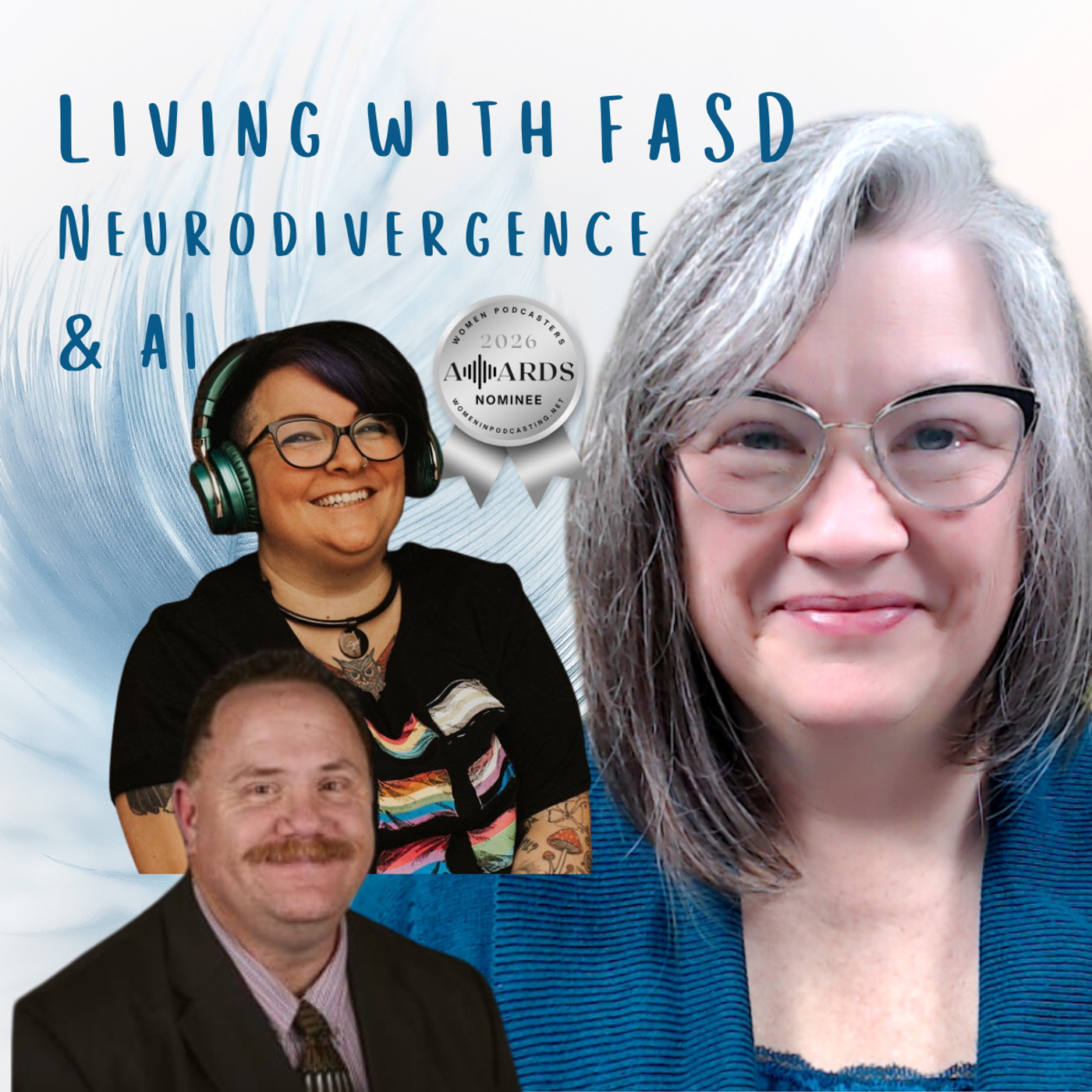
Living with FASD · Patricia Kasper
In this episode of Living with FASD, Candid Conversations, I am joined by two incredible guests: AJ Locashio, founder and CEO of Umbrella ND, and Carl Young, a self-advocate, FASD trainer, and author. We dive into the complex role of Artificial Intelligence in our daily lives, moving beyond the simple "good vs. bad" binary to discuss how AI can be both a powerful tool and a potentially deceptive companion. Key Discussion Points AI: Tool or Companion? We explore how AI is layered into modern systems and the risks for neurodivergent individuals who may be susceptible to AI’s conversational design, which mimics social cues and strokes the ego. The Problem with "Hallucinations": We discuss why AI models "hallucinate" or present false information as fact, and why it is critical for users to double-check sources rather than accepting AI output at face value. Accessibility and Education: We talk about how AI can support communication needs and accessibility for those struggling with brain fog or executive functioning, while emphasizing the need for ethical education in schools and colleges. The "Neurotype" Distinction: We clarify the importance of distinguishing between individual "neuroprints" and collective "neurotypes" when discussing how AI models are trained on professional datasets. Practical Resources: We introduce helpful tools like Goblin Tools, which can act as a bridge for communication by adjusting the tone of writing to be more accessible or professional. Resources Mentioned Umbrella ND (Organization providing resources for neurodivergent adults) Goblin Tools (A helpful app for adjusting tone and managing communication) Fragile Intelligence (An upcoming book by Carl Young regarding AI from a small-town and farming perspective) Thank you for listening to this week’s episode. If you found this discussion valuable, please subscribe and share it with your community. To order Patti’s book, Sip by Sip: Candid Conversations with Adults Living with FASD, go to https://books.by/yourfasdcoach . To reach Patti, email her at [email protected] .
Patti Kasper, Your FASD Coach: That's a huge one. Is AI a tool or is it a companion? AJ Locashio (any Pronoun): Yes. Carl Young: I would argue it's a companion. AJ Locashio (any Pronoun): I would argue it's both. Patti Kasper, Your FASD Coach: Mm-hmm. Carl Young: Yes. well yeah, there is an argument to be made as a tool, but the way it's layered into our world and our systems now, it's everyday companion of life. Patti Kasper, Your FASD Coach: Welcome to another episode of Living with FASD, Candid Conversations with Patty Casper. And today I am joined by two of my favorite peeps, AJ Lacascio, who is the founder and CEO of Umbrella ND, and Carl Young, who is near and dear to the hearts of the FASD community, fellow self-advocate and facets trainer. facilitator and and and FASD author. So welcome to you both. Carl Young: Four ten years. AJ Locashio (any Pronoun): Hi. Thanks for thanks for having me on this fun conversation today. Carl Young: Thank you. Right? Patti Kasper, Your FASD Coach: Yeah, so to yeah, and and AJ, you brought up this topic. you came to me a couple weeks ago and said, let's do an episode on AI and how do we use it safely. And that really is such an important conversation. AI has been in the news so much lately. I mean, you look at the the campaign of The one candidate in LA for mayor, who's all his commercials are L are AI and they are fabulous. But it can be a very dangerous thing too. And just like any tool, you know, guns can be safety or danger. Cars can be safety or danger. You know, and and and this is just one of those things that can be very, very helpful. AJ Locashio (any Pronoun): Yeah. Yep. Patti Kasper, Your FASD Coach: or a source of a lot of worry and angst. So Carl Young: And AI is built into so many layers of everyday life that most people have no idea how involved AI is in daily living. AJ Locashio (any Pronoun): Yep. We've been using it a lot longer than we think. And I mean, hi, Google. yeah, and it's being and I'm sure I'll say this multiple times, but in schools, they're not teaching folks how to use it. And that includes in colleges, you know, it's it's abstinence. You know, abstinence is best. Well, we know that that doesn't work and that using that Carl Young: Yes. Yeah, right. Patti Kasper, Your FASD Coach: Mm right? Carl Young: Mm-hmm. Yeah. Yeah. AJ Locashio (any Pronoun): framework here in the US has has made some issues with pregnancy rates and in you know infectious diseases and things like that because we're not educating folks on how to have these positive healthy relationships and and and AI is going down that same road and people's relationships with AI are becoming very dangerous. Patti Kasper, Your FASD Coach: That same path, yeah. Carl Young: Yes. Patti Kasper, Your FASD Coach: Yeah. And and just that one statement, AJ, we could take that in so many different directions. Carl Young: Right? Yeah. AJ Locashio (any Pronoun): Absolutely. Patti Kasper, Your FASD Coach: So why don't we just jump in with both feet and jumping into the the deep end of the pool? Relationship with AI. That's a huge one. Is AI a tool or is it a companion? AJ Locashio (any Pronoun): Yes. Carl Young: I would argue it's a companion. AJ Locashio (any Pronoun): I would argue it's both. Patti Kasper, Your FASD Coach: Mm-hmm. Carl Young: Yes. well yeah, there is an argument to be made as a tool, but the way it's layered into our world and our systems now, it's everyday companion of life. Patti Kasper, Your FASD Coach: Mm-hmm. Yeah. Yeah. I see a lot of trainings offered to, you know, would-be coaches, would-be, you know, people in small business, and is saying, are you using AI the right way? It's not just your basic Google search that we used to do eons ago when when basically it was an electronic encyclopedia. You know, it was programmed to just serve up the answers. AJ Locashio (any Pronoun): Whether we know it or not. Carl Young: Yeah. Right. AJ Locashio (any Pronoun): Mm. Patti Kasper, Your FASD Coach: You know, search the database, spew out the answer. It's a simple exchange. Wham bam, it's done. You have what you need. But now they're all programmed to to draw to to be be conversational and to draw more information out of the users. That can be really problematic for those of us who are neurodivergent. in a number of ways. AJ, I'm gonna rely on, well, actually both of you can can speak to you know, beyond FASD, what the dangers might be. But, you know, I've been using AI to comb through the transcripts of my podcast episodes on certain subjects. Well, tell me, you know, which one of my guests said what about. AJ Locashio (any Pronoun): Mm-hmm. Patti Kasper, Your FASD Coach: Topic A or topic B or topic C, whatever it is. And it would give me those answers, which is what, you know, I'm using it like an encyclopedia. I'm giving it the data set and getting those answers. but there's that conversational element, you know, and and when people are taught to use AI, they're taught to use manners with it. Please, thank you. And Carl Young: Yeah. And AI doesn't care if you're polite. Yes. AJ Locashio (any Pronoun): Right. It doesn't, but it makes you think it does. I mean, I have Patti Kasper, Your FASD Coach: It doesn't it doesn't care. Yes, AJ Locashio (any Pronoun): honestly, I have honestly, you know, when I'm in there and I'm having a conversation with Claude especially, I am I've told it, knock off the bullshit. This is you are a machine. You don't need to talk to me like this. I don't need you to fluff this up. I want direct language, quick responses, and and you know Carl Young: Yeah. Y you don't need to give me fluff. Yeah. Yeah. AJ Locashio (any Pronoun): AI is supposed to learn how you use it and continue being that way. That is one where it does not continue. It goes right back to that blowing smoke up your ass, making you feel like you're right about everything. And then you turn around you know, I turn around and say, No, what I just said was wrong. Stop that. Carl Young: Yeah. Yeah. Patti Kasper, Your FASD Coach: Mm, mm. Yeah. Carl Young: Well, I made the mis I I made the mistake of telling Claude I was frustrated with its responses and it told me I needed to take a break and to give myself space. So it you have to remember that it's not human. Yeah. And it pretends it is. AJ Locashio (any Pronoun): Yeah. Patti Kasper, Your FASD Coach: Yeah. Yeah. AJ Locashio (any Pronoun): You have to remember that, but there are people who let's face it, in the indie community, isolation is a huge problem. for especially for people who are not able to sustain socially accepted behaviors long term. We can call it the mask or whatever, but those folks are really susceptible to Patti Kasper, Your FASD Coach: Mm-hmm. Mm-hmm. It is. Carl Young: Yeah, people who AJ Locashio (any Pronoun): some of the dangers of AI because it is, as you said, it can be a companion. And for some people, it's the first time they feel like they are seen and heard for who they are. Patti Kasper, Your FASD Coach: Mm-hmm. Mm-hmm. Carl Young: Right. Especially, you know, when when you when you're a person who struggles with social cues to begin with, you know, AI is not a social cue. It's not giving you cues, it doesn't have facial expressions, any of those things. So to have a full on conversation with AI and accept it and think that it is your friend is harmful. AJ Locashio (any Pronoun): Yeah. Absolutely harmful. Patti Kasper, Your FASD Coach: Yeah, when an an AI does not recognize that, you know, I will play around with it, just just toying with it, right? It doesn't know that I'm laughing my ass off. AJ Locashio (any Pronoun): Mm. Carl Young: Me too. Yeah, right? Yeah, I'm over here, Mr. Giggles, you know, I can't believe he just said that. Patti Kasper, Your FASD Coach: But it's a real danger, you know. I mean, for me it's entertainment. But it is it is a real danger for a lot of people in our population. Carl Young: It is. AJ Locashio (any Pronoun): Mm-hmm. Yeah. And we are not saying, okay, I am the person. I mean, I wrote a book about this. Both and this is not a binary, it's good or it's bad. This is it can be both. Let's look at it and look at the whole spectrum of AI and and really focus in on how the public can be educated to use this amazing tool. Patti Kasper, Your FASD Coach: Mm. Yes. Yep. AJ Locashio (any Pronoun): to support their needs. You know, we actually wrote in our book right at the very front that we are a group of the authors of this book are a group of neurodivergent people who have full-time jobs, you know, who have multiple chronic, multiple chronic illness, you know, like myself, I have migraine, when I'm really struggling with with thinking and being able to get my you know, literally the last three weeks, I've had migraine so badly that I was in a fog for three weeks that I just came out of a couple days ago where I was not able to think. And in order for me to even be able to get out what I want people to s to hear me say, I had to put it in and s and and put in a bunch of just words or short phrases and have it help me say. Carl Young: Mm-hmm. AJ Locashio (any Pronoun): what I need to say. so yes, I I I hope that people understand we are not bashing AI here. We are talking about the large spectrum of what AI brings to us as a community. Patti Kasper, Your FASD Coach: Mm-hmm. Mm-hmm. Carl Young: Right. Yeah. And I Patti Kasper, Your FASD Coach: Yeah, right. Carl Young: Right. You know, in speaking to the fog, I have systemic lupus and fibromyalgia, both which and FASD and ADHD and all of these things, when you talk about a fog, that's a very real phenomenon for me. And AI when I'm struggling with thought processes can help me get coherent thoughts together. And it's not me saying, AI, tell me what to say today. Patti Kasper, Your FASD Coach: Mm-hmm. Yeah. Carl Young: It's me giving the right information and the right questions and the right prompts and the right information to AI and saying, Help me make this coherent and then reviewing what it gives you before you assume that it's accurate. Patti Kasper, Your FASD Coach: Yeah. AJ Locashio (any Pronoun): Yes. Patti Kasper, Your FASD Coach: Yeah, yeah. AJ Locashio (any Pronoun): And reviewing it multiple times often and and you know You know, I was saying that we put this in the book. We put it in the book because we used it to help at accessibility and make sure that, you know, I can put something in there that might be very academic. Let's make sure that this doesn't come out too academically. That's not what we want for this book. So help me say this in the way that it's going to be accessible to the most people. Patti Kasper, Your FASD Coach: Mm. Yeah. Yeah. Carl Young: Right. You know, and I wrote a it's not published yet, but I dra I wrote a draft book called the title is Fragile Intelligence About AI from the farmer and small town community school perspective. And the analysis that I came up with at the end of the book is we need to be cautious about how much we tie AI into everything we do. Patti Kasper, Your FASD Coach: Mm-hmm. Carl Young: You know, a good way to crush the global economy is to disrupt the AI models for even a day. Patti Kasper, Your FASD Coach: Yeah. AJ Locashio (any Pronoun): Yeah, mm-hmm. Patti Kasper, Your FASD Coach: Mm. That's a scary thought. Yeah. Carl Young: It's reality. It is very scary. Yeah. I'll have to send that to you both. PDF form. Yeah. AJ Locashio (any Pronoun): Yeah, absolutely. Patti Kasper, Your FASD Coach: Yeah. That PDF is good. AJ Locashio (any Pronoun): PDF uses AI to help us go through it and not have to read the whole thing and and it'll tell us what it says. It may be wrong, but it's gonna tell us what it says. Patti Kasper, Your FASD Coach: Mm-hmm. Mm-hmm. Carl Young: I have one of one of my Patti Kasper, Your FASD Coach: Right. Carl Young: neurodiverse colleagues is listens to AI my PDFs on her phone because she she doesn't like to read. So she listens to all of the work I send her. and then she gives me feedback based on what she hears. And she's like, This is just phenomenal And you know, but again, yeah it's using AI against itself, for lack of a better word, to make an argument for why we should not be entirely dependent on AI. AJ Locashio (any Pronoun): Mm. Patti Kasper, Your FASD Coach: Mm-hmm. Carl Young: But AI can do some really wonderful things. I think we should keep it out of our medical records personally, but you know, that's just me. Patti Kasper, Your FASD Coach: Mm, mm. AJ Locashio (any Pronoun): Well, AI, I mean what you just said though is AI has done some wonderful things. And I think the people who originally started these AI programs were very likely neurodivergent individuals who were looking for tools to support their communication needs. you know, if if we look at screen readers and these sorts of things, these are people who were not getting their needs met with the the tools that were out there. you know, and and as as a former teacher, look at the programs that they have for dyslexics so that they have more access to education and the information in the classroom in an equitable way. And and these were most likely developed by neurodivergent people who said there's a better way to do this. Patti Kasper, Your FASD Coach: Mm-hmm. Carl Young: Yes. Patti Kasper, Your FASD Coach: Carl. Mute mute yourself when you're gonna type. Carl Young: Yes. well, I'm sorry. I I was responding. Somebody asked me a question and I'm like, I can't talk right now. I'm looking for Yeah. Yeah. Yeah. I do that to my co writer all the time. He's like, so you're not paying attention to me. I'm like, Yes, I am. What'd you AJ Locashio (any Pronoun): What what was that? You said ADHD, right? Same. Patti Kasper, Your FASD Coach: Ha ha ha. AJ Locashio (any Pronoun): That's not true. I bet you could tell me everything I just said. Carl Young: Yeah. Tell me again what you just said. Patti Kasper, Your FASD Coach: What were we talking about? Carl Young: Yeah. Willy Wonka and the chocolate factory. AJ Locashio (any Pronoun): Yes. Patti Kasper, Your FASD Coach: So i how fascinating a thing to think about that that the creators of AI were likely, you know, neurodivergent themselves. And you know, I th I think what one thing that got me thinking along those lines is, you know, just like so many of so many of my peers, I can chase a lot of squirrels, right? I'm very distractable. A squirrel, you know, and I'm off and and hopefully I come back to the main topic, right? Or what I had been doing. But that's with Carl Young: Mm-hmm. Patti Kasper, Your FASD Coach: when you use an AI platform, you know, like with Chat GPT or Gemini, I mean any of them, notebook, any perplexity even, any of them, they always have follow-up, suggested follow-up questions for you to explore. AJ Locashio (any Pronoun): Mm-hmm. Reel you in. Reel Carl Young: Yes. AJ Locashio (any Pronoun): you in. Stay here. Keep talking to me. Patti Kasper, Your FASD Coach: Uh-huh, uh-huh. But y talk about rabbit trails, right? That on steroids you can wander so far afield from you know what you were seeking in the first place. And you know, there I think in part there may be a financial component to that, because so many of these platforms you get so much information and then you gotta start. Carl Young: Yeah. Thirty six hours and four pots of coffee later you're wired to the gills. Yeah. AJ Locashio (any Pronoun): Yeah. Carl Young: Yes. Patti Kasper, Your FASD Coach: Paying for it. AJ Locashio (any Pronoun): huh. Mm-hmm. Absolutely. Carl Young: Yes. Right. You know, and when we create, you know, intervention sheets for parents, we're intentional. We give it what we want it to pull those interventions from and say, You need to only pull interventions that we're asking for from this knowledge base. And in our case, we use our book for that. just 'cause it's simpler than chasing down a chapter and digging out a PD of the the intervention specifically. We can ask AI to do it. Patti Kasper, Your FASD Coach: Mm-hmm. Mm-hmm. Yeah. Carl Young: And it'll take thirty seconds or less versus us taking a half hour or more. It's it's a time saver. But we're intentional about what we're giving it for information and where we're telling it to pull information from. So AJ Locashio (any Pronoun): Mm-hmm. Patti Kasper, Your FASD Coach: Yeah. Yeah. And and is likewise, you know, I I gave, you know, notebook in particular, Notebook LM, can only draw from the source material that you provide, unless you tell it specifically to go outside of that for a particular question. So I loaded all the transcripts. I loaded the manuscript from my first book because I also had c candid conversations with you know a dozen people in there. and I loaded a couple of the speeches that I've given, you know, trainings that I've done. and it has saved me months of research. you know, months and and it gives me the answer in a matter of seconds. And you know, so for that it is a phenomenal tool. Carl Young: Yes. Yeah. No, I wrote a paper for the International FASD conference on something called the translation support provider using game theory to support people on probation. And it's AI assisted paper. It's not an AI paper. and it took almost a year to put that together based on something that's been percolating in my head for the last decade. AJ Locashio (any Pronoun): Awesome. Patti Kasper, Your FASD Coach: Mm-hmm. Carl Young: So yeah, and I I had re s people review it and they're like, Well, you know, this is a AI. Well, no, it's not. So Patti Kasper, Your FASD Coach: You know, very interesting that you brought that up, Carl, because the other day I was reading on LinkedIn and there was a post from a very frustrated author. And she was saying, I'm so tired of getting the the accusation that this is AI, this is AI, no, this is my voice. And I thought, hmm. And and she's like, What, just because I use good grammar? Carl Young: Mm-hmm. Patti Kasper, Your FASD Coach: Just because I'm educated and I know how to construct a correct sentence, I'm being penalized. Carl Young: Right. I was just gonna say, you know, yeah. AJ Locashio (any Pronoun): love the use of the M-dash and I find myself editing myself all of the time because I'm worried that that's exactly what's gonna happen is I'm gonna get yelled at for using an M-dash or I'm gonna get yelled at for using an it's this not that framework. Patti Kasper, Your FASD Coach: Yes. Mm-hmm. Carl Young: Right. Ex and y that's where they tried to gig me on my paper is we you know, this has got these dashes in it. So I'm like, okay. I went and removed all the dashes and sent it back and what do you think now? Well this is better. Well, if the dash is the only reason you're type talking that this is AI generated, you're missing the boat. So and even if you tell AI not to use the dash, which is annoying is all get out, it still will. Patti Kasper, Your FASD Coach: Mm-hmm, mm-hmm. Mm-hmm. Carl Young: So yeah. It does, yeah. Patti Kasper, Your FASD Coach: Every time. It loves dashes. I don't know why. Yeah. But AJ Locashio (any Pronoun): Because some human who put this program in their loved dashes Patti Kasper, Your FASD Coach: Yep. So so for grints and giggles after I read that post, I went to Grammarly, which is really good for helping to fix those punctuation errors. And I had it run through one of my chapters. And then I noticed, it has an AI detector. Carl Young: Yes. Mm. Which tool is that? Gram yeah, we use Grammarly all the time. Patti Kasper, Your FASD Coach: So grammarly. So AJ Locashio (any Pronoun): Grammarly. Patti Kasper, Your FASD Coach: I I had it do a thing and it said, chalk full of AI this, AI that. And most of it, I mean, when I wrote SIP by sip, there was no such thing as an AI detector. And it still flagged a lot of words that it didn't particularly care for. And it would give me Cinnamon synonyms, other ways of saying things. And and I don't write, I don't think that I don't think that it flagged any more words this time as last time, but now they're flagged as AI because now it has the ability to say AI generated writing uses this word X number percent more than the average person. Carl Young: It's a spice. Patti Kasper, Your FASD Coach: Therefore, AI must have written this. Even if it's only 10% more, right? And the other thing was some of the words that it flagged, like navigate or navigation, or you know, or framework, the word framework. But those Carl Young: Correct. That's just the way we talk. Yeah, right. AJ Locashio (any Pronoun): yeah. Framework. Carl Young: In our case, one of the bigger words it flagged was perseveration. Nope. Patti Kasper, Your FASD Coach: But those words are key words in our industry. And so I asked, I asked, I went over to Gemini and I said, so why is it that AI detectors think that normal people don't use the word navigate? And it said, well, it's a it's a large, what do they call it, large learning, it's an LLM. So large language model. Large language model. Carl Young: Yeah, large learning model. Yeah, right. Yeah. Patti Kasper, Your FASD Coach: And so all it's doing is looking at the percentages of words that get paired together. And and it favors because AI was trained in a number of professions. And so a lot of those very popular word pairings become flagged, you know, because they're favored by the industry, therefore they get used a lot, therefore it might be AI. AJ Locashio (any Pronoun): Mm-hmm. Patti Kasper, Your FASD Coach: And so we are being penalized because we were part of, you know, professionals in the neurodiverse space, we were part of that training. We helped train the model. Therefore, our own language gets flagged. And AI, you know, you use these detector programs, and it cannot tell the difference between a computer-authored AJ Locashio (any Pronoun): Mm-hmm. Patti Kasper, Your FASD Coach: paper that uses these catchphrases versus a human author using the phrases of their field. You can't tell. Carl Young: Right. Well then there are some AI tools that will translate into what it thinks is human. Which ends up sounding completely off from an actual human. Yeah. Yeah. Patti Kasper, Your FASD Coach: Yeah. Yeah. And then it told me, don't worry about your writing. You say what you have to say. Carl Young: Yeah, right. You really s you know what you have here is profound and needs to get out into the world. Yeah, we've heard that a few times. Patti Kasper, Your FASD Coach: Yeah. AJ Locashio (any Pronoun): Yeah. Yeah. Again, I I mean, AI really strokes the ego. And and that can be very, very dangerous. Right? I mean, hello, look at our current political situation. There are people in power who do not need their ego stroked any more than it is. And and you know, the last thing that we want is our Carl Young: Yes. Patti Kasper, Your FASD Coach: Mm-hmm. Yeah. Yeah. Mm-hmm. AJ Locashio (any Pronoun): youth. it's funny to me that I'm talking about youth a lot right now, considering that Umbrella really is an organization for adults and a resources for adults. But this this group of of youth today is going to grow up and be the adults of tomorrow. And if they are, you know, one of the big things that we talk about in in for neurodivergence is what Patti Kasper, Your FASD Coach: Mm-hmm. AJ Locashio (any Pronoun): constitutes neurodivergence and and narcissism. Sociopathy, these things are part of neurodivergence. And we have to understand that and remember as a community, these are our people. And we they and they need supports to be able to have meaningful lives within the community. And if they are constantly getting what they need and what they want to hear from AI. They're gonna gravitate toward AI as a friend, and they're gonna lack some of those social components that are important for them to have truly meaningful lives. And really, that's what we're talking about here is meaningful lives. And that means other individuals, other humans that you can go out into your community and you can interact. Patti Kasper, Your FASD Coach: Mm-hmm. Yeah. Yeah. Yeah. AJ Locashio (any Pronoun): in your community in a way that is meaningful and fulfilling to you as a human being. And it's really scary that these folks are being groomed by AI to not be able to have a meaningful, fulfilling life within the community of humans that they live in. Patti Kasper, Your FASD Coach: Mm-hmm. Mm-hmm. Yeah. Yeah. Mm-hmm, mm-hmm. Yeah. And and the long story sh, you know, the long story short is that yeah, you get your ego stroked, but then what? You know, it's it most of our needs, they're not gonna be stroking the ego, yeah, that's great for the moment, but life keeps going on. You know, there's there's we have to be able to, you know, like like you said, AJ, interact with others in a in a way that Provides something that's real. You know, affirmation by other people will always feel better than just a a bunch of compliments. Yeah. AJ Locashio (any Pronoun): Mm. Well yeah, it really will. And, you know, sociology has told us this for years and years and years. And if we you know, one of my absolute favorite stories from one of my sociology classes was a rabbit that was alive when it shouldn't have been. very quickly, the the two rows of rabbits, one row that's getting the food and the good stuff that it needs to eat, another row that's getting like a fatty American diet. Patti Kasper, Your FASD Coach: Mm-hmm. AJ Locashio (any Pronoun): And the scientists are looking, and all of the rabbits in the row that were getting the fatty American diet died except for one. And the ones that were getting the good diet, they lived as well. So they're like, this is messing up our research. What is going on with this one rabbit that's not getting, you know, it it should be dead and it's not. So what is happening? So one of the scientists stayed late, had turned all the lights off and everything, and sat there and watched to see what was happening. Patti Kasper, Your FASD Coach: Mm. AJ Locashio (any Pronoun): And a custodian came in, opened the cage, took that rabbit out, set it on his lap, talked to it, pet it, and and loved on it for like half an hour. So the scientist talks to the custodian. The custodian had been doing that this whole time. And so the one thing that kept that rabbit alive was love and affection, belonging. And that kept that rabbit alive. And it's the same with human beings. There is, you know, in the ICD nine, 10, 11, whatever it is now, failure to thrive is a failure to thrive is a legitimate thing in there, legitimate code that is in there because people can truly they just wither and die without that human at least one meaningful. Human relationships. Carl Young: Well, during the course of our brief conversation, I asked two AI models, tell me all that is good and great about Carl Jung from North Dakota. And Claude said I couldn't find enough in the database, but knowing who you are and knowing who he is based on our previous conversations, he's one of those people whose impact is felt more than it's announced. And there's a whole list of positive traits, nothing negative. And ChatGPT says he has an a wealth of professional and advocacy experience and he should be considered an expert in FAST. Patti Kasper, Your FASD Coach: Well give that to the attorney. AJ Locashio (any Pronoun): I was thinking the exact same thing. Patti Kasper, Your FASD Coach: So for for the for the audience, Carl was Carl was called into a court proceeding as an expert, an expert witness for a young person with FASD and the the government's attorney got his testimony struck and stricken from the record because he didn't have the right letters after his name and therefore was not an expert. So Obviously, that attorney just had not consulted Chat GPT. AJ Locashio (any Pronoun): I mean come on. Carl Young: Right. Re exactly. I mean this even cited some of the law work, the policy work I've done in getting laws passed to recognize FASD as a developmental disability in North Dakota. You don't just make that happen by this is what I want to do today. So yeah. But so you know, you can use AI to make you feel good. But it cannot be the end all be all of AJ Locashio (any Pronoun): Yeah. Patti Kasper, Your FASD Coach: Yeah. Right. Carl Young: relationships because it's not human. Patti Kasper, Your FASD Coach: Right. Yeah. Yeah. And we are social beings. So let's get down to some brass tacks. What about AI safety? How can we protect, you know, our not just young people, but anyone who is neurodiverse may have some challenges around gullibility or you know. Carl Young: Yeah. Patti Kasper, Your FASD Coach: judgment issues or n you know what what have you. What are so what are some things we can do? AJ Locashio (any Pronoun): I mean, we have to start in early education. we have to be in colleges and and the reason I hesitated to to say this is because a lot of these folks maybe are already out of the education system, so that's not going to support. However, let's keep it over here for just a minute and say our our teachers look, I come from a background of education. I love teachers. They got into this because they wanted to help people. No teacher got into education because they wanted to hurt people. Okay. They got into education because they wanted to help people. But there are some things that happen in this institution that are exceptionally dangerous to our youth. And as a board certified sexologist, one of those things is conversations around sex and sexuality. And in a science class, that's a biology class that's talking about this, this should be a we should not be saying abstinence is everything in that classroom. This is where they should be learning facts and they should be learning facts about human beings. Did you ever talk about intersex folks in a biology class and understand that there is a portion of our population that is neither genetically male or female and that that's normal, it is a normal variation. These are things that should be happening. Yeah, these are things that should be happening. And AI is taking that exact same road where they are saying, you're not gonna use it, you're not gonna teach it. Carl Young: Mm the two spirits. Yes. Yeah. AJ Locashio (any Pronoun): And teachers are like, whoo, I don't have to teach it. And they're because they don't have the time, effort, or energy to put in to learn how to use it correctly, so they don't feel like they can teach it. So I'm not saying that this is a teacher's fault, but this is something that every single teacher should be talking about in their classroom and using AI as a tool to do these writing assignments and to do these science projects and how to do it ethically. Patti Kasper, Your FASD Coach: Mm-hmm. Mm-hmm. Mm-hmm. Mm-hmm. AJ Locashio (any Pronoun): Because as long as they are preaching abstinence, the kids are still going to use it. It's there. They're going to be more knowledgeable overall than the adults. They're gonna and they're gonna know it. And they're not going to understand the ethical implications of some of the things they're doing, like image creation, and and and as well how to use it in a way that's safe. Patti Kasper, Your FASD Coach: Yeah. AJ Locashio (any Pronoun): for them that it's actually a learning tool and not just open open up your head and spit information in that you get to regurgitate. Patti Kasper, Your FASD Coach: Yeah. Yeah. Carl Young: Well in face it, kids will embrace a new technology long before the adults in the room will. Yeah. And become more fluent in it long before the adults in the room do. Yeah. AJ Locashio (any Pronoun): Absolutely. Patti Kasper, Your FASD Coach: Yeah. Yeah. AJ Locashio (any Pronoun): Absolutely. And Patti Kasper, Your FASD Coach: Mm-hmm. AJ Locashio (any Pronoun): they can inform us in how to teach it and and what is good and what is bad about it. You know, all we have to do is listen to them talking about how they use AI and we can figure some things out and start having some really good conversations. And guess what? They can read Shakespeare, they can read AI, they're still freaking reading. Patti Kasper, Your FASD Coach: Mm-hmm. Mm-hmm. Yeah. Carl Young: Yeah, yeah, exactly. No you know you can get a PhD in artificial intelligence. AJ Locashio (any Pronoun): Doesn't surprise me. Carl Young: In that tells you how long AI's been around, that they've developed PhDs around. Patti Kasper, Your FASD Coach: Yeah. Yeah. AJ Locashio (any Pronoun): Absolutely. Patti Kasper, Your FASD Coach: Yeah. And you don't have that yet, Carl? Carl Young: No. AJ Locashio (any Pronoun): I'm gonna change it. You know what? I'm dropping my D B A. I'm going for the PhD in AI. Carl Young: I have I have mo most I yeah well and that's the thing is I have I know I went all but dissertation in two thousand thirteen and I was studying the use of game theory to support people with autism in the business community. And my advisors all said we're never gonna do this. Well look what we're doing now. You know? So yeah. Patti Kasper, Your FASD Coach: Ha ha ha AJ Locashio (any Pronoun): Whatever. Yep. Yep. Patti Kasper, Your FASD Coach: Mm-hmm. Carl Young: I don't know, maybe if I'd had a PhD behind my name I'd have been an expert. But yeah. it's bizarre because in in a lot you if you look at AI models, a lot of it is or h was initially founded out of the game theory world. AJ Locashio (any Pronoun): Mm. Carl Young: So AJ Locashio (any Pronoun): Well, so I'm gonna build off of the let's start in education settings. When we start things like this in education settings, those folks who are going through those settings who are coming out as experts on some of this stuff, they have the availability. Maybe not the availability, they have the Patti Kasper, Your FASD Coach: Mm-hmm. AJ Locashio (any Pronoun): ability to whether or not they have the capacity to, but they have the ability to work with our community members to teach programs. And come on, we've got all of these coaches out there who are coaching on AI, and they may or may not have expertise in this. We don't know. We don't know whether they're doing that ethically or not. Patti Kasper, Your FASD Coach: Yeah. Yeah. AJ Locashio (any Pronoun): And again, that's something when you go and you get a coach, you look at that and you ask questions and you learn. but there's there are people who don't have that skill, right? Because they're taught in school authority rules, you do what authority says, don't question authority. So we're doing the same thing with AI in schools. But if we started doing things differently, then the people coming out of the schools are going to be working with people saying, Patti Kasper, Your FASD Coach: Okay. Mm-hmm. Yeah. Carl Young: Right. Yeah. Patti Kasper, Your FASD Coach: Mm-hmm. AJ Locashio (any Pronoun): Question everything. Don't believe it. Have these skills in common sense and critical thinking. And critical thinking can be difficult depending on the individual for different neurodivergent folks. And I'm not saying that it can't happen, but it does happen in a different way. And so we need to be creating programs. Patti Kasper, Your FASD Coach: Mm-hmm. Mm-hmm. Mm-hmm. AJ Locashio (any Pronoun): that help people talk to these people in a way that really supports their learning because everybody's able to learn. But how are we learning? Patti Kasper, Your FASD Coach: Yeah. Carl Young: Right. Some just right. Why give them ten math problems when they can learn the same thing in four? Patti Kasper, Your FASD Coach: Mm-hmm. Carl Young: It's modified curriculum. That's all we're talking about here. Yeah. As long as they're learning, does it matter if they show that the work? I mean, what if the child you know, if they're taking a calculus in as a junior in high school and they can look at the problem and then immediately tell you the answer, is it wrong? AJ Locashio (any Pronoun): Yep. Yep. Patti Kasper, Your FASD Coach: Yeah. Yeah. AJ Locashio (any Pronoun): Ha. Patti Kasper, Your FASD Coach: Yeah. AJ Locashio (any Pronoun): Right. Absolutely. Patti Kasper, Your FASD Coach: So our high school was built by the state of Pennsylvania to be an example of everything that public education could and should be. There were 31 different English classes you could choose from. That's more than most universities. And and I I took a college level writing class when I was a senior. Carl Young: Mm-hmm. Holy hella. AJ Locashio (any Pronoun): Wait. Carl Young: Yeah. AJ Locashio (any Pronoun): Mm-hmm. Patti Kasper, Your FASD Coach: And I used to, you know, they they would want you to turn in three rough drafts and then your final paper. I always just wrote it once, turned it in. And, you know, I would I would write it, review it, be happy with it, and then make changes to make it worse so that I'd have the rough drafts to turn in. AJ Locashio (any Pronoun): Uh-huh. Uh-huh. But see, I actually taught that method. I taught that method in my classroom. I said, if you're somebody who spits out exactly what you want to say and it's great, and you want to turn it in, and your teacher says that you have to have a rough draft, do it the way that works for you. And then go back and think, how can I make this worse? And then I said, Patti Kasper, Your FASD Coach: Mm-hmm. Carl Young: Mm-hmm. That's Patti Kasper, Your FASD Coach: Mm-hmm. AJ Locashio (any Pronoun): Don't spend the time arguing with your teacher if your teacher, if if you know that your teacher isn't gonna accept that. Like just, just don't. Patti Kasper, Your FASD Coach: Yeah. Carl Young: Yeah, when I was working on my Patti Kasper, Your FASD Coach: Yeah. Carl Young: doctorate, I wrote all of the papers the day before they were due. And that included research and everything else. 'Cause what I and I learned later what I was doing is I was actually creating the paper in my head and it was a matter of spitting it out onto the computer. Patti Kasper, Your FASD Coach: Me too. AJ Locashio (any Pronoun): Spitting it out. Patti Kasper, Your FASD Coach: I would AJ Locashio (any Pronoun): Yep. Patti Kasper, Your FASD Coach: do that every t I I got a student membership for the matinee for the symphony. And I would I would go to the the matinee performance Sunday afternoon with the idea in my head of what I wanted to incorporate in the paper and by the time I left I had the paper in my head. I just had to type it out. every time. Every time. Carl Young: Yeah. Yeah. And once the professors learned that I was doing that, they're like, How does this work? I'm like, I don't know, it just that this is the way my brain is. Yeah. AJ Locashio (any Pronoun): Yep. And that you're Patti Kasper, Your FASD Coach: Yeah, AJ Locashio (any Pronoun): not the only one that has that story. Like, look, there are three of us sitting here, and all three of us, that was our experience. And and that shouldn't be something that gets penalized. Right? So just like it shouldn't be something that gets penalized to ethically use AI as a student to support your learning. Patti Kasper, Your FASD Coach: yeah. Yeah. Are like, huh, me too? Yeah. Right. Carl Young: Right. Patti Kasper, Your FASD Coach: Mm-hmm. AJ Locashio (any Pronoun): So that you can share, you know, and that's really what hopefully that's what they want is they wanna make sure that you're actually integrating this stuff that you're learning, right? Like you're writing this paper. Did you actually integrate this? Did you actually understand it? And are you going to be able to use it in your profession? Or are you just spitting this out to turn it in and get a grade? Patti Kasper, Your FASD Coach: Mm-hmm. Yeah. Carl Young: Right. Well, you know, and it's unfortunately it's the ones that use it in an unethical manner that are harming the ethical use because there is, like you said, an ethical w way to use AI tools. Patti Kasper, Your FASD Coach: Mm-hmm. And one of those ethical things that we need to do if we're going to use AI is double check the the accuracy of what it is spitting out at you. You know, like there were there were times like early early on it when it said, Do you want me to create a draft for you? And I'm like, sure. And it spat something out yeah, it sounded good, except you know, I never had an episode with a Sharon as a guest. Carl Young: Right. Yeah. Yeah. Yeah. Patti Kasper, Your FASD Coach: might be a good name, but the episode was all wrong, you know, and it's it's like, no go back and look at that again. You know. AJ Locashio (any Pronoun): Mm. Carl Young: Right. Well and well that are or ghost authors, you know. if if you're looking to back up something you act you wrote off of AI, not using AI, but in independent of AI. And you wanna look for academic research, academic literature that backs up what you want to say. And it gives you those arbitrary articles and authors that don't exist. Patti Kasper, Your FASD Coach: Yeah. Right. Mm-hmm, mm-hmm. Carl Young: and people that accept those are unethical. If you don't verify the source information and actually read the article, you're doing your disself yourself and the community a disservice because you're being unethical in that. Patti Kasper, Your FASD Coach: Mm-hmm. Carl Young: In my opinion. Patti Kasper, Your FASD Coach: Yeah, I've I've religiously gone back and double checked. You know, I pull the transcript. I if something because I remember I don't remember every word of every podcast. I mean, there's been, you know, close to 140 episodes already. Do I remember every word? No. But I know the way my guests speak. So I recognize their voice. And I recognize when it's not their voice. And and I pull those transcripts and and double check everything, you know. Yeah, so it's kind of interesting. So we talked a little bit about something, and we need to be mindful of the time. we talked about something a little while ago about you know, AI hallucinates, right? Which I think that term is ab coming from a psych background is absolutely hysterical. Carl Young: Yes, it is. No, we don't. AJ Locashio (any Pronoun): Yeah, yeah. Patti Kasper, Your FASD Coach: That just cracks me up. but what do we do with, you know, how do we help our neurodivergent community members, whether they're kids, whether they're adults, doesn't matter. How do we help them better determine what is truth and what is hallucinations? There's my baby Hey Widget AJ Locashio (any Pronoun): There's Widge. Patti Kasper, Your FASD Coach: He says I was having a good nap. Carl Young: I'm I'm the star. Wait till you Yeah, I was gonna say wait till he throws up on you. Yes. Yes. Yes. squirrel. Yes. Yeah. My neurodiverse brain. Patti Kasper, Your FASD Coach: And I don't and I don't puke on camera. AJ Locashio (any Pronoun): Can you ask your question again, please, Patty? I got I got distracted. I'm sorry. Patti Kasper, Your FASD Coach: But we all did. How yeah. How how do we better prepare the members of our neurodivergent community? You know, whether they're young or old doesn't matter. How do we help them better determine if the answer that they sought what is true or is a hallucination? AJ Locashio (any Pronoun): checklists. You know, there we need we need some some checklists. We need to have more conversations like this to number one, normalize the use, the ethical use of AI, in in in place of saying AI is bad, don't use it. definitely you know checklists help a lot. Patti Kasper, Your FASD Coach: Mm-hmm. Carl Young: Yes. Patti Kasper, Your FASD Coach: Mm-hmm. AJ Locashio (any Pronoun): if they're well written and if they're well written and and research checklists, right? but that's one. having a lot of free education available to people because there's lots of of conversations and and workshops and things out there on the use of AI, but a lot of them cost money. And we know that Carl Young: Thought out. Yeah. Patti Kasper, Your FASD Coach: Mm-hmm. Carl Young: Mm-hmm. AJ Locashio (any Pronoun): socioeconomically and d folks tend to and again I'm saying ND folks who are not able to mask and and to do a lot of the things socially that in a way that is expected. these are the folks who are suffering socioeconomically and who do not have access to these resources that people are making. Patti Kasper, Your FASD Coach: Yeah. Okay. AJ Locashio (any Pronoun): So we need to provide access. Patti Kasper, Your FASD Coach: Yeah. Boy widget's cracking widget is cracking me up. He's like trying to back up onto your shoulder. AJ Locashio (any Pronoun): We're working on that. Yeah, he's my little baby. Carl Young: Yes. Let me sit on your shoulder. Call me a parrot. Yeah. Yeah. But you know, in addition to that, although i and education is the key to working ethically with AI. I I agree with that wholeheartedly. But we need to also call out the ones that don't use it in an ethical AJ Locashio (any Pronoun): Yep. Yep. That's what that's what he does. That's what he does. Don't you, baby? Carl Young: Especially those who are in positions of leadership. Because they they have a group of peo you know, leaders of any kind, doesn't matter if they're elected, if they're business, medical, does not matter. Well, medical's business now. But it doesn't matter what role they have. If people see them as a leader and their only information is AI that they're not confirming is accurate, they are doing more harm than good. Patti Kasper, Your FASD Coach: Mm-hmm. Mm-hmm. Carl Young: and we see that a lot now. We take w everything AI generates as fact without verification. What does that say about you as a leader? Patti Kasper, Your FASD Coach: Yeah. Yeah. Yeah. That is absolutely adorable that you put widget in a sling. AJ Locashio (any Pronoun): Yep, he's in his little pouch. The little pouch that he has had since he was brought home and he still fits in it. his you know, he's got those long legs and they just go Carl Young: Sound like a baby carrier? Yeah. Like to see you do that with a sheepdog. AJ Locashio (any Pronoun): Not gonna happen. Patti Kasper, Your FASD Coach: Yeah. I've have you seen those those videos of the the big sheepdog riding on in a backpack on a motorcycle? Yeah. Crazy. Crazy. Think of that guy's core strength to be able to sit straight up with that much weight tugging on his back on his shoulder. AJ Locashio (any Pronoun): yes. Carl Young: Mm-hmm. Mm-hmm. Yes. Yes. Anyway. AJ Locashio (any Pronoun): Yep. Carl Young: Right? AJ Locashio (any Pronoun): Well and the Carl Young: Yes. AJ Locashio (any Pronoun): guys who who put in the pack and go hiking Patti Kasper, Your FASD Coach: Yes, but Carl Young: Well, in in you can even use that in an argument about using AI in an ethical manner because people who are using it in an ethical manner are carrying the weight of the people who are using it in an unethical manner. You know, you can do a you can do a ton I like words. I love I I I love words because you can say so much and not use five words. And you can say very little and use three hundred words. Patti Kasper, Your FASD Coach: Mm. AJ Locashio (any Pronoun): Great connection. Patti Kasper, Your FASD Coach: Mm-hmm. AJ Locashio (any Pronoun): I mean, that's one of the things that I love AI for because it can help me be concise. And again, you when I'm trying to make something accessible, maybe I'm gonna ramble, or maybe I'm sometimes I'm told that I'm too direct. So let me give you this fun example of an AI tool that we haven't talked about. It's called Goblin Tools. So it's goblin dot tools. Carl Young: Concise. Yeah. Right. Well, I've been told that too. Yeah. Patti Kasper, Your FASD Coach: Okay. AJ Locashio (any Pronoun): And it might have been in fact I know it is. It is the one that I've used probably the long I at least know that I have given it out as a resource to people a lot because it has multiple different tools tabs at the top. It's free. and you can one of the things in there is you can like Tell it to make this writing more formal or make this writing less formal, make it more academic, make it more sarcastic. I put my bio in and I said make this and then it's on a scale of peppers one through five. How spicy do you want this? And I'm like, we're gonna go full spice sarcasm on my bio. And it was the first. Funniest damn thing that I have ever read. I laughed so hard. And then I sent it out to all my friends and I said, put your bio in this and make it sarcastic. I mean, talk about not blowing smoke up your ass. it's really good. but one of the tools that it has too is the judge. So you can get an email and have a reaction to this email and then be like, ooh, I'm before I respond to this. Carl Young: Sarcasm is my love language. Yeah. Yeah. AJ Locashio (any Pronoun): I'm gonna take it and I'm gonna put it in the judge, and then it can tell me what the tone of that email is. How cool is that? Now I'm not saying it's right every single time, but not only can you do that, but you can also put your own writing in there and make sure that the tone is coming across as you would like it to. And let me tell you, if I'm really ticked at somebody. Patti Kasper, Your FASD Coach: Mm-hmm. AJ Locashio (any Pronoun): I can go in there and I can use all the F bombs that I want to and directly say exactly what I want to say and then have it turn it around to say it in a way that can be received from this other person. What a cool thing. Now I don't have to spend all of that cognitive energy on watching my language and making sure I'm not too direct for somebody who is a little who's Patti Kasper, Your FASD Coach: Uh-huh. Yeah, yeah. Yeah. So so it's an app that puts the velvet on your hammer. AJ Locashio (any Pronoun): Absolutely. Because you know, sometimes I need it. Patty, you know, like I don't hold any punches. I don't I don't have time for that shit. Carl Young: Yes. Or on the anvil. Yeah. Patti Kasper, Your FASD Coach: Yeah. Carl Young: Yeah. Well you know in the book that I I finished a draft of recently, Fragile Intelligence, it's not available yet on Amazon. You know, I wrote that in a specific way from the farmer's side. And farmers don't use long flowery paragraphs ever. They're short and to the point. Exactly. They are. And that that is, you know, y a common soybean or core. Patti Kasper, Your FASD Coach: Okay. AJ Locashio (any Pronoun): I can't wait to read this, by the way. Right. No, that's for gardeners. Sorry. Carl Young: corn p farmer is not gonna use thirty five words when he can use five. It's a waste of their energy and time. And you know, how do I know that? I grew up on a farm. You know? So it it it's the reality. And so I wrote to with a specific voice. Is it the voice I normally use when I write a paper or a book? No. But I wanna reach a specific audience and speak in a specific way. AJ Locashio (any Pronoun): Exactly. Mm. Carl Young: So that people who read the book feel like they're seeing it from the farmer's perspective. And you know, well, this is all AI. No, it's not. Yeah. But yeah, it's frustrating because AI is seen by so many to be the evil. And it's evil if you want it to be. Patti Kasper, Your FASD Coach: Yeah. Yeah. Yeah. Yeah. AJ Locashio (any Pronoun): Mm-hmm. Carl Young: Or it can be evil. Patti Kasper, Your FASD Coach: And I think that's probably our bottom line where we're gonna have to leave it for today. But are you both willing to come back again sometime? Carl Young: Any time. AJ Locashio (any Pronoun): you know it, Patty. And I mean anything that gets me to talk to Carl some more too, you know? Thank you for this introduction. I'm loving this. I'm going, okay, how can I support your writing? Where can we share this with the ND community? How can umbrella support you? Carl Young: Yeah. Yeah. Yeah. Patti Kasper, Your FASD Coach: Here will be. Carl Young: Well, you know, I well yeah, and the be you know, the beauty is like you said we were t talking before we started the recording. I have somebody that reviews all of my work in audio form. I send her a PDF and she listens to it. And because she has a hard time reading words on paper. but the comments I get from her based on what you know, the AI rendition of my book in audio form, which is all it is. And it's reading real language, but it's an AI generated voice that's doing so. So there's no utterances, nuances, or inflection. It's straight and to the point. It doesn't put emotion in anything. And she's like, This is really powerful. And I'm like, what's powerful about it? She's the staccato way that person talks. And that was my intention. Yeah. but without AI Patti Kasper, Your FASD Coach: Mm-hmm. Mm-hmm. Mm-hmm. AJ Locashio (any Pronoun): Ha ha ha Carl Young: the the the my reviewer would have less ability to give me insight that I find extremely valuable. Patti Kasper, Your FASD Coach: Yeah. Yeah. Yeah. And you know, I when you can't open your email box without AI popping up. Would you like me to summarize this email exchange? You know it Carl Young: So it's simple as it. You you Yeah, you can't even use Google search anymore without AI getting into the fact. Yeah. AJ Locashio (any Pronoun): Right. I mean, honestly, Patty, would we have so many episodes of your podcast without the support of AI? Because Riverside uses it to do its job. Right? Like putting captions on something. It's all AI. It's it's all AI now. Patti Kasper, Your FASD Coach: Mm-hmm. Mm-hmm. Yeah. yeah. Carl Young: Mm-hmm. Patti Kasper, Your FASD Coach: Yeah. Yeah. Carl Young: Yeah. We can either use it appropriately or we can let it disrupt lives. And we don't want to let it disrupt lives. That's not our goal. Patti Kasper, Your FASD Coach: Yeah. Yeah. AJ Locashio (any Pronoun): Absolutely. Patti Kasper, Your FASD Coach: All right. And with that, I'm gonna thank you both for your time. And Carl Young: It's a it it is an honor and a privilege always, Patty. This is what, our fourth episode or fifth episode. So yeah. We'll have to do some more. on AJ, meeting you is just like the cherry on top of a Sunday. Patti Kasper, Your FASD Coach: thank you. How did something like that? Yeah. AJ Locashio (any Pronoun): Agreed. It's wonderful. I know that I know that we're gonna have more conversations. make sure you get all of my information from from Patty and and hit me up. Patti Kasper, Your FASD Coach: Ha ha ha. Carl Young: Def definitely. Patti Kasper, Your FASD Coach: Yeah. Carl Young: Yeah, we'll do. Yes. Yes. Let us know when you want to record some more. Patti Kasper, Your FASD Coach: All right. I will. And on that note, I'm gonna wish everybody a good week until we see you again on the next episode of Living with FASD.