
Living with FASD · Patricia Kasper
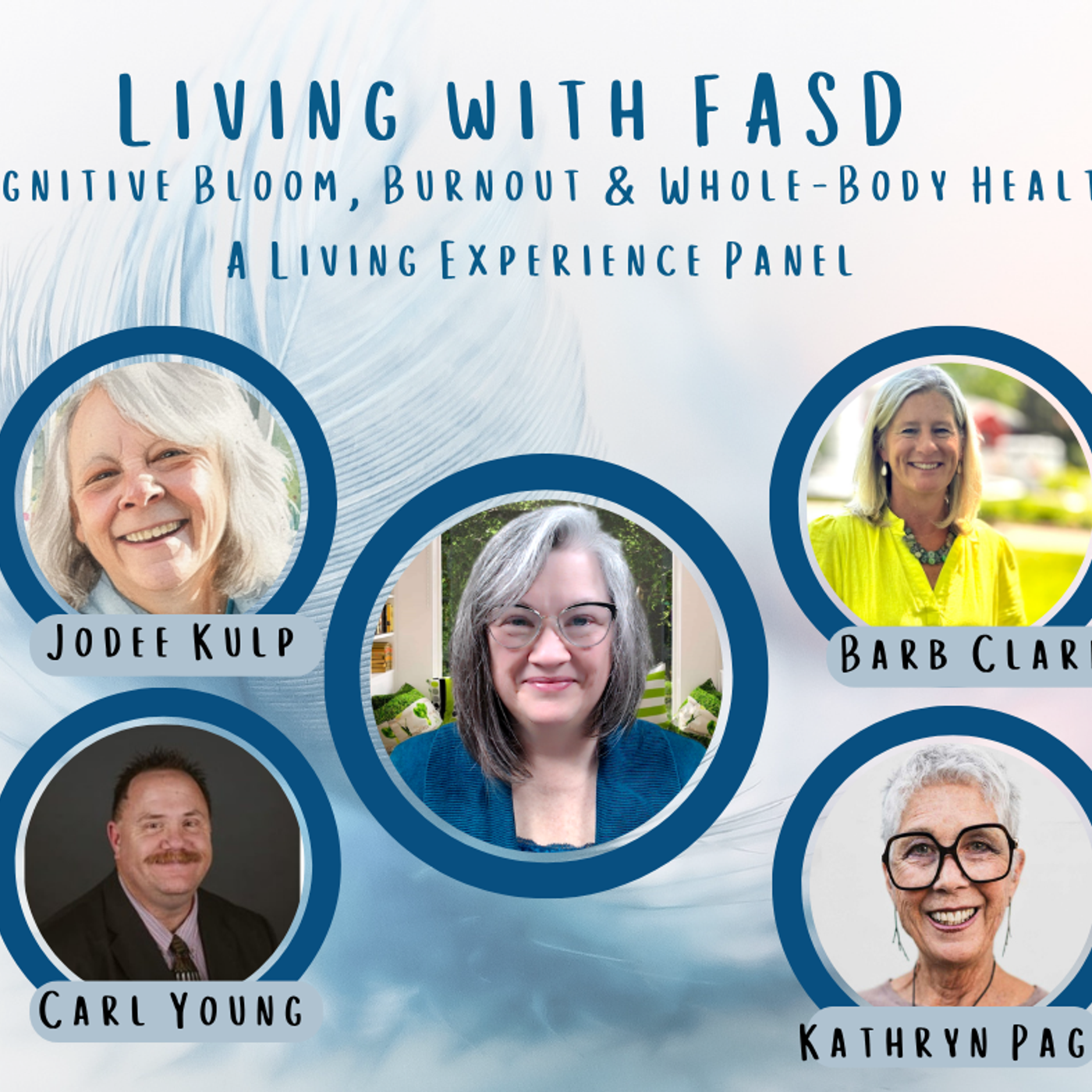
In this special roundtable, Patti Kasper is joined by four leaders and authors in the FASD community—Barb Clark, Carl Young, Jodee Kulp, and Dr. Kathryn Page—for an open, unfiltered conversation about aging with Fetal Alcohol Spectrum Disorder. While headlines and resources frequently focus on pediatric care, adults with FASD face a unique lifespan trajectory. The panel explores the tension between experiencing a midlife "Cognitive Bloom" while navigating accelerated physical burnout, the reality of managing complex whole-body comorbidities, and how late-life identification replaces decades of self-blame with profound self-grace. Meet the Panelists Dr. Kathryn Page (Kathy): Former director of the FASD diagnostic clinic at a county hospital in Northern California and the trainer for Los Angeles County's recent mandatory FASD mental health training. Kathy also joined Patti as co-host for the first three episodes of Living with FASD. Jodee Kulp: Co-founder of the global Red Shoes Rock movement, international speaker, certified health coach, advanced service dog trainer, and the most prolific author in the FASD space. She is the founder and operator of the Better Endings, New Beginnings publishing company. Barb Clark: FASD author (Raising Kids and Teens with FASD and the upcoming The A to Z of FASD), professional life coach, parent advocate, speaker, and trainer. Carl Young: FASD author (Embracing Hope, Embracing Neurodiversity, and Embracing Capacity), professional speaker, trainer, and active legislative policy advocate in North Dakota. Featured Books & Author Links Patti Kasper:4D Living with FASD: Shared Voices, Clearer Understanding – Launching September 9, 2026! Get yours at books.by/yourfasdcoach Discover Your 4D Life: The FASD Living Experience (Companion Study Guide) – Coming soon! Jodee Kulp:Explore Jodee’s full collection of memoirs, fiction, and educational series on her Amazon Store and via Better Endings, New Beginnings Barb Clark:Raising Kids and Teens with FASD: Advice and Strategies to Help Your Family to Thrive! Carl Young:Embracing Hope: Innovative Strategies to Empower Parents Raising Neurodiverse Teens (co-authored with Joel Sheagren) Browse Carl's co-authored series on Amazon Help Spread the Word! If this conversation resonated with you, please Like, Subscribe, and Share this episode on your favorite podcast app and YouTube! Doing so helps algorithms put these vital conversations in front of more people.
Patti Kasper: But one of the things that I wanted to bring forward today for certain was that conversation that we had about bloom versus burnout. Right. We get the cognitive bloom later than neurotypical. Air quotes around neurotypical for those of you who are listening, not watching. the cognitive bloom where where you know we're firing on all cylinders, our minds are working the way everyone could hope for, our creativity is taking off, and it's like, yes, only to have our bodies go, yeah, right. Carl Young: Yeah, good luck with that. Yes, right? Patti Kasper: gonna pull that plug. Right. Barb Clark: They're giving us the middle finger. Jodee Kulp: It's like it's like the wildflowers, right? They don't bloom for ten weeks. It's like boop, they're beautiful, so beautiful, and then boop Patti Kasper: to another episode of Living with FASD, Candid Conversations with Patti Kasper. I'm your host. And joining me today are four very good friends. I'm so blessed. and and there was a fifth going to be with us as well, Mary Byrnes, but there were technical difficulties that kept her from joining us. But we are going to sit down and have a panel discussion on. Aging well despite FASD, right? there's now Barb Clark: Thank Patti Kasper: a lot of interest in what does aging with FASD look like? Because it's always the kiddos in the headlines, right? But you know, a lot of young adults really question, well, what's going on? What should we expect? And maybe today we can get that answered. So joining me in no particular order. Well, no, you I'm gonna go for alphabetical order. Barb Clark, who Barb Clark: Thank Patti Kasper: like me has a coaching and training business in the FASD space. Carl Young likewise works with parents of kiddos, especially with regard to IEPs and stuff like that, and judicial, and he's active as in the legislator space in North Dakota. So between the two of us, we we've got North Dakota handled. And he's and Kathy Page. And no, I went out of order. JK, no? Yep, Jodee. See, I don't even Barb Clark: Mm-hmm. Carl Young: Judy. Patti Kasper: know my alphabet. I need more coffee. Jodee Kulp does not need an introduction, right? Because Carl Young: You Patti Kasper: she's she's here on the show a lot. And all of us so far are authors in the FASD space. Kathy, you've thought a lot about writing a book. We do hope you will crank one out someday. But kathy page: You guys are already doing a admirable job of filling in all those spaces. Jodee Kulp: Yeah. Yeah. Patti Kasper: Yeah. So what what many people who are new to the podcast don't know is that when this podcast started, she was my co-host for the first several episodes. So yeah. kathy page: It's true. It's true. Let me also say are are we are we we all have fetal alcohol, right? Patti Kasper: Mm-hmm. Carl Young: Yes. kathy page: Okay, good. Barb Clark: Yes. kathy page: Didn't mean to interrupt you, Patti. I am so far. Patti Kasper: talking now and let you guys have the floor. So Barb Clark: You kathy page: I mean Jodee Kulp: I like that you said we all have fetal alcohol so good. That's good. Patti Kasper: Yeah. Carl Young: Yeah. Yeah. kathy page: Right. Jodee, I Patti Kasper: Yeah. And kathy page: did not I did not realize that about you. When did how did you realize it? Jodee Kulp: I I I well I I re well some people know the story, but I was at a conference speaking in New York and researchers put my face up as an example of a FASD face, as an adult face, and I was up next to speak. And and I'm like Really? But but you know, I my background, my family background, all of that came, you know, we it made sense. It made sense because my mom had l had a child with a a a deformity that actually she died and then that goes with fetal alcohol and then she had two miscarriages and then I I came. And I also came with the DES, the drug that that so I always thought it was just the drug that my mom took to keep the pregnancy that really wasn't a drug that worked. But you know, it it did create a lot of infertility for the whole thing. So I always thought all the weird stuff that also ties into fetal alcohol was always from that. bizarre physical things that would pop up and and yeah so I I did Lizzie at that point was a young adult and I was not really thinking about it but it it kept gnawing at me. And then as Liz got sicker and I ge became more of a 24 hour a day caregiver and the angst and I couldn't camouflage anymore. I mean I'm very good at masking and camouflaging and I Barb Clark: Yeah. Jodee Kulp: had no idea, right? So I talked to RJ, who I wish was here today by the way. I talked to RJ and said, what do you think? He said, yeah, there's not a question. Cause see, Patti Kasper: Yeah. Jodee Kulp: with with RJ, I could just be just like I was, right? I mean, I Carl Young: You Jodee Kulp: wasn't like masking with RJ. I wasn't goofing. I mean, I was just being me, right? The people that know me Barb Clark: Mm-hmm. Jodee Kulp: well could could see that. Dr. Riley probably figured it out a long time ago. Kathy Mitchell and I were doing a skit and he said, You act just like one of those kids. And I'm like, Carl Young: You Patti Kasper: Hmm. Carl Young: I can see him saying that. Yeah. Barb Clark: Mm-hmm. Jodee Kulp: Yeah, yeah. And I was still but then I sat down and masked and took care of everything. So, you know, yeah, took care. Barb Clark: Mm-hmm. Jodee Kulp: But but yeah, as Liz got sicker and I started having responses because I couldn't manage it, you know, it's like, these are just like her. These are, you know, and then and then I started thinking about what happened at various stages of my life, why I got D's and Fs in fourth grade. how I figured out how to get around math when nobody else did, you know. f I it all the things that, you know, my eyes, my yeah, just kinda like, Yeah, that's that's really what it is. So am I diagnosed? No. I did not go for diagnosis, and you know what? kathy page: Yeah. Jodee Kulp: I'm seventy years old. I don't care. kathy page: So the researchers put your picture up thinking that you that why? What what was the Jodee Kulp: 'Cause they were showing they were showing child faces of FASD and what children look like, right? The the the the filtrum, the eyes. Yeah. And then they kathy page: Of of of so so only only of FAS. Right. Jodee Kulp: Only of FAS. And then they took my face and put it up, and this is an adult face of FASD or of FAS. And I was kathy page: Feel alcohol. How weird. Jodee Kulp: Yeah. So they were young. Patti Kasper: Yeah. Jodee Kulp: They were young and kathy page: Wow. Jodee Kulp: you know, when when I you know, you gotta realize kathy page: Wow. Jodee Kulp: I was Patti Kasper: So so Jodee, let's tell her how they found your photo was a article that Jodee Kulp: yes. Patti Kasper: had been published from Minnesota Public Radio. Completely unrelated to FASD. Was it? Jodee Kulp: No, it was because it was talking about young adults with FASD. So but but Patti Kasper: Because of Lizzie. Carl Young: Thanks Jodee Kulp: the young adults with FASD didn't look like they had FAS, only I did. Barb Clark: Hahaha! Jodee Kulp: And and I was at the New York conference speaking on Our FAScinating Journey, Keys to Brain Potential Along the Paths of Prenatal Brain Injury. So I'm like 'cause at that point it it it it hadn't struck me upside the head like this. kathy page: Right. Jodee Kulp: you know, and at that Barb Clark: Yeah. Jodee Kulp: point the researchers were taking my material and trying to break it down to see if this was accurate or honorable or if, you know, the body and the d brain development and all that kind of thing works. So Patti Kasper: Trying to poke holes in it. Test it. Jodee Kulp: They were poking holes as fast as they could. So not only did they poke holes in all my work, but they poked holes on my face. Carl Young: Yeah. You're a pincushion. Barb Clark: Hehehehehe Patti Kasper: Did it hurt? Jodee Kulp: Y you know, I I it was like I was just kind of flabbergasted, so I just like But you know, life happens, right? Patti Kasper: I you know, that has to be the epitome of masking to be able to stand up at the podium and deliver your talk. Jodee Kulp: After that. Patti Kasper: After seeing your face on a big twelve foot screen. Barb Clark: you Jodee Kulp: You know, you have to have FASD to be able to do that. Carl Young: Yes. Barb Clark: Yeah, it just, over our heads. Jodee Kulp: Well that was silly. Water off a duck's back, right? Carl Young: Yeah, that was, yeah. kathy page: That is an amazing story. Jodee Kulp: Yeah. So I mean, yeah, and and you know, people always said now, that she looks like your sister or you know, a lot of pe you know, we look alike. That we look like we're but we look similar when we have another person that has FASD and has the eyes and the face and they'll say, Is she related to you? And I'm like, Now I know, but I'm not gonna say anything. I'm like, Yeah, we probably We probably were prenatally exposed together in the wombs Barb Clark: Yeah. Jodee Kulp: of the mothers, but yeah. I'm not gonna I'm not gonna bring that up to somebody else, right? It's just Barb Clark: You Carl Young: No. Barb Clark: know what I find fascinating? Most of us were diagnosed as adults in the last handful of years, think even. Mine was a year and a half ago at age of 56. still, some people are like, well, why'd you do that? Because I've known for, I probably figured out 10 years ago, maybe, all of a sudden as I'm speaking and training, I'm like, wait, this is me in so many ways. But people often are like, well, why? And like if you knew like why and I'm like, well, part of it for me was to help just people understand what a huge spectrum it is. Right. But the other thing for me, it's actually it has been giving me more grace with myself in certain areas. It's it's helping me to be like, you know, I shouldn't. Why do I feel guilty about this accommodation or why? Like and I all of a sudden literally still every couple of months, if not more often than that, all of a sudden I'm like, wait. I'm a super metabolizer of medications. This is the one that just hit me in the last month or two. like, I've always had a hard time with meds and not even just the mental health meds, but whether it's pain meds after a surgery or whatever, the normal dose has never fazed me. And that's Carl Young: Mm-hmm. Barb Clark: so common with our kids. So it's just so fascinating how all of a sudden I'll just get smacked with a memory or something that I think about. I'm like, yeah, that makes sense. Carl Young: Yeah, it's helped me with my health. I explained my health journey and the rapid escalation of the number of illnesses that I have. So, Barb Clark: Mm-hmm. Carl Young: you know, it is what it is. But like Barb Clark: Mm-hmm. Carl Young: you said with the medication, you know, I mean, so I'm on this to do what? And yeah, now they have me on an organ rejection, anti-rejection medication. I said, I've never had a transplant. Yes, but your body is rejecting your kidneys. why is that happening? Well, we blame the lupus. Well, I blame FASD. Yeah. Barb Clark: Mm hmm. Jodee Kulp: Yeah. Carl Young: It's weird though that the person on my medical team who knows the most about FASD is my dentist. Barb Clark: Hahaha Jodee Kulp: I think they see the teeth. Teeth tell a huge story. Patti Kasper: Yes. Carl Young: Yeah, they see the teeth and that's what he said. Yeah. Jodee Kulp: Yeah, they tell a whole huge story. And then the teeth tell a huge story for the rest of your organs and the rest of your body. So it all it it often shows up in your in your teeth early. So Carl Young: Yeah, yeah, that's what he said. Yeah, it was a bizarre conversation. So, but yeah. Jodee Kulp: Yeah. Mm. Patti Kasper: you know, with the with the teeth. I remember when I was in the facets training, they're giving examples of the dental stuff and saying you can have too many teeth or you can have too few teeth. And that was one of my moments of, huh, because I'm I have always been missing four teeth. They were. Carl Young: I am now. Patti Kasper: There weren't wisdom teeth that got pulled, although that happened too. It they just were never there. And my mom's older brother, coincidentally, had four too many. Jodee Kulp: He got yours. Yeah. Patti Kasper: Right? That's the joke. But it's all right. He had a big he was a big man with a big mouth. He had room for them. I wouldn't have. Carl Young: You Barb Clark: Yeah Patti Kasper: God knew what he was doing. Carl Young: You Patti Kasper: He lent my teeth out. Carl Young: There you go. You need these more than she does. Patti Kasper: Yeah. But you know, that totally reframed things for me. because who amongst us does not harshly, unfortunately, you know, when we see a kiddo with a mouthful of silver caps, think terrible thoughts about the parent. and make assumptions about the way they are feeding their child. And it's got nothing to well, it may have Barb Clark: yeah. Patti Kasper: something to do with that because if you are, you know, living in lower incomes, your access to quality food is is low. But when your teeth don't have enamel, anything Jodee Kulp: That's right. Patti Kasper: other than water is gonna rot them away. Barb Clark: Mm-hmm. Patti Kasper: And all of us, you know, consume things other than water. Carl Young: Yeah, my dentist said, you know, you could brush your teeth all day long. Not that I recommend that, he said, but it won't improve your teeth. It won't save your teeth. You're eventually going to need dentures. Patti Kasper: Yeah, another huge expense. Barb Clark: Mm-hmm. Patti Kasper: It's an expensive Carl Young: life is. Patti Kasper: it's an expensive condition to live with. Jodee Kulp: Yeah. And a surprising one. Barb Clark: Yes, Carl Young: Mm-hmm. Barb Clark: and an expensive one. It's expensive, like the medical things, the loss of work from the weird medical things that we're struggling with. I mean, we can all say that from, well, not, but some of us can also say that from a caregiver perspective, too. You lose a lot of loss of income because of managing Carl Young: Mm-hmm. Patti Kasper: Always being called to Barb Clark: your kids. Patti Kasper: the school to get your kid, right? Barb Clark: Mm-hmm. Yeah, yeah. Jodee Kulp: And and not just that, just I mean, I I jumped out of the world for five years. You know? Barb Clark: Mm-hmm. Jodee Kulp: yeah. And trying to come back in, it's like I'm not I'm probably not gonna do it. You know, I'll I'll retire from fetal alcohol just because I'm gonna hand it hand the baton off. There's there's there's no way at seventy that I wanna jump back into this field, although I keep getting kids with dogs that need training and and I end up coaching the whole family. along with the dog. So that's why the the the five pound things back there, those are the ones that Oreo picked up and was carrying around with him. I had a service dog at my house who was carrying around my kettlebells. Carl Young: Well, January 25, my doctors convinced me to medically retire. And so I retired actually September 28th last year and I'm busier now. Yeah, Patti Kasper: It my birthday. Barb Clark: Yeah, I was like, you keep saying you're a tired Carl. And I'm like, you know, that's not real retirement. Patti Kasper: Yeah, I just don't see that. Carl Young: I'm busier now than I was then. Yeah, it's it's bizarre. now I'm Jodee Kulp: Well you Carl Young: doing it on my own terms with. in response to my health and I'm not saying yes to every single thing. So yeah, so that makes a difference. Jodee Kulp: are doing great work. You guys are doing great work. You know, I thought Barb Clark: Big time. Jodee Kulp: I thought I'd put out the the f pick the four people that needed their books produced, right? Which we did do. And and now they're on a new n a new caveat of putting out more stuff. So it's like, Patti Kasper: Guilty as charged. Carl Young: Yeah, same here. If you saw our calendar and agenda of books that we were hoping to publish in the next two years, yeah, really slow down guys. Patti Kasper: I I'm trying to compete with you, Carl. Carl Young: We want to write one for criminal justice and we have the education capacity book that is coming out and yeah, we have all of these books scheduled and planned and yeah. Jodee Kulp: The education one, I will tell you, I want to share this right now, is that Red Shoes Rock highest meme for the campaign so far, and we are at seven hundred and eighty thousand views with spending eighteen dollars and we've made thirty-six, so I we've actually monetized this time. Thirty-six Barb Clark: Bam. Jodee Kulp: dollars, seven hundred and fifty thousand views, just so you know how much people make for this kind of monetization. But it qualifies for the next generation, right? So I'm trying to get all the pieces in place for who who takes the baton for us. And okay. I can be honest with you guys. My brain just lost whatever it was gonna say. Carl Young: We were talking about capacity. Barb Clark: you were saying that the busiest the most popular one was something about education. Jodee Kulp: I knew you wanted Patti Kasper: Yes. Jodee Kulp: to know it. I knew you wanted to know it. See, I don't have to be candid with you guys. I don't have to use my camouflagey for this. I can just Yeah, I can just be myself. So I knew you'd get Carl Young: No, be unapologetically yourself. Barb Clark: We got you. Jodee Kulp: the back 'cause you'd either be curious and want to know or you'd forget too. So it didn't matter, right? anyway Any We really have a lot more fun with FASD than most normal people do. Patti Kasper: We just need to have them hang out with us, that's all. Carl Young: That's because we give each other grace to have those little portable moments where, look, a squirrel. Jodee Kulp: I do Barb Clark: Yeah. Jodee Kulp: Okay, so back to the thing. The top mean, Carl, was the eva education one. Schools need FASD education. That got fifty seven thousand views. And it's still running around the internet. So people are still sharing it from sharing it. And we are I'm hoping I'm hoping that builds that we've we've gained about fifteen fourteen hundred people so far on our teams, on our vaul followers. So hopefully Carl Young: nice, nice. Barb Clark: Nice. Jodee Kulp: hopefully that It you know, I i I'd like it to be the clearinghouse because you know, Barb Clark: Yep. Jodee Kulp: if e if people can go one place and see the top stuff that's coming through, the top workshops, the top, you know, material things that help their kids, then that let it be that. Let it be that. It's not related to anybody, right? It's owned by the world. So they're owned. Carl Young: Yeah. Well, you know, and most of my work has been in the policy space for the last 15 years and transitioning from education policy or legislative policy to other kinds of trainings isn't the easiest thing to do because you're known for policy work. Yeah. Jodee Kulp: that's interesting. Carl Young: Yeah. But then on the other hand, you know, my congresswoman's chief of communications called me. Late one Friday evening and said hey, would you write us a policy brief on the potential impact Barb Clark: Yeah. Carl Young: of the DOJ memo on home and community-based services in North Dakota? Like sure Yeah, Barb Clark: Thanks. Jodee Kulp: Wait, I've been at my desk on Saturday. Yeah. Patti Kasper: Yeah. Right? I'll have it for you in ten minutes. Carl Young: yeah, when do you want it Mm-hmm Barb Clark: Yeah. Carl Young: But you know, it's it is what it is and I just keep moving forward and breaking into whatever spaces I can Patti Kasper: And yet at the same time he as he's presenting policy papers for our state reps, at the same time, when he's called to court to be an expert witness, the defense gets him thrown out because Carl Young: Yeah. Patti Kasper: he's not a doctor. Carl Young: And I don't do therapy and I don't do diagnosis, so I'm not an expert, is what they said. Yeah. Jodee Kulp: Eddie, I get that. I c I Barb Clark: yeah. Jodee Kulp: I I have three certificates in dog training, advanced certificates, right? Service dog, which hardly anybody has, and multi level and on top of a lot of other things. I cannot train with our kids for c waivers or anything because I do not have a BA. I'm not gonna go get a PA. Carl Young: What does that have to do with the price of wheat? Jodee Kulp: You know? You know, I can I can Barb Clark: It's stupid. Jodee Kulp: sit in a vestibule in a store with a kid having a meltdown and her dog and let the customers go by and have nobody get hurt. You know, Barb Clark: Yeah. Carl Young: Yeah. Jodee Kulp: and and not have the store upset about it, right? 'Cause it's the the situation is under it's handled, yeah, it's been handled. You know, but Barb Clark: Yep. Jodee Kulp: no. No, yeah. And I won't I won't ever escalate a kid. I will, you know, I I won't escalate a dog either. I'm not interested in either of Patti Kasper: Yeah. Jodee Kulp: those two. Carl Young: Right? Patti Kasper: Yeah. And and yet well meaning therapists who don't understand FAST will escalate those of us with FASD and unintentionally. Jodee Kulp: So so that's exactly right. Barb Clark: yeah. Jodee Kulp: Right. Barb Clark: Mm-hmm. Jodee Kulp: Right. And they'll teach the parents to escalate the kid, which then traumatizes the kid and the relationship. And if it's a service dog team, it traumatizes the team. yeah. Patti Kasper: Mm-hmm. Jodee Kulp: yeah. Done done under the yeah and being paid for well. You know. Carl Young: Yes. Jodee Kulp: yeah. It it they just don't know. You know, you have to walk in the shoes. And I think that's what gave me the gift in in our generation was having the situation, being in my in my body and my spirit, having that understanding that was innate, not knowing why, but just being able to and and Lizzie was extreme. I think you've talked to other people that have worked with her that said, you know, yeah, she was one of the she was one of the top nuts, right? She's one of the the the real big glimmers, the sparklers. Maybe she was a firework. I don't know. But yeah. And yeah and and and and I just figured out how to do things because yeah, because I had F S D too. Barb Clark: Yeah. Jodee Kulp: And we look Carl Young: Well, I remember Patti Kasper: So Carl Young: when I was diagnosed and I called two people, I called my wife, and this was two years ago, and I told my wife, said, well, Dr. Bird says I have FASD. And she said, well, that's a no brainer. Then I called my son, Mark, who also has FASD. And he said, so all of those times you said you knew what I was going through. That was real. And that kind of changed my perspective with him. And actually is when we began to heal our relationship. So, yeah. You know, it explains so much. Yeah, so that's why, yeah. Barb Clark: It really does, Jodee Kulp: It allows me to write the characters because I definitely have ADHD on top of it. Carl Young: Hmm. Barb Clark: Yeah, me too. Jodee Kulp: And and what people don't understand is I'm also an introvert. So I understand that going out and putting the burst of energy in, but then I have to go back in and and and regroup and heal. And and I kind of a rhythm of that. Patty's running to my other side. No. Carl Young: Well, Patti Kasper: Once in a while. Carl Young: I spent last Thursday training social workers for the state. And I said, you know, in regards to masking, said, the person who gets home 20 minutes after our session ends today is not the same person who is here now. Barb Clark: Nope. Carl Young: is that what that means? Yes. It's like I'm taking off my Halloween costume. Barb Clark: Mm-hmm. Carl Young: So, yeah. Barb Clark: Mm-hmm. Patti Kasper: Yeah. We talked one of the things that I mean because we've all talked before. and just as a as a total disclaimer to the audience, we sat down and had this conversation once before. And of course, this is not a word-for-word repetition of it. Carl Young: You Patti Kasper: It Barb Clark: You Patti Kasper: could not be. Barb Clark: Thank Patti Kasper: but the the video feed from one of the participants had not loaded. So although I was able to use the audio track and pull quotes from it for the book that's about to be released, I was not able to put the podcast out there. And it was a really good discussion too. Really, really good. But one of the things that I wanted to bring forward today for certain was that conversation that we had about bloom versus burnout. Right. We get the cognitive bloom later than neurotypical. Air quotes around neurotypical for those of you who are listening, not watching. the cognitive bloom where where you know we're firing on all cylinders, our minds are working the way everyone could hope for, our creativity is taking off, and it's like, yes, only to have our bodies go, yeah, right. Carl Young: Yeah, good luck with Patti Kasper: gonna pull that plug. Right. Carl Young: that. Yes, right? Barb Clark: They're giving us the middle finger. Jodee Kulp: It's like it's like the wildflowers, right? They don't bloom for ten weeks. It's like boop, they're beautiful, so beautiful, and then boop Patti Kasper: Yep. Yep. Yep. You know, and it Barb Clark: Yep. Mm-hmm. Yeah. Patti Kasper: and it I find that things tend to, you know, it it always seems to be, I don't know, do you guys feel experience this too? When things are going really good with the blooming, then then your body will do something, just say You know, like for example, you know, the book 4D Living with FASD, it's about to come out. I am at the I I'm I've the finish line is in sight, and I'm busting my hump, not getting nearly enough sleep, and I'm flying I'm high, I'm enthusiastic. And when I s finally started back to The Lazy River to exercise my body because I've been totally ignoring it since the beginning of May when I started the book. I thought I'm gonna do something great. I'm gonna do laps around the lazy river sideways so that I can really practice the abduction and adduction move with my hips because they're really tight. And Kathy's coming in again. I pulled the tendon. I pulled one of the tendons in my groin. I cannot even get up out of my chair Barb Clark: you Patti Kasper: without some Carl Young: You Patti Kasper: theatrics behind it. Jodee Kulp: Well what Carl Young: Yeah, Barb Clark: Yeah, yeah, yeah, it's whack-a-mole, right? It's a whack-a-mole Carl Young: yeah, right. Well, yes. Patti Kasper: Yes. Barb Clark: thing and like get the 10 and then another thing pops up. Carl Young: Well, you know, like when I was in Seattle this year for the international conference tonight, brought Mr. Sparky, my walker, rollinator thing. And anybody I touched, as long as I was on the carpet they had at the conference center, would get electrocuted. Yeah. you know, gotta have some joy in life, right? This is my joy. How can I spark you today? Yeah, we're gonna spark a conversation. Barb Clark: Yeah, yeah, absolutely. Carl Young: But you know, Patti will sometimes message me at 11, 30, 12 o'clock at night because I don't sleep and she'd be like, are Barb Clark: Me either. Carl Young: you up? Can we talk for a minute? I have a question. So and then Barb Clark: Mm-hmm. Carl Young: that, you know, too, Patti Kasper: 'Cause I know you don't sleep. Carl Young: too, too many questions turns into an hour and a half long conversation. So yeah. Yeah. Barb Clark: yeah. Patti Kasper: That's how we roll. Barb Clark: Yeah. Well, that's my brain wakes up around 9 p.m. That's and that's like my most of the writing of, you know, my first book in the second one I'm working on is between about 11 p.m. and 10 a.m. Carl Young: Yeah, yeah, Patti Kasper: Mm-hmm. Carl Young: yeah, that was the same way with capacity, which is supposed to be out today, but I don't recommend buying it yet. We have to do some edits. But it got written at two o'clock in the morning every morning because I couldn't sleep anyway. Why just lay there and stare at the ceiling? Because that's not going to help Barb Clark: Mm-hmm. Yeah. Exactly. Carl Young: anything. So be productive. Patti Kasper: Okay, so Barb first and then Carl, Barb. For the audience, let's tease your book. Tell us about it. The one you're the one you're writing that yeah, that one first. Carl Young: Which one? Barb Clark: Well, my first book, Raising with FASD, that's out. But my new book, turning in next week on August 31st, 2026, and it's called The A to Z of FASD. It won't publish until September of 2027. So it's got a lot of Carl Young: Well. Barb Clark: the basics. I just kind of pull out each letter like Let's say A, for example, I'm talking about accommodations. I'm talking about advocacy. you know, so each each letter I just ramble like X is a pretty short chapter. Not going to lie. I got X factor in there and that and I'm like, I'm not going to sit and fluff that up. Carl Young: You alright? Patti Kasper: So is that what it w I was wondering? Barb Clark: Yeah, I got a lot of things to put under the C and the B and the A, so I'm just going to keep X real short. Patti Kasper: Yeah. And and I'm sure you can get a decent amount for Q, right? You can you can do quality, quality anything. Quantity, yeah. But beyond that, hmm. But you can qualify anything with a quality or quantity word. Mm-hmm. Barb Clark: Yep, I got a couple for Q. Mm-hmm. Yep. Yep. Yes. Beyond that, Mm-hmm. Yep, exactly. Patti Kasper: Yeah. X okay, what'd you do for Z? Barb Clark: Zoom in and zoom out. And I can just talk. Yep. Talk there. Patti Kasper: Okay. Carl Young: That's legit. Yeah. Right. Patti Kasper: Change your perspective and you you change the situation. Yeah. All Barb Clark: Yep, exactly. Patti Kasper: right. Carl, you said your book is coming out today. Carl Young: yeah, it's called embracing capacity. And the capacity Barb Clark: Mm. Carl Young: term actually came from your 40 book there, Miss Patti. And it's for education and creating a support team around the person with FASD in the classroom. So without negating the authority of the teacher. And we had Embracing Hope that came out just over a year ago and Embracing Neurodiversity, our ministry book that came out this last spring. So, yeah. Jodee Kulp: You can have those muse. Patti Kasper: Yeah. So the Barb Clark: Yeah, I do too. Patti Kasper: I'll I'll I will be importing the book covers and putting them up on the screen. So Jodee Kulp: These are yours, Carl. Carl Young: Yep, those Patti Kasper: yeah. Carl Young: are ours. I don't have an actual physical Jodee Kulp: Yeah. Carl Young: copy of capacity, but the cover is white and it's white to mimic a whiteboard, which you would see in most classrooms. So, yeah. Patti Kasper: Okay. Yeah, I guess schools have gone past blackboards to whiteboards. Jodee Kulp: Yeah. Carl Young: I can't remember the last time I saw a blackboard in the classroom, Barb Clark: laughs Jodee Kulp: They make good Carl Young: unless it was an old classroom that was no longer being used. Jodee Kulp: We make good garden paths, yeah. Garden paths. Garden paths. The slave thing Barb Clark: yeah. Patti Kasper: Yeah. They make good wood? yeah, they would. Carl Young: Yeah. Jodee Kulp: Yeah, they make really good garden paths. Carl Young: Yeah, I never thought of that. you learn something new every day. Yeah, but if you, you Patti Kasper: Okay. Yeah. Carl Young: know, I used to be a truck driver and if you'd told me 32 years ago when I was driving a truck that this is what I would be doing with my life, I would have said you're not. Jodee Kulp: That was about the time you were working in trucking areas, right, Patti? Patti Kasper: truck stop ministry, yeah. That was probably ninety four, ninety five. Carl Young: Yeah, I was, I left the trucking industry in 92. So, yeah. Can't Patti Kasper: Yeah. Carl Young: raise a family and be on the road. Patti Kasper: So in in fact, I I pulled an example from that era of my life into my book on the the chapter dealing with aging. And I had at one point I was working with the church. I mean, because basically what I did, it was a truck stop ministry. I would try I had a route through 11 states and I would Go to all the truck stops. I would, I mean, really be living amongst the guys. I would be showering and eating at the truck stops. and I would be going to local churches and giving them Barb Clark: Thank Patti Kasper: prayer. you know, the work was pretty much over the CB. and I would be giving churches the prayer lists that I had gathered since the last time I had been in their town. And I would collect Bibles and other books, music, whatever it was that I could give away. And I would be driving home the message, you don't have to leave the country to get involved with mission work. And so I was at a church in between Crossville, Tennessee. So a little bit east of Nashville. And I was helping a woman get ready for VBS, Vacation Bible School. And they were doing this t-shirt project. So I was using a box cutter to make the form to put a t-shirt on. So you could paint, the kids could paint them. And it was a brand new blade. Brand Jodee Kulp: Listening. Patti Kasper: new. And it was so sharp, I didn't feel the fact that I had sliced through my finger. I mean all the way down to the bone. My clue was: why is the inside of my finger feel cold? Jodee Kulp: Or wet. Carl Young: Yeah, Jodee Kulp: Yeah. Carl Young: or wet. Yeah, right. So Barb Clark: Classic. Carl Young: I have a high pain, I have a very high pain threshold. So I wouldn't have noticed either Jodee Kulp: Is there is it Yeah. Barb Clark: I did too. Carl Young: until my fingers started dripping. Like, what did I get my hand Jodee Kulp: When I'm in pain Carl Young: into? Jodee Kulp: it's it's serious if I'm in pain. Yeah. Yeah. So yeah. Carl Young: Yeah, yeah. Doctors Patti Kasper: Yeah, yeah. Barb Clark: Me too. Me too. Carl Young: are like, what's your pain level? Like compared to what? know, because if I tell you it hurts, it hurts, you know. Yes, exactly. Yeah, you know, how did you Patti Kasper: Right? Com compared to diabetic neuropathy, everything is a zero. You know, but but Jodee Kulp: What is it? Barb Clark: Mm-hmm. Mm-hmm. Yeah. Carl Young: get through total knee replacement taking only a leave? Well, because I'm allergic. Patti Kasper: Yeah. So I I didn't have insurance, so I just took it in like an entire bottle of hydrogen peroxide and Jodee Kulp: No. Patti Kasper: a and a popsicle stick and gauze. Jodee Kulp: Don't follow her Barb Clark: Classic. Jodee Kulp: orders here. This is Patti Kasper: Right, do not follow my example, y'all. This is not medical Barb Clark: Yeah, we do not recommend this. Carl Young: Yeah, yeah, Patti Kasper: advice. Don't do it. Carl Young: this is for information purposes only. Patti Kasper: Right. Well it's it's information about what not to do. Don't do what Patti did. Jodee Kulp: You know, you it wasn't it was impulsive. Barb Clark: Mm-hmm. Carl Young: Yeah, because you have perfect impulse control, we? And I'm being sarcastic if you can't tell. Patti Kasper: Don't we? So a month Barb Clark: A little bit. Patti Kasper: or two later, when I can't bend my finger anymore and the swelling won't go down, I end up at this country bumpkin doctor somewhere in Ohio and to to get my finger looked at and he's like, you're diabetic. And all of a sudden he started pushing, like so many ignorant people do, you could cure your diabetes if with cinnamon. Barb Clark: geez. Carl Young: Yep. Yep. Patti Kasper: Cinnamon, garlic. Here's the here is the big time loser, okra water. Gag. Carl Young: Yes. Yep. Yeah. Patti Kasper: And every or did you read this book? Or did you read that book? Or did you read this article? And every time I was like I can see where maybe that could help for type two. But how is that going to restore the beta cells in my pancreas, which were destroyed in nineteen sixty-five? not gonna do it and you know the the the reason that was relevant for a book on FASD is isn't that what we get all the time when we're told you know do this with your kids do that with your employees it's like well how is that approach to behavior air quotes again going Barb Clark: Mm-hmm. Patti Kasper: to restore the missing or broken nerve cells in your brain or in or in your liver, Carl, or in my pancreas, or you know, all the things that were taken out by the prenatal exposure. Carl Young: Yeah. Now, when I tell people I have Patti Kasper: How's that gonna get fixed? Carl Young: stage four cirrhosis of the liver, well, you should quit drinking. Maybe I should start drinking, you know? Barb Clark: Yeah Patti Kasper: Ha ha ha. Jodee Kulp: No Carl Young: Because I'm not a drinker. Yeah, I do. I used to have drinks once in a while, but it's not a huge piece of my life. But I could take it or leave it. Barb Clark: Mm-hmm. Carl Young: you know, yeah, you need to quit drinking. no, actually I should probably start drinking. And it was weird, there was a period when I was first diagnosed where I did drink a couple of ounces every other day and I could show where my liver numbers actually improved. And my doctor's like, that's not possible. Really? Okay. Jodee Kulp: Maybe you're five maybe a final line in it, right? Carl Young: You know, but yeah. Patti Kasper: Bec because our bodies Barb Clark: Right. Patti Kasper: always respond like normal. Carl Young: Right, yeah, yeah, Barb Clark: yeah. Carl Young: yeah. You know, like my neurologist, Barb Clark: So normal. Carl Young: you know, you should, I bet you regret treating your body as a jungle gym all those years ago. Well, the trouble is I never did that, you know, Barb Clark: Mm-hmm. Carl Young: but yeah, maybe I should have, yeah, evil, Knievel or something. Barb Clark: Right. Patti Kasper: I I think I have that. Barb Clark: We should have had more fun to be in all this pain and misery. Carl Young: Right? Patti Kasper: Right. Carl Young: Yeah. Well, you know, it is what it is. I just keep doing the things that I need to do to get through each day. Everything else is part of life. Patti Kasper: Yeah, I one of the things I get all the time is you're so strong. Carl Young: You're resilient. Patti Kasper: What choice do I have? Carl Young: Yeah. Yeah. How do you, how do you cope with Barb Clark: Yeah. yeah. Mm hmm. Yeah. Patti Kasper: There's no choice. Carl Young: all of the, all that you've got going on medically? You mean there's a choice? Yeah. Barb Clark: Yeah, what's the alternative? Yeah. Patti Kasper: Yeah. Right? Or all the times, even as a little kid in school and people are like, what's diabetes? And you explain it. I mean, God. I remember correcting the health teacher when second grade, no, you got that wrong. Just a little Barb Clark: Ha ha! Patti Kasper: precocious. But Barb Clark: and swill. Patti Kasper: it's like, I could never give myself a shot. Jodee Kulp: It's protective. I think that it becomes not precocious but Barb Clark: Mm-hmm. Jodee Kulp: protective and I and I saw that with Liz as she got more more more complicated. More things were happening and one thing would then domino the next thing and the next thing and and and the the professional would say something and sh she'd just look at him and she finally she finally just took her filters right off and she just said, you know, F you. It's not that. I'm a type one diabetic. my A one C is lower than yours. What's yours? Mine's five point six. And they're like, Carl Young: Yeah. Yeah. Jodee Kulp: you can't you can't you can't be there. And and you know, and Patti, you know how hard that is. You you run you run insulin. We ran insulin with a syringe because the pens were too we had too they were too big. We had to run tiny, tiny units. And yeah, so so people are like, why are you using syringes? Or you go you'd forget you had syringes as you go through a a police, you know, one of the medical things and and they're not pens, they're actually the needles, you know, that Patti Kasper: So I've been diabetic for so long. The syringes we had when I was diagnosed were glass. And Jodee Kulp: Okay. Patti Kasper: the needles were like this long, and they were super fat. And you had to boil them every day. And you had to sharpen the needle with a whetstone. Jodee Kulp: my goodness. my well that we Barb Clark: You Jodee Kulp: didn't have to do that. We did not have to do that. Barb Clark: Wow, Patti, you're old. Carl Young: Yeah, see all those syringes are you a drug user? No Patti Kasper: I would not recommend those. Those were brutal. yeah. Jodee Kulp: So I a question. How are your I mean, one of the things that we had that complicated everything was Liz's veins were very small and they called her Diva and my veins are very small. giving blood is you d you don't do it, right? You you you just don't do it. So i are do you guys have small veins too? I mean it's my little things that are little. Barb Clark: I don't. Carl Young: Depends on how hydrated I am before I go in. Patti Kasper: That that's a huge piece of it is hydration. Jodee Kulp: Yeah, migration is huge. Patti Kasper: yeah, 'cause if Barb Clark: Yeah, but two of my kids who are exposed have really small veins and they have a nightmare just trying to get it, know, whether it's donate blood or a blood draw, it doesn't work. Carl Young: Yeah, yeah, you have, Patti Kasper: Yeah. So Carl Young: yeah, with me, you'll have a better luck if you use a butterfly needle versus a syringe. Yeah, I'm, always tell them that you you'll do better Patti Kasper: Mm. Yes. Yeah. Yeah. I do too. Jodee Kulp: Yep. Yep. Yep. Carl Young: if you use a butter. Jodee Kulp: So the words was I'm a Patti Kasper: And the Jodee Kulp: diva. I'm just a diva, so please just get the smallest needle you can and bring me some ultrasound. Patti Kasper: Yeah. The the other piece of that is home I was it I was going to college before home blood testing was a was a thing. You know, and and they've Barb Clark: me. Patti Kasper: been doing all this diabetic stuff on TV commercials for, you know, as long as medicine was allowed to be a commercial. but prior to Barb Clark: which I hate. Patti Kasper: prior to that, I mean it was it was nineteen seventy eight, seventy nine. Before the technology was even there. And the the the glucose testers were the size of, remember the very first calculators? I mean, Barb Clark: Mm-hmm. Patti Kasper: it was like this big and this thick. It cost $10 a day to calibrate it. If you unplugged it, you had to recalibrate it. If the temperature changed more than five degrees, you had to recalibrate it. It was a nightmare. And they didn't have. They they didn't do finger sticks in the hospital rooms. Well, night high school was a really hard time for me with sugar management. That was when insurance companies brought in was it DRGs? They when when the insurance companies would start kicking people out, they'd say, You can have X number of days to accomplish whatever. And Three times in nineteen seventy nine, Carl Young: Yeah, like they do with care now. Patti Kasper: huh? Carl Young: Like they do with care now. You got 120 Patti Kasper: Yeah. So three Carl Young: days. If you don't get done, too bad. Patti Kasper: Yeah, three times in nineteen seventy-nine, they threw me out before I was thoroughly stabilized. And so I it was, you know, not home for long and I was back in again. And they were doing venipunctures, right? In the arm every four hours around the clock, over three hospitalizations. So now when I people they they can't feel my veins for, you know, cholesterol check or whatever. And and I say this does not sound good. Follow the tracks. You won't miss. And they're all from nineteen seventy-nine. Carl Young: I have them too. I have needle scars from 1999 when they poked me every three hours in the same arm. like, can you use the other one? Jodee Kulp: I I finally asked for a pick line. I said, I I I don't care. I need a pick line. Carl Young: Yeah. Jodee Kulp: because it it was just too too invasive. It was it actually started being violent, you know. So you know, and the and the other the Carl Young: Yeah, you need to let... Jodee Kulp: other thing is our bodies can be made different. I mean like Patti Kasper: Mm-hmm. Jodee Kulp: different parts in different places that people don't expect and different things in different order and different things that are connected to different things. So there's things that you know, that not only do medications work paradoxically or a tiny like Patti, you we've talked about insulin before. Two units of insulin are a half a unit of insulin was what we needed sometimes to get her stable. And yet most people are on a huge, much more amount than that. So and yeah. Carl Young: Yeah. Patti Kasper: And all that changes through the years, right? And mm-hmm. Mm-hmm. Jodee Kulp: Exactly. well and through the time, through the season, through through Carl Young: Yes. Jodee Kulp: what's going on with the rest of your body, everything all the organs talk together, surprise, surprise. You know, they have to live Barb Clark: Mm-hmm. Jodee Kulp: in the s Patti Kasper: Yeah, who knew? Jodee Kulp: they live in the same house. They have to figure out how to get along. Yeah. Barb Clark: And they don't. Patti Kasper: It's a great great analogy. Carl Young: Yeah, yeah, Dr. Bird made the comment that it's unusual for somebody with FASD to be married for 30 years to the same person and Somebody asked me once how did how are you doing that? And I said the key to our marriage is separate bedrooms because I don't sleep and if I'm Wandering around it just keeps her awake. So we have separate bedrooms, but But you know back to my liver with we're talking about pain and I went to the doctor when I before I was diagnosed, said, my liver hurts. Well, there's no pain receptors in your liver. Did you know that? It's not supposed to hurt. And I said, it hurts. And I said, you know, there's something going on. So then they finally started testing. Well, yeah, you need to stop drinking. So yeah, don't discount our standard experiences just because they don't fit your model. Yeah. Patti Kasper: Yeah. Yeah. Jodee Kulp: Yeah. Yeah. They won't fit your model no matter how few. Carl Young: I have to rewrite the model. Jodee Kulp: look at you like you're going, Well Barb Clark: Yeah. Patti Kasper: Nevertheless, I'm here and Barb Clark: Yeah. Right. Well, I even just Carl Young: Yes, yeah. Barb Clark: not to count it, but I know we have several of us on here have had back surgery. Several of us, several have had knees, you know, like every it is Carl Young: knees and shoulders and yep. Barb Clark: fascinating. And obviously, they're neurotypical people too that have back Carl Young: Huh. Barb Clark: surgery or knee. I'm not saying but but really, I mean, my knee problems go back to fourth grade and it was a genetic thing. I was bow-legged in one leg, but you couldn't tell by looking at me, and that caused problems. So, I mean, could have had that without the exposure, but it was likely from that, right? And all of the different things that most of us are struggling with on here, it's just so clear that it was from that teratogen. Carl Young: Yeah. Patti Kasper: Yeah. Yeah. Carl Young: Yeah, the doctor, every time I have to have a CT scan or an MRI of my abdomen, they're like, you know, your spine is collapsing. We should like put a steel rod or something in there to hold it up. I'm like, no. And then my C spine is collapsing as well. And they're like, we can fix that. I'm like, no. Yeah. Barb Clark: Mm-hmm. Patti Kasper: I I am very grateful that I chose to have the spinal fusions last year. So for people Barb Clark: Mm-hmm. Patti Kasper: that weren't following me for that long, last September I had the lower you know, the very tail end of your spine, there's no space between the vertebrae at all. So the first five discs for where your spine can bend. had all disappeared. And so I'm now back up to five four. I was considerably shorter when missing all those discs. Yeah. So I I'm happy Barb Clark: Yep. Yep. Carl Young: Well, I know my wife gained three quarters. Yeah. My wife gained three quarters of an inch. Barb Clark: You Patti Kasper: that I had it done. I'm Barb Clark: Yeah. Patti Kasper: not in the amount of pain that I had been. Is it a is it an end all be all? No. Barb Clark: No. No. Yeah. Patti Kasper: I can't reach my feet anymore. That's a bit of a drag. Barb Clark: I had the fusion and decompression Patti Kasper: Yeah. Barb Clark: about four years ago. And it's so funny because my husband's like, if like once in a while he'll cause I don't really complain that I'm in pain very much, but once in while he'll maybe see me like have a grip, like have a moment. And he's like, I Patti Kasper: The grimace? Barb Clark: thought you had surgery. And I'm like, you just don't understand pain, buddy. It's there all the time. It's there all the time. And then Carl Young: Yeah, right. Patti Kasper: Yeah. So yeah. Yeah. Barb Clark: some like, cause back then it was like, I couldn't sleep. It was like, Horrific, right? And now it's a lot, but it's not at the point that it was. Patti Kasper: Yeah. It's it's better, but it's not it was not the end all be all. So you know Barb Clark: Mm-hmm. Carl Young: man. Patti Kasper: when you go to the when you go to have surgery, you have to lose not only your your clothes, but they don't let you wear your own socks either. And they give you those ridiculous fuzzy things with the rubber on one side. I don't know what the Barb Clark: Correct. Patti Kasper: why can't you wear your own socks? But I needed help putting those on, and my husband was like, Can't w how do you put socks on at home? And I'm like Kasper, when's the last time you saw me wear socks? Barb Clark: Yeah Carl Young: Right? Well, my wife can tell when I'm in pain before I can usually, because she says I smell different. So yesterday she Jodee Kulp: yeah. Patti Kasper: That's interesting. Carl Young: said, it's going to storm, isn't it? And I said, why? Why do you say that? And she said, well, because you're hurting. I said, no, I'm not. Yes, you are. But yeah, Jodee Kulp: No. Carl Young: she says I have a different scent to my body when I'm in pain. otherwise. Jodee Kulp: that's interesting that she can a an animal can pick that up. Usually. Yeah, that's and that Patti Kasper: Mm-hmm. Barb Clark: Mm-hmm. Carl Young: Yeah. Yup. I'll have to tell her she's part animal. Jodee says you're an animal. Patti Kasper: Either that or Carl really either that or Carl just stinks Barb Clark: There you go. Dodie called you an animal. Carl Young: Yeah, that or Carl just think. Barb Clark: But I think a lot of us still have that. It's that our sensory stuff too though, because I have a good friend who you know, Jodee, who's a caregiver of kids with FASD and she's she's she has type 1 diabetes and I know when her blood sugar is off, I can smell it and I didn't know that for years. I'm like, what is that? Why does she always have this weird feeling? Patti Kasper: Mm-hmm. Carl Young: Yeah, right. Barb Clark: Like I didn't and we were on a plane once and she has one of her daughters has significant special needs and she's always talked about how her daughter always knows when her blood sugar is up and when we're on the plane and all of a sudden I'm like, can you check your blood sugar, please? And she did and I'm like, I now know I Jodee Kulp: Well Barb Clark: so I now can tell her when it's Jodee Kulp: Was it higher low? Carl Young: Yeah. Barb Clark: that's a memory thing that won't work in my brain. I literally and and my daughter is. Jodee Kulp: Okay. Patti Kasper: Yeah. Well i 'cause it's two different Carl Young: Yeah. That's our reality. Yeah. Patti Kasper: smells. Barb Clark: Yeah, Patti Kasper: It's two different smells. Barb Clark: my daughter, I think for her it's usually, well, no, I don't know. Patti Kasper: With with high sugar, you have a sweet or fruity kind of smell. And with low blood sugar, it's an acet acetone kind of smell. Barb Clark: I think it's that one. Jodee Kulp: Yeah, that Patti Kasper: Mm-hmm. Jodee Kulp: one is is definitely that's a valuable one, you know, and Patti Kasper: Yeah. Jodee Kulp: so so Liz Liz Liz is had a dog that was five months old and that could could beat her C GM by by fifteen minutes. Patti Kasper: Salie beat my CGMs by 45 minutes regularly. She would the continuous glucose monitor. you know, I I yeah, Barb Clark: And the CGMs are for people that don't know. Thank you. I know I'm just saying the listeners. Jodee Kulp: You don't Patti Kasper: yeah, thank you. Yeah, I got Carl Young: You Patti Kasper: I got Salie is my diabetic alert dog, God rest her soul. she yeah, I I helped her into her last nap. on her 14th birthday. But Barb Clark: Mm-hmm. Patti Kasper: but she served me well from 2000 the fall of 2012 until COVID hit. And yeah, she she was routinely 45 minutes ahead of the technology. You know, Jodee Kulp: Yeah, they're awesome. Patti Kasper: yeah. So technology's gotten to the point now, I don't think I would get a dog for that. You know, unless Medicare decides they're not gonna pay for the tech anymore, then I'll have to get another dog. Barb Clark: Yeah. Patti Kasper: But hopefully Jodee Kulp: Well, I'm grateful I'm sorry, I'm grateful to to Liz's migraine alert dog because that one that Barb Clark: Yeah. Jodee Kulp: one knows and knows how to how to lay on the paravagal or to on the head to s to Barb Clark: Yeah. Jodee Kulp: do what they do with machines now, right? They actually have machines that Barb Clark: Mm-hmm. Jodee Kulp: do that and she knows ex Liz trained her to do qu and and Liz didn't know. She just knew where it felt good, right? This is what it works. And then you come to find Barb Clark: Yeah. Jodee Kulp: out it's it's the exact same place. So if I've got a a migraine, which is something I do deal with, she Barb Clark: Yeah. Jodee Kulp: Just like that, she's she's on it and Patti Kasper: Yeah. She's she's Carl Young: Yeah, one of the Patti Kasper: part of your pre aura, right? Carl Young: Yes. Well, I have this condition called autotenomic dysfunction, which means I get dizzy and fall down a lot. And my corgi can tell Jodee Kulp: What's it? Carl Young: that that's autotenomic dysfunction. Jodee Kulp: Okay. Carl Young: It's a metabolic disorder. It's not POTS, but yeah, when I stand up, I get dizzy and fall over. So sometimes when I'm walking, get dizzy and fall over. But my corgi can recognize that that's going to happen before I do. Yeah. Barb Clark: Mm-hmm, nice, nice. Carl Young: And he is very productive like that. Don't get up. Patti Kasper: Yeah, yeah, Barb Clark: I feel like Patti, Patti Kasper: yeah. Barb Clark: could have a whole one of these on just menopause and FASD. Patti Kasper: Just Barb Clark: Where Carl doesn't want to talk about that. I mean, I'll say, Carl Young: no, talk about it. You're never going to... Patti Kasper: Ha ha Barb Clark: I'll give you one very of the few positives for menopause with me is it got rid of my migraines because I have a huge history of migraines and I don't get them anymore. Jodee Kulp: Yeah, it got rid of me having my period for three weeks on and one week off and not have cramps that whole time for three weeks. So and they were they were severe. So that was a nice Barb Clark: And through. That's them. Carl Young: Yeah. And for the listeners, when you're in the FASD space, no topic is off limits. And it's rare that you're ever going Barb Clark: good. Patti Kasper: Right. Carl Young: to talk about a topic that I'm comfortable with. So it doesn't matter. you're not going to say anything I haven't heard Barb Clark: Well, there you go. Patti Kasper: Yeah, there's no there's no shame. Carl Young: before. Barb Clark: Yeah. yeah. Well, and you know, speaking of FASD, can just only imagine too, when I was, when I had a hysterectomy last summer, that's in the preop room and they had already given me Versed or whatever. And I was, I'm pretty sure that the whole operating team is never going to forget me because I was maybe using an inappropriate word. That's a word for vagina that starts with a T. I don't know if you want me to say it or not, but I was Carl Young: Or two? Barb Clark: I was telling the whole Patti Kasper: Yeah. Barb Clark: team that because I call my OBGYN, my Carl Young: You Barb Clark: twat doc, and excuse me, I had to say it, and she had never heard the word Carl Young: It is what it is. Barb Clark: before and she's a top doctor, phenomenal. I've had her since right out of med school. And I was so, so I had to tell the whole operating room that she didn't know that word. And I was going on and on and I'm sure they could just could not get that anesthesia in me quick enough to shut me up. Carl Young: See Barb Clark: Hahaha Carl Young: you Patti Kasper: So I had Carl Young: around YouTube! Patti Kasper: I had lumpectomy back in ninety, gosh, must have been ninety-one or ninety-two. My first husband was an OR tech. And so we made sure that I was in his room, right? He wasn't there, but all this the crew that he was with all the time was there to make sure that I got taken very good care of. And it's under light sedation, right? So you're technically not asleep, but you you can't feel anything and you're pretty gorked Barb Clark: Mm hmm. Yeah. Patti Kasper: out. They didn't give me enough to get the to the super gorked out stage. I still couldn't, you know, and I could I could feel like tugging and maneuvering, but I didn't have any pain. But about that time I had just been promoted to clinical director of a psych unit. And I was pretty young at that point. And so I was very like I just got this promotion. And every time my peripheral vision detected movement, I thought there were new people. So I had to tell them all over again. to the same people over and over and over again. And so I was later told that I when I finally stopped talking, I went straight to snoring. Carl Young: Yes. Yes. You mentioned some of the Barb Clark: Nice. Carl Young: stories those OR people hear and can Barb Clark: I bet. Carl Young: tell about their experiences putting people under sedation. Yeah. Barb Clark: yeah. Yep. Patti Kasper: Married to someone who works in the OR? Yeah, I I I know a lot of stories. Barb Clark: Mm-hmm. Mm-hmm. Yep. Patti Kasper: So my goodness. Carl Young: Yes. Patti Kasper: Yeah, some of which are would not be appropriate for the the podcast. Carl Young: Right? Barb Clark: I maybe challenged the boundaries a little bit there already. Carl Young: A little, Patti Kasper: Yeah. Carl Young: yeah. well. Barb Clark: Let's just pretend we're It's okay over there. Carl Young: Yes, well yeah, Patti Kasper: I Carl Young: I've Patti Kasper: Yeah. Carl Young: had over the course of my life two business partners that were British and their filters are entirely different than even ours with FASD. Patti Kasper: Mm-hmm. Barb Clark: Mm-hmm. Yep. Patti Kasper: Yeah. my goodness. Well, what is what is something that each of you would would say to those who are in their twenties and thirties who are like, I wonder what this is gonna be like when I'm in my fifties or sixties or seventies. This whole thing about aging well with FAST. Jodee Kulp: Mm-hmm. Barb Clark: Wow, that's a good, you got silent. Look at us like, ooh, that you got to think deep here. Well, know, part of it, part of part of my Patti Kasper: See, I I got all formal on us. Right? It's like a real question? What do we do with that? Carl Young: Yeah, right. Jodee Kulp: So I think Barb Clark: challenge with my initial reaction to that is like, if I if like, I could go back to my 20s, 30s, and even 40s and do things a little differently. Or, you know, like some of the things that I would do is I would try to get into better Carl Young: you Barb Clark: routines. But also, but in particular around nutrition and and moving my body, you know, I just I would have been even more mindful of that to try to have better muscle strength and see, know, a lot of those kind of things, because then once you're getting in your 50s and beyond, it's never too late, but it's way hard. Jodee Kulp: So so I was blessed with with getting really sick at forty two and and being told I had a five percent chance to live. So you guys can kind of pretty much guess what that is. But Barb Clark: Mm-hmm. Jodee Kulp: because of that, I was also given a a doctor that was a clinical nutritionist and a sports medicine doctor that said, Let's get you through this. And so he he gave me a training program to train for going into surgery, gave me a a feeding program to change my whole diet, which is now things that are coming out twenty five years later, but more than that, on on what what's working, right? Well I can tell you Patti Kasper: Now Maha is telling you what this guy told you all those years ago. Yeah. Jodee Kulp: in the in the nineties, yeah. And and it worked. And I can tell you that that situation, which was as tough as it was, was my gift to getting through it because, you know, the the stretching, the exercises, the the food, getting rid of preservatives, not eating any vegetable oils, I mean on and on and on and on kind of things. You know, rainbow diet, all that thing which wasn't in the media yet. Barb Clark: Mm-hmm. Jodee Kulp: things that that that we did. And then it it and the other thing that was really good for that was that Lizzie it was for her too, but I was so sick that I could feel my I what I didn't usually feel my body except for cramping, I could feel the changes. So I could feel when something was happening, when I did a certain thing a certain way. So it gave me that that intuitive understanding to keep pressing through. And and I think that's what kept her as healthy as she was. up until she was eighteen and then went into spiraled into alcoholism for three years. but then it also gave her the ability to recover. So that was, you know, yeah, that was my gift. My gift was coming up against that brick wall and then working with the right professionals to really do it right. And there's some things I do now that are on the edge that I think I not doing them but that have been come up at our effective things. And again, since this is not a medical advice thing, I'm not gonna give you any ideas, but that that work. And I think looking at alternative medicine, looking at alternative and not the fad diets, but you know, just real clean eating, walking, getting exercise, doing doing as much don't push your body to the point of over stressing, right? And I mean I'm a fitness instructor now and a l and a biblical health coach and And when I do my classes, we don't I don't push. I say, you know, this is this is what we're gonna we're gonna learn to move it and get that synovial fluid going that you've given. We're going to, you know, get your limp moving and and and get your those things the the things that are clogged working as good as we can. And those gifts came from being so sick. Carl Young: Yeah, well, half Jodee Kulp: Here. Carl Young: a lifetime ago, literally half a lifetime ago, I was diagnosed with lupus and I lost 100 pounds in under three months. And Jodee Kulp: Wow. Patti Kasper: Ooh. Carl Young: they're like, how, what kind of diet are you on? And I went from being an Patti Kasper: That's a shock to the system in itself. Carl Young: outdoor guy to being an indoor guy because of sensitivity as a result of the lupus. Jodee Kulp: interesting. Carl Young: Yeah. So sometimes you have to change your life entirely Barb Clark: Yep. Carl Young: in order to be able to get through a situation. And the journey is worthwhile. Jodee Kulp: Yeah. Patti Kasper: It's it's always, you know, I one of the things that I was writing about the other day, I can't remember what chapter it shows up in, but I know what it I just was interviewed by Sandra Flack for her podcast. And Barb Clark: Mm-hmm. Patti Kasper: Sandra always asks her guests to name you know, a Bible verse that is meaningful. And My what I it used to be Romans 8 28, all things work together for good to those who love and trust the Lord and called according to his purpose. And that's great. But what since since really delving into FASD and learning that prenatal alcohol exposure is my story too. We are fearfully and wonderfully made. Right? We were knit together in our mother's womb by the Creator. And to everyone that would say, why would God afflict babies with a toxin? Why would He allow that to happen? For anyone that would be ticked off at God for that. My answer is everything according to his purpose, right? Tie back to Romans. If he wants to use us in a certain way, if we need to be shaped a certain way in order to really be a gift and a blessing to ourselves and to the world, then he's going to allow that thing to happen. It's not. Choice number one. Barb Clark: Mm-hmm. Patti Kasper: But it it is not it's not something to be upset about because we are fearfully and wonderfully made, which means we are awesome, we are special, we are on purpose, exactly as we should be. And That's something to rejoice in. So I would say that. And even though for me that comes with umpting physical conditions, many of which cause pain, it's okay. Carl Young: Yeah. Patti Kasper: It's okay. Carl Young: Well, every time, you know, people ask me every time I get a new diagnosis, which is like I said, happening more and more frequently now Barb Clark: Yeah. Carl Young: is how can you stand it? Like it's part of life. It's just my journey. Everything has a purpose. Mine is not to reason why. Yeah, I had to stop wondering that all the time because it was beginning to affect my mental health. You know, why did I get blessed with this and why did I get blessed with that? Everything comes for a reason. Patti Kasper: Yeah. And blessing when you ask it that way, the blessing is in air quotes, right? Meant very sarcastically. Carl Young: Yeah, right. Yeah. Smack me upside the head with a 2x4. Yes. Patti Kasper: And Barb Clark: Mm-hmm. Patti Kasper: and yet even the most horrendous things can be gifts. You know, I I have I I have been victimized sexual assault. Well, that's a terrible thing. Except for someone who works in mental health, it enables you to really understand your clients and reach them in ways that people who don't know betrayal. can't. Some things book knowledge will never touch. Jodee Kulp: Okay. Patti Kasper: Right. Like Carl Young: Yes. Yeah. Patti Kasper: the schmuck who said, have garlic. Eat some garlic, you'll be cured. Carl Young: All those people in the last 27 years, try this supplement, it'll fix your lupus. Okay. Jodee Kulp: So Patti Kasper: The the other thing that I that I want to leave people with, if if they're if they're still being entertained and still with us, you know, Carl Young: Right? Patti Kasper: one of the things that those of us who are advocates in the space are constantly trying to make better known is the fact that this is a whole body condition. It is a physical condition every Barb Clark: Yeah. Patti Kasper: bit as much as it is mental health and behavioral. And you know, we frequently go back to that lay of the land survey, you know, the 428 comorbid conditions. And I talk about how it's an important piece of medical of it's important for doctors in your future when Barb Clark: Mm-hmm. Patti Kasper: you present with physical symptoms X, Y, and Z, to know that you are predisposed to yada yada yada. So that it can be included in the differential diagnosis, right? In other words, in Barb Clark: Right. Patti Kasper: the decision tree that doctors think about when they try and put the puzzle pieces together. But while there is that, you know, that tendency for all these things to run together, the science isn't there yet for alcohol Carl Young: No, not even close. Patti Kasper: exposure causing certain things. Do I believe that to be the case for my diabetes? Yes, absolutely. Absolutely I do because of the age, because of the way I was cared for before diagnosis. It it's the only explanation that fits for me. Does that mean it's true for other people? No. So I, you know, we have to put that disclaimer out there too. You know, and we're just because Carl got lupus dug on it doesn't mean I'm going to. Jodee Kulp: That's right. Carl Young: No, lupus is most prevalent in black females, African American females between the ages of 20 and 40. Patti Kasper: Why you do have a good mask going, Carl. Carl Young: Yeah, don't I? Barb Clark: Thanks Carl Young: Because... But, you know, but now in the light of social media, I've met literally a thousand guys across the world who Jodee Kulp: it's the present. Yeah. Carl Young: have lupus and a handful of them also have other conditions and those include FASD. Barb Clark: Mm-hmm. Carl Young: But that's not a scientific, you know, take, but in any population you can find certain things. Just have to know Patti Kasper: Yeah. Yeah. Jodee Kulp: Yeah. It'll Carl Young: to look for them. Jodee Kulp: it'll take putting co the commonalities together and that'll take time. But it'll happen. I mean we've got the power to do those kind of things now. Carl Young: Yes. Patti Kasper: Yeah. Yeah. Jodee Kulp: I wanna I wanna say one more thing, Patti, and that is that your new book that's coming out, which is four D and and I really believe that that is the culmination of so many people's work, so many pioneers' work. And and I really if Patti Kasper: Mm. Yes. Jodee Kulp: if they're listening, I really wanna honor that and and She you've taken which how many how many time hours have we talked about, you know, neurology and physical and metabolic and and then you've taken those two pieces and you've changed it to but wait a second, it's not just those, how do they operate within the environment? And then how do they Carl Young: Mm-hmm. Jodee Kulp: operate in in in a in a span of time? And when you put those four pieces together, now you're looking at the whole person because something that that may not happen here in my office where I'm feeling comfortable or feeling in the woods where I'm totally comfortable may may be affected in a if I'm in a in a conference room where I have to run to the bathroom really quickly, you know, which is a real safe place to hide if you need to hide for a Barb Clark: Right. Carl Young: Isn't it? Patti Kasper: Especially if you just saw your face up on a big screen. Carl Young: Yes, right. Jodee Kulp: Yeah. Carl Young: Yeah, yeah, I called Patti the first day when I first started previewing 4D and I'm like, we can apply this to education. We can apply it to justice. And we I'm Jodee Kulp: Well and we will. We will do that. In fact Carl Young: already doing that. yeah. Patti Kasper: And and it's also applicable to other neurotypes, right? To ASD, Jodee Kulp: Absolutely. Barb Clark: Mm-hmm. Patti Kasper: ADHD, I mean the whole kit and caboodle. Mm-hmm. Yes. Jodee Kulp: But any chronic condition. Anybody chronic ca pain it works with that. It it's a human condition. We just you know, it's Patti Kasper: Yeah. Yeah. Jodee Kulp: easy to look at a linear situation because that's what we had to look at before. We didn't have d databases that could turn and spin and at least not for the whole public. And now now that's coming. That's coming where you can Patti Kasper: Yeah. Yeah. Jodee Kulp: say, What really was happening? You know, what you know, Carl Young: Well, if you looked at my body from a side profile, you'd realize it's not a linear line. It's not a linear model. Barb Clark: Hahaha Patti Kasper: Yeah. Right. So yeah, one one of one of the podcast guests that I quote in the book is a former EMT, Jake Chapkis. I think he's in Wisconsin. and this is typical medical sense of humor. The only flat Carl Young: You Patti Kasper: line, right? That low to high spectrum, the only flat line fits dead people. Carl Young: Yes. Yeah. Very Patti Kasper: So anyway, yeah. Carl Young: much so. Patti Kasper: Yeah. So yeah, so 4D Living with FASD, shared wisdom because it's wisdom from all Carl Young: Yeah. Patti Kasper: I knocked over my microphone which then fell Barb Clark: you Patti Kasper: onto the cat who went Carl Young: Jimmy. Barb Clark: Ha ha ha! Patti Kasper: Shared shared wisdom and clearer understanding. So yeah, it's I I wove together people, the pioneers of our field, the ideas that they had that maybe didn't catch on, but were nonetheless very, very valuable with the living experience of the podcast guests who come on the show and talk about their lives. and the podcast guests who are professionals of a variety of stripes. We've w weaving those all together along with this four-dimensional way of looking at things. so yeah, it comes out September 9th and two Barb Clark: Peace. Jodee Kulp: Hopefully. We're doing our best. It's 'cause it's coming to me today, so Carl Young: Yep. You're on. I'm working. Patti Kasper: Yes. and and there's Barb Clark: You Patti Kasper: a companion study guide, which hopefully will only be a month or so behind. to a la. Jodee Kulp: running away. I'm running away now. Barb Clark: Brilliant. Carl Young: Yeah Patti Kasper: Yeah. And there's part two because of a hundred and forty podcast episodes. That's too much wisdom for one book. So that's that's Jodee Kulp: But but I think Patti Kasper: next year's project. That's a third of the way written already. Barb Clark: Nice. Carl Young: Take a vacation, you've earned it. Jodee Kulp: Yeah. Yeah. So so Patti Kasper: I need one. I need one. Jodee Kulp: for for us we've got Tiger Butterfly coming out, which is and Patti Kasper: I can't wait that is such a good book. Jodee Kulp: it got usurped by four D, which was definitely more important. And Patti Kasper: Well, it also got usurped by iridescent spoon. So which is Jody's Jodee Kulp: Yeah. Barb Clark: which is excellent. Patti Kasper: book. We didn't really talk about that early. I mean Jodee is the most prolific writer in the FASD space, so everybody be looking Carl Young: Yeah, it's mixed. Patti Kasper: for her stuff. But Jodee Kulp: yeah, you know what I Barb Clark: Absolutely. Jodee Kulp: did finally? I finally spent a few minutes marketing and I put my books in a series. So the it's all called the Liz Kulp Liz Kulp courage with prenatal exposure, neurodiversity kind of thing. So anyways in a series on Amazon so people can look at the whole if they buy they can get all of them or decide what they want to do and see the order of how they go. Barb Clark: Nice! Carl Young: Yeah. Yeah. Joel. Patti Kasper: Yeah. Yeah. Yeah. S Carl Young: Yeah, Joel and I are doing that as Barb Clark: Great. Carl Young: well. Putting in book one, book two, book three. Jodee Kulp: Yep, good idea. Barb Clark: That's awesome. Patti Kasper: Yeah, so 4D Living with FASD is book one. yeah, and I and I haven't named, I haven't settled on the name for book two yet, but I think it's gonna have something to do with my wildflower nature metaphors. Jodee Kulp: Well that alone just totally changes the thought process. It's not it's no longer Swiss cheese or or or a what is it called? A stretch toddler or all those other linear ideas. It's you know, the the the the prairie has been burned and out of the prairie comes the flo well the wildflowers and the wildflowers. Brilliant. Yeah. Patti Kasper: Yeah. Yeah. Yeah. Barb Clark: Brilliant. Carl Young: It's the truth. Patti Kasper: Yeah. And it and it's a way of highlighting the beauty in the whole process. Right? Jodee Kulp: And anyone that knows the snows were wildflowers, they know that. Patti Kasper: Yeah. Carl Young: Yeah. Well. Patti Kasper: Emphasis on the wild. Barb Clark: Mm-hmm. Carl Young: Right. Patti Kasper: Wild and unexpected and surprising and tenacious as hell. Jodee Kulp: Untamable. Patti Kasper: Yes, that too. Yeah. Carl Young: Untamed wildflowers. Barb Clark: Here we go. Patti Kasper: Yeah. Barb Clark: Well, there's the name for your book, Patti. Patti Kasper: Yeah. Carl Young: Yeah. Patti Kasper: And hands down far more beautiful than any formal garden could ever hope to be. With its rigorous pruning schedule. Yeah. Carl Young: Right? Because you're growing naturally. Yeah. Yeah. It occurs naturally in a given environment. What more can you ask? Patti Kasper: Yeah. So for those of you who don't know, I mean it Jodi's books have been a a wide variety of styles of writing. I mean, we have some that are, Barb Clark: Mm-hmm. Patti Kasper: you know, lean toward textbook. And then like iridescent spoon is is the whole ode to her daughter. Barb Clark: Mm-hmm. Patti Kasper: and it just s Jodee, you are such a powerful writer. And many people out there have seen embracing Zak because that's a that's been out for a year, right? Jodee Kulp: Two years. Two years. Yeah, Joel Barb Clark: More than that, right? Mm-hmm. Patti Kasper: Two two years already? Carl Young: Cheers. Jodee Kulp: and Joel and Justin challenged me to write it. Take they challenged me to take Whitest Wall and re and and bring it the bring Riverdale twenty years ahead. And and Joel had a a kid in one of his stories that was that was liked rockets. And so I took Joel's piece of the the kid with rockets and like rockets and and having meltdowns or having, you know, limbic rages, and used him and i as the main character of the story as an eighteen year old. So he's already past that seventeen year old stage but functioning like an it like a non-typical eighteen year old, right? And he Yeah. But it's people that have read it have said, the what what was one of them? They said you took you took a teacher giving a lecture that was very very factual. Well well it's Zach's legs are pivoting and pistoning in the in the chair as the desk explodes. And and you made them both come real at the same time. And you know I I that's really what I tried to do. Not to not just say the child was overwhelmed, but to allow the the reader to vicariously walk in both the shoes of the person experiencing the reaction of the child and the person himself and value both people not not say, that r you know, I I I've had enough of that and I'm too old to play that game, you know. Patti Kasper: Yeah. Barb Clark: Mm-hmm. Patti Kasper: So Carl Young: I'm too tired to play that game. Patti Kasper: yeah. Barb Clark: Yeah. Patti Kasper: But J Jodee has a whole series, only two of which are out. Whitest Jodee Kulp: And wait. Patti Kasper: Wall came out 20 years ago. And and the beautiful thing is FASD is a constant presence Barb Clark: Hmm. Patti Kasper: in in all four of these, because there's four at this point, right? Jodee Kulp: Yeah. Yeah. Patti Kasper: And and sh each book also tackles another social issue of its time. so Whitest Wall also dealt with racism, which I think is Jodee Kulp: And judicial. Patti Kasper: equally applicable now. and then this one embracing Zak, the the social issues and neurodiversity of many different flavors, right? We've got PTSD, ADHD, autism, and FASD, all and trauma all in there. Jodee Kulp: Yeah. Patti Kasper: And then There's, you know, it's kind of like Star Wars where you go back and forth in time because this next one is exactly halfway in between. It's at that 10-year mark. And the fascinating thing is we we feel like we've been part of this small town. We know the people, we know the places, and it's and and we get questions answered that we didn't know we had yet. And it's just Jodee Kulp: So so the next the next one is secrets, how we keep secrets in our lives and how they can how they can change as we age or what you know, how that when the secrets come out, how things can change things. And the the final book is on is on when when you've got a life going and you think it's okay, and all of a sudden the bottom falls out, and the person Barb Clark: Mm. Jodee Kulp: you care about, whether it's a child or a spouse or a parent, all of a sudden changes. And now you've got you've got that. that that new relationship and and it's walking in that new relationship. But yeah, everything has to be real. It has to be yeah, I want I want people to live it, not just read it. You know, so that when they do live it, which we all are gonna live some of this stuff, they've got a piece that they can, you know, they can walk through with it a little Barb Clark: Thank Jodee Kulp: bit safer. Patti Kasper: And and but you teach Carl Young: in our Patti Kasper: people in through fiction and in such a powerful way. Carl Young: We actually wove characters from Zak into embracing. Jodee Kulp: Yes, you did. You did. Yeah, you did. Carl Young: Yeah, yeah. Jodee Kulp: So so the one the Zak is born in Tiger Butterfly, though we don't know him yet. And in Carl Young: you Jodee Kulp: the third book, Zak actually befriends the kid who's in jail's son because they live in the cities and they're going to become naughty friends together. Which will tie in with your books again, Carl. Which I think will be good. Carl Young: Yep, I Patti Kasper: Yeah. Carl Young: think so too. Barb Clark: Nice. Patti Kasper: Yeah. So there's perfect example of the cognitive bloom. Barb Clark: Yep. Patti Kasper: And wildflower intelligence. Jodee Kulp: Yeah. Patti Kasper: Which is distinct from wildflower nature. The nature is just the totality of who we are and the way the way alcohol has affected us as total beings, and the way we rise above all that. That's part of our nature. And wildflower intelligence are those unexpected flashes of brilliance. And the things that we're super good at because they're outside the box, right? They're unexpected in the The world of people that just look for quote unquote normal that is a town Barb Clark: Yeah. Patti Kasper: in Illinois or a setting on a washer. Carl Young: It yeah. Barb Clark: Yeah. Mm-hmm. Yep. Patti Kasper: And other than those two things just does not exist. So you guys, thank you so much for joining me today. This has been so much fun. And yeah, I wish Kathy had Carl Young: coffee club. Patti Kasper: been able to stay, but we'll have to catch up with her another day. So we'll have to do it Barb Clark: Good to see you all. Patti Kasper: on Z we'll have to do it on Zoom next time. Jodee Kulp: Well and maybe you do it Barb Clark: That might help. Jodee Kulp: with just them. Take put it on Zoom and do it with Kathy and Patti and Patti Kasper: Yeah. Yeah. Jodee Kulp: get RJ to Barb Clark: Yeah. Jodee Kulp: be part of that one. Patti Kasper: Yeah. Jodee Kulp: That would be a good or Miles or, you know, one of the other guys. Yeah. Carl Young: or a mouse. Patti Kasper: Mm-hmm. Yep. Barb Clark: Yep. Patti Kasper: But thank you, thank you, thank you for giving of yourselves, sharing of yourselves and just and and for being such a blessing in my life too. Barb Clark: Thanks, Patti. Jodee Kulp: Thanks, Pat. Carl Young: Thanks, Patti. Be well, my friend. Jodee Kulp: Yeah, he will. Patti Kasper: Yeah. I hope you enjoyed this episode of FASD. Please remember to like, subscribe, and share this podcast so that others can find it more easily and learn more about FASD for themselves. While you're at it, leave a comment on whatever platform you found this podcast. Let me know what you especially enjoyed about today's episode. Or you can email me at living with FASD podcast at gmail.com. Now I want to share some really exciting news with you. I hinted at it at the very beginning. If you followed this show for very long, you may recall some episodes where I talked about my 3D spectrum model, which I came up with, to explain the scattered findings that show up when we do go through testing in the assessment process. Well, over the past year, I have really refined this and I created a new framework through which to understand fatal alcohol spectrum disorders. So you can learn more about this new framework in my new book, 4D Living with FASD, Shared Voices, Clearer Understanding, and also the Companion Study Guide, which is called Discover Your 4D Life. The FASD Living Experience. Both will be available on September 9th. You can order them online at my bookstore, which is books.by/your FASD coach. It'll also be on Amazon. so thank you again for joining us this week. And I I hope you have a wonderful week ahead, and we'll see you next time on Living with FASD.