
Light Headed: A VLD Community Podcast · VLD Community
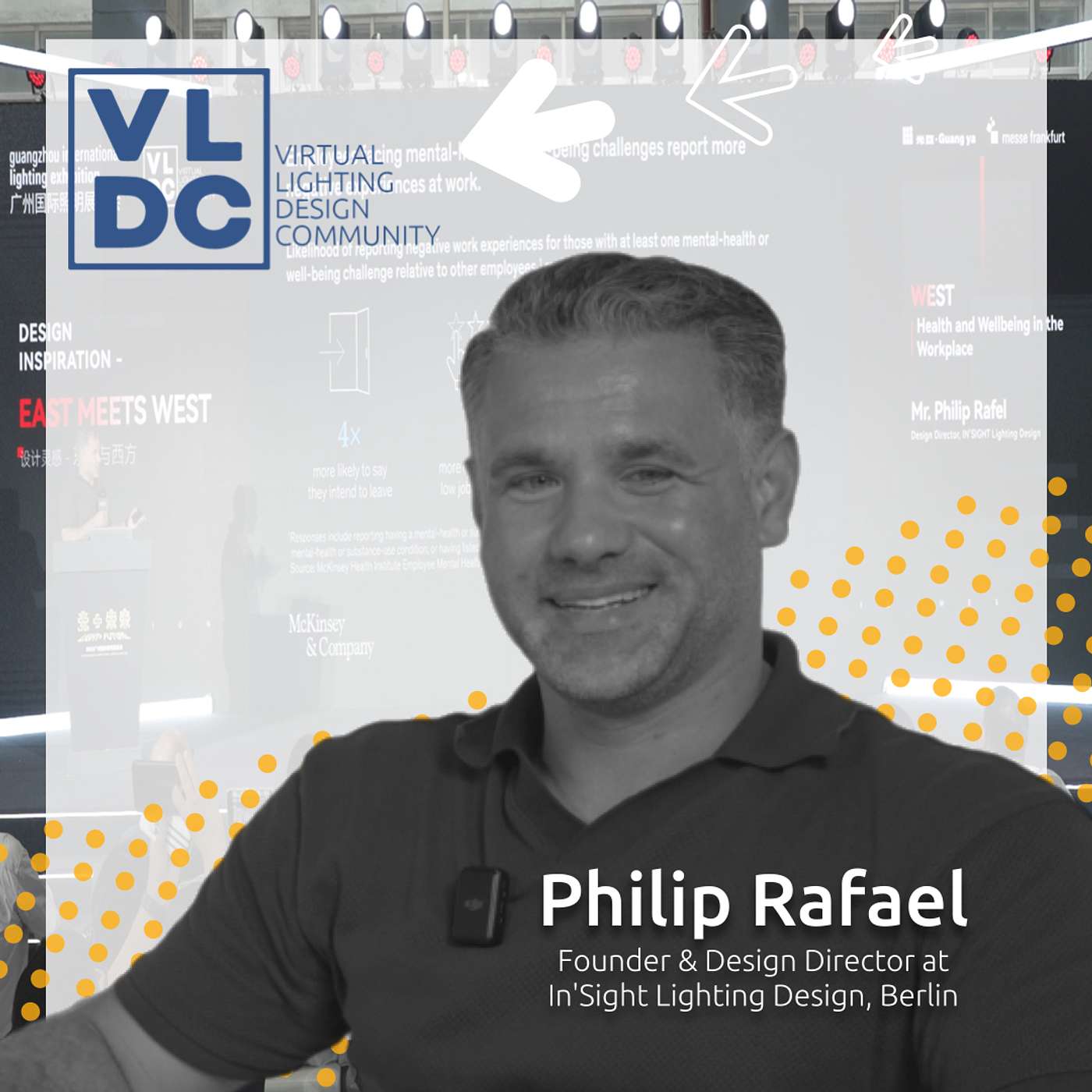
Send us Fan Mail Founder & Design Director at In'Sight Lighting Design, Philip Rafael explores a critical element often overlooked in workplace design: lighting. With over 18 years of global experience, Philip sheds light on how traditional lighting has prioritised productivity over well-being, sometimes to the detriment of employee health and job satisfaction. He explains how a shift in focus can lead to healthier, happier work environments by minimising negative lighting effects like glare and flicker. Lighting can be reimagined to support not just physical health but also mental, emotional, and social well-being, especially as hybrid offices become the norm. "Lighting for health and wellbeing needs to be an experience, providing a variety of environments that nurture our professional, personal, and physical needs." — Philip Rafael In this episode we go back a couple of years when Philip presented this topic at the Guangzhou International Lighting Exhibition 2023. It was certainly a memorable event and the topic is still very relevant and pertinent today. The presentation dived into the transformative power of lighting as a "supercharger" for diverse workplace needs. Philip discussed the importance of flexible and inclusive lighting environments that cater to both extroverts and introverts, advocating for the adoption of biophilic and multi-sensory designs, to name some of the highlights. The take home message included how these strategies can thrive even within conservative company cultures, ultimately creating dynamic spaces that encourage self-regulation and community connection. By integrating scientific criteria with innovative design, he aims to craft workspaces that genuinely nurture the health and well-being of today’s workforce. Aero Hospitality Lighting A leading provider of innovative and sustainable lighting solutions for the hospitality industry. Signify Lighting Academy Providing comprehensive and interactive lighting education and relevant educational resources. Disclaimer: This post contains affiliate links. If you make a purchase, I may receive a commission at no extra cost to you. Support the show Learn more about our community by visiting www.vld.community Follow us on Facebook, Instagram, and LinkedIn. If you enjoyed this episode and want to hear more like this, please signup, subscribe and would appreciate a 5-star review!
0:01We need to understand what health and well-being truly mean. You're not in a position to discuss health and well-being unless you're also looking at the workplace. It can be quite disastrous. We have eye strain, we have tiredness, we dock back postures to compensate for bad lighting, we get stress build-up, and that all leads to reduced productivity.
0:20and with that reduced productivity, we're not happy, and we ultimately just stopped going to work. And the reason people stopped going to work is because they don't feel well. They're essentially concluding that their health and well-being is being undermined by the workplace. What we need to provide is flexible lighting environments.
0:37more variation in lighting levels, more variation in brightness composition, then allow the person to move freely within those spaces. You actually need to come in with a design perspective to have a sort of more holistic approach, to look at the bigger picture and be more understanding on the variety of needs that a workplace may have.
1:07Hello again, and welcome to another episode of the Virtual Lighting Design Community, an online platform dedicated to the lighting industry for connecting people, enhancing skills, and sharing knowledge. For the first long-form episode of the podcast for 2025, we're going back a couple of years to revisit the Guangzhou International Lighting Exhibition, where the theme was lighting for health and wellbeing. Some of these presentations were previously unseen on the community, and we'd love to share a good one here with you all.
1:36In this keynote, Philip Raphael shares his knowledge specifically around the topic of designing lighting for workplace well-being. It's not just about physical health, but also about mental, emotional, and social well-being. A great listen right to the end with lots of takeaway concepts for the lighting designer. Philip is founder and design director at Insight Lighting Design, based in Berlin, Germany. There's already a great introduction at the beginning of the keynote, so we won't take too much time with that here.
2:04Before we get stuck into the episode, we'd love it if you could follow our channel, hit subscribe and share it with anyone who you think would be interested in being part of this lighting design community. This would certainly help us in delivering more great content and keep the community going. Last but not least, please do also visit vld.community and become a member of the community if you have not already done so. Now let's jump into the presentation with Philip Raphael.
2:34It's my pleasure now to introduce you to the next speaker, Philip Raphael.
2:56He's going to share with you his experience of lighting for health and well-being in the workplace. Philip is a highly experienced lighting designer with a passion for creating captivating lighting experiences with more than 18 years of expertise in hospitality, workplace, facade and landscape lighting. Philips has successfully executed projects across Europe, North Africa and Asia.
3:23He is the founder of his practice Inside Lighting Design, an international lighting design studio based in Berlin, Germany. In addition to his hands-on design work, Philip is also a passionate advocate for the lighting design profession. And he actively contributes to the lighting community through articles, publications, lectures, teaching engagements and international seminars. Please join your hands together for Philip Raphael. Thank you everyone for being here today.
3:53To not repeat the introduction, I would still like to discuss or share with you the principles of Insight Lighting Design. And effectively, what we do is to focus on creating lighting environments that can nurture or foster positive and memorable experiences. And this will come through in the presentation today.
4:20So we'll be discussing health and well-being in the workplace. And we need to start in the beginning. We need to understand what health and well-being truly means. And it is not just a question of our sort of medical, physical health, but it also looks into an individual's physical, mental, and social well-being. So it really is,
4:42a broader definition that considers physical health, but also considers aspects such as mental and emotional state. It looks at our social relationships. It tries to understand our overall satisfaction with life. And that truly is a broad definition. And once you understand that, you then understand that you're not in a position to discuss health and well-being unless you're
5:08Pardon that, unless you're also looking at the workplace. Now, work, we all do it, and it's fairly common knowledge that for the average workforce or person that is working, they spend around a third of their waking time in the workplace. So that really is a substantial amount of time. So it becomes critical that we look at how we spend this time
5:39Now, health in the workplace has been studied for a very long time originally, and that is really many decades ago. We started looking at health and well-being from the perspective of productivity. And frankly, it was more about health rather than well-being. It was understood as
5:59how health affected our performance, how much light did we need to perform a certain task, could we stay healthy while doing that task so that we can continue that task without getting tired. And even once we made advancements in science, such as the discovery of the third receptor, even then,