
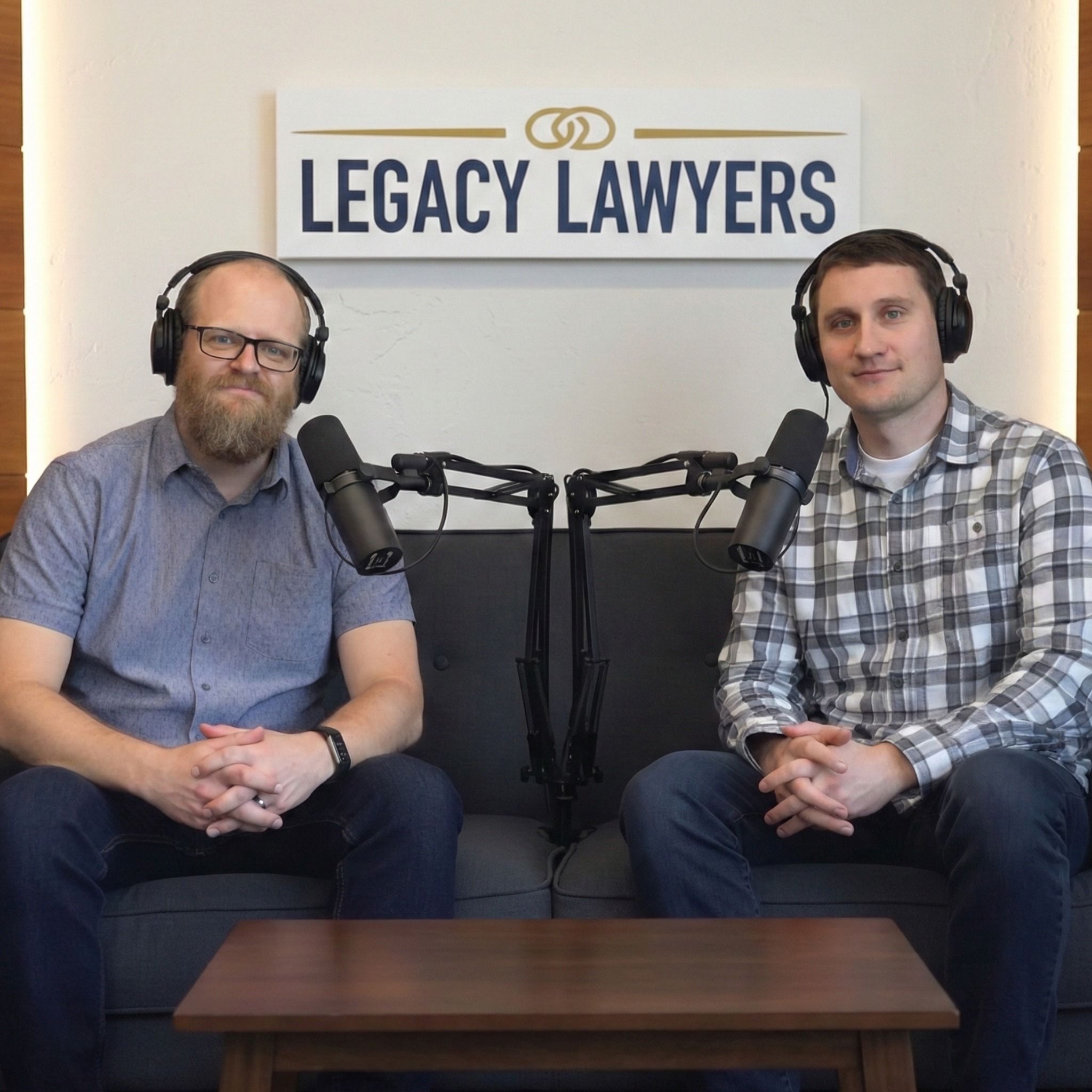
Legacy Lawyers · Voyant Legal, Mike Haslam, Nathan Croxford
An estimated 7.4 million Americans age 65 and older are living with Alzheimer's or dementia, about 1 in 9. Chances are good you know someone, and chances are also good their family didn't plan for how fast it can move. In this episode, Nathan Croxford and Taylor Stone explain what to put in place before a loved one loses the capacity to sign anything. They cover the two documents that matter most, why a name on a parent's bank account isn't a plan, how to choose between a springing and an immediate power of attorney, and why those documents still matter even if a court-supervised guardianship or conservatorship ends up being needed. Key Takeaways: The Closing Window: Cognitive decline can move from a little forgetfulness to a loss of capacity faster than most families expect. Once someone can't sign, the power of attorney is off the table and a court proceeding is the only path left. The Bank Account Shortcut: Adding your name to a parent's account may solve some problems, but it won't handle things like a retirement plan election, and a co-owner's own financial trouble can put a parent's money at risk. Springing vs. Immediate: A springing power of attorney requires proof of incapacity, usually a physician's letter. An immediate one lets your agent help on good days and bad days. Which fits depends on the family's situation. The Seatbelt and the Airbag: Even when documents don't prevent a later guardianship, the person you named gets top priority under the appointment statute, which can keep the process streamlined and out of family disputes. Nathan Croxford and Taylor Stone are practicing attorneys at Voyant Legal in Utah. This episode is for educational purposes only and does not constitute legal advice. Visit voyantlegal.com or call 801.951.0500.
speaker-1: Welcome everybody to another episode of the Legacy Lawyers Podcast. I am your host, Nathan Croxford, and joining me today is the distinguished and honorable Taylor Stone, an attorney, an officer of the court, and just a general all around good human being. speaker-0: That's kind of you to say it. Thank you, Nathan. speaker-1: Thanks for being with me today, Taylor. I think we're gonna talk about some legal topics. Right. speaker-0: Right. and sadly I know that you and I we both kind of enjoy having some of these conversations together, enjoy being on this podcast. Sadly, today's conversation is a little bit more serious in nature. I mean this is a law of course. speaker-1: Depends on how irreverent I decide to get, but yeah I agree. That's fair. No, we'll keep it we'll keep it professional because it is a a serious topic. So it is speaker-0: It is. So so I actually saw a I saw a statistic that actually came out here just recently, which is that here in twenty twenty-six there's an estimated seven point four million Americans ages sixty-five and older that are actually suffering from Alzheimer's and dementia. which means so a lot of people think, well, you know, 7.4 million, that's not a ton for our 300, you know, million plus here in the United States. However, that actually means for that age group, that's a one in nine people. chances are really good for a lot of our listeners, that's somebody that they know, right? Somebody that they know and care about who are in early stages, late stages of Alzheimer's. speaker-1: Well anybody with a grandparent. speaker-0: Yeah. Chances are really good. speaker-1: probably knows that probably know quite a few people in this category. And it's probably prevalent enough that it's not like we're want w like we're surprised when we hear about the next person that has it, right? Like speaker-0: Yeah. speaker-1: something we could go we could do a whole episode on like why on earth do we have seven point four million people suffering from this, but that's a topic for a a different type of professional on a different day. But it's it's a sad and devastating disease. it's also one that can have legal consequences that legal and financial and relational consequences that are that can be devastating. and therefore it's something that as a state and elder law attorneys that we're very interested in and that we are trained to deal with and that we spend a lot of our time working on. So before we go any further, let's just give our disclaimer that Taylor and I are both estate attorneys. but the purpose of our podcast is not to give you legal advice, it's to provide educational content that you can put to use either by researching on your own or by going to see a professional, which is the route we would always recommend that you take. Go see a professional who has the credentials, the training and the experience. All three of those are paramount. to be able to help you deal with a scenario that might involve a loved one. Who is facing us? speaker-0: No, well said Nathan. I think that when we look at that particular number at seven point four million Americans, we're also very cognizant of the nearly thirteen million then other Americans who are helping, usually unpaid, to support those individuals. speaker-1: Yeah, those are the people that are calling us on a typic daily basis because they waited too long, or mom or dad was too stubborn, or a myriad of reasons why there's no pre planning in place to account for this kind of a thing when it starts to happen. And I think one thing that I'll say about Kind of why and how that happens is because I don't think that the average person understands until they've gone through this with someone how quickly this can come on. Yeah. You can go from having, yeah, mom or dad is seeming to seeming to get more forgetful. seems like there might be something going on, and then you blink and We've got a full blown case of cognitive decline that we're too late to do preventative and now we're in kind of crisis mode. So that's really why we want to talk about this is I think that this is a I don't think that this is talked about enough, this aspect of it. I think we hear about the disease a lot. We hear about you know what people are trying to do to to prevent it and combat it and treat it, but we don't hear about the the legal side of it and and what can be done in advance. So that's that's what we deal in every day is we're trying to help people avoid problems before they arise. speaker-0: Well and Nathan, I think that you've really kind of illustrated it well to be able to say is that this is a process. It's not just a real quick fix and then your problems are done kind of a thing, right? Similar to when we talk about a lot of our estate planning. It's a this is the circumstances for this is a good solution for your current circumstances to solve all of these problems. But as time goes on, we make sure that our estate plan can kind of grow with that. But then other times that there's other things that we need to do. In when it comes to people losing capacity. especially in this really insidious way of you know that's really kind of the way that I like to think about this disease is that speaker-1: For sure. speaker-0: it's it it's cruel in the way that it tries to destroy everything that was so amazing and so remarkable about the individual who it affects. And then it destroys those relationships. speaker-1: So well and that's what I was gonna say is it's not only cruel to the person to the that's suffering from it, in a way it's almost more cruel to the loved ones around them when they're watching this person that, you know, was their world when they were little kids and has done so much for them and is so much of part of the foundation that their lives and personalities are built on. be reduced to, you know, at the extremes, just a shell of the person that they used to be and maybe not even the same person. Like that's that's one thing that I think people are most surprised about is that they're like, that's not even my mom anymore. Yeah. like their personality can change, their psych psychiatric and psychological problems can re can arise. I have a family member who is dealing with this who became very O C D as a result of of this and so that's created a whole new dynamic around being in her house and and things of that nature. So it it's super cruel to to the family members and so part of like Cushioning the blow of having this happen is let's already have the legal mechanisms in place to make this as easy as possible in every other way because the emotional side of it and just the sheer care aspect of it is going to be overwhelming for the families. That's just the bottom line. speaker-0: Mm. No, it's so true. I and I think that talking about it in that way, I think that it's trying to address it appropriately because you're saying that as somebody is starting to lose that capacity, we have kind of stages of care that we can provide, right? And we have documents that are associated with that. And then as time goes on, as things maybe get more severe, then we kind of have the the ultimate solutions that you have, like guardianship or conservatorship. And we're we're trying to make sure that this is clear for all of our listeners that because you set up documents, doesn't mean that the guardianship and conservatorship is off the table, right? It's to say that look for right now here's kind of what you can put together and this helps solve a lot of the problems and this could be perfect for the rest of time. But then if things get bad, here's then the next solution and why it kind of you get into this you know other other solution to kind of some of the other problems that you're getting in. speaker-1: Yeah, and we'll get into this, but just to kind of expand on that, doing so one of the things we're going to talk about here in a in a bit, part of the document set that we're that we're gonna discuss is durable a general durable power of attorney and an advanced health care directive. And Taylor's absolutely correct that just having those two documents and let's add a a trust, a trust that accounts for their assets and and helping avoid probate and maybe doing some long term or some pre-planning for long term care. Even having those even though having those documents won't necessarily take the need for a a later guardianship or c and conservatorship off the table, it will make putting that guardianship and conserv conservatorship in place much easier, more streamlined, less subject to family infighting, objections, things of that nature. So we've kind of covered this in an abstract way. Let's maybe start talking about the concrete and you know the the actual mechanics of of what this looks like to plan for this. Absolutely speaker-0: The the kind of main two documents that we're talking about right here at the outset when it comes to I'm trying to make sure that I'm providing for mom or dad, right, is I they need to have at least the capacity to draft what's called a power of attorney. So this is a general durable power of attorney. This means that I can step in on their behalf to access bank accounts, I can make business transactions, I can do all of those things for that individual. Okay, so that's Kind of the first one. That's on the it's on that financial side. I can make legal decisions for them, right? When it comes to any of their finances and any of their assets. The other document then would be an advanced health care directive. Very similar. I'm assigning who's going to act as my agent. But this is for healthcare. They're going to help make those health care decisions. Now we all know, too, that I have what my decisions are already are concerning all of these things. And these people are just going to make sure that those things are being accomplished. They're being executed. They're doing it all for me. They're not coming in and then stealing my money. They're not coming in and just, you know, making all sorts of bizarre healthcare decisions for me, anything like that. I've given my guidance and as I'm starting to lose that capacity, they're able to make those decisions for me. speaker-1: Yeah. and the I think one of the important thing one of the important points that you mentioned but we should maybe expand on is that you said that mom or dad or loved one who were trying to do this planning for in advance, they need to have the capacity to sign those documents. so what that that's a that's a nice way of saying don't put this off. I think one of the things that I've noticed a lot in the dozens and dozens and maybe hundreds of cases that I've dealt with where a client's loved one or a client has lost capacity is how quickly you go from a little bit of forgetfulness to a full blown scenario where now they don't have the capacity to handle their own legal or financial affairs and they also don't have testamentary capacity to be able to sign legal documents to a point, you know, to to put those people in place without court guidance. And at that point, if if we let it go too long, you cannot you know, I get peop we get calls all the time where it's like, I need a power of attorney for my my mom and we ask excuse me more questions And what we find out is that that person has long since lost the capacity to to sign those documents. So at that point, we we don't even have that option anymore. That those tools are are now off the table and we have to go directly to a court proceeding to get guardianship and conservatorship. So don't don't delay this. This is something every adult human being should have. And to be clear, this you know, dementia and Alzheimer's is is one way you get there, but this could happen to anybody. We're all one accident or one really severe illness away from being in a scenario where we need this kind of thing. So yeah, our our topic today is cognitive decline, dementia Alzheimer's, but there's there are other ways that you get in a position where you need these things. speaker-0: No absolutely. As as we're starting to look through this, I mean it's really this idea too, especially you've kind of touched on it as well. When we talk about getting a power of attorney, a lot of I know that I've had some people who come in and say, Well, I I don't need a power of attorney, I don't need a financial document or a document that allows me to access mom or dad's finances because I put my name on their bank account. So, you know, that solves all of those problems, right? speaker-1: Well, that solves one problem, maybe. speaker-0: Yeah, exactly right. speaker-1: Maybe if maybe maybe several. Having access to be able to help them with their finances probably solves a lot of problems, but not all of them. if for example a legal let's say they have a retirement plan and some sort of an election on their retirement plan needs to be made and they need to sign for it and they're unable to do so Having your name on their bank account is not gonna solve that problem. Having a well drafted general durable power of attorney is going to solve that problem. speaker-0: And and especially too back to the idea of well I just put my name on you know mom and dad's accounts. Well now usually in the eyes of the law that is an account that you own. So hey if you're now having financial issues, now if you get into a car accident and it's your fault, now that other side can now access mom's account because I put my name on her account. Yeah. speaker-1: Yeah, there are definitely downsides. There are definitely downsides to doing that. that's that's what we would call a shortcut planning technique. Go put your name on a on an account. That's not to say we don't ever counsel people to do that. There are times where we'll put you know, as we're helping a client put their power of attorney and healthcare directive in place, we'll suggest, you know, it might be a good idea for you to take that power of attorney after it's been drafted to the bank and have them add you as an a as a an attorney in fact on their account. So an an an a pa a power of attorney on their account or make make make you an authorized user as opposed to just slapping your name on as a co owner. speaker-0: Yeah. No. Great great points there. I I know as so also I wanna make sure that we touch on this too. A lot of people say, Well, I have a power of attorney for mom or dad, but it's not immediate. It's just on their incapacity. That's the best thing to do, right? Because I have to then well I mean, as soon as they're incapacitated, then I can have access to that account. Which do you think would be better? To wait until they have capacity or to do it immediately. speaker-1: Well, it's I I guess my answer is that every single one of these cases is going to be very fact dependent. It's a case by case thing. So whether or not a loved one should have an immediate power of attorney. So let's just describe the difference. an immediate power of attorney means that I've named an agent to act as my power my my attorney in fact, which is the legal term, my agent under a power of attorney. But I've said I only want them to be able to do that in the event that I'm incapacitated. That is what we call a springing power of attorney, meaning the the powers in that document spring into existence when the triggering event of incapacitation occurs. the problem is that there has to be some proof of the incapacitation. You don't get to be you the child. you, the loved one, doesn't get to be the judge of when someone's power of attorney has sprung and you now have those powers. That's gonna have to be a an examination by a physician, a letter written indicating that they have lost the ability to manage their own financial and legal affairs safely. At that point now those powers have sprung into existence. On the other hand, an immediate power of attorney is one where I, as the person who is executing that document and naming an agent, I've said, I want this specific individual or I want all of the individuals I've named in the successorship, I want them to have immediate powers to do those things, even though I'm not yet incapacitated. we see this a lot, like I I would say for the most part. somebody that's not having any kind of cognitive problem, their their power of attorney should probably be springing. And that's because there is a potential for abuse with these documents. You don't wanna just like it's a it it's a a pretty serious proposition to to hand over you know immediate powers on a on a power of attorney. And I think we have an episode, it looks like episode ninety two maybe. Right. We talked about power of abuse of powers of attorney. So so I would say for the most part having the springing is is gonna be the best bet. Now the times where we use the immediate are are when, for example, we have a loved one, you know, we have a client who is is currently experiencing some early cognitive decline. And just to as a side note, I think we need to point out having a diagnosis of dementia or Alzheimer's, having some mild initial symptoms does not mean that that the person is incapable of executing these documents. it we do have to be careful and there's kind of a continuum where we go from, yeah, we've got a diagnosis and we have a stage one type of a situation to, you know, now we're in a very extreme or or we can't have a a coherent conversation with this person. They wouldn't remember from five minutes ago what what we were talking about, nor would they understand what what's being done. We're beyond that point. but when we have a a client come in, generally this is the time when we were contacted by their children and they're saying, Mom is struggling, we'd like to get some things in place. The discussion we have with the client and with their loved ones at that point, if we've been authorized to talk with the loved ones, is probably a good idea to make this an immediate power of attorney, meaning we want to be able to skip that step of needing to get a a doctor's certification and by making it immediate. mom can have a good day and then she can have a few bad days. And even on the bad days we can be out helping her get some things done that she would otherwise need to be doing on her on her own, right? Or with assistance. So that's kind of the analysis of Should it be a springing or should it be an immediate? It's gonna depend on the circumstances. speaker-0: Like most things for us, right? It's gonna depend on the circumstances. speaker-1: Everything. Every case. Right. speaker-0: And I I want to ensure also that this is clear as we kind of referenced it before, that just because we have those documents in place, mom and dad come in, they've they got those together when they had, you know, complete capacity, there's no issues. Now let's referring back to specifically the Alzheimer's and dementia. One of the one of the many harsh aspects of this is usually paranoia. And so say that I now have this for my parents. I have power of attorney, I have an advanced health care directive for them as well, so I can make financial as well as health care decisions. Well, one of the problems with dimension Alzheimer's is then I'm trying to help mom pay bills and she starts to say, Wait a minute, you're stealing my money. You have access to my money? How you can't have access to my money. I never authorized that. I have the documents that say that you forged those and the paranoia continues, it begins, right? With them starting to lose those things. Real big issue that we've run into is a lot of these individuals then going in and saying, usually it's the children, right? The one who has who's acting as that attorney in fact, or as that healthcare agent or that financial agent before their parents, them coming to us and saying, Well, I have power of attorney, but mom thinks I'm stealing everything. So I I can't do this anymore. What should I do? speaker-1: Yeah, and so sorry I didn't mean to cut you off, but yeah, so I mean there are a couple things to keep in mind, there are quite a few things to keep in mind, we'll touch on One is a power of attorney and a health care directive are both revocable documents. Yeah. So as mom and and so I guess what we're trying to say is we've seen different types of reactions in clients and their loved ones To having this type of a disorder. Some are very they're they're calm, they're they maybe get a little bit more docile than they used to be. they're very open to suggestions, they can be easily manipulated, they're not gonna be the type that's gonna go out and necessarily revoke that document or put up a fight, right? In which case I know it sounds bad, but that makes it easier to to help them, because they're more cooperative, right? But then you have the kind that you're talking about where somebody is very paranoid, they also are in really good physical health, so they're able to still drive, they're able to still do all the all the other things. They could go into the bank tomorrow and say, I've revoked my power of attorney and I want that That dirt bag son of mine off of my bank accounts, he's stealing my money. And a bank representative hearing that, they're not gonna say, Well, ma'am, before we take your word for that, we need to conduct a medical examination and make sure that you're in the right mind. No, they're gonna hear somebody's trying to steal their money and they're gonna say, Well, let's lock up your account. So so I we don't we don't wanna give the false impression that that putting a a trust and a power of attorney and a healthcare directive in place, all good things, all things that should be done no matter what, that doesn't necessarily guarantee that we won't need a more invasive approach later, such as a guardianship or a conservatorship. so just keep that in mind because There are some families, clients that will do this work for and they will never need a guardianship or a conservatorship and they may have the most they may have the most, you know, profound case of this illness that you could possibly have and it's just not gonna be a problem. So but but for every one of those there's at least one or more that that you're gonna eventually grow out of or yeah, like the situation is gonna change enough that the power of attorney or the healthcare directive is not going to be enough anymore. speaker-0: Well and I think that is that's really the reason, Nathan, you know this too, is that this is the reason why we thought this was so prevalent and why we wanted to put together a podcast on it, is because oftentimes people will just think, Well, I have those documents ready. Why there should never be then a reason why I would even consider doing a guardianship or a conservatorship. And we want to make sure that it's it's abundantly clear to you that there might also be circumstances where that would be required. And it's just that what here's something that's actually nice under the statute though, having those documents In place, that then gives you the highest priority when it comes to becoming a guardian or a conservator. Is because if you've already done that pre-planning, while mom or dad had the wherewithal, the cognition to be able to say, Yes, I want these people to step into this role, when it then comes to that moment when they have to go and stand before the judge to be able to get that guardianship or conservatorship, the judge is able to say, Look, sir or ma'am, I know that it might be difficult right now, but we do have have a record that you said that this was going to be okay for these individuals to step into that role. And that way you're not fighting brother and sister, mom and dad, whomever else, to see who should be in that in that capacity or to be that agent for them. Nope, they've already said that you could be in that role. And even though the paranoia's now happened or any of those things, you at least kind of have that higher priority in front of a court to say, no, I can be that person that they've already chosen to be able to step into that. speaker-1: Yeah, and I think just to clarify, when Taylor mentions priority, what he's talking about is a statute that lays out the priority of appointment, meaning who has who in an and in what order has the right to be to act in that capacity for any given person. And the first person at the top of the list in that statute that will always Trump everyone else is somebody who has been nominated by that person when they had capacity in a document like a power of attorney or a a healthcare directive. So the fact that you know, we're pointing out that having these documents doesn't necessarily prevent a need for a later guardianship and conservatorship, that's that's a given in s And what I mean by that is the documents that we're talking about actually contemplate that that might happen and accounts for that by allowing the person to name an individual or individuals in a set situation. So we'll have a conversation with a client who's setting up a power of attorney and a healthcare directive. And one of the questions we'll ask them as we're designing those documents is, okay. if you ever needed guardianship or conservatorship, because we don't have a crystal ball, we don't know if you'll you'll be one that needs one or not. But if you do need one, who would you choose as your first choice agent? And who would you choose as a backup? And who would you who would you choose as a second backup? So the documents I don't want people to hear this and go, well if there's still a chance I might need a guardianship or conservatorship later then I don't even want to waste time, money and and and you know, attention on putting them in place because they're not gonna do any good. No, they they in some cases they save the day. In some cases they're all that's needed. In some cases mom or dad goes to their grave and never needs the next the next step. But in the event that that they're not one of those people, we should absolutely still do those documents because it makes moving to that next step so much easier. So you would have, let's say you had a s a sibling, so you're Taylor, you're you're named as your parents first choice they probably named each other as their first choice agents, right? But in the event that it's not a spouse because that spouse has either died or lost capacity themselves or just two elderly and frail to do it. I'm putting you on the spot. Are you the first choice agent? speaker-0: I think so, right, mom and dad. I think that I am the first they not listening to this. Why would you guys listen to this? speaker-1: I d I did Taylor's parents' planning, so speaker-0: That's right. Didn't I? No, you did. It was for my in laws. speaker-1: Your in laws, that's right. That's right. Yep. And they were hilarious. And they actually gave us they gave us a a term that I now use a a lot, which is the new boo clause. So your father in law was hilarious. He's like we don't we don't want a new boo, meaning a spouse dies and another suitor comes into the picture. He calls it so I now when I'm talking to clients will say, This is the new boo clause. We don't want a new boo coming in and and messing things up. Anyway, if if you are the first choice, which you're probably not, it's probably your wife and your and your p in laws planning. Or one of her siblings. But let's say that she was named as the first choice agent. Her brother, for whatever reason, thinks it should be him and that he's doing a much better job looking out for mom and dad's interests. This has never happened, by the way. Never has a sibling challenged in court a document like this. Never. Yeah. spoiler. Almost every case involves this in some fashion. So putting that little concern to bed will be an easy task for the judge when they're looking at a power of attorney that's or a healthcare directive that's been properly drafted, properly executed, and lays out the priority of appointment because at that point he can say, Mr. Brother, I appreciate that you care about your parents and I'm sure you do a great job, but the fact of the matter is is that you are not the person that your parents chose. I'm looking at the document right here that says that it's your sister, and it is the order of the court today that your sister is hereby appointed as the guardian and conservator for your parent. And that will be all. So it's open and shut at that point, except for maybe that one time that you had that judge go rogue and but but that's a story for another day. I guess I guess the the moral of that story is there are no guarantees in life. But that doesn't mean we shouldn't take Precautions we should because most judges are gonna follow the statute. The vast, vast, vast majority are gonna follow the statute and appoint the right person. speaker-0: 'Cause no the j no judge wants to be the judge who doesn't follow the law. Like I I again I at least I speaker-1: I don't right. I don't get it. I don't get it. speaker-0: Well, here in here kind of at the end there, Nathan, I like to think about truly having those documents in place, truly like a seatbelt, right? Or like having a guardianship is that airbag, right? That speaker-1: That's a great analogy. speaker-0: that seat belt for sure is going to solve kind of a lot of your major problems as kind of time's going on. That's your power of attorney and advanced health care directive. But if it comes to it, having that airbag in place, that's gonna be a great one that'll show up, you know, if needed in a real emergency. speaker-1: But that that's actually a brilliant analogy, I have to say. Like brilliant. Because we don't we don't go in car shopping and say, Yeah, I don't want the seat belts and the and the airbags. Like I'm what are speaker-0: I'm not gonna need it. speaker-1: the odds? What are the odds? And even if I am in an accident, it's not gonna be the kind where my face gets violently slammed into the steering wheel or the dashboard. no, we don't do that. We buy the car with the protections built into it because we never know what kind of accident we're gonna be in. Right. We just don't. Same thing is true here. Build the protections, buy the vehicle the legal vehicles that have the protections built into so that when if slash when you you do get a an airbag in your face instead of a steering wheel, or you get held into your seat rather than thrown through the windshield. and we've just seen way too many cases of people legally getting their heads slammed into the steering wheel or being thrown through the windshield that we just don't want to see it happen to anyb anybody else. So that's why our message is always please find a trusted advisor. work with a law firm that focuses on holistic, you know, planning and and that deals with all of these issues and get it all squared away and do it at a time when your loved one has full capacity and then as soon as your loved ones is done are done doing this, do it for yourself. speaker-0: Well and I think that we've always said it, Nathan, the best time to have done good planning was yesterday and the second best time is today. So now before mom s or dad starts to say, you know what, I'm just not paying my bills. I'm just not able to keep up with that. I can't find am I able to drive anymore? Am I any of those things before all of that slipping starts? Let's just get it done. Let's get the seatbelt on. speaker-1: Yeah, I mean, we're coming up on some holidays where we get phone calls right after Thanksgiving. And the phone call is we live out of state. We came to mom's for Thanksgiving and found out she's been eating cat food for the last six months and she hasn't bathed and we need help. And they're already in a mess, right? So so it it it hap it can happen so fast. so really don't wait until mom's eating cat food to to do this. speaker-0: Yeah. Yeah. Reach out beforehand. Reach out to somebody. Get that spelled on. speaker-1: And if you'd like to reach if you'd like to reach out to us, if you're in the area Western United States, we are can be found at voyantlegal.com. this podcast can be found on all the major podcasting platforms. If you got anything out of this episode today, please share it with someone that you know, please give us a a review on our podcast. We'd love any of those things. And unless you have anything else, Taylor, I think we're gonna wrap it for today. speaker-0: Sounds good to me. No. speaker-1: Thanks everybody. We'll catch you on the next one. speaker-0: See anything. speaker-1: See ya Taylor.