
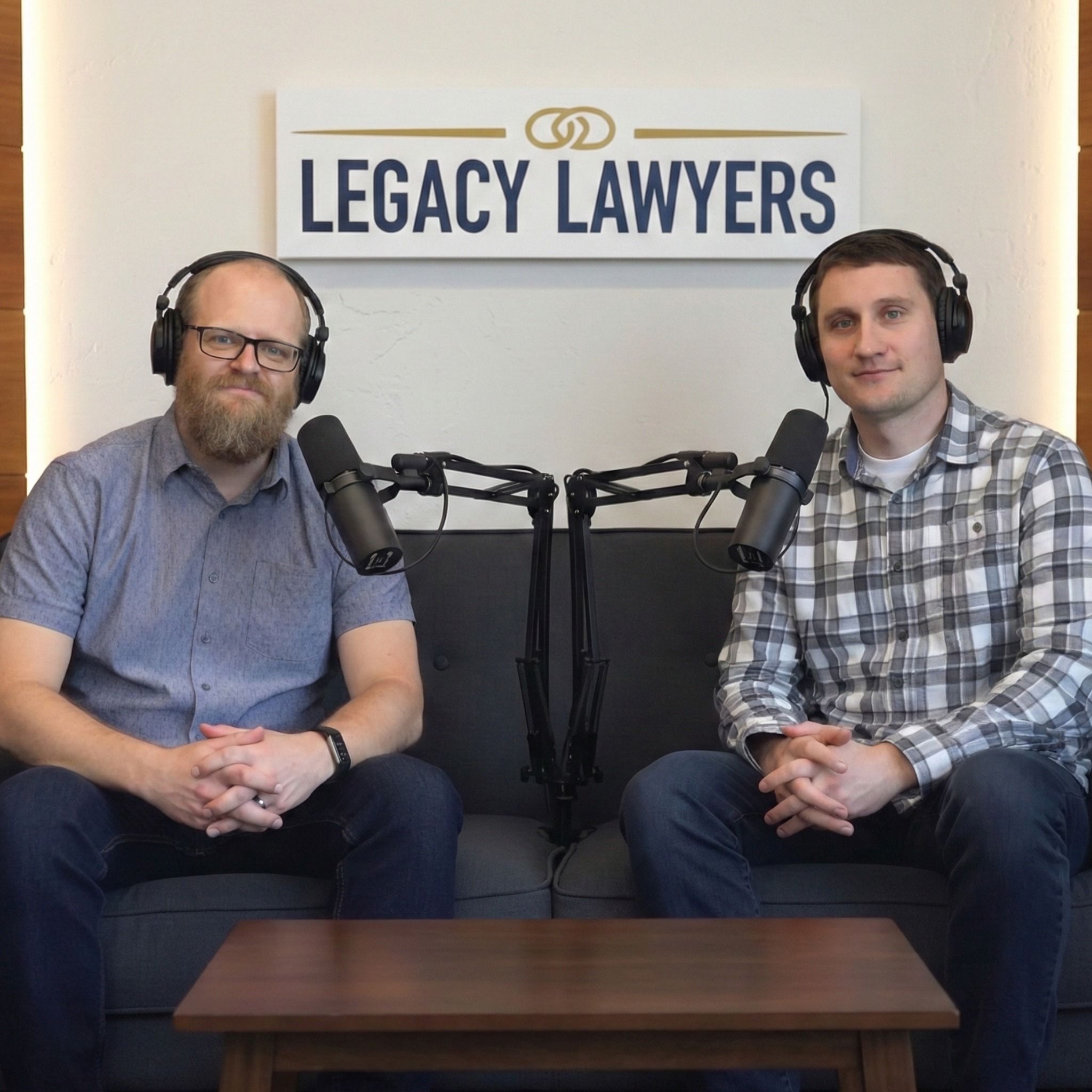
Legacy Lawyers · Voyant Legal, Mike Haslam, Nathan Croxford
Leaving everything to your spouse and "trusting them to do right by your kids" isn't a plan—it's a wish. In a blended family, a standard will is a ticking time bomb. Under Utah law, a surviving spouse who inherits outright has full legal ownership and can completely disinherit your biological children, intentionally or not. In this episode, Michael Haslam and Taylor Stone break down the exact tools needed to guarantee financial security for your spouse and protect your children's inheritance. Key Takeaways: The Remarriage Risk: How remarriage can automatically revoke your prior will under Utah Code § 75-2-301. The QTIP Trust: The single most important tool to provide lifetime income for a spouse while locking in the principal for your biological kids. Neutral Trustees: Why naming a spouse as sole trustee triggers family conflict. Three Real Scenarios: Walkthroughs of classic failures involving remarriage, stepchild friction, and special needs asset disqualification.
Michael Haslam: Hi everyone, welcome to the Legacy Lawyer podcast. I am Mike Haslam and I am here with Taylor Stone, one of the amazing attorneys in our office. Taylor Stone: Hi everybody. An amazing attorney. Everybody heard that, right? This is being recorded. Hey everybody. Hey there, Mike. Michael Haslam: Hi Taylor. Well, today we're going to touch on a touchy subject. Taylor Stone: Yeah, that's way to say that. Yeah, I think so. ⁓ I think this one actually would be best if we kind of ran through a little bit of a scenario there, Maybe you'd, if you'd allow me, my man. ⁓ Michael Haslam: I love. Taylor Stone: So here's kind of a circumstance, and sadly this is one that doesn't seem like it's too much of an exception, but it's something that kind of happens a lot. In fact, quite a lot nowadays. ⁓ Let's say that we have a man with two adult children ⁓ from his first marriage. Potentially his other spouse has passed away or no, they've ⁓ been divorced, something like that. But he has two children from that previous marriage. Then he remarries. Happens, right? ⁓ New spouse has two children of her own. So now we have two individuals, they each have two kids of their own, right? He of course cares about that new spouse so he wants to take care of that new spouse. But he also wants to take care of his own kids, something that makes sense, right? So he of course leaves everything to his new spouse outright with kind of this trust, this belief, excuse me, he has this belief that hey, new spouse is going to do the right thing and take care of his kids when he passes away. Michael Haslam: So the idea is he just wants to leave everything to his second spouse. And then when they die, it's just all gonna go to his kids. That's his expectation. Taylor Stone: Yeah, and that's the hope, right? He just says, hey, you know what? We love each other. You know how I feel about my kids. Go ahead and make sure that my kids are taken care of. Then, of course, husband passes away, right? So now we have new spouse, two kids from husband who passed away, and new spouse has two other kids, and then that spouse remarries. chances are real good, she might be thinking, hey, maybe I'll help out those other kids, but usually that she'll be helping out her own kids, right? And maybe even leaving those other funds to now the new spouse that she now has, right? Michael Haslam: there's just like ⁓ things, ⁓ maybe not 100, but 50, at least 50 things that can happen ⁓ the first ⁓ dies, right? So after he passes away, ⁓ new wife, right, you said could get remarried, could have a falling out with the kids, ⁓ fall for a scam. That's a big one. And the list goes on, right? ⁓ the end result is... Taylor Stone: ⁓ for sure. Yeah. Jeez yeah. Michael Haslam: His wish that whatever wasn't needed by his spouse goes to his kids does not happen. Taylor Stone: Yeah, exactly right. And mean, well intentioned too. I mean, the husband, he loves the new wife, right? And he wants to make sure that his kids are being provided for, without some sort of tool in place? That's just usually not the way that those kinds of things go, right? And I think that we even have, and I mean, a lot of people might think, well, this is kind of, this is an exception or something like that. But honestly, I think that we have over 40 % of all families, or blended families right now in the US, roughly, I mean, depending on who you ask. I mean, almost half, right, of families or blended families, and especially remarried families with stepchildren, I think it's more than half, maybe 60-ish percent of that. Yeah, so I mean, the numbers are there. Michael Haslam: And then if you want to take it a first step further, so if you listen to this and you're in your first marriage and you're like, I don't know if this applies to me, pause, big pause button, stop. So this actually applies a lot when our clients pass in their 70s and 80s, a surviving spouse gets remarried. So there wasn't like this, it wasn't a blended marriage. Taylor Stone: here. Michael Haslam: blended family, wasn't a second marriage, but it still became one later in the process. So what we're going to talk about applies to everybody who is married and they're going to leave everything to their spouse. And then the question is what could happen next that could interfere with the estate plan. We're going to talk mostly in the blended family context, but I guess what I'm saying is you don't think you are a blended family, but you probably are at some because later on, if your spouse remarries, you just became a blended family. ⁓ Taylor Stone: Yeah. And that's, you bring up a great point Mike. A lot of times we think about our, know, we're in a different stage of life. We have young kids, you know, we're just starting out and things like that. And we're not actually anticipating that anything really would happen to us right now, right? I mean, we don't really hear even death knocking on the door even for our parents usually, right? At this stage in the game. However, I mean, I know I don't know the next time that I'll be coming capacitated or even when I would pass away. And because of that, I want to make sure that things are kind of ready on the off chance like this that something like this would happen, right? Thank Michael Haslam: So some of these strategies are something to consider even if you don't have a blended family right now. Taylor Stone: Worth a listen, that's all we're saying. Just go ahead and listen to us. You guys can listen, it's fine. Michael Haslam: Just think about it. Think about it. So what's the answer then? You just explained, right? ⁓ Our fictitious client or our example here, his hope was that everything would go to his kids, but it didn't. got disreeled because of a second marriage or falling out with the kids or whatever it was. So what is the answer? Do we just... give up or do we think we got a good path? Taylor Stone: Well, I think even before we give the answer to this little quiz then, we should probably go with our disclaimer, right? So ⁓ our disclaimer, see if I can get it right there, Mike. ⁓ Michael Haslam and myself, Taylor Stone, we are both practicing attorneys. However, we are not your attorney. The information that we are providing you at this time ⁓ is just for education and entertainment purposes, right? mean, looking at this face, how is this not just for entertainment, right? ⁓ And so don't take this, of course, as legal advice for your particular situation. By all means, seek competent legal counsel. And if anything, you can come in and talk to Mike and myself. Michael Haslam: you Taylor Stone: and we can see if we can answer some questions for you and help you solve some of these problems that you'd be having. Did I miss anything Mike? Perfect he says. ⁓ Michael Haslam: We're always happy to help. Taylor Stone: So so a solution to this there's actually a few solutions that that we have that we can kind of talk you through and that's what we want to be able to provide to you is that there are some solutions very first We would always say put together an estate plan, right? I'm sure a lot of people will think well in a state plan. That's pretty broad But what does that actually mean in this context an estate plan probably shouldn't just be a will that's for sure, right? And in fact, the only kind of a will we'd include is kind of something called a poor over will but let's really dive into what we really call just a trust. In this particular context, you're going to want to set up a trust with some very, very specific provisions. That's one of the wonderful things about a trust is that it allows you to be able to have prolonged distributions of assets, especially as the landscape of your family life usually changes or those family relationships change. One of the particular things that you could put together is something we like to include in situations like this, especially with blended family is we like to include something that at least in all the legalese is they call a qualified term inable ⁓ interest property trust or a q-tip trust or provisions that actually are very similar to a q-tip trust I'm sure all of you are thinking is this sponsored by q-tip is that no Michael Haslam: Yeah. Yes. Yeah. I know when I hear when I hear of Q-tip trust, I'm always like that. That's weird. So we usually will just yeah, we'll just call it a surviving spouse's trust or a survivor's trust. I like survivors trust rolls off the tongue. It's short or sometimes a family trust. Taylor Stone: That's not a thing. That can't be a thing. Yeah, that's a lot better. Nice. I think it's descriptive, which is the best part, right? It's a trust that's set up really for your surviving spouse. ⁓ I heard an analogy just recently for a trust kind of like this, and the example that was given was of an orchard, right? So let's imagine that ⁓ this fictitious character that we have, let's call him Tom, let's say that that was our client, Tom, he has his kids, he has this orchard. Now, ⁓ this kind of trust that we'd be setting up, imagine that orchard, we can sell all of those apples on behalf of the surviving spouse. She's being taken care of. Great, selling those apples, she's just enjoying the income from that, and for very specific reasons, she can receive those. However, in this trust, the kids still own the orchard. So his children still own that orchard, new spouse, she gets the income from those apples. Right up until then, she passes away, then they get everything. Kind of a nice example, right? Michael Haslam: like it. Yeah. So in that example, do the kids, what prevents the kids from selling the orchard and. Taylor Stone: No, that's a great question. Yeah. So, what was that? Michael Haslam: saying, sorry, you don't, can't, we sold it. Yeah, what prevents the kids from selling that orchard while the spouse is still living and needs the income or the apples? Taylor Stone: Yeah, so the language that, again, what prevents it? Really good drafting. That's what included there. Michael Haslam: Well, the trust, the concept of a trust, That's, I mean, it's not just the orchard. It's what owns the orchard, right? And it's truly not the kids. Taylor Stone: Right. Right. Mm-mm. No, so it would be actually this document itself that we'd be putting together. This trust itself would actually have that very provision in it, meaning it would say, okay, we're holding this orchard, income or any other assets that we have that are generating income would be able to be provided for or be providing for this individual, this new spouse. And then on her passing, then we make sure that the rest of that is able to go to the children. So that way, look, we're providing for new spouse while she's alive making sure she's being taken care of and then the rest of it is being saved still to be able to go to those children on her passing. So that kind of takes away or at least solves that kind of initial problem of well maybe she's just gonna provide for her own kids. Well if she's only getting the income and then when she passes away it automatically comes to ⁓ other kids then it looks like we solved just that little bit of a problem. Can you think of a wrinkle in there Mike? ⁓ can. ⁓ Michael Haslam: I can. So I like it. I like it. We have the assets in this survivor's trust. ⁓ The assets generate income that goes to the surviving spouse. But the surviving spouse ⁓ doesn't have the ability really to take those assets out of the trust and go sell the orchard. You can't sell the orchard. Yeah. Taylor Stone: So she can't sell the orchard. There you go, I just gonna say. Michael Haslam: So that ensures that when she does pass and she no longer needs the income from the trust, the kids get their inheritance, in this case, the orchard. So what if, and this happened, I just read the article here in Utah, we had a weird winter and spring. And so what if the trees don't produce that year? We had the late frost. No fruit, no fruit. Taylor Stone: Exactly. Right. Yeah. Late frost, geez, early frost. Like, man, was nuts. Michael Haslam: Or like 10 frosts. so ⁓ heat up, cool down, heat up, down. So is the spouse, yeah. Did we just punk the spouses? Are they stuck? Taylor Stone: Yeah Geez, great question. So I think in this particular instance, we would make sure, and I think that again, this comes down to kind of that good drafting. We would ensure then in a trust, in that particular trust, in the off chance that there isn't any of this other income that's being able to be provided, that the trustees, the ones who are managing this trust, right, we're kind of getting away from our analogy now, they're the ones who would be able to use some of those assets to still continue to provide for that particular spouse. ⁓ ⁓ sure that they're able to ⁓ provide for her while she's still alive. And then again, to still ensure that there is a remainder to be able to come to the children if it comes to that. Michael Haslam: So the trustee of the trust could go sell one of the 20 acres of the orchard and say, hey, we didn't get income this year, so we had to sell some of the farm to make sure the spouse is still taken care of. Taylor Stone: Yeah. Yeah, absolutely. I think that's a great one. Now, I want to put a wrinkle in there if you like, Mike. I like your early frost example. That's a good one. So if the income goes away, there's a provision then in place that a trustee might be able to use some of this property still to be able to provide for that person because, the intent of Tom was to make sure his new wife was being taken care of, right? And would like to, if there is something left over, to be able to go to his children, right? So we're covering that. Now, what if new wife decides to get married? Michael Haslam: Okay. Yeah. Taylor Stone: ⁓ yeah. Would that change anything? Michael Haslam: ⁓ Now we have. so should it change anything? Yes, you know, ⁓ and in that case, you can just leave things as is, right? But there's this really powerful concept under the law that once you're married, there's a lot of marital rights that spring into effect. So once... surviving spouse remarries were worried about their new spouse saying they have some rights or claims to the trust. Taylor Stone: Right, right, I think that that's kind of like the big thing that I'm sure a lot of people would say, well, I'm not sure that Tom wanted anything like that. I'm sure he didn't want new husband of his new wife, you know, that far removed now to potentially get anything, you know, kind of ⁓ going forward or anything like that, especially if his new spouse was to pass away. Michael Haslam: So there's a couple ways you can address it, but one of our favorite go-tos are requiring a prenup in order for the spouse to remain a beneficiary of the trust. So it's really nice, because then you don't have to be the bad guy. You're like, hey, my deceased husband set up this trust for me. It requires that when I remarry to have a prenup or else the trust stops distributing income to me. You can be like... I wouldn't ask for one, but the trust requires it, right? You don't have to be the awkward person saying, don't know if this is really gonna work out, we should just do this. it gives you a nice, it gives a surviving spell, it's a really nice way to ensure that prenup without being the bad guy, the trust can be the bad guy. Taylor Stone: you I was about to say, nothing says love like let's talk about a prenup. And I think that's great, and especially to be able to phrase it in the way, like, look. I'm receiving these apples from this orchard, right? And I will get them until I pass away. However, I have to write a document between me and you, new spouse, that says you don't get any of these apples from this orchard. And if you're not willing to sign that and be able to agree to that, then maybe we can't move forward with this marriage, right? And again, I think that makes sense. And I think that Tom's kids, I think they'd agree with that. I think that they would be okay with a provision like that. Michael Haslam: Mm-hmm. Yeah, it's a great way to handle that. So the key, you probably are seeing a trend, like we keep talking about, well then this can happen, this can happen, this can't happen. So the key to the magic to this trust being effective all boils down to almost the question of, well, who's the trustee, Taylor? Taylor Stone: Great question because let's put this in there. Trustee being, let's make sure that we're kind of defining what our term is. If you think of the trust as kind of a treasure box, right? We all kind of love this analogy here at the firm. If it's a treasure box, the trustee is the one with the keys, right? They're able to open that box, they're able to put assets into it, they're able to take things out of it. But all they can do is take things out of it and use them for the beneficiaries. So back to our analogy, the treasure that we have in that treasure box is this orchard, right? and that income that's going out to the new spouse. Well, if the person who's able to access that asset and determine, like in the example you gave, Mike, if the trustee is the person who's supposed to say, well, we didn't have any income this year, we're gonna have to sell that portion of the orchard on behalf of the new spouse, if the new spouse is that trustee, instead of one acre of that orchard, she might say, maybe we should do three. Maybe we should do several, right? worst part is that it's unlikely that she would do something like that. I'm sure she's wanting to just abide by the rules of the trust, do exactly what Tom wanted, right, as her deceased spouse. However, what do think the kids are gonna think, no matter any kind of decision she makes as the trustee? Do think they're gonna be happy with it? Michael Haslam: Probably not. mean, it's just really hard, right? When you know someone has got such a huge conflict of interest, right? ⁓ Taylor Stone: Yeah. Yeah, I think it's that. It's the conflict of interest. It's the fact that the person who's supposed to be the restraint on what comes out of that treasure box is the one who's benefiting from there being no restraint on assets coming out of that treasure box, right? Michael Haslam: Yeah, the surviving spouse doesn't have really any incentive to leave the assets and the trust any long, know, like they're incentivized to potentially move it out faster, as fast as they can, right? Potentially. There's a lot of factors there, right? If they want to leave some to their new husband, if they want to leave some to, you know, they're just mad at their stepchildren and they want to leave it just to... Taylor Stone: There it is. Michael Haslam: anyone but them, right? Like they have this incentive to like pull it out quicker. And the children, they're wanting to pull out as little as possible, bare minimum, nothing, you know? And you know, they probably are in a lot of circumstances, that's not truly how they feel. They just want a reasonable amount, but they might want nothing. Taylor Stone: Yep, And I think it's that, that you're hidden right on the head to, is I'm sure everybody just wants something to be reasonable. And usually we have kind of those standards that we put underneath a lot of these trusts is to say that funds can be used on behalf of this surviving spouse, right? And we usually follow what's called the HEMS standard, you know, that being the acronym, which is Health, Education, Maintenance and Support. That we're trying to make sure that that person is just being provided for for their health for sure. If there's a health crisis, yeah, let's use assets from that. Let's sell some of those acres of that orchard to be able to help out mom, right? ⁓ to get through school, especially school these days. My gosh, that's the whole orchard and probably somebody else's orchard too. Michael Haslam: you Taylor Stone: Right, but being able to try and provide for them so they can take care of themselves maybe a little bit more. Right, being able to help out in that way, I mean that's always something to help out with. I think that when we get to that maintenance and support though, that's where it gets a little bit ⁓ ambiguous. Yeah, what does that ever mean? I know when I talk to clients it usually is, we're gonna make sure that you stay in a home and we're gonna make sure that you have food. Right, you're not gonna be destitute because there's still apples in the orchard, that kind of a thing, right? Michael Haslam: What does that mean? Yeah. What about my cruise to Alaska? Should the trust cover that under the HEMS standard? Taylor Stone: Right, how about down payment on a new house that's maybe 1.2 million? 1.3 is the cutoff, right? Like how much should it be? Too excessive, right? Michael Haslam: I mean, when does it become like, when do, yeah, when did we cross the line? So if the spouse is that person, that's just really hard for it to actually work. And at that point, I kind of tell clients like, you're really, if you're using the spouse as the trustee on the survivor's trust, Taylor Stone: Yeah. Michael Haslam: you're mostly just trying to protect against potentially fraud and abuse. even then you're not doing a very good job because they just have to trick the surviving spouse to write that check or sign that contract and you're pretty much there. So you really, might as well not do the survivor's trust if you're gonna have the spouse be the trustee. That's kind of where I've landed. Taylor Stone: you And that's fair too, right? And being able to kind of explain it in that way to say, there's probably too much potential probably for manipulation there too. And we should have seen that as well. I know that we have several clients that we've had the opportunity to work with where it was just trying to stop people from manipulating them, right? Stop any of that kind of undue influence as we say, to be able to just try and access their assets for sure. ⁓ So who would you pick? Who would be a better solution then, other than the surviving spouse? Michael Haslam: So you can swing the other way and you can have one of the children of the deceased spouse be the trustee. Taylor Stone: Sure, that's an option. However, what could be kind of an issue with that? That's usually kind of where we always land is to be able to say let's, you know, maybe try and find one of those children and the other spouse. However, I think you nailed it that it's more of a swing of the pendulum and it gets a little bit too far to that other side as well, right? Michael Haslam: Yeah, it can totally go the other way. And then the surviving spouse is stuck with a trustee who's just going to be really tight on all distributions. And then you're creating a lot of conflict there. So some clients are OK with that because there's a couple children they really feel like, love them just as much as they're they were blood and they're not worried at all, they're gonna do that to them and the kid is the trustee feels right and then you can build ⁓ in a mechanism to remove them if they turn out not to be right. ⁓ Taylor Stone: it's back to that good drafting, right? Maybe some extra oversight, that kind of thing. Yeah, for sure. Michael Haslam: Yeah, if you draft it, well. But if you don't go with the spouse, you don't go with the kids, then you're left with a professional trustee. Taylor Stone: Yeah, a professional trustee and there's... There are several institutions that are willing to do things like that. know ⁓ several banks that are willing to. And I'm sure the moment that we say professional, people kind of get their hackles up a little bit to say, like, whoa, wait a minute. I thought I was putting together a trust that wasn't supposed to be spending a lot of the money, spending a lot of these assets on kind of these extra third parties, right? However, I think a lot of our listeners are able to understand the reason that sometimes having a third party trustee, especially in circumstances like this, Michael Haslam: Mm-hmm. Taylor Stone: might not be that bad of solution. Michael Haslam: Well, you're just weighing the risks, right? Like what sounds worse to you? You lose, you know, a couple thousand dollars, whatever it might be, right? Each year and trustee fees after, you know, after you pass and it's just during the window of while your surviving spouse is living. So you maybe have five, 10. Taylor Stone: Yeah. Michael Haslam: maybe 15 years, worst case, usually of like trustee fees or, well, I guess not worst case. There's all sorts of time when people pass, right? ⁓ So you have these annual trustee fees or ⁓ every time the family gets together, it's a little bit like, what are you doing with the trust money? How are you managing the trust money? What's going on with the trust money? Taylor Stone: And that's said on either side. That's if the kids are the trustee or if, you know, new spouse is the trustee. They get together for Thanksgiving and it's always a, hey, I noticed this new vehicle. What are we doing? Yeah, exactly. How much is that for my inheritance or anything like that, right? Michael Haslam: What that run ya? ⁓ you're going on a trip? tell me about that. Taylor Stone: ⁓ Let's talk about it. Or they're saying, look how, it would be so nice if we had a little bit better spread, but I just don't have access to these funds from the trust. I really wish. Michael Haslam: I mean, you know, if we had a little more money, we would have repaired that thing, you know, like there's this passive aggressive, you know, nice comments throughout Thanksgiving dinner. Taylor Stone: Yeah, exactly. Right. So I mean it really is kind of weighed out. We've been fortunate enough to have amazing clients who have a lot of trust in a lot of their family and you know that we have blended families that really care about each other and so we've been able to find you know strike some really good balances with a lot of people. But you know I'm not sure that that's going to always be the case for sure and so you have some kind of this other mechanism out there with using a third-party professional trustee service for sure. Michael Haslam: Yeah, and I think the longer I've done this, like the more I've leaned towards, like if there's any doubt at all that. the family will have a hard time with the spouse being the trustee or the kids being the trustee, it's worth just delegating it ⁓ because the cost otherwise is way more than what you would have spent on having that independent trustee. It's just emotional, financial stress. You can't even put a value on the emotional part of it. Taylor Stone: I'm One of our clients we actually had was in a very similar circumstance to this. And in fact, I can share a little, of course, all anonymity, right? Names have been changed to protect the innocent and all. Let's say that this individual, their name was Jane. Jane had kids, right? From a previous marriage, Jane marries Tom, different Tom than the orchard scenario, of course, right? And of course, they're in love. Jane changes her estate plan to say, well, I'm providing for my kids, but I still want to provide for the Michael Haslam: Yes. Taylor Stone: spouse and she actually took option number one there Mike she had ⁓ Tom actually be the Survivors Trust trustee and in fact they didn't even do a Survivors Trust remember how we said income is you know supposed to be for the surviving spouse and the the rest of the orchard that's being held for the kids wasn't like that this was all assets for the surviving spouse to be able to take care of them so ⁓ what do you think happened to Michael Haslam: Trustee. ⁓ Taylor Stone: to those survive the original kids, Jane's kids. Do you think they saw any of those funds? Michael Haslam: change. Yeah. Taylor Stone: No, and it's just like the situation that you had talked about that there was no real reason for that surviving spouse to be able to, you know, not just spend as much as they wanted, right? Tom, in that scenario, Tom just got to kind of do whatever he wanted. I mean, regardless of what was said about, you know, Jane's kids or anything like that, you know? And so that's why good planning, good planning can save a lot of heartache. And think about that relationship now. Whatever good relationship had been built while Jane was alive, gone. Yeah. Michael Haslam: He Taylor Stone: just because, ⁓ we decided, know, Tom decided, well, I wanted to spend through these assets and there was nothing to prevent me from doing so. Right? Pretty tragic. Michael Haslam: But everyone knew that wasn't Jane's intent, right? Taylor Stone: Right, that was the worst part too is that, and you could even see that from the documents that no, Jane really wanted to take care of those kids, really provide for futures and grandkids and those other things. But no provision that stopped Tom from doing whatever Tom wanted with those assets. And so sold assets, did whatever he wanted with them. Yeah, just too bad. Michael Haslam: So that's an example, right? Where, hey, I'm just going to trust that my spouse will make sure it all happens right, right? And just didn't. It did not. Taylor Stone: Yeah. Wishes and hopes for sure on all of that. If we have, do you think we have time for just one more little wrinkle to throw into our scenario there, Mike? Michael Haslam: Yes, but only if it still applies to the orchard scenario. Taylor Stone: I like the orchard scenario. Okay, we're going back to the orchard. There you go, all right. So, we got Tom, this is new Tom. Better Tom, Tom and his orchard, right? And we have new spouse. New spouse, and we have the orchard and everything's going. Now, what if one of... Michael Haslam: If you can't tie it back to the orchard, I don't want to hear it. Taylor, go ahead. Taylor Stone: ⁓ Tom's kids then, who's supposed to inherit the orchard afterwards, what if one of those kids has ⁓ an illness or an injury and all of sudden they start to receive benefits from the state? Yeah, become disabled and then all of a sudden get onto social security, get onto Medicaid even to be able to receive benefits. Does that affect anything if all of sudden they inherit that orchard outright? Michael Haslam: or they become disabled, your own government assistance. does, it really would. All those programs have asset limits, right? So they say, hey, if you go over this threshold, you get kicked off your benefits, including if you inherit money. So that's a big ⁓ deal. any of Tom's kids, then a trust finally transfers the orchard to them or potentially even though they haven't received the orchard yet, if it's done wrong, it could be considered theirs even though they haven't received full control and access to it yet. Taylor Stone: Yeah. Exactly, right, because they would have that future interest. They know that there still will be something, right, that's left over for that individual. I think that's something that we often think about is, or often kind of miss or don't think about is that, well, I solved this one problem, okay, ⁓ new spouse, all that, I got that taken care of. I have that survivor's trust or that Q-tip trust that's all set up for that new spouse. ⁓ shoot, there might be some other problem, right? I'm missing this other. And this is, of course, one of ⁓ other problems you potentially might also have. I think this one of course is the most salient or the most readily visible only because it has such implications, right, ⁓ for an individual who's receiving benefits from the state. Great benefits that really help them throughout their lives, however, if they go over those asset limits, then they immediately roll off, right? Michael Haslam: Mm-hmm. And that can easily be addressed if the trust has the supplemental needs, trust, provisions and options and language. And every trust really should have it. That's just good. Taylor Stone: Yeah, let's call it what it is. It's good planning, right? Michael Haslam: good planning, just put in every trust, just do it. And then you plan for it. And if you haven't, then you can have this awkward thing where they're kicked off a benefit, right? And they still can't access the assets that got them kicked off. Taylor Stone: Yeah. Yeah, that's now new spouse has access to the income. They're looking at stepchild who's all of sudden rolled off benefits and everybody's saying, well, hold on a second. Well, is this a me problem? Is this a you problem? What's supposed to happen? Is that what Tom had intended in the beginning? And the answer is likely not. Yeah. Michael Haslam: Yeah, no, yeah, you never. And that can even happen if you already know one of your children are disabled and on government assistance. I mean, yeah, that could happen down the road to them. After you pass away, that could happen to them. even if it's even going on now, I mean, that changes the whole equation too, right? And the equation it changes is, One, that, right? I gotta make sure I do my planning so they don't kick it off their benefits, but then you also have to consider a little bit like, okay, am I gonna try to take care of them at the same time I'm taking care of my spouse? Am I gonna go to primary beneficiaries and try to take care of both of them? Taylor Stone: Yeah, great question because obviously you'd want to split some of the income coming from that orchard not only to take care of that person but also to take care of this person who's a dependent, a dependent on you, right? Michael Haslam: Mm-hmm. Taylor Stone: And so, mean, trying to split those things up and then you pass away, right? That's again, kind of more worst case scenario that you're trying to deal with at that time. And it just comes back to the fact that, if you're in any of these circumstances, as you're starting to think about your planning and what life looks like, maybe life after life going into a new marriage, right? Or into a blended family or as you know, you're both kind of getting a little bit older to think about, well, if something happens to us, now that I've been given a couple of these ⁓ these new scenarios to worry about from the legacy lawyers. Maybe this is something I should kind of review my plan and see kind of where I have these, maybe these shortfalls that I'm not noticing before. Michael Haslam: Yeah, and expectations is key here. Expectations are so important. If people have the right expectations and they get followed, things go way better than if outcome A was expected and outcome B happened. So, you need to know exactly how your plan would work if one of you passed away. And then, you need to make sure like, because you don't know if you're gonna go first or your spouse is gonna go first, right? So it's kind of shotgun type of provision, right? It could be, that's what they call them. That is a bad term in this situation. Taylor edit that out at some point. But it's a provision that it could benefit you or be something you're annoyed with, right? If I'm the surviving spouse and. Taylor Stone: It's probably the wrong term there, Mike. Yeah Michael Haslam: I want to use some of the assets and I have to go to this independent trustee and explain to him how I want to use the trust assets. Like that feels really annoying to me as a surviving spouse. But if I'm the deceased spouse and you know, I'm like, ⁓ I want the peace of mind that the things go to my kids how I want and my spouse is taken care of, then that's not annoying. I think that's great. like, you know what I mean? So it can swing both ways. Both spouse need to really understand that's how it would work and what the criteria is for using those assets and what reasonable cadence is for depleting them. And then the kids need to know, hey, I think we're gonna live to 90 based on our retirement plan and everything. There's probably not gonna be much there. don't, or it's just gonna be the house probably, best case scenario, right? Or. There should be millions there because we got way more income than we're going to spend. It should just keep growing. Taylor Stone: These orchards, man, they are producing all the time. I think that's great though, Mike, that it's this idea of managing expectations. I think that is a lot easier conversation to have with, again, going into a new relationship, or, you know, and as you're getting married, as you're starting to talk about those things to say, and if anything were to happen to the two of us, what is that, what do you think that's supposed to look like? How are you going to be provided for? Right? And even to talk about, and if I were to go, what's supposed to happen afterwards if you did get married, and any of those types of things. You know? And know that there really are Michael Haslam: Yeah. Taylor Stone: some of those kind of those answers there because I can tell you that I'm sure that conversation is a lot easier to have than you know the children of Tom looking at you know new spouse of Tom and saying well who's in charge and what do we get and are we taking care of you are you taking care of us or anything like that you know all of them just left help holding the bag of apples not too much of a tie-in Michael Haslam: I see what you did there, yeah. So if we put a bow on it, go buy a bag of apples and then go meet with your trusted advisor and make sure you understand what that really looks like. And if you need help finding a trusted advisor, let us know. We're always happy to help. Taylor Stone: Yeah. Yep, exactly. More than willing to. Michael Haslam: Thank you, Taylor, that was fun. Taylor Stone: Yeah, you too, Mike. Always a pleasure, All right? And if you guys have any questions, anything that you need, please reach out to Voight Legal. We're more than willing to walk you through any of these circumstances and just hear about the things that are going on and hopefully point you in the right direction. Michael Haslam: I don't know if Amity stopped recording. think we're still recording.