
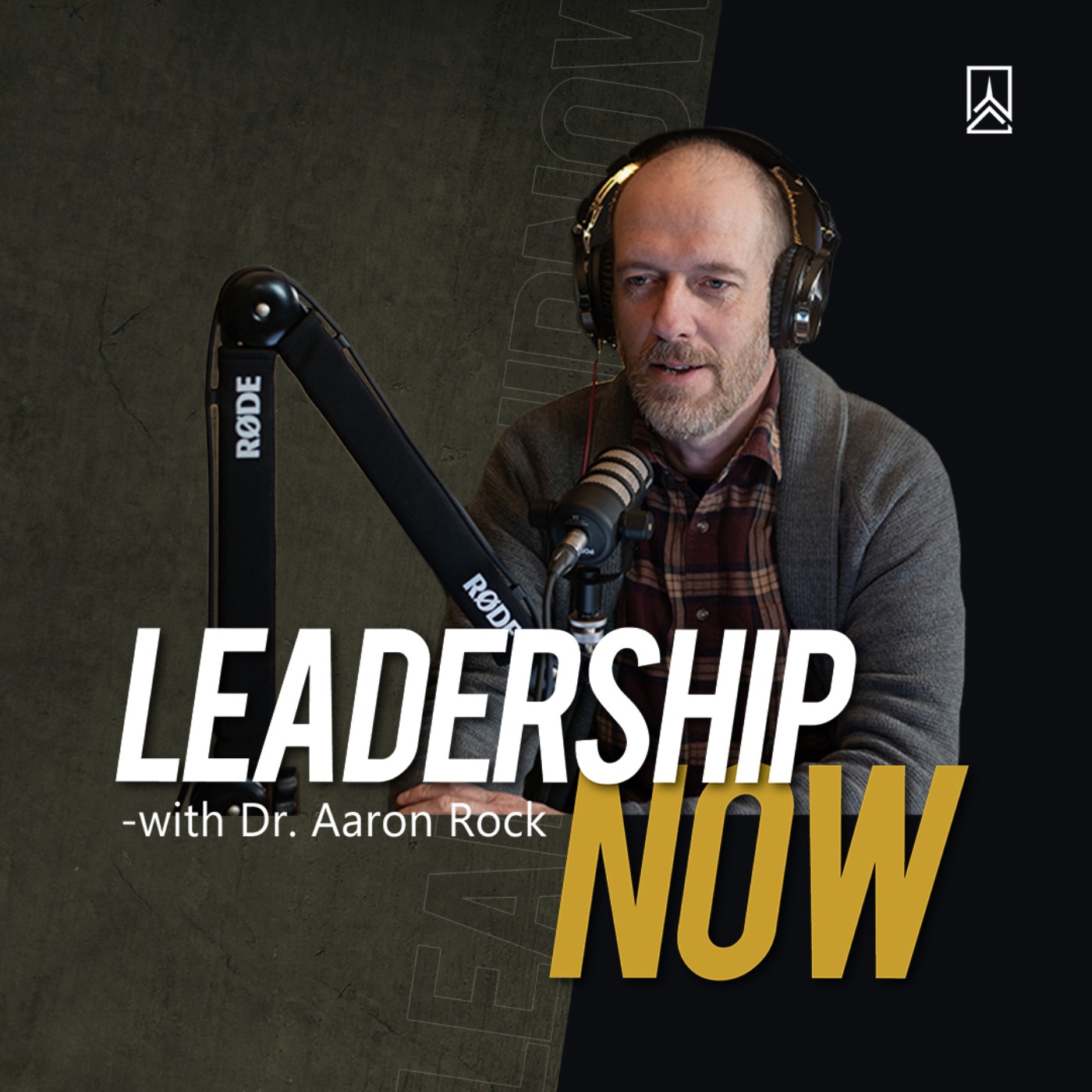
Leadership Now Podcast · Dr. Aaron Rock
Tune into this episode of Leadership Now with Dr. Aaron Rock where Aaron discusses the value of being faithful long term, as well as some practical ways to maintain faithfulness in all areas of life. More Resources: More resources at beachheadmedia.ca Beachhead Media YouTube
Welcome to Leadership Now with Dr. Aaron Rock hosted on Beachhead Media and other podcasting platforms. Aaron has served as a pastor, chaplain, denominational leader, professor, and writer, and he is a desire to help others think Christianly about all of life. On this show, we discuss the nuts and bolts of theology, church life, ethics, apologetics, culture, politics, and other issues to help you lead better. Now. Welcome back. Thanks for tuning in. As always, I am your host, Jesse LeFramwaz. In the studio with me is Dr. Aaron Rock. If you didn't get a chance to check out last week's episode, we talked a little bit about sexual purity. And more particularly in the summertime, there's a lot of valuable insight. In that episode, so if you haven't listened to that one, I would recommend checking that out. But today we've got a new topic for discussion. And to introduce it, I want to draw your attention to the fact that we live in a world where attention spans are short, marriages are short, expectations of revival, even in our own country are short. People are switching jobs very frequently. Things seem to come and go so quickly. They're so quickly embraced and just as quickly cast aside. You seem to kind of get the sense that things like faithfulness, long-term commitments, and even just the ability to just stay the core. So with where you at, those types of things seem to be increasingly rare in today's world. So, Aaron, what we're going to be talking about today is really we want to answer the question, how and why should we as believers play the long game in a culture that doesn't seem to value any sort of long-term faithfulness whatsoever? Yeah. Well, let me go back to my childhood back in the dark ages, back in the medieval era. When I was a kid, I remember going to church. We went to a few different churches, not because we were church hoppers, but because we moved cities. And I remember thinking, why is it that almost every sermon revolves around the exact same theme of faithfulness? It just seemed to be a theme that would come up over and over and over again. So, isn't there anything else you guys can find in the Bible to preach on? It seemed to me that every week somebody was preaching on faithfulness. Now I don't think that that was literally true, is probably more of my perception, but it certainly felt that way. Now that it made my fifties, I have a heightened appreciation for the concept of faithfulness. I've always appreciated it, but I'm seeing it more and more and more as central to the Christian life. So I'm in my fifties now. I have adult children, so I can look back on almost 28 years now of fatherhood. I have 30 plus years of vocational ministry under my belt. We got the grandkids jumping around. By the way, we're having our, well, we're not having it, but my son will be providing us with a six grand child, Lord willing to be a teacher. So that's cool. Anyway, when I look back, I have a greater appreciation for anything to do with long-range, longevity, perseverance. So long-range commitment and relationships and ministry and marriage super important, long-range perseverance, people that just keep pushing forward. They don't step back. They don't step aside. They just keep showing up. They keep pushing forward. Principle-based, like long-range, principle-based decision-making that sometimes hurts you in the short term. Blesses you in the long run. Long-range hope. Thinking years, decades down the road and not expecting things to just change overnight. Long-range prayer, praying for the same people, the same situations year after year. Jesse, these things bear a lot of fruit and that's going to be our topic today. And I want to encourage our listeners, especially the younger ones. You may not have a lot of life experience behind you, but if you can wrap your mind around this virtue, this value of just being faithful, you will be a great Christian. You will be very beneficial to the kingdom of God. Your life will be blessed. You will be fruitful. You don't have to be the greatest communicator, the greatest servant, the greatest musician, the greatest preacher, whatever your calling is. You don't have to be the greatest look and the smartest person in the room are the most educated. But just being faithful is how we win over the long haul. And it's so rare that just by being faithful, you will be unusual in the eyes of your fellow, I get what we call them, your generation. So that's what I want to talk about and help people to think through how, why is faithfulness and longevity and commitment and perseverance important? How does it flesh itself out in different spheres and areas of life? There's definitely a ton of value to faithfulness, even just in my own life I've seen. I've been blessed by so many Christians who have been faithful to me. And so there's tremendous value in that. And we're going to kind of break that down a little bit more as we go on. So I think it'll be valuable to kind of break up this idea into different pieces. So we're going to talk about faithfulness in a few different categories. We're going to start off with what exactly does it look like to exercise faithfulness in your own personal life? Well, I think at its core for the Christian who has surrendered him or herself to Christ, it's about adopting the values and the principles of the kingdom of God. Instead of being a pragmatist, I'm cool with thinking through the pragmatic implications of your decisions. I'm bringing to practicality. But even practicality has to be reigned in and constrained by your principles and your values. So when you read scripture and you understand the values of the kingdom of God and you adopt those as your own honesty, worship, selflessness, purity, the fruit of the spirit, the commandments of God. You adopt these into your life and you choose to live them out. When you say, I, for example, I want to be marked by integrity. I want my private life and my public life to align in keeping with the word of God. And you exercise a principle, you adopt the principles of scripture and you exercise a principle centered life. So then you apply them to your marriage, apply them to your conversation, your finances, your decisions, your sexual morality. And when you fail, you immediately acknowledge it and you realign and you apply them, you apply them. And then if you fail, you immediately acknowledge it and you realign. You're not tugged to and fro by cultural whims. You're not easily manipulated. You stand your ground, you're tenacious in your belief. And being tenacious doesn't mean you have to be rude and arrogant, although almost certainly if you are a tenacious, you're going to be perceived and accused of being that at some point. This is really important in order to stay the course and play the long game in marriage, just saying like, come hell or high water, I will not quit. I will not quit. In our faith, come hell or high water, I will not backslide. I will not give in. I will not relent. I will not cease to profess the name of the Lord Jesus Christ. You can have a bullet to my head. You can take my life, my children, my wife, my health. I will not relent. I will continue to pursue the Lord. Now obviously when he goes grace and all of that, okay, but I'm talking about our side of the equation in the process of sanctification. That's where you win over the long halloween. You need more people like that. There's also another element here. So in addition to being very principled and tenacious, we have to, in order to play the long game, have an awareness of who we are, what our identity is like in Christ to really wrestle that one to the ground. And then to have a sense of how has God wired me and equipped me for use in His kingdom and to be comfortable with that to realize that there's some things I'm never going to be great at, but it's great to know that. To know that I have gifts that the Lord wants me to maximize and utilize for His kingdom, but I don't have to be everything and all things to all people. Being comfortable in your own skin. What that does is that guards you from comparing yourself to people. It guards you from attention seeking behavior because you're comfortable with who you are. It guards you from spiritual attacks. Seek to undermine your sense of worth and value. Guards you from that stuff. Being comfortable in your own skin. I think it's an incredibly important element of being principled, being faithful long-term. And then out of that, anybody who's in leadership, presumably you are or you want to be or you wouldn't be listening to a show called Leadership Now with Dr. Aaron Rock, you want to influence people. That's your view of leadership. I want to influence people, but I'm not that's not the same as pleasing people. So when I get up to preach, I want to influence people. Hopefully I'll bless people. I mean, it's certainly nice to be agreed with, but that's not my goal. My goal is not to be agreed with. My goal is not to please people. I'm really not in it for the paycheck. I'm really not in it for the public applause because there's a lot more applause to be found elsewhere and there's a lot more money to be made elsewhere. In the many different fields of life. So I want to influence, but I'm not concerned with pleasing people. These are some basic building blocks that need to be present in the life of a person that's going to play the long game and be principled and persevere and push forward and everything that relates to their personal life. And it would be good for our listeners to assess themselves in this area. Do I know what my principles are and am I unbudging in them? Am I tenacious in my belief, especially in the core value? So your beliefs will change over time in lesser issues. You may be very dogmatic in some minor area of the Christian life and later realize, I think I got that one wrong. You may be really dogmatic in who you cheer for in terms of sports teams and switch your legions. You know, these aren't sacrosanct things. But in terms of the core issues, like basic obedience to the ten commandments, basic appreciation for desire to demonstrate the fruits of the Holy Spirit, you can't fudge those things. You can't be blown to and fro by the winds of change. Your theology isn't developed in the context of what's popular, what isn't. And unfortunately, I'll just say this. I know. I see it. A lot of people change their theological stance as almost as much as they change their underwear. It's like, well, this is trending now. So I'm over here. Now this is trending. We're here and well, this guy thinks this way. So I'm going to change my beliefs and people are like all over the map on things. And it almost seems like the least principled they are, the more dogmatic they are. And it is so easily, you may think you're on top of the trends and surf in the waves of cultural change. But actually, you're probably just being manipulated. So if you are going to change your beliefs, make sure that you change them very, very, very slowly. The thought through them that you've, you've really wrestled the ground. Am I changing my beliefs in this area because it's the in thing or I took a course in a seven-hour, I tended a conference and I had this eureka moment. Or am I being manipulated? Am I being led astray? Or is this a genuinely an area of my thought life that needs to be modified? I think in the conversation of faithfulness, a lot of the focus and we've talked about this on other episodes before is very much on external actions. But like you mentioned, it's very important to have those personal things down as well. If you want to remain faithful, you need to have those principles and that tenacity and those sorts of things. Now what about speaking about reputation? Now it's not uncommon, especially as a Christian living in today's world for our reputations to be under attack from people who oppose us, people who disagree with us. What should our response to this be? Should this completely throw us off course? Should this make us change directions? Or if not, how can we actually maintain faithfulness that will sort of prove that our reputations warranted? So we have two things working against us. We have the offence of the cross. So in any generation, anyone that preaches the cross of Jesus Christ is going to offend and then therefore they will be attacked. But we also have an anti-Christian culture and country that we're living in. And so because of that, as we speak to the crazy issues of the day, we're going to throw some people off. We're going to bother some people. We're going to fire upon the enemy and they're going to want to fire back. So our basic faith will draw fire from the enemy and our comments on cultural issues will draw fire, in sermons, personal conversations, tweets, whatever, right? So it's going to happen from all different perspectives. And our reputation then will be attacked. So some people are honest enough to disagree with you and then to debate the issues. Most civil doers aren't going to debate the issues because they really don't have any, there's no substantive argument to support their viewpoints. So like transgenderism is complete and total crap. And instead of arguing the point and trying to prove scientifically that gender isn't binary or gender isn't concrete and absolute, they have to threaten you. They have to belittle you. They have to shame you. They have to pass laws because they're losers. And that's what losers do. They threaten, they harass. They try to undermine your reputation because they don't actually have any substantive arguments in their favor. It's all nonsense. It's smoking mirrors, right? And so we're going to draw a lot of fire from the enemies of Christ when we take a stand for righteousness. Now I'm a leader. I'm not the most famous guy to ever live, but I have a, you know, three or four people that follow me, I guess. And over my tenure as a pastor and leader, I have had my reputation and my viewpoints attacked over and over and over again. Like all sorts of stuff. I'm a liar, I'm a fraudster, I'm a closet Muslim, like all sorts of things, right? But the reality is the Bible says, beware when all men speak well of you. So in other words, if you're taking a stand for Christ, it doesn't mean that a retember attack that we necessarily are taking a stand for Christ. We could just be idiots or embrace her personalities. But when the Bible says, beware when all men speak well of you. And if you search your heart, you're like, I'm going to say this or do that or take a stand against this issue because I just, I believe it's right and true. And people attack you. It's actually easier to accept because you know that they're attacking the king for whom you are an ambassador rather than yourself. So I've differentiated over the years between attacks against Aaron Rock and attacks between pastor Aaron Rock. So personal attacks might be, I don't know, people attacking your appearance or people attacking your abilities or lack thereof or maybe your personal lifestyle choices. But very, very rarely do people actually attack me in those areas. In fact, I can't even think of any in recent times. Almost always my reputation is under attack in my capacity as a pastor. So as an ambassador for Christ and I'm preaching teaching, they're attacking me in terms of my duties and responsibilities. So it's, I guess I could say this, it's less personal even though it does hurt. It's less personal than if someone is maybe belittling you as a child for who you are, you know, as a person. So a few things that help us to stay the course even when our reputations are being attacked is very simply to consider the source. So if I believe that pleasing men is not the, not a value for me and not something that I should be really considering when I'm speaking the truth, then if I displeased them and they're, then why should that really bother me? So I need to consider the source if they hate Christ and I'm preaching it as behalf, they're going to hate me. Now they're going to, they're going to, they're going to attack me because they think they're attacking me, but I just know they're not attacking me. They're attacking my office as an ambassador for Christ. People sometimes accuse you of things like if you're, I'm an assertive person. I don't, I don't think I'm rude, but I, have I ever been rude? Yes, but I don't think I'm, I don't think that's a besetting sin. I'm an assertive person. I'm confident in my beliefs and I'm tenacious in the articulation of them. And I, and I don't think I'm a legalist either. I think I have a fairly good balance between differentiated between core issues and peripheral issues, but when I assert myself in a particular area, I have many, many, many times been accused of being arrogant or prideful. Very rarely to my face, but I've heard people communicate that to me through, through other channels. And it often throws me off because I, I assess myself and I think I don't think I am. And well, yeah, we all have bits and pieces of pride in this. I don't, I don't, I don't, I honestly don't think that's a besetting sin, but people can conflate the two. So if you're like, no, you're not doing this, but I want to absolutely not. It is not happening. Period. Or you need to do this or that. Well, you're arrogant. No, that's being straightforward and blunt and confident and defending whatever it is I'm defending. So in my mind, when I, when I've received that, obviously, I, those kinds of accusations, obviously, you have to take a moment to, to assess like, am I? Like is this actually a word from God? But if you've assessed yourself and you don't believe that that's an accurate description, you can push forward and consider the source. But what it often is, is it's just the human heart manifesting itself. Like people they're living in sin or rebellion against God don't like to be confronted. Period. So why would we expect that confronting them is always going to result in a, okay, yeah, I'll do what you tell me to do. That's the human heart, but you can't give in. It's like parenting 101, who's in charge of the household, the parents? So as soon as proverbial little Johnny or Sally pushes back against mum or dad and mum or dad's like, okay, you know, you can have your dessert before your meal. You just lost. If you let your kids say, I don't want to, you know, I wanted it because, and then kick up a stink and throw up your hands and say, well, what am I going to do with little Johnny and Sally? I don't know. Okay, I'll give you what you want. You just lost. And it's the same in public ministry in life. People are going to act like children. They're going to push back. They're going to reject authority. They're going to reject the truth. And if you give in, you're outing yourself as an unprincipled person and you, you lose and they lose. They may think they've won, but actually they lose. So you got to consider the source at the same time you have to, to, to play the long game, you have to guard your heart, which is something I've had to really think a lot about over the years. You have to guard your heart because we can, without even knowing it, we can easily receive someone's garbage. We can allow it to like build up. So attack number one. Okay, not to be deal number two, number three, number four, number five, 10, 20, 100, thousand, 10,000. Over time, it's like, man, why am I doing this? Like a Zekeal went through moments like this and his public preaching where he talked, well, you know, people coming to him as people do, hearing his words, basically cheering him on, but not doing them. And he went through a real funk in his ministry. And so we have to think, we have to think about, we have to guard our hearts from believing the lies and just almost simplify things and just push forward and keep preaching the truth regardless of the outcome. Now, there's nothing wrong. It's not like we, we have to, we're somehow obligated to put up with everything. There's nothing wrong with pushing back at times. It wouldn't spend too much time doing it, but pushing back against offenses or attacks in your reputation, clarifying. It wouldn't spend too much time doing it because, you know, all it takes is a blogger or a group of people that gang up on you and you could make it a full-time job defending your reputation. Nothing wrong with blocking people that are attacking you. There's nothing wrong with silencing your opponents. That's fine. But you're never going to completely get rid of it. People are going to gossip behind your back if you're a leader. People are going to spread rumors about you. People are going to undermine you. People are going to put words in your mouth. People are going to misinterpret you. It's going to happen over and over and over again. Don't back down on your principles. And if you know what you believe and you stick to it, the good thing is you'll eventually wear them down. See, evildoers are like wolves. If they look at a herd and they see the weak wildebeest and they attack, but the wildebeest fights back and continues to fight back and doesn't back down, eventually it'll take off. If you stand your ground, there's a... People have probably watched nature shows of watchmaking, they're kind of cool. And I saw this one where a group of dingos in Australia were trying to eat a kangaroo. They're trying to catch a kangaroo and it'd be heard or whatever they call them mob of kangaroos. And these dingos are chasing the kangaroos all over the wilderness and the alpha male will call them, who's literally like rippling with muscles. He just stands there. They take off. All the girls take off. All the young ones take off. The babies take off. And he just stands there. And he's like towering over these dingos and they're barking and carrying on and then they just realize, yeah, we can't take this guy down. So we'll go find some other weaklings. So you have to stand your ground. And the neat thing about this is Jesse. And I've seen this. This is where long term ministry is also a benefit where it hasn't happened. It hasn't happened every day. And I wish it would have more often. But I can think of specific situations where people are confronted. They don't take it well. They leave. They trash talk you. They talk behind your back. And then a couple years goes by or years goes by. And suddenly they apologize or suddenly they're back and they're changed. They've been restored. And that's a blessing. And you didn't change. You guarded your reputation. You didn't allow it to throw you off. You didn't change your values because a whole bunch of people came after you. You stuck it out. You stood firm. And eventually the wolf becomes a sheep. And that's pretty cool. That's the kind of transient we want. And when wolves become sheep and turn to Christ and find literally transformation in Christ. And so I guess if I could summarize it, maybe say it in a sentence, guarding your reputation is about maintaining your principles and your values over the long haul and letting God be your defender. Absolutely. I mean, like you said, there's a lot of times where you're not necessarily going to see or even reap the benefits right away. But long term, even specifically with the reputation, you can 100% see how God will work positively through that faithfulness. Now, a little bit more practically speaking, what does faithfulness look like in the different areas of Christian ministry, whether you're leading a ministry serving? What does that look like? Yeah. So, the Christian church is the family of God. We are the bride of Christ. We are brothers and sisters in Christ. We're adopted sons and daughters. A lot of beautiful language applied to the Christian church. The Christian church is not a company that you go to to purchase spiritual commodities. The Christian church is not like any other institution, like a social club that you attend because I'm kind of into church right now. As a Christian, the Christian church is your spiritual home and family in this world. And we are to be part of churches. We're to become members of churches, we're to participate in the life of churches. And this is a message that doesn't resonate in many kinds of churches. It's certainly not a concept that I see in the Roman Catholic church. It's not a concept I see in the Eastern Orthodox church. Those kinds of churches, there's fees for services. There's very much of a clergy lady distinction where you come and you receive sacraments, you listen to, you're not the clergy are doing the work. You're just kind of there to watch the show. But in the true biblical Christian church, you're a full on participant. It is not a spectator sport. It's a full compact sport. And in Christian ministry, there's many different areas of service. I mean, there's categories of services, different kinds of ministries that you can be in. We have different gifts and abilities. Unfortunately, we live in a culture where church shopping and pu shopping has been a moge for a long time. And people are like, I am going to ABC church. You know what? I know XYZ church has a new program. So we're going to go over there. And maybe we'll hop over to this church back to that church. It's not uncommon for people to go to five, 10, 15 churches in the course of their lives. Not because they're in the military and they're moving cities, but they just, they just grow bored or they get into a dispute or they follow the latest trends or whatnot. And I'm not suggesting that there's never a valuable, there's never value in leaving a church and going to another. There are times when a church is unfaithful to the gospel or maybe they're preaching the truth, but there's no spiritual life there. There's no true fellowship or prayer or pastoral care. Like yeah, there's reasons for people to leave churches. But it just seems to me that people are very fickle. We've had people even our own church over 25 years. I can think of people that have become members here like three times. You know, they come, they're all in and they leave and then they're fused out of their back and they're all in and they're leaving back, you know, back, forth, back, forth. What does that communicate to your children? What does that communicate to the world? What does that communicate to pastors about what you expect of them? See, let me just say this, pastors are responsible for their own behavior, but pastors come from within congregations. And there's a lot of people out there that to cry all the mega church, they're all about the show, they're all at the show. Well, where do you think that comes from? It comes from the way lay people treat pastors. If you treat pastors like businesses, then you're going to train up a generation of people that think that the way to build a church is to try to keep you through the little gimmicks or watering down the message or light shows or fog machines or Sabbath Sundays or whatever it might be. And frankly, I wish lay people would take more responsibility for the state of the church because there's many, many more of them than there are pastors and leaders and churches, right? So lay people, for example, by being faithful to churches through thick and thin, communicate to pastors that they value faithfulness and not the latest and the greatest trends. And pastors by being faithful to churches and not looking for the next promotion demonstrate that they also are committed to the actual community of faith of which they're part. They're not hired guns, they're not employees, they're not show men, they're not service providers, they're brothers in Christ and there's obviously a place for women to serve in the church too who are genuinely there for the greater good. And when you stick with a church long term as a lay person, as a clergy person, there's all sorts of benefits. It benefits you. You get to see, there's so many benefits to long term ministry. So why you got to take responsibility for your actions? You see what works over time or what doesn't work. You get to know people on a deeper level. You have to maintain your creativity and your freshness instead of recycling the same place, jumping from church to church to church, you know, your top favorite, you know, hundreds of them, it's just recycling them. You have to maintain, you have to be fresh and you're preaching, you're teaching, you're a ministry development, accountability. It's good for your soul to stick it out, even when you don't feel like it. There's going to be times when like, I love this. And other times like, what did I do? What did I sign up for? But pushing through that benefits you, it sanctifies you. It's good for others. People are going to trust you more and say, yeah, you know, I mean, I mean, I didn't even understand why he's making that particular decision, but he has a track or a faithfulness. So I'm going to assume he has some wisdom about him. Maybe he may be see something I don't. They get to watch you and your family grow up and see how you handle all the different circumstances of life. We all experience trauma. And when churches see their fellow brothers and sisters handling that well, it blesses them. And then honors God. I mean, God is the ultimate when it comes to faithfulness. I'd remind our listeners of Deuteronomy 7 when it says, no, therefore, the Lord your God is God, the faithful God who keeps covenant and steadfast love with those who love him and keep his commandments to a thousand generations. I mean, that we're talking about some long, long term faithfulness there. And so I would encourage people, if you're a church hopper and a pew shopper, you're dishonoring yourself, you're robbing others of the blessing of seeing you over the long haul. And you're not demonstrating one of the virtues and values of God, which is faithfulness and perseverance. So if you're going to jump ship, make sure you have a very valid reason for it and stay true to your ministry and to the people of God. This actually creates a culture of authenticity, rather than showmanship. And bloom where you're planted. Blum where you're planted become really, really good at what God has wired you to do and let God bring the increase in His time and in His way. Yeah, that's really great. And it really is a shame that that's such an unusual message and it's so countercultural because so many people are missing out on so many of those great blessings. Talking about something that is countercultural, this aspect of faithfulness definitely would fall under that. There's been a lot of debate, especially among Christians about revival and reformation. Should we expect it? Is it going to happen? Should we just throw our hands up and say, oh, our country's lost or city is lost? And so forth. So maybe you can speak a little bit to what faithfulness looks like in expecting revival and reformation. Well, I think there's always in faithfulness interwoven into it is the concept of hope. So that doesn't mean that we can predict the future. So if I say I'm praying hopefully for revival in Canada, revival in the Western world, reformation in the church, I'm not predicting what's going to happen. I don't know the plans of God for the next several generations. I don't know when Jesus is coming back. I just don't. And I would be aware of anyone that would say they do. We just don't know that. But if I look back at history and I compare some different things that have happened in history to what's going on now, there have been many, many points in history that are as bad or worse than what we're experiencing in the moment where God brought revival and reformation. Now often it was localized to a specific nation or continent. I don't know to the state and human history of any global revivals that took place that completely transformed the globe. But imagine living in the time of Josiah, the king of Josiah, king of Israel, where it was so bad people had forgotten where the Bible was, the Torah. And it's rediscovered in some bin, some Tupperware container back in the corner of the storage room of the temple. And there's revival. And then we think in just in terms of the revival that our Lord and Savior Jesus brought in the first century. And then we think of how hard it was being a Christian in the first three, three hundred and fifty years of the church and then Constantine made it legal. And there was a huge growth in the church. People are very familiar with the reformation, of course, and the revivals that came out of that, the great awakening. There's been even the work of the Puritans in England and then in the New World. There's been many times throughout history where everything seemed lost and things were pretty dark and dismal. And then God moved in a way to bring about substantive change. And maybe only lasted for generation two generations, five generations, but it's pretty cool to read about that, the different revivals and generations. So one hand, I don't know what the future holds, but I think people are a bit naive to think, oh, this is definitely the end of the end of the end. I mean, it's never been this bad before. And then it's like, you clearly don't, you've never read human history. Um, here's what we know. Revival has happened and therefore can happen. Will it? I'm not a prophet, I don't know, but I know it has happened and can't. And so why would I not live my life in such a way that I'm in a show faithfulness in the hope that it will happen and hopefully sooner or later? The alternative is to be negative, net or negative, netly. It's all like, ah, we're done. World's done. Canada's done. The Western world's done. We're cooked. You can go on social media and see all kinds of comments. I think to myself, like, how does that help anyone? How does that help you? How does it help your listeners? It's not even like you're thinking, we're done. Let's move across the Atlantic Ocean to a new continent that's been discovered. Like the Puritans did, right? You're not even providing a solution. You're saying, we're done. Canada's done. Canada's cooked. I think in myself. That is such a strange, how do you live with yourself? How do you get up in the morning every day? We're done. We're cooked. How about showing some faithfulness and at least praying and living with some anticipation that they're very well could be revival and reformation? Even that posture, that mindset encourages people, gets people thinking, wow, it could happen. And it motivates people to be faithful. But we're done. Canada's cooked crowd. You're not helping anyone. You're just a commentator on the bad stuff. By the way, when people say things like that, the sad thing is they're disregarding all the great things that are happening. Many people, we've seen this in our own ecclesial context in the past five years. We've baptized more people in the past five, six years than we did in all the time, twenty years before that. I'm pretty sure anyway, a lot of people have been baptized. And the church is growing and other faithful churches are growing. Like, in many, it's kind of an exciting time to be alive. It's hard. It can be stressful, but there's also some excitement there. So be, be very careful of being like a Doomsday prophet. Because if all of a sudden God brings about revival, the question is, is he going to use you to participate in it? If you're the, we're done, we're cooked crowd. Why would he use you? Maybe some people get a bit of a kick out of bad news, but bad news, while it should be received and understood, not overlooked. In my mind, if you're a good leader, should immediately force you towards thinking about, in case solutions, what are some solutions? What are some things I can say to encourage and build people up? How can I instill hope in them? So yes, we're not talking about putting our head in the sand and ignoring the issues of the day. But being faithful through the long haul, God is going to use, if God is going to use his church to bring about revival or reformation, I can tie this because it's always been the way, this way. It's going to be a move of God. And as God moves, he will use as his primary agent's faithful Christians. It's as simple as that. He will use his primary agent's faithful Christians to bring about change to the proclamation of the word through lives that are consecrated to the things of God, through families that are consecrated to the things of God and through churches that are unflinching and their commitment to the things of God. So why would you not want to be one of those people? Exactly. Personally, I've just never been able to understand the whole negative mindset and just operating under the assumption that God can't bring about revival. It's always been confusing to me. But maybe to wrap up, Aaron, you could talk about just a couple of other areas that we could think long a term and focus on faithfulness. Well, don't be bothered by the trends. And what I mean by that is it's so easy to be distracted. This is a pretty broad topic, but it's so easy to be distracted by what is trending in the moment. One of the benefits of being in your fifties is that I can now think back. So I've been an adult longer than I was in. And I can think back to different fear mongers, fear mongers in my lifetime, my short lifetime. And there's people that seem to be I'm sure that are wailed with and I am. But I remember some distractions when I was a child. So there was when I was very young, I remember there being a lot of talk about Russia, sending a nuclear bomb over. And then there was a real concern in their early 80s about climate change in terms of the world freezing to death. Now it's completely flipped to global warming. But we're going to be in an ice age by now. So that was a big thing. There was a period of time when we were all going to die because the ozone layer was going to collapse. There was a lot of false prophets. Gorbachev was the anti-Christ and the whole mark on the head and everything was somehow tied into biblical revelation. He was going to come and destroy us. There were false prophets in the 80s that talked about crisis coming back. We're done in the 80s and that clearly didn't happen. There was different epidemics that were going to potentially take us out Y2K. So the computers weren't going to be able to work program to handle the switch of the date from December 31st, 1999 to January 1st, 2000. They're all going to collapse or crash. And it was going to be global catastrophe. The banking industry and technology were still here. There was the SARS outbreak. Obviously, the most recent one is the global one would be COVID. We're all going to die. Everyone's going to die. Get your mask on. Don't talk to your friends. We're all still here. Still taking away with our antibodies. Now, I think there's more of a cultural angst. Marxism's taken over the world. The transgender people are coming for our kids. The pride people are coming for our kids. The liberal government, nobody can afford a house. Look, all of these things are things for us to consider. But none of them are going to bring about the end of the world. People die in the process and suffer through all these different catastrophes. But so many people lose their focus on the trends. This is especially the conspiracy people, which is I feel bad for them because not only is there things to be afraid of, but there's these hidden enemies out there. There's these unnamed groups of people, the Jews or some global cabal, some thrown room under the Antarctic ice that world leaders swear allegiance to or different global organizations are about bringing about the end of the world. It's all fear mongering. I just don't have time for that. Don't be so bothered by the trends. Keep focused on the main things. You should be a faithful Christian should be for the most part oblivious to people who aren't going to like this because a lot of people make their full time living out of keeping us on the edge of our seats in terms of what's going on in the world. But oblivious to most of the nonsense in the world, you don't need to know about every political issue. You should probably read less news, not more. Get out for a walk more and see the world more or less looks the same as it did in 1982. You probably shouldn't listen to as many news, podcast, you don't need to keep up on the latest and greatest trends. You don't need to be aware of like everything that's going on in the world. Don't worry too much about foolish men. Even in the Christian world, there's a lot of, uh, probably shouldn't use this word idiots that are pastoring little churches that have realized that they're, they're really not good at it. They're really not called to it so they just spend their time on social media creating controversies. They become social media influencers. Everything is a controversy. They post on all sorts of stuff. Stuff that no one cares about to try to create a stir. And we need to be aware, of course, of a lot of the issues and fully in favor of calling out evil doers and, you know, pushing back and all that sort of stuff. But there has to be elements of hope in all of that. If we think about some of the biblical prophets, we don't know for sure. But roughly speaking, Isaiah prophesied for probably around 60-ish years. That's a long time. Jeremiah for about 40 years, Ezekiel, private 2022 years, Daniel, potentially for up to 70 years. He probably came into Babylon in his teens, might have lived through till his 90s, maybe died just before some of the depictions the end of the book. But he, um, these are long-term prophets who, in their lifetimes, maybe saw some glimmers of hope. But for the most part, just stuck it out there in very, very, very difficult times. And when your life is only 70 or 80 years, like a 20 year, 70 year commitment is a long, long, long, long time from the vantage point of your lifespan. But it's just a drop in the bucket in human history. And the world doesn't revolve around you. So being faithful over the long haul, even if you don't, I would think that if the Lord does not come back before I die, that what I've said in what I've done, Lord willing, will continue to bear fruit for generations to come long after I've been forgotten or my disciples or the disciples of the disciples of the disciples that I make have been forgotten. And it's a, it's a, it's kind of a fascinating thing. We can never fully know this, but it'd be fascinating thing to somehow find out how even some of the blessings we've received might be directly tied to the ministry of someone that's been dead for 200, 500, 1000 years already. And yet something they did or said, shaped a person who shaped another person, who shaped a small group, who shaped a large group, who shaped us. And we've been the beneficiaries of their faithfulness over the long haul. So I want to encourage our listeners. And I'll maybe end with a verse from the book of Galatians chapter 6, verse 9, where it says, and let us not grow weary of doing good for in due season, we will reap if we do not give up. So do not give up. Don't give up on your marriage. Don't give up on your children. Don't give up on your church. Don't give up on your vocation. Don't give up on your country. Don't give up in your city. Be blessed. Be faithful. Pray for revival. Be part of the solution. Be a principle-centered person. Be tenacious. And allow God to use you even long after you have been forgotten to bring blessing into the lives of other people. And so that's my word of encouragement today. And I hope that people will receive it and act accordingly. Yeah, that's a very encouraging message. Thank you, Aaron. That's a great place to end it. And just again, to summarize, faithfulness is a critical aspect of life as a Christian. God can and does work things out quickly, but very often things just very simply take time and to not be faithful and to not stick it out over the long haul is to rob yourself and others of the many blessings that God provides for those who are faithful to him and are faithful to the work of the ministry. So as always, we hope and pray that this episode was a blessing to you. And we will see you next time for another episode of Leadership Now with Dr. Aaron Rock.