
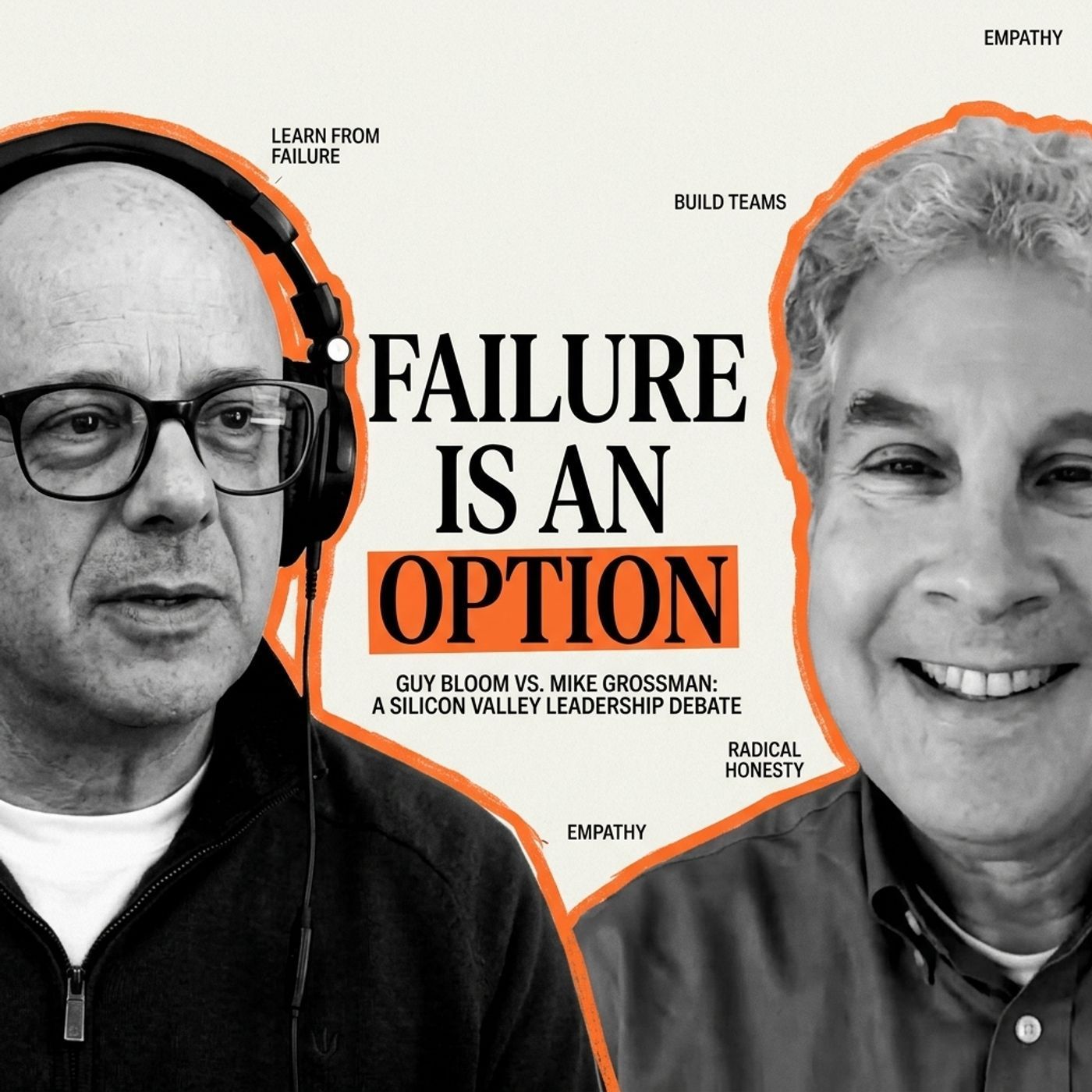
Leadership BITES · Guy Bloom | Living Brave Leadership
Mike Grossman shares his journey of running early stage technology companies in Silicon Valley, reflecting on the challenges, successes, and the importance of people in business. He emphasizes the need for emotional intelligence and understanding the context of business, particularly in relation to people and financial aspects. Mike also discusses the significance of having the right people in the right places and the challenges of managing and dealing with people as a company grows. The conversation covers topics related to leadership, team dynamics, hiring, company culture, and the impact of technology on business. It also delves into the importance of radical honesty, mental health, and managing expectations in a business environment. The conversation delves into the roller coaster ride of business environments, the importance of emotional resilience, and the challenges faced by entrepreneurs. It also explores the motivation behind writing a book and the evolving nature of decision-making in the tech industry. Takeaways Silicon Valley CEO Mike Grossman shares insights on running early stage technology companies The importance of people and financial context in business Challenges and successes of managing and dealing with people as a company grows Trust and role modeling are essential for fostering effective communication and team dynamics. The focus on input rather than outcome, radical honesty, and managing mental health are crucial for navigating the challenges of running a business. Emotional resilience is crucial in navigating the ups and downs of business environments. The decision-making criteria in the tech industry is evolving, and the pace of change is accelerating. Chapters 00:00 The Journey of Running Early Stage Technology Companies 03:10 The Role of People in Business 08:42 Managing and Dealing with People as a Company Grows 17:08 Fostering Effective Communication and Team Dynamics 18:07 Challenges of Hiring and Company Culture 18:32 Adapting to Small vs. Large Organizations 20:26 Managing Expectations and Radical Honesty 21:12 Defining Success and Societal Expectations 22:05 Navigating Business Pressures and Mental Health 23:00 Focus on Input and Managing Expectations 24:31 Navigating Business Challenges and Results 25:19 Maintaining Equilibrium and Managing Expectations 32:06 Impact of Technology on Business 35:34 Navigating the Roller Coaster 36:46 Emotional Resilience and Professionalism 37:16 Mental Health and Decision-Making 40:07 Motivation for Writing a Book 50:54 Evolving Decision-Making in Tech
AUDIO Guy Bloom and Mike Grossman: So, Mike, absolutely wonderful to have you on this episode of Leadership Bites. Welcome. Thanks very much, guys. Great to be here. So whereabouts in the world are you, Mike? I'm in Palo Alto, California, which is about an hour south of San Francisco and very close to Stanford University. Yes. So I think I know Costa Mesa. Yeah. Guy Bloom: So Mike, absolutely wonderful to have you on this episode of Leadership Bites. Welcome. Thanks very much, guys. Great to be here. So whereabouts in the world are you, Mike? I'm in Palo Alto, California, which is about an hour south of San Francisco and very close to Stanford University. Yes. So I think I know Costa Mesa. AUDIO Guy Bloom and Mike Grossman: That's pretty close. Yeah, I did some hours. Right. Yeah, so many years ago, I had a client there. Guy Bloom: That's pretty good. Yeah, so I did some of the experience. Right. Yeah, so many years ago I had a client there that I did some some some work for, so I I know them. And Duke Stump is somebody I had on the podcast a long, long time ago. And I think he's in that California area. He's the marketing director at Nike and Lululemon and did all sorts of marvellous things. But anyway, I digress. It's this is not about them, this is about you. Now, if I met you at AUDIO Guy Bloom and Mike Grossman: did some work for. I know them. And Duke Stump is somebody I had on the podcast a long, long time ago. And I think he's in that California area. He's the marketing director at Nike and Lululemon and did all sorts of marvelous things. anyway, I digress. This is not about them. This is about you. Now, if I met you at a barbecue or a social gathering and somebody said, you two should talk. And I went, Guy Bloom: a barbecue or a social gathering and somebody said, you sh two should talk and I went, Mike, what do you do? AUDIO Guy Bloom and Mike Grossman: Mike, what do you do, you Guy Bloom: You know, without without downloading your C V, you know, and I'm sure that'd be like all blame, that's a big question. But in essence, you know, I'm a painter and decorator or whatever it is. Tell me tell me what's your answer to that. What do you do, Mike? Who are you? I I I would say that I've spent most of my career running early stage technology companies in Silicon Valley. And AUDIO Guy Bloom and Mike Grossman: know, without without downloading your CV? You know, I'm sure that would be like, blimey, that's a big question. But in essence, you know, I'm a painter and decorator or whatever it is. Tell me, tell me what's your answer to that. What do you do, Mike? Who are you? I would say that I've spent most of my career running early stage technology companies in Silicon Valley. Great. Guy Bloom: the common theme is that they're innovative. AUDIO Guy Bloom and Mike Grossman: The common theme is that they're innovative and trying to do something that really hasn't been done before and have venture capital funding to help enable that. Guy Bloom: and trying to do something that really hasn't been done before and have venture capital funding to help enable that. AUDIO Guy Bloom and Mike Grossman: So you've also, you have a book called Failure Is, and then the word not is kind of ripped out, but Failure Is an option, Reflections of a Silicon Valley CEO by Mike Grossman. So definitely suggest people have a look at that. So let's get into this a little bit. I think that one of the reasons people are more, maybe not relatable, but you can see where somebody's coming from is if you know the journey. Guy Bloom: So you've also you have a book called Failure Is, and then the word not is kind of ripped out, but failure is an option, Reflections of a Silicon Valley CEO by Mike Grossman. So definitely suggest people have a look at that. So let let's get into this a little bit then. I think that one of the reasons people are more maybe not relatable, but you can see where somebody's coming from is you is if you know the journey. that they've been on. Yeah. So just give a little bit of that, okay guy, this is the how I got here. you know, born under a tree. AUDIO Guy Bloom and Mike Grossman: they've been on. So just give a little bit of that okay guy this is the how I got here you know born under a tree Guy Bloom: you know, to you know, lived you know, lived by my wit alone in the jungle, you know, whatever it is. You know, how did you get from A to B in in a manner that would help people make sense of, okay. When he talks about what he's about to talk about, that's where his credibility comes from, that's where his history comes from. Well, I got into this line of work I would say first because of my father, who worked in technology for AUDIO Guy Bloom and Mike Grossman: you know, you know, lived, you know, lived by my wit alone in the jungle, you know, whatever it is, you know, how did you get from A to B in a manner that would help people make sense of, okay, when he talks about what he's about to talk about, that's where his credibility comes from. That's where his history comes from. Well, I got into this line of work, I would say first because of my father who worked in technology for. all of this career, much of it at IBM and the IBM Watson Research Center in Yorktown for many years. And so as I was growing up, I was less interested in being an engineer or computer scientist myself. Guy Bloom: all of his career, much of it at IBM, in the IBM Watson Research Center in Yorktown for many years. And so as I was growing up, well I was less interested in being an engineer or computer scientist myself. AUDIO Guy Bloom and Mike Grossman: I got a chance to see what my dad was working on and I found it very interesting. I think that was the first step. The second was that some years later after graduating from university, I had a job at a management consulting firm and ended up spending about seven months with Apple as the client. Guy Bloom: I got a chance to see what my dad was working on and I found it very interesting. I think that was the first step. The second was that some years later, after graduating from university, I had a job at a management consulting firm and ended up spending about seven months with Apple as the client. AUDIO Guy Bloom and Mike Grossman: and it was a very exciting place to be. And it was at that point that I thought, yeah, I think I might be interested in pursuing a career in this industry with an eye to focusing on entrepreneurship. And so eventually it took a while to what I, you Guy Bloom: And it was a very exciting place to be. And it was at that point that I thought, yeah, I think I might be interested in pursuing a career in this industry, with an eye to focusing on entrepreneurship. and so eventually it took a while to when I you know I met my wife in Australia, which was AUDIO Guy Bloom and Mike Grossman: I met my wife in Australia, which was an exciting but also complicating factor. Eventually, when we had our first kid, it was literally the same day she went into labor, actually. I left my job to start technology company number one. And that started what has now become a three decade journey of lots of ups and downs and... Guy Bloom: exciting but also complicating factor. eventually when we had our first kid, it was literally the same day she went into labor actually, I left my job to start technology company number one. and that started what has now become a three decade journey of lots of ups and downs and successes and failures along the path. and it's been a very interesting career and I really didn't know what I was signing up for when I first embarked on it. I think that's the so you know, the role I have in life is leadership and executive development, working with senior teams, etc. AUDIO Guy Bloom and Mike Grossman: successes and failures along the path and it's been a very interesting career and I really didn't know what I was signing up for when I first embarked on it. I think that's the role I have in life is leadership and executive development, working with senior teams etc. I'm not on a global stage, but in my space, you know, I understand what that reference is. And the one thing that seems to be amongst, I suppose, a few others, that universal truth is, yes, if I'd have fully understood what I was getting into, it's, and I suppose that's the story of success, isn't it? It is that, yeah, it's been a journey. And when people nod with that look, Guy Bloom: not on a global stage, but in my space, you know, I I of I understand w what what that reference is. And the one thing that seems to be amongst I suppose a few others, that universal truth is, yes. If I'd have fully understood what I was getting into, it's and and I suppose that's the story of success, isn't it? It is that, yeah, it's been a journey. And when people nod with that look. AUDIO Guy Bloom and Mike Grossman: your journey may not have been mine, but I know what you mean. Guy Bloom: Your journey may not have been mine, but I know what you mean. That you know, the the the AUDIO Guy Bloom and Mike Grossman: swings and roundabouts so I guess that would be worth delving into and let's do that. before we do where are you now Mike in the terms of if that's a little bit of the history that took you here what are you actually actively engaged in now that lets people know where your focus and your energy is? Guy Bloom: swings and roundabouts. So I I I guess that would be worth delving into and and let's do that. So w before we do, w where are you now, Mike, in the terms of if that if that's a little bit of the history that took you here, w what are you actually actively engaged in now that lets people know where your focus and your energy is? I've run six companies, and my most recent of which was acquired about four years ago, and I for the first time in my adult life have been taking an extended break. And my big project recently was the book that you mentioned. I think moving forward, probably gonna run I've run six of these companies, I'm gonna probably run a seventh, but I want to make sure I also have a creative track. AUDIO Guy Bloom and Mike Grossman: I've run six companies, the most recent of which was acquired about four years ago. And I, for the first time in my adult life, have been taking an extended break. And my big project recently was the book that you mentioned. I think moving forward, I'm probably going to run, I've run six of these companies. I'm going to probably run a seventh. But I want to make sure I also have a creative track. as I move into the future. So the book being the first example of that. But other writing projects, I'm actually working on a film project right now as well. So it's kind of an eclectic mix. I'm on a few boards. I advise a bunch of first time CEOs. I think it's likely I'll be a CEO again, trying to do things that are creative. Guy Bloom: as I as I move into the future. So the book being the first example of that. But other writing projects, I'm actually working on a film project right now as well. So it's kind of an eclectic mix. I'm on a few boards, I advise a bunch of first time CEOs. I think it's likely I'll be a CEO again and I'm trying to do things that are creative. AUDIO Guy Bloom and Mike Grossman: So I'm fascinated by people that get certain things like in sports. Some people I just notice if they're very good at a thing, you know, they're a... Guy Bloom: So I'm fascinated by people that get certain things, like in sports. Some people I just notice if they're very good at a thing, you know, they're a they're a fantastic soccer player, they can they're great at golf, you know, they've just got the the algorithm for just understanding how to move and how to hold themselves. And and I and I think maybe in business there's a there's there's something about people that kind of get the algorithm. They can see how it works. So AUDIO Guy Bloom and Mike Grossman: they're a fantastic soccer player, can, they're great at golf, you know, they've just got the algorithm for just understanding how to move and how to hold themselves. And I think maybe in business there's something about people that kind of get the algorithm. They can see how it works. So Guy Bloom: So that kind of, you know, having done, I mean run six businesses, you know, looking to a seventh, just before we say anything else, for people that look AUDIO Guy Bloom and Mike Grossman: that kind of, you know, having done, having run six businesses, you know, looking to a seventh, just before we say anything else, the people that look at that idea of I want to start up my own business. Guy Bloom: at that idea of I I want to start up my own business. AUDIO Guy Bloom and Mike Grossman: at whatever level, whether you're young and you think I may as well do it now before I get older, or I'm a bit older and I want to step away into something else, I've got this revolutionary idea or I just want to own a little restaurant around the corner, it almost doesn't matter. But what are some of the things that, well you know, it's a bit of a jump to the end really, but I think it's kind of the point isn't it? Somebody that gets business in the sense of, it doesn't matter what it is, Guy Bloom: At whatever level, whether you're young and you think I may as well do it now before I get old, or I'm a bit older and I want to step away into something else. It's I've got this revolutionary idea, or I just want to own a little restaurant round the corner. It almost doesn't matter. Yeah. But what is what are some of the things that we, you know, and it's a bit of a jump to the end, really, but I think it's kind of the point, isn't it? Somebody that gets business in the sense of look, it doesn't matter what it is. What what is AUDIO Guy Bloom and Mike Grossman: maybe where the book comes in as well, one of the things that you've started to notice that say insert product here, insert service here, whatever it is there are some things that just are kind of true and if you approach it like this let me give you a little bit of wisdom regardless of what it is that you're doing. I'd love to start to maybe pick on some of those. Yeah I mean I think I would say Guy Bloom: Maybe where the book comes in as well. What are the things that you've started to notice that say insert product here, insert service here? Whatever it is, there are some things that just are kind of true. And if you approach it like this, let me give you a little bit of wisdom, regardless of what it is that you're doing. I'd love to start to maybe p pick on some of those. Yeah, I mean I think I would say AUDIO Guy Bloom and Mike Grossman: before I really answered the question that I didn't know the answer to that question when I started this. And I remember the first company that I co-founded, it wasn't actually a technology company, it was before Silicon Valley. Guy Bloom: before I really answered the question that I didn't know the answer to that question when I started this. and and I remember the first company that I co-founded, it wasn't actually a technology company, it was before Silicon Valley. And I remember going to a trade show and our fur I think it was maybe the second or third customer asked me whether an invoice would be put in to the the box. It was a it was a AUDIO Guy Bloom and Mike Grossman: And I remember going to a trade show and our first, think it was maybe the second or third customer asked me whether an invoice would be put in to the box. It was a clothing company. I didn't even know what an invoice was, which showed a remarkable level of ignorance. And so a lot of what I've learned, I've learned along the way. And I think that that's generally what the experience is. Guy Bloom: clothing company. I didn't even know what an invoice was, which showed a remarkable level of ignorance. And so a lot of what I've learned, I've learned along the way, and I think that that's generally what the experience is. But what are the key themes? I think the first is that business is fundamentally about people. AUDIO Guy Bloom and Mike Grossman: But what are the key themes? I think the first is that business is fundamentally about people. Guy Bloom: And that's people you work with, that's the people that you provide services or goods to, it's the people who invest in your companies. It's it's intensely people centric. And I think often that's forgotten. People think of business in a very logistical utilitarian way, but without people there's nothing. and so AUDIO Guy Bloom and Mike Grossman: That's people you work with, that's the people that you provide services or goods to, it's the people who invest in your companies. It's intensely people-centric. And I think often that's forgotten. People think of business in a very logistical, utilitarian way, but without people, there's nothing. And so... Guy Bloom: Paying attention to who your constituents are, the people who work for you, the pr people who work with you, the people who buy your products and so on. I think that's fundamental to every business. And then the second piece is that business is in a context, and the context is financial. I mean you're you are trying to AUDIO Guy Bloom and Mike Grossman: paying attention to who your constituents are, the people who work for you, the people who work with you, the people who buy your products and so on. I think that's fundamental to every business. And then the second piece is that business is in a context and the context is financial. you are trying to make more revenue than you spend in expenditures. I mean, that dynamic matters a lot. Guy Bloom: Make more revenue than you spend in expenditures. I mean that that's that dynamic matters a lot. AUDIO Guy Bloom and Mike Grossman: And it's easy to forget that in the early days of the company. It's easy to spend too much money. It's easy to not really figure out what your business model is that will enable you to sustainably generate revenue. So it's kind of the juxtaposition of those two things. It's the people piece. It's the financial piece. And it's bringing it together. Guy Bloom: And it's easy to forget that in the early days of the company. It's easy to spend too much money. It's easy to not really figure out what your business model is that will enable you to sustainably generate revenue. So it's kind of the juxtaposition of those two things. It's the people piece, it's the financial piece, and it's bringing it together. AUDIO Guy Bloom and Mike Grossman: So taking one thing at a time, people. Guy Bloom: So taking one thing at a time, people you know, I don't really know how to run a business. I mean technically I intellectually I do, but the reality of I've not run a large organisation, but I've spent the last twenty five odd years around people running organizations. AUDIO Guy Bloom and Mike Grossman: You know, I don't really know how run a business. mean, technically, intellectually I do, but the reality of I've not run a large organization, but I've spent the last 25 odd years around people running organizations. Guy Bloom: one of the things that seems to be universally true when the P E companies bought in and were three years later down the line and it succeeded or failed or whatever it it is, there seems to be two things that I think I I've heard you say that really resonate with me. One of them is around people and I don't mean just necessarily we should have created a kibbutz where everybody was at one with the universe, but it usually came down to the right people in the right places. Yeah. And AUDIO Guy Bloom and Mike Grossman: One of the things that seems to be universally true when the PE companies bought in and were three years later down the line and it succeeded or failed or whatever it is, there seems to be two things that I think I've heard you say that really resonate with me. One of them is around people. And I don't mean just necessarily we should have created a kibbutz where everybody was at one with the universe, but it usually came down to the right people in the right places. Guy Bloom: And you know, that meant, you know, we should have if it went wrong, we should have dealt with that earlier. And if it went right, it's because we dealt with that, even though it was hard at the time. So people, it's not create a come by yar environment. Yes. It's a place that people feel you know psychologically safe in, etc. But it may be tough, but it's the right people. So I want to talk about that for a minute. And then there's also then something about, I think you're right, not getting distracted, knowing what it is. AUDIO Guy Bloom and Mike Grossman: You know, that meant, you know, we should have, if it went wrong, we should have dealt with that earlier. And if it went right, it's because we dealt with that, even though it was hard at the time. So people, it's not create a kumbaya environment. It's a place that people feel, you know, psychologically safe in, et cetera. But it may be tough, but it's the right people. So I want to talk about that for a minute. And then there's also then something about, I think you're right, not getting distracted, knowing what it is. that regardless of service or product, stay in your lane. Don't get distracted, stay the course, don't try and fix it by doing something, unless you've had some revolutionary idea and that's part of the answer. But in truth, it's the distractions. So I don't mind which one we take for that. Let's look at people. Is there a difference, it's quasi-rhetorical because I think there might be, but from a start-up... Guy Bloom: that regardless of service or product, r d stay in your lane. You know, don't don't get distracted. Stay the course. Don't try and fix it by doing something unless you've had some revolutionary idea and and that's part of the answer. But in truth, it's the distractions. So I don't mind which one we take for. I mean let let's let's look at let's look at people. Is there a difference? And it's quasi rhetorical 'cause I think there might be, but from s a start-up AUDIO Guy Bloom and Mike Grossman: And I've just got one client who 20 years ago there was four of them in a Polter cabin. Now 20 years later 1.3 million, billion sorry, you know and of course the journey is not all the people make it through. The ones that got you here might not get you there. Some people can adjust, some people can't and I'd just be interested in that little bit of... Guy Bloom: And I've just got one client who 20 years ago, there was four of them in a power cabin. Now, 20 years later, 1.3 million, billion, sorry, you know, and of course, the journey is not all the people make it through. The ones that got you here might might not get you there. Some people can adjust, some people can't. And I'd just be interested in that little bit of AUDIO Guy Bloom and Mike Grossman: Yeah, maybe the, the, you start up to the, the transitions that an organization goes to and the realities of managing and dealing with people and sometimes having hard, the hard conversations that maybe you've had to have. I'd, love to hear a little bit of just thoughts on that. I mean, I agree with the sentiment, which is the, Guy Bloom: Yeah. Maybe the the the when you start up to the the transitions that an organization goes to and the realities of managing and dealing with people and sometimes having hard the hard conversations that maybe you've had to have. I'd I'd I'd love to hear a little bit of just thoughts on that. I mean I agree with the sentiment which is that You who the people are and what roles they're in AUDIO Guy Bloom and Mike Grossman: who the people are and what roles they're in. Guy Bloom: makes all the difference and that periodically requires you to make changes. sometimes that's letting go people who were good at a certain point in the company's progression and now can't scale with the business successfully. and those are very hard. AUDIO Guy Bloom and Mike Grossman: makes all the difference and that periodically requires you to make changes. Sometimes that's letting go people who were good at a certain point in the company's progression and now can't scale with the business successfully. And those are very hard. decisions to make, but they are necessary if you want to build a big and transformative company or certainly anything that's sustainably successful. And yet it's very difficult to do because often you're dealing with people who you really enjoy working with, you have a relationship with, who have done a good job and yet can't take you to the next level. And I guess an important note there is Guy Bloom: decisions to make, but they are necessary if you want to build a big and transformative company, or certainly anything that's sustainably successful. And yet it's very difficult to do because often you're dealing with people who you really enjoy working with, who you have a relationship with, who have done a good job, and yet can't take you to the next level. and and I guess an important note there is AUDIO Guy Bloom and Mike Grossman: This relates to certain types of businesses more than others. So you were giving an example of a corner restaurant. You need good people, but probably there's not a moment in time when somebody who's good is outgrown by the restaurant. Now, maybe it's a restaurant where you aspire to have 30 different restaurants. Guy Bloom: This relates to certain types of businesses more than others. So you were giving an example of a corner restaurant. You need good people, but probably there's not a moment in time when somebody who's good outgrow is is outgrown by the by the restaurant. Now maybe it's a restaurant where you aspire to have 30 different restaurants. AUDIO Guy Bloom and Mike Grossman: And the person who's successful at one might not be able to scale to 30. But in a technology company, when you're trying to build a billion dollar company, that's a different context. there, the skill set is very different when you're a raw startup from when you're a pretty big business that's rapidly each year. And very often the people aren't the same at the different stages. Guy Bloom: And the person who's successful at one might not be able to scale to thirty. But in a technology company, when you're trying to build a billion dollar company, that's a that's a different context. And and there the skill set is very different when you're a raw startup from when you're a know, a pretty big business that's growing rapidly each year. and very often the they're the people aren't the same at the different stages. AUDIO Guy Bloom and Mike Grossman: So the biggest issues you have to be tough minded. You have to be, I think empathetic to folks, but you also have to make sure that you're, you know, you're, you're being realistic about what people's strengths and weaknesses are and what is really needed in terms of the team to make it successful. Guy Bloom: So the biggest issue is you have to be tough minded. You have to be I I think empathetic to folks, but you also have to make sure that you're you know you're you're being realistic about what people's strengths and weaknesses are and what is really needed in terms of the team to make it successful. AUDIO Guy Bloom and Mike Grossman: I'm really quite intrigued by that, lifespan of a person really, because again, being 18 or being 80, you go through in five years, in 10 years, people's lives shift and their motivations shift. And I'm just interested in how you... Guy Bloom: I'm really quite intrigued by that, the lifespan of a person really, because, you know, again, being eighteen or being eighty, you go through in five years, in ten years, people's lives shift and their motivations is shift. And I'm just interested in how you AUDIO Guy Bloom and Mike Grossman: How you keep that kind of connection to what's going on for people, because if there's just you and Bob in a, you know, I say in a porter cabin, it's an easy conversation. But as the team grows, keeping a line of sight on, you know... Guy Bloom: How you keep a y that kind of connection to what's going on for people, because if there's just you and Bob in a in a you know, say in a porter cabin, it's an easy conversation. But as the team grows, keeping a line of sight on, you know AUDIO Guy Bloom and Mike Grossman: somebody now doesn't want to do the travel because now they've got a kid on the way or actually before they have a kid they're happy to be all over the world they don't care you know who knows there's many variables but you know what what's that how do you keep tabs on what's going on for people because you can't read minds Guy Bloom: somebody now doesn't want to do the travel because now they've got a kid on the way or actually before they have a kid they're happy to be all over the world. They don't care. You know, who knows? It does it there's many variables. But you know, what what's that how do you keep tabs on what's going on for people? Because you can't read minds. Well there's two parts to the answer. The first is that even as companies grow, I've always believed as a CEO you have to try to invest a lot of time with with people on the team, even if the team is getting very large. AUDIO Guy Bloom and Mike Grossman: Well, there's two parts to the answer. The first is that even as companies grow, I've always believed as a CEO, you have to try to invest a lot of time with people on the team, even if the team is getting very large. I mean, some of the initially startups that I've run, I've ended up being several hundred people. And I do the best I can in those situations to meet with everybody. Now can't do that every day, obviously, but over some period of time, you can, with great intention, try to meet with folks, speak to them and try to understand not just what they're doing for the business, but what's going on in their lives. So that's a piece of it. The second piece is, the management team. Guy Bloom: I mean some of the initially startups that I've run have ended up being several hundred people and I do the best I can in those situations to meet with everybody. Now you can't do that every day obviously, but over some period of time you can with great intention try to meet with folks, speak to them and try to understand not just what they're doing for the business, but what's going on in their lives. So that's a piece of it. The second piece is is the management team. AUDIO Guy Bloom and Mike Grossman: It's really vital that you have people in who are helping to run the company who care about the folks on the team and have a high level of emotional intelligence and ask these questions and try to get a sense for how people actually feel. It's an elusive goal though, because a lot of people won't share how they really feel. Guy Bloom: It's really vital that you have people in who are helping to run the company who care about the folks on the team and have a high level of emotional intelligence and and ask these questions and and try to get a sense for how people actually feel. It's an elusive goal though, because a lot of people won't share how they really feel. And the AUDIO Guy Bloom and Mike Grossman: You know, they keep things to themselves either because that's what they're used to doing or because they don't feel comfortable sharing. And so as the company grows a lot, it becomes very difficult to really know how everybody's thinking. I've always believed in doing a lot of surveying. So at least in a global sense, you can get a sense for how people are feeling and you might be able to see patterns. But at the individual level, unless somebody is spending time with folks, Guy Bloom: You know, they they keep things to themselves either because that's what they're used to doing or because they don't feel comfortable sharing. And so as the company grows a lot, it becomes very difficult to to really know how everybody's thinking. I've I've always believed in doing a lot of surveying, so at least in a in a global sense, you can get a sense for how people are feeling and you might be able to see patterns. But at the individual level, unless somebody is spending time with folks, AUDIO Guy Bloom and Mike Grossman: you can lose track of that very easily. That's really interesting, isn't it, actually, because when you go 50, 100, 200, 300, 400, whatever it is, the truth is, actually, I have to have a certain element of trust that people are having those conversations at a local level. And maybe there's something about all I can do is a role model what I think would look like and then set a standard for an expectation, because I can't be in every meeting and line managing everybody. Guy Bloom: That's really interesting, isn't it, actually? Because when you go fifty, a hundred, two hundred, three hundred, four hundred, whatever it is, the truth is, yeah. Actually I have to have a certain element of trust that people are having those conversations at a local level. and maybe there's something about all I can do is role model what I think good looks like and then set a standard for an expectation. Because I can't be in every meeting and line managing everybody. So AUDIO Guy Bloom and Mike Grossman: Right. I mean, I would ask somebody who reports to me, for example, how often are you having one-on-ones with the people on your team? How often are the people who report to them and so on doing the same thing? So it's part of the dialogue, but you can't control it because there's only so much time in the day. And so you, yes, you try to model it. You try to check on it. You try to build a culture where that's part of the dynamic. Guy Bloom: Right. I mean I I would ask somebody who reports to me, for example, how often are you having one on ones with the people on your team? How often are the people who report to them, and so on, doing the same thing? So it's part of the dialogue, but you can't control it because there's only so much time in the day. And so you y yes, you try to model it, you try to check on it, you try to build a culture where that's part of the the dynamic. AUDIO Guy Bloom and Mike Grossman: But you don't have complete control over it. you grow an organization, one of the things I've noticed, Mike, is that sometimes when you just as much as you might, somebody might thrive and as you expand, they just absolutely grow with you. And that's a beautiful thing. Some fall by the wayside for whatever reasons that motivations aren't there to work at that level or their competencies and their whatever. But there's also something about bringing big hitters in. Guy Bloom: Mm-hmm. But you don't have complete control over it. As you grow a an organization, one of the things I've I've noticed, like, is that sometimes when you just as much as you might somebody might thrive and as you expand, they just absolutely grow with you and that's a beautiful thing. Some fall by the wayside for whatever reasons, their motivations aren't there to work at that level, or their competence isn't there, whatever. But there's also something about bringing big hitters in. AUDIO Guy Bloom and Mike Grossman: who I've noticed sometimes in very, very large organizations, they've got that reputation for having done a thing. But in truth, they're to pulling levers and there's 10 or 15 people around them that go and make it happen. Guy Bloom: who I've noticed sometimes in very, very large organisations, they've got that reputation for having done a thing. But in truth they're used to pulling levers and there's ten or fifteen people around them that go and make it happen. AUDIO Guy Bloom and Mike Grossman: And then when you bring them into a small organization, when they pull that lever, it doesn't go anywhere. It only goes to them. And I'm quite interested in that. Have you ever been caught out by a... Guy Bloom: When you bring them into a smaller organisation, when they pull that lever, it doesn't go anywhere. It only goes to them. And I'm I'm quite interested in that. Have you ever been caught out by a a hire where you go? In theory, massive company, massive role, that individual should knock it out of the park. But in truth, it's been a decade or longer since they've actually had boots on the ground experience. And actually, damn it, you know, the the th they just couldn't just as some people couldn't go up, some people can't come down. AUDIO Guy Bloom and Mike Grossman: a hire where you go in theory, massive company, massive role, that individual should knock it out of the park. But in truth, it's been a decade or longer since they've actually had boots on the ground experience and actually, damn it, you know, they just couldn't, just as some people couldn't go up, some people can't come down. Guy Bloom: I'll I'll just be interested. I have definitely had that experience. And you know, generally speaking, I've gotten better at hiring the right people, which means that now I'm a I think I get it right about 60% AUDIO Guy Bloom and Mike Grossman: just be interested. I have definitely had that experience. And, you know, generally speaking, I've gotten better at hiring the right people, which means that now I'm a, I think I get it right about 60%. percent of the time and in the old days I used to get it right about 20 percent of the time but I still get it wrong 40 percent of the time. Guy Bloom: of the time. And in the old days I used to get it right about 20% of the time, but I still get it wrong forty percent of the time. AUDIO Guy Bloom and Mike Grossman: In general what I found is that people who work in big companies have trouble adjusting to working in smaller companies and so what I've learned through the years is that when somebody comes out of a big company expresses interest in playing a major role in a smaller company that I need to spend a lot of time with them before they get hired. Guy Bloom: In general, what I've found is that people who work in big companies have trouble adjusting to working in smaller companies. And so what I've learned through the years is that when somebody comes out of a big company, expresses interest in playing a major role in a smaller company, then I need to spend a lot of time with them before they get hired to make sure that they really understand what they're signing up for and how you get things done effectively in a small environment. AUDIO Guy Bloom and Mike Grossman: to make sure that they really understand what they're signing up for and how you get things done effectively in a small environment. It's definitely the case that a lot of people who are successful in bigger organizations are successful because of the teams around them that make them look good. But in a smaller company, have, you have teams around you, but they're, they're smaller and you often have to do more yourself. And it's a very different challenge. Guy Bloom: It's definitely the case that a lot of people who are successful in bigger organizations are successful because of the teams around them that make them look good. But in a smaller company you have you have teams around you, but they they're they're smaller and you you often have to do more yourself and it's a very different challenge. AUDIO Guy Bloom and Mike Grossman: Yeah, I think I've seen a lot of people caught out by that and great people, technically great people brought in, but it's quite a shock, I think, to the system when they've realised actually I've it's and I noticed that some of them it's like I've become junior again. Guy Bloom: Yeah. I think I've seen a lot of people caught out by that and b great peop technically great people brought in, but it's quite a shock, I think, to the system when they've realized actually I've it's and and I I noticed that someone say it's like I've become junior again. And in in truth it hasn't that you've become junior again. It's just that actually you've got to build something. And actually taking something over that's already in place is not the same as creating it. And I think everybody thinks they're entrepreneurial. AUDIO Guy Bloom and Mike Grossman: And in truth, it hasn't that you've become junior again. It's just that actually you've got to build something and actually taking something over that's already in place is not the same as creating it. And I think everybody thinks they're entrepreneurial. I've got that entrepreneurial spirit. Nobody ever says no, I ain't got it. I don't think you find out you have until until you get in there. So with that in mind, know when you're building something, particularly in this day and age, I think there's a big shift in Guy Bloom: I've I've got that entrepreneurial spirit. Nobody ever says, No, I ain't got it. But in truth, I don't think you find out you have until until you get in there. So w with with that in mind, you you know, when you when you're building something, particularly in this day and age, I think there's a l there's a big shift in there's always a generational difference but I guess, but there's a real thing at the moment between what people might be wanting in society in terms of their definition of success and maybe what that personal AUDIO Guy Bloom and Mike Grossman: there's always a generational difference, I guess, but there's a real thing at the moment between what people might be wanting in society in terms of their definition of success and maybe what that personal definition of success maybe and they don't always align and the more people you have in an organization the more truths you're carrying. Guy Bloom: definition of success may be. And and they don't always a align. And and I and the more people you have in an organization, the more truths you're carrying. AUDIO Guy Bloom and Mike Grossman: Yes, you know for be it demographic be age be educational backgrounds where they're coming out politically I mean back in the day I think I could get on a train strike up a conversation with somebody and we'd revel in the differences with each other and we leave as friends now depending on you know Which side you're on flipping ekkers, you know, it's it's so actually there's a withdrawal from having conversations, etc So i'm just interested in that Guy Bloom: Yes. You know, for be it demographic, be it age, be it educational backgrounds, where they're coming at politically. I mean, back in the day I think I I could get on a train, strike up a conversation with somebody, and we'd revel in the differences with each other and we leave as friends. Now, depending on, you know, which side you're on, flipping echers, you know, i it's i so actually there's a withdrawal from having conversations, etc. So I'm just interested in that I suppose not letting society's positions get in the way of a business's success. I'm just interested in how that how you manage that kind of thinking around what it takes to keep people focused and and not get distracted. Over the years I've come to the view that how you manage the culture of a company AUDIO Guy Bloom and Mike Grossman: I suppose not letting society's positions get in the way of a business's success. I'm just interested in how you manage that kind of thinking around what it takes to keep people focused and not get distracted. Over the years, I've come to the view that how you manage the culture of a company has an enormous impact. Every company has a culture because where there's people, the culture forms. But often, I think the people who are in charge don't actively manage what that culture is like. It sort of emerges organically. And I think it's much better to actually try to be very intentional about how a company and how a culture operates. And so how do you do that? Guy Bloom: has an enormous impact. Every company has a culture because where there's people, a culture forms. But often I think the people who are in charge don't actively manage what that culture is like. It sort of emerges organically. And I think it's much better to actually try to be very intentional about how a company and how a culture operates. And so how did you do that? AUDIO Guy Bloom and Mike Grossman: you articulate a very explicit set of values and you then apply them in terms of who gets added to the team, how people's performance is reviewed and how the company in some sense reviews itself. So I give a specific example. Some values might be integrity without compromise, relentless velocity and analytical rigor. Just use those as three specific aspirational statements. Guy Bloom: You articulate a very explicit set of values and you then apply them in terms of who gets added to the team, how people's performance is reviewed, and how the company, in some sense, reviews itself. So I give a specific example. Some values might be integrity without compromise, relentless velocity, and analytical rigor. Just use those as three specific aspirational statements. AUDIO Guy Bloom and Mike Grossman: And so what I would do is when we're hiring people, I'm not just looking at their experience or whether I like them or whether it seems like they do a good job. Very specifically, we're going to focus on. Guy Bloom: and so what I would do is when we're hiring people, I'm not just looking at their experience or whether I like them or whether it seems like they do a good job. Very specifically we're gonna focus on AUDIO Guy Bloom and Mike Grossman: Can they give examples of integrity without compromise, relentless velocity, and analytical rigor? And if they can't, if they don't seem to exemplify that, well, then they don't get added to the team. And then later, if they do get added to the team, when it's performance review time, we're not just looking at how effective they were in their job. Guy Bloom: Can they give examples of integrity without compromise, relentless velocity, and analytical rigor? And if they can't, if they don't seem to exemplify that, well then they don't get added to the team. And then later, if they do get added to the team, when it's performance review time, we're not just looking at how effective they were in their job or How how well they what their results were, let's say. We're also looking at did they behave with integrity, did they behave with you know, were they analytically rigorous, did they move fast? And the the net effect of all of that is that you you build a group that has a shared sense of what's important. And I think it's much easier, irrespective of maybe people's political views or otherwise, you you've you've put together a group that AUDIO Guy Bloom and Mike Grossman: how well they, what their results were, let's say. We're also looking at did they behave with integrity? Did they behave with, were they analytically rigorous? Did they move fast? And the net effect of all of that is that you build a group that has a shared sense of what's important. And I think it's much easier, irrespective of maybe people's political views or otherwise, you've put together a group that... has real alignment because you've made explicit what's important. And I think that sort of group is much more likely to work well together, even when they have disagreements or when there's adversity. I think when companies don't do that, when it's more ad hoc and they're hiring for whatever reason, then you end up with more dysfunction, I think, over the long term. Guy Bloom: has real alignment because you've made explicit what's important. And I think that sort of group is much more likely to work well together even when they have disagreements or when there's adversity. I think when companies don't do that, when it's more ad hoc and they're hiring for whatever reason, then you end up with more dysfunction, I think, over the long term. I've come to notice that, that when I'm working often called in with a team that, you know, wants to go good to great, but sometimes they just th the there's a there's a the breaking apart for some reason. When personalities have become the focus of the conversation, AUDIO Guy Bloom and Mike Grossman: I've come to notice that when I'm working, often called in with a team that wants to go good to great but sometimes they just, they're breaking apart for some reason, when personalities have become the focus of the conversation I think that's when they've lost their focus on what they're there for. So I think what I'm hearing from you is aligning it just to make sure I've understood you is actually the job of the CEO is to ensure that we're all clear what we're here for. And yeah, if somebody's got aberrant behavior that needs a conversation, we'll have that conversation. in truth, if... Guy Bloom: I think that's when they've lost their focus on what they're there for. So I think I think what I'm hearing from you is aligning it just to make sure I've understood you, is actually the job of the CEO is to ensure that we're all clear what we're here for. And yeah, if somebody's got aberrant behavior that needs a conversation, we'll have that conversation. But in truth, if if what we're doing isn't the galvanizing. AUDIO Guy Bloom and Mike Grossman: If what we're doing isn't the galvanizing energy, if the focus on clarity on what good looks like, actually manage your own context, manage your own personality. Let's all agree what good looks like. And that might be irritating to you, but do you know what? Guy Bloom: energy, if if the focus on clarity on what good looks like. Actually manage your own context, manage your own personality. Let's all agree what good looks like. And that might be irritating to you. But do you know what? AUDIO Guy Bloom and Mike Grossman: kind of deal with it because if we're sharing that, let's put a man on the moon, Mr. President kind of thing, we're all trying to get the rocket ship to the moon, then the truth is our individual personalities and motivations should not become, they're not so much of secondary importance, but when we're here, that's what we're here to try and do. And actually there's a question to me, if that's not where your energy's going, what is it that's stopping you from kind of... Guy Bloom: kind of deal with it because i if we're if we're sharing that let's put a a man on the moon, Mr. President, kind of thing, we're all trying to get the rocket ship to to the moon, then the truth is our our our individual personalities and motivations should not become they're not so much of secondary importance, but that when we're here, that's what we're we're here to try and do. And actually there's a question to me, if that's not where your energy's going, what is it that's stopping you from kind of AUDIO Guy Bloom and Mike Grossman: having that. So, and I guess the more the CEO is beating that drum and repeating that, that's what we're here for. That seems to be the, that's what we hired you for. That's what you're being performance managed against. That's why you're here. I mean, business is a team sport. It's not that different from football or basketball. You're trying to put a group together that will do their best to win. And so, Guy Bloom: having that. So and and I guess the more the CEO is beating that drum and repeating that, that's what we're here for. That that seems to be the that's what we hard you for. That's what you're being performance managed against. That's why you're here. I mean business is a team sport. It's not that different from football or basketball. You're trying to put a group together that will do their best to win. And so AUDIO Guy Bloom and Mike Grossman: You're trying to be explicit as a CEO about what the team is trying to accomplish. And then you're also being explicit about how they should go about doing that. It's not just what you do, it's how you do it. And it's the combination of those two things that I think maximize the chance of success. So you advocate for radical honesty. do. I guess that's, you know, there's a fine line, isn't there, between Guy Bloom: You're trying to be explicit as a CEO about what the team is trying to accomplish and then you're also being explicit about how they should go about doing that. It's it's not just what you do, it's how you do it, and it's the combination of those two things that I think maximize the chance of success. So you advocate for radical honesty. And and I and I and I and I guess that's you know, blu there's a fine line, isn't there, between AUDIO Guy Bloom and Mike Grossman: the honest conversation, bluntness and actually weaponizing the conversation. So what does radical honesty mean to you in practice? How would you know? Guy Bloom: the honest conversation, bluntness, and actually weaponizing the the conversation. So what does radical honesty mean to you in practice? How would you know AUDIO Guy Bloom and Mike Grossman: Yeah, that's not radical honesty, Bob. That's just smashing somebody in the face with your position versus actually, no, that's very kind of you, but you weren't really being honest there. So what is that nice spot that says, no, that's radical honesty, that's radical candor, that's a conversation I can respect and would expect. mean, my personal bias is to be very direct with people about what you think, including tough discussions. Guy Bloom: Yeah, that's not radical honesty, Bob. That's just smashing somebody in the face with your position versus actually, no, that's very kind of you, but you weren't really being honest there. So what what is that nice spot that says, no, that's radical honesty, that's radical candor, that's that's that's a conversation I can respect and and would expect. I mean my personal bias is to be very direct with people about what you think, including tough discussions. AUDIO Guy Bloom and Mike Grossman: but to try to be empathetic when you express your view and in some sense, be kind. If for example, you're talking to somebody and telling them they're not doing such a great job, you should try to do it in a way that is respectful and considerate, but that doesn't mean you shouldn't communicate it. And it is a fine line to walk, but I think Guy Bloom: But to try to be empathetic when you express your view and in some sense be kind. if for example you're talking to somebody and telling them they're not doing such a great job, you should try to do it in a way that is respectful and considerate. But that doesn't mean you shouldn't communicate it. And it is a fine line to walk. But I think AUDIO Guy Bloom and Mike Grossman: it's important that you thread that needle because if... Guy Bloom: it's important that you thread that needle because if you know if if you do it in a way that's not empathetic, then it's just an unpleasant, dysfunctional, toxic environment and who would want to really really want to work in that. And I think a lot of organizations are like that, but but I wouldn't want to be associated with one of them. but the by the same token, if you avoid the tough discussions, I think you kind of miss the point, which is as I see it AUDIO Guy Bloom and Mike Grossman: If you do it in a way that's not empathetic, then it's just an unpleasant dysfunctional toxic environment. And who would really want to work in that? And I think a lot of organizations are like that, but I wouldn't want to be associated with one of them. But the same token, if you avoid the tough discussions, I think you kind of miss the point, which is, as I see it, in an entrepreneurial business or maybe a business of any kind, the job quite literally is fixing problems. That's what you do. You might try to anticipate the problems so that they don't emerge, but very often you're fixing things that go wrong. Therefore, it's really important to be very direct about, what is going wrong? As opposed to sweeping it under the rug or trying to avoid the topic because it's uncomfortable. Guy Bloom: In an entrepreneurial business or maybe a business of any kind, the job quite literally is fixing problems. That's that's what you do. But very often you're fixing things that go wrong. Therefore, it's really important to be very direct about well, what is going wrong, as opposed to sweeping it under the rug or trying to avoid the topic because it's uncomfortable. AUDIO Guy Bloom and Mike Grossman: You won't solve anything if you don't actually confront it. And so I think that that's a very critical piece of running a business successfully. But again, how you do that depends on the approach and you can do that in a nice way or you can do that in a very unpleasant way. And that comes back to a question of values for me, and I would prefer to do it in a nice way, but you can't avoid the issue where you're going to pay a price for it. Guy Bloom: You won't solve anything if you don't actually confront it. And so I think that that's a very critical piece of running a business successfully. But again, how you do that depends on the approach. And you can do that in a nice way or you can do that in a in a you know very unpleasant way. And that comes back to a question of values for me. And I would prefer to do it in a nice way. But you can't avoid the issue where you're going to pay a price for it. AUDIO Guy Bloom and Mike Grossman: So this is something about a person's intention, isn't it? It's that almost the question, who are you doing it for? If you're doing it for you to unload, maybe just take a deep breath and walk around the block. But if you're doing it for them, because actually they need to understand, they need to know, they need the clarity, then your intention's probably good. Yeah, I mean, you're trying to do it because you're trying to help the group succeed. That's the way I would got it. Guy Bloom: So this is something about a person's intention, isn't it? It's that almost the question, who are you doing it for? If you're doing it for you to unload, maybe just take a deep breath and walk around the block. But if you're doing it for them because actually they need to understand, they need to know, they need the clarity, then your intention's probably good. Yeah, I mean you're trying to do it because you're trying to help the group succeed. That's the way look at it. AUDIO Guy Bloom and Mike Grossman: Certainly if somebody is expressing something because they're individually frustrated or angry, I think that's making it about themselves. I don't think that that's very constructive whatsoever. Guy Bloom: Certainly if somebody's expressing something because they're individually frustrated or angry, I think that's making it about themselves. I don't think that that's very constructive whatsoever. AUDIO Guy Bloom and Mike Grossman: Yeah, who was that comment for? Was it for you to get it off your chest or was it for them so they could learn? Yeah, that's interesting. So yeah, I like that. I like this idea. I think this idea of radical honesty is a great thing. Yeah, as long as your intention is in place, therefore make sure you're in the right place before you embark. And if you are, then the chances are you'll be on a good one. So in these environments where... Guy Bloom: Yeah, who was that comment for? Was it for you to get it off your chest or was it for them so they could learn? Yeah, that's that's interesting. So yeah, I like that. I like this idea. I think this idea of of radical honesty is a is a great thing. Yeah, as long as your intention is in place, therefore make sure you're in the right place before you embark. And and if you are, then the chances are it you'll you'll be on a good one. So in these environments where You know, if I if I was going to look at the world right now, I'd say, you know, when the internet happened and mobile phones came out and everybody said it's gonna be so much easier, you know, we were we were promised cars that fly in the air and all this kind of stuff. In truth, things have probably just got faster. And I I have said this before, but somebody once said to me, you Girl, when I kind of was coming up, there was a buffer. Something could go wrong on a Monday. AUDIO Guy Bloom and Mike Grossman: If I was going to look at the world right now, I'd say when the internet happened and mobile phones came out and everybody said it's going to be so much easier, we were promised cars that fly in the air and all this kind of stuff. In truth, things have probably just got faster. And I have said this before, but somebody once said to me, when I was coming up, there was a buffer. Something could go wrong on a Monday. you had a couple of days to put it right before the world knew about it and then when they did, Wednesday or Thursday, you'd already course corrected it and people had learnt from it. He says, now of course it goes wrong at nine o'clock by 10 o'clock, you know, et cetera. Therefore that buffer for learning or that buffer for failure seems to have disappeared. So I'm interested in that. Guy Bloom: You had a couple of days to put it right before the world knew about it, and then when they did, Wednesday or Thursday, you'd already co course corrected it c and people had learnt from it. He says now, of course, it goes wrong at nine o'clock, by ten o'clock, you know, etc. Therefore, that buffer for learning or that buffer for failure seems to have disappeared. So I'm interested in that AUDIO Guy Bloom and Mike Grossman: At one end, it's the... Guy Bloom: At one end it's the it's the AUDIO Guy Bloom and Mike Grossman: It's that ability to trust people, but it's that recognition that maybe the pressure makes it very hard to do so. And it's how you as a CEO manage maybe your own inner voice, your own, you know, the workload, the pressure, the anxiety. You could say mental health at one end. Guy Bloom: It's that ability to trust people, but it's that recognition that maybe the pressure makes it very hard to do so. And it's how you as a CEO manage maybe your own inner voice, your own, you know, the workload, the pressure, the anxiety. You could say mental health at one end. AUDIO Guy Bloom and Mike Grossman: But in truth, running a company is still running a company, but it seems to be much quicker, much faster, less room for ambiguity, more expectations, people can comment on it on social media. There seem to be a lot of factors that, you know, it used to be analog and now it's digital. I'm just wondering how... Guy Bloom: But in truth, it it's running a company is still running a company, but it seems to be much more much quicker, much faster, less room for ambiguity, more expectations, people can comment on it on social media. Th there seem to be a lot of factors that you know, it used to be analog and now it's digital. And I'm just wondering how you either you at you do it yourself or you advise that maintaining your own equilibrium, managing, you know, because a business takes a certain amount of time to grow, people have certain expectations, there's etcetera. So as all the stuff of life is happening. How do you sail a ship that is your mental health in the in the sea that can be quiet and it can be stormy? How d how do you do that? The biggest thing that I talk to AUDIO Guy Bloom and Mike Grossman: Either you do it yourself or you advise that maintaining your own equilibrium managing, you know Because the business takes a certain amount of time to grow people have certain expectations Etc. So as all the stuff of life is happening, how do you sail a ship? That is your mental health in the in the sea that can be quiet and it can be stormy. How do you do that? The biggest thing that I talked to the folks I work with about, and I referenced this in the book that I wrote, is to try to focus on the input rather than the outcome. And that's something that I came to regard as important, but it took me a long time to get there. the basic idea is you can control how hard you work. You can control who you work with to a certain extent. You can control your effort and Guy Bloom: the folks I work with about, and I and I reference this in the book that I wrote, is to try to focus on the input rather than the outcome. And that's something that I came to regard as important, but it took me a long time to get there. But the basic idea is you can control how hard you work, you can control who you work with to a certain extent, you can control your effort and and AUDIO Guy Bloom and Mike Grossman: in some respects how good of a job you do, but you can't control how well things go. Guy Bloom: in some respects how good of a job you do. But you can't control how well things go. AUDIO Guy Bloom and Mike Grossman: In the end, there are just too many factors that are out of your control. Things do go wrong. Maybe they'll get picked up on social media. Maybe it'll be some sort of firestorm. Maybe there'll be some event in the world that has an adverse impact on your business. And I had one company that was doing exceptionally well, and then Congress passed a law that legislated the business model out of existence. And it happened one night. We had no idea it was coming. And suddenly a company that was, I think, objectively Guy Bloom: In the end. There are just too many factors that are out of your control. Things do go wrong, maybe it'll get picked up on social media, maybe there'll be some sort of firestorm. Maybe there'll be some event in the world that has an ad adverse impact on your business. I'm I ha I had one company that was doing exceptionally well, and then Congress passed a law that legislated the business model out of existence. And it happened one night, we had no idea it was coming, and suddenly a company that was, I think objectively AUDIO Guy Bloom and Mike Grossman: going to be worth hundreds of millions of dollars was worth almost nothing. You can't control that. And so it's not worth worrying about it. And that's a hard thing to come to terms with because we live in a world in which success is judged based on results in many ways. Guy Bloom: going to be worth a hundred you hundreds of millions of dollars was worth almost nothing. you can't control that. And so it's not worth worrying about it. And that's a hard thing to come to terms with because we live in a world in which success is judged based on results in in in many ways. But you can't really control the results, at least in my experience. And so therefore it's not really worth worrying about AUDIO Guy Bloom and Mike Grossman: You can't really control the results, at least in my experience. And so therefore it's not really worth worrying about. We talk a lot about that in the companies that I run. It's really, in some respects, I'm not going to worry about the results. I mean, we have to pay attention to them. Don't get me wrong. They have a practical impact. But as people try to do their jobs, let's focus on what actually is within our control. And are we doing that well? Guy Bloom: We talk a lot about that in the companies that I run. It's I d I really in some respects I'm not gonna worry about the results. I mean we have to pay attention to them, don't get me wrong. They have a practical impact. But as people try to do their jobs, let's focus on what actually is within our control. And are we doing that well? And that's where to put the attention. That's one comment. The other comment is I think it's important to not get too high or too low. AUDIO Guy Bloom and Mike Grossman: And that's where to put the attention. That's one comment. The other comment is, I think it's important to not get too high or too low. Guy Bloom: In in these types of business environments, a lot goes right and a lot goes wrong no matter what you do. It's a roller coaster ride. And the earlier stage the company is, the more significant the the sine wave. And AUDIO Guy Bloom and Mike Grossman: In these types of business environments, a lot goes right and a lot goes wrong no matter what you do. It's a roller coaster ride. In the earlier stage, the company is the more significant, the, the sine wave. And What I've learned is don't get too high when things go well and don't get too low when things go badly. If history is any guide, when things go badly, if you keep at it, Guy Bloom: what I've learned is don't get too high when things go well, and don't get too low when things go badly. if history is any guide, when things go badly, if you keep at it. So th they'll end up moving in a better direction. But likewise, if things go well, you have to expect that at some point adversity will strike. So you have to try to be level and and not be so tremendously impacted by the roller coaster. AUDIO Guy Bloom and Mike Grossman: they'll end up moving in a better direction. But likewise, if things go well, you have to expect that at some point, adversity will strike. You see, you have to try to be level and not be so tremendously impacted by the roller coaster. Guy Bloom: I know people in emergency services and I think that's something that I think I hear there as well, which is if you if you allow the what's in front of you to AUDIO Guy Bloom and Mike Grossman: I know people in the emergency services and I think that's something that I think I hear there as well which is if you allow the what's in front of you to be the day that you're going to have emotionally, you'll be up and down, the adrenaline will spike constantly, you'll be emotionally exhausted and at first that is going to happen and one person called it elegant disconnection. Guy Bloom: be the day that you're going to have emotionally. It will you'll be up and down. The adrenaline will spike constantly. You'll be emotionally exhausted. And at first that is going to happen. And one person called it elegant disconnection. AUDIO Guy Bloom and Mike Grossman: which he said, I'm not disconnected, don't care. I'm elegantly disconnected. As in I really care, but I can't allow myself to react. Guy Bloom: Which he he said, I I'm I'm not disconnected, don't care. I'm elegantly disconnected, as in I really care, but I can't allow myself to react as the day is unfolding, especially you turn up to accidents or whatever it is, or you're in an A and E and w depending if it's a child or another. He says, I just I wouldn't make it to you know, three o'clock on the first day. So actually there is I I think there's something there about that kind of prof professionalism is maintained. AUDIO Guy Bloom and Mike Grossman: As the day is unfolding, especially you turn up to accidents or whatever it is or you're in an A &E and depending if it's a child or not, he says, I just I wouldn't make it to, you know, three o'clock on the first day. So actually there is I think there's something there about that kind of professionalism is maintenance Guy Bloom: on preservation of the of the of the emotional state, I guess. Yeah, I really like that expression. I've not heard it before. And but I agree with that. And AUDIO Guy Bloom and Mike Grossman: on preservation of the the of the emotional state, I guess. Yeah, I really like that expression. I've not heard it before. And but I agree with that. And Guy Bloom: if you let your emotions get the better of you in in in situations of crisis, two things happen. I think first you don't do as good of a job of dealing with the issue. AUDIO Guy Bloom and Mike Grossman: If you let your emotions get the better of you in situations of crisis, two things happen. I think first, you don't do as good of a job of dealing with the issue. That's the practical implication. But second, it has a big toll on your mental health. And just as an aside, I mentioned before that one of the activities that I'm involved with right now is advising first time CEOs. I talked to probably about 10. Guy Bloom: That's the practical implication. But second, it has a big toll on your mental health. And and just as an aside, I mentioned before that one of the activities that I'm involved with right now is advising first-time CEOs. And I talked to probably about 10, some more than others. Yes. And the one common theme, even though they all have different personalities and different businesses, is that they all struggle to some extent with their mental health. AUDIO Guy Bloom and Mike Grossman: some more than others. And the one common theme, even though they all have different personalities and different businesses, is that they all struggle to some extent with their mental health. And so I think being able to disconnect in the elegant way that you described, I think is very important to be able to be healthy mentally. I think it's the observation I've made of having worked with senior people, the ones that seem to have Guy Bloom: And so I think being able to disconnect in this in the elegant way that you described, I think is very important to be able to be healthy and a mentally healthy. I think it's the observation I've made of having worked with senior people, the ones that seem to have the better decision-making capability. I don't necessarily mean the most intelligent or the most experienced are those that are the most level. And that doesn't mean AUDIO Guy Bloom and Mike Grossman: the better decision-making capability. I don't necessarily mean the most intelligent or the most experienced are those that are the most level. And that doesn't mean the Guy Bloom: They sociopaths and fundamentally disconnected. But actually they have very often high levels of intellect, high levels of emotional intelligence, but they've learnt to hold a midpoint of it being observational. AUDIO Guy Bloom and Mike Grossman: sociopaths are fundamentally disconnected. But actually, they have very often high levels of intellect, high levels of emotional intelligence, but they've learned to hold a midpoint of it being observational. rather than reactionary. So they have an intellectual reaction rather than necessarily an emotional reaction or they recognize. And then when something gets through that initial filter, they kind of know, I need to pay attention to that because 80 % of the time I'm fine. But if this one's got through, then it must be something of significance. I find that quite... Guy Bloom: rather than reactionary. So they have an intellectual reaction rather than necessarily an emotional reaction or they recognize and then when something gets through that initial filter, they kind of know, mm, I need to pay attention to that. Because eighty percent of the time I'm fine, but if this one's got through, then it must be something of of of significance. So I'm I find that quite AUDIO Guy Bloom and Mike Grossman: Quite a powerful thing, there's something. Especially I've noticed in earn-outs when, you know, if a P-back company takes over on a three, five year earn-out, the first year everybody's at one with the universe, but as that funnel decreases, and they get two years out, one year out, or whatever it is, everybody loses their goddamned mind. There is something there about you, actually, if you're going to make the way through this and not infect everybody around you, that, call it mental health, but state Guy Bloom: Quite a powerful thing, there's something especially I've noticed in earnouts when you if a P back company takes over their own three, five year earnout, the first you know, the first year everybody's at one with the universe. But as that funnel decreases they get two years out, one year out, or whatever it is, everybody loses their goddamn mind. And I just I've just come there is something there about actually if you go if you're gonna make the way through this and not infect everybody around you, that that you call it mental health, but state AUDIO Guy Bloom and Mike Grossman: management is, you're going to have to manage that for everybody else's mental health. And I find that a fascinating topic. Now, listen, when you wrote the book, you know, this is a you're a gentleman who has, you know, clearly spent a huge amount of time in the cut and thrust of organizations. Guy Bloom: management is you know, even you know you're gonna have to manage that for everybody else's mental health and I find that a fascinate a fascinating topic. Now listen, w when you wrote the book, you know, this is a y you're a you're a gentleman who has, you know, clearly spent a huge amount of time in the the the cut and thrust of organizations, you w when you wrote failure is an option, reflections of a Silicon Valley CEO. What was your motivation for for doing that? What was it that made you go, hold on a minute, I'm gonna a little pause here. Then before I jump into number seven, I'm I'm gonna write a book. Because I've written a couple and the first one definitely pickled my brain getting getting it out. So what was your what was your motivation? And and also, you know, who who's it f who's it for? Who do you want to who do you want to read it? AUDIO Guy Bloom and Mike Grossman: When you were at failure is an option reflections of a Silicon Valley CEO. What was your Motivation for doing that? What was it that made you go? Hold on a minute. I'm gonna have a little pause here before I jump into number seven I'm gonna write a book because I've written a couple and The first one definitely pickled my brain getting getting out What was your what was your motivation and and also, you know, who's it who's it for who do you want to who do you want to read it? Guy Bloom: I had some discretionary time and a former colleague listening to me to tell some stories suggested that I consider writing a book and I originally dismissed the idea. And then another former colleague said that he thought it was a good idea. And somewhere in there I started believing them and decided I would I would tackle it. But but what really motivated it was the sense that there are a lot of business-related books that are written. AUDIO Guy Bloom and Mike Grossman: I had some discretionary time and a former colleague listening to me to tell some stories suggested that I consider writing a book and I originally dismissed the idea. And then another former colleague said that he thought it was a good idea. And somewhere in there, I started believing them and decided I would tackle it. But what really motivated it was the sense that there are a lot of business related books that are written. But I hadn't seen any that really told the story of what it feels like to be in these early stage venture funded technology companies and where people have written books, they tend to be either how tos, how to sell or raise money or market, or they tend to be heroic. Guy Bloom: But I hadn't seen any that really told the story of what it feels like to be in these early stage venture-funded technology companies. And where people have written books, they tend to be either how-tos, how to sell or raise money or market, or they tend to be heroic. journeys or stories about somebody who came up with an idea and then they face some adversity and then at the end they're a multi-billionaire and everything is great. And that just wasn't what my experience has been, and I don't think it's the experience of nearly anybody in Silicon Valley or more broadly the high tech industry. You know the real life experience is very unpredictable. It's up and down it's tough AUDIO Guy Bloom and Mike Grossman: journeys or stories about somebody who came up with an idea and then they face some adversity. And then at the end, they're multi-billionaire and everything is great. And that just wasn't what my experience has been. And I don't think it's the experience of nearly anybody in Silicon Valley or more broadly, the high tech industry. The real life experience is very unpredictable. It's up and down. It's tough. Guy Bloom: It's interesting, but but it's a wild ride. And I hadn't seen that anybody really had told the truth about that story. And I thought, I think I'm gonna do that. I've run six of these crazy companies and it's been up and down and down and up and in a kind of unpredictable order. Why don't I tell people about that? And and then as for who is the book for, it's for people who I think are AUDIO Guy Bloom and Mike Grossman: It's interesting, but it's a wild ride. And I hadn't seen that anybody really had told the truth about that story. And I thought, I think I'm going to do that. I've run six of these crazy companies and it's been up and down and down and up in a kind of unpredictable order. Why don't I tell people about that? And then as for who is the book for, it's for people who I think are... interested in being entrepreneurs or are currently pursuing it or working in these types of entrepreneurial companies or who more broadly are curious about what this ecosystem looks like, what is it actually like, not how it's covered by the media very often, but what is it for the people who actually are living it. Guy Bloom: interested in being entrepreneurs or are currently pursuing it or working in these types of entrepreneurial companies or who more broadly are curious about what this ecosystem looks like. What is it actually like? Not not how it's covered by the media very often, but but what is it for the people who actually are living it? AUDIO Guy Bloom and Mike Grossman: What are their lives like? I think that for the people who read the book, what they'll realize is, even if they're not in that industry, they'll realize, actually, it sounds pretty familiar in a lot of ways. I can relate to it. Because in some sense, it's just the human experience. And there's a lot of parallels with folks who pursue very different careers. Guy Bloom: You know, what are their lives like? And I and I think that for the people who read the book, what they'll realize is even if they're not in that industry, they'll realize actually it sounds pretty familiar in a lot of ways. I can relate to it. because in some sense you know it's just the human experience. and it's there's a lot of parallels with folks who pursue very different careers. AUDIO Guy Bloom and Mike Grossman: If I'm reading it, I'm not an entrepreneur. Guy Bloom: If I'm reading it and I'm not an entrepreneur inverted commas by the you know the kind of the general understanding of that. But I'm in an organization and AUDIO Guy Bloom and Mike Grossman: 30 commas by the general understanding of that. But I'm in an organization and Guy Bloom: actually maybe I've got a start up a different division, I've got to, I've got an idea for a different product or service, or I'm trying to do something different. Whatever it might be, is there an entrepreneurial mindset that actually would say you don't have to be, you know, it's your company inverted commas, but actually there might be an entrepreneur. AUDIO Guy Bloom and Mike Grossman: actually maybe I've got a startup, a different division, I've got an idea for a different product or service or I'm trying to do something different, whatever it might be, is there an entrepreneurial mindset that actually would say you don't have to be, you know, it's your company in Verticommerce, but actually there might be an entrepreneurial Guy Bloom: Entrepreneurial mindset here that a lot of people could do with reading it, regardless of that title meaning what it generically might mean. AUDIO Guy Bloom and Mike Grossman: mindset here that a lot of people could do with reading it regardless of that title meaning what it generically might mean. I think the answer to that is yes. mean, a lot of similarities in being a effectively intrapreneur within an existing organization. Yeah. And so, yeah, it's very parallel. It's hard to do anything new, I would say. It's hard to create momentum out of nothing. And that's the challenge with any new project, whether it's a new company or a new product, let's say, in an existing company. And there's a lot of things that can go wrong, a lot of things Guy Bloom: I think the answer to that is yes. I mean a lot of similarities in being a effectively intrapreneur within an existing organization. Yeah. And so, yeah, it's very parallel. It's hard to do anything new, I would say. It's hard to create momentum out of nothing. And that's the challenge with any new project, whether it's a new company or a new pr or a new product, let's say, in an existing company. And you know, there's a lot of things that can go wrong, a lot of things AUDIO Guy Bloom and Mike Grossman: that will go wrong and the question is how do you deal with that? Yeah okay so in terms of just you know we've been talking for 44 minutes 45 minutes if somebody was looking at you and going listen I'm starting up an organization, I have a new business or you know I'm just relatively new in my career Guy Bloom: That will go wrong. And the question is, how do you deal with that? Hmm. Yeah. Okay. So in in terms of just to, you know, we've we've been talking for 44 minutes, 45 minutes. Or do you know I'm just relatively new in my career. AUDIO Guy Bloom and Mike Grossman: I've enjoyed this conversation with you, the barbecue's coming to an end, what have you got for me? If I just pay attention to it, it doesn't matter what I'm doing, it doesn't matter where I am, over the next five years, 10 years, 15 years, 20 years, if I have that frame, regardless of who, where, what or why, if I frame it through that, I will probably be more successful than not. What would you offer? Guy Bloom: I've enjoyed this conversation with you, the barbecue's coming to an end. What have you got for me that could that could you know if I just pay attention to it? It doesn't matter what I'm doing, it doesn't matter where I am over the next five years, ten years, fifteen years, twenty years, if I if I have that frame, regardless of who, where, what, or why, if I frame it through that, I will probably be more successful than not. What would you what would you offer? AUDIO Guy Bloom and Mike Grossman: I would say that it's better to be proactive than passive about how you live your life or pursue your career. That good things happen. Well, maybe, maybe you just say things happen when you get it in the game. Guy Bloom: I would say that it's better to be proactive than passive about how you live your life or pursue your career. That good things happen. Well maybe maybe you just say things happen when you get in the game, AUDIO Guy Bloom and Mike Grossman: in a way that they don't if you just think about getting in the game. seen a lot of people from an entrepreneurial perspective who hesitate at the Guy Bloom: in a way that they don't if you just think about getting in the game. I've seen a lot of people from an entrepreneurial perspective who hesitate at the AUDIO Guy Bloom and Mike Grossman: one meter line. And there's a big difference between almost being an entrepreneur and being an entrepreneur. And because once you start doing it, there's a set of consequences that I would say by and large are. Guy Bloom: one meter line. And there's a big difference between almost being an entrepreneur and being an entrepreneur. And because once you start doing it, there's a a set of consequences that I would say by and large are helpful. They you know opportunity emerges because you get in the game. I think that that's an important thing. At the same time I think it's important not to create artificial AUDIO Guy Bloom and Mike Grossman: helpful. The opportunity emerges because you get in the game. I think that that's an important thing. At the same time, I think it's important not to create artificial success metrics. Life is unpredictable and there's a lot of luck involved. There's a lot of timing involved and you can't control a lot. Guy Bloom: success metrics. It's you know it's life is unpredictable and and there's a lot of luck involved, there's a lot of timing involved and you can't control a lot. So focus on what you can control and do whatever whatever you want to do, do it as well as you can do it. And try to regard your success in terms of that as opposed to what the results might or might not be. AUDIO Guy Bloom and Mike Grossman: So focus on what you can control and do whatever you want to do. Do it as well as you can do it. And try to regard your success in terms of that as opposed to what the results might or might not be. That would be the advice I would give to somebody. Guy Bloom: That would be the advice I would AUDIO Guy Bloom and Mike Grossman: Am I hearing that learn to fail fast as in just get going, you know, and it'll flick dominoes and it'll have effects and some of them are you could you Guy Bloom: give to somebody. And it'll flick dominoes and it'll have a f effects and some of them are you could you could AUDIO Guy Bloom and Mike Grossman: guess that would happen. Others, you had that conversation with somebody and they went, actually, I know somebody who could, who knows, right? As in you got to get going for stuff to happen. That's right. You have to go into motion. But also in terms of this concept of failure, I would recommend that people redefine what failure means. I mean, it's a lot of times failure is just things that go wrong. And often things that go wrong cause you to adjust or pivot. Guy Bloom: guess that would happen. Others you had that conversation with somebody and they went, actually I know somebody who c I mean who knows, right? As in you gotta get going for stuff to happen. That's right. You have to go into motion. And but also in terms of this concept of failure, I would recommend that people redefine what failure means. I mean it's a lot of times failure is just things that go wrong and often things that go wrong cause you to adjust or pivot. AUDIO Guy Bloom and Mike Grossman: And that leads to success. you know, and sometimes you can do a good job and the outcome might not be great, but if you've done a good job, it's something to be proud of. And I'm not sure I would really regard that as a failure in the end. Guy Bloom: And that leads to success. So, you know, and sometimes you can do a good job and the outcome might not be great, but if you've done a good job you it's something to be proud of and and I I'm not sure I would really regard that as a failure in the end. AUDIO Guy Bloom and Mike Grossman: So there's fundamental incompetence which we do have a conversation about but then there's that, you know what, that's okay. You've learned something from that, right? know, so every day's a school day. That's how we all got here. And not beating yourself up by that need for perfection and maybe not allowing, Guy Bloom: So there's fundamental incompetence which we need to have a conversation about, but then there's that, you know what, that's okay. You've learned you've learned something from that, right? You know. So every day's a school day. That's how we all got here. And and not beating yourself up by that need for per for perfection and and maybe don't allowing AUDIO Guy Bloom and Mike Grossman: well, don't know, I haven't got it all worked out. Yeah, it's all right. Nobody has. You're just... Guy Bloom: Well I don't know I don't I haven't got it all worked out. Yeah, it's all right. Nobody has. You just it's a bit like having kids. Yeah, you just you know, I don't know if I'm gonna be a good parent. Yeah, don't worry about it. Yeah. Just don't be a bad thing. That's right, that's right. Just just don't be an awful parent. We all know what that looks like. Just don't do that. And everything else actually will be surprisingly okay, you know. Sort of stuff. You said to read. What was it you said to read? The Finewood AUDIO Guy Bloom and Mike Grossman: It's a bit like having kids. Yeah, yeah, just, you know, I don't know I'm going to be a good parent. Don't worry about it. Just don't be an awful parent. We all know what that looks like. Just don't do that. And everything else actually will be surprisingly okay. so you said to read, what was it you said to read? The Finewood? You everybody, you were just saying that everybody should read about failure. Did you say read the fine wood? Sorry, no, I misunderstood what I said. just forget that. So in terms of where the future takes you, I think you maybe you mentioned it at the start. Guy Bloom: You said everybody sh you you were just saying that everybody should read about failure. Did you say read the fine wood something? Sorry, no, I mis I misunderstood what I said, so just for f forget that. So in in terms of where the future takes you, I think you maybe you you mentioned it at at the start. AUDIO Guy Bloom and Mike Grossman: Do you have a kind of, how do you choose the next thing? Do you wait for an inspiration? Do you go, no, I've got a sack full of possibilities that I could do. It's just, you know, me just deciding which one I've got the most energy for, or do you sit there and wait for somebody to say something and you have an epiphany and you jump in? What's going to make Mike Grossman get back in the saddle, you know, and go again? Guy Bloom: do you have a a kind of how do you choose the next thing? Do you do you wait for an inspiration? Do you go, no, I've got I've got a sackful of possibilities that I could do. It's just, you know, me just deciding which one I've got the most energy for, or do you sit there and wait for somebody to say something and you have an epiphany and you jump in? What what's gonna make Mike Grossman get back in the in the saddle, you know, and go again? AUDIO Guy Bloom and Mike Grossman: It's, know, it's an interesting question because I think if you had asked me this 30 years ago, if we could go on a time machine and you asked me, I used to think more in terms of forcing these issues that I would, I would be proactive about identifying what I wanted to do. And, and then I would pursue it. I'm much more organic in my approach these days. speak to people, I read things. Guy Bloom: It's a you know, it's an interesting question because I think if you had asked me this thirty years ago, if we go on a time machine and you ask me, I used to think more in terms of forcing these issues that I would I would be proactive about identifying what I wanted to do and and then I would pursue it. I'm much more organic in my approach these days. I I I speak to people, I read things. AUDIO Guy Bloom and Mike Grossman: I think about it almost as listening to the universe and things emerge. And as they emerge, I realized, you know, I'm interested in that. I think I'm going to spend more time on that. me. he, or he mentioned epiphany. Yeah. I mean, now and then that's how the book came about. It's like, you know, something that I'm going to do that. It was more spontaneous. And I, and I wasn't like that 30 years ago, but my observation these days is that most of the best things in my life. Guy Bloom: I I think about it almost as listening to the universe and things emerge. And as they emerge, I realize, you know, I'm interested in that. I think I'm gonna spend more time on that. Excuse me. Or he or you mentioned Epiphany. Yeah, I mean now and then that's how the book came about. It's like, you know, you know something? It I'm gonna do that. It was more spontaneous and I and I wasn't like that thirty years ago, but my observation these days is that most of the best things in my life came about spontaneously. They weren't planned. They reflected just listening to things around me or opportunities that emerge or people that I met in an unexpected way. And I'm trying to embrace that more these days than I used to. AUDIO Guy Bloom and Mike Grossman: came about spontaneously. They weren't planned. They reflected just listening to things around me or opportunities that emerge or people that I met in an unexpected way. And I'm trying to embrace that more these days than I used to. Because I'm also interested in, particularly in that Silicon Valley kind of space, does it have to be something brand new or is it no, just making something better? Or actually there's a fear now that with AI, go and you get going and, you know, within five minutes. Guy Bloom: 'Cause I'm I I'm also interested in particularly in that Silicon Valley kind of space, does it have to be something brand new or is it no just making something better? Or actually there's a fear now that with AI going you get going and, you know, within five minutes The thing you you started to put together's already disappeared. So i is the decision making criteria different than it used to be, do you think, when you s when you started? As in if I if I start off twenty, thirty years ago, the chances are I've got a I can get a run at this before anybody else gets an R on it. Or actually now, how do I you know, once once people see what I'm doing, boom, d is it more yeah, is it just more dangerous to make a decision, I guess? AUDIO Guy Bloom and Mike Grossman: The thing you started to put together has already disappeared. So is the decision-making criteria different than it used to be, do think, when you started? As in, if I start off 20, 30 years ago, the chances are I can get a run at this before anybody else gets an eye on it. Or actually now, how do I, know, once people see what I'm doing, boom, is it more, yeah, is it just more dangerous to make a decision, I guess? It's an interesting question. I suppose it's easier to replicate things now than used to be the case. But ultimately, I don't think the decision tree is that different. Certainly in Silicon Valley, you're trying to create businesses that have a certain set of characteristics. These are businesses that are big and transformative. Guy Bloom: It's an interesting question. I I suppose it's easier to replicate things now than than used to be the case. But ul ultimately I don't think the decision tree is that different. It's certainly in Silicon Valley, you're trying to create businesses that have a certain set of characteristics. These are businesses that are big and transformative and AUDIO Guy Bloom and Mike Grossman: really enormous if you end up fully succeeding. And that's very hard to do. Let's sort of start off by saying that. And a lot of things have to go right. But the themes are similar. It's like you need to find a market that is big. You need to be addressing a need that people have, a pain point that's very significant. You need to be able to solve that in an innovative way that makes people's lives better in some fashion. Guy Bloom: really you're enormous if you end up you know fully succeeding. And that's very hard to do. Let's sort of start off by saying that. And a lot of things have to go right. But the themes are similar. It's like you need to find a market that is big. You need to be addressing a need that people have, the a pain point that's very significant. You need to be able to solve that in an in an innovative way that makes people's lives better in in some fashion. AUDIO Guy Bloom and Mike Grossman: you need to believe that you can create some form of competitive advantage if you execute it well and do it fast. I think all of those things are true now and they were true 30 years ago. But having said that, what is also common across those time periods is that new technologies very quickly disrupt old technologies. Guy Bloom: You need to believe that you can create some form of competitive advantage if you if you execute it well and do it fast. I think all of those things are true now and they were true 30 years ago. But having said that, what is com what is also common across those time periods is that new technologies very quickly disrupt old technologies. And so AUDIO Guy Bloom and Mike Grossman: in this space, if you build something that's a great idea today, it doesn't mean it's going to be a great idea in five years or ten years. And I think the time period for that is compressing. So you can come up with a good idea. might be, if you're not careful, within a couple years you'll be obsolete. Guy Bloom: the space, if you build something that's a great idea today, it doesn't mean it's gonna be a great idea in five years or ten years. And I think the p time period for that is compressing. So you can come up with a good idea. It might be if you're not careful within a couple of years you'll be obsolete. So pace is yeah, definitely a key. And I think that's that that that seems to be something I I AUDIO Guy Bloom and Mike Grossman: So pace is definitely a key. I think that seems to be something I really notice. Now, listen, I could keep you talking. I'm just aware of your patience and people's willingness to listen to a podcast. So listen, if people want to find out a little bit more about you, Guy Bloom: really notice. Now listen, I could keep you talking. I'm just a l I'm I'm just aware of your patience and people's willingness to listen to a podcast. So so listen if people want to find out a little bit more about you Mike AUDIO Guy Bloom and Mike Grossman: of course they can look up on Amazon. Failure is an option. Reflections of a Silicon Valley CEO by Mike Grossman, of course. Guy Bloom: Course, they can look up on Amazon. Failure is an option reflections of a Silicon Valley CEO by Mike Grossman, of course. if people just wanted to reach out or pay more attention to you, where would they look in any in any particular place? I mean they could go to the website for the book, which is failure is an option.com, or feel free to email me directly. You know, my email is Mike Grossman86 at gmail.com. AUDIO Guy Bloom and Mike Grossman: If people just wanted to reach out or pay more attention to you, where would they look in any particular place? mean they could go to the website for the book which is failureisanoption.com or feel free to email me directly. My email is mikegrosman86 at gmail.com Perfect. Well, listen, on that note, Mike, I'm going to even though I've got a thousand other questions, but that might be podcast number two. I'm going to bring us to a conclusion and just say thank you. you go online with somebody, they start asking you questions. Each one could be its own discussion point. So, you know, I really value it. I've enjoyed hearing you talk. So just thank you for the investment of your time. was an absolute pleasure. Thank you, Guy. Guy Bloom: Perfect. Well listen, on that note, Mike, I'm going to, even though I've got a thousand other questions, but that might be podcast number two, I'm going to bring us to a conclusion and just say thank you. You know, you go online with somebody, they start asking you questions. Each one could be its own discussion point. So you know, I I've I really value it. I've enjoyed hearing you talk. So just thank you for the investment of your time. It was an absolute pleasure. Thank you, guy.