
Leadership BITES · Guy Bloom | Living Brave Leadership
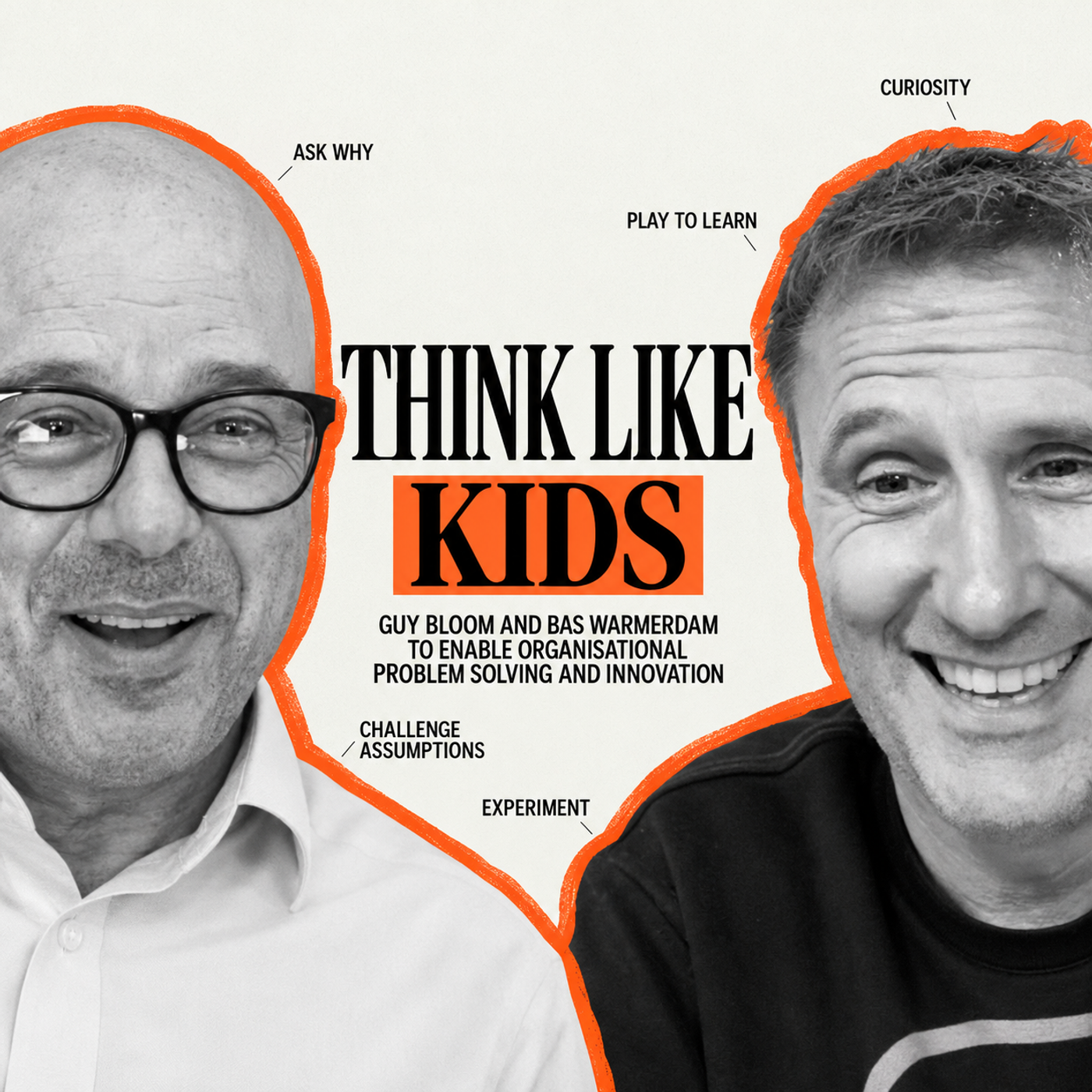
In this episode of Leadership Bites, Guy Bloom interviews Bas Warmerdam, who discusses the innovative approach of utilizing children's creative thinking to solve complex organizational problems. The conversation explores the importance of childlike intelligence in fostering fresh perspectives and problem-solving skills within professional settings. The conversation explores innovative approaches to problem-solving in educational settings, particularly through engaging children in collaborative projects that involve real-world challenges. Bas Warmerdam discusses the dynamics of teamwork, the importance of creativity, and how children's perspectives can lead to unexpected solutions. Takeaways Childlike intelligence fosters creativity Simplifying complex problems aids understanding Engaging children fosters creativity Collaboration bridges communication gaps Chapters 00:00 Harnessing Childlike Intelligence 01:54 The Journey to Innovative Thinking 08:12 Engaging Adults with Childlike Perspectives 14:30 Translating Complexity for Kids 16:44 Real-World Applications of Childlike Thinking 23:47 Fostering Collaboration Among Teams 24:49 The Power of Imagination in Problem Solving 27:11 Engaging Kids in Real-World Challenges 30:14 Transforming Adult Perspectives 31:39 Learning from Children's Insights 35:35 Encouraging Creative Thinking 40:09 Applying Childlike Principles in Professional Settings
Guy Bloom00000: So on that note, Baz, it is great to have you on this episode of Leadership Bytes. Welcome. Bas Warmerdam: Thanks, thanks for having me. Guy Bloom00000: absolute pleasure and as I do with I think the last hundred and sixty something guests I've had on so maybe one day I'll break the theme but I can't do it right now is I just want you to introduce yourself and I'd love you to do it from the perspective of if you're at a social gathering and somebody said well you two should speak and I went Baz what do you do? what would be the kind of non-CV download but trying to make sense of it for people this is what I do. Bas Warmerdam: Yeah, so first of all, my name is Bas Marmerdam. I'm located in the Netherlands, so it's a Dutch name. And the introduction, it depends on the type of social gathering. But Guy Bloom00000: There is that. Bas Warmerdam: normally it would be something like, well, what I do is we just help organizations solve complex stuff, but we utilize the creative thinking power of kids for that. Guy Bloom00000: And that's what pulled me in straight away when I got to hear about you. I work with organizations, I do leadership development, executive coaching, all that kind of stuff. Don't need to explain that right now, but I am working with senior teams and the thinking process is something I'm quite fascinated by. So Bas Warmerdam: Yep. Guy Bloom00000: just... Let's, I don't know where to begin, but I think maybe, how did you get into a space where you went, this is a frame of reference that I think not just is some kind of ethereal idea, but I think this stands up to some empirical poking and I think there's Bas Warmerdam: Yeah. Guy Bloom00000: something in it. How did you get there? Bas Warmerdam: Yeah, a quick intro and then I'll definitely answer your question. But my background is I've got a degree in biopharmaceutical sciences, then sort of got tricked into... doing work as a strategy consultant, which I also in social gatherings love to explain as, we were just hired by organizations who had a problem flowing over there. And then we pretended we knew how to solve stuff and for some weird reason started wearing a suit and getting paid way too much money. And that was the starting point of my career. And I was just sort of, you know, as most of the lists probably as well, just go through sort of a process that everybody goes through. So in my case, did an executive MBA, you get these way too expensive degrees, etc. And you had all these smart people surrounding me, but they were all the same. And I was looking for something different. I got in. contact with some ideas that kids have this unbiased view on things and started reading up about that and came across some cool inventions they did. And I wanted to connect that to that world of strategy consultant. And that was basically the starting point, but that was theory. You know, it's a fun story. And the only thing you can sort of check if it's real is start doing it. And I started doing that over 10 years ago. Guy Bloom00000: So when I think of that, I've got two things that jump into my mind. Somebody, Bas Warmerdam: Yeah. Guy Bloom00000: I heard it somewhere, I read it, maybe, heaven forbid, I haven't thought it, probably not, but somebody just went, you know, know kids sometimes just look at their own feet and they just spend 10 minutes kind of. walking but looking at their own feet because they're kind of they're curious they're fascinated they're they're interested Bas Warmerdam: Yeah. Guy Bloom00000: and somewhere you lose that and I thought you know that that's that's stuck with me so I have no idea if this is going to bear any value to the conversation we're going to but but there Bas Warmerdam: It does. Guy Bloom00000: was that that's the bit that when you speak I kind of go you know well that's and that's why I wanted to speak to you because there is something about that curiosity and there's an exercise that is pretty well known in the circles which is the building a tower with spaghetti. Most people have come across it and for those that listening basically you build a tower with spaghetti right and it's the one that can stand up the tallest and the evidence piece around it seems to be that kids are pretty good at doing it and One of the reasons that they're pretty good at doing it is they don't negate what could happen. they seem to just work from a position of possibility. So I'm gonna pause there because I in no way hold expertise in your field. Bas Warmerdam: Hahaha Guy Bloom00000: But when I came across you, those were the things that kind of jumped into my mind. And I'm just, I don't know, just to be great to hear you sort of pick up on that and or start to talk about, well, there's some truth in there, guy, and that's why, that's where it takes us. Bas Warmerdam: Yeah, it's the famous marshmallow challenge you're referring to. we're Guy Bloom00000: That's the one, yeah. Bas Warmerdam: actually doing that when we work with kids as well to let them experience that they do it differently than professionals do. And we can touch upon that a bit later. But what I find fascinating is, you know, there are not a lot of kids who are sort of busy with the paradigm shifts around energy transition or I don't know. thinking about governance or strategic alignment. It's just that stuff they're working on. And I love that. But if you can connect their thinking to these type of challenges, then the fun happens. And they have these fresh perspectives on it because they have never heard about it. And the weird thing for professionals and it's the same for me is, you're aware of what you've learned and the way we should do things. And even the thing we kicked off before the countdown, like, yeah, well, I'm wearing the headphones because I always do that. And that's the same in organizations. People do stuff because they always did that or they heard it somewhere or whatever. Kids don't have that sort of baggage yet and it's fun the way they react to certain situations. And if you combine that sort of, we started calling that childlike intelligence, but if you combine that childlike intelligence with the expertise in an organization, then the magic happens. And I still love doing it. I was talking to a friend yesterday and said, why do you still like doing this? Because I used to be somebody who would jump up and do another job in two years or three years time. But I think the reason why I still like it is that kids sort of keep inspiring me as well. Because we work on a lot of different challenges from organizations. But each time they come up with something different and it keeps you fresh. that keeps me fresh as well. Guy Bloom00000: So when you walk into a room of inverted commas adults and whatever that means but Bas Warmerdam: You Guy Bloom00000: you know let's say you me in the room and Bas Warmerdam: Yep. Guy Bloom00000: you have people that will you know there's always a distribution curve of it doesn't matter to do this sounds exciting let's go for it all the way Bas Warmerdam: You Guy Bloom00000: through yeah you could do any old rubbish and they'd be up for it right there's always in fact Bas Warmerdam: Yeah. Guy Bloom00000: those are the ones I usually got to worry the most about because actually you don't even know if what you did was any good because they just Bas Warmerdam: Yeah. Guy Bloom00000: they just enjoy doing stuff but all Bas Warmerdam: Yeah. Guy Bloom00000: the way over to the The saboteur would be the wrong word but the person Bas Warmerdam: Yeah. Guy Bloom00000: that inverted commas has seen it all before is dismissive of doesn't see how it's going to help, why are we doing this, this looks like a waste of time. So what's the frame for walking into a room and saying to people, look you're all somewhere in reference to what we're about to do. What's your lead in to getting people to meet you halfway on the bridge of contribution. Bas Warmerdam: Yeah, you phrased it very nicely and I totally understand the curve you're describing. So a couple of things. So one, when I came up with this idea about 10 years ago, I explained it to friends of mine. It's a couple and they're both corporate lawyers. And they knew that I had a good job. And I said, no, I'm going to quit my job. I'm going to do this. And the guy reacted like, this is brilliant. This is unique. It's really, really brilliant. And his wife said, this is ridiculous. This is never going to work. So you have these sort of two completely different views on what this could be. And I see the same when I enter a room or when I start talking to potential clients or doing a session. And maybe the easiest way to explain it is I do these sessions thinking like a child for profession. So just I did one couple of weeks ago. He 100 CFOs in the room, all wearing the same gray suits. Guy Bloom00000: You Bas Warmerdam: And I just tell them my story and then I start challenging them. And that's where the connection. occurs because what I challenge them to is, you know, just write down your most complex problem you're working on, no matter the complexity. And the second challenge is how would you explain that to a 10 year old and then give them examples, et cetera, et cetera. So it's not about. you know, giving them all these kids are brilliant and they will solve everything. But it starts with can you look at your problem from a different perspective through the eyes of a 10 year old? And I always love to, especially for the critics, love to sort of point out to these guys, if you're not able to translate it to something that a 10 year old can understand, that's your problem. Then you don't understand it well enough. The cool thing is there's a difference between people in a professional setting and at home. let's say 80 or 90 percent of the people in the room have kids or at least in their surroundings. So they know how kids can be. And once you connect that sort of at home situation to the complexity in organizations, then they're open for it. Because a lot of people understand that kids do think differently. And if you can explain how to connect that different type of thinking to the stuff they're working on in their organizations, then you there. And of course, it's not magic. So you keep having critics, you know, it's sort of the same curve. But the fact that a lot of people have kids or are aware of how kids are different. Yeah, that's the way. Guy Bloom00000: So there is, and please, you know, course correct me and calibrate Bas Warmerdam: Yeah. Guy Bloom00000: me because I'm coming at this with a conversation with you for the first time. Is that a metaphor or a lens cleaning that kind of says there's something about the ability, maybe like the new starter, like the Bas Warmerdam: Mm-hmm. Guy Bloom00000: person who is outside of your industry, Bas Warmerdam: Yep. Guy Bloom00000: the person who... reality is smart enough to understand it but doesn't but hasn't been shown it and actually maybe the problem is when you understand the thing too well it becomes its own problem And I think when people start in a new organization as a new hire, especially if something's gone wrong before, and people say, me explain the history to it, sometimes we'll actually don't. Let me just experience it because I don't want to understand it maybe as well as you do. And Bas Warmerdam: Yeah. Guy Bloom00000: I just wonder if some of that is in play here. Bas Warmerdam: Definitely, think there's a big overlap on the same dynamics as the new guy in the office. But then to the extreme, because suddenly it's not that 25 year old or the 30 year old or whatever the age, but it's a 10 year old. But what you then have to do is... You have to do some explanation. So that's also part of the way we work here. We translate complexity into something that a 10 year old can understand. So building a story and then these kids can react on that story. But what I've recognized, it's really sort of the newcomer to the extreme. But at the same time, and that's also very cool, is people are open to the ideas that come out of it because it's only a 10 year old saying that instead of, I don't know. new colleague or a consultant or whatever. So it comes from a source which is neutral and that adds value on its own besides that fresh perspective. Guy Bloom00000: So there's the child element, you know, a new pair might be, you know, they may have motivations, they may have, but actually from the child's perspective, I offer you this with no Machiavellian, no political Bas Warmerdam: Yeah. Guy Bloom00000: intent, no, there's a purity to my question. Bas Warmerdam: Yeah. Guy Bloom00000: And actually, if you can't answer it, now as long as it's not, know, why does it taste like a banana? And we're talking about cars, you go, hold on a minute. But as long as it's actually on target as a question, actually the challenge is, well, that's over simplistic, is it? So Bas Warmerdam: Mm-hmm. Guy Bloom00000: is that part of that process that actually, am I hearing you say that part of the answer to this or part of its process is how? how intrinsically basic can you make it so it becomes more navigable, more... is that part of this? to reduce it, not to the ridiculous, but to reduce it to its base concepts that actually then means, and then maybe go from there, but actually let's remember what we're trying to solve. Is that part of that? Bas Warmerdam: It is sort of part of it and that's a vague answer, but let me clarify. Yeah, I love the conversation, Guy Bloom00000: Calibrate my thinking there please. Bas Warmerdam: I'm calibrating my thinking on the spot. A couple of things. So one, maybe let me explain a couple of things first and then it makes sense why I'm giving this answer. If we work on a project, it basically consists of a couple of steps, but the first two steps are step one, understanding what's going on. So that's professionals among each other. What's the problem? Why aren't you solving it on your own, et cetera? And then step two is translating that into something that a 10 year old can understand. So in step three, we can start working with kids on it. That's what I was doing when I started my own organization. But what happened is we saw these translations that we made popping up in different corners in the same organization, because suddenly it became so clear what was going on. That was not the goal. The goal was only to bridge it towards the thinking of kids. So they came and asked, can you help us clarify our own problems in a way that a 10 year old can understand? So one thing that what's happening is even if you don't get kids involved, even translating it to something that a 10 year old can understand clarifies it, because then, and then coming back to your answer, you have to get to the core dynamics. What is really going on? And sometimes, you you can translate something which is going on in the financial sector to something that's going on in a cookie factory. It's the same dynamics. It's a different product or service or whatever you want to call it. And then suddenly people start viewing it in a different way. So that's definitely one thing that's going on when you do that. And the other thing is kids really, really look at it differently and they challenge you on so many perspectives. That's just fun. It's not that they have all the answers, but they trigger you to different kinds of thinking, especially if you increase volume of kids. So if you get a lot of kids involved, then your thinking is definitely challenged. And if you combine the output of that with the expertise, then the fun happens. Guy Bloom00000: So how are you doing that as an actual reality? it... So give me a sense of if I was watching a video what might I see in a room? You know, five adults and 25 kids or what are the age? Where do you get them from? Is there a shop? Where do you get them from? Bas Warmerdam: Yeah, I have different answers to the last one, but as this is recorded, I'll keep it professional, Guy Bloom00000: Yes. Bas Warmerdam: I'll run you through it. So back to the steps. So the first step is, you have the three, four experts in a room clarifying what's going on. And I'm really challenging them. Here you have examples of it, why it's not working, et cetera. But that's basically consultancy stuff, understanding what the problem is. Now, step two is translating. But step three, and that's what you're asking for, is we take over a couple of primary school classes, depending on the country you operate in. But normally, that's in the age range of nine to 12, because then they're still in primary school. So one teacher, and we can work with them for a morning or a full day. So let's say, on average, we have 25 kids in the room. And the clients are there, maximum of three professionals in the room, because otherwise it's, the dynamics get a bit weird. And we work with them for let's say three or four hours and we run them through different steps in the classroom. So when we're working with the kids, it's not about solving the problem, it's about teaching them problem solving skills. And accidentally we sort of play with them on that real life case of the organization. So we're teaching them those problems. problem solving skills and you have these professionals sitting in the back of the classroom or walking around and there's interaction with these kids. And most of the times I really, you know, we work with illustrations and we have this fictive things that we created where the story is taking place, but we let the main characters actually look the same as the clients. So if you really look at them and you look in the back, then you can recognize them, but you really have to look very, very good. in about two, three hours suddenly they see the connections like, wait a minute, that's that guy in the back of the room. this is actually real. Yes, it's real. So we build up the tension. But we do this with multiple classes, so primary school classes. So on average, we involve five to 10 different primary school classes in the area that the client operates in. And I love to work with really diverse group of kids. So it's not only sort of the high potential smart kids, but in very different areas, very different backgrounds, very different types of school systems. And we run the same program and we have these kids thinking about solutions, but from the angle of, hey, this is a problem solving skill. How would you apply this to this case? And what's happening now? So that's, and by the way, this is sort of the the process explanation, but in reality it's chaos. And we actually kick off with the Marshmallow Challenge, because then they start building something and they can explain something. And then the whole morning is chaos. And at the same time, they're, you know, taking these problem solving skills in and they're actually solving something. And the way I present the problem to the kids is, you know, we have these thousand professionals who haven't been able to solve this. So I said, we're going to come to you because I think you can do it. And in the beginning, they're like, who's this weird guy? But suddenly, you know, connection takes place. They actually see that we like the ideas. You see these professionals in the room and then, yeah, they start trusting you a bit more and the proud, they're very proud at the end. So that's cool. Guy Bloom00000: So what can children between nine and 12 cope with? Cope with is probably the wrong word, manage, Bas Warmerdam: Yeah. Guy Bloom00000: as a level of reflection. I mean, you can't talk thermonuclear fusion and we can't, know, or can we? I don't know. What is it that, yes, exactly. That it's, what are they able to sensibly work with that you could go, well, they could manage a relationship question, they could manage a marketing question. Where is your... just because right now I'm like going, know, well, because there are nine year olds and nine year olds and, you know, et cetera, Bas Warmerdam: Yeah. Guy Bloom00000: et cetera. So I just be understand what is it that they can work with that because, you know, puzzles are set to age groups, aren't they? You know, this puzzle is for a level of complexity with. just give me a sense of how What an example of how that commercial situation take off the client's name but imagine how that was translated into their voice and then how they could offer it back and how that could then be picked up on as not childlike thinking but blimey there's an answer in there. I'd love to get a sense of that I think. Bas Warmerdam: Yeah, yeah, no, clear. for me, there are a couple of things in your question. the short answer is nothing is too complex. So. As I mentioned, I live in the Netherlands. I wrote a small book here that's only in Dutch. it's no promotion. if I translate that to English, it's called Little Consultants. And in the book, I challenge myself, what is really complex and how would I explain that to a 10 year old? In my case, it's quantum mechanics. So I started reading up about quantum entanglement. But even quantum entanglement, you can easily explain to a 10 year old so they can help do stuff with it. So there's no limit. to the complexity only into what you can translate it into. But just to give you a quick example, so we did a big reorganisational challenge for a Dutch client, it's basically the Chamber of Commerce, and it was about these two departments that had to be fused into one. they how do you make them sort of one entity so they start working as one team and we explain that to the kids and and that's also why I just refer to the cookie factory we changed the setting into a cookie factory and I just wrote a story and I explained to this 10 year old you know we have this building there and you have these guys getting on their bikes to this building they spend about eight hours there and in the evening they they get back on bikes again and the fun thing is they get money for it what they do there And in this building you have these different rooms on the top left. That's the green room. That's where the planning guys work. And the planning guys have to figure out which cookie we're going to sell in one year time, which in two years time, which in three years time. Next to them is the yellow room. And that's where the inventors are staying. And the inventors, come up with a new cookie every minute and they want to start selling it straight away. And then in the bottom left you have the rule checkers and everybody with a great idea has to go there to ask for permission and they just say no to everything. And then on bottom right you have the production guys. They actually make the cookies and they're sold from the garage. And there's a boss looking, she's responsible for this whole building. And what she notices is within these rooms, it's going fairly okay. But between these rooms, it looks like they talk a different language. It looks like they have different priorities. And if they're really honest, they don't like each other. And that's a problem. And then the question is, how can you make sure that they start working together? And in this specific case, I also wrote in an additional element and I explained to these kids, you know, in this fictive world where this story is taking place. There's a board game that sells like crazy and the board game is called the collaboration game. But the problem is we lost the rules of the game. So can you help us rewrite the rules of the game so they can start playing it again? And we have a video game that consists of 10 levels. And in a normal video game, if you finish one level, you get something, so it becomes easier to get to the next level. So what do they get at each level? So it becomes easier. And now we haven't solved anything yet, but we created sort of a platform to explain to kids what's going on. And then they can start help thinking about it. And that's one of the ways that it works. And then kids can start reacting on it. And the fun thing is you can in these storylines, you can actually involve the real players. So how do you pronounce your name? Is it Guy or Guy? I'm not sure. Guy Bloom00000: Well, Guy en Francais, but Guy for England. Bas Warmerdam: Yes, So for instance, if you were part of the problem, I can write you in the story. I can actually name you a guy, then they would recognize it straight away. Or I give you a different name and I call you Eric, but you and I know that's you. And then kids start reflecting on those dynamics of Eric. that's really cool because every professional knows, they're basically saying, I don't know what guy's doing, but that's really weird. But what he should be doing is this. And that's really helpful. What's happening in your head now? Guy Bloom00000: Well, you know, it's like all things isn't it? I don't think you've ever come across horse whispering or that kind of exercise that you can do with leadership. It's like the first time I was like, so hold on there's a horse right? And then, yeah, yeah, Bas Warmerdam: Yeah. Guy Bloom00000: yeah, yeah, and they go in and the horse just... and that's it. And of course it just takes you a second and then you make sense of it and you go, this is quite a fantastic experience. So it's just letting that percolate through my brain. I'm interested also, I guess, in attention spans and turnaround and Bas Warmerdam: Yeah. Guy Bloom00000: that kind of ability to get kids into the right headspace, give them time to work on it and turn out an action. mean, that's, you know, if you just work with a group of adults, you know, the reality of the timeline of bringing them into a shared perspective, doing the actual work and then manifesting an output. Good Lord. That's its own job of work. So I'm just interested in Bas Warmerdam: Yeah. Guy Bloom00000: that kind of... What the kids experience, I think, actually, just at this point. I mean, we can look at the adults in a second. But how... Is it... that you're more or less working with the same schools. Well, no, no, can kind of, as long as the school's up for it, we can kind of go in. And do the kids need time with you prior, or is it no, just hi, you've never met me before and off you go? A little bit of that would be quite interesting. Bas Warmerdam: Yeah, so we never work with the same group, or never is a bit too strong, but we love to work with fresh groups, new groups, because one of my personal ambitions is to have this experience for as much kids as possible, because the link to the problem solving skills, you know, just spread that to different, as much groups as we can reach. But if we look at sort of the process within within the classroom, I definitely recognize, if you have to work with a group of professionals for two or three hours, that requires some planning and some reenergizing, etc. And it's the same with kids, of course, and the time span, they can sort of take up stuff is, I think, even shorter. And the group is way more diverse than professionals, I think, because we're still there's no selection taking place. just a primary school class and they live in the same neighborhood. And that's it. So in practice, what that involves is a lot of energizers, you know, just having fun with them. By accident, they learn something and by accident, they solve stuff and being really well prepared and flexible. So we have all these different tools to get these kids excited, work on the same problem and we know what we are looking for for the organization. Not so much as what they should say, but what we would like them to work on. So we can be surprised on what they say about that. And it's really short exercises. So we use a lot of fun, cool perspectives to have these kids look at these problems. And what we see happening each time is kids really feel proud, especially if you blow up the part about, this is a problem a thousand professional haven't solved that. And most of the times that is the case because it is something they're not able to solve and we're doing it with them. So they feel proud, they're having fun, but for some kids it's already fun because they don't have math or whatever. It's a different morning. But it's all fine, as long as it gets them excited, then we're up for it. So we do this with very diverse groups, very diverse neighborhoods, etc. And we can do it with any school. who's up for it, so that's basically the way we do it. Guy Bloom00000: And could you give me, if you're able to, and I think it's confidential, is just that, just an example or two of where maybe people have, as an organisation, have contributed to the process, they've been in the room, but they themselves have been surprised. I could imagine that you could go, okay well we'll see how this goes but I imagine that you know over time there's been a my goodness or two Bas Warmerdam: Yeah. Guy Bloom00000: and I'm just interested in what that might look like. Bas Warmerdam: Yeah, I'll give you a couple of examples. So one thing that I really like, not so much because what the kids were saying, I mentioned it because before I forget to mention it, is we had this challenge for these two managers in the same organizations and they were going like this. So I had to add, you know, my department is way more important than yours or whatever they phrase it, but they were not aligned. We got them involved in this Consult the Kids project and they went to the same class. So they joined the same session. And there was a session where there was the class of one of the kids of that of those managers. So we love to work with groups of kids where there's a link to some of the employees. But the reaction at the end was we changed into humans again. And that's what I loved. So they sort of took off their professional, I don't know how do you say that in English, but they chucked away the professional thing and they started acting normal again. that was the effect was brilliant. It had nothing to do with what the kids said or et cetera, but they changed the setting. But more to the fact what kids have mentioned or what we experience is. We did a big project for the Dutch railways. And basically the question was about what should be in the train if people would still like to go by train in 10 years time. And that's a question which is fairly close to sort of the world of kids, so they can really go for it. And what happened was one of the kids mentioned something that we didn't think about anymore, but she mentioned there are a lot of people in the train. that's, you know, not rocket science, but it was an element we didn't think about. But what happened is that her friend sitting next to her then mentioned in her own words, if there are a lot of people in the train, there are probably also a lot of smart people in the train. And that really triggered a couple of people in that classroom, including myself because what happened was we recognized that there's knowledge in those trains. So if you hover above a country, you see all these trains going by, there's knowledge in there. So how cool would it be if you can check questions in there and you're basically creating a crowd thinking concept within public transportation. You can do that in trains, in buses, or actually talking to a big airport at the moment to start piloting this while people are waiting for their planes. Guy Bloom00000: Hmm. Bas Warmerdam: And that's the way it happens. So you get triggered by these sort of micro thoughts or something in a chirp that's even in English. Guy Bloom00000: Yeah, it's like a wiki. It's like a crowd-surfed Wikipedia, isn't it? Yeah. Bas Warmerdam: Yeah. Yeah. And for me, and I told this to a couple of friends and they said, I would never participate in that. And I recognized Guy Bloom00000: Yeah. Bas Warmerdam: that because there are people that's like, no, not for me. For me. And I know there are way more, a lot of people like me. I get intrigued by a question. Something happens in my mind that's fun. I get energy from it. And so that could work. yeah. Guy Bloom00000: take 10 % of an airport in a 12 month period and they, the 10 % of somebody who's just sat there looking at something and goes, I think I know what the answer to that is. know, who knows, right? It's a crowd surfed, you know, et cetera. Hmm, yeah, I love it. Bas Warmerdam: Yeah. if you would do that, yeah. And if you would do that, let's say, he threw airport, you have somebody from Canada, somebody from Saudi Arabia, somebody from Japan, somebody from Guy Bloom00000: Hmm. Bas Warmerdam: you have all these different cultures going by. They could work. So what happens in the classroom is those type of, yeah, micro thoughts. And you start playing with it. And sometimes. you sort of translate that back and that's the second translation step we also use in our process. But you start translating those ideas back into something that makes sense in the professional context again. Guy Bloom00000: their video clip once, I think it was Shell, but it was one of those all, it was an all company and they were doing this event horizon thinking which is just Bas Warmerdam: Yeah. Guy Bloom00000: that kind of let's think above the event horizon and the capacity to do that was to work with possibility and not just go yes but and yeah but it became yes but imagine if it did opposed to yes but it never would yeah but what happens if it did right and that Bas Warmerdam: Yeah. Guy Bloom00000: it's that kind of it's taking the but to a to a possible as opposed to an impossible so there is this kind of yes but just imagine if I suppose like Dyson vacuum cleaners went yeah but imagine there was no bag Yeah, but we need the bags for the accessory sales. Yeah, Bas Warmerdam: Yeah. Yeah. Guy Bloom00000: imagine if you didn't. Yeah, but nobody would buy that. Yeah, but imagine if they did. It is that kind of capacity, I guess. Bas Warmerdam: Yeah, and for a lot of kids that comes naturally because they don't know that bags have to be there or they don't know that this has to occur. we also, we work with more than 20,000 kids around the world already. And we did sort of an analysis on their way of thinking. And we identified four thinking mechanisms, and one of them is no rules. And the fun thing about kids is they don't know that certain rules exist, linking to what you just mentioned with the dice and they have to be back to that. And the funny thing about kids also is that they sometimes know there are certain rules, but they don't care. And Guy Bloom00000: Yes. Bas Warmerdam: that's cool, but it's exactly what you want. So instead of that, you have to say to these kids, just imagine something that they do that by naturally and to make sure of it. That's also one of the problem solving skills that we teach the kids and that's yes. And so if they see somebody sitting next to them, you know, writing down a cool solution, for something and they think, well, this guy is crazy, that's ridiculous. I always say to them, you're allowed to think that, but you're not allowed to say it. Because what you have to do is you have to say yes to the things she's written down and then you add something to it. So end and then build on it and then create way more solutions. So even in a classroom that really helps. But the real reason why we're there is they have this imagination. by nature because they don't know these rules apply and that opens up our thinking as well. Guy Bloom00000: Yeah, I'll never forget being on a program once as a delegate 100,000 years ago and I went to say something, hesitated and pulled myself back and the facilitator said, what were you going to say, Guy? And I said, that's a stupid idea. And he said, well, your stupid idea is currently better than everybody else's no idea. Bas Warmerdam: Yeah. Yeah. Guy Bloom00000: which I love and that's stuck with me. It's creating that space of allowing it out. So you spoke about kids not knowing the rules and also even if they do, kind of, so what? I mean, when you say rule, you know, as in an unbreakable rule, you know, I think you said four things. Were those the first two or was that just one of them? No rules. Bas Warmerdam: Now the first one is no rules, explaining these two different angles. The second one that we found is something that we started calling have fun. So if you look at the solutions kids come up with, 80 % of the solutions have a fun element in there that makes them smile. And we apply that quite often when we work with professionals only, so no kids involved. we sort of reteach those skills to professionals is I was explained to them, you if you come up with a solution that makes you smile, the chance increases that you actually start doing it. And the worst thing that can happen is you smiled. So that's good. That's a value on its own. So that's the second mechanism that we found. And the third one is is something that we started calling do good. What we notice is that kids have a really cool sort of moral compass, so they want to do good for the people or whatever involved. And the funny thing with kids is that they can shift in two seconds to something really evil and then shift back to something really good again. But in essence, there's a tendency to do good. And if you apply that in professional settings, that already delivers value on its own. And the fourth one is something that we started calling no shame. And, and, know, if we work with professionals, yes, we get cool stuff already, but it's thinking like times 10 gets really sort of stretch your thinking. And if you still see sort of an ethical boundary, when you're coming up with ideas, you have to really cross it. And I explain it to professionals very often, like, okay, if you come up with an idea, at least three people should get angry to really worried about your state of mind. Then you're almost there. And it's not. The goal is not to make people angry, but goal is to stretch your thinking. Guy Bloom00000: that it's disturbing the status quo, it's giving people something to challenge their reality. Bas Warmerdam: Yeah. Yeah. Guy Bloom00000: Interesting. So you mentioned there's a no kids version of the working with kids, right? Bas Warmerdam: OK. Yeah. Guy Bloom00000: So how does that, I mean again not so much how does that work but just... I can imagine that the children themselves have an energy, they have a way of disarming people and having an intelligent naivety that isn't filtered through the world yet. And I can see that. Then you work with adults and that comes with the full distribution curve of what adults can be. So what's your kind of... manner of getting is it getting adults into a childlike state or no it's balancing two truths about their ability to do that kind of work when actually they've just you know they've it could be that they've been mandated into a process you know I sometimes call the no obligation fully mandated workshop Bas Warmerdam: Yeah. Guy Bloom00000: Thank you for coming to the thing that you had to come to. Bas Warmerdam: Yeah. Guy Bloom00000: So some people are really excited about it, but others not. So how do you get the adults into a space where this principle is workable? Bas Warmerdam: Yeah. Well, via sort of smaller experiments. So let them experience that kids really view things differently. So that's sort of connecting them to what's basically our foundation or formula or whatever you want to call it. Share examples. So that show them this is real. And at the same time, show them a couple of clients. So it always helps if you can mention, I will work for Philips shells and OV. OK, this is something different than I thought you were working for schools. Now we work with schools, but we work for the big corporates, different countries, et cetera. So that builds authority at the same time, just keeping it relaxed. But it's necessary to get some people on board and then let them experience it full blown and then, you know, really working on their own challenges, then applying these different lenses and coming up with something that we started calling curious little experiments, setting something up because you wonder what's gonna happen. No KPIs, no defined results, I'm just curious what's gonna happen. But from the perspective of doing good, having fun, solving something. And that really triggers a lot of people. again, more than sure that maybe 10 % in the room is like, okay, not my cup of tea or I liked it, okay. that's, know, again, there is a good there as well. But you get them on board, fire those type of tools, especially if you help them. You know, everybody has their own. problems in a project or a team or whatever. And if you sort of give them ingredients, how they can improve that or solve that, then you're creating value and then you're there. Guy Bloom00000: exciting. Now you said your book is not translated into English. Now Baz, what's going on? Bas Warmerdam: Yeah, I got a request from a couple of organizations already. We we're doing stuff in the US and Canada as well. And that sounds bigger than it is, but we're trying to get some Guy Bloom00000: Yeah. Bas Warmerdam: going there. So the request came, but it's also something linked to sort of prioritizing things. We just love working with clients more than translating a book and working on that. Guy Bloom00000: You've got to be able to give it to Google or something and go translate this into English to do the bulk and then read it. It's got to go back 20 years and that was a painful exercise but it's got to be doable. But it's got to become easier. Bas Warmerdam: Definitely, definitely, it's... Yeah, but with the Chedji Petit it becomes easier. Guy Bloom00000: So Baz if people wanted to connect with you and just reach out and find more about you where do they go? Bas Warmerdam: Well, two ways are most convenient. So one is the website called consultingkids.com and kids, of course, then is K I D S. And the other one is just look me up at LinkedIn. The name is maybe you can share it, but the name is Bus Guy Bloom00000: percent. Bas Warmerdam: Warmerdom. And if you just type that in LinkedIn, you'll find me connect me and let's start. talking and that's also one of the reasons why I reached out to you guys. And we have a strong base in the Netherlands. We're trying to do stuff in the UK, Germany and some other countries, but I believe this can be done anywhere and we should do this in the UK. Yeah. Guy Bloom00000: When we finished, I'm going to have a little conversation with you about some stuff. So, consultingkids.com, Baz Warmerdam, B-A-S, and then W-A-R-M-E-R-D-A-M, but your name will be in the title of the podcast, ba-bum, there you go. Bas Warmerdam: Yep. Guy Bloom00000: So listen, you know, all of these things could go on and on and on, and as a... facilitator, consultant, whatever you want to call me. I often say this with a bottle of wine and a pizza. We could be at this for two or three days. I just have to round it off to Bas Warmerdam: I think so, Guy Bloom00000: people's willingness to listen to a podcast. So listen, think this is, I think it's really exciting. I think with all of these kinds of things, sometimes these are tools in your toolbox and... There is that phrase, there? The thinking that got you into the problem may not be the thinking that gets you out of the problem. Bas Warmerdam: Yeah. Guy Bloom00000: So there's a whole host of reasons to look at different interventions, especially with mature teams where, you know, is this just, we're always going to approach everything in the same way. Or actually, is there an input into us as a team or whatever it might be that gives us another hat that we can put on that says, hey, we're stuck. Let's, let's, do you remember that work we did with Baz? that hat on and ba-ba-bum. So I think there's there's huge value in that. So on that note I'm going to say thank you so much. Obviously stay on so we can just talk for a few moments and I can make sure everything's uploaded but from me to you it's been an absolute joy. Thank you so much. Bas Warmerdam: Thanks for having me.