
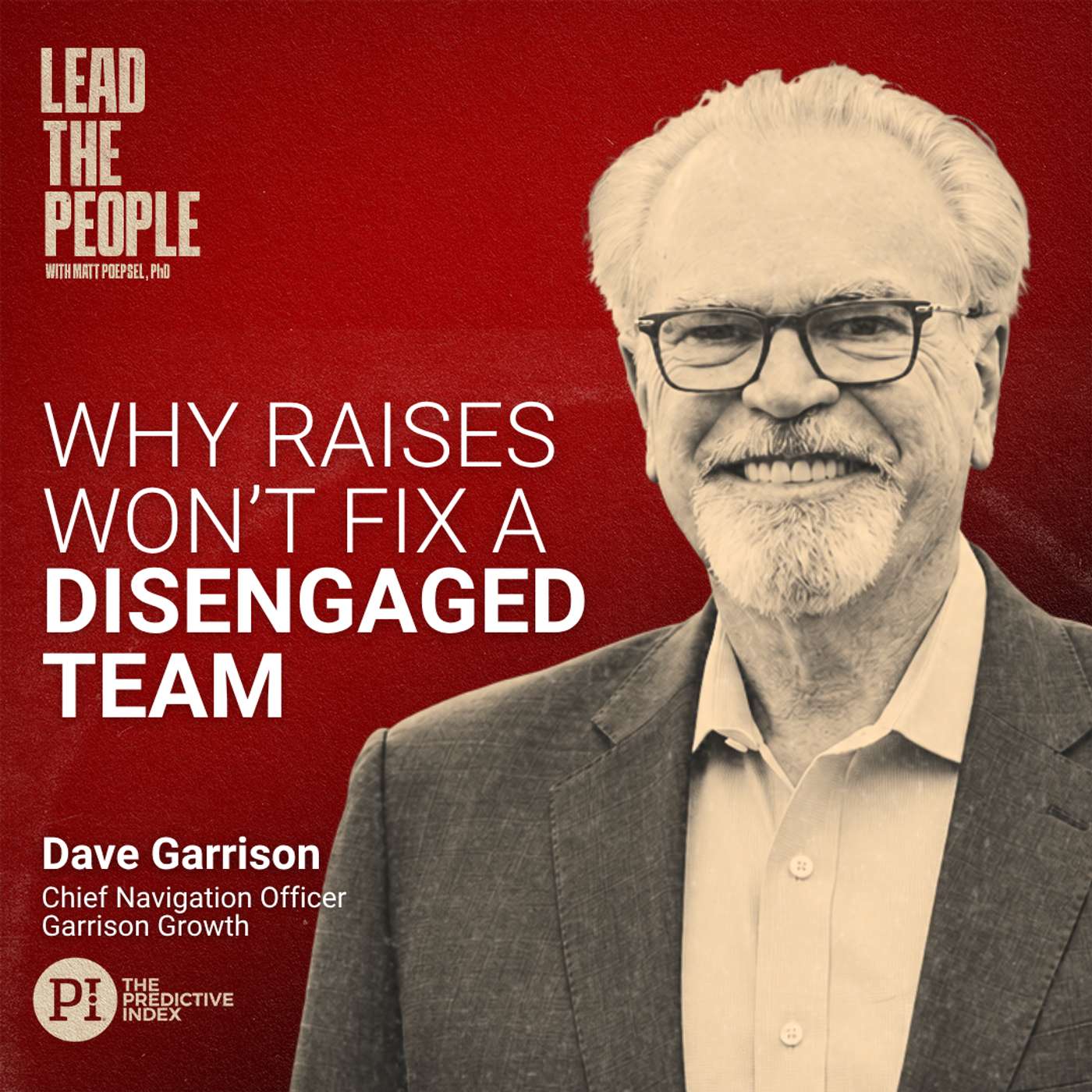
Lead the People · Matt Poepsel, PhD
Start with our free behavioral assessment. Go to trypi.com/ltp . Dave Garrison’s factory client was sure workers were leaving for General Electric because the pay was better. So Dave had them run small group sessions and ask what was really going on. People were finding out on Wednesday or Thursday how many hours of Saturday overtime they owed, after they had already promised their kids a ball game or a church picnic. Once leaders posted the schedule two weeks ahead, the problem went away. Dave ran public and venture-backed companies as a CEO and served on the Ameritrade board, and he says most leaders hear “I got a better job,” write a story about money, and never find out what the people who left would have said. Matt Poepsel sits down with Dave Garrison, Chief Navigation Officer at Garrison Growth and author of The Buy-In Advantage: Why Employees Stop Caring and How Great Leaders Inspire Everyone to Give Their All, to talk about the polite “okay” that follows a big announcement and what it hides. Dave explains why a team that seems fine may only be compliant, why exit interviews rarely tell the truth, and why debate in meetings wastes time you could spend collecting everyone’s ideas. He also makes the case that AI adoption stalls for the same reason as every other initiative. People were done to, not done with. What you’ll learn: Compliance Looks Like Buy-In: Teams that say “tell me what you want me to do” will stay mercenaries until leaders meet four needs. People want a purpose beyond money, to be seen as a human being and not a human doing, room to grow, and a voice in how the work gets done. Share the Checklist, Not the Idea: Skip “any questions?” Give your team the criteria that tell you an idea is good, let them brainstorm first, and put your own idea on the board last. Weigh the Ox: Galton’s county fair and a classroom election guess both show how collective genius works. Collect everyone’s input with no debate, give each person four votes, and let the leader go last. Three Is Greater Than Seven: A CEO with twenty ideas leaves managers guessing which one will get asked about. Hold to three until they’re finished and keep the rest on a “next ideas” list. Highlights: (0:00) Meet Dave Garrison (2:23) What happens when you tell a team “this is what we’re going to do?” (5:34) When to be directive and when to be participative (11:53) The factory story and the General Electric pay assumption (14:59) Why giving answers got us promoted and why it’s hard to shake (16:34) Slowing down to ask questions in a business demanding speed (21:05) How people are wired and why quieter voices get steamrolled (23:18) “Three is greater than seven” when you’re the guy with seventeen priorities (26:15) Leaders who think their people are coin operated (27:51) Why resistance to AI adoption is a buy-in problem (31:37) Are You Smarter Than AI? Resources: Follow Dave on LinkedIn: https://www.linkedin.com/in/dave-garrison-growth/ Take the free buy-in assessment...
Dave Garrison (00:00): Instead of sharing your idea and then asking the world's dumbest question, which is any questions? What we do instead as great leaders that inspire people to give their all is we think about how do we know our idea is a great idea? It's because it needs a checklist in your head that nobody can see. Matt Poepsel (00:28): Hey everybody, before we get started, welcome to this episode of Lead the People. I'm so glad that you're here. Just had an amazing conversation with Dave Garrison. I think you're going to love it. Basically what we started to talk about was this notion of buy-in. And it's so frustrating sometimes when we feel like our people aren't buying in, but Dave helps us understand there's things that we can do as leaders to be able to ensure that we can get that kind of buy-in. There's things that we have to go first. I always say as leaders, we go first and Dave teaches us exactly how to do that. He also talks about the importance of asking questions versus answering questions, something we may have been rewarded for doing for a long time, but we have to break ourselves of that habit. And finally, how do we tap into our collective genius? (01:09): There's so much great talent and insight and perspective on our teams, but we have to take steps to structure a way to get that to surface. So I think you're really going to enjoy this conversation with Dave as much as I did. I'll leave you to it. (01:26): Most leaders are going to recognize this moment. You bring an idea to your team, you're fired up about it, and you get back applause. Okay. A few weeks later, nothing's moved. My guest says that's a buy-in problem, and a few weeks later it's really damaging more than we even think. Dave Garrison ran public and venture-backed companies as a CEO and served on the board of Ameritrade. And today he works with leadership teams around the world, getting their people to genuinely care about where the company is going. His book is The Buy-In Advantage: Why Employees Stop Caring and How Great Leaders Inspire Everyone to Give Their All. I love how practical it is, and I can't wait for this conversation. We're going to dig into things like why a raise won't fix a disengaged team and what the best leaders do instead. With that, Dave, welcome to the show. Dave Garrison (02:07): Thank you. Delighted to be here, Matt. Matt Poepsel (02:09): Well, this is a hugely important topic in my opinion, because we are needing buy-in to make these types of transformative changes in ways and at a speed we've never had before, and I wouldn't say it's going all that well. So I thought we could start with where I mentioned in the open, what is happening when you tell a team this is what we're going to do, and then you get back that kind of muffled response. Dave Garrison (02:33): Yeah, so what's happening is people hear you, they respect you, and they're what we call compliant on the buy-in scale. On the barometer, they're compliant. Look, tell me what you want me to do. I'll do the best to do it. Thank you very much. What's for lunch? Where do you guys want to go? What are you doing this weekend? Matt Poepsel (02:50): It's unbelievable and it's so true. It's like, what is the basics that I need to know? Are they overwhelmed? I don't think that they're completely ignoring our plight, so to speak, but it seems like there might be a lot going on behind the scenes there. Dave Garrison (03:02): There's a mindset of what my role is at this organization. What we know from the research is people are looking for four things from an organization. Most of the time, none of those needs are met, so then it becomes transactional. They're mercenaries. You pay me money, you tell me what to do. I'll try my best. Glad to be here. Thank you very much. So it's not people are unpleasant. If you want to do a satisfaction study, people might be satisfied. People might be engaged, so we get distracted by this engagement number from Gallup. All that says is, "Would you recommend this as a place to work?" Well, you might recommend it as a place to work because you like the free pizza Fridays, you like the people you work with, it's close to your home. It's easy. It's easy work. You have no idea why they're saying they're engaged. (03:52): Buy-in is a much higher standard. Buy-in is what you see Friday nights at football games and the high school football stands. That's buy-in. The people are capable of it. Where is it on Monday morning? Matt Poepsel (04:07): Well, and I tell you, it's one of these things where as the leader, the reason that you are a leader is because you're trying to tap into the collective energies of your team to be able to accomplish things that are obviously more than you could do by yourself. And there's talent you have on the team, you need to tap into all of that stuff. But I know one of your YPO members had described something to you that I relate to as well, which is you find yourself running up the top of the mountain and you're like, "All right team, here we are." And then you look backward and you're like, everybody's still at the bottom. You're, I thought you were with me this whole time. What is going on there and how do we find ourselves in that place just over and over again as leaders? Dave Garrison (04:39): Yeah. Sometimes it's hard when we live inside our own jar to understand that people are in their jar as well and we can't read the label when we're inside the jar. So let me give you a practical example. Right now we're in budgeting season. So typical company will say, okay, here are the new targets, here's what we need to do. How are you going to do it? Which is a great way to disengage people. That's done to, not done with. Even if you've preset the targets, the opportunity is to go to a team, your team and say, Hey, here is what we're being asked to do. I'm curious, couple things. One, what questions do you have about the target? Two, what are your ideas on what we could do to help achieve it? And three, what are unintended consequences? I'd like you to consider those questions before we meet next Tuesday to talk about the ask. (05:29): That's working with people, not to people, not done to, that's done with. Matt Poepsel (05:34): Dave, I haven't made that mistake since this morning. When I all of a sudden wanted to move the team forward, everybody says that they want clarity, so I just come out and say, okay, here's what we're going to do, as opposed to then taking people with me and saying, what questions do you have? And in some regard, I'm looking back and I'm sheepish obviously hearing you say that because despite my tenured experience, it's easy to fall into that trap when we're under a time pressure, when we kind of get a conflicting message. Sometimes people don't act like they want to be asked. They even claim to want to be told what to do. How do I mediate that in my mind of saying, when's the time to be directive versus be participative, so to speak? Dave Garrison (06:10): Great question. If there's a fire or an emergency or instant action is needed or great harm will be done, tell people what to do. Otherwise, here's what I'd suggest. So you probably have a great idea about what to do to address some issue. Here's what we need to do to really delight clients we aren't doing now or whatever it is. I would ask you instead of sharing your idea and then asking the world's dumbest question, which is any questions? What we do instead as great leaders that inspire people to give their all is we think about how do we know our idea is a great idea? It's because it needs a checklist in your head that nobody can see. So what if we flipped the order and how about if we said, the issue I'm trying to address is how do we better delight clients or how do we reduce waste on the factory floor or whatever it is you're trying to address, I'd like to address that issue together and here's what I think is important as we consider an answer. (07:04): Is it something that could be implemented in the next 30 days? Is it easy to understand? Is it something that doesn't require outside resources? Whatever your checklist is that lets you know your idea is good, share the checklist, not the idea and give people a chance to share their experience and brainstorm their own ideas and then listen to their ideas first and then share yours. It may be that they've got much better ideas, but if you ask any questions about my idea, the answer is, hey man, great idea, man. Let's do it. Matt Poepsel (07:38): Well, it's one of those things too when I talk to my students, my graduate students, and they always say that the worst managers they've had in their history are micromanagers, people that didn't give them agency, give them a chance to have some input. And sometimes those managers might have just been poor managers, sometimes they may have been caught up as I have been. There's a lot of different reasons for it, but it's so amazing, Dave, when you say that, if I look back at my most rewarding times in my career, it's when a boss would've come to me and said, let me draw the box for you. So just give you the bounds, like you said, the checklist that's in my head, and then just let me know how I can help. If you need me to unblock something for you or answer something for you, happy to do it, but it's on you, man. (08:14): And I'm like, whoa, those were the times I got to stretch and grow and felt like I actually got to contribute at a different level. Dave Garrison (08:20): What needs to get done and the boundaries with which we do it are the important criteria that managers provide. The how we do it, let people apply their own experience. It is contrary to what has been done to us, so it's not natural. It doesn't cost anything, but most of us have never had that training. Four things that we know today's workforce is looking for four things. And that is they're looking to align with a sense of purpose of the company other than making money. It's how are we making a difference in the world? Give me a compelling purpose. The second is they want to be seen as a human being, not a human doing. The third is they want an opportunity to grow and learn, no big surprise. And the fourth is they want freedom and flexibility in how to make that happen. They want their voice heard. Matt Poepsel (09:09): Yeah. And it seems like we're in this perfect storm where those things, I don't know if they can't be offered, I don't know if we just don't remember that we need to offer them, but in many cases you see employees complaining that they're not being offered, and we feel more constrained and impinged than ever, whether it's the fact that now we have Gen Z workers who've entered and we don't really understand them all that well, or the pandemic sent us work from home and we haven't figured that out just yet or there's economic pressures or now there's AI. It is just unbelievable. At least what I'm seeing, are you seeing this in your research as well that there's just a lot that's making it harder to provide those things or are we just not being creative enough? Dave Garrison (09:43): Yes and yes. And I don't think it's any different than 20 years ago or 40 years ago. It's just the issues were different. The telephone was being introduced, the computer was being introduced, the mobile phone was being introduced. It's whatever. It's just different this time. And I don't think it's generational. I think it's economic cycle. It's where you are in the economic cycle of life. For example, if we look at whatever generation you pick that's 25 years old, they're interested in what do I really want in the future? Can I really afford a house or an apartment? Can I buy a condo? How do I deal with that issue? Can I afford to get married? Can I afford to have a family? Those are the issues they're thinking about. That's no different than any other generation at that age. So a lot of the research is showing it's age specific, not, oh, this generation is this, that generation is that. Matt Poepsel (10:30): When the Gen Alpha turns 25, they're going to be thinking about the same thing. How do I launch? Where do I land? These kinds of things. So the world will look totally different obviously by then. Well, maybe not totally, but a lot different by then. But yeah, I like that framing of it too, because I think it's too easy to chalk it up to artificial differences or this generation's just different, they value different things. Dave Garrison (10:49): Yeah. What’s the matter with kids these days? They don't roll up their shirt sleeves and put the effort in. Matt Poepsel (10:53): Yeah. I found an issue of the Harvard Business Review from the 1960s and the counterpoint that was in there was my employee showed up with mutton chops and bell bottoms and what am I supposed to do to coach this person? And they were debating this and it's so anachronistic, but it's like, okay, you're right, it just changes. It's always been there and we kind of have our own narrow view of what the workplace norms and realities are in that case too. Dave Garrison (11:17): Yeah, we call that your story. So you have a way to interpret the world that's perfectly true for you based on who you are, what your beliefs are, and what your experience is. If you present your story as the truth, like let me tell you the way it is, that's just telling people, I'm not interested in what you say. That's the truth. And you shut people out. That's doing to people, not doing with people. What great leaders who inspire people do is to say, Hey, look, here's how I make sense of this situation. It's just my way. I'm curious to know what you see. That's very different than here's the truth. Do you got anything to counter that? Matt Poepsel (11:53): And I think that the stories we tell ourselves kind of inform our worldview, just like you're saying. It reminded me of one of your factory clients that you were talking to who was really convinced telling themselves a story that they were losing talent to go down the street to work for another competitor because it was just that they were paying them more. What was really going on there? I think it's a really nice story to help us frame this up a bit. Dave Garrison (12:14): Well, in defense of the leaders who said people are going down the street to General Electric because they pay more, it makes sense because all they heard was, I got a better job. I got a better job. I got a better job. And the story they made of that data is, oh, they got more money. So we said, look, please do small group meetings and do a discovery session and ask what's really going on. And what they found was it was pay, but not what they thought. Here's what was happening. People were finding out on Wednesday or Thursday about the number of hours of overtime they had to work on Saturday, and people had already made commitments to their kids to go to the ball game, the family picnic, the church event. And they said, there isn't enough money that we could get paid to make me to renege on the promises to my family I've already made. (13:03): That was the only money issue. So when they got their planning cycle right and could let people know two weeks ahead of time, the issue went away. It wasn't about more money, it was about fairness about money. Matt Poepsel (13:14): And money's the easy thing to cite. And especially I think a lot of times we say, oh, sorry to hear you're leaving. We want to schedule an exit interview. You're like, okay, great. And they're like, we want to hear what was really going on. You're like, am I going to throw all these people under the bus on my way out the door? You know what? I got a better offer. They're like, okay, money it is, check. Moving on. Dave Garrison (13:32): The greatest lie. Matt Poepsel (13:33): Yeah. You go right to the CEO and you're like, oh yeah, they got paid more down street. They're like, well, can't compete with that. See you later. And you're like, wait a second. And now the real issues aren't surfacing. So what great advice to say, do a small group session and figure out what's really going on and being like, wow, that's actually something we can do something about. Dave Garrison (13:47): And the leader is not necessarily the person to do that if they're the issue. So one of our clients sent an exit document to the homes of employees who had left and said, pick one reason. Interestingly, pay was a major reason, but tied with pay was my boss, specifically poor communications. So they sent the same survey to the bosses and said, why did this person leave? Almost 100% of the bosses said, money. And so exit interviews done traditionally like, okay, what allowed you to leave, you're not going to throw people under the bus like you say. So we're not getting the data we need and the leader is not getting the feedback they need on how to improve and they're being measured on sales or throughput or operational efficiency or cost of money or something, but it's generally not what is our turnover rate? How are people experiencing this? (14:40): What's our productivity? Those are not numbers that come front and center in the weekly C-suite meetings. Matt Poepsel (14:45): Yeah, and they really need to, but I want to take us back to something else we were talking about just a minute ago, which was that let's say that I want to be one of the more benevolent bosses and I want to make sure that I'm giving people all those four characteristics that you shared with us earlier. I'm a problem solver and I've always loved solving problems. I look at them like puzzles. It's true in business, it's true in life. And so I'm the one who always tries to tell myself, don't give the answer, ask the question. Why is giving answers something we've actually got promoted for in the past? Why is it so hard to shake that habit? Dave Garrison (15:20): Yeah. Ms. McDonald in first grade at Anna P. Mote School in Marshallton, Delaware had a bulletin board that had cars on it. And for every book you read, your car moved forward. And I was trained from first grade that there is a right answer or behavior and we get rewarded for that behavior. So if she asked a question in class, what's two plus two? It's call on Dave, call on Dave, call on Dave. So we are trained, one, that there is a right answer, which is untrue. Two, we are trained that the person who gives the answer the first is somehow rewarded or the brightest or the most recognized or something. So we've gone through these years of training of memorization of right, and now we try to say, oh, I know the right answer without acknowledging there is no right answer. You have a right answer. (16:10): I have a right answer. Neither of them are right. Neither of them are true. It's just our truths. So when we can reframe and think about your answer and ask yourself, how do I know it's a great answer? And share the characteristics, not the answer. Matt Poepsel (16:23): It reminds me that a consultant that has the answers, you pay a little, but the consultant has the right questions, you pay a lot because - Dave Garrison (16:29): I love it. Matt Poepsel (16:29): They unlock something else completely different, right? Dave Garrison (16:32): I love it. Matt Poepsel (16:33): Oh man. But I think that sometimes I think a leader just makes the same mistake that I made this morning where it's like, if I give you the answer, we're going to go a lot faster. And if I invite dialogue, now all of a sudden, when's this going to end? We're going to be here another two weeks debating this issue. It feels like it's slow at a time when the business world is asking us and demanding of us to go faster than ever. So how do I reconcile that in my brain, the difference between slowing down to ask questions versus just telling people like, let me just fast-forward us in this process, right? Dave Garrison (17:03): I'm going to give you information that could cause you pain. Debate and discussion, eliminate it. Don't fall for it. Don't get sucked into debate and discussion in your meetings. Not a good use of time. Replace it instead with framing the issue that you're trying to solve, agreeing on criteria, allow people to brainstorm, just list out the different ideas, and then call on everybody's experience to inform each other what the best idea is. And we call that process, it's collective genius, but that specific voting is weighing the ox. Take us back to 1906 in the UK. Sir Francis Galton, statistician, rural UK, they had a county fair. They had an ox hanging from its legs, and he wondered, could people guess the weight of the ox? So 800 people or something came to the fair. Nobody got the weight of the ox right, but being a statistician, he took the median. (17:58): It was within one pound of the 1,198 pound ox. Fast-forward, US election. A month before the US presidential election, I asked my classmates on my section call from around the world, I said, "Who's going to win the US presidency and by how much?" They all dropped it in the chat. No discussion, no debate, no discussion, nothing. I forgot about it until February. The next call was coming up and I realized I got to give them the answer that they gave me. I looked it up. They were within a 0.4% of the results with no discussion, no debate. So what I'd ask you to do is use a process that's easy and simple to tap into everybody's expertise with no discussion. And what you'll see, this solution got the most answers. That's based on our collective wisdom. Matt Poepsel (18:45): That collective genius you're talking about, it's almost like if we open up for debate, now all of a sudden we're shaping each other's opinions, we're grandstanding, we're trying to win people over to our side. Am I right? Am I right? Give me some support here. But what you're saying is tap into the collective, but don't let the social processes kind of take us away from the point. Collectively, you're going to do a lot better than any of you are individually, and it doesn't require all that debate. Dave Garrison (19:08): And when you put up the ideas and go through that process, it's no longer Matt's idea. It's all of our ideas and it's just all on a board and they're all equal and we give them weight. And you know what? The second best idea, we'll get to that one next. Matt Poepsel (19:20): Yeah, I think that's a great, great example. I like the idea too of surfacing all the ideas because I don't have the perspective of everything else that my team might be working on, but then once I see the list, if there is some sort of voting or something, even without the debate, I'm sure we could still do a pretty effective job to land in the right place. And like you said, most of the things we do in business are pretty survivable, that if you didn't get the priorities quite right when it comes to one, two, three, but you get more or less, the cream's going to rise to the top, so to speak, if you tap into that collective genius. Dave Garrison (19:48): Yes. And to be clear, I want to caution you, this is not a process to allow your team to guess at what you think is right. This is not guessing what the boss thinks. Leaders go last. So when we're sharing ideas, you share your idea last and you don't put any more weight on it. You just say, "Well, here's another idea," and allow people to vote. If there are 15 ideas up there, give them four votes. You could put all four votes on one or one vote on each of four or however you want to do it, and then see what collective genius tells you. If you've set it up right, you as the leader should be fine with any answer because it meets the criteria you selected. So you're in control, but people are engaged and they're buying in. Matt Poepsel (20:29): Yeah, and I think that's where the whole thing comes back to is buying in. They had a participation role. I think the thing that we see disengage people the most, like you said, is when you're just handed something and you didn't have a chance to input at all, if you put in your input and it didn't get voted on, but you feel heard, it's a lot easier to accept that we're going in a slightly different direction versus if you never even got a chance to weigh in, you're like, "Do you even see what I'm seeing? Do you even care?" It's pretty isolating almost. And in terms of collective genius, I think you're really founded on this principle of that all of us are smarter than any single one of us, and it really comes down to values. And I know that in our world, when I think about behavioral dynamics, it's something I think about a lot. (21:08): And being with Predictive Index, I definitely understand the role of different personality types and how that can shape collective discourse, if you will. Is that something I need to take advantage of or take consideration of, I should say, when it comes to leading a group discussion? If we're reviewing, for example, how did the voting go if we didn't have any debate or when I'm landing it, how do you think about that in the context of collective genius, this understanding how people are wired? Dave Garrison (21:31): I think that understanding how people are wired, if we could back up a step or two, is really important as you hire the next person on your team or as you look at the composition of your team. It's probably more important there. But then if you know you only have one person, for example, who is process oriented or whatever, then make sure that their voice is being heard, make sure that their ideas are up there, not for debate or discussion, make sure that they contribute because their ideas will be different than the person who has a different orientation. Matt Poepsel (22:02): Sometimes we call those balancers, right? So typically this happens, I see this quite often when you have a sales team of these dynamic maniacs, people love risk, and then you hire your first sales operations person who's very different, and all of a sudden you invite them to the meeting and they're like, "Oh my gosh, I work with crazy people." And it's hard for them to be as extroverted and really put their opinions out there and they get steamrolled, and then all of a sudden we don't get all the benefit of why we hired this person who's very different from us unless we take steps. So that's what I'm hearing. The collective genius has to allow the collective voices to be heard almost. Dave Garrison (22:35): Yes, absolutely. And the other thing teams can do is to identify what their cumulative predictive index or Kolbe or Myers-Briggs or whatever, what their cumulative scores, ratings, orientations are, and make sure they're aware of the questions that they would not ask because it's not represented in their group. Matt Poepsel (22:56): Yeah, that's right. Yeah, I agree. I like that a lot. It's really interesting that the team itself is more, this is very gestalt, I suppose, but it's more than the sum of its parts. It's like you don't just take the average of everybody. It's got its own dynamic, and I think families are that way, work organizations are that way, period. Any group, any human system is kind of that way, and we have to understand it kind of takes on a dynamic of its own. Dave Garrison (23:16): Absolutely. Matt Poepsel (23:17): Well, I'm just asking for a friend here, Dave, asking for a friend. Let's say hypothetically you knew somebody who has trouble with priorities and they just had too much on their plate. They sign up for way too much. You have this great phrase, which is that three is greater than seven when it comes to priorities. I'm the guy, okay, I've claimed it now. I'm the guy that has seven, maybe 17 priorities at once because I love all the different things. What is it that you have for advice for somebody like me, and I know my listeners too, where it's just so tempting to have so many priorities, quote unquote. Dave Garrison (23:48): There's a company in New York that we interviewed two levels down from the CEO and said, "What's it like to work here?" And they said it's pretty miserable. And I said, why? They said, "You can never win." And I said, "You got to tell me what you're talking about." The CEO has 20 ideas. I have to choose which one to work on. If he asks me about one I chose not to work on yet, God help me because then he'll say, "You're not responding to what I do." So that's where the three is greater than seven. If the CEO or the leader, supervisor, manager can remain consistent with the three until they are completed, and if it's a big one, just chunk out the work, you'll be much more successful and people will be much less confused. Don't ignore your other 17 ideas, put them on the new ideas, next ideas list. (24:36): And then when you finish number two, bring up another one, but allow people to feel celebrations of accomplishment as opposed to overwhelmed because I don't know what to do next. Matt Poepsel (24:45): It's so brutal too, to be honest. As somebody who's kind of lived this for the last 30 plus years, when you don't take the time to pause and celebrate the achievement, you're just really onto the next thing all the time. It's debilitating in a way. Dave Garrison (24:55): It is. Matt Poepsel (24:56): You really end up exhausted and don't feel like you've accomplished anything. And then you look back and you're like, "Holy cow, I did a lot of stuff. No wonder I'm exhausted." Dave Garrison (25:04): Yeah. But imagine how your people feel if that's how you feel. Matt Poepsel (25:07): Right, right. And I think that's the thing that we have to take, not even just the opportunity, but I would say the responsibility to make sure that they're not inheriting our sort of distress because we can't do the discipline work of setting priorities. And therefore, when we hand it to them the way that that CEO did, you're setting your people up for struggle and we definitely shouldn't. Most of us don't do that on purpose, but it's a byproduct. Guess what? You still have to take accountability for it. Dave Garrison (25:33): Absolutely. I've not met the leader who says, "I'm waking up this morning and my first thought is, how can I make my people stressed, miserable, and confused today?" Nobody wakes up to that intent that I've met, or if they do, they're not there for very long. And so the question is, how can I reframe that? How can I make this an environment where people have to work hard and stretch, but they feel really good about what they're doing? They can relate it to a purpose. They know that they're growing personally and they know they're appreciated as a human being. Matt Poepsel (25:59): Yeah, and I think that's a huge one, and that's kind of hard to come by sometimes these days. So many times I feel like we think that our people are coin operated, and we think a lot of times that they're just showing up for the money because if we stop paying them, they'd stop showing up, which may be true, but I do feel like it's more than that. What do you think about advice to leaders who might feel that way, who feel like they're so pay dominated and fixated and they think people are really just about the paycheck? Dave Garrison (26:23): What I'd suggest they do is to take an assessment with their team of buy-in, which is free online on our website, I'll give you the link later, and ask the team what sense they make of it because if they think it's all about money and that's their orientation, then I can almost guarantee it is only about money and they have a group of mercenaries that don't have missionaries. And what you want are purpose-driven missionaries that are aligned in a team to accomplish something greater than themselves as opposed to coin operated, do this, do that, do this, do that. Thank you, it's Friday. Oh God, it's Monday again. That's not what we want. So take the assessment, discuss it with your team and say, okay, given all this analysis and discussion, and where can we start? What's one thing we can do to begin to change this environment? (27:11): Because it's a process of change. It's not an event. It's not a put out a memo, okay? We're no longer going to be about money, we're only about the results. No, no, no, wait a minute, wait a minute, wait a minute. We want to be about getting collectively everybody's best effort and thinking about how we can accomplish something great. Matt Poepsel (27:29): Yeah. And I feel like this is the heart of buy-in, right? And it's really about this notion that if we want to tap into the collective, we have to be able to slow down enough and we have to take the steps to make sure everyone is able to contribute their point of view and have a chance to, like you said, whether we use voting techniques, et cetera, that's how we get it. And I really feel like in this frame right now, I hear a lot of CEOs expressing frustration that the organization isn't agile enough. It's not moving fast enough. I just told the board that we made this huge AI investment, nobody's using the AI. What the heck? Dave Garrison (28:06): Oh, yeah. Matt Poepsel (28:07): So help me connect the dots between collective genius, which you've really landed for us and you worked on, and then now this thing is ripping the headlines today, which is like, okay, resistance to AI adoption, for example. Dave Garrison (28:17): Yeah, we work with a client who has introduced AI maybe a year ago and didn't get any take. And so they said, "We're going to set up an evangelist and each department will be an AI evangelist." Didn't get any take. It's a human behavior problem. It's not a technology problem. Technology works fine, but if people don't have the context and the personal experience with it and understand it as a tool that works with them, it's not going to take off. So what I mean is, is AI just another thing to do? Is it another thing on my to-do list you want me to do, or can I relate AI to our company's purpose, to our objectives? Do we agree on how it's a tool? And then have you given me a chance to actually explore and use it on my own? For example, have you shown me how to use it to select a place to go Friday night on a date, on date night? (29:07): Have you allowed me to experience in a non-work, low risk situation to teach me about the criteria? It's interesting because that checklist in your head criteria is what AI requires. Most people think it's a search engine, and then they wonder why the results aren't good or why it's garbage on the output side. And so what I would argue is it is a buy-in problem for AI. It's not a technology problem. It's a buy-in because it's not related to purpose and values and what it is we're trying to accomplish. And people are not given an introduction in a low-risk environment, so they become the experts themselves. They are done to, not done with. Matt Poepsel (29:47): One of the things that I'd love to get your take on as we come to a close here is that I kind of feel like buy-in, at least for my outsider's view, is really what I would call hyper-local. What gets one person to buy in might be slightly different than their teammate next to them. And if I'm The manager, I kind of have to go around the room and hear everybody. I can't just make one blanket assumption that everyone's the same. Is that more or less true? Dave Garrison (30:06): It is absolutely true, but if you are vulnerable yourself, then you will allow trust to occur because you're encouraging other people to be vulnerable as well. We're all going to decide what it is that we are excited about and buy in about, but it doesn't mean everybody needs to be managed differently. It's everybody needs to be listened to. Every idea has to get on the table. Everybody has to be valued as a human being, not a human doing. We have to understand what growth means to each individual. Matt Poepsel (30:36): I like that a lot. I think it's one of the earliest lessons I had to learn as a manager was that not everyone's just like me. I don't know, maybe I'm just completely self-absorbed, but it was a lesson early on. I remember I gave a work assignment to someone that was to create a detailed document or a procedure or something that I didn't... I hate that stuff. I was almost sheepish when I was like, "I'm going to need you to do this." And they're like, "Oh, good." I'm like, "Oh good, what do you mean?" They're like, "Well, yeah, I love this stuff. I really have been wanting to do something like this." I'm like, "Really?" It was eye-opening for me and kind of liberating after that to realize that I had it all wrong. I thought everybody just wanted to hear what I needed to hear or was motivated by the same things I was motivated by. (31:13): It turns out, no, we've got all kinds of different, but I had to ask and listen and say, "What are your strengths and how do we turn up the volume on those here within the context of what we're being asked to do?" Dave Garrison (31:21): Absolutely. There's so many stories about delegation. They're too busy. I can't ask them to do that. I can do it better. All these different stories and you become the bottleneck in the organization with the best intent. Matt Poepsel (31:32): Yeah, no doubt. No doubt. It makes it hard to show up and be your best for others when you're completely overwhelmed. Well, I'm going to overwhelm us with something a little different, Dave. We've got a trivia question for us here. This is, are we smarter than AI? You and I are a team. We're going to have AI ask us a question. When I saw on your YPO profile, it says he's an avid sailor and accomplished pilot and a fierce yet mediocre golfer. I can relate to that last part. We're going to get a question about golf. (31:55): I love it. So here's a trivia question. What is the term for a score of one stroke under par on a single hole? Is it A, bogey, B birdie, or C, eagle? What do you think? Dave Garrison (32:05): B, birdie. Matt Poepsel (32:08): B birdie. So audience, if you're playing along at home, it's one stroke under par. Is it bogey, birdie or eagle? We're going with birdie. It is correct. Bogie is one over and eagle's two under. I don't know that I've ever seen a birdie or an eagle personally, but I'm definitely less than a mediocre golfer, so maybe we should go sometime. I got an even better question for you, Dave, which is where can my listeners go to learn more about you and all about the buy-in advantage? Dave Garrison (32:32): Yeah, Matt, so a couple of different ways. One, just connect with me on LinkedIn. We'd love to hear about your experiences. Two, if you go to garrisongrowth, one word, garrison G-R-O-W-T-H.com, you can see on there free assessments that you can share with your team and understand where your issues are and decide where to start. There's lots of resources there as well. We'd love to hear from people, love to hear about your challenges and love to hear what worked for you because buy-in is a universal issue. It's not an issue of one geography or one industry. It is something every leader is facing and it's a leadership issue, not an employee or a generational issue, and it costs nothing to address. Matt Poepsel (33:14): I love that. Listeners, I'm going to have those links for you in the show notes. You're only one click away from connecting with Dave and learning about all the great work that he's doing over at Garrison Growth. Dave, thanks so much for being with us today. I've really enjoyed the time. Dave Garrison (33:25): Dr. Matt, my pleasure. Thank you.