
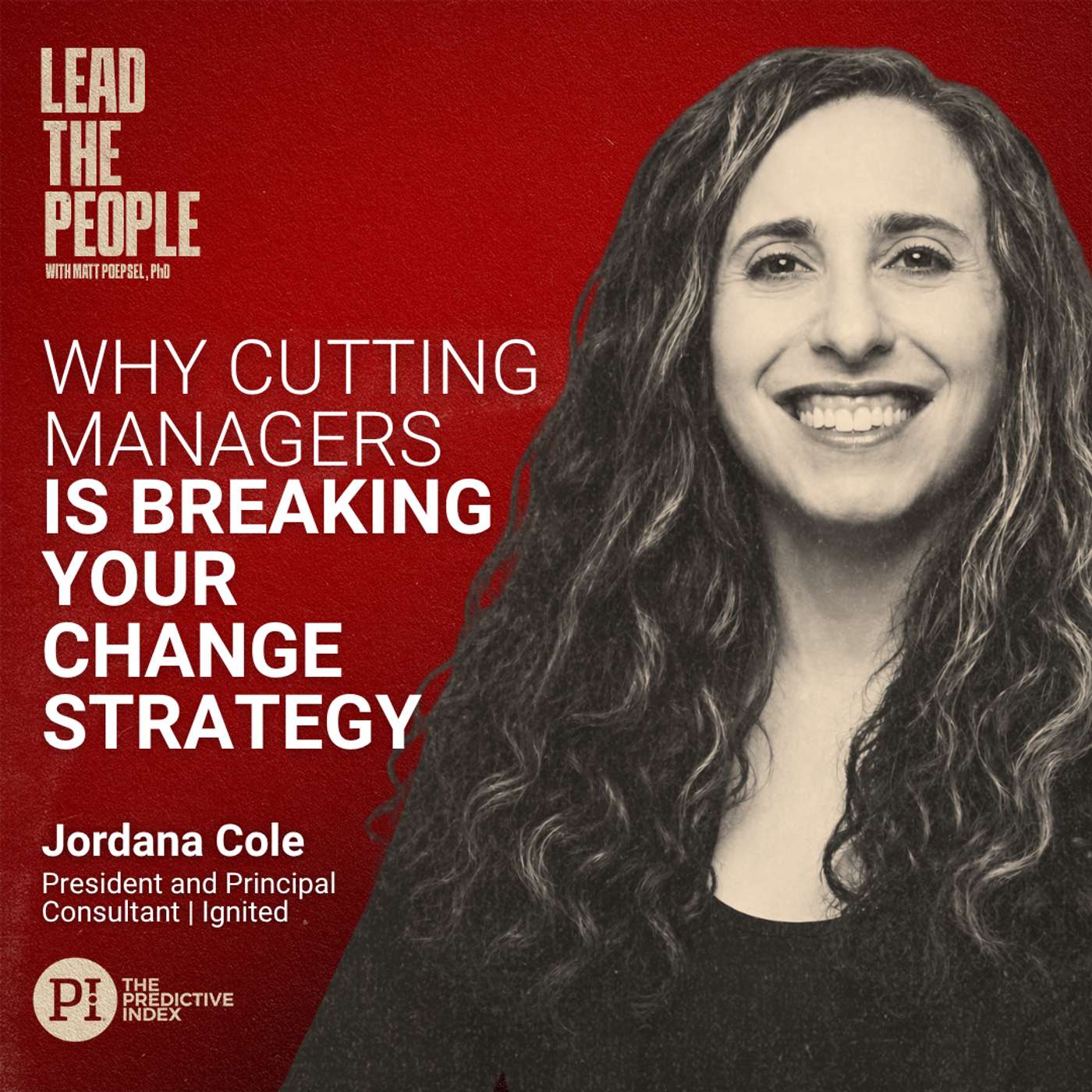
Lead the People · Matt Poepsel, PhD
Start with our free behavioral assessment. Go to trypi.com/ltp . Cutting middle managers to save money is the trend everyone's calling unbossing. Jordana Cole calls it a mistake dressed up as a strategy. As President and Principal Consultant at Ignited, she's watched organizations de-layer their way into a leadership gap, then wonder why their change initiatives quietly die. Matt Poepsel presses her on the real cost: spans of control jumping from seven direct reports to twelve, managers burning out with less support and less job security, and change efforts stalling because nobody's left to walk them the "last mile." Jordana argues change is a habit built one conversation at a time, not a rollout you check off a list. She also shares her "supermarket rule" for catching vague engagement survey questions before they waste a team's time, and argues that AI should amplify a leader's instincts instead of replacing the hard parts of the job. Oh, and she owns 14 ukuleles, which becomes relevant later. What you'll learn: Why Unbossing Backfires: Span of control has jumped from seven direct reports to twelve in some organizations, and that math quietly kills development time. Change Is a Habit: Sustainable change doesn't happen at rollout. It's built through the small, repeated conversations leaders have after the announcement. The Supermarket Rule: If two people could read the same engagement survey question and answer it differently, the question hasn't done its job yet. AI as Amplifier, Not Replacement: Jordana trains her own AI on what energizes her and what drains her, turning it into a pattern-spotter instead of a task-taker. Highlights: (00:00) Meet Jordana Cole (02:48) What convinced Jordana leadership can be taught (05:24) Why change is a habit, not a single launch (09:45) The burnout hiding inside middle management (12:34) The real math behind unbossing (16:42) Turning engagement survey scores into action (17:53) The supermarket rule for vague survey questions (22:05) Leadership as a facilitator of momentum (25:26) Moving AI from replacement to amplification (33:21) Trivia: are we smarter than AI Resources: Follow Jordana on LinkedIn: https://www.linkedin.com/in/jordana-cole-mapp-pcc-a8445a8/ Visit Jordana's website: https://ignitedbyjordana.com Watch Jordana's TEDx talk, "What to Do When You Don't Know What's Next," on YouTube Follow Matt on LinkedIn: https://www.linkedin.com/in/mattpoepsel/ Subscribe to The Predictive Index on YouTube: https://www.youtube.com/c/ThePredictiveIndex Created in partnership with Share Your Genius: shareyourgenius.com Experience it for yourself at trypi.com/ltp .
Jordana Cole (00:00): We need people who want to be in leadership because they love helping people grow. They love coalescing great talent and different people to come together to drive positive outcomes both for them and for the business. But those people are looking at this going, "I'm not getting the support. I'm not getting the resources, and I'm just trying to tread water myself, so why would I want to do that?" Matt Poepsel (00:29): Hey leader listeners, before we get started, I want to tell you about something new I'm trying out. As you listen to today's conversation with Jordana, love to know what questions come up for you, what kind of reactions you have. If you drop them into the podcast comment section wherever you listen to your podcasts or follow me on LinkedIn, drop them in over there, I'll be happy to answer them or I'd love to hear what your reaction is. I want to keep the conversation going all about this notion of leadership and connection and all these types of things that I'm talking about with Jordana. I think you're really going to enjoy this conversation. We started off with Jordana's definition of what leadership is. Sometimes it can be a bit amorphous, so I think you're going to enjoy that. She also talked about this nature of change being a habit. (01:07): It's something that doesn't happen once. It happens progressively over time, and I found that really fascinating. She also talked about what to do when we get feedback, especially that difficult to hear feedback through an engagement survey when our team's not all together in a great place. What do we actually do in that moment? And finally, she shares some innovative ways she's using AI to deepen her leadership that I found absolutely fascinating. So I think you're really going to enjoy the conversation, so I'll let you get to it. (01:39): If you've made a leadership decision this year, there's a decent chance somebody on your team quietly decided they never want your job. And that's not a joke. It's a real trend right now and it has a name unbossing. Flatten the hierarchy, cut the middle managers, let the teams run themselves. My guest today thinks that's a mistake and she's got the research and the day job to back it up. Jordana Cole is the founder of Ignited where she helps organizations turn leadership capability into behavior that holds. She also spends a lot of her time on AI though, not the way you'd expect. She cares less about what it takes off your plate and more about how it makes people better at their jobs. She works with it every day and still says leadership is the one thing. It can't replace. Jordana, welcome to the show. Jordana Cole (02:16): Thanks, Matt. I'm super thrilled to be here. Matt Poepsel (02:19): I'm glad to see you again because we had a chance to have you on a different webinar that I host, which was fabulous. And I thought, how do I get more of that energy and more time with Jordana? And here we are. Jordana Cole (02:28): Indeed. I mean, I felt the same way. So anytime we get to chat, I am very happy. Matt Poepsel (02:33): But you're one of my favorite people because you study the craft of leadership like I do, you appreciate it, and you also believe that it can be taught. And in fact, you went and earned your master's in positive psychology, another one of my favorite things. And so my first question for you, Jordana, what is it that convinced you that leadership can be studied, can be improved, can be something that we actually learn? Jordana Cole (02:53): Because leadership actually is an action. We think of it as a title, we think of it as a role, but it is the things that we do on an everyday basis. And leadership spans every areas of our lives. You lead communities, you lead families, you lead your own life, you lead friendship groups, and certainly you can lead teams and people at work. So if it is an action, that means that there's got to be behaviors associated with it. There's got to be skills that translate into those behaviors. So what are the things that separate better leaders from good leaders, from okay leaders, from poor leaders? Matt Poepsel (03:32): I can't tell you over the decades how many conversations I've had. Management, leadership, what's the difference? Leader, I'm not a leader, I don't have the title. And you're like, oh my gosh. And it's so refreshing to hear you talk about it as another voice in the wilderness, so to speak. But for all the leadership that happens out there, for you to be able to frame it that way I think is incredibly important, especially now. I would argue we need leadership more than ever in an area of uncertainty and pressure and all the different types of things happening. Jordana Cole (04:01): Yeah, absolutely. And it's so interesting in a lot of work I do, especially when I'm doing leadership development or workshops, one of my favorite exercises to do is to ask people think about the best leader they've had in their lives and share a bit with a partner a story that personifies that leader. And I can't tell you how many times people choose somebody from their personal lives. It could be a parent, it could be a grandparent, it could be a teacher, sometimes even a sports coach. I'd say it's about fifty fifty, and I've done this with several thousand people. I don't have the official study behind it, but I'd say fifty fifty on the professional side and on the personal side. And when you pull out how do you define leadership based on that, it's the traits that that person embodied and often how that person made the other person feel, how they brought out potential and capability in them, and that's what led to the positive outcomes. Matt Poepsel (04:55): Something I've experienced too. The course I teach at Boston College, same thing. It's about fifty fifty. My students pick somebody from their personal life, could be my mom is a leader. And I'm always encouraged when I see that, because I say the same thing you do, which is leadership isn't just something we do at work and then we go home and we don't ever lead in our communities or in our families. But I think it's great too when they choose somebody from work and they'll talk about, we were going through a big project and they really held us together, whatever they say. So both are really cool in that way. But the other thing I observed is that of course we're going through a lot of change right now. And when you talk about change, you said it earlier, leadership is about behavior. And so you had mentioned that it's something that you embed over time. (05:31): It's not something that you just launch and say, okay, we're doing this change initiative and then we can just move on with our lives, so to speak. Tell me about leadership's role like that during change. What does that look like in practice? Jordana Cole (05:42): It's so interesting because I see so much of change management focus is on the implementation of the thing, but that's actually where change begins. It's like building the infrastructure. It's not where the change actually happens over the long term. And change is a human phenomenon. Change is people are making a choice to do something and not just do something once, but do something consistently that is part of their day-to-day over time. And if I were to just break it down into one headline, change is a habit. Change is a habit that has become part of our day-to-day. And leaders play an instrumental role in that because leaders are the ones having conversations, identifying what your team is working on, identifying what's in the way of them being able to successfully meet their goals, identifying where their interests are, where their growth opportunities are, what their motivation needs and recognition needs are. (06:41): And those are the kind of sweet spots that turn something from a thing you're asking people to do or a thing you're doing once into a habit that sustains over time. And it's amazing to me how few organizations focus on this, especially given how much money they spend on something changing and then it just winds up failing. It's because we are completely missing this side. I kind of think of it like in delivery, you order a package online, there's this huge infrastructure that's been set up on how you can place the online order, on the warehouse having what you need, on what's being picked. But ultimately that most important step is getting it from that warehouse to that person's house and that person having it with them in their day-to-day life. And that to me is the last mile, that last mile shipment. Leaders are the last mile of making sure that that change is embedded with their people. Matt Poepsel (07:39): It is a habit. It's something we have to do over and over again. And a lot of times if you're going to do something once, you're like, okay, we could probably just do it ad hoc. But when you have to do it so many times, like you said, whether you're DoorDash and you're bringing meals or Amazon, you're making deliveries, you're going to be doing that a bazillion times every week, so you better get really good at it. And I think there might've been a time maybe when the change just wasn't as frequent, it wasn't as dramatic, and so maybe it was okay that we were just not so great at change. But now when there's no end in sight, I love what you're saying, which is it's something that it's going to take a long time. It's something we have to get good at. We have to make it some of just like, don't even ask the question about, well, why are we changing? (08:16): You're like, no, no, that's not the right mindset. We're making this change and it's just in the fabric of how work is now. Jordana Cole (08:22): Yeah. Instead of why are we changing, what do we need to effectively change and what do we need for that change to effectively stick? And I think there's multiple layers of that. Certainly there's the individual ownership. At the end of the day, I'm the only person who can take the action to make the change, but my leader can help, again, remove obstacles in my way, understand what's needed to support me, and then the organization can create conditions that are either going to enable or derail that change from sticking. And we have to look at from all of those particular lenses. And it is interesting because your comment about change and the rapidness of change, I think it's a little bit of a myth. I think that we've always had a lot of change. I think what's happening now though is the stacking of change on change on change without the loop ever closing. (09:11): And because we're not focusing on the adoption part, we just see kind of change fizzling out and then we're onto the next thing or we're not giving it enough time to stick because our time horizons have shrunk, our attention spans have shrunk. So we expect things to happen instantly because we're in a world where we can get everything we want on demand. So why can't we get human change on demand as well? So our expectations have shifted and our volume has shifted, but the frequency of change I don't think has. Matt Poepsel (09:44): It's true. And I feel like this is where I see leaders burn out because it's like you're responsible to change the thinking, and I don't mean the thinking, but change the way of thinking, the critical reasoning, if you will, of the people around you as well as their emotional state, you're responsible for that to a certain degree, as well as the behaviors and are they producing the results? But by the way, you don't get to directly control any of that because you can't make anybody do anything. And people are like, oh my gosh, I'm under all this pressure. We've got to get my department. Everybody's looking at us and we've got to get this change manifested so we can show we're in line with everybody else and I'm getting a lot of resistance and I can't just get in there. And you're like, yeah, that's right. (10:25): So that's why I think a lot of time it's exhausting if you don't approach leadership and study it the way you have. I feel like that's probably what's leading to a lot of burnout among the middle managers for sure. Jordana Cole (10:35): I've seen it in the research. I've seen it in conversations that I've had. A, the reward for being in leadership isn't necessarily higher than the cost right now. And sometimes the costs feel like they're outpacing it. So you're being asked to do more, do more with less. You aren't necessarily getting additional pay or other flexibility for it. You in fact get a lot more pressure on you from all different angles. And frankly, there's not even job security with it anymore because organizations have been de-layering and they've been de-layering at that middle management section. So a lot of people are looking at it then going, okay, so I'm taking on more responsibility. I'm taking on more kind of tension from different sides and I'm not getting the support I need. I'm not getting additional money and I don't have security. Why would I do that? And that means that the people who are stepping into leadership are probably doing it for the wrong reasons. (11:34): We need people who want to be in leadership because they love helping people grow. They love coalescing great talent and different people to come together to drive positive outcomes both for them and for the business. But those people are looking at this going, I'm not getting the support. I'm not getting the resources and I'm just trying to tread water myself, so why would I want to do that? And we're in for a rude awakening. I'm really, really afraid of that because I also think that that middle management layer is the nexus point or the bridge between strategy and execution. They're close enough to the front line to understand what's really going on, but they're also elevated enough to be able to understand the horizon view and the strategy and make those linkages to both sides. And if you don't have that anymore, what happens? You wind up with strategy that winds up being set without understanding the day-to-day impacts and you have execution happening without being able to think about the long term. Matt Poepsel (12:34): Yeah. And I'm sure the vast majority of my listeners are in this position right now where you've been promoted a few times and you're in this very precarious role, I would say, where everything is changing, executive appetite has not slowed down, your individual contributors and team members are going through some stuff. And at the same time, we have to act and we have to move because the window of change is upon us. And so when you see that the organizations are flattening, you call it the flattening of the org or unbossing and lots of different terms for it, you're seeing that the average number of direct reports has increased from seven to twelve, I saw in one study. So now more and more of my time that I would want to spend individually coaching people and developing them is now naturally thinned. And at the same time, because we're changing everything, there's a lot more collisions. (13:20): So there's a lot more administrative demands on managers to go get answers, unblock stuff, smooth over ruffled feathers so there's even less time for development. So I find that not only are we souring what leadership looks like and the attractiveness of it, but even for those who are already in those positions, it's tough right now. It's really tough right now. Jordana Cole (13:40): It is. I think that leadership is heavier now than it's ever been because there are so many expectations on you. There was a study that actually came out from the UK in the past year that indicated that people believe that their manager has more of an impact on their overall wellbeing and their overall health than their doctor. And it's actually on par with their spouse because we do spend more time at work than anywhere else. And those relationships do have impacts on us, not only at work, but at home. We also bring our personal lives into work even when we try and separate it. So managers are trying to hold in two hands both the care for the people and care for the business and both sides are asking for more and more and more of them. And you spoke to development and that's true. (14:31): When you have that span of control, it is impossible to have one-to-one conversations that are meaningful and not just reactive and task-based. It's also, let's be honest, not the only thing oftentimes that those managers are doing. They have their own work. There's so much more of the player coach model too. So you've got your own work you're responsible for, your team's work that you're responsible for, and all the administrative work to make that happen. So the quality, the capacity, the energy that's there is significantly reduced. Now, in our space, we care a lot about development. We think a lot about the long term. When it comes to potentially other business areas or other C-suite leaders, that might not be as paramount for them, but I'll tell you what is paramount for them that is also getting hit on this. And it's the change adoption stuff because we are implementing that right now. (15:25): Again, going back, change is a habit, change is personal. Everybody has their own needs and their own perspectives that may or may not impact their ability to adopt a change or want to keep that going. And when you don't have those one-on-one things with a leader and feel like you are cared for as a human being, that's going to create more resistance. If we don't truly understand what your needs are and are able to aggregate those back to themes to understand how we have to enable those or implement those in the organization, you're not going to be likely to change. And change as a habit means that it's something that progresses over time. We don't go from sitting on the couch to running a marathon tomorrow, and the organizational changes that we implement are in the same vein. We need to create smaller steps of progress and momentum along the way. (16:20): And when there's nobody there who's noticing that, who's celebrating that, who's talking about that to iterate on it, it's going to stop. So that increasing the span of control, that decreasing the number of leaders that you have isn't just impacting the future, it's the reason your change initiatives are failing. Matt Poepsel (16:42): Yeah. And it's directly showing up in a bunch of different places. And I know that you're a big data person like myself, and one of the places it shows up is in engagement surveys. If your company's doing what they're supposed to, then there's at least some level of employee listening taking place. Pulse surveys, monolithic surveys, it doesn't matter, anything in between. And you mentioned, for example, Jordana, that companies don't always have a survey problem, but they often have an action problem. How do you recommend that? Two things. One is that an organization can move from, okay, we listened to, okay, we're doing something about it. And then even let's zoom in a little further and say at the team leader level, I'm the leader of the team within this entire context. What's my responsibility when I get some of that survey data about my team landing in my lap? Jordana Cole (17:27): Yeah. And that's even if they get that data because sometimes they might not even get that. So I think the first responsibility, if you don't automatically get that, is ask and share why you think it's important and find out what you are actually capable of receiving. There's two things with this, and I have a lot of challenges with the way that we do engagement surveys right now, but working in the method that this is what's happening and how do you react to what's there? So I think the first thing is recognizing that the engagement score is a signal, it's not the whole story. And one of the first things that we can do is understand what's actually underneath that question. So why is that thing happening? So if we're asking a question like my manager cares about me as a person and that rating is low, finding out what does it actually look like to you to feel cared for? (18:21): What does that mean to you? Give me an example of how that shows up in the day-to-day. So I think the first thing that any leader should do, whether you're in the HR suite looking at the aggregate results or the C-suite, or you are a team leader, is actually getting curious and finding out what that means to that person. Too many engagement survey questions are vague. I have a rule of thumb. I call it the supermarket rule. And by that I say, if you were to go into the supermarket and find two different people in two different aisles and give them the same statement, would they interpret it in the same exact way? And if they can't, then that means that there's more uncovering for you to do. And when you treat it as something to get curious about rather than to get defensive about, it opens the door for understanding, which can actually create small actions that you can change. (19:12): And I think that's all in service too, not just looking at the score, but what would change actually look like on this? What's the actual behavior? What's the actual action that we believe is connected to that score at the end that we can control, even if it's small, to experiment with and see if it moves the needle? And how will we know that change is occurring? What will we monitor? What will we discuss? What will we measure? And is that something I'm even willing to do? So I think it starts with that reflection, then that conversation, and that conversation leads to identifying that action and making that an ongoing conversation. So it is a loop, and I think a lot of our engagement survey processes don't actually close the loop. We just leave it open-ended. And part of that looping, and hopefully what you're kind of seeing and what I'm describing is it's a dialogue and it's a collaborative one. (20:12): We spend way too much time trying to solve for people, and this is true both in engagement surveys and change action planning, then conversing with to identify what's actually going to move the needle for them. Matt Poepsel (20:25): I think it's a fabulous point. Spoken like a true psychologist. We have to be clear about the moving pieces and we have to heavy measurement. We got to close the loop on that and make sure we're moving that needle. And what I think is amazing about it too is you don't have to be a psychologist to be a manager who has curiosity as you've just taught us. And so something amazing happens when you bring in a poorly performing survey item, for example, and you bring it in front of your whole team, and let's take your example about care. And sometimes where I come from, we call that a suitcase word and you're like, let's unpack that. What is care? Exactly what you said. And what does care mean? What does it look like? Where can we improve it? The other thing I think that leaders get in trouble sometimes is pretending like they're the only ones who have to take action on survey results. (21:10): And the reality is that you will wear yourself out completely if you try to do everything for your team, but the very act of guiding the process, facilitating the dialogue, encouraging others to ask their own exploratory questions out of curiosity, creating a safe space, those things are your role. But then when people start to come in, your people, they say, "Well, here are some things we could do to improve it," you can dole those responsibilities out as well. You don't have to take all that and shoulder it yourself because you just won't have the capacity to do it all and your job and develop them just exactly as you taught us right now, that is leadership personified and it actually brings the team closer together so it becomes an opportunity, not a, "Oh no, we got a weak engagement item." In this environment, yeah, you did. (21:54): Of course you did. Now what are you going to do about it? How are you going to take advantage of it almost? It's almost a gift in some ways to bring your team back together around something tangible in a world that's increasingly intangible. Jordana Cole (22:05): Yeah. I love the way that you just described that because as you were talking, it kind of coalesced into a definition for me about what leadership truly is. And a leader is a facilitator of momentum and it's momentum that creates growth and positive outcomes. And that word facilitator is so important because you aren't doing, you are influencing. And you're so right, that is something I talk to clients all the time about is how are we bringing people into the conversation? And that's part of what's burning leaders out is they are assuming responsibility for things that are not there solely to own. When you work with your team of it's us together against this problem or even better, it's us together in service of this goal, what's going to be meaningful to you? Let's actually create something that is meaningful that we can track and that we can come back together and talk through. (23:05): That builds momentum way more than sitting in a room as the HR leadership team, as the C-suite and going, how are we going to action plan or what are we going to cascade to the organization? And this same exact approach for engagement survey also works for change planning. We should be bringing people into the change conversation of if our goal is to make this process work, how are we going to get there? What do we need to make that happen? And one additional thing that I'll add that you hit on, and this is just our brains, we are as creatures, biased towards the negative. We focus on what's working, what's lower, and there are so many things that we can learn from what's working well. And taking the time to not just look at where our lower survey indices are, but where are our highest? (23:59): What's working there and how do we keep that momentum going even when things are hard? Because at the end of the day, when people are staying, it's because of that stuff. And even when you're looking at a lower rated item, have a conversation. What are examples when the opposite were true? What are some things that if we did them more consistently because they're already working, would help that happen more frequently or help that happen more deliberately? We are much more likely to get the behaviors we want to see if we identify and reinforce the right behaviors that are already happening, and they are happening around us. Matt Poepsel (24:38): Yeah, I think every day, given a chance to shine a light on, and one thing that leaders could do that is fast and free is recognize those things a little bit faster, easier, casual ways, informal on the spot ways, in front of the team ways, all kinds of good stuff with that. But I definitely want to shift gears in a second here too, because I mentioned earlier in your intro that AI is everywhere, obviously. I'm to the point now where I use it so much that I'd be sad if you took it away, but at the same time, I still consider myself new to the party. I've only used it for a few years, but I do want to get your take on this. When you think about AI specifically, most people, from what I've seen and experienced in the conversation I've had, they look at it and say, "How can I take the things that I'm doing and get AI to help me do it either faster or completely, take some work off my plate?" What's your take on this now that you've had more experience with it? (25:26): You use AI regularly yourself. If I'm a leader of a team, how should I be thinking about AI? Is it just to free up some of that capacity now that I've got more direct reports, I need to get some of my time back or am I missing something if I take only that approach? Jordana Cole (25:38): Yeah, I think you are missing something. And by the way, we're all new to it because it didn't exist more than a few years ago. I think what's wild about this technology in comparison to others is that there's been no kind of curve of adoption. It landed in our laps and everywhere in our lives all at once, and now we're just trying to make sense of it. Look, there's nothing wrong with using AI in that way to delegate to tasks, to utilize it as assistant, to free up capacity. But here's the thing, when we use language like AI is helping us become more efficient and AI is helping us become more effective, subconsciously we're interpreting that as AI is replacing me. And that's what's causing resistance, that's also what's causing governance issues, and that's what's causing a lot of fear. Also, at the end of the day, AI is our own creation and business is our own creation. (26:28): There is no business without human beings. Human beings drive the business forward and human beings are our customers. So if we look for AI to replace all the things, actually business goes away. So instead, how do we think about AI in a way of it's not removing what I don't like, but it's helping me to amplify what's uniquely me? And one of the things that AI does really well is it spots pattern. And I think one of the things that we're missing with AI, particularly in the learning and development space, is this is the first tool that allows for one-to-one. Most of our learning is one size fits all. Most of our action planning is one-size-fits-all. And in fact, I think some of the training that we're doing around AI is still about the one-size-fits-all. Let's learn the fundamentals. But this is a tool that can learn us, respond to us. (27:17): So a couple things with it, I've actually been experimenting this with a couple of people. Even having a mechanism where you can feed AI some of the information about you at your best, whether it's profiles like predictive index, strength profiles, personality profiles, motivator profiles, whatever it might be, feedback that you've gotten about when you're at your best, things that energize you, actually leveraging AI to calibrate a couple times a day, where's your energy level right now? What are you doing in this moment? Who are you with in this moment? What's going on outside of work? What's on your plate? And starting to surface themes by collecting that data of being able to notice when are you actually energized? Are there themes of when you are drained and how can we help you build in some micro moments of suggestions? So if you have a daily briefing where AI is looking, okay, we've got a few weeks of data now and know that when you are in a meeting with a large group of people, that tends to drain you. (28:17): But we've also learned that when you get to talk to this person one-on-one or when you get to move outside for five minutes or when you get to pet your dog, that actually energizes you a little bit. So before this meeting, here's a small thing that you can do to ramp up your energy so that you're less drained coming out of that meeting. So that's one example. Another way that I think AI could be really great is the things that you think about, the things that you're passionate about, the things that you're good at, have it help find more resources to support that, but in the way of understanding how you work. So I've trained my AI of these are the things that I love talking about. These are the things that I think about. Here's how I tend to talk about them. These are the sources that I really like. (29:04): Once a week, pull five resources of recently published research, of articles, of thought leadership that might inspire me to think differently or help enhance some of what I'm already talking about. And it pulls things that I wouldn't necessarily normally find on my own, but because I've created the parameters of helping it understand who I am, what I am like at my best, it helps to energize me in that regard, not just replace me. And that research, I still write based on that. I'm not letting AI write it for me. And it's also elevating the thinking that I'm bringing in and the partnerships that I have with people. Matt Poepsel (29:42): It's so true. I feel like part of the downside of not having as much access to a manager, a senior manager, the CEO, whoever you report to, or if you're a CEO, some other executive coach or the board or however, then some of that time that you would've spent with another human, you can actually differently, it's not the same, but differently with AI and being able to say, as you had suggested, Jordana, when it can see it in my calendar and I'm on a dog walk and I say, walk me through my day, take a look at my calendar and ask me some questions about each of the meetings I had on the books, it'll do it. And then as I talk to it over time, if I get in the habit of doing that at the end of every day, my dog's happy, but also you're feeding the AI and it's looking for those patterns, like you said. (30:24): So I think we're past the point where it's, can you do these things? You can do lots of things. The question is, will you? Will you prioritize your leadership development? Will you teach this AI partner to ask you questions about, well, who was in the room? How did you show up for them? How do you think they left the room feeling after having been in your presence, taking you back to the earlier definition of leadership you gave us? How do others feel when they're with you? This is all of a sudden something that we can, it's there for us, but we have to do it. We have to follow through. Jordana Cole (30:51): It was interesting hearing you call that out because I think we're emerging into a different level of prompting. When prompting first came out, it was about being very explicit with instructions. And it's funny because I think in some ways AI taught us a really core leadership skill, which is how to set clear expectations. And if AI's not getting it right, you have nobody to blame but yourself in a way that we would tend to blame other people for not getting it right. And now good prompting is about collaboration and conversation, which is also a leadership skill about asking good questions, but also asking it to ask you questions, asking it to clarify what it heard and seeing what comes up when you bring two things or two people together because it creates a multiplier effect. It's not three plus three equals six, it's three times three equals nine. (31:39): And I'm going to do this because it's easy to go on the negativity bias, so I'm going to talk about the positive side of it where yes, we might have less time with people now. And at the same time, AI is in our pocket. So let's imagine that we didn't have less time with people. We still had the same time we always had. AI is a fantastic on-demand accountability partner, and it can be completely customized to what creates accountability for you. What makes you do something versus what makes me do something are two very different things. If we're able to train that AI to prompt us or nudge us at different times to see how's that going, to celebrate with us in a way that feels authentic to us, it's adding on and supporting almost like a team, that same celebration that you might be getting from a manager, that same celebration that you might be getting from a friend or a partner, but you are able to customize it to meet you exactly what you want when you want it on demand. Matt Poepsel (32:38): Yeah, 100%. For those who take advantage of it, I think it's going to unlock another level of development, of attention, awareness, of feedback, accountability, all these things. And it's early days. So if you're listening and you're like, "I'm not that comfortable with AI yet," totally fine. We're all on a journey together. But I'm very encouraged, Jordana, that you've been able to explore with it and experiment to the point where you're seeing ways of deepening it and marrying it up to all the things you studied from a positive psychology leadership. You're a student of the craft and I really appreciate you for it, but I really appreciate you now more than ever because we're about to be trivia partners. We're going to have AI ask us a question. Oh boy. And I always try to pick something related to my guest's background and I saw that you're a ukulele player in a rock band. (33:21): Am I saying it right even? Jordana Cole (33:23): Yes, yes. I own 14 ukuleles. Matt Poepsel (33:28): So that did not show up in my search that you own 14 ukuleles, but we're going to get a question about ukulele and here it is, multiple choice. What does the Hawaiian word ukulele roughly translate to in English? Is it A, small guitar, B, jumping flea, or C, singing wood? I know Jordana Cole (33:44): The answer to this. Oh Matt Poepsel (33:45): Yeah. Jordana Cole (33:46): I know the answer. It's going to surprise you. It's actually B. Matt Poepsel (33:50): It's actually jumping flea? Oh my gosh. Audience, if you're playing along at home, you can test Jordana. She owns 14 of them. I wouldn't do it if I were you. But is it A, small guitar, B, jumping flea, or C singing wood? We went with B because I've got a ringer on my team and waiting for the answer and here it is. Spot on. You got it right. Jumping flea in Hawaiian. The name is said to refer to the way a skilled player's fingers jump rapidly across the fret board while playing. I don't even know what a fretboard is. You've got 14 of them. Jordana, this is why you're one of my favorite people in the world. You never cease to surprise me. Jordana Cole (34:22): Well, if you want to learn about ukuleles, I'm more than happy to teach you. Matt Poepsel (34:26): I might have to take you up on that. I think it's fascinating. Until then, I've got a much better question for you. Where can my listeners go to learn more about you? Jordana Cole (34:33): Yeah, so a couple places to check out. One, find me on LinkedIn. The good news is there aren't many Jordana Coles. I'm regularly posting and I love interacting with people and just mind melding about all things, leadership, people development, positive psychology, future of work. You can also check me out on my website, which is ignitedbyjordana.com. And if you need a little bit of a boost of uncertainty and want to take me home with you, I do have a TEDx talk that's been making waves around the world called What to Do When You Don't Know What's Next. I'm on YouTube in the TEDx channel, so feel free to find me there. Matt Poepsel (35:10): I love it, listeners. I'm going to have those links for you in the show notes. You're only one click away from getting connected with Jordana and consuming all of her great content, her ideas. She's an inspiration. I enjoy, she's a great LinkedIn follow. Jordana, thank you so much for being with us today. I've enjoyed having you on the show. Jordana Cole (35:24): Thanks, Matt. I've loved being here.