
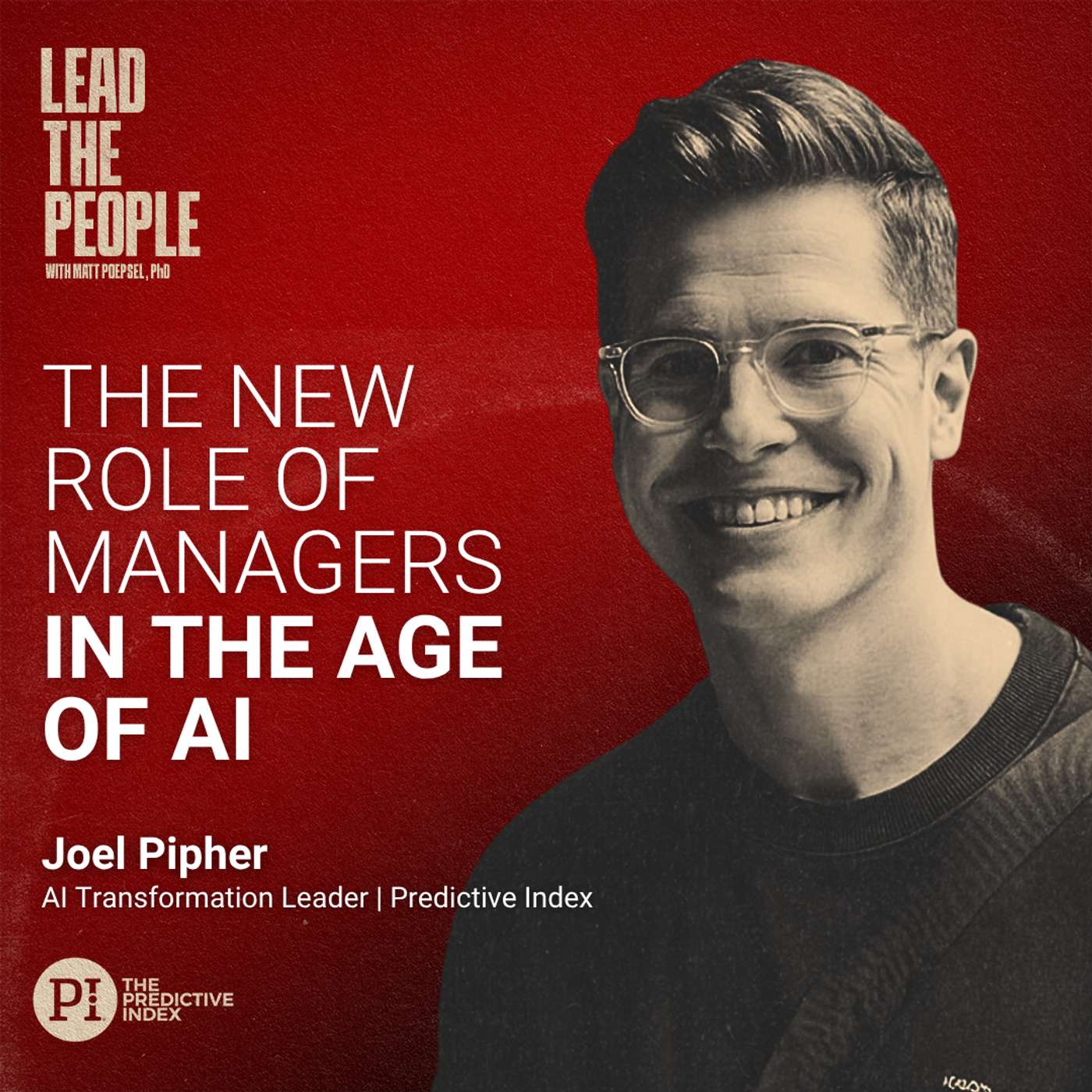
Lead the People · Matt Poepsel, PhD
Start with our free behavioral assessment. Go to trypi.com/ltp . AI transformation isn’t just a technology problem; it’s a management problem. Executives want faster adoption, employees are wondering what AI means for their jobs, and managers are stuck in the middle trying to turn all that uncertainty into something their teams can actually work with. Matt Poepsel sits down with Joel Pipher, who leads AI transformation at The Predictive Index, to unpack what it takes to grow with AI without losing the human side of work. Drawing from his experience building AI programs inside large enterprises and startups, Joel breaks down why AI adoption needs a clear North Star, why experimentation has to become part of how teams work, and why managers can’t afford to sit on the sidelines. Together, they explore what happens when managers start leading both people and AI agents, and why the leaders who learn to translate, experiment, and role-model the change will be the ones best equipped for what comes next. What you'll learn: Managers Aren’t Just Messengers: The middle manager becomes the translation layer between executive AI ambition and what the team actually needs day to day AI Adoption Needs a North Star: AI works best when it is tied to a clear business direction instead of becoming adoption for adoption’s sake Create Space to Experiment: Protect time, budget, and knowledge-sharing so AI experimentation becomes part of the work, not extra work Managers Will Lead Humans and AI Agents: The next challenge is figuring out how people and agents work together without losing the human side of management Highlights: (00:00) Meet Joel Pipher (01:45) AI transformation puts managers in the middle (02:42) Early lessons from AI transformation (07:34) AI in a startup environment (10:01) Why AI adoption needs a clear North Star (13:29) The manager’s role as the translation layer (15:13) Creating space for teams to experiment with AI (17:07) How AI can help managers lead better (18:07) Why managers need to role-model AI adoption (21:48) Practical ways to build an experimentation culture (26:15) What’s next for AI and managers Resources: Follow Joel on LinkedIn: https://www.linkedin.com/in/joelpipher/ Learn more about The Predictive Index: https://www.predictiveindex.com/ Follow Matt on LinkedIn: https://www.linkedin.com/in/mattpoepsel/ Subscribe to The Predictive Index on YouTube: https://www.youtube.com/c/ThePredictiveIndex Created in partnership with Share Your Genius: shareyourgenius.com Experience it for yourself at trypi.com/ltp .
Joel Pipher (00:00): What we're going to see is the continued proliferation of agents in probably two forms. One are personal agents that are working with you as an individual on your day-to-day work. Then the other is more role-based or job to be done based agents that sit alongside your team. The challenge for a manager is going to be, how do I work on a team where I'm managing both humans on one end and agents? What are our ways of working going to look like? How do we make that experience feel more human? Matt Poepsel (00:34): Hey, before we get started, I want to tell you about something new that we're trying out. As you listen to today's conversation with Joel, just let me know what questions come up for you or what sort of reactions you have. You can drop them into the podcast comment on your favorite platform or hit me up on LinkedIn, would love to hear about it. I really enjoyed my conversation with Joel. He started off his career working in AI early days, I would say, and experienced some of those unique challenges when the technology was a little clunky and also the environment he was in, he describes, had its own sets of challenges. But then when he moved on to a little bit more of a startup, the technology evolved a little, the situation and the context evolved a lot, and he shared some of his lessons learned with that as well. (01:12): Most importantly, for us as listeners, he gave us tips on what we can do if we're leading transformation from the middle. If we find ourselves in this uncertain environment, but we've got our team members who are looking up to us, what can we do? And he just shared so many great tips about things we can actually do ourselves to drive the change forward and really be the role model for that change. Throughout the whole thing, I love how Joel balances technology considerations along with people considerations. That's a really appropriate and exciting approach. So without any further ado, I'll let you listen in. (01:49): Many of you are living some version of this scenario. Somebody up top is fired up about AI, somebody down the hall scared of it, and you're the one in the middle trying to hold it all together. My guest today has stood on both ends of that spectrum before he ever landed in the middle of it himself. Joel Pipher leads AI transformation here at The Predictive Index, and before that, he founded an AI and machine learning program at one of Canada's largest telcos back when the tools were clunky and you had to be pretty technical to get anything out of them. Then he went on and did it all over again inside a startup. He's watched this technology grow up. Joel, welcome to Lead the People. Joel Pipher (02:20): Thanks, Matt. Excited to be here. Matt Poepsel (02:22): I've been looking forward to this conversation for a long time. Certainly we started our AI journey a little bit before I met you, but certainly gone on hyperdrive ever since. I really have enjoyed learning about your background and I can't wait to walk through that with our listeners today. I considered myself late to the game. I've been using AI just for a couple years now, but you go way, way back. I thought maybe we could get started with that. Take us back to the telco you were working at, AI and machine learning program, these kinds of things. It was the dream I expected it was where everything just flawlessly works so well together and it's just like butter. Joel Pipher (02:53): Yeah, exactly. I mean, when you write the book 10 years later, of course, of course it's so smooth. No, it is the exact opposite. For some context, like you said, I founded the AI machine learning program at Telus, so one of Canada's largest telcos way back in 2017, so almost a decade now. So you think if you're not familiar with the organization, it's like a hundred thousand people, a hundred-year-old company that's grown by acquisition. The focus really when I joined was around digital transformation, data transformation, cloud migration. That was the name of the game. Then there was this mini AI machine learning hypewave, a lot of centers in Canada that had a lot of great talent, and so saw an opportunity to tap into that. But this was way before LLMs, way before you could just interact with a chatbot and build prototypes and apps, no ChatGPT, no Cloud, hard to imagine what it used to look like. (03:42): But to your point, Matt, the builders were data scientists, machine learning engineers, data engineers, building, deploying models. It was a very technical sport working alongside the business. To your ask, was it clean? No, definitely messy. Most of the hard work, they might get mad if I said it out loud, but I will. Most of the hard work wasn't actually the modeling and the building. It was everything around it. The data supply chain, probably the biggest thing that carries over today. Garbage into these systems, garbage out, privacy, security, governance, and one of the biggest pieces was change management. You have to be very technical to understand these systems, but what was happening at that point is you're trying to use machine learning and AI models to drive business outcomes. Business stakeholders owned those outcomes. There was a lot of lack of trust there. Explainability was a lot of where our focus went to making sure that business stakeholders like marketers, for example, could really understand why a model was making a recommendation. (04:48): A great example just to bring that to life would be we built a recommendation system to route all of our outbound marketing campaigns across different products, offers and channels, all driven by machine learning system. At that point in time, the business was very comfortable just blasting all customers with the same message because if you're a marketing, outbound conversion rates are so low, so they didn't want to put their business at risk by moving to a more targeted system that they really didn't understand how it made decisions. A lot of our time and my time at that point was around education, running small pilots, proving value before you scale, that's where it was, and a lot of experimentation, a few different use cases, small teams on each, really trying to prove business value alongside of that. That was the name of the game. Looking to what others are doing outside of the organization, we were looking to the Facebooks, the Googles, the Netflix of the world to figure out, hey, what are they doing? (05:43): Also, how can we partner with organizations like them or startups to build our capabilities faster? Super, super messy, very much like experimentation. Some of that trickles over to what we do today, but it was a really exciting time as well. What Matt Poepsel (05:55): You're making me realize is there's so many more moving parts when it comes to, there's the technology itself, but just as you pointed out, the nature of the data, it's complex. I imagine inside of a large telco like that, you have resources because you're a really big company, but at the same time, regulatory, a lot of risk there too. A lot of inertia, a lot of. We've never done it like that before, so I'm sure you ran a lot of human resistance too. And then when you think about, "Hey, tons of data, great news, we can feed the models. Oh yeah, by the way, that data needs to be cleansed," which means you need to clean a lot of data. For anybody who's listening now, your company has a lot of these different things, like how clean is your data? How adventuresome are your people? (06:33): What's the nature of your technical appetite? All these things. I can see where it's multifaceted that shapes the environment that you find yourself in. Joel Pipher (06:40): 100%, and it can feel overwhelming at times. You quickly go down the rabbit hole of all of the different edge cases. I think what we found too is it's hard to know where to start. That inertia can cause you to not make decisions and to slow down, which is a decision in and of itself. It's definitely a challenge, and I think we're still seeing that today as well. It hasn't necessarily changed that dramatically in 10 years just because the technology has shifted. Matt Poepsel (07:05): One of the coolest things about your background is then you went to a very different sort of environment because now you're in a startup, so clearly they're not only accustomed to change, they're driven by it, they're asking for it. 30 people, so not the regulatory risk of a large telco and a couple more years perhaps of the technical development of AI. But as I recall, this would've been a time of your career where this stuff still is nowhere near where it is today with vibe coding and how easy it is to do things. So what changed for you in that job though? I know it wasn't easy. What sort of challenges did you push to the side because of this new operating environment, but which ones still persisted? Joel Pipher (07:41): We're at a very cutting edge, deep machine learning AI startup based in Toronto. We worked globally within very highly regulated industries, so think like insurance and healthcare and stuff like that. We faced some of the challenges I just described, but more with our customers than internally. We're changing the way they work and in very sensitive risk-averse environment, so we still face some of that challenge as well. Internally, my role shifted a lot. I did several tours of duty, which was a huge advantage of being in a startup, everything from customer success and delivery being on the front lines with our customers to deeply understand their problems. I did a stint in as chief of staff, so more operations and then product and go-to-market, so a lot of experience there, which was super fun. But I think when I take a step back and think about what really changed, it wasn't, to your point, the level of education that needed to be done because we had a very deeply technical team. (08:35): 80% of our team was engineers, machine learning scientists. They understand the technology. They're advancing the technology, so they get it and they're hungry to try different things. It was really around driving focus. It was at a pre-product market fit company, so it wasn't about, "Hey, how do we improve our operations and our outcomes with AI?" We were thinking about what product are we selling? To whom in what market? How do we make focused investment decisions? How do we place bets that are going to pay off and do it really quickly? So that's where a lot of the work was. An example of that would be I designed with our team an operating system that helped us make those investment decisions faster so that we could run an experimentation pipeline and improve that. I think that was a real big difference there. It was the job became less around, "Hey, how do I create energy around playing with these tools, experimenting, trying new things to how do I just corral that so we can focus on the right things to move the organization forward?" So it was a complete shift, but it was also super fun. Matt Poepsel (09:38): You change one set of problems for another set of problems, and maybe problems is the wrong term, but just constraints or realities, whatever you might want to call it. Again, back to the listeners, you might have people surrounding you saying, "I'll try anything new. I'm naturally experimental." And you're like, "Well, that's good, but at the same time done to the extreme, that can also create challenges you're sharing with us, Joel. And one thing that you taught me too was this importance of something that you refer to as the North Star. What's the role of a North Star when you're going through some sort of a tech transformation like this? Joel Pipher (10:05): I think it's pretty critical. And what I mean by that is, I mean, I'm sure a lot of your listeners are already be familiar with that term, but just setting a clear vision, a target state for where you want to be as an organization when you grow up. It's really important that you have a clear North Star and that North Star, whether it's for an AI transformation program or any technological program like that, is to tie it and couple it deeply into your business strategy so it isn't sitting off on its own. I think where we see AI programs face challenges or fail is when adoption, it's all about adoption for adoption's sake, and that really doesn't drive change. It's hard to bring people along for a variety. You don't make optimal decisions. It doesn't advance the business. So having a clear north star is tied to the business strategy. (10:52): First start with that, the business strategy and work back on how is AI going to enable the next phase of your company and how is it going to move the needle, accelerate your journey there? Could it shave off months or years of where you want to get to because you can be operationally more effective, you can make decisions faster. These are the types of things, but having a clear understanding of where you want to be is really important so that then when you're going through a transformation program, you can focus on the right levers, the right dimensions, the right investments that are going to take you to the next stage. I think it's super critical. Otherwise, it feels like you're either doing this because your board or your exec team told you and nobody really knows what direction they should be rowing in. Matt Poepsel (11:33): Yeah, sadly, I think that's pretty common. It's hard to come up with that north star when it's talking about a technology transformation that changes so fast and no one really knows where it's going, but yet we rightfully look to the top of the organization. We say to the CEO, "Okay, you want us to invest all this AI stuff? Where? Where are we headed? How do you see this shifting our business?" Some of them I see have talked to a range of them and some are pretty articulate about it and some are mumb about it completely and everything in between. It makes it hard when you say that there is no north star that's even been attempted or there's one and you can see it, but it's pretty faint and you have to squint really hard to see it versus somebody who's like, "Hey, we can't predict the future. (12:11): You can't hold me to this because everything's changed so fast, but generally speaking, here's where we think we're going and here's how we're going to judge the progress we're making toward it." That's just such a more comforting thing considering there's so much uncertainty everywhere else. Joel Pipher (12:23): 100%. I mean, a way you can get potentially through that is through scope. Maybe because the world is changing so dramatically, maybe you don't set a five-year vision. I'd probably advise against that. Maybe it's six months out, maybe it's a year out, but set a shorter timeline so that it can be a bit more crystallized. Then I think the other piece is setting up a culture of experimentation. Worked at the startup, that's so critical today. It should be part of a transformation program. It should be setting that up because to your point, strategy is going to shift and it's going to shift faster than it has in the past. Matt Poepsel (12:59): I think that as I think about this, the nature of adoption, the nature of deployments, any large scale organizational change, my mind always goes to the middle of the organization. Right now, the middle is completely under attack. There's everything from AI is going to automate away, manager jobs, or it's going to create so much efficiency that we can just squish that layer and flatten our organizations. We saw recently that the average manager went from seven direct reports to 12, and I'm thinking, when am I supposed to find time to coach my people and develop them? There's all kinds of things, but let's talk about them for a second. If you're in the middle of an organization, you didn't make all the decisions about the investment or even the direction, but you've got to carry it through down to the individual contributors, the frontline team leaders. (13:41): What advice do you have when you think about that role? It's not just about relaying information anymore. When you think about the middle of an organization when it comes to transformation like this, what comes to mind for you? Joel Pipher (13:53): First and foremost is acknowledging, let's be honest about where they're sitting to your point. It can be an exhausting position to be in. If you look at where the manager sits, you've got executives above that probably really excited about AI, the potential, they want to move fast. They might be further ahead in their thinking than the rest of the org, likely. Then below you have your direct reports on the front lines who are probably stretched thin anyways. On top of that, they're probably concerned about their job security, what happens when they start to automate parts of their jobs. So you're probably feeling that tension alongside of your own fears about your work and how that might be automated. I'd say the role of a manager is really to be not a switchboard, you're not just the one passing information through. Part of it is being a translation layer, enabling your team to know how AI is going to impact their day-to-day. (14:50): They probably don't care as much that there's an AI transformation program and your team probably cares about, okay, how is this going to impact my job today, next week? So your job is really to help them through that. I think there's the flip side as well. I think asking for more from leadership if you feel like priorities aren't clear, the strategy ain't clear, the why's not clear, looking for that so you can do that. I think that's one part. I think the other piece I mentioned before is creating an environment where your team can experiment. That could be setting up protected time for your team. It could be putting aside some budget so team members could experiment, test different tools, creating space where they can share learnings, maybe naming an operator on your team who's responsible for finding opportunities where AI can really accelerate your work. (15:34): I think that's another piece. Adapting your own role, experiment with these tools, find where the friction is slowing you down or maybe there's a place where decisions are getting stuck. Can you build something yourself that's going to help you get through it? You're going to learn where AI works, where it doesn't, where it makes your job better. At the same time, it's probably going to help role model that behavior to your team. There's a lot you can do as a manager, but to your point, it can be a very uncertain time. I was on a call with Salim Ismail of EXO community at anybody heard of the Moonshots Podcast, and you mentioned that the number of direct reports is going up to seven plus. His prediction is that that's going to 10, 20 plus in the next few years. So finding ways to create that leverage through your team with experimentation and also testing these tools is a really important aspect of how that role's going to evolve soon. Matt Poepsel (16:25): It's incredible just even to do the math on that when you think about it. Let's say I spend an hour a week with each of my directs because I'm here to develop the future leaders of tomorrow and the next layer of the business one hour a week. It's not a lot. I got 20 directs, that means half of my time without bathroom breaks, half is spent developing people. I think that not every organization even understands, much less appreciates that reality of it, but maybe we will get to a point where AI does so much of the work that we can free up our managers, our leaders to be able to say that the thing that AI can't do for us is develop other humans and that's something we're going to look to you to do. Joel Pipher (17:01): That's my bet that I would place. It's one of the reasons I joined The Predictive Index in the first place. To your point, when there's payoff from AI, it's going to create capacity for managers so you can spend more time with your team. I think where it goes well as well is that it can create not only leverage in capacity, but also in intelligence. More specifically, equipping managers with insights on and behavioral intelligence around their team, a better deep understanding of how your team operates individually so you can be a better communicator, a better leader, you can deliver feedback, better you can develop and coach your team members. I think that can really be amplified with AI. No longer do you need to be an expert in behavioral science with the tools that we've launched. You can get that insight right from our platform. It can make the job feel more human. (17:56): That being said, I think we're still in the messy middle, so it's going to look like more of a J curve where maybe the experience feels worse before it gets better. But I think those two things, those two types of leverage are going to be really critical for the manager going forward. Matt Poepsel (18:07): Yeah, that take us back to something you said earlier, which is really you're talking about agency, like role model the change, use the tools yourself. Something I hadn'tpreciated until you said that was that I'm old enough to have been through many technology transformations, but these used to be things like ERP systems, like those enterprise resource planning systems or the CRM customer relationship management systems. At the time you're doing a big monolithic rollout like that as a manager, you can't do anything. All you can do is share your feedback and make feature requests. This is not like that at all. AI tools are available for your personal use, for your company use, et cetera. So the agency is something that we have in terms of this technology transformation that isn't always part of it. I think that's all the more reason, Joel, to do what you suggested, which is role model the change. (18:51): If you're a manager not using the tools and your team members are afraid of transformation, that's on you. I mean, you're not showing them how you're using the tools, so they're like, of course they're going to be scared about that. Joel Pipher (19:02): Totally. I think the floor to be able to use these tools is lowering every day. It's almost every second at the rapid pace of change. Look at what happened this week. Fable 5.1 came out. I think a new version of Grac came out yesterday, GPT-6 came out. It seems like every week, almost every day, there's something new, a new agent, a new app, a new model. So that floor is going to rapidly reduce. It's going to make it easier for anybody to pick up these tools, to one shop things, to build without being a technical expert. Matt, you mentioned at the beginning of this conversation that, hey, you felt like you're late to the game. I feel like there's no better time to start using these tools and getting into AI than today, and then the next best is tomorrow. I really feel it's getting easier to use, and we're going to see that cycle continue, which is really exciting, but I think you just got to get started. Matt Poepsel (19:54): Yeah, one thing I appreciate about you in particular is that you really keep your eye on what's happening outside of the four walls, and then you bring those insights back in. It's wise for any manager who's listening to do that as well to a reasonable degree. There's so much AI chatter out there that's hard to keep up with it, but by that I simply mean if you follow the thread, you'll see that AI companies are plowing a lot of dough into trying to make tools more accessible, easier to use. It's only going to increase. Now it seems like they want us to be coding our own applications inside of Slack, inside of Microsoft Teams without being coders. If you know that and you look at it and you're like, "My team doesn't have to put in requests to IT anymore because they're going to have the tools at their fingertips. (20:40): How do I get in front of this? How do I skate to where the puck is going if I can use a hockey analogy with Canadian?" It'd be nice to be able to do that. Yeah. Joel Pipher (20:48): For sure. You can think about other applications where you can use these tools enabling you to be a better communicator or articulate where the puck is moving. A great example at my last company, our CRO, our chief revenue officer was having a difficult time articulating insights from the market, what he was hearing from customers and how that should shape our product experience. That process in and of itself would be very tedious, probably creating documents, decks in the old world. What he was able to do is rapidly create a prototype of where he thought the product needed to be, get that in front of our product team, immediately get alignment, and we save months and months of work. So that's just one example of how you don't have to build something that's going into production. You can build a prototype that helps you make a decision faster with your team or articulate a vision and get that in front of your dev team so that they can get you what you need faster. (21:43): There's so many different ways you just have to think about where to start. Matt Poepsel (21:48): I think also in addition to being a role model, you've used the term multiple times about experimentation, and I feel like this is absolutely the right approach. Something I've actually enjoyed about being a product person for a long time is being able to do that type of experimentation. But I think for any manager who's listening on the call today, knowing that you don't just get to have that, your team going off and being comfortable with experimentation, what are some things that organizations can do and that managers in particular can do, Joel, to create an environment where experimentation the way you're suggesting is something that's welcomed, attempted, because not everybody automatically just wakes up in that type of environment. Joel Pipher (22:26): Maybe I'll speak to more of what the manager can do, what's in your control. There's simple things you can do. I think I've already mentioned before, you can create space for your team. That can be maybe you put protected time in the calendar for your team to be able to play with AI. Another one is also create some space where your team can share learnings. Maybe that's through Slack, maybe that's through protected time where you can actually chat about it. What do you learn? What are your wins? Those are small, really small things. Giving your team some budget to be able to play with these tools and some guidance around what you've seen work. If your organization's deep into Claud, find ways to get that into more people's hands, find ways to share some of the skills that you've been building, some of the workflows and the prompts that have worked for you or with any of the other ones if you're using ChatGPT, Copilot, whatever, those are very low-hanging fruit things you can do. (23:20): The other thing I've seen that's really effective if you really want to lean in is you name an AI operator on your team, somebody whose core job starts to evolve towards identifying the problems, the points of friction in your team that AI could be applied to or automation can be applied. They're the ones probably that are thinking more at a systems level that are really excited, probably the ones that are most leading into AI. Leverage that to enable them to go with a mandate to start building and then share what they built with the team. Ideally, they're building systems that your team actually uses, and so your team's going to learn from that. They're going to be able to provide feedback. That is more of a specific bet, but having a named owner oftentimes can really help accelerate. I think those are a few things you can do as a manager, but it really comes down to you creating that space instead of time to hear from your team about what's working, what's not, how can you enable your team to go faster? (24:17): I'm sure they'll tell you if you just create that space. Matt Poepsel (24:19): Yeah, I think you've got a really nice mix of strategies there. I like the idea, for example, something that's a little bit more mechanical. Let's put some calendar space on there. Actually, if you don't create that space in the calendar, then people are just going to be busy and you can't just expect them to do it on nights and weekends. But the other is we're all in this together sharing of best practices and frustrations and using the power of the group to be able to normalize the fact that we're all going through some things and creating that space and still probably creating one-on-one time for people who need a little extra coaxing, which is totally acceptable, totally fine. I think we overlook sometimes how we hire certain people in the organization to protect the company from risk, to be very thoughtful and plotting and detail oriented. (24:58): And then we come in, we say, "Hey, everything's changed now. Isn't that great?" They're like, "No, not great at all. This is terrible." So some people need a little more custom attention. Joel Pipher (25:06): There's probably going to be people on your team that are ahead of the curve. Lean into that too. Maybe they're the ones that are actually going in building, but then you could bring them back and get them in front and the applications that they're building, get those in front of your team members that are more detail oriented, that might be more tactical or might be more risk averse and have them stress test what the other has built so you can build something that's going to be more robust over time. Different ways you can really lean into the strengths of your team to enable your team to move fast without completely breaking everything in the business. Matt Poepsel (25:42): One of my favorite things about this conversation is that there's so many things that you've suggested that we do. A lot of times when there's these sweeping changes in the market, we feel helpless. We feel like we're being paddled about as opposed to driving things on our own. While we can't change the pace of adoption or the nature of what's being said, or we can't avoid the headlines that our team is reading when there's fear about AI and what it's going to do to thing, you've given us so many things that we actually can do. A lot of times, just focusing on those things can kind of get you through and take your people with you and hold them close. I really appreciate that about this part of the conversation. Ready for the tough question? Crystal ball time. Let's do it. Crystal ball time, Joel, 12 to 18 months. (26:20): What do you think is going to happen? I mean, I know you can't predict with any precision, but just at least even in general, you sit so close to this stuff. What's going to happen in organizations as a result of all of this continuous innovation over the short term, I'll call it? Joel Pipher (26:35): I love this question because I think it's probably the most embarrassing question you could ask anybody because the one thing I could probably tell you is that I will be wrong. It's difficult enough even to predict next week. All of the releases from the Frontier Labs this week, what's going to happen next week, let alone 12 to 18 months. I'll go through maybe what I see at a very high level and then it might be more impactful to your listeners like the manager. Get a high level, 12 to 18 months. My intuition tells me what I've seen is that there could be a correction in the level of investment that enterprises that companies make in AI. We're already seeing a shift from token maxing and adoption being the key metric to ROI. There's been studies from Google, for example, I think they surveyed 2,400 executives and they found that the majority of them, like 84%, were seeing increased financial returns from AI, but only a fraction of them, it was around 26% said those returns are accelerating. (27:30): When I was on this call with Salim from EXO and Moonshots, he was way more blunt from the CEOs he's talked to, about 6% of CEOs are reporting bottom line impact. So on one end of the spectrum, there's companies that are doing really well, that are seeing real value. On the other, there are challenges, and so there's this gap. I wouldn't be surprised if we see a correction. What I would say and where my prediction is, is that I think we'll move through that pretty quickly and in the long term it's going to look like a blip compared to previous cycles. If you think about the internet and. Com, boom, I think this one is going to be pretty short for a couple reasons. First, the cost of AI compared to previous technologies is decreasing rapidly. I think McKinsey put it that the cost of decision making is being reduced by upwards of 90% from AI. (28:23): And so if you can replicate that at scale, it's going to take that down. They did a really interesting study where they looked at transformation of technologies like AI over history, and how fast does it take those technologies to reduce their costs down to the technology that they replaced? I think steam power took 55 years. Then the internet took seven years, and then there was a bunch of technologies in between. They're predicting that the cost of AI will get to parody with human labor in two years. We're dramatically seeing that drop the floor of using these tools, the experience is improving, so I think that's going to make it easier. Then third, this is the big one that I would leave you with, is recursive self-improvement. So if you haven't heard of this term, it's the ability of an LLM, a model, an agent, an AI application to improve itself over time. (29:12): Anthropic early last year, they were at about 10% of their code was written by Claude. The end of the year it was 40%, 60% in Q1, and I think they're over 80% of their code is actually written by Claude. Their product being released is written by their own agent. At OpenAI, I believe all of their flagship models are writing their smaller models. So we're going to see that the output or the outcome of that is the technology is going to rapidly increase. That's very meta, so I said correction, I think we're going to move through that pretty quickly even if we notice it at all. Then I think from the manager, what we're going to see is the continued proliferation of agents in probably two forms. One are personal agents that are working with you as an individual on your day-to-day work, and then the other is more role-based or job to be done based agents that sit alongside your team and help you accomplish work. (30:03): So the challenge for a manager is going to be, how do I work on a team where I'm managing both humans on one end and agents? How do we get work done? What are our ways of working going to look like? How do we make that experience feel more human? And I think we're going to see that over the next 12 to 18 months, but don't hold me to that prediction. Matt Poepsel (30:20): It's a fascinating insight and while the timeframes may compress or they may nuance a little bit differently, if you're listening and you're not a technology person, it's okay to feel a little overwhelmed. These types of things, they seem very technical and foreign if you don't live in them, but I think one assurance I take from all this is that I've said it a bazillion times, every business is a people business and AI doesn't change that. The reality is that the organizations that can get their humans through that J-curve that you mentioned, Joel, can get us productive, working well together, because if any AI model can do it, that means that our competitors can do it too. It becomes sort of table stakes, so to speak. But the people that are able to create the kind of environments that allow people to work at their best, I think that's competitive differentiation in the long run. (31:05): So I really appreciate your approach, Joel, because you have told us today about all of those things. You're talking about the technical bits, but also you've touched on the human stuff too and talking about sharing wins with coworkers and as a team and these things too. So I find you have a very balanced approach, which I really respect. Appreciate it. I might respect you more if you get this trivia question right. At the end of every session, I like to do a trivia question with my guests. You and I are a team, we're going to go up and I call it, are we smarter than AI? I think that was a funny name for this segment a long time ago. Now it doesn't feel as funny, but we're going to do it anyway. But I always try to base it on the guest background and I had seen in the news, and I know you had shared a fun fact as well, that there was an attempted abduction and you intervened and you prevented it from happening. (31:52): You're such a humble guy, but I thought we would get a trivia question about heroes. You ready for a hero-based trivia question? Here it is. Which superhero is famously known as the Caped Crusader and protects Gotham City? Is it A, Superman, B Batman, or C, Spider-Man? Joel Pipher (32:06): The Batman. Matt Poepsel (32:08): It's got to be, right? So audience, if you're playing along at home, which is the Cape Crusader that protects Gotham City? Is it Superman, Batman, or Spider-Man? We went with Batman, and of course that is the right answer, 100%. That's one Joel Pipher (32:20): For one, right? We're done now? We're good? Matt Poepsel (32:21): That's it. We're one for one. We have proven definitively we are smarter than AI. I think that's the one. Well, I got another good question for you though, Joel, which is where can my listeners go to learn more about you and all the great work that you're doing at The Predictive Index? Joel Pipher (32:34): Yeah, I'd say two places. Welcome to hit me up on LinkedIn. Just my name, Joel Pipher. And the other place would be follow what we're doing at The Predictive Index, whether that's LinkedIn, social media or our own website. Stay tuned. We're doing some really cool stuff that speaks to a lot of the stuff that I talked about, making it feel more human to leverage AI. So come check us out. Matt Poepsel (32:53): I dig it. Listeners, I have those links for you in the show notes. You're only one click away from getting connected with Joel and learning about all this great fast-paced moving world. This is a nice positive message of it's going to be different. We know that, but we can lead us through it. I like it. Joel, thanks so much for being with us today. I've enjoyed the conversation. Joel Pipher (33:09): Love being here. Thanks, Matt.