
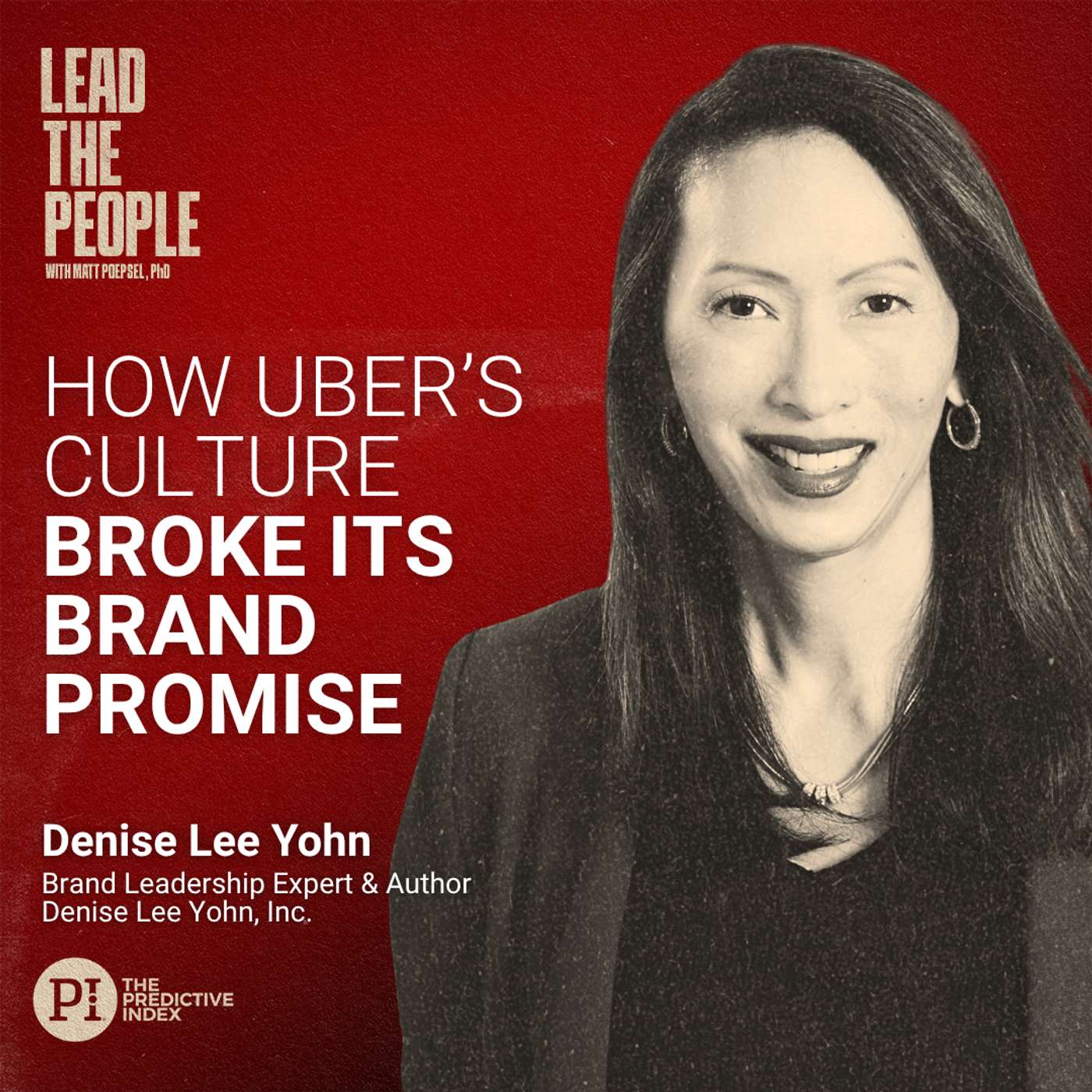
Lead the People · Matt Poepsel, PhD
Start with our free behavioral assessment. Go to trypi.com/ltp . Travis Kalanick built Uber on a promise of democratic freedom, everyone gets to feel like a rockstar, not just people who can afford a limo. Denise Lee Yohn tells Matt Poepsel what came next: a tech-bro internal culture so far removed from that promise that customers eventually deleted the app in protest. "We're not going to believe what you say about yourself," she says. "We're actually going to act on what we know and experience about your brand." That gap between the brand a company claims and the culture it actually runs on is the subject of this conversation. Denise, founder of Denise Lee Yohn, Inc. and author of Fusion: How Integrating Brand and Culture Powers the World's Greatest Companies, walks Matt through what she learned as Sony Electronics' first brand manager, why category values like integrity and teamwork are table stakes rather than differentiators, and why she treats customer experience and employee experience as manifestations of the same underlying culture rather than two separate budget lines. She also makes the case, using an analogy about parents who only listen to one of two kids, for why employee feedback deserves the same weight leaders give customer feedback. You'll learn: Brand Starts Inside: Internal alignment and clarity have to come before any outward campaign, or the brand promise rings hollow. Category Values Aren't Core Values: Integrity, teamwork, and respect are table stakes, distinctive values are what actually drive differentiation. CX and EX Are One System: Employees can't deliver an experience they don't personally have; treating customer and employee experience separately costs you both. Culture Needs Deliberate Energy: Values on a poster don't do anything, they need to show up in meetings, recognition, and daily operations. Highlights: (00:00) Meet Denise Lee Yohn (02:39) Why brand building needs to start inside a company (06:01) When Uber's brand promise and internal culture didn't match (08:02) Operationalizing values instead of just aspiring to them (09:10) Category values versus core values (13:18) Treating customer experience and employee experience as one system (16:26) The parent who only listens to one of two kids (17:15) Why employee expertise is a competitive advantage (20:20) Everyone contributes to culture, not just leadership (26:06) Reinforcing values through recognition in daily meetings (28:53) Are you smarter than AI? Resources: Learn more about Denise Lee Yohn: https://deniseleeyohn.com Follow Denise on LinkedIn: https://www.linkedin.com/in/deniseleeyohn Follow Matt on LinkedIn: https://www.linkedin.com/in/mattpoepsel/ Subscribe to The Predictive Index on YouTube: https://www.youtube.com/c/ThePredictiveIndex Created in partnership with Share Your Genius: shareyourgenius.com Experience it for yourself at trypi.com/ltp .
Denise Lee Yohn (00:00): Everyone contributes to the culture in an organization. I've heard stories of administrative assistants who have really shaped the culture of a team in such a way that it kind of ripples out to the department and then the entire company and then to the customer and then to the community. So control what you can and steward the influence that you have. Matt Poepsel (00:30): Hey there. Before we get started, I want to tell you about something new I'm trying out. As you listen in to today's conversation with Denise, I'd love to know what questions come up for you. What sort of reactions do you have about our topic, all about culture and employee experience and how to make sure that brand, these things are all tied together? So if you put them in the comment section of whatever podcast platform you're listening to or hit me up on LinkedIn, I would love to hear from you and I'll be sure to answer them. So let's keep the conversation going. I think you're really going to enjoy this conversation with Denise. The first thing that she tells us about is all about alignment. How do we make sure that people are clear about the nature of the brand promise and the nature of the values that we're trying to bring to bear, which is really powerful. (01:09): The second is that we have to act on those things and make sure that our behaviors, the types of initiatives, the way we approach our work, for example, is consistent with that brand promise. And then she gets into some important areas of integration between things like the employee experience and the customer experience. Sometimes we overlook one or the other. We really need to make sure we see these as tightly integrated. And finally, she and I got to talking about how everything's changing in the world, and yet at the same time, how is that going to impact how we approach these notions of brand and employee experience? And I found her responses really fascinating, so I think you will too. I'll let you get to it. Thanks. (01:51): What if the polished brand your company shows the world and the culture your own employees live through are actually two different companies? Today we're talking about why brand and culture can't be pulled apart and what a leader can do about that starting in their next meeting. We're joined by Denise Lee Yohn, author of three books on brand leadership, including most recently Fusion. She spent years building outward campaigns for brands like Burger King and Land Rover before moving client side through Jack in the Box and Sony Electronics. She's now the person CNBC, Fox Business and NPR call to explain why a brand's promise and a workplace's reality have to match. Denise, welcome to the show. Denise Lee Yohn (02:26): Hello, Matt. Matt Poepsel (02:28): It's so great to see you. I don't know which I love more, to be honest with you, brand or customer or employee experience. And we're going to get to talk about them both in the intersection of those. So I'm really looking forward to our conversation. Denise Lee Yohn (02:38): Me too. Matt Poepsel (02:40): Well, I mentioned that you have this history of having worked on the agency side and then you switched over to client side, so you've really seen it from all angles, but something along the way convinced you that the energy that gets piled into brand building really outward, that happens quite often, but it really should start from the inside. What is it that brought you to that realization along the way? Denise Lee Yohn (02:59): Yeah, it was something that actually I learned at Sony Electronics. So I started as their first ever brand manager, which is kind of incredible that the brand had been so successful up to that point without anyone doing anything about it. But even at that time, this was like what, in the late '90s, the CMO and president of the company could start to sense that they were going to need to rejuvenate or revitalize the brand. So they brought me in, but the CMO at the time felt very strongly that we needed to start brand building inside. As opposed to jumping right into launching some big brand campaign, we started working on internal alignment and engagement with the brand to ensure that what we eventually promised in our marketing was actually the reality that we were offering and that we were experiencing inside the company. Matt Poepsel (03:53): And when you say inside, so this would mean different functional teams, so whether it's sales or other kinds of content marketing, et cetera, that you wanted to start on the inside, make sure everybody understood brand consistency and some of its core elements before then talking to the outside world basically? Denise Lee Yohn (04:08): Absolutely. Because no one had really worked on the brand before, everyone just had maybe an intuitive understanding of what the Sony brand stood for, but there wasn't the clarity and precision and alignment of that understanding that we felt was important to move the company into the next era. So we always talked about how if you ask people at Sony, like you said, whether in sales or marketing, engineering, et cetera, what does the Sony brand stand for? You would get answers that were kind of in the same zip code, but not necessarily the exact address. And so we wanted to make sure that we had that precise clarity. Also, something that we felt convicted about was that the values of the brand needed to evolve as the market evolved. So one of the examples I give is innovation. So Sony had always been known as a very innovative brand, but as digital technology was rapidly increasing, our ability to compete based on technology innovation alone was quite limited. (05:15): And so we needed to think about innovation in other areas, innovation in marketing and customer experience. And so having that understanding of what does innovation mean across all of these different disciplines is something that we needed to work on as well. Matt Poepsel (05:29): It makes me remember something else that you had taught me during our last conversation, which is around it's easy to say what you want your brand to be all about, but if it's not, it's going to be a little bit hollow. Customers, they're going to see through that. They're going to stop believing in it. So you could say a lot of companies right now are saying, "Oh, we're very innovative." And Sony's like, "No, we have thousands of patents to prove it." They could back it up. My question for you, Denise, you got any examples you could share with us about a company who had a brand promise externally they were trying to make, but maybe internally it didn't quite line up? Denise Lee Yohn (06:01): So an example that I actually talk about in Fusion, so this goes a little bit back, but I actually feel more comfortable about talking about it now because I hate to criticize efforts in process because you never know exactly what's happening, but I'll talk about Uber. Uber started, Travis Kalanick started the company to democratize limo service. He wanted everyone to be able to feel like a rockstar when they were being picked up and dropped off and going clubbing or whatever. Why should that experience of having car service be something that was only exclusive to those who could afford it? And so the values of the company were very much about democratic freedom, about the customer experience and respect and value of everyone that they were serving. The company started that way, but once we started learning more about the internal culture at the company, we found out about the typical tech bro culture that was in the company, definitely lots of hierarchy, definitely a lot of misogyny, and a lack of respect for a lot of people in the organization. (07:07): And so here's an example of company that's kind of positioned as one thing, but was really operating as another. And once that kind of truth came out about Uber and then some of the customer experience failures they had, that's when the whole delete Uber thing happened because people just realized, Hey, we're not going to believe what you say about yourself. We're actually going to act on what we know and experience about your brand. I Matt Poepsel (07:33): Think that really raises the bars. At first, we were kind of talking about the consistency of internal and external. You talked about getting people aligned at Sony Electronics at the time, make sure that we were clear internally about the brand, but now we're saying we also have to be consistent in how we act in accordance with that brand. So even if we're all clear that innovation's what we want to say we're about, if it's only one part of the business that's innovative, then well, it's really hard to back that up and have people really feel it if we're not truly going to innovate in all parts of the business internally. Denise Lee Yohn (08:02): And Matt, you're raising something else that I think is really important is that it's one thing to want to be innovative, for example, it's another thing to actually run your company as an innovative organization. One of the things I talk about in fusion is this idea of operationalizing your values, driving your values into the actual operations of the company. So if you truly want to be an innovative brand and want to therefore cultivate an innovative culture, well, are your operations supporting that? Do you have an R&D ethic that promotes experimentation, that is not only okay with, but celebrates failure, that really values the learning process through multiple prototypes and testing and innovation? Matt Poepsel (08:47): And then Denise Lee Yohn (08:48): Are you rewarding people based on the innovative practices they bring, whether it's innovatively running a meeting or innovatively creating a product concept? This idea of your values can't just be what you say or aspire to, they actually have to be how your company operates. And that's really the core of this brand and culture alignment. Matt Poepsel (09:10): And you talk about two different types of values, really. You talk about category values. Well, I don't even want to differentiate between the two, but the second type is core values. Can you tell us the difference between how you think about category values versus core values and maybe some examples of each? Denise Lee Yohn (09:24): Yeah, so category values are the values that everyone in your category, every company in your category needs to embrace and deliver on in order to compete. And in general, they are values like integrity or respect or teamwork or even innovation or even I would say customer centric or customer led or customer oriented. These days, if you are not those things, you are not going to be able to attract customers and actually grow as a business. And then core values are the values that actually distinguish your particular company. What are the unique ways of thinking and acting and communicating and believing that enable you to own a distinct position in the marketplace? And often what I see happening is that companies, they might really want to become very values driven, and so they start with category values, but then they just kind of stop there and they don't go on to identify, define, and then operationalize the more distinctive core values. (10:27): And that's where then you get into the problem of trying to differentiate yourself on things that either aren't true or just things that you say versus actually in a different way from your competitors. Matt Poepsel (10:39): You did it again. You raised the bar on us again, Denise. What I'm hearing is that we have to define our values. Some companies don't even make it that far, but if they do, you can't really stop at those category values. So if I'm a bank, for example, and I say, oh, we're relationship oriented, and you're like, "Yeah, I would expect that all banks should be. What else?" And they're like, "What do you mean what else? That was it." You're like, "No, that's not going to make you different than everybody else." Denise Lee Yohn (11:01): Right, right. And Matt, I've done a lot of thinking about this lately because I'm a keynote speaker, and so I'm getting more and more calls from companies wanting me to speak on values. And so I've really been thinking about why is this such a difficult topic? I mean, for someone who's been working on this for years, I'm kind of like, "Come on, you guys. Let's get on the bandwidth." But what I think I have realized is that even those category values are quite difficult to maintain and to really make true. When you say that you value teamwork, for example, again, you can't just say that. Do you really operate in a way, do your managers cultivate a culture where teams really feel a sense of belonging and solidarity and group performance, things like that? I'm not discounting how difficult it is or how important it is to have these category values, but what I'm just saying is that you need more than that. (11:57): If you want your brand and your customer experience to stand out, you really need to be focused on those core values. Matt Poepsel (12:05): I can see why you'd be getting a lot of calls because in my experience at least, you have so much AI out there and it's so easy now to listen to customer data and hear what you're supposed to be articulating that there's a lot of sameness out there. Yes. Then the other part is that trust is at an all-time low because of a lot of different failures in the market promise that we make as companies and then fulfilling them. So I think people are leaning on values more than ever of wanting to do business with businesses they have an affinity with. The volume is turned up on values, but that doesn't make them any easier to pull off. So we need experts like you to help us even think about it, much less act on it. So I'm not surprised you're getting a lot of Denise Lee Yohn (12:45): Calls. Yeah, for sure. Matt Poepsel (12:47): But you also have a model called lead from the inside out, and that's a model that talks about threading this culture and these types of things into brand and turning those brand experiences and bringing them in line with the experience employees are having too. I see a lot of companies that will put a slug of money into customer experience and they definitely want to have the customer experience first and front and center, a lot of work being done there. And then maybe see employee experience, if they talk about it at all, it's something on a different line item in the budget, stakeholders, different owners, different models, different everything. What's the real risk that we run into if we think about these as two separate things and maybe even give them different temperature within the business? Denise Lee Yohn (13:28): You can't expect employees to deliver to customers an experience that they don't have themselves. Employees need to have the kind of experience that you want customers to have. And I'm not just talking about being nice to your employees or being friendly to employees, that's baseline for both employees and customers. But if you want your customer experience to be really tech enabled and seamless and intuitive, but everything that you do with your employees is bureaucratic and slow and on paper, employees A, won't develop the skills and the capabilities to actually operate in a way that will deliver the customer experiences that you want, but B, they won't develop the appreciation for how important it is and how it makes them feel and how differentiating that experience can be. And so what I talk about is that this integration alignment of brand and culture really starts with the integration and alignment of customer experience and employee experience. (14:23): How do you bring some of those values that you aspire to deliver for customers to your employees and design very deliberately that employee experience the way you design your customer experience? There's been so much work in the last 20 years on customer experience, personas and journey mapping and empathy maps and all this stuff. Bring all of those tools and processes into your work with employees. And that not only helps you, again, deliver the customer experience that you aspire to, but it also helps you get more out of your workforce. You reduce turnover, you increase retention, increase productivity, increase motivation and engagement. And today's job market is kind of a little wonky in the Bay Area. There are so many layoffs, et cetera, but still there are a lot of employers that are struggling to keep their workforce and to keep their workforce productive and skilled and focused and engaged. (15:20): And so really focusing on the employee experience is key to winning in the workplace. Matt Poepsel (15:27): You've raised the bar on us again in a really good way, which is now saying we can't even just make sure that we're aligned on it, that we're actually executing on it. We also have to make sure employees are getting a similar experience. Otherwise, it's disingenuous really is what I'm hearing. And my mind couldn't help but go, I'm a big Disney fan and I'm wondering, is it as magical to fill out an expense report if you're a Disney employee as it is to be in one of the parks? I don't know, maybe it is. Somebody can write in and tell me, but maybe. Denise Lee Yohn (15:52): I would hope so. You would think though because they're all cast members, so hopefully there would be some process. I always think about the Ritz-Carlton and their model of ladies and gentlemen serving ladies and gentlemen. And everything when you examine the employee experience and the human resource practices and the culture building they do in the organization, everything really does align with that idea of we are treating you, engaging you as an employee, as a lady and gentleman. And that then naturally translates into the kind of service and experience that customers get. And Matt Poepsel (16:26): You have this great analogy too, which is around if we act on customer feedback, but we ignore employee feedback, it's like being a parent who's got two kids, but you really only listen to one of them. It really brought it home for me. I have three kids. I don't listen to any of them. I tell you, there's way too much chatter, too much feedback. Don't tell them Denise Lee Yohn (16:42): That, Matt Poepsel (16:43): Right? Don't tell them that. Thankfully, they're grown now. They survived. But essentially, I can totally see that. And we ask for employee feedback through engagement surveys. And one of the biggest complaints I hear from employees is they say, "I wait in and nothing ever changes." And at the same time, a lot of times customer feedback is almost immediate like, "Oh, one person had one problem, let's scramble everything." And I think it's important to pay attention to customers. But when you think about that, what is it that managers, executives should understand about this kind of playing favorites almost between customers and employees? Denise Lee Yohn (17:15): People ask me which is more important, employee to customer, and it's like both, right? I would say there are two issues. One is trust and the other is the employee knowledge or kind of employee expertise. So let me talk about the second first. Your employees, especially your frontline employees, know more about your customers and about your products and about your experience than you do sitting in corporate or as a manager. And so if you're not actively soliciting and then listening to and then acting on their feedback, you are missing the opportunity to really serve your customers well because your employees have all that expertise and knowledge, and I think that they want to share it with you. The second issue is the lack of trust that you fail to build with employees. Again, when you ask someone for input, that doesn't always mean that you have to make every change that they recommend or act on every suggestion that they make, but acknowledge, tell them what you are doing as a result of hearing from them. (18:18): And I think that that is the way that trust builds. People want to be heard, they want to be engaged, they want to be treated like people. And so acting on someone's input is the most valuable thing you can do to convey the value that you put in that relationship. Matt Poepsel (18:32): I think when you take the time to listen and you act on it, it really closes that loop, right? Denise Lee Yohn (18:39): Yeah. Matt Poepsel (18:40): As a consumer, I get really frustrated when there's this, "Hey, will you fill out this survey?" I'm like, "No, because first of all, I just had terrible experience with you, cable company, and you don't want to hear what I had to say. That's clear." But I think for the employees too, it's frustrating because they tend to want the company to succeed. They want it to be a positive working environment. And I'm not sure what gets in the way a lot, but it does happen that we will put out a survey and either get busy with something else or maybe not know how to do it. But I think coming back to saying, "We've heard you, and of these five top priorities, we're going to focus on these two," is a perfectly acceptable response because when you do that, somebody says, "Okay, well, you heard me. (19:20): That's great. And at least you picked some things that as a collective we weighed in on. You were clear and transparent about what you weren't going to prioritize just yet. And if it continues to be a problem and we fix the other two, maybe mine will come up to the top of the list, whatever that is." Maybe sometimes employers put too much pressure on themselves to say, "Well, if I told them we heard it, but we're not going to work on it right now, isn't that going to just make them mad?" And you're less mad than if you don't tell them don't do anything at all, right? Denise Lee Yohn (19:45): Exactly. You're absolutely right, Matt. Matt Poepsel (19:48): Yeah. And I think that as managers too, what we might be able to say is, okay, we saw the company said that they're going to focus on the two things kind of centrally, but those other three, one of them is really important to us as a team, and so we're going to operate on that here on the local level. We're going to work on that thing. Let's say role clarity didn't show up at the company level. That's something as a manager that you can absolutely action for your team specifically, and that can go a long way too. I feel personally a lot less control over the customer experience than I do the employee experience of people who are right around me. And maybe that can be different depending on what your role is. Denise Lee Yohn (20:20): That's a really great point, Matt, especially when you are working in functions that aren't necessarily customer facing. Your ability to affect what a customer experience is, you definitely do impact the customer experience. Everyone in the company impacts the customer experience, otherwise you probably shouldn't exist. Your job shouldn't exist, I should say. But it may not be so clear or easy for you to influence that experience. But you're right, being able to influence what the people around you experience. And something else, Matt, I think that that brings up is that you may not have a large span of influence, you might not have lots of direct reports, but everyone contributes to the culture in an organization. I've heard stories of administrative assistants who have really shaped the culture of a team in such a way that it kind of ripples out to the department and then the entire company and then to the customer and then to the community. (21:16): So control what you can and steward the influence that you have. Matt Poepsel (21:19): I think what you're helping me understand in this conversation is that I can be a culture champion, and I've always thought about the employee experience that way, and I've tried to be a good steward of the culture, but I can also be a brand ambassador, another fun term, but I can do it at the same time and realize that just by doing my job in a certain way, whether I'm customer-facing or not, I can do both of those things. If we've said, because let's take your clarity from how you started our conversation, we have to be clear internally that we want to be seen as innovative. And let's say we're not an AI startup, we're a bank and we're like, "But we still want to be innovative." Okay, great. So then if I'm encouraging others to experiment and not making them afraid of failure, then am I being a cultural champion? (22:01): Yes. A brand ambassador? Yes. And so just by being a thoughtful manager, I can kind of check both boxes at the same time. That's what you're opening my eyes to in a way I hadn't thought about that before. Denise Lee Yohn (22:10): Well, I really like the way you've articulated that, Matt. That's exactly right. Matt Poepsel (22:13): It does bring up something else though, which is that we're experiencing a lot of change in the marketplace right now. And I just mentioned AI startup. There's a bazillion of these things now, of course, and it's swirling around us. And there's kind of a lot of pressure that CEOs are under right now, which is you have to modernize and change everything. And my question for you as a culture and employee experience champion and integrator, do you have a sense that that's true for those things as well? Do we have to be prepared to reinvent our employee experience and our brand values because everything it seems has changed? Or is that something that would be kind of too reactionary? Denise Lee Yohn (22:50): That's a great question, and I'm not sure that there's one single answer. I will say that as a leader of an organization, you need to be aware of how AI and other technology is disrupting your culture and your employee experience. And as you bring in AI agents and as you adopt certain ways of using AI in your operations, that will certainly impact your employees even if you don't really intend it to. And so just I think being aware that there is an impact, the first step. But then I think it's kind of the responsibility of the leader to determine, okay, well, if this is impacting the way, let's say, employees interact with each other, because now they're interacting more with an agentic employee versus a real human employee, maybe think about how do our values still apply in those interactions? How do we make sure that we are using these tools in a way that still is aligned with our values or maybe consider the additional risks or temptations that might exist and address those in advance versus just kind of saying, oh yeah, everything's the same, and then realizing, oh, people are actually struggling with this or we've actually opened the door to a lot of risk or some ethical dilemmas or whatever. (24:14): So I think just taking responsibility for discerning what is the impact of these new tools on your culture and on your employees is the first step. Across the board, leaders need to be upskilling their workforce so that we can use these new tools. And so that alone, it requires some culture change in terms of becoming more of a learning organization. I think the specific ways that those tools might affect your company is really something that's up to the individual leaders to determine. Matt Poepsel (24:45): I love that term, discerning. So it's being thoughtful about it, being aware, being watchful, seeing where maybe some of your values are being tested by so much change so quickly. And what I'm also hearing you say is we don't have to throw them all out and start with a blank sheet of paper and draft new values, but we might have to lean into some a little bit more than others. We might have to emphasize them differently depending on what it is that the response is going to be. And I think what we're seeing is challenging now. As an example with AI, a lot of times we have this opportunity to do things differently, but if our values historically have been around stability and consistency, well, those are going to be tested versus other values like innovation and being responsive to feedback. Those are going to be probably a little bit more aligned with what's happening. Denise Lee Yohn (25:31): Yes, for sure. Matt Poepsel (25:33): I want to tell just one thing real quickly. I'm always trying to hit on practical tools and Predictive Index sponsor of the podcast. At PI, we talk about cultural values under this notion of threads, which is teamwork, honesty, reliability, so on. And one thing I like to do is take the first five minutes of some meetings and be like, let's talk about a threads moment that somebody had, and maybe it's with a different department, somebody else across the building, somebody in the room is fine too. And it's really a nice way of just bubbling up the fact that there are values reinforcement things happening all the time. And if we just hit a quick pause button and celebrate that, it kind of reinforces that culture. Are there any other techniques that you might recommend for my listeners who are in the day-to-day doing the work where they may have an opportunity to do all these great techniques you have shared with us today, Denise? Denise Lee Yohn (26:17): Yeah. Well, first of all, I want to affirm the practice that you do, Matt, because that's something that I write about my book and that I've observed at some of the best companies. I remember working with Chevron and they would open every meeting with a safety moment and that everyone would have a turn at a meeting to share anything from why you should use the handrails when you walked up the stairs to how are we practicing safety in one of our plants? So I definitely think that that's a great practice. Another thing has to do with the way that you recognize performance. And recognition is such an important aspect of employee experience for people to be seen and then to be called out and saying, "Hey, I see that you did this really great thing." And if you can connect that recognition to a value, I think that really helps reinforce how important your values are and how your values really guide behavior and attitude. (27:13): So if you can say, "Hey Matt, I saw that you did X, Y, Z in this interaction with your colleague, and that really demonstrates our value of empathy. I really kind of got the sense that you truly understood what was going on for your teammate and you acted appropriately." That just is a small, subtle, but powerful reinforcement of your values. Matt Poepsel (27:36): I love that. It is powerful, and it's one of those techniques. They're so rare in life. I call it fast and free. Five minutes is not going to derail your meeting and it doesn't cost you anything to have somebody recognize another person or share a safety tip if your cultural value is safety first, all those kinds of things. So yeah, I love that. It's just like I could have this conversation all day because you had the agency experience and the client experience. Now you're a keynoter and a consultant about these experiences. I think it's really, really important in an increasingly digitized world. I feel like more human is what we need, and that puts us right into these things like brand and values that can seem a little ephemeral or squishy or hard to get your little abstract. They're not, they're not. You're making it real for us, and I really appreciate that. Denise Lee Yohn (28:21): Oh, well, thanks. And thanks for asking great questions. And I totally agree with you that it's so wonderful, so great how technology is transforming what we're able to do. But at the end of the day, we are humans and the human-to-human interaction and connection is really what is most valuable. And so I would hope leaders understand that, keep their focus on that, and that will naturally, as you said, lead them to pay attention to brand and culture and how these two things really need to be integrated and aligned. Matt Poepsel (28:55): Yeah, 100%. Well, we're about to have a collision of technology and human because you and I are going to take on AI in the trivia segment. Oh no. Yes, it's going to be great. Are we smarter than AI, I think is what I call this segment. I can't even remember. But I saw in your background that you've had so many life-changing experiences. I think you summoned the Mount Kilimanjaro, you flew in a helicopter, but you also participated with a professional ballet company. Is that right? You did some work with ballet? Yes, I Denise Lee Yohn (29:19): Did. As a child, Matt Poepsel (29:20): Yes. As a child? Yeah. We're going to get a question about ballet. So here's our question and create multiple choice. What famous ballet tells the story of a princess named Odette who is turned into a bird by an evil sorcerer's curse? Is it A, The Nutcracker, B, Sleeping Beauty, or C, Swan Lake? Denise Lee Yohn (29:37): Oh, I think I'm going to have to go with C, Matt Poepsel (29:39): Swan Lake. Yeah. Okay. So audience, if you're playing along at home, who got turned into a bird? Was that part of the Nutcracker, Sleeping Beauty, or Swan Lake? And you got it. It's absolutely right. Yay. Von Rothbart was the evil sorcerer. I did not know that. Swan by day, allowing her to return to human form at night. There you go. Well, I have a much, much better question for you Denise, where can my listeners go to learn more about you? Denise Lee Yohn (30:04): Yeah. Well, thanks, Matt. Thanks for this conversation. Thanks for the invitation to share. My website, deniseleeyohn.com is really a portal to everything. It's got lots of free resources, including free chapters from my books, as well as all of the articles and blog posts that I've written, and it's also portal to my socials. From a professional standpoint, I'm mostly active on LinkedIn and I'd love to link in with people there. So deniseleeyohn.com. Matt Poepsel (30:31): Perfect. Listeners, I have those links for you. In the show notes, you're only one click away from getting connected with Denise and learning more about her amazing work. Denise, thanks so much for being with us today. I've learned a ton and I've really enjoyed it. Denise Lee Yohn (30:41): Thanks so much, Matt. This has been great.