
Kansas Reflector Podcast · Kansas Reflector
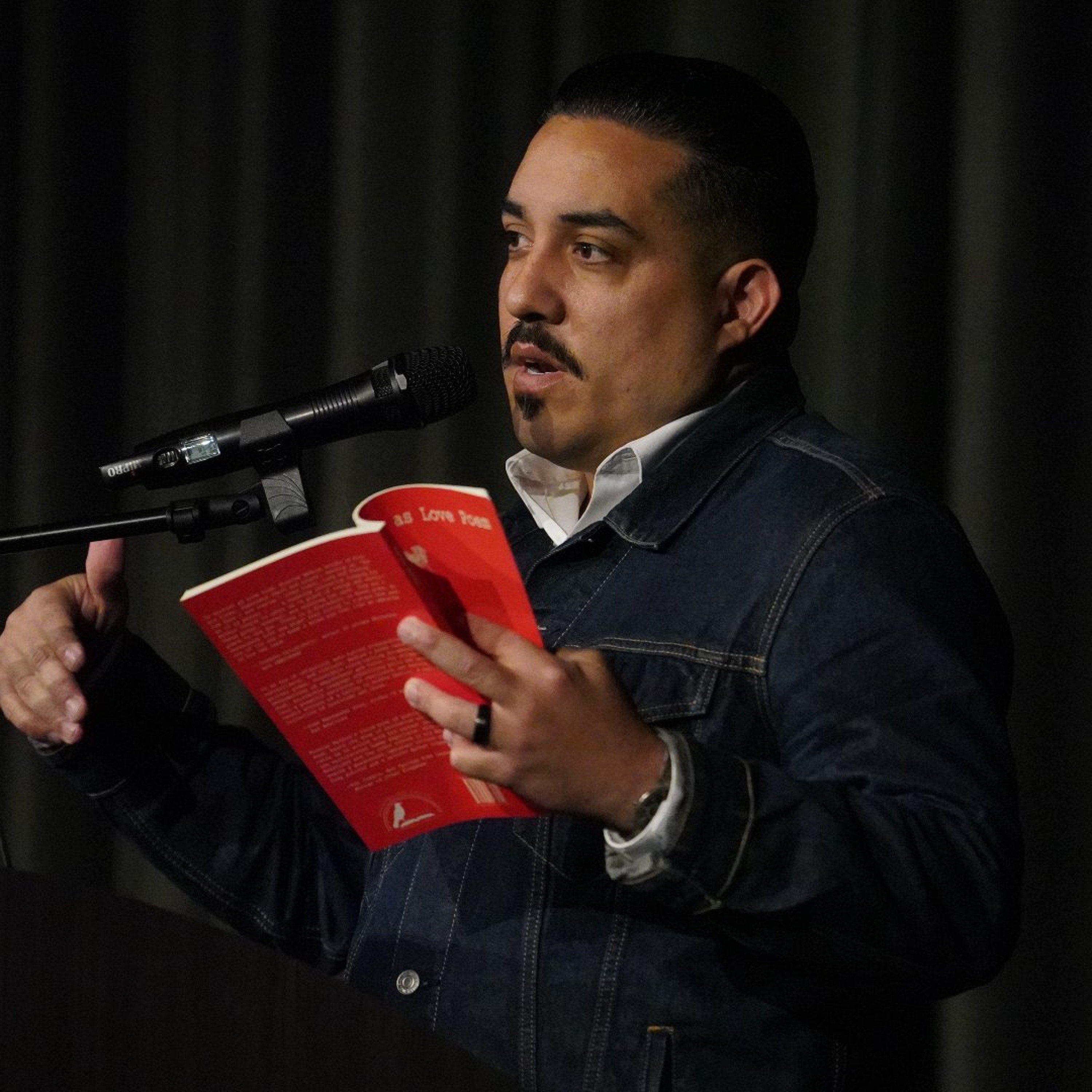
Kansas Reflector opinion editor Clay Wirestone interviewed former Kansas state poet laureate Huascar Medina in September about his latest book, "Protest as Love Poem," and the challenges of living through this political and cultural age. Medina has also written opinion columns for Kansas Reflector. New episodes of the Kansas Reflector Podcast drop on Mondays. Kansas Reflector staff interview elected officials, politicians, researchers, experts and everyday Kansans who are in the thick of state politics and current events. This episode was hosted by Clay Wirestone and produced by Anna Kaminski.
Speaker 1 0:01 Author Hawaskar Medina has published books of poems and written nonfiction for Kansas Reflector. He served as Kansas poet laureate from 2019 to 2022, and his newest book, *Protest as Love Poem*, came out this year from Meadowlark Press. My name's Clay Wirestone, and this is the Kansas Reflector Podcast. Today, a conversation with Oaskar Medina. Speaker 2 0:31 I'm going to start with a poem today, Clay. If that's all right with you, it's titled "Orphiacento: Eurydice near Ellis Island, difficult stems. She sings. She sings all that happened to ourselves. Powers the gods invoke. Shall we at last to receive be opened wide? Song of the heart, born into the whole, a constellation of our voices, undimmed by her breath. Only the God can hear a breath from nowhere, astir, and the God, a wind. It seems to her, interrupting what she says. Ah, but the wind's breath. Ah, but the space is to build her godlike house in unusable space. She sinks from me. Where? Where? I chose this poem play. I'm really thinking about where we are at right now in the United States, democratically, and Eurydice is someone that Orpheus was trying to save, bring them back from death, and I see this collection as an attempt to do so symbolically. She was a a character in in Greek mythology, the wife of Orpheus, and he did try to bring her back from the dead with enchanting music. But I'm trying to do so with poetry, and she's equivalent to me to Lady Liberty, so these poems are for Lady Liberty when it's all said and done, and I I decided to use the cento form because I think pulling back from other words have already been written and using them again also allows me to contemplate. how we're going through history and seeing the same problems arise again, and that words have already been written that can be used. There are tools out there that we can utilize to have conversations about what's going on. And for those who don't know, a cento it's a poetic form. It's created by stitching together lines, phrases, or passages from other authors. The words derive from Latin "cento," meaning a patchwork garment or a patchwork cloak. This is the last section of the book. It's the fifth section. I don't claim to have written this section. I've created this section. I've I've stitched this section together, so his authorship in a sense existed before I did. I pull from the the sonnets of Orpheus, and they are in the Duino Elegies, written by Rania Maria Rilke, and that work was inspired by human loneliness. You know, he has existential crisis and also devastation of World War One. Analogies focus primarily on death, loss, and emotional processing of grief. And right now, I do think we need to process the reality that American democracy is dying, maybe dying. Some people say it's already dead, which leads me to the rest of that this section, where I I pull directly from the work of Marvin Bell, yet a collection, and then of his work, Incarnate the Dead Man Palms by Copper Canyon Press, and I really wanted to focus on using his word because he had this poetic invention where he was speaking in these poetic voices with this overarching consciousness of which they were alive and dead at once, and it felt very defeating at times. And at other times, it felt rebellious. So it was mystical. It's anonymous. It's a collection of voices. It's like this this aggregate of of of humanity building into these different poems that he had. And you know, he has he has this line in one of his poems where he says that he is powerless to stop the battles, you know. So recognition that that even though we may feel helpless, we can still have say in what's occurring. So that work is really important to me. So I was able to use his lines to write some of the the poems in this collection As well, Speaker 1 5:41 so Oasker, what was what's the name of that the the form again you just were mentioning? Speaker 2 5:50 Sento the Speaker 1 5:51 Sento. I think that's such an interesting observation about you know using other people's words, the idea of kind of authorship, because I I find as someone who you know writes opinion pieces that there is a real challenge when you're writing about kind of the national scene right now, things about you know things from ice. You know, well, I mean, things really from every direction, and it feels very hard. It feels very difficult to be an individual voice, right? Because it's like, well, of course, there's you know, of course, an individual voice can say anything, but what is that against the machinery of the state, right? So I think it's interesting to kind of have the cento there as it's kind of a you're kind of doing a collective voice almost. Speaker 2 6:52 Absolutely, it's a collective voice. I believe in collective survival. This this book focuses; it's meditating on the idea of collective survival as a love language, a way of us working together, that standing up for human rights is something that's deeply tender. You know, it's this protective devotion that we have for each other. So, at its core, it is a love poem to humanity. This work, and we we had a conversation a long time ago, Clay. We were talking about Walt Whitman, and you said something to me, and I wrote it on my whiteboard, and I've kept it ever since. Intimate authority, you know, the giving ourselves permission to speak, not necessarily from the mountaintop, right, but to to have say, you know, personally, it matters that are public. When I think about the poetry that I've written, I believe I come from a long list of of those individuals who are singing songs about America, right? Like Whitman had "I Hear America Singing," right? And he's he's singing about those mechanics, the carpenters, the masons, the boatmen, the woodcutters, the mothers, you know, and and he says each singing what belongs to him or her and to none else, right? So it belongs to them. Those songs belong to them, but they also belong to everyone. And it's it's this continuation of this song. You know, we're all part of this larger choir, this collective voice, right? It goes into Langston Hughes. I too, you know, it feels like a continuation of that work. I too sing America. I am the darker brother. And then Julia Alvarez took it for for the Latinx community. Right, she wrote it bilingually. You know, she's talking about Caribbean culture through Latinx lens in the Pan American landscape for us, and I really, I really connect with that. You know, I'm singing from the rooftop here in the Midwest. I'm wanting to be heard. I have something to say. I hope other people join in song of truth about what is occurring today, and and to share their realities. You know, poetry operates that way, Speaker 1 9:02 well, but it's it's it's interesting because I think as just hearing you talk about this, right? It's it's that tension between you know the the the fact of reading and or writing a poem, which is often an intimate act and a revelation of intimate thoughts, and yet you know, choosing to deal with, as Whitman did, as as so many other authors have done, you know, choosing to grapple with, you know, these big, these gargantuan themes, right? What is America? How are we American? And you know, that is is such a such a fascinating tension. I mean, do you find yourself? Do you? I mean, you as as I have known you, Hawaskar, you are a kind of the epitome of a performing poet, right? You're someone who, you know, it. Feels like a lot of what you do. I mean, it's not so much that it's aimed to the public; it's just that that's the mode that you're in, right? You are are someone who who goes out and shares this stuff. Do you ever feel like oh, do you ever have poems that you like? I would not read this in public. Like I want this to just be on the page, or just to myself? Does that does that happen? Speaker 2 10:25 I have a poem I've been writing for well over a decade called "Hello or Hell." I have not shared it fully with anyone. It's a conversation I have with myself. That's how I got into poetry, right? Initially, it was this internal examination of self. So I was looking inward for so long, but I think as you progress in in your work, and your work develops more more more meaning, more vision, more more mission. Right? It became a tool, a mechanism for change, a way to advocate for those around me. So there was this outward aspect to my work now, and the performance act of act of it, and not to say that it's performative. It's to say that I'm trying to connect. I'm out here, you know, building these these these these bridges, opening these roads, these gates, these doors, these windows into someone else's life who is right next to you, so we can have conversations about the similarities and the differences to kind of humanize different lived experiences in Kansas, Particularly, Speaker 1 11:41 so just to take a step back here, Oscar, give us a so you're the former poet Lord of Kansas. You have a new book out, Protest as love poem. Try to give try to give us a little bit of a summary of kind of like where you are now, what you're working on, like how many paths are you are you walking here as we we tape this in September of 2026. Speaker 2 12:14 The road meanders for me. Every trail feels new. It has always felt that way of being the first of anything. I just spoke about that yesterday. Actually, I spoke about that on Saturday, and we had a our first Hispanic Heritage Month festival in Topeka that we had to put together ourselves, right? And I provided a platform for others to share their stories about our culture. I I don't travel alone anymore. I bring others with me that is important to the work that I'm doing. I'm going to be at the Casas Book Festival talking about Ponce's love poem coming up next weekend. There's going to be other poets out there as well, but my work. If we want to focus on my work, what I'm doing, which is a question you ask, I'm reading in communities. I'm having conversations with individuals. I'm sharing Proteus's love poem. All proceeds from the book, all all royalties from this book, are going to El Centro, which is a an organization helping immigrant populations. I'm not trying to profit off of this moment in time. I feel activated. I feel I need to engage our community through art for change. So I had a event also this past week, called "Sharing Home" at the Lawrence Arts Center, where I was with Iski Karukis, who's Turkish, with Nick Carswell, who's Irish, and then Jose Baus from Colombia. Two musicians, two poets, a cellist, a guitar player. We had a piano there as well, and we were sharing poems about longing and belonging, becoming, being in America. You know what's next in America for us. So I'm trying to have these conversations in multiple spaces, through multiple disciplines, through collaborative efforts. Some of them I have to create myself. Other times I'm invited, but it's important that the work is about identifying the humanness of my lived experience in Kansas. I want empathy. I want to to evoke empathy in people right now. I want us to have a compassionate audience in front of us. It's important to me that they see it that way because the work now is political. Because the political is personal. The personal is political. A civic poem is a love poem. A love poem is a civic poem to me. I write these poems because I love the communities that I'm a part of. I love the state. I want different for us here, and it's okay to ask for more, to set boundaries. It's a challenge, and I feel I've been, I haven't earned, but I feel I have space enough to speak the way that I do openly. You know, I I have no deep affiliations to like to anyone or anything, so I can say what I want. That comes with risk, but that's okay. Like I'm willing, I'm willing to take that as long as I can help protect my family and and my communities. Speaker 1 15:35 Well, I mean, I would also say that that you know what one of the pieces that you were just talking about that, I really want to emphasize here because you know I am also as we I think this actually will come out after a podcast in which I talk about the book that I have coming out, and I'm doing a lot of events around that as well. You know the way I've been doing it has been very much you know I'm you know, ask, you know, partnering with other folks that do most of the heavy lifting, and I show up. What you're talking about in terms of creating spaces, in terms of making things happen, you know, that is exponentially more work. It's exponentially more difficult. I mean, do you find yourself? How is how is your your soul in all of this? For want of a better word, like how how tiring does this become? Speaker 2 16:31 It is exhausting, but there is this drive for different, Right. I'm okay with being uncomfortable. I mean, I've been trying to make a living as as a poet. You know, I don't know who still does. Right, as a writer, fully. Sometimes it's good. Sometimes it's not. But I'm I am tired. But I want to spend my time attempting to do good, to feel well, to feel safe, to advocate for others, and there is there is anger involved in this. It's not all just love, but I feel like it. The injustice is visceral in our communities. the The apathy is easy to see. People are disengaged, so there are some of us who have to keep the light on. And I feel that I am responsible for that for whatever reason. I don't. I don't have a hero's complex. I will tell you, I am not a hero. I am. I am a concerned citizen, a son, a concerned father, a concerned community member that cares, that has an ability to connect with others who has learned to disarm and mitigate spaces, facilitate spaces for open dialog over hard truths in soft ways, as I usually say, and I continue to do that work because if I can't go home and sleep at night, knowing that my family is safe, like what what am I to do other than to try to create that piece if I cannot find it if it's not given to me? Speaker 1 18:33 You know, you wrote a column for Kansas Reflector recently about Hispanic Heritage Month, which we're in right now, and you noted kind of a what you felt like had been sort of a change in terms of folks wanting you to show up and read, or the number and where where those requests were coming from, and I was wondering, as someone who, you know, you've now been doing this. You've been doing poetry in a public way in Kansas professionally for, you know, better part of a decade, right? Speaker 3 19:16 Correct. Speaker 1 19:18 What have you seen that has changed? I mean, obviously, we have kind of the ever-present, you know, national force of Trump and whatnot. But what changes have you seen in in Kansas and in your work over that time? Speaker 2 19:38 I will say That the polarized nature of discourse when politics are involved at the moment scares people. You know, there is this: the bridge has gotten wider to cross. It it takes a lot more effort than it. Before, and people are tired. People are tired. People are losing faith. Some people are losing hope, and I also believe that organizations just they they want to survive right now. They're trying to go under the radar per se, because they don't want to be targeted for being too too left, right, too progressive, and that's that's unfortunate when when we're out of this moment in time, because I I I work in the arts as well, I I will I will think and process deeply how quickly organizations shifted away, you know, from language of of diversity, equity, and inclusion, simply to protect, you know, their funding. You know, it's almost as if the the money mattered more than the individuals they were serving, and that that is something that I don't say lightly, but it's something that I think needs to be stated that some of us feel this way right now, and I'm hoping that there's a switch. I hope, I hope that we return to to this this bravery in the arts, this open discourse, this freedom of expression, right? And you know, visual visual work, music. I think there will be a resurgence of it. I believe we're about to enter if things do turn turn for better. Right, that's the hope that there will be this resurgence of voices, but it's not going to be the same as before. Speaker 1 22:00 Yeah, well, that's. I think to me that is the, and this is more just me as a as an observer. You know, it's it's one of the things as a writer. I think you know you, you know you have kind of the territory of you know personal feelings and experiences, and while I write about that sometimes, as as an opinion writer, I, you know, I try I try not to write about those things about just my feelings. Right, I want sometimes to be grounded a little more, but certainly feelings wise, the thing that I worry about is the length of time that might be required to get back to what we knew, you know, even just a very short handful of years ago, and that that can feel very daunting. It can, it it Speaker 2 22:56 can, Clay, but I can I can state for me what we had before wasn't good enough already for me. So we need different. I don't want to to bounce back with the the status quo before. There needs to be a realignment when it comes to the work that we're doing, to the way that we perceive artists and writers and authors in our communities, and what they have to offer our communities. Speaker 1 23:30 Sure. So let's let's just talk brass tacks here. What are some of the things? Anything in particular over the next couple of months in terms of your own appearances or plans across Kansas that you'd like to highlight? Speaker 2 23:48 Oh, absolutely! I mean, the book festival is coming up next weekend. I'm the Kansas Book Festival is such a gem. I hope more people attend. Hope it continues to grow. You know, I mean, Tim Bascom is going to be there. Ben Lerner is going to be there. White Townley, he has new book, Making the Turn. Denise Low, House of Grace. Gary Jackson, Small Lives, and then Jennifer Maurice McCauley is going to talk about Neon Steel. I mean, that there's wonderful, talented writers that are from our area, our region of the country, you know, we we tend to forget how much talent is here, or others do. And I just really want to highlight that the Castle Book Festival is going to be grand, and I'm excited to be there. I'll be participating. I'll be reading and having a conversation with Lindsay Garcia about being in the public eye as poets and editors. I'm also working on this is pretty new on a spoken word operata, which is bringing attention to data centers. So. That's going to take a couple months, but that's that's work that I'm I'm working on as well. Of course, I have Prairie Full, the lyric essays that I'm writing, which are are deep and taking time. I'm being careful how I talk about the communities I'm a part of. I want to make sure I get it right, that the tone is correct. I'm fascinated by what I've encountered, the conversations I've had, and how how I'm examining myself in this moment in time, and how I'm participating in in Kansas as an artist. Speaker 1 25:38 Well, Wasker, if folks want to know more about you, know about your books, know about your new book, "Protest Is Love Poem," how should they go about that? Speaker 2 25:54 They can visit metalarkpress.com if they're interested in "Protest as Love Poem." They can go to my website wascarmedina.com if they're interested in upcoming events, news about my work, conversations that other people are having about the work that I like to share on there. It's all available on the web, social media as well. I'm on Instagram wasgar.medina. I'm easy to find. Just Google me. Speaker 1 26:22 Okay. Well, Pawaskar, good luck, and thanks so much for taking the time to talk. Speaker 2 26:30 Thank you, Clay. Take care. Transcribed by https://otter.ai