
Julie Gammack's Iowa Potluck · Julie Gammack
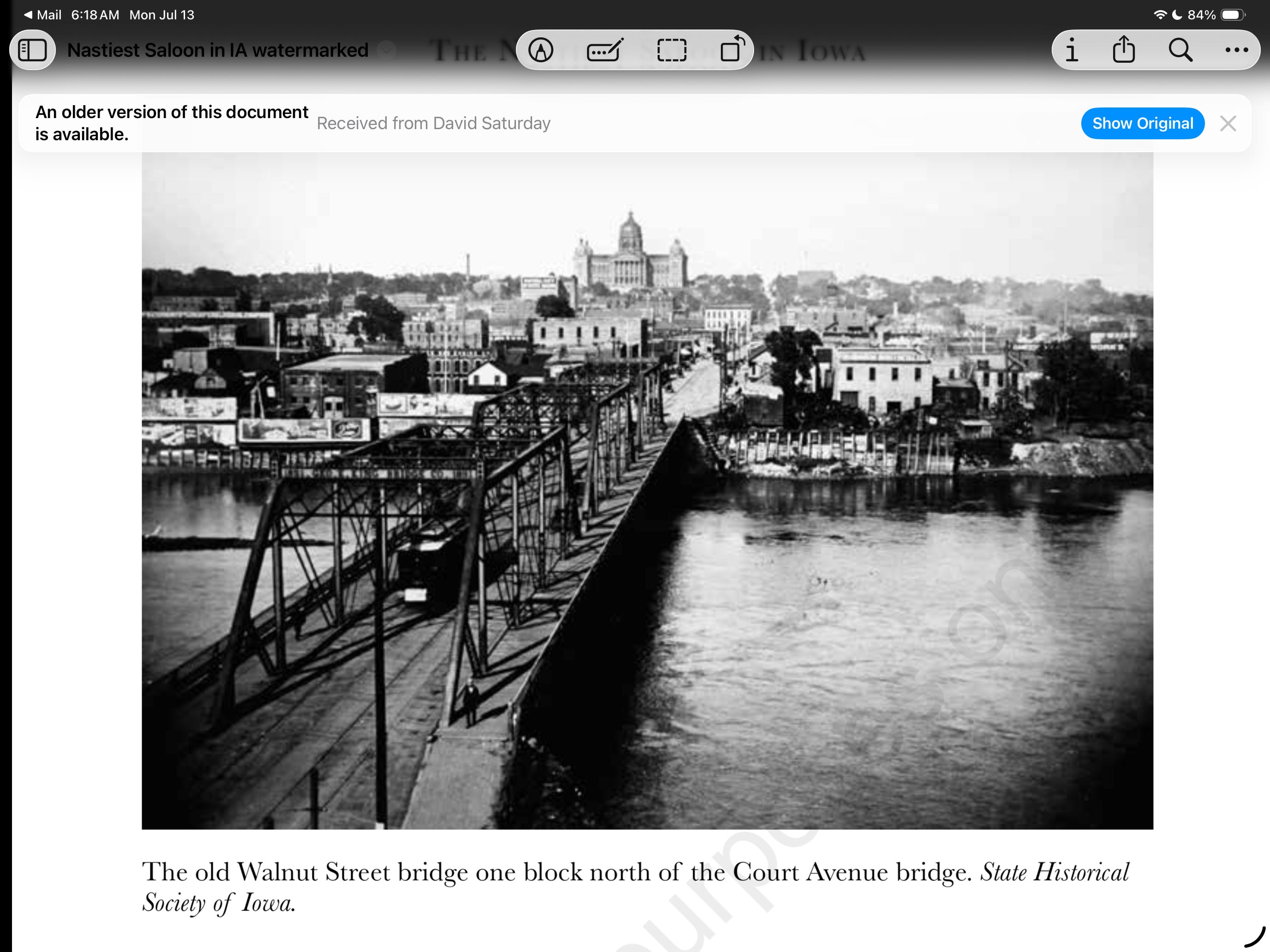
Wait just a minute—where else can you join a one-hour conversation with debut authors and readers from across Iowa about a book that's sure to fascinate anyone interested in the hidden, sordid history of Des Moines? If you enjoy conversations like this, consider becoming a paid subscriber. Your support helps fund merit-based scholarships that enable emerging writers to attend the Okoboji Writers’ and Songwriters’ Retreat. See who is coming: David and Rose Donovan I interviewed David and Rose Donovan about their debut nonfiction book, The Nastiest Saloon in Iowa: Murder, Prostitution and Corruption in the Heartland. The conversation explored the remarkable family history and historical research that led to the book. We had a nice-sized group of subscribers on the call, too. A family mystery became Iowa history Rose Donovan is the great-granddaughter of Erastus Wallace Scott, the notorious saloon owner at the center of the story. What began as David Donovan’s genealogy hobby evolved into years of research uncovering a forgotten chapter of Des Moines history involving murder, prostitution, political corruption, land fraud, and organized crime. Rose admitted she initially resisted learning more about her family’s past, but the story ultimately became less about her ancestors and more about revealing an overlooked period in Iowa history. The murder that remains unsolved The book includes the 1905 murder of farmer Edward Gresser, whose land was the target of a fraud scheme. Although no one was ever convicted, the Donovans believe the evidence strongly suggests Wallace Scott was involved in the conspiracy, if not the actual killing. The case remained unresolved despite years of investigation. Two years of painstaking research David described an exhaustive research pouring through newspaper archives, census records, Ancestry.com, court and property records, wills, and other historical archives. He estimates reading hundreds of newspaper articles over a 20-year period, often searching every variation of names to uncover connections between the Scott family, the Carter gang, police officials, and politicians. Des Moines’ forgotten red-light district The authors explained that Scott’s saloon stood at East Court Avenue and First Street, just across the river from downtown Des Moines and only blocks from the State Capitol. His research included stories from the turn of the twentieth century of a where now government buildings stand that contained brothels, gambling, violent crime, corrupt police officers, and political payoffs. Corruption reached ‘respectable’ society One of the book’s more surprising revelations is that prominent Des Moines business interests allegedly profited by renting properties used as brothels. Newspapers of the time reported that city leaders also relied on fines collected from prostitution to help finance municipal government. Public health crisis The discussion explored how widespread prostitution fueled a severe syphilis...
0:00[music]
0:05SPEAKER_03And see who shows up today.
0:07SPEAKER_03How lovely.
0:09SPEAKER_03Welcome, everyone.
0:11SPEAKER_03Yeah.
0:13SPEAKER_03Oh, there's Doug Burns.
0:15SPEAKER_03You know Doug.
0:18SPEAKER_03Doug, you can turn your,
0:20SPEAKER_03not only turn your microphone on,
0:22SPEAKER_03but leave it on for the duration,
0:23SPEAKER_03if you would,
0:23SPEAKER_03because I'm sure we can just make this a conversation like we're having
0:28SPEAKER_03a dinner party.
0:31SPEAKER_03Everybody's included.
0:33SPEAKER_03How's that?