
Janek Gwizdala Podcast · Janek Gwizdala
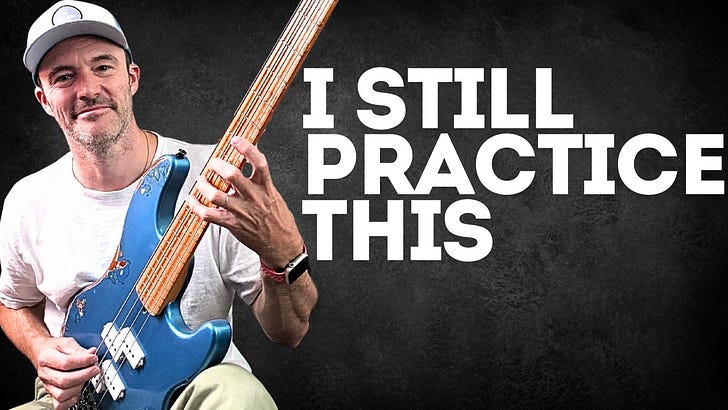
If you’re already subscribed to my substack, you’ll have read a little about what’s in today’s episode yesterday already. Go straight to the video if that’s the case, and get stuck into the practice routine I’m sharing today. For those new to the podcast or to my substack…. The longer I play music, the more value I find in returning to simple ideas. This episode begins with one major-scale exercise pulled from a practice video I recorded nearly eight years ago. It’s a straightforward shape, but it contains an enormous amount of useful information: fretting-hand technique, articulation, fretboard knowledge, major-scale harmony and the ability to feel equally comfortable in every key. I demonstrate the exercise in several positions, discuss the fingering and pull-off mechanics, and explore ways of introducing rhythmic variation. Then I show how quickly a technical pattern can escape the practice room and become something musical through inversions, suspensions, tension, resolution and spontaneous harmonic movement. But the episode is also about something larger: deciding where our time should go. After 30 years of traveling to play music, I’m thinking carefully about the balance between touring, recording, teaching and family life. I still intend to record extensively. and my goal is to release at least three albums a year—but accomplishing that means becoming more selective about the work I accept and more protective of the time I have at home. That thinking has led to two new ideas. The first is the launch of my private one-on-one Zoom lessons. There is now a limited selection of one-hour sessions available each week, with options to book either a single lesson or a discounted package. These lessons don’t have to be limited to scales and technique. We can work on improvisation, practice strategy, finding direction when you feel stuck, preparing for professional situations, navigating the music business or simply getting better results from the limited time you have with your instrument. We live in an era of unprecedented access to musical information. What most musicians still lack is personal feedback: someone they trust who can look at what they’re doing, identify what is working, uncover what isn’t and help determine the most productive next step. The second idea is a small-group, one-day music intensive. I’m imagining approximately six hours of teaching with two instructors, a maximum of around 40–50 attendees, a good shared lunch, opportunities to meet other musicians and potentially a closing performance. It would offer more depth and interaction than a conventional clinic without requiring the expense and logistical commitment of a residential music camp. I’d love your input: • What would make an intensive like this impossible to miss?• What have you disliked about clinics or music camps you’ve attended?• Who would you like to see joining me as a guest instructor?• Which city should we bring it to? Ian Martin Allison, John Patitucci and...
0:00[music]
0:08SPEAKER_01Okay,
0:11SPEAKER_01so I'm going to give you one thing and one thing only to work on in today's episode
0:17SPEAKER_01because it's what I'm working on today.
0:18SPEAKER_01It's what I got up and practiced a little bit just after the kiddo went off
0:24SPEAKER_01to school and kind of worked around,
0:27SPEAKER_01had my morning a little bit, did some work at the computer and I'm back to it now.
0:32SPEAKER_01And I think it highlights the fact that we can just work on something really simple,
0:38SPEAKER_01something and one thing,
0:40SPEAKER_01not a thousand different things at the same time and get a lot of benefit out of
0:44SPEAKER_01that.
0:52SPEAKER_01Regardless of what music you play,
0:53SPEAKER_01what bass you play, what style you play, it doesn't really matter.
0:57SPEAKER_01This is just one of those kind of fundamental technique builders, maintainers.
1:02SPEAKER_01I don't know.