
Italian Roots and Genealogy · Bob Sorrentino
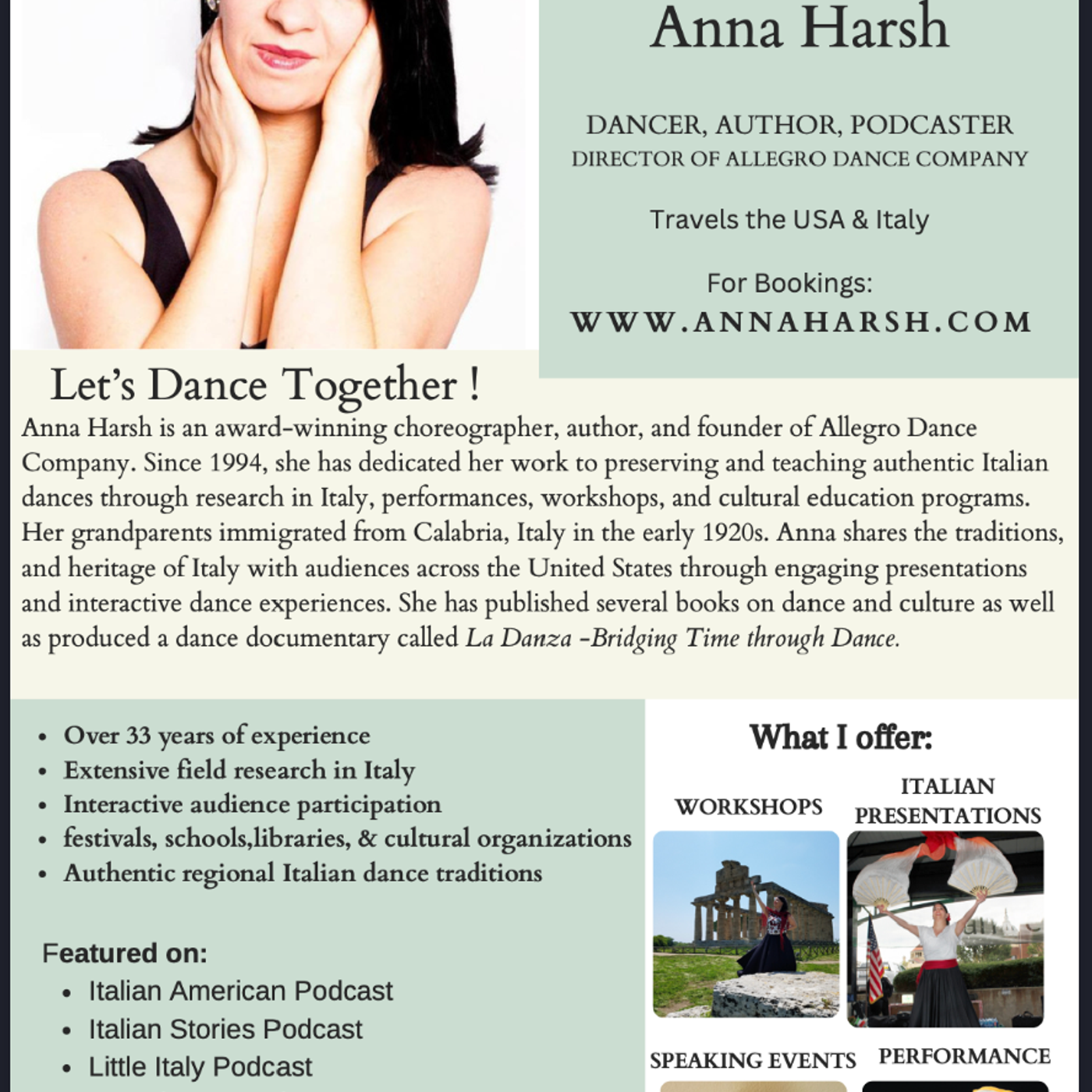
The conversation explores the rich history and cultural significance of Italian folk dances, particularly the Tarantella, as discussed by Anna Pishner Harsh, an artistic director and author. Through her experiences and research, Anna highlights the diverse variations of dances across different regions of Italy and their storytelling elements, emphasizing the connection between dance, community, and heritage. Takeaways Diverse Italian folk dances Cultural significance of dance Chapters 00:00 Introduction to Italian Roots and Genealogy 06:28 The Journey of Dance and Community 10:03 Exploring the Tarantella's Rich History 12:32 Stories Behind the Dances 17:21 Dance as a Reflection of Society 20:21 Instruments and Costumes in Dance 24:25 Children's Literature and Cultural Education 29:32 Connecting with Anna Pishner Harsh
speaker-0: Welcome to Italian Roots and Genealogy, where history lives in our blood. We explore the journeys, records, and family stories that connect Italy to the world. Because when you discover your roots, you don't just find names, you find yourself. And be sure to subscribe to our YouTube channel, our blog, and our Facebook group, Italian Roots and Genealogy, and check out our great sponsor, Phil Italy, if you want to plan a trip trip to the homeland. my guest today is the third member of the Pishner family, Anna Pishner Harsh, who is the artistic director and author from the Allegro Dance Company in Washington or Pittsburgh PA. So welcome Anna. Thanks for being here. speaker-1: It's such a pleasure, Bob, thank you for asking. speaker-0: so yeah, as we were talking before, I'm very excited to have you on. mainly because we all know and dance the Tarantella at countless weddings, at least over my seventy-five year lifetime. But there are so many more dances from the north and south that you're fluent in. so before we get into that, what got you started? I guess it's almost thirty years now in doing the dance. speaker-1: Yeah, I've had the company. this is our 33rd year on tour. And ironically, this started out as a college thesis project that I was doing as a dance major at Slippery Rock University in Pennsylvania. And my professor asked, Well, what are you gonna do your thesis on? And I said, Well, I think I was going to do it on Italian folk dance. And she's like, Okay, you have to present 25. Page paper, research paper with all of the details. And then I had to teach some of the other dance majors the dances that I was going to research and then present it for a concert. And I thought, okay, no-brainer, right? Been dancing since I was walking. And knew various Tarantellas from family members, but I didn't know details. I needed research and details. So I quickly figured out, Bob, that. I couldn't find that in a library across the United States. And of course we didn't have the internet there then. So it was really, really challenging. But I called one of my friends who was a dance director of another dance company in Pittsburgh. her name was Jane Farrow and she ran a compagnoli. They no longer exist now as a group, but At the time I gave her a phone call from college and I said, Jane, I really need your help because she had researched in Italy and had dances that I could use for my project. So she gave me a beautiful dance called Ballo della Conca, which is a dance from Abruzzo, and it's a three-four waltz-like dance that women do with basins of water on their heads. And they have to balance it doing that three, four waltz step. And they make these little patterns on the floor that dedicate to their travels from to and from a well. So the women would go to the well, get the water, bring it back to their gardens, to their villages, to their families to wash and clean and and drink and whatever they needed it for. So this was the story that that dance told. It told it through the movements, through the balance of that basin, that they were strong women, hard working women. From Abruzzo. And so I thought that's beautiful. So she told me that story, and I of course, researched that and talked to her via phone. Now, I don't know if you remember phone cards, but in the 90s we had those phone cards that you had to buy to make long distance phone calls, right? So I spent my whole phone card on that one conversation with her about these dances because She couldn't email it to me. It didn't exist. And so I had to listen over the phone and write it down step by step. And then she gave me the music and anything else that she could provide via snail mail. And so I received it at my college dorm and I remember my parents saying, You spent your whole phone card on one conversation. I said, But it was very important. But my teachers and professors said, Anna, there's not any of this written down. You're hitting on something. This is not only, history of dance, we don't have any of this in the dance library here. So they encouraged me to take this research that I was doing, not only on tarantellas, but also other dances like that, to my hometown in Clarksburg, West Virginia, to the Italian festival. And I said, okay, yeah, I'll give it a try. And so I gathered a few friends in my mom and dad's backyard and we rehearsed every Sunday, had some pasta after rehearsal, of course, and I noticed neighbors starting to form as I would rehearse. And they would bring their lawn chairs down the street, block off the street at this point, and watch us dance and practice every Sunday. And I thought, why are they watching us? We're just rehearsing something for a show. Nothing special, I thought. But they said, I've never seen this before. Where did you get this dance? I want to know more about it. So each week we would entertain the neighborhood and have this block party and rehearse. And my brother was inside rehearsing with his band. And so my parents were hostess, of this crazy party that we had every weekend. And then we performed at the festival that, Labor Day weekend that year. And The crowd was so large for my beginnings of my dance company. I thought, what is happening? What where did all these people come from to watch us perform? And as soon as we got off the stage, we were bombarded with people saying, Can you dance for my daughter's wedding? Can you come to this parade? Because they saw the passion, they saw the connection and how it brought the community together. And I think that was the biggest lesson I learned really fast from learning these dances, right? So that was thirty three years ago and we never have stopped. Throughout the years I've had over four hundred and some dancers and singers, musicians that have toured all over the United States and Italy and even danced for Pope John Paul II. So it's been an adventure for sure that I didn't expect. speaker-0: Yeah, that's really fantastic. And now something like you thought was gonna be a simple college thesis turned into and turned into a career, I guess, of sorts. Yeah. So so I I wanna start with the Tarantella because that's what the one that everybody knows. I think we all are familiar with the Neapolitan one. That's probably the one that's done at weddings or or at least we think that's the one from the But there are several variations and and why why does each region in the south almost have a different variation of the speaker-1: They all have different stories to tell, don't they? the tarantella is a family of dances, it's a genre of dances. And so under this umbrella of dances, let's say each spoke of the umbrella is a different dance called the tarantella, but they all have different names. in Puglia, we have pizzika, which means to pinch, the bite of the spider. And in the campagna region, we have tamariata. And that has seven variations itself. It has its own variations. And they all tell stories. And then Calabria, we have the Calabrese Tarantella, of course. Sicily has their own variation with tambourines and beautiful footwork. And so even Basilicata has a mixture. They have a Tarantella that we perform from the city of Lucana. And they are a mixture of pizzica steps with calabrese steps. Because if you think about the boot. Where is Basilicata? It's sandwiched between those two regions. And so the dances reflect the land, the dances reflect the people, and their own personal stories of that specific area or region. And even let's say I'm in Calabria, I might do my armwork a little bit differently. And people can say, I know exactly what city you're from in Calabria. or maybe you hold your your skirt. a specific way, or maybe you turn and do a specific arm motion and they will know exactly what town you're from in that region. So it's very specialized and people have a different approach to the footwork or the arm work. And it's not always six eight. It's not always that rhythm. It's sometimes four four. So I think there's a lot of variations that people don't even know about or explore. We're one of the last companies in the United States that even has this vast repertoire of dances because I keep going back for more, Bob. I keep going back for more regions and teachers to teach me whatever I can absorb. And now I have teachers that are waiting on me. When will you be back? I want you to save my dance too. So I think it's really interesting to study it because you learn more about yourself. You learn more about your people that you've come from, the DNA that you, branch off of. And I think the steps in the footwork really tell their stories and the history, because the Tarantella is thousands of years old and was not meant for weddings. that's what we do today because that's how we gather, right? But thousands of years ago, this was meant to heal someone from a bite. And it could be a bite from a spider, but What I tell students is what is your bite today? Is it grief? Is it loss? Is it anxiety? What is something that is biting you that you need to release or get out? And that is what the Tarantella was meant to be for. speaker-0: Yeah, and and that's interesting that you say it's thousands of year old years old 'cause I think most of us figure, well, this was maybe, late Middle Ages, Renaissance or something like that. We don't realize that it goes back much further than that to some of the original tribes, right? Yeah. speaker-1: That's right. This is an ancient dance. And the reason we know that now is because I've been working with archaeologists and museum curators. And now we have frescoes and vases that we can point to and say, Well, that's the shape that they're making on the vase. And as if those pictures or paintings or frescoes came to life and moved, this is what it would look like. Absolutely. speaker-0: Wow, that's something. So you mentioned the stories. They all all the dances have a story. So g give us a few of the dances with the more interesting stories behind them. speaker-1: Yeah, so let's talk about pizzica. Pizzica obviously means the the pinch or the bite. But in Puglia, this was a dance made by women for women. But we do have men that dance with us, but it was about a woman's choice. Who is she going to dance with? And she has a red scarf sometimes that she'll dance with. And the scarf that I understand now is a meaning of life and death. You are on this side of the scarf and you are alive and dancing. But on the other side of the scarf, which is very thin, is death. And so we remind ourselves as we play with the scarf or move the scarf through the space that we are lucky to be alive and we should celebrate that. And that it is about passion, the passion for your maybe somebody that you're looking for to be with forever, but passion for your community, right? And passion for your heritage. And so that red scarf might be the love for each other, the love for your community, and the twirling that we do. I don't know if anybody's talked about this, but people always ask me, why do you guys turn so much in the Tarantella? or spinning and spinning. And I said, Well, the spinning is sending those vibrations up to the heavens to God, right? And hoping that we are healed and to pray for us. And so these dances are very prayerful, sacred. and ceremonial. And I think if people maybe understood the background and the history of it, I think their movements or the approach to the Tarantella could change. speaker-0: Mm-hmm. and what what are the some of the the other I guess dances that we wouldn't necessarily know about? I only know about a few because you you you saw my little video there. but nobody else I I think most Italian Americans think, the Tarantella's Italian and that's it. speaker-1: That's it. Yeah. Yeah. And that's only found in the southern regions of Italy. In the northern part, let's say central Italy does a salterello, which has a little jump to it because saltare means to jump. And so we have this little jumping movement. So you're gonna find salterellos in the central part of Italy. And then as you travel north up the boot, you're gonna find those dances like you had in your video, La Ferlana, La Moresca, we do a dance from Lombardi, it's called Cercolo Cercasso. Which also has other influences like French or German, because you're at the top of the boot now, you're gonna get other influences in those dances. And it's still a circle dance. Chercolo is a circle dance, but it was about mobile nobility. So kings and queens did this dance, but we're talking about a different time period now. It's not thousands of years ago, but like you said, maybe Renaissance or medieval ages. These are the dances that, are easier to find because they are written down in different kinds of texts. But I learned them in Italy and I have never seen them besides my own dance company. I've never seen these dances performed in the United States at all. We're one of the only people that I've ever seen for example, Chercolo performed. So it's rare and I love teaching it at schools and universities because it is a partner dance. It's very very elegant and it does circle around with your partner and in and out. You can just tell it's very organized and has counts to it. Whereas the Tarantella is wild, the spirit tells you when to move to the next step and you don't have counts, you don't have a organization like that. speaker-0: and it's interesting you mentioned the the nobility. So I'm I'm I'm guessing probably I guess all of the European and Mediterranean countries, the no the nobles probably had different more structured dancing than the people in the countryside. speaker-1: Absolutely, because remember, dance was one of those things that they would learn to have manners, to have etiquette. You had to be able to dance. And if a gentleman learned how to dance specifically, then he could be a really good salesperson or could make different kind of deals, because he had elegance, he had etiquette, and he knew how to hold himself, right? And greet one another. And it was all about manners and etiquette at the time, I don't know when that disappeared, but I wish that would come back. I I think more people would have understand, how to greet one another like we do in Italy. you're always greeting someone with elegance and nobility in a sense. when you say hello to someone, they're very mannerly, to say hello and kiss on both cheeks or something like that. So these gestures or things like that were very common. And so then they put them into the dances so that we could practice our elegance and etiquette manners in a more formal setting and grand balls, for celebrations, birthday parties or whatever somebody was newly crowned, perhaps. So these were celebrations for sure. And it was all about showing off who you are and who you knew. And some of the line dances that they had in Emilia Romagna region, where you stood in that line really mattered. Because if you were closer to the king and queen, ooh, you are very important in that kingdom, right? And then the further and further away, maybe you're not such a great dancer yet, or maybe you're working your way up. So where you stood in line mattered, and also if you could dance well mattered. speaker-0: that's something. Yeah. Yeah. my my dad's mother came from two noble families and I all and I and I well, she's Caracolo. Her mother was Caracolo, so v to a tupper echelon. And I always think of when you see these movies on television, stuff like that, I always think Boy, I wish if I could go only go back two hundred years and hover over what they were doing a and stuff. It would just be so amazing. so I guess there would I guess for the upper classes there were ballroom type dancing and stuff like that. But were there I guess work dances and mating dances and festival dances across speaker-1: Yeah, they're always going to have a song in the field to sing, or a dance or a move maybe while they were working. Many of the dances that I also have researched have that feeling of, that looks like they're picking grapes, or that looks like they're harvesting. And so sometimes you have a harvest dance or or things that replicate what they did for a living. So it's like Clues game, right? A mystery that I can keep solving because every time I see a new dance or learn about a new dance, I'm like, you get clues about who they were, what time period that was, maybe how they worked, what they did for a living. So the dances tell us so much, so much, like an archaeologist. We're digging into history and you can learn from these subtle clues, maybe they're costuming. or their gestures or how they greeted one another in the dance. the northern dances have so much of curtsying or bowing, right? And we don't have that in the South. Not at all. No one's bowing to anyone. So so it wasn't like that. It wasn't organized like that. They just had circles where who can I heal? How what do you need? And I think that's maybe speaks to how, I grew up. What do you need? How can I help you? They're always ready to heal you or help you and do something that you needed. But in the northern parts, it's just, more organized and they have counts. And so my dancers love it because they have counts. Don't get me wrong. They love choreography, right? But letting go, there's something about the letting go part in the Terantella that's very freeing and elegant in a different way. And I really love doing those as well. speaker-0: I often think I think about it more with with fashion, who came up with the idea to wear a s a a tricorner hat or certain time type of robe or something like that. And I I guess it applies to dance and song, all of a sudden somebody came up and and the whole everything shifts, speaker-1: Right, right. And that will affect how they moved also. how they were dressed. the tighter the corset in the in the skirt, let's say for women, well, she's not gonna move her upper body very freely, is she? But, in the further the south you go, she maybe she wouldn't wear that as much. So it just depends on the time period and we go from togas to to corsets, so It's really interesting as I keep digging through and I have a whole host of friends and new people that I have mentors that I look up to and that I keep researching with. Every time I go back to Italy, I find a new archaeologist or a museum curator or a writer or my own family that lives in Italy still. We keep in touch and go and see them and and they know my mission. And they they're always like, you know who you should study with and they'll point me in that direction, which is great. 'Cause I love it. speaker-0: And I guess also I guess the instruments are key in all of these things because if you're dancing in beside a palace or something, you probably have harpsichords and things like that. But if you're out in the field it's probably a flute and a drum or something like that, right? speaker-1: You got it. I even had castanets handmade for my dance company that I bought in Campania. My teacher knows someone that makes them. They're handmade from olive trees from the Campania region, and they're called Nakare. That's what we call castanets. And we use them for the Tamariata Tarantella. So It's interesting to teach that too. Just how do you play them? When do you play them? What's the rhythm of those? Because Tamariata is the dance of the drum. So I'm also learning the drumming part of it, the tamburo of it. And so there's so many layers to learning the dances that people can dig into and really tap into their roots in different ways through rhythm, through movement, through the vibrations of the the rhythms and the music. And it's just another way to showcase your heritage and really be connected to the past and the present at the same time. speaker-0: So who makes all your costumes? speaker-1: I do. You're looking we have pieced together throughout the years some amazing seamstresses. So when I first started the group, I had my mom and I and I my aunt jumped in and sewed a lot. My grandmother crocheted like it was speaker-0: Mike Web. speaker-1: beautiful, beautiful crocheting bits. And so my aunt and my mom really taught me how to sew. And then I had a few other ladies that have sewn over the years for us, have made circle skirts and all kinds of things. But then I ended up making the ritorta, the veils for some of the dancers and the aprons and the even the capes that we wear that represent Calabria's beautiful waters there off the the coastline. So I've learned a lot of skills, picked up a lot of things because you have to, right? And so that's how we make the costumes. I wish you could buy them, but you cannot buy these costumes. You have to make them. Now we have bought bits and pieces, maybe a shirt or a skirt, but then they have to be altered and adjusted to make it look like a costume, right? speaker-0: Yeah, yeah. When we went to Avellino a few years ago, they had some of the women were dressed in the the the costumes from there and it's it it's remarkable 'cause they're not simple costumes either. speaker-1: No, not at all. And I have to say, if I had to pick the material, because of the southern costumes, they're very heavy and sometimes made of wool. Well, I I can't do that here because as today, we have the n ninety seven degree weather. So I think my dancers would melt. And in fact, a few years ago I was wearing my character shoes for a performance and literally my shoes melted after the show. They peeled right off. The songs peeled right off. So it's not an easy gig, Bob. It's not an easy task. But we do it and we love it. And each year I have more and more people that join us. And we pr have performed, like I said, in so many different states. Last year I think we did twenty six cities and six states. It's it's enjoyable. And we love teaching people across the United States of these beautiful dances, whether they're Italian or not, Learning about another culture, another language, another movement is always important because it gives you perspective, doesn't it? It gives you a worldly perspective, for sure. speaker-0: Well, and I always say that. I we lived in England for a couple of years and you don't really know a place unless you live there. if you go on vacation, you're on vacation, you go to a restaurant, but when you live there, then you really get to understand the culture and and you England was easy because they all spoke English, but you still you won't learn the customs and the little idiosyncrasies and how they do things and stuff like that. so I see I see some books behind you. A couple look like children's books. So why don't you talk about some of the books? speaker-1: Yeah, because of this work, right? I have alumni now that have children because we've been around that long now. So they have encouraged me to write all of my research down, the stories, the history, the adventures that we went through. And so I wrote two little novellas so that the next generation could enjoy it and understand that, not every day is going to be easy, but with that one idea. planting that one seed, like in my grandfather's garden I talk about, planting one seed could flourish into a full-fledged career just by taking a chance. they did. They took a chance and came to the United States. I took a chance and said, Okay, let's g grab a few friends and create some magic here. So the first two books, La Danza, Conflict, Passion and Healing. Those are the themes of the Tarantellas that I researched. And so that's the first book that I wrote. And then the second book, The Italian Dance Quest, talks about the central part of Italy and northern Italy, all the dances and the teachers that I've enjoyed in northern Italy and central Italy. And then I also offer questions throughout the book so that the next generation can ask themselves or ask their family members, questions that maybe I wish I could have asked, that kind of thing. So that they can start journaling and thinking about their own adventure, no matter what background they come from. But on the book tour of those first two books, so many people said, Do you have anything for the Piccolini? Do you have anything for the babies? the next next generation. I said, Well gosh, that's a good idea because I wish I would have had a children's book that maybe had the Tarantella or something in it. So I created this little character, her name is Alesia, after my grandparents' last name, Alessio. And so she goes on an adventure. And she has a garden that she dances in, of course. She's practicing her tarantella in her garden. And so in the first book, Alessia discovers a spider web. So she has another special gift that she can hear all of her friends in the garden. So she meets Signor Rano, Mr. Spider, and he talks to her about culture and the weaving of the web and that the The dance could take that same shape of the web, weaving your feet back and forth like he does. So he talks about that and she helps him find a perfect place for his spider web in her garden and keeps all the pests away from her zucchini and tomatoes and things like that. And then the second book, she goes on another adventure and she meets Cochinella, which is a ladybug. And She's practicing her tamariata in her garden, but she might have spread too many seeds, Bob. So she has way too many vegetables and it's overgrown. And so the ladybug suggests that maybe she can bring a little luck to her community by sharing her garden and all of the bounty. And so she goes on a little adventure and we talk and we learn about the tamariata in the second book. And so that the children can learn glossary words. Those are in the back of the book and activities they can do with their family, besides a story, because I worked with so many teachers over the years. They're like, please include activities and glossary words we can, share and teach. And so learning that language as soon as they can, right? speaker-0: Yeah, yeah, I keep s I keep saying we have class on Saturdays at at at our club and yeah, I learned a few things and struggling there. I a a teacher told us he's he he said y you need to understand volere, potere and dovere. He says, 'Cause if you learn to conjugate those, you just have to put the infinitive after it and everybody's gonna understand you. speaker-1: And you're on the road. Yeah. I I struggle with it too, but I'm learning as well. And I had to learn really quickly because all of my dance classes in Italy are in Italian. They do not speak English in my classes. And so sometimes it's a private lesson and sometimes it's a group lesson. And so I've been catching on and I'm almost almost not quite, but almost to the point where I could teach a class in Italian. So That's my next goal is to conquer language a little bit more and learn to play my tamburo here, and do all of those layers that really make the show exciting to watch. speaker-0: Yeah, that that's that's great. And yeah, I keep saying I I need to go out I need to buy a few children's books in Italian and start from scratch, and learn like a kid again. speaker-1: Yeah, that's why I wrote those because those are what I would have wanted as a child. she dances in the garden like I did with my grandfather and you get to learn some things and practice those words in the back, So speaker-0: Yeah, no, for sure. so before we go, where can people find the books? Where to where can they find you if they wanna have the dance troupe come in? How do they do that? speaker-1: Sure, you can find everything. All of my books are on Amazon. Just look at Anna Harsh on Amazon. You can find all four books. And my new book will be out in 2027 where Alessia has another adventure and she might discover some stars. But otherwise, you can see everything that Allegro does in our tour at Allegro Dance Company.net. So visit the website. You can even book a class with me via Zoom. Or book us to come to your location and do a wonderful workshop or event. speaker-0: That's fantastic. Well, thanks again. I really, really appreciate it. very interesting for me and I and I hope everybody else to understand that there's not just a Tarantella, there's a lot of other dances and a lot of history behind all those dances. speaker-1: Sure. Keep practicing.