
Invisible Not Broken - Chronic Illness Podcast Network · Hosts: Monica and Eva
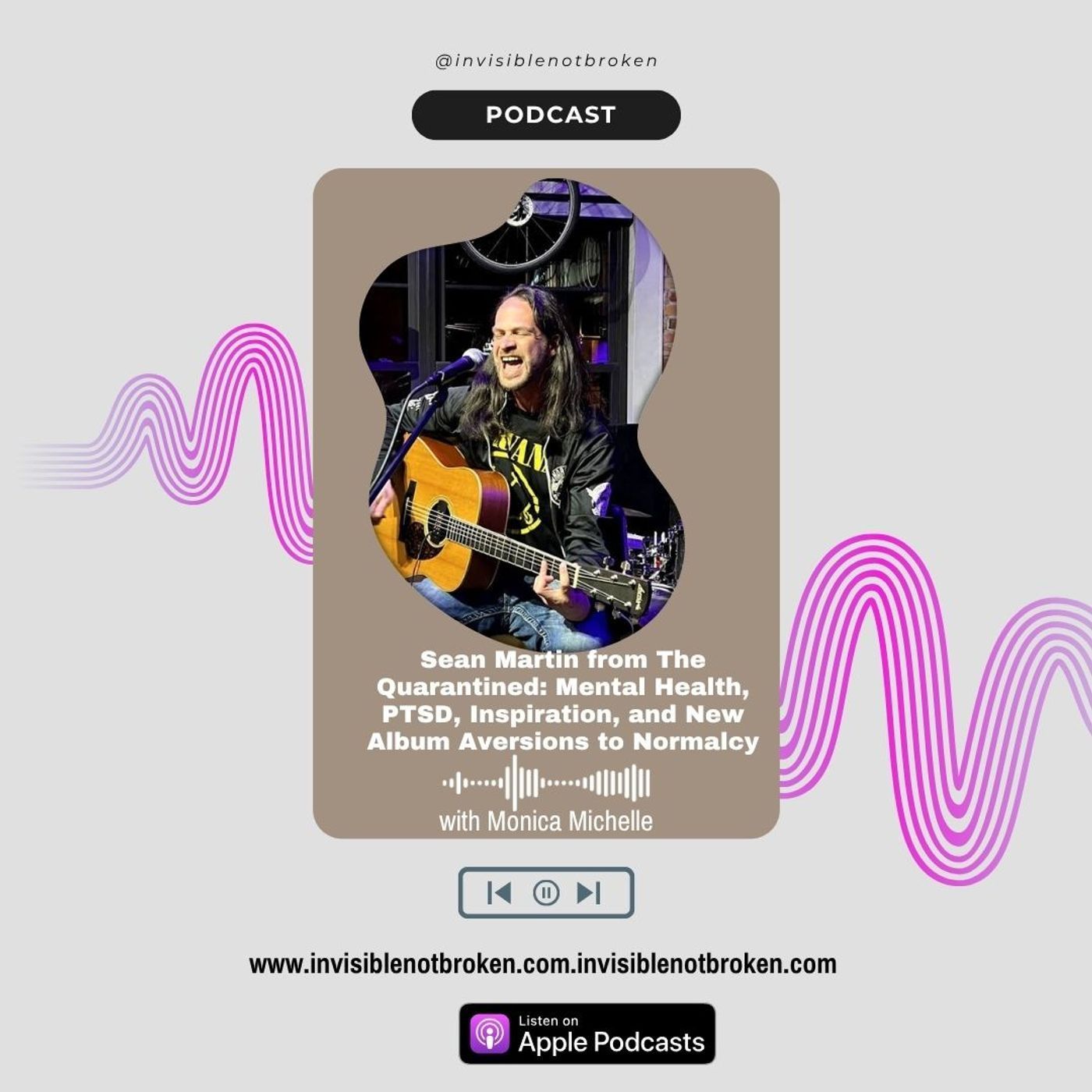
In this episode, Sean Martin talks about his new album AVERSIONS TO NORMALCY and how mental health, PTSD, and empathy influence his music. keywords mental health, PTSD, empathy, history, art, society, resilience, healing, leadership, forgiveness key topics The connection between mental health and physical health The importance of hope and acceptance in recovery Seeing through bluster to understand underlying fears Military experience and PTSD advocacy The influence of history on understanding fascism and authoritarianism The concept of aversion to normalcy in societal collapse The use of art and music as healing tools The Socratic method as a tool for self-awareness The importance of self-reliance and community support The role of forgiveness in emotional healing sound bites "We are in a non-existential existence and that doesn't make any sense." "That's all I really give a shit about at that point." "You don't need to imagine. I'd be able to tell you exactly what it was." Chapters 00:00 Introduction to Sean Martin and the episode's themes 02:05 The link between mental health and physical health 04:01 Understanding motivations and empathy in conflict 08:22 The origins of the album 'Aversion to Normalcy' 12:35 The impact of fascism and authoritarianism in society 16:38 Post-military life and the journey to normalcy 21:22 The Socratic method and its applications 27:56 Recognizing and helping with PTSD episodes 33:36 Finding a new normal after combat trauma 44:00 Art as a tool for healing and expression 54:52 The significance of the album and upcoming projects
monica michelle: Hey everyone, today I get talk to Sean Martin and he has an amazing album out right now called Aversion to Normalcy, which I love the name. And he's here to talk to me about PTSD, about art creation, and everything else. And you're involved in a lot of things. So I am going to turn this over. You've been really kind to me in letting me reschedule a whole bunch of times. So I really want to thank you for that. It's part of why I want to talk to you because we don't get a lot of mental health discussion on the show. And I think it is right in line with chronic illness and health and what affects you every day. So I'm really glad to have you here. Sean Martin: yeah. Yeah, right on. Awesome. Thank you so much for having me. Yeah. This this would be this would be great. Yeah. monica michelle: go ahead. Sean Martin: yeah, I was gonna say the yeah, the connection between mental health and your actual health is one that's much larger than a lot of people would like to really believe. Of course there is the aspect of if your health is going down and you feel bad and down about it, it's not going to help your at physical health when your mental health is just everything sucks, everything is horrible, and I'm never gonna get better. But if you have hope and if you have a a a a vision of yourself recovering and what that's going to look like and moving towards that and it get to a level of acceptance instead of fighting against your illness, you have a much better chance of getting better. It's it's something that that goes along with the actual physical health. It's what nurses pay attention to. It's what physical therapists pay attention to. How how likely is this person going to achieve over this period of time if they're always, this sucks. I don't want to do this. I hate you. I hate this entire thing. Screw this entire world. Nobody loves me. Please help me. I'm sick. I'm stuck. You know, like it's it's such a dichotomy. And they don't realize it because all of those feelings are valid to them. They don't realize that they're extremely contradictory, you know? But when you have somebody who's raring to go and is understanding the program and is is getting into especially with physical therapy, it it it things start to improve faster and sometimes medical science just goes, He started to feel better. I don't know. monica michelle: You just talked about something that I had like much later in the interview, and I'm just gonna bring it up now. you talked about Sean Martin: Okay. monica michelle: how you are able to see through bluster, and that is such an interesting thing. And when you're talking about the fuck it, I don't want to do this physical therapy. I'm mad at the world. What the fuck is going on? This isn't fair. and then you can hear underneath it, I'm terrified. How are you able to do that? Is that just an incredible level of empathy? do you have anything that really helps you see through? what people are projecting into what they actually want to say. Sean Martin: yeah, it okay, so people monica michelle: And are you a parent? Because I feel like that's a parent thing that we all sort of end up having to. well, you are good. That took me to my kids being teenagers to get through Sean Martin: Actually I'm not a parent. No, no. This this this comes monica michelle: the blaster and be like, you don't mean fuck you, mom. You mean I'm scared the world's frightening. Okay. Sean Martin: Yes. Yes, in essence. But I didn't learn from parenting, I learned from the military. monica michelle: please talk to me about that. I have a lot of friends who ha are now out but really Sean Martin: Yeah. monica michelle: carry some serious baggage still. Sean Martin: Yeah, absolutely. PTSD is is one of the things that I advocate about. and for me, I've gone through many different combat experiences in the in the one deployment that I had in Iraq, but it was during a very consequential time. and so from that I learned a lot of you know, we had a lot of detainee operations. We had to do interrogations. You know, before the interrogators got there, we had to f there's there's a gap of when your interrogator shows up and how much do you know about them. And it and usually if you say, I don't know anything, they're just like, Well then who who the fuck does? You know? Get me s get me the adult in the room, you stupid asshole. You know, is usually how that goes. So so when somebody shows up and says, Who are you detaining? You're gonna have a good answer depending on who you're talking to. You know? So if you're guarding people, you already need to have at least a little bit of knowledge. And the ability to to create and understand personality profiles What is likely f a course of action for someone to take is something that's very important if you're going to keep them in a particular spot. You need to know who you're actually detaining in order to be able to detain them, right? So monica michelle: So how are you able to do that if there's I mean even if there's like how are you able to look through that that space and get to know someone quickly or at least get to know what they're trying to say? Sean Martin: So it's understanding motivations and intentions, and the blocks that come between that. And in order to understand that, all obviously you already hit it, is empathy. The secret monica michelle: Mm. Sean Martin: is compassion and empathy. When you understand and the diversity that exists in this world, I always say there's eight billion ways to live a life. You've usually seen one, you've gotten used to one. So that means there's Seven billion, seven hundred and ninety-nine million different other ways for someone to experience this thing we call the shared human experience. So when you when you go into every situation and realize that everybody has motivations, everybody has intentions, everybody has the results that that they're looking for. Sometimes their motivations and intentions do not add up. Sometimes they are fully aware that they do not add up, and that's when they're lying to you. And other times they don't realize that their intentions and and motivations line up. And they're just operating on it on a different level of consciousness and self awareness. And that's that can you know that is obviously a a dangerous position for someone to be in, but they can be talked out of that. They can be persuaded out of that. You can, well, it goes down to the it goes down to an individual. monica michelle: How we do that? Especially as we're watching fascism come forward. Sean Martin: Yeah, it goes down to an individual level. You know, monica michelle: Mm. Sean Martin: it's much easier to when you understand why somebody believes something, it's much easier to convince them of something else or reinforce what they believe. So if you don't know, then you're just swinging in the dark. It's like then you're swinging like John Edward at a at a, you know, at his audience. I Karen, you have a Karen. it's Karen died, right? yes! Right, yeah. So that's monica michelle: I love that you brought him up. I love that. Sean Martin: it's it's charlatanry at its best. But when you understand when you understand the person on a level, then it's truly having empathy for them. And if you have an answer for them, direct them to the answer or direct them to the people who are. Or the things that are the experts that they need to see in order to find the reasons for why they believe. You have to be aware, though, a lot of people don't want to have reasons for what they believe. The entire organized religion operates on this exact concept. You don't need to have a reason to believe it. You need to have faith. And if you don't have faith, then you don't understand what we're talking about. That's not how reality works. So you need to have evidence for the things that you believe. Otherwise, We are in a non-existential existence and that doesn't make any fucking sense. monica michelle: You have a lot to say about fascism. And when you're talking to me about empathy, and I'm I I think we're both in the same country, right? We're both in the US. Yeah. so we're watching a lot of Cheeto dust of fascism just floating all over us right now. And I think that there's no accident to the removal of PBS, which was like how all the kids learned empathy was Mr. Rogers and and Sesame Sean Martin: yeah. monica michelle: Street. And there's a big attack on this. It does not feel accidental and you have a new album out called Aversion to Normality. And Sean Martin: Yes. monica michelle: I'm very curious because I've been listening to it all morning. And thank you, I can practically taste the clove cigarettes after listening to this. Really feel like I'm back Sean Martin: Yeah. monica michelle: in the clubs, which from the gray hair you can tell just how long ago that was. I was just listening to and I'm so sorry, my new medication, everyone, this is gonna be a lot of fun. I was listening to Skeleton Chair and Unspoken. And it feels like both of us had a lot of these themes around this. Do you wanna speak a little bit about how you named your album? where this album came from? Did it come from like being in this pressure cooker of a country right now? Or was this just something that had been building? Sean Martin: so I've military history i is was something that I was always very interested when I was in the military. And monica michelle: Hm. Sean Martin: so military history is very different than regular American history. Because American history doesn't really tell you exactly what happened at Lexington Concord. It doesn't tell you exactly what went down at the Battle of Bulge. It just says it was really bad. But military history tells you exactly how bad because they are able to tell you exactly what it was because they knew the people who did that shit. So for me, understanding history is what drove this to take the best lessons that they had already learned, that I had already learned about how to. Not fall into a fascist society. What is the difference between a democracy and an authoritarian democracy? Because you can have both. And it's important to know that once you lose your democracy, it becomes a facade. And that travels across every single different authoritarian society that has ever existed. Ever. Not just in the last hundred years, fucking ever. So Aversion to normalcy, the the t the line that goes along with it is when tyranny becomes the norm, in order to survive you'll need an aversion to normalcy. And that's supposed to reinforce the idea that if your society is doing something, Sometimes that means you need to go the opposite motherfucking way. It's the exact same simplistic, a little bit more complicated version of well, if if all your friends and everybody you know and 40 million people are jumping off a bridge, are you going to as well? It's that exact same thing. And the reason where that comes from is a version to normalcy. Because they needed to be able to tell Americans. Nazism looks a a lot and and the German society looks a hell of a lot like us right now. But there are very distinct differences. And when you see what the the demonization that they use and the otherization that they use and the dehumanization that they used to justify all of their atrocities, then you start to see what the difference really is. But unfortunately, in our society nowadays, we are crossing that line. We are turning into an absolute authoritarian fascist society that uses concentration camps to scare people out of coming to it. We need to realize that's the reality. That's their stated reality. That's what they say it is. That's not my interpretation of it. monica michelle: Mm-hmm. Sean Martin: That's what they're saying. Hey, guys, look how cool we're being by locking up all of these people. And now nobody wants to come to our country. Mission accomplished. monica michelle: It's like no one read Project 2025. And if you're wondering why a disability podcast is talking about this, let me explain for one second. We survive based on policy. If you're disabled, your ability to survive is based on policy. When our government goes fascist and is telling us what's normal, there used to be ugly laws, which meant that if we used canes or wheelchairs, we weren't allowed legally to be out on the street. We've had people like RFK Jr. talk about putting some of us in camps to get us off our medications. We are on a constant battle to have our healthcare, which they keep removing, all the new tests. I'm so sorry, everyone. I'm just gonna really explain real fast. I'm on three new medications right now. So I'm little confused, but please bear with me. I do have a point, I promise. Sean Martin: You're good, you're good. monica michelle: it's just so frustrating when you have a brain and like the thoughts are back here and they're fighting like the good fight to come forward to the mouth. And mouth's like, yeah, no, we're gonna filter everything out. Did you remember about the Kardashians? You could talk about that. Like, Anything important is just back there. It's lovely. I swear. Being being this sick is annoying as fuck. And part of the annoyance is RFK Jr. taking out the funding for all of the different colleges that were doing actual research to make some of us better. And that's why we're talking about fascism right now, because fascism only allows one type of body, one type of person, one type of beliefs. And everyone else, I mean, you can absolutely go back and look at each society and what they did. to disabled people. So this is not out of the realm of discussing in health. I always have to fight this. I get a ton of like letters going, why are you talking about politics? I'm like, it's how we survive. Policy is whether Sean Martin: It is monica michelle: you live or not. Sean Martin: yes, and and and especially in this case, the the ADA is slowly being chipped away. So all of a lot of the protections that that disabled people with disabled movement, your your rights are and your ability to go places and ability to monica michelle: Mm-hmm. Sean Martin: do things is being absurdly threatened to a manner that makes me seriously piss the fuck off. monica michelle: me too. But let's talk about the BTSD of this. Sean Martin: And and I have full and I have full range of motion. I have full ability to move. It's it it like I'm pissed off for the people who I know. It's like I know what it's like to to be in a wheelchair. I know what it's like to be disabled. I've had a bunch of knee surgeries. I know what it's like when it's difficult to move your knee just a little bit an inch and you need to move the entire thing to get up and go get a glass of water. I know what that feels like for a very monica michelle: Figured. Sean Martin: short period of time. And so it makes me appreciate people who have to live with conditions for their entire life and monica michelle: You you talking about the you talking about the physical Sean Martin: We as a society need to help them, not make it harder. monica michelle: therapy was like, I know you've done it if you were swearing like that. Like you definitely did physical therapy if you know how to swear on a physical therapist. I love mine, but he hears me like I've I've gotten Sean Martin: Exactly. Exactly. monica michelle: creative at this point. Like Sean Martin: Yeah. monica michelle: So let's talk about the PTSD of this because I there's so much here and it's it can come from so many different things. And there's a lot of us with medical PTSD. There's waking up in the middle of a surgery. And then there's also going to I I don't know if you were in an a a war or in a surgeon, but you were seeing action. And Sean Martin: Yes, it was. monica michelle: yeah, there's so talk to me about what that's like. For me personally, it was like being caught in the worst moment of my life that could show up at any time, usually at the worst times. Sean Martin: Well, yeah, in this case, it's not really like associated with like a major fear because I've already accepted that I'm going to die. It's just the matter of how. monica michelle: That is a badass quote. Sean Martin: That's all I really give a shit about at that point. Like that's that's truly what the mentality of an infantryman is. If they're firing mortars at you, you go, ha let's hope one doesn't get me this time, you fuckers. Because what do you what else are you gonna do with mortars getting around you? You know, you run out of the area. That's it. So if you walk out of the area, then at least you feel a little bit better about it. Right? monica michelle: So how do you go from that to making me like sitting in a a an apartment, a house, living a regul like how do you how do you reconcile those two lives back together again once you're out of the military? Sean Martin: Yeah, so I mean they are polar opposites. They they are the absolute opposite of each other. And it makes living a regular life very, very boring. It makes it like I was I was very proud of myself in in that I was in things that were of consequence. The shit that we did, the shit that we said, every result that we had had a consequence. And that consequence would be a part of a war effort that was defining history in the moment that we make it. That's that's a hell of a thing. And then a c a few years later, monica michelle: So how do you go into like a regular job? Sean Martin: whether you the whether the difference between you get yogurt or an ice cream is like, well, why am I being bugged with this stupid ass fucking decision, right? Like, what do I want to eat tonight? Who gives a shit? There are people dying. You know, like you're you're you lose a sense of you're one of another eight billion people. You're you're you're not special anymore. You're not this, you know, you're not doing something that's for other people. You now have to take care of yourself. You have to understand yourself. You have to understand all of the things that make the reasons you choose things obvious and apparent to you. And if you aren't aware of those things, a lot of people who spend their life in service never really take the time to really ask themselves those questions. The best leaders have already done this. So it's an important monica michelle: So what Sean Martin: thing to distinct. monica michelle: what helped and what hurt when you first got out and when you were working through the mental health of this that that was amazing what you said that all of a sudden you're one of eight billion again. You're you you're going from like, if I do this, I might save lives versus what are we eating for dinner? do I go for a walk? Do I s do I scroll? Like these are like the yeah. How who helped who didn't Sean Martin: Yeah. The trash needs to be taken out and then my god. monica michelle: The the mundane things that are like this has to get done. You're like, nope, that had to get done. Like how do you Sean Martin: Yeah. monica michelle: how what helped and what did what hurt in coming back? Sean Martin: What what hurt was was substance abuse. monica michelle: Mm. Sean Martin: What hurt the most is thinking that you're that you don't need help. And not f in thinking that And putting it out on it not understanding the locus of control, not understanding the things that are within your control and the things that are without your control. And that things without your control are are are thing are not things that you completely ignore. You stay aware of them, but you don't restrict yourself because you can't control them. You know? You have to let something be itself. And and that is also one of the One of the hardest parts I've been told about parenting is you have to let them make stupid decisions at one point at some point or another. You monica michelle: Yeah. Sean Martin: can't protect them from everything. They're gonna fuck up. Yeah, yeah, no, I know. monica michelle: I'm sorry, did you just hear my teeth grind? I think you heard my teeth grinding. Sean Martin: Every parent has a fucking problem with it. And the truth is that that's the natural protective motion that we have as people. That's not wrong. It's a human reaction. But when you but when you think further about it and understand that their character develops by what they do and what they say when the chips are down is what makes them into the better version of who they can be instead of you making the decision for them. monica michelle: So we're getting a lot of right we've definitely seen the unaliving, I hate you having to use these phrases, but right of soldiers. We're seeing a Sean Martin: Mm-hmm. monica michelle: lot of soldiers come back from insane conditions after a hegseth has taken over the military. what are some of the things that if you love someone who's coming back that they could set up and do to help them? And what should they never say? I mean, like I I think like I I personally did not have the words to to help someone who had come back. And that Sean Martin: Yeah. monica michelle: still haunts me a bit. I'm curious, and I'm not asking you to like heal me in any way, shape, or form. I'm just asking, like, from your perspective, did someone do or say something? Is there something that someone did or said that you're like, God, that would have been really helpful if they didn't? Sean Martin: If they didn't, yeah. I mean there's a lot yeah. I I mean monica michelle: Then help us out here. And I'm so sorry, one more thing. how do you get like you can't lead anyone into wanting help? Was there something that that twisted for you that was like, yeah, I need help? Sean Martin: Yeah, okay, so for me, the the time when I realized I I couldn't just deal with this on my own. I needed to ask for greater help 'cause I was just at a loss was in two thousand twelve when I had a temporary psychotic breakdown. And monica michelle: Mm. Sean Martin: I and it was it was from beating my head against the window because I didn't want to live anymore. So it was and and then I walked around for three days with a concussion and nobody knew because I didn't tell anybody. And it was like this weird, you know, breakdown like I was having a mental breakdown where nothing made sense and I was hallucinating because of the concussion. It was just I created this horrible situation for myself that led me to, you know, realize after three days and I couldn't remember anywhere where I'd been and anything that I'd done, anything that happened at all. I was like, I I need to I need to never do this again. Like like what I what 'cause I didn't even know how I got there. That was the scariest part was that it was like I it was like I woke up and was like, Holy shit, who am I? Where have I just been, you know, this entire time? And that put me into the psych ward. in the in the West LA VA in Los Angeles. And then after that, I was given an opportunity to go to an inpatient clinic for PTSD and it was just for combat veterans. And in there, that is where I learned all of the things that that I needed. And it took me many more years to develop and refine the things that I had learned and how they applied to me in a regular, everyday kind of way. And also having a an overview and a long term view of your healthcare so that you're not just constantly treating yourself and not growing and developing. monica michelle: So what I'm hearing from you is there's really nothing that someone outside of you can do to be like you need help. That has to be something that just comes internally. Okay. Sean Martin: No, I mean it can. I mean, look, you can do interventions. You can you can sit them down and have a real honest conversation with them. Hey man, why do you do this? You monica michelle: Hmm. Sean Martin: know, start a start using the Socratic method. Don't come at them and be like, you're like this, you're like this, you are to you are to me like this and this and this. monica michelle: I only know this because I went to a Jesuit high school. Can you explain for everyone else what the Sakraq method is? Because I freaking love it, but I also know some people are gonna be like, what? I'm sorry, what? Sean Martin: yeah, the the Socratic method is essentially the the aspect of asking the person questions that gets them to define and refine their beliefs. And usually you can use a Socratic method to show someone through their own answers whether they're right about their f original assumption or completely wrong about their assumption. Or at least get them to start questioning it. Because they're answering the questions. You're not telling them anything, you're proposing things to them. So it's a very different way monica michelle: Yep. Sean Martin: of argumentation and it's the reason why Socrates is as famous and has surv and his name has survived as long as it has. monica michelle: Just a quick note: if you are someone whose doctor is not listening to you, this is a very helpful way to get doctors to order tests. If you have teenagers, this is like the best way Sean Martin: yeah. monica michelle: to handle teenagers who are suddenly getting really weird content on TikTok and trying to convince you that they're a lizard people. This is like the way that you can't reason someone out of it. You have to use this method so that they themselves are able to start seeing it. I just wanted to point that out because I freaking love Socratic method. Sean Martin: Yes. Yes. It is it one of the prem monica michelle: I I only great part of going to a Jesuit high school. Like that was the only good part of going to a Catholic high school. Sean Martin: Yeah, the the only reason why I even know is because it's one of the easiest ways of interrogation. Asking questions. It's not it's not like where where get off my plate, you know, it's not Harrison monica michelle: Ha ha Sean Martin: Ford. It's you know it it's just sitting there and be like, So, how do you really feel about this? What about this? Man, bro, t what do you think? That's interrogation as well. If you don't know and understand the difference, then you're not using all of the effects that you're at your all of the available abilities at your disposal. monica michelle: I I've absolutely used this on where were you at 3 a.m.? Why did you not text your mother? I've I've used the Socratic method to just find out exactly where. Sean Martin: Yeah. monica michelle: It's very helpful. I just want to run back to something that I think is really important for us to talk about because people are going to be having service people come home. Looks like pretty soon. what are some of the things that you wish people had done for you when you first came home? And was there something that you're like, God, that would have been really great if you just didn't? Sean Martin: I wanted people to listen. monica michelle: Okay. Sean Martin: I wanted people to to try and understand. The number one thing that people kept saying to me over and over and over again is I would tell them I was in the airborne infantry and I told them I went to Iraq and I told them it was really bad. And the number one thing that people would say all the time is, man, you know what? I can't imagine. I can't imagine. And they wouldn't finish the sentence. That's what they would say: I can't imagine. And the thing that would piss me off about it the most is that if you gave me ten fucking minutes, you wouldn't have to imagine. I'd be able to tell you exactly what it was. Then you don't have to, imagine it. Stop acting like I don't fucking exist and acknowledge the fact of what you sent me to go and fucking do. monica michelle: Wow. Sean Martin: That was the that was the hardest thing for me. And of course, I never got that across as well as I just did right now. I never would be able to get to get that across to people in the moment. This to me is like kind of a catharsis because truly that is the real issue. And it's it's a one of of frustration, but it's also a frustration that we're not coming together on this. We need to we need to understand each other more so that we can understand why we're going to war. And then sooner or later you can all get together and say to the people who want to go to war, think again. monica michelle: Trying to hold all of this because what you're saying is reminding me so much of caste systems, where there's certain jobs Sean Martin: Yeah. monica michelle: that need to be done or that people believe have to be done. But the people who do it, it's it's just better in in the side just like gets pushed off to the side, either behave with normalcy or it's better if we just don't see that. And I'm sure every disabled person just nodded, because that's very much our reality. because when you and I don't want to conflate both things, but I feel like I do have a level of empathy with I can't imagine. If someone asks me about my disorder, and I'm not saying that this is nearly as traumatic as having shells being thrown at me, but I do dislocate by moving. And every time I say that to a person, the look of sheer horror, I can't imagine. And then this blank stare of I I and then there's just like these words that sort of like I actually have someone say, Your life must be a living hell. And I'm like, this is fun, thanks. and it it just feels like there's groups of society where people are like, it's just better if we don't see you. We might need your service. And I feel like thank you for your service has almost become a bless you. I've I have military people in my life, and either it's fuck you or thank you, and both are get out of my face. At least that's what they've told Sean Martin: Ha ha ha ha. monica michelle: me they feel like. so I'm just throwing that out there because as you're talking about this, it just feels real to me that it's like. Just shush. Like, why are you still doing that? And I don't think there's a way to not do that. At least my my stuff is visible. You can see my bones sticking out of my body. It's a great Halloween costume. But PTSD, there's there's very little visible except behavior. So how has that worked in your life? Are are you doing like how is the daily life with PTSD? Sean Martin: God, I okay, it's monica michelle: And it's start saying you wish people understood about it. Jesus Sean Martin: so I I I l I love what you just said. There's so damn much. There's so much truth to that. It's that's it's so fantastic. No, no, you you nailed it. You nailed it. monica michelle: Okay, thank you. I didn't mean to conflate the two things, but Okay. Sean Martin: I I'm s I'm still laughing about it monica michelle: Yeah. Sean Martin: because of how awesome that was. Yeah. monica michelle: I'll take it. Sean Martin: So God, Right, answer that question again. I'm sorry. I needed a second. monica michelle: No, you're all good. I was asking you about PTSD and like what the daily experience is with it and what you really wish other people knew about it. And if you want to follow up with, is there policy that could be enacted that could actually help people with PTSD? Sean Martin: Yes. Okay, so every day, this is the the best explanation that I've that I've gotten for it is y you know the feeling right after a jump scare? Not monica michelle: Yes. Sean Martin: the not the moment where you realize it wasn't a real threat. That moment after the jump scare after the the scare where you're like, That's a threat, what the fuck? that moment. That feeling that you have in your body, we repres I represent it with my face because I'm an actor. But the body Retains that indefinitely. And so it'll keep you up, it'll affect your stomach, it'll affect your sleep, it'll affect weird ass shit like your blood like your blood pressure, sometimes your vision, sometimes your speech, sometimes weird ass shit that's that then creates together to create some other kind of anomalous condition that turns into a fucking cancer and you die. It's unreal the effect that stress has on the body. And when you continue it on an excessive level, that's what PTSD really is. It's not the, my God, I'm scared of something. Never gonna do that again. I've got PTSD for it. That's monica michelle: Mm. Sean Martin: the dumbest fucking joke ever. And it's been so popularized. I've had to use the joke in order to make the point to people. It's un like it's unreal how like how. Badly people misunderstand what PTSD is, how it's a condition over time and it has a daily cost. And if you don't get in front of those costs and don't realize that you can treat them, you can take control of them and apply the solutions when you feel them. And when you can do that, you can start to get yourself on a on a sort of normal track and start to realize that this depression that I've been sitting with for the last week and a half, it's just my body reacting to nothing. There's no reason why I should be why I should feel like this, but I feel it. And it's really, really weird to have your nervous system operate independently from your mind. But that's really what PTSD is is i i is. And so it's got a daily conversation. Cost. It's got a long-term cost. It goes in cycles because your nervous system runs on cycles. So once you start to get in front of what those cycles are and how it can just change. You know, it doesn't mean it's a cycle that's always gonna stay the same. No. It it's your nervous system. It'll react to things that aren't even there. And then it'll set off on another cycle. And then you can start to realize how, you know, that gets really fucking annoying after a while. You know? It may it to the regular corporate world. You look inconsistent. And that's the worst fucking thing that you could possibly be. So the corporate world views me as fucking useless. Doesn't matter how good he is. Doesn't matter how how you know abil how able he may be. It doesn't matter what he's capable of thinking of or what he's capable of seeing. He's inconsistent. We can't rely on him. So, so it's important to realize that that's not just that's not really my experience, but that's how the corporate world viewed PTSD for a very, very long time. And it's really important that that's part of the stigma. And when we can start monica michelle: Mm. So we're Sean Martin: to remove that kind of shit, then then we can start to move forward as as a society. monica michelle: Yeah, late stage capitalism is good for no one and it doesn't actually make capital. It it actually loses capital. There economically, Sean Martin: Right. Yes. monica michelle: capitalism doesn't even work for what it's called. Like it it taking care of people is actually the best ROI. It's the best return on investment. is there anything that aside from the tools you just mentioned, do you have any other tools to help you if you are in the middle? I want to say flare because that's what we call our disability things. but it feels like PTSD is a flare like literally a flare-up of the mind and the body. Is there something that you can do when you're in the middle of that or is there something that someone who is next to you could do to help? Sean Martin: Yeah. the the first thing that that usually people who really care about someone when they see someone, you know, usually if some if s if PTSD is taken it's okay, so it's not exactly like a flare because if the reaction to to someone having a a bad PTSD episode Could be many different things, but are not limited to really pissed off and pacing around the room, really hungry, really depressed, and don't want to do anything in order to solve any of those problems. It could be hyper vigilance, hyper activity, manic kind of thing. They could look like they're the happiest they've ever been. So it's not like you can just say that. You know, if someone it the flare looks like this, so if I recognized it, then first you have to be able to recognize it. You have to know the person well enough in order to say, this is actually out of character. I know what their baseline is. And sometimes with PTSD, if you've been buried under it for long enough, you don't know what your baseline is. And that's really important to understand. That if they don't know what the baseline is, you trying to help them, you're not gonna know either. And so they'll be able to convince you that of of just about anything because you don't have the frame of reference of being inside their head. And if they're lying to themselves, they're able to lie to you. And if they don't know they're lying to themselves, it's gonna happen regardless of whether or not they love you or respect you or really care about you. They may really, really, honestly, completely care about you, but they will still lie to themselves about this. So it's so it's important to understand and take away the personal hurt that might come from that. monica michelle: Hmm. Sean Martin: And set it aside in order to truly understand the situation instead of having the situation have consequences. Because everything that they've been doing already has a shit ton of consequences that only they see. monica michelle: So how were you able to figure out what your new normal was post combat? Because I assume that your your normal and like where that was was very different before you were in the military. How were you able to figure out when like what those levels were after? Sean Martin: So it took me a long time actually. I I didn't figure it out until I got to the I didn't even feel it until I I got to the inpatient clinic around two thousand monica michelle: Mm. Sean Martin: and twelve. So I got out in two thousand and nine. No, two thousand seven. I'm sorry, two thousand seven. And I had been monica michelle: Wow. So that's Sean Martin: I I had been going to music school. I'd already graduated music school. Already done sh a shit ton of things. And none of that was me feeling normal. None of that was me feeling like myself. And then it was a very fleeting moment in which I could see, that's where I can be. It wasn't like, I got there and now I'm good. No, I've got the baseline. Don't need to go anywhere. That's not, no. It was I got a view through the clouds of what it of what it possibly could be. And then it took me another seven years of denying. Trying medication because I didn't believe that the VA knew what they were talking about when it came to PTSD. I didn't, they weren't telling me the right answers. So that made me go, I'm not gonna trust you. For at least for medication. And so I'm gonna try to fix it myself, usually through cannabis. The absolute fucking best. Like, yeah. Yeah. monica michelle: I I'm a big fan. There there's a whole drawer full of it here. Sean Martin: Yeah. It's it's so, I mean, that that got me through a lot of things. a lot of situations and you know was able to connect me to a you know a a I didn't want to lose the side of myself that had teeth monica michelle: Mm. Sean Martin: because I still had a I was living in still in a very dangerous world. I couldn't trust everybody who was around me. People who had been betraying me, you know, in some of the most important things of my life. So it I still had to have a I couldn't walk around everywhere like a victim. I had to rise above that in order to exist in the world that I wanted to live in. So I knew that I had to eventually, once the VA started to make sense to me, I started to use medication. And now I'm on a very very light medication that is not like invasive and does not have a bunch of negative side effects. It barely there's no negative side effects whatsoever. But it but I'm able to feel now when I'm on it and when I'm off it and the differences between it over time. Because I was able to pay attention to those things. Because I deliberately wanted to pay attention to those things. And so I did that and I made sure that it was the right medication for me. And I've been on it for a few years now, and I can get back to that balance a hell of a lot easier when the shit happens. But it still takes time. It still fucks up my entire week. It still fucks up my entire days. It still fucks up relationships left and right. It's just what fucking happens. You know, I'm a very expressive person, obviously. monica michelle: I really enjoy about this interview actually. I don't feel like I have to tone myself down for you. It's lovely. Sean Martin: Yeah. Thank you. Yeah. It it's yeah, it it's just one how I am, you know, and I'm I'm an I'm a natural performer. That's that's what I've been pretty much my entire life. And or at least been involved in my entire life. And it's one it's one of those things that you know I can cause a lot of damage if I don't control who and and what I am. I can't just let anybody tell me what I can and cannot do. I have to have a moral sense, a moral center to where I can tell when somebody else is giving me a bad and illegal or a a dumbass order. And it's important for the military and to know I this is a control thing with the military, but it is not controversial thing to say the military needs to understand what illegal orders are and when to disobey them. That's part of the use the Uniform Code of Military Justice. It's a rule. So when somebody monica michelle: You just Sean Martin: says, you know says that, they're operating fully within their all of their legality. monica michelle: And for anyone listening to this, there will come a time where you you will have to answer for it. Like we we got to see Nuremberg trials and Sean Martin: Yeah. Yeah. monica michelle: you do have the option to say no. And if you don't take that and there's a new administration, orders were not enough to to keep people from jail. Just wanted to point that out to any ICE agents. Just hello. sorry, the rage. Sean Martin: Right. Right. monica michelle: anymore the cannabis today. That might have helped. usually wait till nighttime Sean Martin: No, and and monica michelle: for that. Sean Martin: all of this really monica michelle: That's Sean Martin: all of this is really centered around and the art is really centered about accepting the rage. Not trying to put away the rage. Don't be scared of the rage. Embrace the rage. Because the rage, in the end, when monica michelle: So this is an interesting thing. Sean Martin: you learn how to channel it, becomes clarity and it becomes purpose in action. And it and when you use your logical brain to find the right answer, your rage can make a a good decision that needs to be done and you can also use your mind to make sure that it's a nonviolent one. monica michelle: I I kind of half wanna talk about this because I think there's such a difference in how men and women are raised with rage. And I think men are allowed a lot more space with that for the detriment. And I think that women are taught to lead that like the first time I did martial arts and I got to hit something and scream at it, broke something open in me that never quite closed again. Like I can yell, Sean Martin: Yeah. monica michelle: I can hit something. What? This is amazing. Sean Martin: Ha ha ha. monica michelle: but I also really wanted to talk to you about like stoicism and mental health in the media. Do I have time with you or do you have something like right after this? Okay, Sean Martin: No, no, I've got time actually. So it's fine. monica michelle: I I just want to make sure we could talk about like all the I have like I have three pages of notes for you because I was like reading your medium interview, which was really fun for me because I'm I did almost all my work in the Silicon Valley. And listening to all these young men talk about ancient Greek philosophy and stoicism and completely missing the point was Sean Martin: Ha ha. monica michelle: Some of the more entertaining moments along with Patagonia vests. I and Sean Martin: Yeah. monica michelle: when I was reading through you actually do under like at least from what I've researched and known about Stoicism, you you kind of understood a lot more than it's it's about getting that crypto, bro. that that just is not. do Sean Martin: Yeah. monica michelle: you want to talk a little bit about stoicism in your in like as I didn't want to say crutch, as a component of your, you know, toolbox? Sean Martin: Yes. it is one of the most important. to me, stoicism went along with combatives. So while I was learning how to choke someone in every different way, how to make every bone of their body turn against them, be used against them, while I was figuring out how to execute the most vicious and and fastest way to kill someone. Right alongside that was you need to know exactly when this is supposed to be used, and especially the 99.9999% times in which this is never supposed to be used. And that was one of the most important aspects of of at least my young mind philosophical introduction into stoicism. Because, mind you, I was 19 years old when I was doing this. It was not even Couldn't even legally drink when I was given all of this information. So the philosophy behind it was very much important to the people who were teaching me this. They needed to know that I knew this shit. And so nowadays, to me. Understanding how you know, first off, it it's about the locus of control. You have to understand what's in inside and outside of your control. You have to understand the aspects of your ego and the ability to control it. And it's so important to stay humble if you see yourself as having a position of power in any sense of whatsoever, you then need to humble yourself. So that you serve the lowest among us. It has to be that. Otherwise, it's fucking abuse. monica michelle: You talked in your medium article about forgiveness. And that is that's something I've meditated on a lot. I have been through a lot in my life. And it that word feels almost weapon to me. Like it it feels like a something that's pointed at me. and it's also something that I'm told if I don't feel I'm always going to be angry. I think I'm just gonna be angry anyway. It's just a core piece of my personality at this point. but I I've kind of come to my own sort of relationship with that word. I'm curious how you feel about that word. Forgiveness. Sean Martin: With with what word? Forgiveness. It's I would say that forgiveness is is an essential part of helping yourself move forward into something. It's not something that everybody else around you deserves. And it and usually it's not really about what they deserve. It's more about what What is necessary I the w the the word escaped me, but what it what is necessary for necessary for your It's necessary for yourself. monica michelle: So what does it look like to you? If you say I forgive something, I forgive the thing or the person or myself, what does that look like to you? Sean Martin: There's a there's an aspect of acceptance. There's monica michelle: Mm-hmm. Sean Martin: there's an acceptance of of what the shared reality is, what your feelings and experiences are, where what it also brings up. I mean this is you know, assuming a lot of work has already been done to get to the point of of forgiveness. there are people in my life who I'm not gonna forgive them, but I'm gonna forgive what they did to me. And but monica michelle: Hmm. Sean Martin: I but to them personally, I will walk up to them and give them a middle finger to their face every single fucking day. if I have to. There are there and and even if I don't have to. And sometimes because sometimes these people motherfucking deserved it. You know? They des they like yeah. Like you you could sit there monica michelle: Yeah, no, I feel it. Sean Martin: all day and just Yeah. Yeah. No, it doesn't monica michelle: The news pretty much does that to me. Yeah, absolutely. Sean Martin: you're you're not alone in that I promise. and But it's it's also i important to to know about forgiveness that it's not necessary to forgive the the the people for what they did. It's important to forgive yourself for any of the guilt or the shame that you feel about being in that situation. Because monica michelle: Wow. Sean Martin: it's it's so important to to understand that. S' hanging on to guilt and shame for yourself as some kind of motivator is like locking yourself in an Iron Maid and being like, it's a comfy bed, right? Because I have a blanket. No, it's still filled with spikes. It's probably gonna kill you. Stop holding on to guilt and shame. It's the first thing that we need to monica michelle: There's an artist. Sean Martin: learn to let go of. And that's what forgiveness to me is really about. It's about letting go even when we don't want to. monica michelle: I love that. I I think it's beautiful. There's an artist who d does a new take on the broken thing. the kits soon I am very bad at pronouncing things today. but the broken pottery with the gold. But what she also did was build a very rustic wooden box around it with nails pointing directly at the cup. And then it's called I'm Still Fine. And I was just like, My God, that feels so much like when you're in that Iron Maiden and you're like, if I just stand really still. And I just make myself really small and I don't breathe too much, I won't get hurt. And yeah, that if that's where art is so important. It can hit you in the solar plexus in a way that words sometimes don't. And I wonder if you could talk a little bit about is you write your lyrics, right? I as far as I could tell you, you do all the writing of your own lyrics and you're creating melodies around those. is is there something in that process that is healing or allows you to say the things that maybe are better set under the surface. Sean Martin: Yeah. I mean I I there is a lot of catharsis that comes out in making the the records. However, the song isn't the catharsis. It's a lot of times it's me reporting about the catharsis. It's talking about what it's going on inside someone's head. monica michelle: Mm. Sean Martin: You know? It's it like for example, Nemesis. The The narrator will say, in this case, it's me, right? Talking about someone who is a narcissist abuser, bully, and loves to take out anything that they possibly can on everyone around them, and that's just how they go about it. And the entire the thing is not just like, you know, fuck you, two bullies and meh. Like it's that's not the song. The song is If you had the ability to end the bully entirely, would you take it? monica michelle: Mm. Sean Martin: knowing that if you if you decide to choose violence Then you're becoming the bully. So in the end, you have to set up what the and what the the song really does is you set up boundaries. Keep that person away from you. And you decide, monica michelle: Mm. Sean Martin: I'm never gonna go back to violence. Because I can, I I I can, but it's not going to help the situation. They will create their own destruction. Ineevitably, and if you have the ability to be a justice in that process, be a justice in that in that process and live and breathe and be justice. Be, but don't be vengeance. And it's a it's important to realize that when you cross over into vengeance. Then you stop using your powers for good. You're starting to use them for yourself. And truly the work that we need that we need to do as a nation is not running around and rounding up all of the all of the Nazis and saying, we're gonna put you into camps now. No. The the option that we have to do is say, we're going to teach you just how stupid you really were. And we're gonna be able to show it to you and prove it to you beyond any kind of any kind of denial. And when there is no deniability left, then we are going to offer our hands out to you and say, now we're gonna show you the better way. monica michelle: There are so many things I want to go from there. I just watched Ted Lassau last night. and there was a scene where someone had gotten hurt, and like horrible racist people did horrible things. And his father was there and he said, No, we're not going to fight back, we're gonna fight forward. And that just really felt like everything you just said. but you know, we also have like I think there needs to be accountability. We're watching people like Marjorie Taylor Green, Tucker Carlson. So sorry, this pug like doing acrobatics over here. Seriously, Sean Martin: Yeah. monica michelle: like look at look how are you supposed to get anything done or a complete thought? Like it's not possible. if you're if you're not watching this on YouTube, that is my goblin pug. so we're watching like a whole bunch of these people who made this happen. Rogan's another one who jumps back and forth on that fence so often, he's starting to look like a little flea. and they want to actually not just say Well, the I was wrong and this is bad. They want a seat at the table right now in leadership. And that's where I have a little like that's where I think, yeah, forgiveness fight forward. But if you were so fucking wrong, if you were so wrong voting for this man three separate times, and now you're like, I thought he was gonna hurt those people, not me. maybe this is like I don't know what that looks like, but I certainly think that it means you get very quiet and you don't try for leadership. You sit and hush and try to figure out why. You made such a bad choice. Sean Martin: That would be the decision if you were it. Because monica michelle: Yeah. Sean Martin: you would have humility. They have none. So yeah, no. monica michelle: That's where I'm having trouble with this like I mean Sean Martin: It's this is this also what I'm talking about with with the the eight million different ways. It's important to realize there's a process to everything. Even if that process is absolutely fucking horrible, there's still a process to it. And if you understand the process, monica michelle: What do you think the process looks like? Sean Martin: then you can understand why. And truly, those who are especially like recently with Milo Guilinopoulos, I have zero, monica michelle: yeah. Sean Martin: zero fucking sympathy for him whatsoever. Fuck him entirely. He didn't think it was happening to him. Bitch, that's the fucking lesson. Of the entire realm of history about all of authoritarianism. You just lived it, bro. You lived being the idiot who got duped and you went on national television and said, I'm such an idiot for being duped, and you want us to be thankful for that? No, we're going to now ridicule the fuck out of you because that's how that works when you make such an epically horrible, harmful, destructive decision and act like you were fucking cool with it. So, no, there needs to be a count of fucking Billy. There needs to be monica michelle: That yeah. Sean Martin: justice. There needs to be an understanding of just how fucking wrong they really were. There needs to be that. Whether that will come and what device that comes through, I don't know. I don't know. I see other streamers, you know, doing lots of making lots of great work. Oscar Quentin, Dean Withers, Parker, like those guys are knocking them down. It's unreal. How they have gotten the arguments down and are able to change people's minds instantaneously. It's some of them are just you understand that there's a difference between ignorance and stupid. And you and also in this, it's important to understand how to categorize the people who you who you are trying to deal with. Because you you're dealing with a problem. You're saying these people do not deserve to have any say in in the f in. Where our nation goes from here, or what the zeitgeist needs to s the zeitgeist needs to stop listening to them. You are 100% right. How we go about doing that entirely is it is it's going to revolve around not forcing them into a sense of justice, but forcing them into a sense of I can't go anywhere crossing this Rubicon. And that Rubicon is I need to admit I was wrong. It it and we as socially it like if you talk to people in the Netherlands about how they deal with white supremacists, it's really actually kind of fun. Like they make kind of a game about it because the entire time they're like, really? really? Like they're finding ways to ridicule them the fucking out of the room. They don't try to like beat the shit out of Like Germany, they'll just beat the shit out of you. Like regular people will will be like, dude, no. You know, like they've they've made the entire display of anti-Naziism completely illegal. Illegal. And the and the country and the citizens react before the illegality is is given its due process. All right. So it's important to realize that in in the in the places where it comes from, it is beaten out of existence. So it's important to realize that here in the history of dealing with this, we our country was the one who said we need to try them. It's the Nuremberg movie. If you haven't seen it, I highly recommend you go and see it. You know, not for any actors' sake, but for the sake of the information that they bring up, the choices that they bring up. Very relevant to what we're dealing with today. And it's probably something we're going to see in the ICC. There is no fucking way they're they are escaping this now. There is no they have crossed Way too many lines. So of those of you who are wondering, is there, you know, some way in which an international court is going to help deal with this? Yes, there is. And yes, it's coming. And yes, you don't have to really fucking worry about it because there is no mechanism that we have, a legal mechanism in our country to deal with what is happening right now. It needs to be built. And how it needs to be built is with an international court. And the only one that does that is the ICC. It's gonna happen. monica michelle: I think you make a really great point about the ridicule and the whimsy. I'm a big fan of handling things Bugs Bunny. Like Bugs Bunny style to me Sean Martin: Yeah. monica michelle: is like that's how you can actually get things done because force meets force just ends up in an explosion. If you find things like the frog in Portland or drag queens having drag sheds, like the collective joy Sean Martin: Yeah. Yeah. monica michelle: is resistance. And again, part of why this is absolutely along with what we're talking about is I'm old enough that I remember Reagan. And Reagan put a stop to all stem cell research. That was him. And we are now getting to the point where there is a vaccine that could have saved my father's life. He he died before that could have happened. But if we had had more of this research, if we had had what, 40 years? Yeah, it's 40 fuck I'm old. we could have had 40 years of actual research and stem cells and what that could have accomplished so much sooner. And this is where we're talking about this is fascism when you decide that that people's bodies aren't fitting that thing, so they're just thrown away. When you decide that your book that tells you how to live is the most important thing without the science, w we lose so much. And I think that's really important. We've been talking a lot about Everything except your album and I wanna get back to it. And that's me. That is my fault. Sean Martin: Well, the reason why I talk about the reason why I talk about this is because this is what the album is about. We are still talking about the album. Everything that we have talked about monica michelle: Yeah. Sean Martin: on here, there is an issue brought up in the album that references every single fucking thing that we're talking about. Trust me, it's there. monica michelle: And it's everywhere you can stream. I I found it really fast and I it it's on my playlist now. Sean Martin: Yeah, great. Yeah. It's on every streaming service. It's on all the Spotify, the Apple Music, the Pandora, the whole entire nine yards. It's also on the quarantine.bandcamp dot com. It's our website, thequarantine.com. monica michelle: that was what I that was my opening question and of course I got distracted. you wanna talk about Sean Martin: Yeah. monica michelle: the way you you got that name in? Sean Martin: yes. so the quarantine is to set up the dichotomy of how the process of otherization comes into existence. What is the result of the process of otherization? The quarantine. monica michelle: That's amazing. And did this come during like our standard quarantine? Sean Martin: No, this action I thought of this name back in like when I was in high school. I monica michelle: Wow. Sean Martin: have held on to this one because it it it just it it was about a week where I was just fucking obsessed with it because I started to I was reading the autobiography of Malcolm X. I was, you know, reading about the the all the different black liberation, the h the Huey Newton, I was reading about the Black Panthers, I was reading about the Indian resistances, I was reading about everything that I could to find out about revolution. Because I monica michelle: Mm. Sean Martin: had just gone to a bunch of war protests. And I'm like, yay, we're in San Francisco and it's all cool. And there's a naked dude. And yeah, it's more signs and stuff. And no, and there's a naked chick. wow. Everybody's yelling. Okay, this is cool. Yeah. And I'm like, I didn't understand any of it. Any monica michelle: Hmm. Sean Martin: of it. I'm walking through Height and Ashbury. I have no idea of the history that that goes on there. No idea of the importance of the reason why it was even why it's even a a named place. And people go, I didn't know that. So I was starting to learn. And as soon as I started to to learn and to have this stuff, I started to realize, god damn, we just quarantine people and act like it's fucking okay, isn't it, don't we? So I'm like, man, that is the process of weatherization. So it's the active result of it. So and then it becomes an active noun. monica michelle: I was thinking about from a totally different perspective, but that goes back to everything we just talked about, about that there's groups of people who it's just like, if we quarantine them, they can go ahead and do the service to us for us. But we just we need to keep that nice little wall to Yeah, wow. Wow. Okay, I'm sorry, my my head just got turned around and now I'm I'm trying to remember where I was at, but that that's just such a like I think about like I researched the plague a lot and the quarantine was done For the betterment of everyone else, but also tremendous bravery. There was a village where no one left. They all stayed quarantined and no one tried to run away. And that saved like the towns around them. And so, but this is a totally different perspective because that's a forced quarantine when society tells you that you are a problem here. Sean Martin: Yeah. And it's the definitely the music is set around where the quarantine is unjust. However, I am a d I am a a guy who is very much all about isolating yourself from society to gain perspective and gratitude and wisdom. I that is monica michelle: How do you do that? Sean Martin: that is very much a big thing. So okay, so Becoming self-reliant is its own skill. Learning how to cook. Just the basic levels of like, you know, cooking and taking care of yourself. Like that, those are all skills that you have to learn. You don't just be usually I was lucky I had a mom who like showed me, you know, you don't need to be afraid of of any of these things. These are all. you know, things that we use to make ourselves, you know, nice food and we all feel good after eating it. And it's a way of showing love. You make food for somebody, it obviously monica michelle: Hm. Sean Martin: means that you care about them. So there was a deep connection when I was a very young when I was a very young kid to always watching my mom cook and showing me, you know, this is how we make an apple pie. you like those apple pies? Next time you're gonna help me make an apple pie. And then you're gonna make an apple pie. And then we're all gonna enjoy your apple pie. What do you think about that? And I'd be like, I don't know. monica michelle: Ha ha Sean Martin: I don't know. And then eventually I'd be like, yeah, it's no big deal. So now I can, you know, start to to to not just begrudgingly go through every meal and have all of my nutrition be just basic stupid shit and process crap. Now I have an option to actually ex you know surprise myself, you know? monica michelle: Mm. Sean Martin: So That really becomes the the the aspect of isolation is not about longing for something that isn't there. It's about being able to appreciate what you have right in front of you. So loneliness is not, yes, you feel you know alone, but you're not lonely because you still have yourself. If you don't like yourself, isolation is gonna feel like abandonment. monica michelle: wow. Sean Martin: So it's important to realize the difference. There's a big fucking difference. And a lot of times we think being alone means being lonely. No. The same old hippie terms, not all who wander are lost. monica michelle: One of my dad's favorite quotes there. Sean Martin: It's at aging hippies, it's their fucking bag, man. It's I grew up in Northern California. Man, that shit was everywhere. That was monica michelle: Did we grow up in the same place? I feel like we grew up in the same place. Sean Martin: yeah. If it if it was the northwest, it's the same place. Yeah. monica michelle: That's pretty funny. You have a quote, and I'm trying to remember if this was one of your song lyrics or if this was just something that you said and I did way too much research on you and I did not actually cite my sources, which I as an English major, major crime. you said anger is easy to manipulate. A calm mind asks better questions. And I feel like that just sums up a lot of what we've been talking about, but I really wanted to hit it home, especially when you were talking about I feel like we we cripple young men. I feel like we are absolutely crippling them with this or they're crippling themselves. I'm not gonna put it all on on on the society when everyone does have autonomy. But we keep telling them things that actually will heal them and teach them how to do things in their life like sewing or taking care of someone or cooking. And we're denying them one of the most beautiful parts of life, which is caring for another person. And it feels to me like that just creates this perfect storm of rage and isolation. Sean Martin: Yes. My God. I mean, because a lot of times people say that that anger is really just love with no place to go. And and monica michelle: Ooh that's good. Sean Martin: and the thing that you brought up about is they don't have something to care about. Man, that is deep and fucking massive effect on this. A lot of people, like look, a lot of men just go straight to dogs, right? I've got a dog. And I love her absolutely. And she's, you know, a a smiling golden retriever. So every time I look at her, it doesn't matter how terrible I'm I'm feeling, which is usually all the time, I've got a happy face somewhere in the room. It's very, very helpful. I didn't realize how helpful that was until I got it. So a lot of times, like people need to understand and feel the difference between conditional love and unconditional love. And we need to understand that ourself needs to build unconditional love with ourselves. And at the same time, we will fail ourselves in this endeavor. And then we have to f find a way to continue to love ourselves, even though we have reasons not to. monica michelle: And that goes back to the forgiveness discussion we just had. Sean Martin: Exactly. You see how it all comes around. All of these skills help you to make an a life that is much better with them than without it. And a lot of times we don't put names directly to these things, but once you have the language for it, then it becomes second nature. But a lot of times we don't grow up with the with the the names for these things. We don't Know the process of of forgiveness and the caveats that go with it. We don't monica michelle: Hmm. Sean Martin: know the process of how to deal with rage and the caveats that go with it. What are the the healthy ways and what are the unhealthy ways of sh of letting rage out? What are the healthy ways and unhealthy ways of showing rage? Just because you have rage doesn't mean it's automatically you're wrong. No, but that's how we treat it in an argument. That's how we treat it most of the time in the society. However, there is such a thing as righteous rage. There is also a thing where monica michelle: Mm-hmm. Sean Martin: you have irrighteous rage, and then you're just kind of funny. Yes, monica michelle: Anyone in a relationship knows these two. Sean Martin: then you know it's just kind of funny, and you start to realize that there's deeper aspects of you perceive levels of control and power, and that affects how you see the world. That affects how things people say affect you because you're constantly looking through one singular perspective. And if you learn that the thing, the thing that I found to get me through all of this shit and all of this hyper psycho world that doesn't seem to make any sense ever is usually when you're feeling at your at the end of at the end of some place where you're like, I can't go any further with this. There like and even if it's not to yourself, even if you're feeling those suicidal feelings. The things the two things that have helped me start to pick myself up off of that floor is monica michelle: Mm. Sean Martin: perspective and gratitude. Perspective, because when you're down in that place, the only perspective you can see is straight to the ground. You can only see all the negatives. But if you look be if you gain another perspective on yourself, you'll start to see. other things and you'll start to gain information. Then you can orientate yourself in the way. If we go back to to infantry ways, how does someone use a map to figure out where they are in the real world? Perspective and orientation. That's how they that's what they teach you in the fucking military. Then you rely on your techniques of reading the map and figure out and once you have perspective and orientation, you can go anywhere. You know the map works. You know the cut the the the compass works You got it, dude. You can go anywhere now and never be lost. Fantastic. Yay. Go on. It also works when with your mind. Perspective creates an orientation on the problem to where you stop holding on to all of the shit that that may that put you in the ground. Then gratitude. If there's nobody, and it's important to have this caveat: if you don't see anybody else around you who deserves gratitude, you may be a hundred percent right. Maybe nobody around you truly deserves any of your gratitude whatsoever. I have been in those positions. I know what it's like. monica michelle: Mm. Sean Martin: And it is very real. There's still one person who deserves gratitude. Yourself. At least if if monica michelle: It's a very humanist perspective. Sean Martin: at least if only to say I got through this shit, this horrible fucking experience. And I've met a woman who have been kidnapped and taken up into the woods and was for it was was getting ready to be killed. And she escaped and had and and lived out in the woods like four days until she got found. It was it's an unreal story, but it's very real when you talk to her because she has all the details. It's fucking unbelievable the amount of courage. And and perspective that this woman has. But the one thing that she rang rang home with me was I still had to retain the gratitude for myself. Because even though I couldn't never forgive the guy who who went and did this, I still had to remember that I had the gratitude for myself to walk through the woods for four days. Nobody can ever take that away from me. monica michelle: Mm. Sean Martin: Nobody can ever take the my accomplishments away from me because I earned them. And damn, that's fucking real. monica michelle: That's actually one of the things that has helped me the most with my disability. Like I said, I dislocate by moving. And each time it hurts as bad as you would imagine, a dislocation would hurt. So when it's just feels overwhelming, I just start thanking any body part that is not like screwed up, or I thank my brain for coming up with stories, or I just try to thank different parts that allow me to still feel joy and some level of intelligence. I'm not claiming much, but some level of focus and And creativity. I have one more question for you that I'm dying to ask because you actually achieved one of your dreams. You recorded at Blackbird Studios. And I'm wondering what does it feel when you when you hit that moment where it's like, yeah, I've been wanting this forever and you get to do it. What's the up and what's possible like I I've hit those experiences every once in a while and I wasn't good at celebrating them. I I it was like, okay, that happened and like I got the Peabody Award. Like I've I've hit major accomplishments when I was a professional photographer and each time it was like okay, so what's next? What's what what's the next goal? Like I could never sit and just be happy about it. I'm curious how you handled hitting that pinnacle. Sean Martin: That is so funny because I do that shit too. monica michelle: Ha ha ha. Sean Martin: I I do that shit. I I did that whole entire big thing. Okay, what's next? No, you just climbed that mountain. I don't give a shit about the mountain the mountain's done. It's over. It's fuck mountain. Yeah. monica michelle: It's already finished. In the review. Sean Martin: Do we need to go back to the mountain? Then don't talk about the fucking mountain. You know, like it's that that's how monica michelle: Never ha no. Not even revisiting it. Sean Martin: I I yeah, now you're exactly. It's important to have perspective and gratitude on those positions when you realize man, then you So in this, in this time, I had had a solid three years or so of recording this music on my own. So to have monica michelle: yeah. Sean Martin: a knowledgeable producer who took care of all of the tones, I didn't have to think about anything except playing the music. making the best performance that I possibly could. And I got to do that for five days. And man, it was absolutely just dope. Just the best feeling in the world. And it took me three years of of pain and and you know remorse and and and instability, not being able to to, you know, record something and be like, I think it's good. And then come back the next day and be like, it's shit. What was I thinking? my God. You know, like it's you do that for three years. And then you finally get out of that cycle and you realize I can do this better than I've ever done before because I took the time to grow. Now I'm ready to execute. And monica michelle: Yeah. Sean Martin: I walked into it knowing I was ready to execute. And man, it felt like you know, just walking into a room and n you know, knocking whatever you need to do out of the park and just walking out and be like, Kobe. You know, monica michelle: Yeah. Sean Martin: it's like it's it's it's a great feeling. And you know It's because I was able to there was only some small parts in which I had to do like a ridiculous amount of takes. And it's funny because like even in your artist brain, you're still like, I know all of it. And then there's that one part like, I can't do it. What happened? You know, I wrote this. I should be able to play it, you know? And there were there are times when you're just so like you just get taken off that high or like you before you'd be like, dude, that was one take. You nailed it, dude. No problem. Man, and do that for the entire day. And then that one riff at the end. we just need this last four seconds of riff. okay, no problem. And you keep flubbing it. And you're like, I ingrained a mistake. Fuck. You know? And then you you realize that, but then you learn but then you learn the things to overcome it. monica michelle: Mm. Wanna share those for everyone Sean Martin: And that was also a y monica michelle: who needs help on that one? Sean Martin: Yeah, I'm okay, so in well, just in learning to overcome the things in which you've ingrained. monica michelle: Mm-hmm. Sean Martin: Okay, so first it starts with unlearning. And with that is a process of letting go. You you have to humble yourself before yourself and realize I can't do this yet. And then make monica michelle: Mm. Sean Martin: a plan to learn it the right way. And then you go and repeat that plan, and then you make it fun for yourself. Stop making it rote mechanical, start making it something you use. And then when it's just something you use all the time, then it's not like I am going to thing and it's a thing. No. It's just do it, done. that's what that is. And then that's when you go, Whoa, I can't believe I just did that. That comes from the practice and the training that you give yourself, but you have to give yourself the mental space and not just try to constantly tell yourself that, I'm always right because I'm the originator. No. No. You can still make mistakes. You're still human. Accept and and and be aware of your of your humanity and use it to your advantage. Don't deny it. monica michelle: I have kidnapped you for almost like an hour and a half and Sean Martin: Yeah. monica michelle: my pain levels are getting to a scary space right now. So I am going to have to stop this. I do hope you'll come back because I still have like three pages of notes and things I wanted to get to. And I I I'm easily distracted by cool conversations. So But what do you want Sean Martin: Yeah, absolutely we'll do this again. Yeah, that's fantastic. Thank you. monica michelle: to plug? I we've talked about your album, but we also I feel like we we we didn't even get to talk about spread love. Everything's gonna be linked on the show notes, but if you wanna do a quick just where people can get your album, I'll have a link to it on the show notes, but where you want them to go. Sean Martin: Sure. so go to the quarantine dot com. That's got our that's our main webpage with all of the videos, all of the music, Press articles, gallery, photo gallery. It's got all the things. It's got poetry on there. So if you're a poetry fan, I highly recommend. monica michelle: Mm-hmm. Sean Martin: then you can go to Spotify. You can go to Apple Music, you can go to Title and all of those other distributors to listen to a version to normalcy. But it's important to remember that Bandcamp.com has the full discography. So we're still in the process of making official releases for those distributors. But we have Bandcamp for the real fans. So monica michelle: Yeah. Sean Martin: I recommend going to Bandcave because you get the real full experience of everything that we've been putting out over these years. You know? then there's, yes, free love. I have an open letter about PTSD. It there's a link on the website. I let's see, we have the Music in the Digital Era, eight-part blog that I did about creating something from nothing. monica michelle: Mm. Sean Martin: And what what I'm writing about what the process is from 2010 on to like 2015 to 16, looking at the music industry, saying, where the hell am I supposed to fit into this bullshit? Because I don't fucking fit. I am not Kesha, all right? I am not Britney Spears. I am not the Backstreet Boys. I'm not even the Foo Fighters. So what the fuck is going on? You know, it's me trying to figure out where I exist in this universe. So I highly recommend going to do if you're a creator looking to start something, hopefully this will be some inspiration for you. We've got a lot of really great things coming. We've got a re-release of the album. We've got two new singles to release. We've got music videos, we've got a documentary in the works. my god. Like Netflix style quality, it's gonna be huge. We've got some great business that we're that we're trying to make. We're making some business apparatuses to help the music industry get rid of the fraud. We wanna push them, these fraudsters out of the fucking music industry, and I'm making a a business organization to do just that. monica michelle: That's amazing. We've all watched what's happened to I mean, I'm not a fan of we'll just leave that alone. we've seen what happened to Britney. We've seen what happened to Taylor Swift and her music and whether she was even allowed to have it or not and how things got sold. And we've also Sean Martin: Yeah. monica michelle: watched what's happened to producers with people like Hesha. so I it's really amazing to see someone trying to protect. I can't thank you enough for this conversation. I've had the best time. You've totally distracted me from all my dislocations in the last hour. Thank you so much. I really do hope you'll come Sean Martin: I'm glad. monica michelle: back on. Sean Martin: Yes, it was it was very much fun. This was awesome. This is so much fun. Thank you so much for having me. This is great. Of course. We'll come back. monica michelle: You're very welcome. Okay, everyone. there should be at least episodes through December. All of the interns found jobs, so yay babies, but that means I'm alone. So I don't know what the release schedule will look like next year, but hopefully, hopefully there will still be new episodes next year. Everyone be kind, be gentle, and whatever it looks like to you, be fierce. And there we go. Okay.
More Invisible Not Broken - Chronic Illness Podcast Network episodes →