
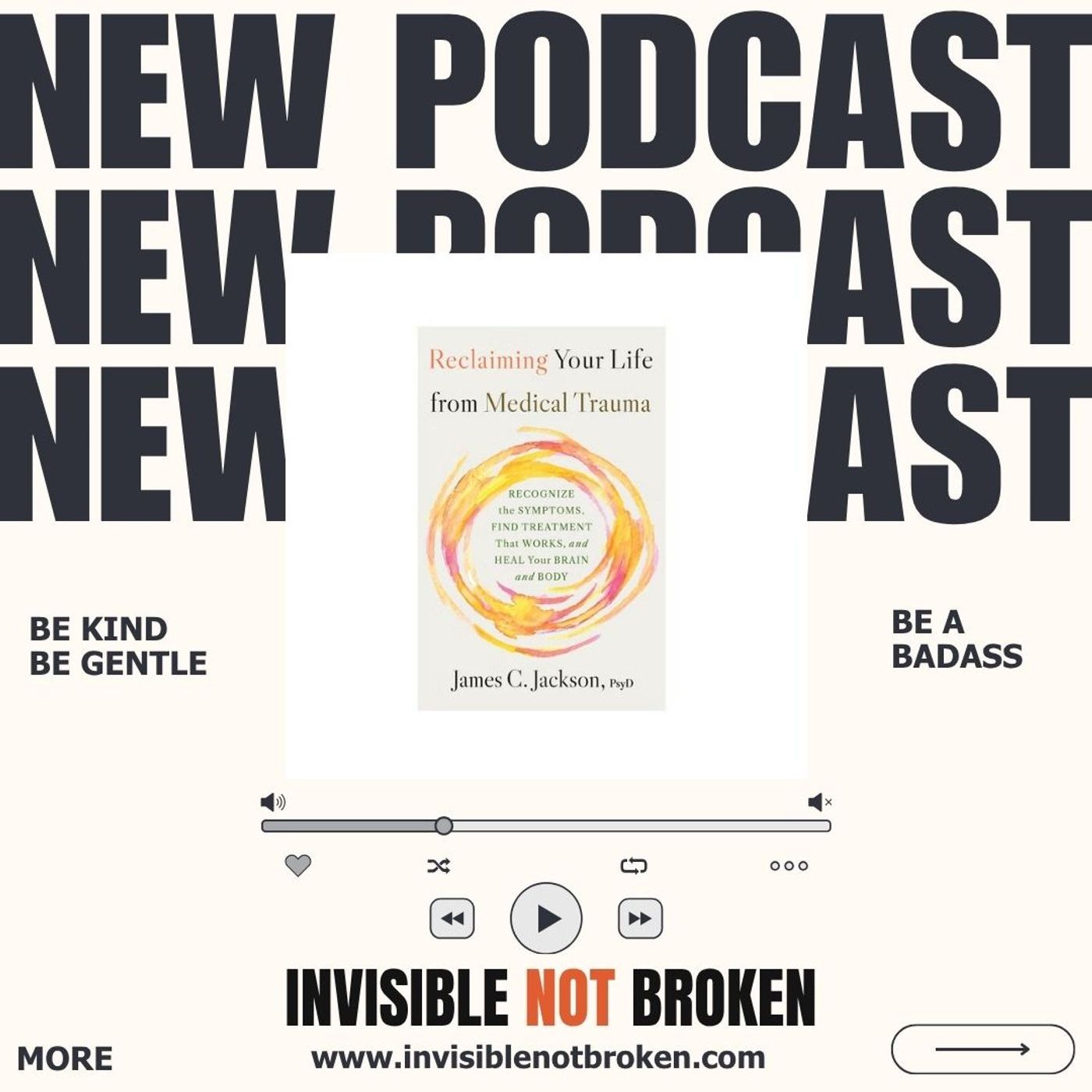
Invisible Not Broken - Chronic Illness Podcast Network · Hosts: Monica and Eva
summary In this insightful interview, Jim Jackson discusses the profound impact of medical trauma, its recognition, and how healthcare providers and patients can work together to foster healing and resilience. Topics include trauma-informed care, the importance of empathy, and practical interventions to improve mental health outcomes for those affected by medical experiences. Chapters 00:00 Introduction to Medical Trauma and Its Impact 02:43 Understanding the Roots of Medical Trauma 05:31 Hypotheses and Findings on Trauma in Medical Settings 08:30 The Importance of Early Intervention 11:29 Addressing Racial and Marginalized Trauma 14:21 Trauma-Informed Care Approaches 16:56 The Role of Patient Stories in Understanding Trauma 19:41 Shifting Perspectives on Trauma 22:24 Hope and Healing in the Face of Trauma 25:23 The Publishing Journey and Future Directions 29:09 The Rise of Medical Trauma Awareness 32:05 Kintsugi: Finding Beauty in Brokenness 36:32 Communicating Medical Trauma Effectively 41:04 The Power of Lived Experience 47:02 Taking Action Against Medical Trauma 50:46 Advocating for Change in Healthcare
Invisible Not Broken: Hello, everyone. I cannot begin to tell you how excited I for this interview. If you've been following along my journey, this is someone who is following right in what I was dreaming about studying. So I get to talk to Jim Jackson today. He is publishing his book this month. So by the time you hear it, it will be out on the shelves. You will have to go and look at this because I know so many of us are looking for that person who can bridge between. our experiences with chronic pain and chronic illness in the medical community. And I think Jim Jackson might be the person to really help us understand how to talk to people and also understand what's going on with us and our own psychology, because he wrote, reclaiming your life from medical trauma. Does that sound familiar to anyone? Recognizing the symptoms, find treatment that works and heal your brain and body. I am so excited to get to talk to Jim Jackson. He is also at the Vanderbilt Medical Center and hi Jim, I'm really happy to talk to you. Jim Jackson: Hey, it's great to be here with you and I agree with you. I think this topic will resonate with your listeners. When I broach it with people, the topic of medical trauma, whether it is a neighbor or an Uber driver or somebody I sit next to in Sunday school class or whatever it might be, ⁓ they get it. They get the idea that people's lives have been impacted by medical events, whether they are acute, whether they are chronic. And ⁓ everybody has a story, I think, about medical trauma. Invisible Not Broken: You're very right. Everyone does. And as you start talking to more people, even if you haven't personally experienced it, medical trauma isn't just like what you would see on house or on the pit. This is, this can be more insidious. And I think you're, you were really hitting something when I was reading through your intake, as you're talking about gaslighting and that sort of, ⁓ like, I mean, I personally have had ⁓ PTSD from medical procedures that were done wrong or that the doctor was frightening. I'm really curious how you got involved in this. Was it from listening to someone or how did this become a part of your studies? Jim Jackson: Yeah, it's a great question. It's a great question. So 25 years ago, and I feel really old, by the way, when I say that, but 25 years ago, I came to Vanderbilt Medical Center as a psychology resident and Invisible Not Broken: You Jim Jackson: I joined a research group. It wasn't really a research group yet. It was becoming a research group. It's now called the SIB Center, the Critical Illness Brain Dysfunction and Survivorship Center. was new and budding, if you will, in those days. And the focus of the SIB Center then and now was on helping understand the mental health challenges, the physical challenges, the brain-related challenges. that occurred in people after they were critically ill. What happened to people after the ICU? That was what we studied. And I joined this team and I began talking to people who had been in the ICU, who had been on a ventilator, who had had long complicated illness stories. And as I talked to them, whether it was in the clinic or in many cases, it was at their home around the dinner table, I did home visits in those days. was a Invisible Not Broken: Mmm. Jim Jackson: There was a theme that cut across so many of those stories. And that theme was, you know, I'm alive and I'm better. I'm grateful to be alive, but I have brand new problems that I didn't have before. Right. I've got challenges that I didn't want. I didn't ask for, and I'm struggling with those. And I had worked with trauma patients, survivors of trauma at the VA quite a bit, people who'd been in Vietnam or Desert Storm, the Korean War, whatever. And I had a notion of what trauma looked like. I was young in my training, but I had notion of what trauma looked like. And ⁓ as I interacted with these survivors of critical illness, I started to realize, you know, this looks a little different. Their story looks a little different than It does with the Vietnam veterans, for example. But it feels the same. know, something happened. They weren't expecting it. ⁓ It derailed their life. They're struggling to make sense of it. ⁓ I thought that sounds a lot like trauma. And as I started turning over stones and opening doors and looking behind them, as I started asking questions, not only with survivors of critical illness, but also with people who had chronic illness, I began to realize that trauma was such a common theme in the lives of these people. Not everyone had trauma, not everyone has trauma. We should be careful in not overdiagnosing it, but it was clear that many, many people did. And for them, it was often one of the great challenges of their life. Invisible Not Broken: So it sounds like that was the hypothesis that you came in with. How close to your lived experience with everyone was the result of your, like, I'm so sorry, my brain's on stop. You had a hypothesis, you got to experience a lot of people in very different sections. Did that support your hypothesis or did your hypothesis change? Jim Jackson: It's a great question. ⁓ I appreciate you bringing hypothesis testing into this conversation because I'm a psychologist, of course, and a scientist. ⁓ Hypotheses are tricky things. Rarely do you have just one. Often you have many in the real world. And ⁓ I think my hypotheses were that a significant portion of people who didn't have trauma before would have trauma after they experienced critical illness, chronic illness, et cetera. And I think I hypothesize that a significant portion of these people would develop problems with anxiety, would develop problems with depression, would develop problems with PTSD. And I think all of those hypotheses were confirmed, right? Like I did indeed find out and the field at large has proven. Invisible Not Broken: Ugh. Jim Jackson: that many people do experience critical illness or chronic illness as traumatic. I think the field has equally confirmed that rates of anxiety and depression and even PTSD are very high in medical populations. So I would say the hypotheses were confirmed. Now, there are a lot of nuances in that, right? There are a lot of complexities to that. But I think what the science shows is that ⁓ What I'm calling medical trauma is a gigantic concern and I think what my clinical experience shows is that it's a concern that we are still not paying very much attention to as a medical community. And that's a problem. Invisible Not Broken: There's so many ways I want to go with this conversation. So I'm to start with the first one. Your research, seems that one of the, least to my mind, one of the first things I could see the use of it is to ⁓ begin to treat the possible trauma even before it solidifies. So if you know that this is someone who has the markers for this could become anxiety or trauma, you can already start either the behavioral therapy, the therapy or the medication. Is that where this would be going towards or? Okay. Jim Jackson: Yeah, I think that's exactly right. You know, in the context of illness, as you well know, you don't decide to develop chronic pain, right? Like you don't decide to. Right. Yeah, exactly. So, you know, you don't decide that you don't decide to get critically ill, but but once that happens, certainly in a hospital setting, once that happens, we can be more thoughtful or less thoughtful. Right. We can be Invisible Not Broken: was not my choice. That's a very expensive hobby. Yep. Jim Jackson: more strategic or less strategic in the way that we engage you if you're a patient. one of the got these allergies. I'm so sorry. One of the ways that we can be more thoughtful, I think, is we can practice trauma informed approaches with patients and we can identify who is likely at particular risk for developing again, things like anxiety and depression, PTSD. Invisible Not Broken: No worries. Jim Jackson: and we can give them particular care, right? Like we can intervene in a way that ⁓ would be focused ⁓ and perhaps a little bit unique. You know, I'll give you an example. If you're in the ICU and you're 87 years old, this is what my experience has been as somebody who works in the ICU. If you're in the ICU and you're 87, you might not want to be in the ICU, but ⁓ Invisible Not Broken: Yeah. Jim Jackson: But you don't experience typically that critical illness in the same way that you would if you're 37 or 27 or even 47, right? If you're 87, we need to be concerned about you. But the truth is, your subjective experience is that I've lived a long life. You know, I've been contemplating my mortality for a while. Maybe. My spouse has already died, right? Maybe I'm ready to go. People talk about that when they're 87. But if you're 37, you're not ready to go, right? And you want to watch your child graduate from college, perhaps. And you've got goals. You want to make partner at the law firm. You want to run a half marathon. You want to grow old with your husband or wife, whatever it is, right, if you're 37. We know that ⁓ that experience of being critically ill, it lands on people really differently when they're near the end of their life versus people who were in the middle of their life or certainly versus people who are young. Same with families, right? If you're the son or daughter of a 90 year old, you've been thinking for a while that you're potentially going to lose that parent that you love so much and you don't want to. but you've been preparing for it for a while. But if you're the parent of a 22 year old on life support in the ICU, you haven't been preparing for that at all, right? ⁓ That's your personal nightmare. So ⁓ even with families, it hits really different. So one of the challenges I think is to try to figure out recognizing that we need to be compassionate to everyone, right? We need to attend to everyone's needs. But one of the challenges is to figure out like, Who are the people that are at particular risk and how can we intervene to try to head off the development of, let's say, PTSD at the past? How can we head it off at the past? And I think the point is, I think the point is there's a critical period, right, where the PTSD hasn't developed yet, right, where the anxiety disorder isn't set in concrete yet, right? And if we intervene during that critical period, Perhaps we can stop that condition from developing because once it develops, as you know, once you ring the bell, once the genie's out of the bottle, it's pretty hard to put it back in. Invisible Not Broken: It's very similar to chronic pain where you can get into a cycle and that cycle is almost impossible to break once it starts. ⁓ We are talking a lot about the intervention of trauma and I think it's important that we both like as you're listening to us, we're both in the United States, I believe, and we're both palm colored. And I think it's important we also discuss some of the risk factors because we just talked about a few of the things that could be happening as far as age and other things, but I would feel very wrong if I did not bring up that the racial trauma that someone who is of a different skin color than you and I would also be experiencing tremendous terror and fear in an ICU and that that is almost a marker to make sure that they are on the safety track of like someone just putting in extra eyes on that. ⁓ I'm also really curious what the trauma intervention will be. So please feel free to talk about either of those, but. I just wanted to make sure that I brought up that there's a whole nother level of trauma that can occur to people's bodies in the ICU. Jim Jackson: Yeah, sure. Let's tackle the first thing first. And I think that's right. Right. It is absolutely the case that people from. Invisible Not Broken: Oh, and I, sorry, I still want to add in trans because we've certainly talked to quite a few people who are trans who had absolute fear, terror, and trauma in ICU settings as far as being misgendered and then being afraid on how they would be treated after such things. Jim Jackson: Yeah, I think that's right. I think that's exactly right. And I think, you know, however we want to define marginalized communities, right, people who, ⁓ yeah, absolutely. However we want to define marginalized communities, whether that is trans or whether that is people from highly rural areas who find themselves in a hospital in Invisible Not Broken: Thank you, that was the word I was looking for. Jim Jackson: Chicago or New York City and they're overwhelmed by all the stimuli or whether it is people from a racial or ethnic minority who feel very out of place in the ICU and they've had a long runway of experiences of being dismissed and they've been the victims of gaslighting. However we want to define people who have been marginalized, I think your point is really well taken and that is that they have unique and particular challenges, right? And they're fighting the normal battles that I see survivors fight. And then they're fighting all of these additional battles instead, right? Often just to be heard, often just to be validated. And I think with them, we need to take particular care. And I think we need to recognize, and this is really important, we need to recognize and empathize with them. in understanding why they often are suspicious, why they often are reluctant to seek help, right? Why they often are ⁓ very cautious in medical settings is because they've had a very long history of negative interactions with people that are traumatic in their own right, right? And those shape their perspectives. Yeah. Invisible Not Broken: And we do have the numbers, the numbers of survival rates are very different. So we do have that. So as we're talking about this, I want to also discuss what are the interventions we can look at? What are some of the things that as, I hate to put this on as patients, but that is the one thing we can control is what we can do. But also let's give doctors and the administration some ideas on how they can also step in. So what are some of these things that from both sides we can work on to getting that trauma to? Jim Jackson: Exactly, exactly. Yeah. Invisible Not Broken: not necessarily solidify and Jim Jackson: Yeah, absolutely. Well, you know, one thing that's happening at Vanderbilt that's a really good development and I'll, I'll, I'll talk about my experience and then we can kind of broaden out from there. ⁓ I see patients in the ICU and in the medical ICU at Vanderbilt and, that model, that model of embedding a psychologist in an ICU ⁓ is, is still relatively rare, relatively uncommon, but, it's hugely important, right? Because this is a gigantically stressful environment. And I think frankly, that's the least that we can do, right? So if there are professionals that can be embedded, I think they should be. It doesn't happen everywhere. There are reasons for that. Needs to happen in more places than it does. ⁓ Moving beyond that, I think there are trauma-informed care approaches that ⁓ we can utilize that that are often hugely helpful. And those have a lot to do with everything from ⁓ engaging people with a little more respect than they otherwise would be engaged with perhaps, or ⁓ highlighting and helping foster in people a sense of safety, emphasizing things like calming, ⁓ trying to foster hope, trying to set boundaries, trying to humanize, as my colleague, Wes Ely says. trying to humanize the culture of ICU care, right? Where we're treating you more like a person, less like a patient, right? Where we're making eye contact, where we're honoring ⁓ your needs, where we're writing notes, for instance, in a way that wouldn't reflect shaming and blaming in a way that would reflect validating, right? Like that's an important thing. think... ⁓ Back in the old days when I came up, patients typically didn't have the opportunity to read the notes that doctors were writing in a hospital in poor penmanship, right on paper. Now often patients do have the ability to read their notes and not infrequently, they're shocked and surprised and I would say really hurt by some of the ways that they're characterized, right? By physicians or nurses or. OTs or PTs or whatever the case might be. So to me, these are simple and powerful interventions, right? Let's treat people as if they're humans. I hate to say it, right? And let's make sure that's reflected not only in the way that we engage them, but in the way we speak about them, right? In the way that we write about. Invisible Not Broken: Ha ha! also love to add in that even if you haven't been to the emergency room, I think all of us felt very medically traumatized over the summer and over the last few months as we've seen doctors and nurses use patients as content and making cute little funny dances about chronic pain patients. And I don't think you have to have had it happen directly to you to feel scared to go into the emergency room now knowing that a doctor might take a picture of your sheet afterwards or Jim Jackson: Yeah. Invisible Not Broken: would be talking about how you cannot possibly be in chronic pain at 30 and you're obviously like that stuff I feel is traumatizing in and of itself even beyond the stuff that can happen in a in the ICU and patients aren't content. I would love to get patients are not content really trending. That was very upsetting. Jim Jackson: Yeah, I think that's right. Yeah, I agree with that. And I think for me, you know, when people read my book, they will they will read a lot of patient stories. But but in my own case, these are composites, right? These are composites of many different patients. And details have been changed pretty significantly to de-identify the stories of these patients. And to me, that's important because I think Invisible Not Broken: Yes. Jim Jackson: if you use real patients, even if they provided consent, which of course they would need to, ⁓ I think that's potentially a complicated thing because there are power differentials, there are possibilities in which a patient might be happy to provide consent. And a year later, they might want to take that away, right? But if ⁓ their story is being told ⁓ in a book, they don't have that luxury. So I'm really careful. to change the details, often pretty significantly, ⁓ of these stories, retaining the core themes and the key truths, but changing the details so that ⁓ we can honor the struggles of these patients in a way that preserves their stories. seems important, seems very important to me. Invisible Not Broken: I deeply appreciate that because your discussion on consent means the world as someone who has been in lots of medical situations that warms my heart. I want to talk about your book and I really want to make sure we get into this because I'm fascinated. What were some of the things that you held as truth when you started the book that either were completely upheld by the book or shifted as you were writing and researching? Jim Jackson: Yeah, sure. So there's one big thing I can mention and this maybe preceded the book, but I think it speaks to your, I think it speaks to your point. So ⁓ once upon a time, ⁓ I think I've always been kindhearted and genuinely caring in the way that I engage patients. And having said that, I think I had a view of trauma that was ⁓ Little bit limited a little bit uninformed. I think I thought if something happens That would be trauma with a capital T. I'm gonna affirm that that's trauma, but but if it doesn't rise to a certain level I'm not so sure I'm gonna call it trauma. I think that was my view and about eight or nine years ago I Well, it's longer than that I guess more like 20 years ago about 20 years ago I got stuck in an elevator at the Albuquerque VA Medical Center. And ⁓ it wouldn't have been traumatic by anybody's measure. That is, I was stuck on the elevator for about ⁓ five minutes. I made it out. I wasn't harmed. ⁓ I had a panic attack on the elevator. And as I detail in the book, after that event developed, I became profoundly claustrophobic. profoundly claustrophobic and my kids developed problems with anxiety as a result and I canceled trips to big cities because I was afraid I'd have to ⁓ go up on a high floor on a high rise and I had a hard time for a while riding planes and riding on planes. really impacted me. Here's the point. ⁓ I began to realize, you know, this little thing, little thing being stuck on an elevator for five minutes, man, that kind of changed my life for the worse. That was a really big problem for me. And I started to realize, you know, if that little thing impacted me that much, maybe this is the way it is with a lot of patients, right? Maybe some of the things that I've been calling little for them, maybe they're actually pretty big things, right? Just like the elevator was a big thing for me. And so I think what the book reflects is this idea that as practitioners, we need to really shy away from saying, you know what? This is just anxiety, right? Really shouldn't bother you that much. Or you know what? I don't really see why you're so afraid about that. I mean, these are things that even well-meaning practitioners say, right? These are things I'm sure that I have said. I'm trying hard not to say them, right? Not to engage this way because I think what this work in trauma has reminded me is that your story is your story, right? My story is my story. And And we need to honor your story, whatever it is. And I think we need to be really careful about saying, you know what, if it doesn't reach a 16.5, it's not really traumatic, right? Well, that's kind of up to you at the end of the day. It's not up to me. And I've become, think, much more humble in the process of writing this book with regard to how I think about the struggles that other people have. I really want... to validate them. Definitions are important. I don't really think we should throw out the DSM-5. I personally think it has ⁓ all sorts of value, right? Like definitions are important, but ⁓ I am now very reluctant to say to someone, it's just anxiety. Because you know what? Just anxiety to me could be profoundly impactful and life altering to them. And I think for me and others, ⁓ we need to embrace humility rather than pride. And I think next to that, we need to embrace curiosity, right? Which is, you know, before I judge your experience, I'm gonna be curious about it, right? I'm gonna ask questions and I'm gonna learn from you. Invisible Not Broken: I wish you were my doctor. You would have definitely helped me with a lot of anxiety with just the humanization of what you're saying. Also, I love what you're saying about curiosity and you don't have to understand to be compassionate. You don't have to get it to just say, wow, that sounds really stressful. ⁓ Sorry, this is just from someone who's heard anxiety from doctors as a, that's fine, you're just anxious. ⁓ What is the takeaway then from your book? Jim Jackson: Yes. Invisible Not Broken: What are you hoping that a doctor would look at this and change an administrator will look at this and change and what do you hope a patient would get from reading this? Jim Jackson: Yeah, they're great questions. So, so my experience with other colleagues now, and I should clarify like Vanderbilt is a place where Vanderbilt is a place where even as we're improving, you know, we've got work to do, but Vanderbilt is a place where we are oriented toward trauma informed care and, and being attuned to problems like PTSD and dealing with ⁓ patients compassionately, think we're really good at that and I'm grateful to be part of that team, but, but nobody's perfect, right? Like we're trying to improve, but, but when I encounter physicians or, or for that matter, therapists, allied health professionals, nurses, ⁓ I raised this issue of medical trauma and among physicians in particular, many of them are not really familiar with the term, but when you introduce it to them, they immediately say, ⁓ gosh, that makes sense, right? Like I haven't thought of that, but that makes sense. So part of the goal of the book is I'm really wanting to invite people to consider thinking about medical challenges in a little bit of a different way, right? I'm, I'm not trying to tell you what to think or what not to think, but I'm wanting to invite you to consider the possibility that a lot of things that you haven't defined as traumatic could be hugely traumatic for your patients. Right. And I think If that happens as a result of the book, if there is some number, if there are some number of physicians who think, ⁓ gosh, I am more open than I used to be to the idea that this is traumatic and gosh, I'm even going to ask people questions about that, right? I'm going to pull the thread and see where it leads. If there are people who do that, ⁓ I'll be filled with a lot of gratitude because I think that will be a great outcome. ⁓ because I, you know, I think the truth is again, This is not easy. Like Robert Frost, the famous poet, like he famously said, the only way around is through, right? Meaning there's no shortcut, right? And I think in mental health, there's no shortcut. think sometimes we have oversold. It's just my opinion. ⁓ sometimes we have oversold how easy it is to rid yourself of anxiety or depression or PTSD. mean, there people who have beautiful success stories of thriving. and doing that in a short time. But for many people, including me, I have OCD. ⁓ These battles, they take a long time, right? Like it takes a long time. It's never quite over. I ⁓ think, you know, it's not simple on the one hand. On the other hand, mental health treatment can be effective, right? It can be really effective. And so if this book leads to, ⁓ again, some number of people, Providing mental health to patients, being a conduit to connect patients with mental health and for patients to begin to realize, ⁓ my gosh, maybe there's some hope for me. That'll make me so happy. I think when people read the book, I think they will find two things. I think they will find that it's not promising rainbows and unicorns, ⁓ Clouds made out of cotton candy because this work is really hard. It's not doing that. On the other hand, I think the book is suggesting, you know, there are reasons to be hopeful. And one of the reasons to be hopeful, honestly, one of my biggest reasons to be hopeful as it relates to my own challenges or the challenges of my patients is this. It is my belief, this is why you should be hopeful, because you can have really difficult things going on, right? Chronic pain would be one of them. And even with that, you can find a way to live a meaningful life, right? And that's the, to me, that's the beautiful news, right? That we need to talk about more, which is, gosh, let go of the perspective that says the only way you're gonna be okay is if all of your symptoms are gone, right? That is logical, it's not very helpful, right? We can empathize with it, it's not helpful. Let's consider embracing a different paradigm, which says, for me, Even if your OCD never goes away, you can still have a really satisfying life, right? And too often during the pandemic, you know, I led with my colleagues, hundreds of support groups for people with long COVID, hundreds and hundreds and hundreds. And it was a gift and it was a privilege. It was so beautiful. And many of those patients started with the idea that, you know, the only way things are ever going to be okay for me is if all these long COVID symptoms go away, right? Invisible Not Broken: Mm-hmm. Jim Jackson: And I understand that, right? My heart goes out to you if that's your view. And over time, many of these patients began kind of brick by brick, ⁓ beginning to build a different perspective, which was, you know what? I can find a way to be okay, even if these symptoms don't go away. And I think when patients can embrace that perspective, I can be okay. I don't like these symptoms, they're horrible, but... Invisible Not Broken: Mm. Jim Jackson: I can be okay even if they don't go away. That's the secret sauce, right? When that's the perspective that you can hold on to, not perfectly, not always, that's a life changing. Invisible Not Broken: I'm just so excited because like this was my thesis. This is what I wanted to go for my PhD in psychology for. So I am so happy to hear someone else is talking about this because I am not going to go for my PhD. So it's really nice to hear it's happening. ⁓ Can I ask what the interest in the publishing world was for this book? Did you have issues with with getting this through? Is this thing that the wider world is paying attention to? Sorry, my throat got caught there. Jim Jackson: ⁓ well. Yeah. Yeah. Yeah. Yeah, yeah, yeah. Well, the you know, I wrote a book before this about long COVID and ⁓ that book had high interest and ⁓ and that was during the pandemic in those days. Everybody was talking about COVID and long COVID. Now, these days, sadly, not many people are talking about long COVID, right? Like our long COVID patients, many of them feel very ⁓ forlorn, right? They feel like the world is passed them by. And I think Objectively, that is what's happened in many cases, sadly, right? So for me, ⁓ when I pitched this book, this current book, ⁓ I didn't have to pitch it to ⁓ a group of agents. I already had an agent. I didn't have to pitch it to a lot of publishers. I had one publisher and they were, of course, interested in it. I have, excuse me, as I have talked about it, as I have worked to promote it, I would say there's a very high level of interest in the topic. And I think that's growing. And I think that's happening for a few reasons. One of the reasons that I think is driving it is that ⁓ this topic of medical trauma, I don't know that I'd say it's in vogue necessarily, but there are increasing people, celebrities and public facing people, influential people who are talking openly. about their own medical struggles. So, know, Christina Applegate, who I remember from TV and the movies, you know, she just married with children, right? She just wrote a book just a month or two ago about her battle with MS. And it's really beautiful and it's really moving. And I would call that medical trauma. know, Cheryl Crowe, who lives ⁓ in Nashville here now, ⁓ you know, talks movingly about her battles with cancer and how that constituted Invisible Not Broken: Married with children, yep. Jim Jackson: medical trauma, Lady Gaga talks a lot about her battles, right, with all sorts of things that I would consider medical trauma. So I think there are some people who, through their courage and bravery, I don't know that they have set out, I don't know that they're carrying a torch for medical trauma per se, but I think what has happened is by virtue of their honesty and their openness, I think people are starting to think a little bit about this idea that Wow, this experience with illness, it really leaves a mark. So I think, you know, when it comes to books, you know, you write a book and you publish it, you send it into the world. And ⁓ until it lands in the world, it's hard to know if no one will read it, if a lot of people will read it, if people will quibble with it, if they won't. So ⁓ I'm trying to treat this... ⁓ with kind of an open hand. That is what the impact of the book will be. I'm hoping that the impact will be that this will start a conversation that needs to be accelerated about medical trauma, that it will cause patients to feel heard and validated who feel like they've been suffering in silence with medical trauma, that perhaps it will give them a vocabulary that many of them don't have currently and that... ⁓ providers will begin to be curious about the idea of medical trauma. I'll just note, I'll hold this up. I know your listeners won't see the cover of this book, but. ⁓ Invisible Not Broken: We'll have it like there'll be a way to buy it like we'll have all the links in the show notes Jim Jackson: Yeah, very good. So there's an image on the cover. It's kind of gold and pink in a circle. And this is a nod. This is a nod to a Japanese art form called Kintsugi. And I don't know if you're familiar with that, but it's this idea with broken vessels in Japan where they break these pots, these bowls. and they put them back together with gold. They use gold to put it back together. And the broken vessels are even more beautiful after than they were before. That's the notion. And I think ⁓ that's the idea that I'm wanting to invite people to consider. Not that, ⁓ gosh, you need to develop post-traumatic growth, right? Or ⁓ you're not doing your part, right? That's a heavy burden to put on people, right? Invisible Not Broken: Sorry, you're not selling a course for like $30 a month to like... Jim Jackson: No course. There's no course. There's no course. And it makes me so sad that people do. Right. I mean, there's no doubt. Right. Yeah. No doubt. I we can have a long conversation about that. But I do hope that people will wonder a little bit about this idea of juxtaposing, you know, broken and beautiful together. I hope people will consider the idea that Invisible Not Broken: My rage. Jim Jackson: there can be beauty in the midst of difficult struggle, right? And I hope they consider the possibility that that's an idea that doesn't just apply theoretically to somebody else, but that's an idea that maybe could apply to them. And ⁓ I hope that in reading the book, people can begin to hold two different things together. And those two different things that we want to integrate are... this is really traumatic and hard, and I'm finding a way to live a really rich life that we can hold those two things together. Invisible Not Broken: So because I have in almost 50 years of living found out that I cannot control anyone else's behavior, I'm wondering, as you were talking about vocabulary and for a lot of us, we've learned that if we talk about, I'm kind of feeling gaslit here or I'm in agony or I'm feeling traumatized by this, we get treated depending on the doctor very differently. Jim Jackson: Right, yeah. Invisible Not Broken: So I don't know what vocabulary to use to get points across. mean, like right now, as I'm talking to you, have a dislocated rib, but I'm talking to you calmly. Most doctors are like, you aren't in pain because you're not screaming. How do we get across the seriousness of our situation to a doctor who is not, we're not showing what they're expecting to see. So how do we not go over where they now feel like their favorite word hysterical or under where we're not being. listen to what's the is there magic vocabulary because I don't know the doctor to patient speech. Jim Jackson: Yeah. Yeah, I think. Yeah, I think it is so complicated and you're quite right, right, that that ⁓ there is this invisible illness dynamic that people talk about, right, that leads often to sort of an assumption that, ⁓ you look fine, so you must be fine, right. And ⁓ that's so problematic, but it happens so often. One thing we have started doing and we could pass these on to you if you wanted to have them as resource. ⁓ We. Invisible Not Broken: ⁓ gosh, yes. Jim Jackson: Yeah, so we've started creating some pocket cards. We're about done with one right now on ⁓ the topic of medical trauma, medical trauma pocket card. And that medical trauma pocket card has half a dozen bullet points. And ⁓ basically, the idea would be you give it to a provider and it summarizes very kind of effectively. Here are the five or six things that I want you to know about me. ⁓ related to medical trauma and you know, one of them is ⁓ Some version of you know, don't take my avoidance and my fearfulness and Matt my anxiety as a as a sign of me not wanting to participate in care You know understand that that's more statement about the history that I've had right so ⁓ It's distilled much better than that, but we have had Excuse me. We've had good luck with things like pocket cards and I think that's one thing that can be very helpful You hand it to your doctor. It summarizes all the information right there. ⁓ I think that's a step in the right direction. Invisible Not Broken: My next question is can we make that into an app? Jim Jackson: We probably could actually. I mean, if you're interested, let's have a conversation about that. Invisible Not Broken: ⁓ if you could stay on after we finish for just like 10 minutes, I have so many things I want to just ask you about being more on the show more often because your knowledge and information is so useful to this community. do want to ask you, I don't know you personally, so I don't know your history and if I'm wrong in this, you have my absolute apologies, but I'm not sure. I don't know if you're part of the disability community or if you've experienced medical trauma yourself in these situations. And then my next question would just be, how would you write a respectful book? Jim Jackson: Sure. Yeah, sure. Yeah. Yeah. Yeah. No, no. Well, I'm, you know, I. Yeah. Invisible Not Broken: And it seems like you've really got given a thought and I'm just thinking for other people out there who want to write about something that they have knowledge of but haven't personally experienced how they could do that in a way that's great for the community. Jim Jackson: Yeah. Yeah. Yeah, it's a great question. So for me, I started at Vanderbilt 25 years ago. And I don't know how many encounters I've had during that time with patients and with research subjects and such. It's been a huge number. So I've heard so many stories so intimately about the struggles that people have had. But I think for me, One personal place that I write from now that again wasn't always there is from the place of being someone who has lived experience of having OCD. I developed OCD. You know, I say I developed it. Maybe I had it. But in 2018, for all intents and purposes, I developed OCD kind of out of the blue, I think 30 years before. I think I'd had some symptoms, but. Invisible Not Broken: Mmm. Jim Jackson: It had really been gone. during a stressful season in my life, ⁓ it was like somebody turned a breaker on one day. And ⁓ I started having these intrusive thoughts and these symptoms that I later learned were OCD. And it was ⁓ a trauma for sure. wasn't a medical issue per se, it was mental health issue. But it very much fit the mold of here's something that I didn't ask for, I don't want, here's something that doesn't seem to be going away, right? Here's a chronic problem that waxes and wanes. ⁓ Every time I think it's gone, it reaches out, it grabs me and kind of pulls me back, you know, and I don't want to accept it, but maybe I need to, and I feel ashamed. And so, so many of the things that people articulate who have chronic illness, ⁓ fit very neatly with my experience as someone with OCD. It's invisible, people don't notice it, so on and so forth. So when I wrote my book, ⁓ to the extent that people find it empathic and kind and compassionate, and I think they will view it that way, I think ⁓ some of that was influenced by this really hard struggle that I've had with OCD. And ⁓ in particular, I think the OCD dynamic that was useful to me is one that we've talked about already quite a bit. And that was that I desperately wanted to get rid of it. I prayed to God to take it away. I did everything I could. I worked really hard. I was the best patient. All of that, right? In the service of it going away. And it just didn't go away. Right? Just didn't go away. And ⁓ it was in the fact that it didn't go away and it was in learning to live with it that I began to realize, wow, people can do really hard things, right? They can live with really hard things. And so when I speak to patients about that and we wind up in this place of ⁓ them wondering if they could go on with a hard thing. I feel like personally I'm engaging them from a little more of an honest place because I too have been down that road and I too have sort of decided And I think I've demonstrated, I can live with a hard thing. And the idea would be, gosh, if I can live with a hard thing, I'm going to believe that you can live with a hard thing, right? Like I might have more resources or you might have more, you know, our situations might be different, but this is a deeply etched onto me conviction of, wow, like you can live with a hard thing because I can live with a hard thing. I think my... my belief in patients, their ability to be resilient and even to thrive that's grounded in this lived experience I have. I think lived experience is really important. And I think ⁓ to the extent that I have a platform where I can influence people, it's not a huge platform, but to the extent that I have a platform, I try really hard. to tell my story with a lot of honesty and authenticity. And I think that's so important. And the reason I think it's so important is because I think if I do that, it gives other people permission to do the same, right? And I feel like we all would be a lot better if we were willing to lower our masks with each other a little bit and relate. from a place of a little more vulnerability. It's scary, right? Like there are reasons why it might not be appropriate, whatever. But if we could learn to be a little more vulnerable with one another, if people in leadership, people driving the train could learn to do that, I think we'd all be better, right? We'd be better for it. Invisible Not Broken: It sounds like your answer to my question is the radical concept of empathy, of seeing your subjects as full human beings and also finding the through lines of your thesis, which is there is trauma and you are able to go into your own life and see how you've had experiences similar and then feel empathy. Wild concept that empathy is the answer for almost everything. Jim Jackson: Exactly. Yeah. Exactly. Yeah, exactly. Yeah. I think that's right. And I think the other thing I would say is pushing back a little bit. I mean, this has been my own story, but pushing back against the radical individualism that kind of rules our culture, which to me often says, hey, you can do this on your own. sure, can do all sorts of things on their own. But in my experience, generally, ⁓ if you've got a chronic illness, Invisible Not Broken: Mmm. Jim Jackson: try, trying to be ⁓ a, kind of a, kind of a lone cowboy on a horse, right? Battling this without any support. I just think it's almost impossible, right? And certainly unwise. And so there's a section in the book, ⁓ in my previous book too, which is about the idea that, you know, you gotta find people, you gotta find people. If you don't have people in your life to lean on, let's, let's brainstorm and figure out how to help you find. Let's get you to a support group. have a lot of those at Vanderbilt. Let's offer resources because I think it's just a fact. If people are supported in the midst of these journeys, they do better. If they're not supported, they do worse. It's just, I think it's that simple. Invisible Not Broken: Mmm. I do remember talking to someone who was doing research in stage four breast cancer. And she said that her number one indicator for survival was how many female friends that the person had. was like, that is wild. Jim Jackson: Exactly, Yeah, it's true. It's true. And I think, you know, there's this interesting line of research that basically says that, ⁓ you know, outcomes are better. Again, this isn't surprising to you or to me, but but if you're part of a family, outcomes are better if your person, whoever that would be, or your people, if they identify this as our problem. As opposed to your problem, ⁓ things unfold much better. Right. And, and I'm grateful for my wife, Michelle, because when we were in the hard throes of the early days of this OCD, and it was such a, really a terrifying season for me, she was very interested in making this our problem was her problem too. And when I interact with ICU survivors, long COVID patients, et cetera, et cetera, and they have resources. and we connect together as families. I'm always about inviting them to think of this as your problem, right? Let's just not make it the problem of the wife or the husband or the son or the daughter or whoever the person would be. Let's make it collectively our problem and let's bear each other's burdens, right? Let's bear one another's burdens. Invisible Not Broken: Well, as we're talking about hospitals and ICUs, the main idea is outcome. And we look at like the surgery for the outcome. We look at the medicine for the outcome. It seems like one of the largest indicators of how someone's going to do even right alongside medication surgery is the psychological component. So it seems almost like as we're doing intake with patients and we're finding what they're allergic to, we also need to find out what what will help them with their outcomes as well. It seems almost as important to me to create that systemic questions in hospitals with intake. Jim Jackson: Yeah, that's exactly right. And it is about, ⁓ it's pushing back against the idea of siloing mental health as if it is something over here, right? Mental health is health, right? Like mental health is health. So ⁓ I think there's a need, it's ongoing, for better integration. And I would say not only in the hospital, but at follow-up visits, at physicals, everywhere somebody engages a patient, ⁓ let's not just talk about ⁓ their blood pressure, their ⁓ A1C, whatever it would be. I mean, let's be curious as practitioners about how they're coping, how they're feeling, whether there are struggles that they're not wanting to tell us about, and how could we create an environment that would feel safe for them to talk about? on and on and on on. Often in my experience, it's, I never want to say as simple, but sometimes it's as simple as, know what, I'm going to ask a question, right? I'm just going to ask you a question. And that's all it takes, right? It's just, we're going back to the word again, it's just curiosity, right? It's, it's respecting you enough to ask you a question and then letting the answer unfold, giving you time. And if you need support, helping you find. Invisible Not Broken: We are getting close to an hour, so I do want to ask you, what's the call to action in your book? What do you want people's next thing to do when they put the book down? Jim Jackson: Yeah. I think the call to action, and I appreciate you synthesizing it just like that. think the call to action is if you are struggling, if the medical experiences you've had, which aren't just illnesses again, right? It could be gaslighting, right? It could be being dismissed. It could be a range of things. If those have left a mark on you, commit to doing something about Right? That commit to doing something about it could be, I'm going to find a therapist, could be, I'm going to find a psychologist. It equally could be, I'm going to talk to my partner, right? About something I haven't talked to them about before. It could be, I'm going to pray. It could be, I'm going to do a little meditation. It could be, I'm going to write about my experiences. It could be 101 different things. But ⁓ the invitation is... Let's stop sitting with this, right? If it's gnawing at you and causing you problems, impacting your life and functioning, let's stop carrying it by ourselves. Let's do something about it, right? Something is better than nothing. Now, there are things that are not helpful, right? And you alluded to this, right? You alluded to the kind of flim flam man that is selling a course for $30, right? It might be more like, $3,000 right like there are bad actors out there and they should be avoided right, but if you're struggling with something it has left a mark it's causing you Emotional distress and that's reflected in things like Missing appointments and avoiding checkups and and not wanting to get ⁓ a skin check because you're afraid that your ⁓ Cancer has come back whatever it might be ⁓ stop avoiding Invisible Not Broken: So many. Jim Jackson: and do something about it. I'll share a quick anecdote as we leave if that's okay. Years ago, Invisible Not Broken: Absolutely. I just want to run there just because I know a of people are going to be thinking about this, but OB appointments. There's so many of us who miss them because of trauma. So I just want to throw that out there. If you're avoiding that appointment, make the appointment. Sorry. Go ahead. Jim Jackson: Yeah, sure. Absolutely. All these things. All these things. Years ago, moved, my wife and I moved to Nashville from California and I had a car, just a little old Mazda and ⁓ I was busy and had a lot going on and one night I was driving it and the check engine light came on and ⁓ this is a true story, I'm ashamed to say. So I had some sticky notes in the car and I took one of them and I posted it over the check engine light so that I didn't have to look at it. And I just kept driving the car. And ⁓ that was my method of avoiding. And ⁓ eight or nine months later, I was driving the car one night and it started shaking and started smoking and the engine sees right? Like the engine died. And the next, the next day, yeah, exactly. The next day I sold it ⁓ at a scrap yard. I remember this really well. I sold it for $50. That car left it by the side of the road. Invisible Not Broken: Go figure. Jim Jackson: So, ⁓ you know, all of us have a check engine light, right? Some of us are quite aware of what it is. Some of us less aware, but for some of us that check engine light is blinking. And the book highlights what that blinking might look like, right? It might look like being angry all the time. It might look like out of control behavior, right? It might look like ⁓ avoidance. It might look like. Invisible Not Broken: Hmm. Jim Jackson: Sleeping problems because I'm nightmares about my time in the hospital It might look like a lot of things but if your check engine light is blinking Don't do what I did right? Like don't cover it with a post-it note and keep driving because if you do it's gonna catch up to you instead Find the courage dig deep lean into it If you don't have the courage surround yourself with some people who will help give you that courage and lean into that hard thing ⁓ Invisible Not Broken: Mm-hmm. Jim Jackson: because that is a wiser choice than avoiding it. Invisible Not Broken: So before we sign off, you had talked about two things that I think could actually deeply change medicine and the experience for the better. And those are making sure there's a psychologist or a psychiatrist on the wards and to have those cards either through a digital means or printed out. How can we, as we're listening to this going, oh my God, that would change things. How do we make that happen? How do we make that happen? How can we help? How can we advocate? Jim Jackson: Right. Yep. Yeah, it's a great question. Yeah, it's a great question. I mean, I think in hospital spaces, if you're there, if your listeners are there, ask for a psychologist. And if they say there isn't one, say, why not? know, how can you get one, right? This is something I think people would value. I think that would be a really good step. With regard to the card, the pocket card, ⁓ I'm happy to provide you with a copy of ours. Glad for you to share it with your listeners and the many people you speak to. And let's have a conversation, you and I, about the idea of an app. I think it's a great idea, actually. So let's do that. Invisible Not Broken: Wonderful. I will be talking with you in a second. Everyone, thank you so much for joining us ⁓ this week. I'm probably going to go back to once a month. I'm so sorry, everyone. All of my interns left me. They all found jobs. We're very happy for them, but I can't handle the schedule anymore. I'm sick. So probably going to go back to once a month unless I can get more co-hosts ⁓ to start taking some spots. Everyone be kind, be gentle and whatever it looks like to be fierce. Please go to our show notes. will hopefully have these as a download on that page where you can just directly download it. And yeah, be fierce everyone. never need it more. This is definitely the year for fierceness. Jim Jackson: Yeah, absolutely.
More Invisible Not Broken - Chronic Illness Podcast Network episodes →