
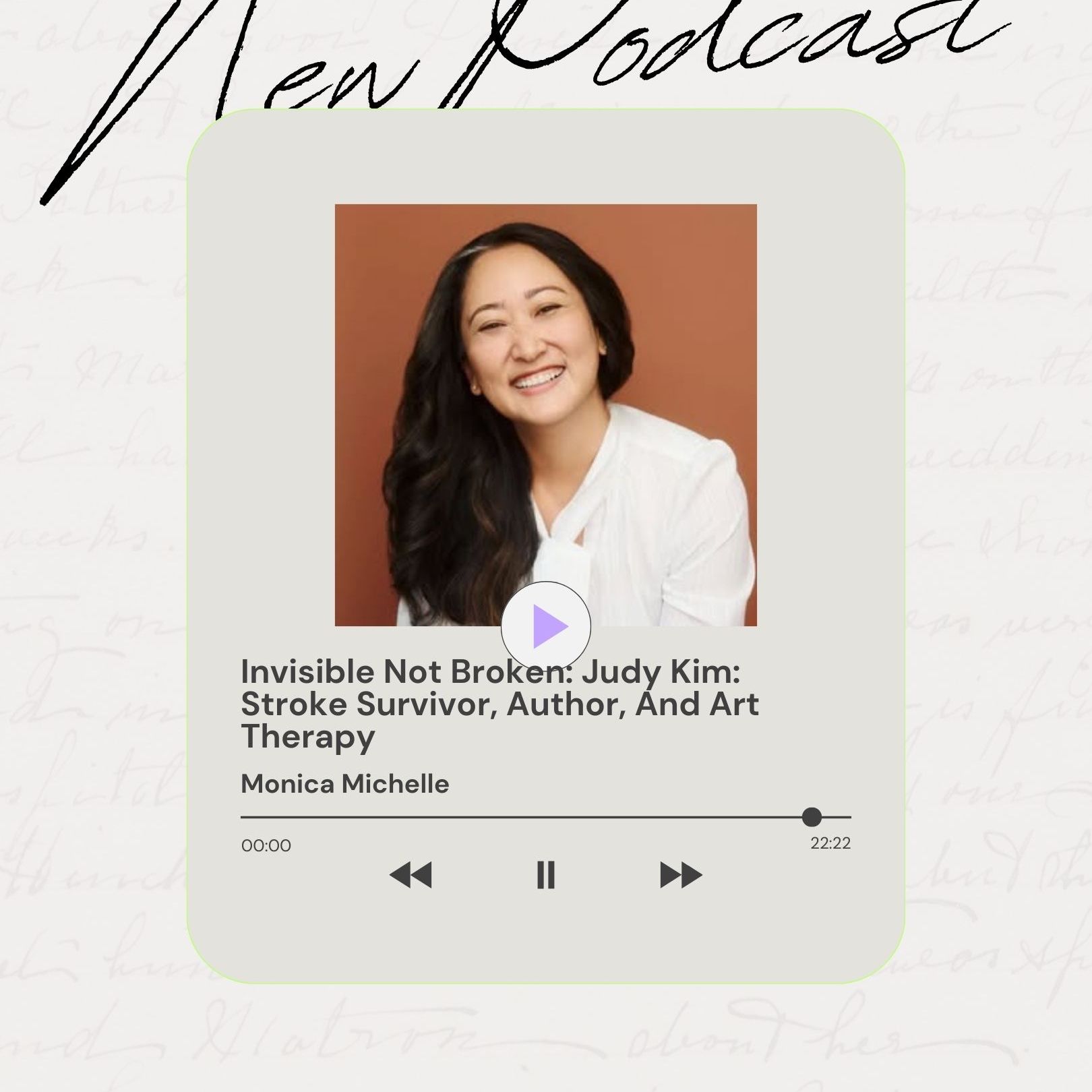
Invisible Not Broken - Chronic Illness Podcast Network · Hosts: Monica and Eva
🌈 Ever had a moment where your life changed in an instant? 🌀 Judy Kim shares her powerful story of surviving a stroke and how it inspired her to write "Super Survivor." Her journey highlights the importance of sharing our stories and supporting one another. What’s a pivotal moment in your life that shaped who you are today? Drop your thoughts! #LifeChangingMoments #SuperSurvivor #Podcast #Community #Support #InvisibleNotBroken #JudyKim #ShareYourStory #Resilience #Empowerment
Invisible Not Broken: you know, whenever we come on here, I'm interviewing Judy Kim today, who's a very interesting author who has some amazing things to say about an event that happened in her life. But first, I just want to explain when we come on here, we're laughing. It's because the pre show is a lot of fun. Sometimes I'm just going to recording the pre show because that's usually where we just are chatting. So we're going to try to continue that energy. We're going to break the curse of I press record and we suddenly get serious and we're just going to keep having fun. ⁓ I'm going to talk to Judy Kim today and ⁓ am blanking today because I have not had my coffee yet. What is the book? It's a great title. And I was like, I will of course, you're most else I don't need to write it down. And then my brain died. ⁓ Judy: I know you're okay. It's a long title. Well, so it's called Super Survivor and is, should I show you a copy? ⁓ actually, if I do that, I'm going to wake up Tucker. So ⁓ should we? Should we? Okay. Invisible Not Broken: You can absolutely show us a copy. ⁓ We also have a puppet on it. have my Labrador and we've got the cutest puppet here. If you're listening, can head over to YouTube. You can head over to YouTube and watch and see how cute Tucker is because Tucker is absolutely Jim Henson creation. And they're gorgeous cover. You super survivor. There's something reminds me about the like the Stephen Hawking book cover like Judy: Hi guys, this is Tucker. Now that I've woken him up, I'm going to grab the book. ⁓ guys. ⁓ there we go. Thank you so much. Invisible Not Broken: of like that like individual standing at a great unknowable and that feels a lot like what you experienced. You were an individual who stood in front of a great unknowable. Judy: yes, there. ⁓ the idea for the book cover came from this piece of artwork that I created when I was in art therapy. And it is a I called the stroke a wave and it's basically like a huge wave ⁓ you know, from the ocean coming in and it crashes over you and it just sweeps you from one spot to another. And ⁓ it's destructive, it's beautiful, ⁓ you know, all sorts of things. ⁓ So I had created that with ⁓ left side and my right side, you know, a photo of ⁓ which, the right side will be vibrant as it appears, you know, but then the left side's the one taken out, so there's all the shadow on the left. And so it was, yeah, it was just like the image of that ⁓ that inspired So. ⁓ Invisible Not Broken: That's fascinating. I'm like obsessed with the whole, I was like going, wow, this is really interesting. That space coming in at you, that's so powerful. But the idea of like the vibrancy and the not, let's go to the physicality real quick of a stroke because I think, I know, I'm speaking for myself. I'm saying everyone seems to, don't know if everyone seems to. I personally am very curious what it physically feels like because I feel like we get like a lot of like. Judy: Thank Sure. Invisible Not Broken: know, doctors saying it feels like this. I'm like, have you had a stroke, sir? you sure? Because I ⁓ then all the medical stuff that the doctors are telling you are only discussed by male bodies. And I'm assuming I shouldn't assume but like I am an ovary owner, I think you might be as well. And when it comes to I them. ⁓ Judy: a couple I kept I kept them after Invisible Not Broken: I call it shark week. They look like a shark brain. It's very cute. carry, they're my accessories. I carry with them everywhere. Even if I don't want to. being that in the medical community, ⁓ we're going to be cracking up. If you're, if you're annoyed by my laugh, this might not be your episode. We were having way too much fun. ⁓ You would not believe the comments I get on this podcast. I'm like, wow, thanks for like giving me a nice thick skin, a laugh that gives you a migraine. I'm so not. Judy: Nah. too. Oof. Invisible Not Broken: Sorry. Point being that you know, you get like being in the public in any way, or form has to be the most healing experience because what you think would absolutely devastate and destroy you becomes something that's funny. It's ⁓ healing. And if having ⁓ raise two teenagers did not get me to that point, being on the public with public comments available certainly got me there. ⁓ Judy: I might be starting one myself. ⁓ Yeah. ⁓ my gosh. I've actually been inspired by, or at least just taking these comments really to heart. thankfully I've gotten really, really, really nice ones so far. Yeah. Yeah. Invisible Not Broken: You need take those to heart. Everything requires energy to start, right? Getting off the bed requires energy. Starting a new point in your life requires energy. And whether it's positive or negative, those comments can become fuel to lift you forward. So whatever is lifting you forward, take it. Whatever is taking you back, find it funny. But when I'm asking about the physicality of the stroke, it's because almost everything we know about medical science is from the male body. The female body is just almost not steady at all, if only a little bit. So when doctors are like, if you're a woman, you might experience these from a stroke. like, will I? Will I? Tell me why. Tell me, tell me how you know that. So I'm asking another person who has the double balloons with them all the time. What, what does this actually feel like? And I'm not saying this is not medical advice, everyone. We are not doctors, neither one. Judy: Yeah. ⁓ yes. Yes. Invisible Not Broken: a medical professional, we're just talking about personal experience. Don't sue me, have no one. Let's put it that way. Judy: Hmm. Absolutely. Yes. I see that all the time. I experienced a stroke, but I am not an expert. only had one people. ⁓ Okay. So I, so my stroke doctor ⁓ at was a female. Invisible Not Broken: Yeah, but that one was very funny. Judy: So yeah, yeah. Now I never asked her whether she had one. I don't think she did, she, ⁓ yeah, she was pretty phenomenal. so now going back to, ⁓ the stroke itself, gosh, Ooh, ⁓ what call And I think what lot of stroke survivors call it is the worst headache you've ever had, like the ⁓ absolute worst. And I've had many strokes from the age of four because of what is called Moyamoya syndrome. And so it's this disease where your internal carotids keep progressively shrinking. And if your brain doesn't get enough blood, then it forms these collateral vessels, ⁓ have really thin walls. And especially if you have that at a high blood pressure, they'll break. And that's what happened with me. had high blood pressure. I was probably overdoing it and vessels cracked and it flooded. And yeah, so pain, the pain was crazy bad. That really, really, really awful headache. I had experienced ⁓ numbness, which I, you had, you know, the TIA or sorry, transient. ischemic attack is the mini stroke is very similar to a stroke. It's, you know, but it can be a precursor. It also is, you know, it can have some of the same symptoms. So, but so I'll just say that and then we'll just go back to this stroke. the stroke had caused, ⁓ you know, numbness and tingling and then, paralysis on my left side. So my arm my left, felt by bone fell out of my shoulder socket because it had, you know, been paralyzed and, and then also on my left side, my left foot, ⁓ it experienced drop So ⁓ I wasn't able to walk for a while, for a couple of months actually, but it felt like forever when it was happening. And basically the signals between your brain and your limbs really don't link up as quickly as they used to. And I also had what was called left side neglect. So ⁓ I did not ⁓ that stuff, I couldn't realize that stuff on the left side existed. Like I would see a sheet of paper and if they gave me a puzzle to do like or an exercise to do, circle all these, entire left side of the sheet was ⁓ filled out because I didn't see it at all. Or thought at one point they had my arm in a wheelchair in an extension of the wheelchair. And I was about to curse someone out for being in my personal space. And it was my arm. Mine. I said, how, how is this possible? It is shaking up. I didn't think I would get emotional. Um, it. Invisible Not Broken: We have a lot of emotions here, all of them. Judy: Yeah, ⁓ but ⁓ thought how in the world is this possible? How is this my new reality? How, how I going to function without being able to function like, ⁓ and knowing what's going to happen next? How am know, like if my brain is fooling me into telling me that this arm that's been a part of my body for the last 39 years, then how am I supposed to work? How or not work, you know, work too, but how am I supposed to work? that was really, really scary. and you I lost control of bodily functions, you know, went in bed. but, I know that meanwhile, this is the effects the stroke. But during the stroke itself, gosh, it was just so dark. It like it was nighttime the whole time. You know, the massive pain, I was constantly nauseous because even when I had TIAs, ⁓ would, would, ⁓ there's my pup. He's saying hi again. ⁓ He, no, not Tucker. So. Invisible Not Broken: He's upset. He has had a moment. It's okay. Support Dr. Motions. Judy: Woo, there. So the... Sorry, guys. So one of the side effects of a stroke is that you lose your train of thought that you lose some cognition. ⁓ what happened. And so it happens to this day. But ⁓ Invisible Not Broken: podcast we support that and the reason I support them the reason it's not gonna get edited out is because a lot of us are starting over if you're listening to this podcast you're listening to it either because someone you love is experiencing something or you're experiencing a situation where you have to start over again and it's not gonna look perfect and I don't want you to wait until it's perfect to try something so we keep these things in just because we want you to know we're okay with it not being perfect so you should at least try not to be so judgmental of yourself Judy: Absolutely. Absolutely. Mm. And for me, it's been, I just experienced my seventh anniversary of the stroke. So, ⁓ went out to dinner, you know, like, you know, just, ⁓ was amazing because in past years, I just been focused on either the recovery or Invisible Not Broken: Did you do something? He told me he did something. Judy: the, hey, look at how much I've accomplished, you know, I said, ooh, yay, went back to work. Ooh, yay, I did this, you know, ooh, I got promoted. This is how exciting is this? And don't get me wrong, all that was exciting. But when this year I released this book and I went public, like you were saying, you know, putting the public facing front out there and Gosh, I didn't even tell my neighbors that I had a stroke. We moved to this condo in the city and it's so much easier for the medical appointments, for not having steps for, I can do them now, but six years ago ⁓ was not doing them. I could not say, hey, let's commit ourselves to this house. Yeah, ⁓ yeah, yeah, yeah, ⁓ Invisible Not Broken: Wait a minute, this was right at beginning of COVID. ⁓ my God, just put that together. wow, this is like such a stressful experience you're having. I had you like this, you like I'm lucky enough that I was born with all these genetic defects and I've been a frog in hot water my whole life. So everything's like, ⁓ okay. ⁓ that's cool. ⁓ people have like suddenly like ⁓ apart of their lives is like insanely shocking to me. And I cannot imagine what you are going through. And then you add on to you. think we're married at the time you have the stroke and COVID's going on. So getting your husband to those appointments. Judy: Mm hmm. Mm hmm. ⁓ yeah. Yeah. Yeah. we're still. ⁓ well, you know what? It's funny because ⁓ hear that a lot more now in retrospect, you know, after I've shared my story with so many people, they're like, ⁓ Invisible Not Broken: I'm making everything a thousand times more difficult. Judy: And COVID, ⁓ my God, you're so lucky that you didn't actually have your stroke and were in rehab during COVID because you would be completely isolated. You would have no one able to visit you, you know, all of these things. And I... Invisible Not Broken: You Judy: I'm so grateful that that didn't happen. Although I can't say that I made it unscathed, right? Because it's funny, like I had the stroke, I had to adjust to everything. And then it's like, ⁓ this is your new normal Judy. And then it was like, ⁓ and COVID. what? Here, let's put that icing on the cake. you know, but But aside from that, fortunately, and I've never, I've not gone with, I have not tested positive yet ⁓ but suspect ⁓ that also because I found after the stroke that I also have EDS. So ⁓ after, I gift a curse. So I think, you know, I a pots? ⁓ Invisible Not Broken: I'm so jealous. Judy: ⁓ and all of these symptoms that other people are experiencing COVID, I happen to have before COVID. So, ⁓ I don't know if it's some sort of protective germ, you a protective genetic disorder, but it just doesn't, you know. ⁓ Invisible Not Broken: No, because I have EDS, I absolutely got COVID and dislocated all my ribs from the coughing. was like alien movie, like ribs open up. Yeah, it was not fun. I do not recommend ⁓ zero out of five stars. Judy: My ribs on my left side stick out. They protrude because of the spasticity. they haven't been dislocating, but other things definitely dislocate like all the time. Like my ankle just ⁓ all that. ⁓ was like the. Yeah. ⁓ Invisible Not Broken: I just started using the road machine. ⁓ my God, yes. I can show you pictures. I send them to my physical therapist just to like, ⁓ hey, guess what you have to deal with. not a fun person to have around. I swear I'm fun for like a half hour. And then like people have to be in my life all the time. like, ⁓ God, ⁓ ⁓ Judy: No. Well, so that's part of what I am trying to accomplish with the book, actually. Yeah, not to get too serious, but I'm totally joking. I'm totally joking. The part of it is ⁓ to create an awareness about invisible illnesses ⁓ about how much you assume anything about anyone. You can't. ⁓ Invisible Not Broken: We're gonna go back and do this a lot. Totally fine. Hmm Judy: It's not even the people who suffer, they don't say a word. Sometimes, a lot of the times they don't say a word. At least with me with a stroke, I again, didn't tell my neighbors, didn't tell anybody else at work except the people who needed to know. You know, I just, I kept it private. in this case, you know, like I, so part of the reason why I came, out into the public is because there were so many people that I had spoken to, other patients, et cetera, that verbalize what it is that they were going through, whether it was to their doctors, to their friends, to their family. And for me, everyone thought that I looked completely normal, or they still do, right? I mean, there's nothing, whoo, like. I mean, I couldn't move my, I couldn't move my hand at some point, you know, but, but right now you can't tell that you can't tell that, you know, like, well, don't see the facial droop right now. Cause I'm, you know, ⁓ I'm as tired, but it, you know, it had been there at one point, all the things and, and like a little bit of lazy eye. That's the one thing that really kind of hangs out when I'm tired and I'm like, darn it. know, ⁓ like. ⁓ Invisible Not Broken: think exhaustion really adds to the symptom list. It's something that I don't think people understand. I think there's a lot of like, oh, you're a woman, you're stressed. Calm down. Don't work so hard. It's person of hysterical. And when we get tired, though, I think there's a intake words. There's a massive uptick in our symptoms in ways that we don't necessarily. Judy: ⁓ yeah. ⁓ thankfully. ⁓ my gosh, and they're so uncontrollable. It's not like you, it's not with like, with fatigue, this sort of fatigue that you can just lay down and say, I'm just going to chill out, you know, ⁓ hey, I'll just watch a little bit of Netflix and hang out. No, ⁓ there's none of that. There is laying down and there is ⁓ ⁓ moving anywhere. It is forcibly not moving anywhere because your body has taken you hostage and it's saying, no, you've overdone it ⁓ we don't like you right now and there's nothing you can do about it. Sorry. Like you absolutely have to shut down, you know. Invisible Not Broken: You're a slave. You get the experience of people in your life, especially the people who used to be in your life pre this, who get jealous of the time you have now. I get the experience of people who used to be in life when I was working 80 hours a week who were like, ⁓ my God, you have so much free time now. I'm like, ⁓ my God, you have no fucking clue. Holy shit, do you understand what my life is? Judy: Do they get jealous of my time? ⁓ deserves murder. ⁓ am sorry. ⁓ know we just put this on tape. Please don't come after me. You police or anything. But. Invisible Not Broken: Silicon Valley is where I used to be. So I was in the Silicon Valley. That was my work life was in that world. Go, go, go, go. 80 hours a week, nothing. 80 hours a week was nothing. yeah, those people from that world have very interesting ideas about what my life is now. Judy: Yeah. YAH! I used to work for, yeah, I used to work for Deloitte. And so my, ⁓ what that whole 90 hour a week thing was like, you know, and I still push, push, push, push, push. And still one of my like, ⁓ yeah, I can do this. And I refuse to accept that I couldn't work anymore. So I think that in pushing further and further, ⁓ I was able to accomplish what I have. but at the same time, you know, my vascular neurologist will say to me, you do have to watch it. And I'm like, yeah, but if I didn't push then, ⁓ and like, yeah, but, know, and I, but so yeah, I've, I, you know, I fly to Columbus all, you know, fly to Dallas and ⁓ Invisible Not Broken: Mm-hmm. Judy: there are these times where I see people and everyone is like, they had no idea. And they're like, well, hang on. can't, you know, wait? And they don't, unfortunately, I don't make enough mistakes that they see it frequently, you know? And so they're like, okay. And I feel terrible about whatever mistakes I make. But. You know, they, had no idea. And so they're like, she's just slacking. what heck? And I'm like, yeah, yeah, I'm, slacking. I'm just balancing a few too many things at one time, but also, you know. I'm trying to make people aware of what it's truly like because like you said, if even people who know you, who've seen you forever, ⁓ have said, ⁓ know what happened, ⁓ still like, ⁓ we're out to lunch. We're fine. You know, like, ⁓ yeah, come to this family party. Come to that. ⁓ they, yeah, yeah, exactly. ⁓ like. Invisible Not Broken: Yesterday you did it last week. Why? Judy: And they, they, sorry about Tucker. He, they do not know about spoons. They do not understand it at all. Yeah. Yeah. Invisible Not Broken: Dogs have no understanding, none. My puppy gets so concerned about like, why aren't you moving woman? Like you're supposed to be playing with me right now. Judy: Ha! Invisible Not Broken: had talked to like, I just wanted to go back a little bit. And if this is too rough, just we'll switch up topics. But you had been talking about your recovery and like this arm that is a part of you. And like, I feel like there's also the sense of betrayal of the body. Like it's like we're like, ⁓ as said, we own a body. Like, we are not our body. We own it. We sit in it. We live in it. It's like an avatar. And like, yeah. Judy: Yes. ⁓ I feel like we're only renting it, but. Invisible Not Broken: I'm like Annie DeFranco in between some times between my mom and some maggots. Like, yes, I love Annie. But sorry, Gen X, what can I say? This idea of like, there's this limb, it's a part of you, you grew it, and it's not obeying you. It's just there. It's to the point where it's almost disassociative. And then you're also at this point where you need help for everything, including like personal things. This seems like a loss of autonomy down to being a newborn. Judy: Mm-hmm. Mm-hmm. Oof, I might not go that far. Like, ⁓ yeah, no, no. Invisible Not Broken: That's fair. I'm only taking from what I'm hearing. I'm not experienced this, but I'm curious how you go from an intense lack of autonomy to a point where you're like, I don't know this arm. And then how do you decide to take the amount of energy it would take to go from, I don't know this arm. I don't know this body right now, but I'm going to fight for whatever I can, or I'm going to work towards whatever I can get back to. And I'm wondering what that energy was, what that push off was. And how you, because like, I know this is like a journey. So you're going to have a whole lot of points where you're like, I don't want to anymore. This is fine. I'm done. Like what, what is the things that you go back to without like, you know, inspiration porn that kept you, I think we both have a severe hatred of inspiration porn. Judy: Yeah. ⁓ no, no, I'm not. Woohoo, sunshine, rainbows. No, no. You know, they're okay. I'll get, I'll get back to that in a minute. No, no. ⁓ no, no. The inspiration porn part. but, ⁓ no, no. Yeah. Yeah. so from, from being honestly on of the world's, from a career perspective for me, ⁓ Invisible Not Broken: No worries, that was a lot that I just wrote. ⁓ we can do that one all day, no problem. Judy: And then feeling like I had achieved all of this and even had brain surgeries and I recovered from that 10 years prior, you know, and I felt like I was cured. was on top of the world, you know, like, wow, I overcame this and check this out. Guess what I can do. and it and then to have this horrible headache and to lose my body and then all of a sudden feel like I had no control over anything to feel like ⁓ I have no idea what the hell is going to happen. I don't know whether I'm going to be stuck in this bed. I can't get up and walk. I can't sit up for extended periods of time. At first, the pain was so bad. I can't even remember the entirety of that three weeks that I was at the first hospital. And I was in the ICU for 10 days. And it was... I, you know, I've interviewed or been interviewed by other, ⁓ you know, OT patients and stuff, and they have said, you know, so what's it like? you deal? And I said, I'm going to be honest with you. it was not easy. It was a shit show ⁓ the time. it's still kind of a mind fox sometimes, you know what I mean? Like it still is, but, at the time it was like, my God. like the wave, it just came over and it just ⁓ washed the entire beach you know, ⁓ and. ⁓ And you were swept away. was nothing you could do. Nothing except try and then try to do the things that they were asking you to do. Like try to move, try to, you know, do these exercises, try to speak, try to remember, try to, you know, and honestly, that's, is ⁓ I could do. couldn't, ⁓ I fought and I was stubborn ⁓ you know, my mom and my husband were saying, yeah, you know, ⁓ no, you, you have to stay in, you have to stay in rehab. Like you've got to be here for like four to six more weeks. And I'm like, fuck no. Like ⁓ no way ⁓ was like, mom, I need you to leave the room right now. I need you to leave. Like you can't and she was laughing and I'm like, cause she was, she was so uncomfortable, right? Like I don't think she was just that tactless. just think she was uncomfortable. I'm like, mom, like you, you've got to leave. ⁓ I can't right now. ⁓ so, ⁓ know, I kicked her out of my room. They're like, you have to stay, you have to do this. And I was like, why, why can't I just go home? ⁓ And then come into outpatient every day and work my ass off every day. Why can't I do it? And then of course, it's in hindsight. It's not until after that you realize. what they were doing, the strict rules, the, you know, everything that they, you know, when they said, okay, you, can go, you can go pee Judy. We'll take you in by wheelchair and then transfer you over and whatnot. But we're going to keep a hand on you the entire time that you're in there. So those of rules. I resented for so long and I was just like, get me out of here, please guys come, drive me to Mexico, bring a wig, like get me out of this hellhole. Invisible Not Broken: Still break. This is a movie, I swear. Judy: Yeah, it's, was, you know, and it's so, it was ⁓ Certain things were so easy to joke about back then because you can, you know, have, ⁓ yeah, what else are you going to do? Right. It's like, all right. Are we going to, burrow down ⁓ and like ⁓ hide or, say life is over. Or are we still gonna say that, know, ⁓ mind is still like, well, ⁓ like ⁓ was okay at that point. I still cracking jokes. was still so, if I was able to make people laugh, I was going to do it because it made me feel better about myself too. And also, you know, like made life easier for the therapist because usually, You know, like my speech therapist, for instance, said, Oh yeah, I get cursed at all the time. And I'm like, I was a gem. She's like, she's like, yeah, you absolutely were. You're like, you have no idea. Um, anyway, anyway, I, um, I feel like I've got enough topic. Um, but so. Invisible Not Broken: No, you're saying humor is so important because like I do stuff like that just to make sure they see me as human. Like my dad was in and out of hospitals all the time and you could always find the ICU because the nurses were cracking up. But he also got the best care because everyone remembered who he was and wanted to be in his room. So I use that as well. Also singing supper like if I'm going to be the sick, I have to be entertaining, right? Like Judy: Yeah, yeah, but Yeah. Yeah. Yeah. Yeah. Well, don't they say that the funniest people, you know, have gone through the hardest things too. Invisible Not Broken: Yeah. I think it's really true. It's a coping mechanism. think humor is, ⁓ is the coping mechanism for people who are experiencing things. can't change. If you're under the control of something that you have no autonomy over, you can't fix, can't make better. The only thing left is humor. Judy: Mm-hmm. Yeah. Yeah, yeah. mean, well, I mean, and I joke all the time with who ⁓ people who now know too, but, ⁓ who have worked with me for years, like as outside parties, like auditing us, like the company, ⁓ they're like, this happened to you. We've been working with you for years and we have no idea, like, or we had no idea. And then I'm like, I'll ⁓ I'll you. I'm like, I'll tell you the miserable stuff. Invisible Not Broken: Okay. Judy: I'll pretend to make you feel bad for me. what else am I going to get out of it? ⁓ start laughing like... ⁓ Invisible Not Broken: I mean, a book, apparently, a book is what you got. I had a stroke and all I got was the ability to write this really great book. Here you go. Judy: It was so cathartic. It was so, so cathartic in so many ways. Invisible Not Broken: Yeah, there's so many people who are going to experience things or have experienced things and they're like I actually do want to write this I just don't know where to start how what like you've done a lot of mentoring with people How would you mentor someone who's experienced something or is experiencing something like I want to tell my story? Judy: So the way the book started or well, the very beginning origins of the book was like three months after the stroke. And I decided I wanted to accomplish a goal. I said, I'm going to tell this stroke to go itself. And, know, I'm ⁓ yeah, yeah, yeah, yeah. ⁓ yeah. OK, stroke. Fuck yourself. Invisible Not Broken: Hmm. You can swear here. We have to hurt. get to be fuck. Like, that's a big point. Yeah. Judy: Go on. And so, ⁓ I've told it already so many times. already knows. ⁓ ⁓ so I, ⁓ said, I am going to, set a goal and, but, you know, like, I'm going to go run Broad Street in Philadelphia. And that's a 10 mile race. you know, one of the bigger races in Philly. Invisible Not Broken: Get them, Steph. ⁓ I feel it. Judy: or actually one of the biggest races in Philly, brings in people from all over. ⁓ I said, ⁓ better thing to do than to run for 10 miles when I couldn't even walk? Let's, you know, let's do this. And then, of course, it doesn't happen because I asked my doctor, ⁓ or he said to me, don't you think it would be a good idea to ask your doctor what he thinks about? you know, whether you're going to do this or not. And I was just like, no. And I was like, ⁓ wait, doc, you think I can do this? And said, ⁓ he I don't it's the best idea. Not because of ⁓ the 10 He's like, I'm sure you could run 10 miles. Like once I started running, right. But, I, he was it's training involved. And you know, your blood pressure going up and down that I think that would be an issue. So I'm like, okay. But what I had tried to do, when I first started ⁓ this decision, I said, I'm writing a blog. I, need write down my feelings somewhere. and so that's, that was the of it. And that was, and that was so. Puglet. And that was, ⁓ no, no, no, it's okay. Tuck is back on the sofa now. ⁓ he's like, ⁓ mom's not paying attention to me at all. So I'll have to bribe him with treats later. So yeah, started with a blog and I think so ⁓ when I to transfer that over to someone to say, Hey, this is my advice for you then I'd absolutely say, write it down. Invisible Not Broken: Sorry, distraction, but she was making a loud noise. Judy: record, gosh, record as much as you can because the first picture I have, for instance, was like 10 days in ⁓ ⁓ was a ⁓ dog in my hospital room. And that's why I was like, Ooh, can you take a picture of me with a dog? Like, I do want to remember this sort of thing. And, you know, not even knowing how far, how long it was going to survive, how far it was going to make it, you know, et cetera. But I was like, here, take a picture of me. Or when I had slow speech, if too tired, if I couldn't, ⁓ you if ⁓ my slowed down, like really, really, really slow, ⁓ and would record myself on a voice note. And I would say, I need to know what this actually looks like to the outside world. Because I to know for myself. I wanted to know. ⁓ I had video of when I wasn't walking right or when I was trying to walk right. And, you ⁓ either to begin with, you know, the evidence of it all has been great. It's been such a ⁓ marker for me that I can go back and, you know, like look at in terms ⁓ of ⁓ the writing. I mean, strokes are isolating and chronic illness is so isolating. And so if you don't write it down or if you haven't found your community, you know, I feel like I'm just finding my now. then who do you have to talk to about it? You really don't, you know, it's like, okay, now there's internet, but even with the internet, you know, people aren't going to be like, You know, they're not announcing that, Ooh, they're, they thought their left arm wasn't part of their body and they went to bed. They were going to announce that sort of thing. Yeah. Yeah. So, um, you know, without that community, where else, what, what else do you have? So my recommendation is find your outlet. Um, any outlet that you can, you know, like you've made it, you've made it. Invisible Not Broken: I haven't seen that thread yet. Judy: to the other side in terms of you've survived, you started gaining things back. whatever you have left, your consciousness, your intelligence, your thoughts, whatever, put them down because you'll actually love to ⁓ it later. Now for me, it's also sometimes upsetting later, but also is like, wow, if I didn't write it down, I wouldn't be able to look back on it and say, Hey, guess what, I overcame this because am so driven ⁓ I would push and say, I used to not be able to cross the street. And, you or like they, you know, I would have to wait for the signals to turn like two cycles of them before I would move on because that was the safe thing to do. And I, you know, those were the things that you had to learn. You had to learn how to function out in the real world. And if you just say, go, go, go, go, I want to get better. want to get better. I want to go back to work. Then you can so easily forget about everything else that you've been able to get back. Right. So, um, that is, that is what I recommend. mean, share your feelings if you're up for it. Absolutely. Talk to the people you can talk to. Ask if you have, if the hospital has any resources for you. At the time, I spoke with a neuropsychologist who, you know, like we talked a little bit, but we ended up talking more about like my regular life therapy than we did, you know, stroke therapy. And there were there, it turns out when I was part of the Patient Family Advocacy Council, I had found out so it wasn't until afterwards that I found out that they do have people who are specialized in this, let me help you walk through your stroke care. And yeah. So I mean, like, just try to find like four stroke patients, try to find the support, but then for writers or people who want to write and share your story, absolutely just put down as much material as you can. And then you can sift through it and decide what you want to do later because it's overwhelming, right? So decide, okay, well, this for me, it was. Yeah, I'm sharing my story. But what is it about the story? Like, is it just a kickass of therapy? And guess what, I was able to get all this back. And so let me tell you all about it. know, it's not, you know, it wasn't, it wasn't. It didn't necessarily ⁓ start way. So, you like, ⁓ and the other thing I should say is that ⁓ and I should wrap this up. Invisible Not Broken: Hmm. Judy: I think, you saying, because I can go on forever. So ⁓ one the things that they teach you after stroke is to set a but to break it down into goals, sub goals, and then to break those sub goals down to slithers of sub goal and keep doing keep doing it, keep breaking it down. And then when you accomplish something, you know, like the fraction of whatever it is, check it off, write it down, check it off, say, I did this, I did this, and I did this. you can look back at it and say, ⁓ guess what? I did do this. ⁓ putting it in smaller chunks instead of the big chunks give you the ability to say, to feel like you had progress. Because if you don't. And you just say like, well, my goal was to read a book. And if it doesn't happen for two years, then it doesn't, know, you're like stuck for two years, like, ⁓ you know, but, but yeah, you know, like, ⁓ when they baby steps, it's baby steps. You know, but then it's also, it's It is also, I am learning a lot of this myself in that it wasn't until this whole process that I have learned what the possibilities are. It is like the world just like split wide open and the possibilities are like, ⁓ wow, you mean you can go to Vegas and do an interview, you know, like, or you could like, you know, you could. be interviewed or you could, you know, and do all these amazing things and meet all these people that you never would have met before that, um, and met a community where there are people who can make you feel like you're not that alone. You also have people who have had similar strokes or go through the same body aches or, know, like, Well, you didn't experience this, but when the snow hit here in Philly, you know, like are ⁓ joints and muscles aching all over the place? Do I feel like I was hit by a truck? Yeah, absolutely. But ⁓ now have people to talk to. And that is such an amazing feeling because you don't have to feel alone. So ⁓ if you write a book, ⁓ absolutely do do ⁓ it. ⁓ Do it so that other people can experience it too. So that you can, I've heard so many times now, I've set an example for people who wanna do it and that they can see that now they can do it. And honestly, yeah, if I can do it, you can do it. So. Invisible Not Broken: Mmm. Talk to me about the art therapy, because even if you're someone who has had something, you're like, I am not a writer, but I do want to get across what I'm going through. Doodle sketches, embroidery, interpretive dance, like talking to a recording software. Like there are so many ways, like we're talking about storytelling and storytelling can be anything from making music to writing. And you got to go through art therapy. What were some lessons you got from art therapy? Judy: Mm-hmm. It can, yeah. ⁓ wow. sorry, I don't know what happened there. So, ⁓ right. All right. Tech I do not get along. so ⁓ ⁓ therapy, so to start, will say, and I kind of alluded to this before I was go, go, go, right. Just constantly go, go, work, work, work, work, work. Invisible Not Broken: You're all good. The chaos of the universe, that's what happens. Yeah Judy: And I don't want to waste time. don't want to spend it on things that I think are pointless. TV shows, that's, that doesn't necessarily count, right? I mean, like if you want to binge something, binge it. ⁓ ⁓ ⁓ Invisible Not Broken: I'm quite the villager. If I say Miracond, it is never running. It is always, always on Netflix. If you see me running, you better start too, because there's a very wrong. Judy: So, so. Invisible Not Broken: There's a dinosaur or zombies, but I do not run for no reason. Judy: I was dying, dying, ⁓ literally and figuratively in, So in, ⁓ in ⁓ I, get so claustrophobic. I do not like being out of control. So, you all stereotypes of not, ⁓ it's the not being able to escape thing. And ⁓ I was allowed leave the hospital. Invisible Not Broken: Sorry. ⁓ Judy: So that was like probably of the biggest hardest parts for me. And so when you're not in therapy or in your room alone, ⁓ or you have family, ⁓ friends that visit, then awesome. But most of the time, especially when Hubs is at work, you can't exactly expect him to be there all the time. Then you're by yourself. you know not really wanting to watch tv maybe at the most i was like on facebook or like ⁓ know on the cell phone and surfing but because you're alone art therapy saved me ⁓ art therapy i you know i've i'm creative here and there you know love music love you know like making things but Invisible Not Broken: Mmm. Judy: know, I was never necessarily good at it or I kind of just thought, this, would kind of be like a waste of time, like, for me being a corporate nerd, right. and so, and they would give you adult coloring books and I would be coloring books, really. But then when I started to do it, I said, ⁓ my gosh, this is amazing. can focus on something, ⁓ know, it's like, it doesn't really require a ton of thought. And actually made something pretty by the time you're done. And then in art therapy also, it taught me that, you know, I painting and normally I'm a perfectionist ⁓ and this allowed me to say mistakes are okay and mistakes are beautiful. They can actually turn out wonderfully. And it's like okay so you don't have to ⁓ to be perfect all the time. You don't have to you know think that your time has to be so regimented that you can't go fun or explore or try this. Like I taking a paintbrush and I was just like flicking ⁓ flex a paint onto it randomly, you know, it's just, and I was like, I don't know what the heck I'm making. I'm just making this. And it was, you know, no direction, necessary, no, no, no, no, no necessary thoughts and, you know, vision. And then until later, you know, until the wave thing, it's actually behind me right there. I don't know if you can see it or not. Invisible Not Broken: Yeah, it's gorgeous. Judy: But yeah, these things teach you that you can simplify things and break them down. that was one of the biggest things, to slow it down, to cherish the time. then, you know what? There's no set way of doing things. ⁓ And you don't need to be classically perfect. It's living then more of living in the moment. And that's where the joy ends up coming in. Invisible Not Broken: is ⁓ I'm an artist and that's actually my job. ⁓ it's so to see everyone going towards generative AI because it's the product is not the point. The point is the process. And point is learning how to take what's in your mind and express it to others. And that journey of constantly trying to go from the internal to the external and back again, that ⁓ Judy: Yeah. ⁓ Invisible Not Broken: like that's almost like that journey of like the hero to the underworld of like going to like the people and then going deep inside to gather everything and then bring it back out again over and over and over again. That's the actual point of art. And yeah, sorry, the gender of AI thing drives me insane in every little. And I wanted. Oh, yeah, it did get very bright there. It was like, you know, the whole halo. Judy: ⁓ no, no, you're good. You're good. I just sorry the I feel like the light just went out. ⁓ it went. actually got really dark and then it got I've got break because I did this. OK, sorry about that. I think that's better. I think this is back to where we were before. Yeah, no, we are. Invisible Not Broken: You No worries. We're closing in on an hour and I have one question. Thanks to ⁓ Tim Ferris that I always ask everyone. It's my favorite question. And it's, if you have one purchase that's under a hundred dollars, what is it that was actually worth it for you? Judy: yes. My more recent ⁓ now I've doing it for a while now, but I've been truly wearing everything more often, but it's been the crystal jewelry. Thank you, thank you. This one I got at the... Invisible Not Broken: It's so pretty. Judy: holiday market at the Grand Central Terminal. Her name is Annie Zhang. Everybody go look her up. She's amazing. ⁓ And then like I found this other person on Etsy who allows you to just put your stone ⁓ ⁓ kind of mesh thing that so you can change it out and you can like depending on you know what you're needing for the day. Yeah. ⁓ Invisible Not Broken: Yes, it's beautiful, Lori. ⁓ Nice kit, this is like a mask kit, a silver mask kit. Oh! Judy: So yeah, it's crystals and crystal jewelry. I am a goodbye. Invisible Not Broken: It is, it's beautiful. If we were not closing an hour, I'd ask you more about what jewelry means to you, but we're closing and we will need to see that for another shot. Judy: Thank you. I will, I can email you or send it to you or, yeah, absolutely. Invisible Not Broken: My other job in life before I got sick was a jeweler. I used to be a jeweler. I'm GIA certified. I've had a weird life. I cannot thank you enough for covering ⁓ I've done has been in the field of storytelling or create even when I was working in Silicon Valley, I was still as a photographer over there. So it's always been something storytelling. Yeah. ⁓ Judy: ⁓ nice. Very creative though. That's awesome. Well, everyone is lucky. Everyone's really lucky. And I am super lucky that you have those talents and gifts and that we can, yeah, yeah, yeah. Invisible Not Broken: storytelling. You know, as we're talking about like everything of going, that was what interested me so much about your story is that starting over these were if you're chronically ill, you're always starting over. No matter which place you get to on the ice where I'll get to walking, I swear I'll get standing. I swear I'll get to sitting up most likely, but not you're going to end up back down to ground zero. You're going to to keep starting over again. And that's what really interested me about your story was like talking to someone who went. all the way back to ground zero to start over again. And I'm always interested in what it takes people to keep moving forward. So your book is so important. am really hoping if you are listening to this on the road, it's okay. Just when you get to somewhere where you can type safely, go to invisiblenotbroken.com. I will have a link to the book right there. You can just purchase the book right from our show notes. ⁓ GD, I'm so happy to have had you on. Thank you so much for your time. Judy: Thank you. Thank you so much. ⁓ Invisible Not Broken: All right, everyone have a great day. Be kind, be gentle, and whatever it looks like to be fierce. If you're in the United States with us, being fierce is no longer optional. Be fierce in whatever way you can. Being disabled is obviously a very political thing. So call, write, comment, do whatever you can. We are going to be doing more episodes this year, so wish me luck. to a month we can do it and if not it'll be funny so i will see you guys hopefully in the next few days and please make sure you comment like share i don't advertise so if you've heard of us it's because someone told you so be kind and do that to us too
More Invisible Not Broken - Chronic Illness Podcast Network episodes →