
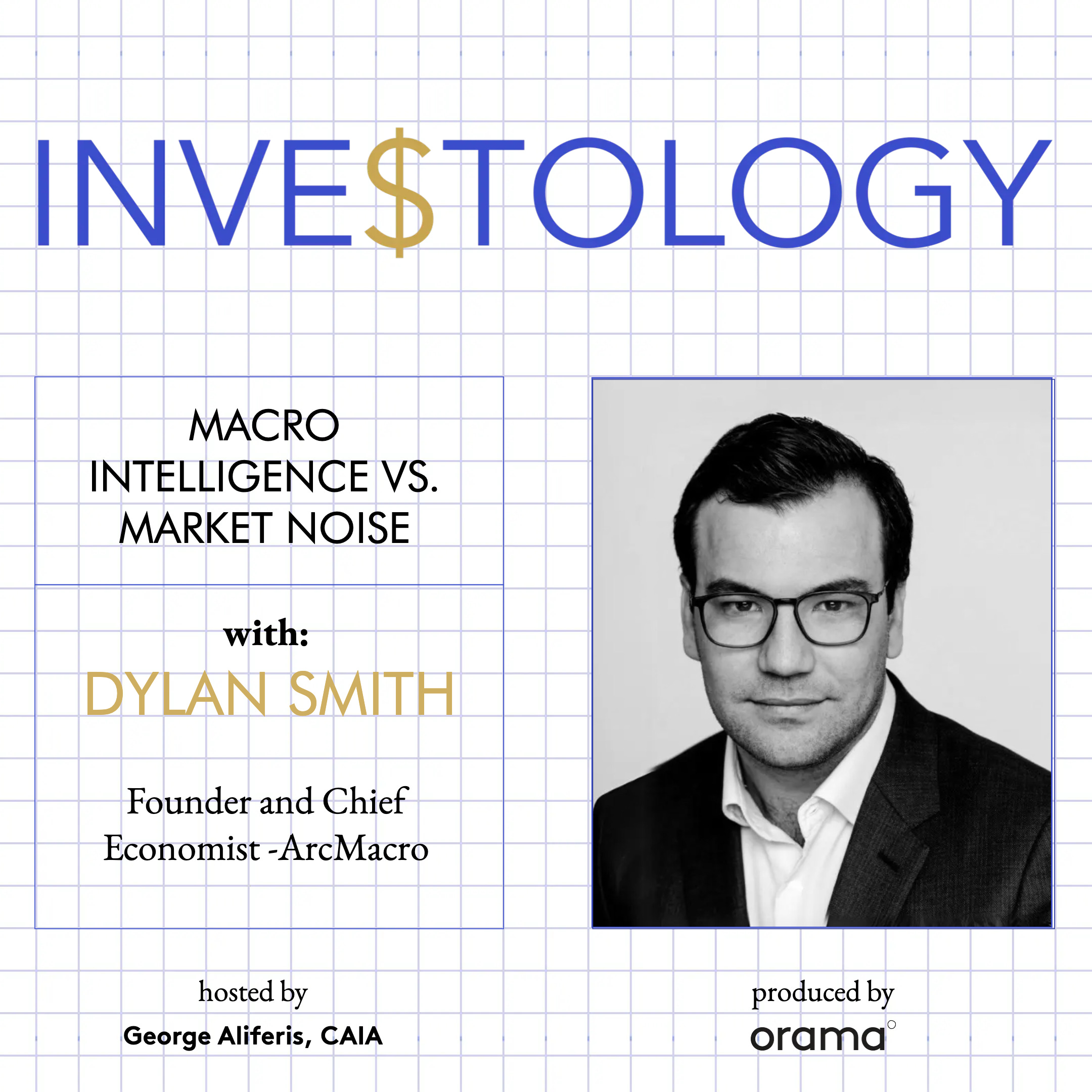
Investology: Investment Management Intelligence · Investment Management Intelligence
It’s great to be back on the podcasting seat! Watch it on YouTube or listen on every podcast app. This podcast is about gathering investment management intelligence. It’s not an investment podcast where we discuss macro itself. Yet macro matters. This was a rare opportunity to understand how it works for sophisticated hybrid investors, and what goes on behind the scenes by talking to Dylan Smith from ArcMacro (Tangents on Substack). A few selected quotes from our conversation Macro for private market investors If you have in mind private market performance, […] it's long term and returns are driven by slightly different things, although they are affected by macro. We've re-looked at the economics toolkit. We've kept most of it, but we've shifted the focus to say, okay, we've got to be a lot more long term. We've got to be a lot more structural. That’s Dylan key differentiator. He’s serving private market LPs. But I think his framework is applicable to anyone with a longer term perspective. Signal vs. Noise - 2026 version Every time someone meets me for the first time, it's, "Oh, you're an economist. What a great time to be an economist," like, "There's so much chaos in the world." I did not bring up the famous Lenin quote in the conversation: “There are decades where nothing happens; and there are weeks where decades happen” although I had it in mind after Venezuela, Iran. But the conversation showed me I was making a common mistake: People tend to view often developments almost as entirely political, and I think partly that's the news media's fault because that's their natural lens as they report. We went on to discuss this signal and noise in more depth. But ultimately having a solid macro grounding helps to avoid investment biases. But it doesn’t mean you should only stay the course without doing anything. We also talked about hedging, and shifts in allocation. Assign probabilities Our primary framework is scenario-based. But it's not just sticking our fingers in the air and saying, there's a whole universe of things that could happen. It's based on understanding that, events now chain into the future, and they can branch away. But we can assign pretty good probabilities around that by mixing some fairly sophisticated modeling and data. This is quite different, and a lot more practical from thge traditional perspective of an economist producing ONE forecast, usually with a lot of caveats. AI and the Dunning-Kruger effect in macro AI is about averages, and it's backward-looking. It produces the next most likely token based on its understanding of all the past information. You're trying to think about scenarios, what might happen in the future and what's important about the differences and inflection points. Like, is this a meaningful shift in the kind of structure of the economy? It’s too sophisticated for AI to answer. It will give you an answer, and it will sound confident about it, but there's a huge amount of risk in that. And if...
0:00I've been often asked why I don't cover macro in a podcast
0:03because there are so
0:03SPEAKER_00many popular macro podcasts and the reason is simple.
0:06SPEAKER_00I cover investment management, not investing.
0:09SPEAKER_00So it's not about getting investment ideas.
0:12SPEAKER_00It's about gathering investment management intelligence.
0:15SPEAKER_00Yet macro matters enormously.
0:18And therefore what I want to try to understand is how it works
0:21and how do you
0:22separate the macro that you use as a sophisticated long-term
0:25investor to the macro
0:28SPEAKER_00news and noise that we are covered with.
0:34And that's why I'm so grateful to have the opportunity to talk
0:38to Dylan Smith,
0:40SPEAKER_00Chief Economist for Private Markets and the founder of Arc Macro.
More Investology: Investment Management Intelligence episodes →