
Inflammation Nation: Science Informed Wellness with Dr. Steven Noseworthy · Dr. Steven Noseworthy
The episode delves into the complexities of the microbiome, emphasizing the limitations of probiotic intake and the benefits of fermented foods. It highlights the importance of short chain fatty acids and challenges the notion of a universal healthy microbiome profile. Takeaways Microbiome complexity and individuality Limitations of probiotic intake Benefits of fermented foods and short chain fatty acids Chapters 00:00 The Return of Inflammation Nation 05:34 The Influence of Early Life on the Microbiome 11:14 The Limitations of Probiotic Intake 17:30 The Importance of Short Chain Fatty Acids 22:44 The False Target of a Healthy Microbiome 28:47 The Theater of Activity in the Gut 34:32 The Failure of Probiotic Intake 39:51 The Practical Strategy for Gut Health LINKS Dr. Noseworthy on the Web Work with Dr. N
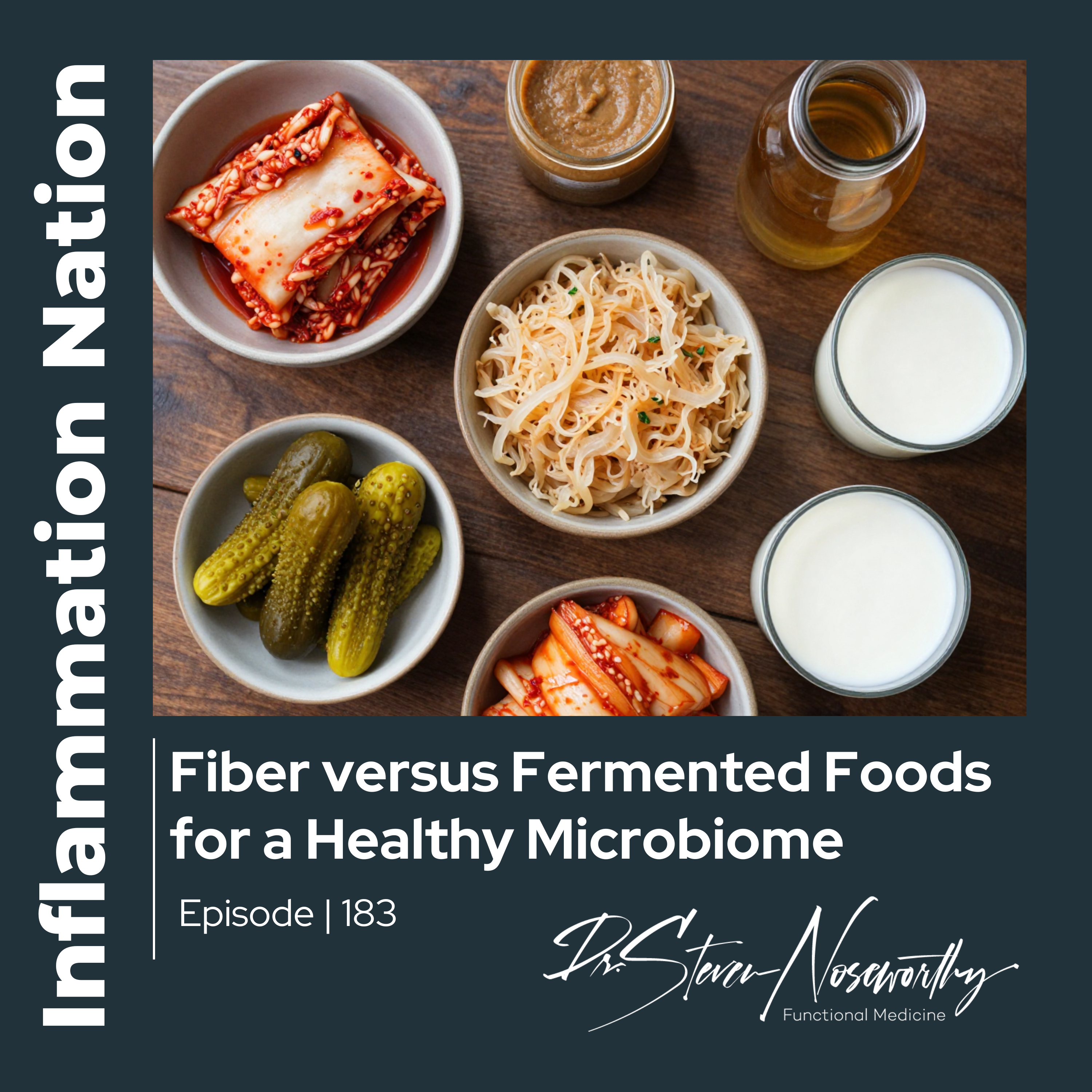
Dr. Steven Noseworthy: Hey guys, welcome back to a long-awaited episode of the Inflammation Nation. Hey guys, welcome back to perhaps a long-awaited episode of The Inflammation Nation. I've been silent on the podcast scene for quite a long time because I've been traveling, working, and working on some additional projects that have taken a ton of time, but I have not abandoned the inflammation nation and I'm excited to get back into the saddle and into the swing of things. Today I want to share with you a about three weeks ago, I was asked to do a webinar for a group of about 200 practitioners over in the United Kingdom. And the the topic that they wanted me to talk on was about the microbiome and this concept of what's mu called mucosal immunity. And that basically refers to the immune system that lives inside the lining of the ⁓ the GI system in mostly in the small intestine. And of course, this is a hot topic. you know, it's not just a hot topic now. It's it's been ⁓ a key aspect of natural health, or I should say in all natural health disciplines going back probably centuries, if not a couple of thousand of years. But certainly in the field of naturopathy, ⁓ you know, we kind of inherited from them this idea that health begins in the gut. And there's strong arguments for that. in in any given case, yes, starting in the gut first might be quite helpful. In fact, could be the right thing to do, but in some cases it's not. So I I don't want to give you the impression that all you have to do is fix your gut, whatever that might mean, whether it's getting rid of infections or reducing inflammation or fixing a leaky gut. And then everything else in in your health and your wellness is going to get better. Sometimes that happens and sometimes it's not. But one of the things I want to talk about today, I just I just want to share with you, I'm not going to recreate the whole Two-hour webinar that I did. But in the course of that webinar that I presented for the UK group, I reviewed ⁓ an article that was published in Cell, the journal Cell, which is a one of the top-tier journals. And it was a study done back in 2021. It's commonly referred to as the Standford study. And this is where they compared high fiber intake to the consumption of fermented foods. And I'll come back to that and give you some specifics. about what the study showed and and some practical takeaways. But one of the things that I want to address is I want to address the ⁓ I'm tempted to use the word rampant, the rampant use of probiotics, both in a clinical setting as well as among healthcare consumers who can just go to a store or go online and buy some kind of a probiotic. And that world ⁓ has changed. it's a multi-billion dollar industry and that's only going to continue to grow. But one of the interesting things that well per I find it interesting, maybe you'll find it interesting as well, is even though there are literally hundreds of brands of probiotics that are available around the world, there's only about 10 manufacturers that make about 75% of all of them. And so it's almost like no matter which brand you're buying, you're still getting it from the same source. And really what you're buying into is a lot of branding and marketing and so on and so on. ⁓ But even so, I I think that the use of probiotics, again, just for you perhaps as a healthcare consumer, but certainly me as a clinician, ⁓ has been one of those kind of 50-50 deals where if I give a probiotic to somebody, I'm not really sure if it's going to help. And and maybe I'm just choosing the wrong thing, maybe I'm not dosing correctly. But I think if we dig into the more recent research, let's say over the last five to seven years. Certainly since the human ⁓ microbiome project kicked off back in 2007. ⁓ I think we we've learned so much about the microbiome. And to be honest, one of the things that we've learned is that we don't know as much as we think we do. And maybe that's a good place for me to start. Let me just start by telling you about this thing called the the human microbiome project. And you may have not have heard of this, but you probably certainly have heard of the human genome project, which is where they, you know, crack the human genetic code and Using that information to drive a lot of different types of research and clinical applications. Well, back in 2007 and spanning from 2007 to 2016, so roughly nine or ten years, the National Institute of Health spent roughly $250 million creating an infrastructure of research and database and ⁓ research laboratory techniques to be able to catalog and identify. ⁓ the the human microbiome. And I'll come come back to like what does the ⁓ the word microbiome mean? Because ⁓ sometimes we use words a little bit loosely. And I'll probably continue to use terms like microbiome and probiotics and that kind of stuff in in the way that we normally use it, but although there might be some technical differences. But getting back to the human microbiome project, ⁓ it turns out that to to date, and I'm recording this roughly June, the ⁓ say the middle of 2026. But since the Human Microbiome Project kicked off in 2007, researchers have identified close to 5,000 genetically unique species of probiotics. And I'm using the word probiotic to refer to beneficial bacteria. That's how we normally use the word, even though there's some nuances to that. But think of that. Like you let's say that you go to health food store or online or even your your doctor gives you a probiotic and you look on the label and there's maybe one, sometimes two, three, maybe seven different species of probiotics in that, that's just a fraction. Like if if we know about five roughly 5,000, and and we're discovering more all the time, we collectively, I I don't do this research. I just read the research, but the human microbiome project and all the Associated research that's come out of that, we're we're off to almost 5,000 unique genetically unique organisms. And the interesting thing about that is the statistic is that 70% of these 5,000 genetically unique organisms have never been cultured in a lab, and we don't know what they do. And so even though we know about roughly 5,000 different organisms in the gut that we classify as healthy bacteria. We don't know anything about them. And so we know about the smaller portion of the picture rather than the bigger portion of the picture. And it's become very common ⁓ these days for researchers and even labs are putting this kind of information on their reports. ⁓ labs that do stool testing and you know specialty stool testing, I mean. And what they're doing is they're, you know, giving someone an an assessment of their microbiome of the healthy bacteria that are in there and whether things are You know, too high or too low, or just right in the middle in the optimal range. And they're making connections between the levels of individual species and certain disease conditions. So for example, ⁓ I'll just pick on a lab called Vibrant Labs. They have something called the gut zoomer, which in the functional medicine world probably is the most detail-oriented assessment of the microbiome that's available to us. There are some labs that don't assess. Microbiome at all. There's some that do it at a very surface level. And there are some that really drive into a lot of detail. We can even talk about the retail space and look at companies like Viome, who are more than happy to ⁓ you know, take a few hundred dollars of your money and send you a, I don't know, 72-page report about hundreds and hundreds of different species that I they've identified in your stool of which we know nothing. And and so the trend has become. More detail, more detail, more detail. And just because we can test for something and maybe do so accurately reliable, it doesn't mean that there's practical application of that information. And so, you know, going back to this test called the gut zoomer, and and these Vibrant is not the only lab and the gut zoomer not the only test that do this. The labs will generate these tables that show organisms high or low and then associated health conditions. And and the tendency is for a healthcare consumer. And perhaps even an unseasoned or inexperienced functional medicine doctor to look at those tables and go, ⁓ my gosh, I either have that condition or I'm going to get it. And these associations are correlations and they're weak correlations at best. So just because you have a particular species in your microbiome that's either too high or too low, and somebody tells you, well, this is associated with condition X, Y, and Z. That that is a weak correlation. There's no causation. There's no causality. And these are loose associations. And it doesn't mean it really doesn't mean anything. I hate to say it. And the vast majority of labs that are putting this kind of detailed information on their reports for me as a clinician to try to interpret, or for you as a healthcare consumer, to look at to try to understand like what's going on with my gut and and how's this affecting my health? Like sometimes too much information is not a good thing. Or I should say more information is not a good thing, particularly if it causes confusion. So that's kind of like the big picture is that we know less than we think we know about the microbiome. And to be honest, whenever someone takes a probiotic, it it's almost like they're kind of like, you know, rolling the dice and taking their chances, because the literature is actually pretty clear on this, is that you can give multiple people. with even similar gut environments. And no, let me say it this way. You can give ⁓ let's say you've got 10 people with similar complaints and they're all age and gender match, right? So let's say, you know, we're all talking about 42-year-old women. ⁓ and and you can give them the same probiotic with the same strains, with the same dosing, and you're each person's going to have a completely different reaction to that. And some are going to derive great benefit, others will not, others might actually get a little bit worse. And so that's, you know, presents a little bit of a complication for us because we're we're told pretty much every day through social media and influencers that, you know, your gut and your microbiome and all of these things are so critical to your health. And and I would say absolutely that is true. But to to articulate that you can intentionally manipulate the microbiome in a specific way by using specific strains, specific doses, or from a sim specific company. That's just not clinically real. And it's not practical. So the the human microbiome project really kind of opened our eyes and and maybe the place where we are right now is that we we don't know what we think we know, ⁓ or we don't know what we don't know. And and we'll continue to discover different strains, and hopefully at some point, all of them will be studying a lab in such a way that we can actually tell what they do. Some of the other things that came out of the microbiome project, and understand that your microbiome is modeled after certain specific variables. To say it one way, your microbiome carries a signature of your first year, one to three years of life. And you carry that throughout the rest of your life. And what we know now from research is that. The human microbiome actually begins when you're in fetal development. Like when you're in your mother's womb is actually when you start to develop a microbiome. We used to think, we being scientists and science in general, used to think that babies were born with sterile guts. And it's only when they're out of the womb or even in the process of birth that they ex get exposed to some kind of bacterial load, and that inoculates the gut, and that's where the microbiome starts, with birth or shortly after that. But now we know that even the mother's microbiome has an influence over developing babies while they're inside the womb. And so that's where it begins. But the two main things as it relates to very early stages of life that have an effect on the microbiome that again you tend to carry throughout your life. And I you know, call it a signature, call it a fingerprint, call it a baseline or a set point that your microbiome tends to want to go back to all the time, unless you're doing things to take care of it. And those two things are number one, whether you were born C-section or naturally. ⁓ Babies that are born through natural vaginal birth and not C-section tend to have much more diverse microbiome than infants that are not, particularly premature babies. And the second thing that really ⁓ has a big influence on the signature is whether or not you were breastfed and for how long. And so when we look at a combination of things, the the health of the mother's microbiome and her immune system in general, as her baby is growing in the womb, has a big influence, as does the manner of your birth, as does whether or not you were breastfed. And so the best combination of those things is going to be a healthy mom with a healthy microbiome and a natural vaginal birth and being breastfed for a prolonged period of time. That that would set Babies up for a good future in terms of their own microbiome. Now that's kind of your set point. That's your beginning point. And the literature says that the first one to three years is critical. The first year is more important than the third year. And within the first year, the first three to six months is really kind of the critical aspect of that. And so, you know, if I could give any advice to expectant mothers or women who are planning to have children, is number one, you got to be healthy to have a healthy baby. That's step number one. Step number two is do everything you can to avoid a C-section. And the third is breastfeed, at least for the first six months, and perhaps even longer. And you know, I understand that there are, you know, this is personal choice and individual circumstances can vary, and there are reasons why we make decisions to do or not do certain things. So there's there's no judgment. I, you know, that I just want to come across that way. ⁓ the other thing that we understand is that aside from this set. Point or the signature or this fingerprint that I'm talking about, your choices throughout life really make a difference to how your microbiome behaves. And this is going to come down to not just your dietary choices, which probably have the single biggest influence, let's say controllable or modifiable influence on your microbiome. But we also know that things like stress and infections and thyroid issues and other health problems can affect the microbiome. Neurological health can affect the microbiome. We do have studies that show that in the case, for example, of ⁓ head injuries, we can see shifts and changes through the brain gut axis with the microbiome. But one of the other things that's important is exposure to environmental chemicals. And you know, you're you're you've heard me and many other people talk about the importance of controlling your toxin load, like reducing exposure and and supporting the systems like your liver, your gallbladder, et cetera. That help you to clear out these chemicals that we're being exposed to all the time. But one of the impacts that the like the the load of, say, chemicals and pesticides in particular that are in the food that we're eating, one of the impacts that it has on the gut is that it diminishes the diversity in the microbiome. And I've used the word diversity a couple of times. And there's the research talks about alpha diversity and beta diversity, and there's different mathematical calculations like the Shannon or Simpsons index that. That labs can calculate. But at the end of the day, I think it's pretty clear that having a diverse microbiome is beneficial for us. And we should be doing things that promote that. And diversity means having an adequate amount of multiple different species, which then kind of begs the question: like, why is this even important? Like, why do we want to have a good load or a good population, a good diversity? Of healthy bacteria in the gut. Again, w we usually w use the word microbiome. Sometimes we'll we'll say probiotics. But kind of as a side note, the word probiotic technically is something you take by mouth. Right? So if you take a pill or if you consume fermented foods that have these organisms in there, that is a probiotic. So technically, probiotic does not refer to the beneficial bacteria in your gut. And and that's just kind of me being a little bit nitpicky because I know that that. These terms ⁓ come under colloquial use, like this is just the way we normally use it. So most people, when they say microbiome, they mean the beneficial bacteria. When they use probiotics, they're not referring specifically to things that you take by mouth. They're just talking about healthy bacteria in the gut. And I understand that. But when we're talking about research, sometimes we have to make these distinctions. And so technically, if we if we look at the microbiome, that includes two main things. That includes What's called the microbiota, which refers to the organisms in your gut. And that could be good, bad, or neutral, right? Just because an organism is in your gut doesn't mean it's a quote unquote probiotic. And some of the organisms in our gut are neutral. They don't do anything helpful for us. We kind of give them a place to live and they're hanging out. They're just kind of using our resources, but not helping us. But they also don't hurt us. Those are neutral microbiota. Then we have adverse microbiota. or potentially pathogenic ones. And these are ones that under normal conditions, as long as things are normal in the gut, they don't help us, they don't hurt us either. But given an opportunity, then they start to increase their population and they start behaving as if they're some kind of a pathogen. And so we might refer to these ⁓ potentially bad or adverse bacteria as potential pathogens or what we call opportunistic infections. This is typically What we're looking for when we look at a stool test, we're looking not necessarily for things that are there that should never be in the gut. Most of what happens when people have gut infections, and I'm using that term a little bit loosely, what we're looking for is we're looking for these opportunistic infections or overgrowth of things that are normally there in very small amounts in healthy guts. And then we have the healthy bacteria, the beneficial bacteria. Again, we usually call them probiotics. And these are things that do good things for us. And this is really the crux of the matter. Like the reason why we want a diverse microbiome is because we want the advantage of the things that they do for us. And the reason why we call them beneficial bacteria is because they live in our gut. And they again, we kind of give them a ⁓ moist, dark, warm, nutrient-rich environment to live in. And then they process certain inputs. And most of that can come from the diet, but there are other things that feed the microbiome. And they produce things that are good on our behalf. And we call these postbiotics. And so we can we can differentiate between prebiotics, probiotics, and then postbiotics. And prebiotics are basically ⁓ normally we use the term prebiotics to refer to fermentable compounds that are in our diet. But the reality is that the bacterial species in your gut are. We could classify them into, let's say, two, maybe three broad categories. One is those that feed off fermentable carbohydrates. These will be called saccharly. And these are the things that feed off sugars and starches and different types of fibers. And then we have what are called proteolytic or proteolytic species, and these actually feed off amino acids. And there are also a third category of beneficial bacteria that feed off essential fats. And so if you're sitting around, you know, as you think about your gut, if you're thinking that you have to have fiber and carbohydrates in your diet to feed your microbiome, that's only partially true. And in fact, this is one of the reasons why people could go on very low carbohydrate diets like a ketogenic diet, or even go all the way to carnivore and have zero plant based or carbohydrates coming into the into the diet and have a very low fiber intake, they can still have a normal ⁓ Microbiome in the sense of producing the things that these things normally produce. And I'll give you the list of those things coming up here in a second. And that's kind of interesting because at the end of the day, no matter what the mixture or the profile is of the microbiome, what we're interested in is the is the postbiotics. These are the things that come after we feed. are probiotics, the prebiotics that are necessary nutrients for them. And again, that runs the gamut of carbohydrates, sugar starches, and fibers, as well as amino acids from protein, as well as essential acids from fats. Now granted, these saccharolytic categories, the ones that feed off carbohydrates and fibers, these make up maybe 75% of your microbiome. Or I shouldn't no, I shouldn't say it that way. They are responsible for maybe 75% of the production of the postbiotics that we're interested in. But in the absence of, let's say someone's on a carnivore diet and they're eating zero carbohydrates and no fiber, these species can do what was called cross-feeding, and they can feed off the postbiotics that are being made by other categories of organisms, things that feed off amino acids and essential fats. And they can also actually degrade the mucus layer. That lines the gut. And this is a healthy thing. Like we're we expect to, like, if we could go in with a scope and take a look at the lining of the gut and zoom in to the point where actually see all the individual components, we'd see all these different cells called epithelial cells that line the intestines. And this is kind of part of when we talk about leaky gut, it's this system that breaks down. And part of a healthy gut is having an intact, what's called mucosal barrier system. But the very top, lining of this system on top of the cells, kind of projecting into this the open space of the gut is a a layer of mucus. And this is actually food material for the same species of carbohydrates that I'm sorry, same species of healthy bacteria that feed off carbohydrates and fibers. And so even in the absence of fiber intake or carbohydrate intake, you can still have Plenty of postbiotic production from these species because they just turn to an alternative fuel source. So I've used the term postbiotics a couple of times. And postbiotics, again, are things that are made by healthy bacteria that do good things for us. And that falls into, you know, maybe three or four different categories. I'm not giving you an exhaustive list here. I'm just talking about the things that are ⁓ top of mind and perhaps most important. So one thing that these organisms do for us is they actually produce certain vitamins, ⁓ sometimes minerals. And so for example, a large dep, and depending on the individual person, maybe up to 40% or so of the folate, the vitamin B9 that we have in our system is actually made by these healthy bacteria in your colon. It also, that whole system also makes a portion of our vitamin K, particularly K2, and it also makes ⁓ vitamin some of the B vitamins. And so we like that. Like we like to have a microbiome because they do good things for us. And to be honest, if you have, if you were to do a stool test and you had a healthy microbiome in terms of number and diversity, but they weren't producing the things that we like to see at the other end in terms of these postbiotics, I don't really care about having a healthy profile of the microbiome. At the end of the day, we want a healthy microbiome to be able to access the benefits of these postbiotics. And again, part of it is vitamin mineral synthesis synthesis. Another is that these play a role in detoxification. And if we look into our liver system or liver liver detox system, on a you know technical terminology, we would talk about phase one and phase two systems where we have different enzymes and compounds that are used to take things that are toxic to convert them into something that we can get rid of in, you know, whether it's through our stool or urine or sweat. And That same system exists in the microbiome. And so, you know, now from now on, hopefully what you think of when you think of, hey, I need to detox, it's not just about supporting your liver, it's about making sure you have a healthy microbiome as well. And so the more of these beneficial bacteria you have in your system, and the more you feed them things that make them happy, the more robust that portion of your detoxification system is going to work. So it's not just about the liver, it's about the gut and the microbiome. And l let's kind of cut this short, but let's focus on perhaps the most important part of postbiotics. And again, that's the that's the production of your microbiome, are a class of compounds called short chain fatty acids. And then these break down. There's actually five of them, but three of them are, you know, what we might call the big three and and account for the vast majority of what short chain fatty acids do for us. And those are butyrate, propionate, and acetate. And of those three, butyrate is the One that does pretty much all the hefty heavy lifting. So when I say short chain fatty acids, I really mean butyrate. If I say butyrate, I'm talking about short chain fatty acids in general. But again, butyrate is the big one. And so again, the reason why we want diverse microbiome is to get butyrate and to help with detoxification and to help with ⁓ vitamin and mineral synthesis. And let's add into that ⁓ expansion of an anti-inflammatory class of. Immune cells called regulatory T cells. And so having a healthy microbiome is encapsulates diversity of the beneficial bacteria, but it must include the postbiotics, particularly short chain fatty acids. And by the way, these short-chain fatty acids are also fuel for your colonic epithelial cells. The cells actually feed off the short-chain fatty acids, or I should say they use it for energy. And this is part of how the cell lining replenishes itself. And so if you have, for example, a leaky gut where the system is breaking down, it might imply that you have some problems with short chain fatty acid and butyrate production. And then we can kind of trace that backwards. Well, what's the problem? Is it a low diversity and abundance in my microbiome? Do I just not have the right numbers and the number of species that I need? Or am I not feeding them the things that need they need to do their job? And so going back to the word microbiome, there's two parts to it. One is the microbiota, and we just kind of walked through that whole thing and talked about pre and post and pre and pro and and postbiotics. But the other aspect of the microbiome is what's called the theater of activity. This is the term that's used in the literature. And that's just a kind of a scientific way of talking about the environment of the gut. And that encompasses everything from the pH of the gut. To the immune system in the gut and all these other factors, because you can have the same microbiome profile in your gut, but if the theater of activity is different from one person to the next, then one person's microbiome is going to function a lot better than others. And a lot of times when we see people getting better, like they take supplements or change their diet, and their gut starts to get better, it's not necessarily because we're remodeling or reshaping the microbiome. It's because we're taking We're improving this theater of activity. And this allows the microbiome that's already there to flourish and to start doing the things that it's supposed to do. And so the microbiome encompasses not just the bacterial portion of that, it encompasses the entire biochemical environment that those organisms live in. All right, so all of that to say, I want to share just a summary of a paper that I reviewed for this particular webinar that I did. And 2021 from the journal Cell, it's commonly referred to as the Stanford study. And what they did in that study is they took ⁓ two groups of people that had low fiber intake, right? Because what we've heard for probably decades now is that if you want a healthy microbiome, you have to eat a lot of fiber. And I'm telling you right now, that's not entirely true. and but this is what happens in science. Like we we start to understand something and we come out and we plant our flag and we say, well, this is what we know. And this is what science says. And then two years, 20 years later, we learn more and we go, well, we have to go back and kind of modify what we thought and what we're what we're saying. And so what this study did is they took two groups of people, everybody had low fiber intake. And so for one group, what they did was they had them increase their fiber ⁓ for whatever their starting point up was, up to, I think it was 40 grams of fiber per day. And you know, just depending on which guidelines you go by. Women usually they say maybe 25, 30-ish grams of fiber per day, and men, you know, more along the lines of 40. But everyone in the study, male and female alike, ⁓ went into a high fiber diet, which is 40 grams per day, roughly, if memory serves. The other group didn't change their fiber intake. Remember, everyone started with low fiber. What the second group did was they increased their intake of fermented foods. And now fermented foods would be things like ⁓ sauerkraut, kimchi. You can get fermented cottage cheese if you handle dairy well. ⁓ kefir, key k-e-f-i-r. No, most of us say kefir, but technically it's kefir. ⁓ and this can be made from water or dairy, even coconut companies make it w with coconut. we also have things like kombucha, we have kavas, k-v-a-s-s, and these are all fermented compounds. This is really interesting because back in, I think it was the early 1900s, there was a Bulgarian researcher named Mechnikov. And he was doing some research and he noticed that in his area in Bulgaria, the people who lived in the rural communities who didn't have access to, you know, what we might consider high quality food, they were actually healthier than the people who lived in the city whose diet was different. And when he went and interacted with these rural people, pretty much everybody was consuming a fermented dairy drink. Now, I I don't know if it was called Kavas or something else or kefir or whatever. Of course, Bulgarian, they they probably have their own name for it. But nevertheless, he started to theorize in the early 1900s that it was the regular consumption of this fermented drink that led to better health. And this this kind of started the modern era of thinking that health in general and health in the gut specifically is tied to good bacteria in the gut. And so for maybe the next several decades, the the thrust was to support healthy bacteria in the gut for health. Now, in 1920 or so, penicillin was discovered and the idea that health was going to come from killing bad bacteria took over. And that's really what's dominated the medical environment and and even part of the functional medicine community. Cause it's like there's not many of us who presented with a ⁓ a ⁓ diotic gut where otherwise neutral bacteria have overgrown and are causing problems. First thing we want to do is we want to kill those things off. And, you know, we choose to use natural compounds to do that. And that certainly is part of a comprehensive approach to trying to heal the gut, so to speak. But it's kind of interesting that the very first idea was for health and the gut was that we had to support good bacteria rather than killing off bad. So back to the study. So these the two groups, the second group that didn't change their fiber intake but just started to consume more fermented foods, at the end of 17 weeks, I think it was, ⁓ the fermented food group far outperformed the high fiber group in terms of remodeling the microbiome. As well as production of short-chain fatty acids. Now, there's more to the study than this, but this is the point that I wanted to bring out today is that when we look at the modern and even historical approach of giving probiotics to change the microbiome, that has largely not delivered on its promises. And it sounds good, like, you know, hey, you've got a low microbiome and We want more of these things, so let's give them to you. It turns out that when you take probiotics by mouth, they work while they're in your system, but they're only transients. And that's a that's actually a different classification. When we look at the microbiota and we look at these different bacteria that live in there, we have what are called ⁓ commensals, and these are things that take up resonance in your gut. And then we have transients, and transients are things that don't. And this is where oral probiotics live. When you swallow a capsule that's got lactobacillus, bifidophilus, acromansia, sacramyces bouardi, or whatever the flavor of the month is. That's only working while you're taking it. And it and it really is on average for things like lactobacillus, bifidolivus, bifidophilus, et cetera, once you stop taking them, within two to three days, their effect is gone. Now that's a little bit different with what are called spore-forming probiotics. And these are things that might be in what's called the bacillus species or family. And they hang around a little bit longer. And so the effect of taking that, if you were to take ⁓ some spore-forming probiotics, but then stop, the effect will last maybe two to three weeks. And that's going to vary from person to person, and perhaps even based on the quality of these probiotics you're taking. But the bottom line is this. So if you're relying on taking probiotics to support your gut, you have to take them all the time. You can't just stop. Whereas if you incorporate things like fermented foods, even before thinking about increasing your fiber intake, if you incorporate fermented foods, a couple of things happen. Number one is, and this most of this is coming from the Stanford study, and I have checked and the things that I'm talking to you about right now. It's not just the Stanford study that showed that. There's many other studies that confirm the same concepts. But when you increase your consumption of fermented foods, you do see an increase in production of short chain fatty acids. And that's for a couple of different reasons. one is there is going to be some fiber. Like if you're eating kimchi and and ⁓ sauerkrop, for example, or you're consuming fermented pickles, not pickles made with vinegar, but fermented pickles or fermented vegetables, then There is going to be some fiber to that, right? So in that group that didn't change their fiber and started to eat more fermented foods, yeah, you could argue their fiber went up a little bit because they were eating things that have fiber in it, like sauerkraut or kimchi, for example. But that's going to be negligible in comparison to someone who's doubling or perhaps even tripling their fiber intake, and that's the only thing they do. In addition to that, one of the major benefits of consuming fermented foods is that The food itself, as well as the liquid that the food is in. Now think about sauerkraut. If you ever ever bought a bottle of sauerkraut or kimchi, there's liquid in the bottle. Like when you're at the end of the bottle, do not throw that away. In fact, as you're spooning out whatever your dose might be, you know, whether you're treating it like a condiment and putting it on your plate or in a bowl or just eating it out of the bottle, like I like to do, make sure you're getting some of the liquid because the liquid is teeming, teeming with beneficial microorganisms. And a lot of times these are organisms that we won't get ⁓ in, say, a for a specifically formulated ⁓ probiotic. And the interesting thing about this Stanford study was that when they did their post-research or their post-protocol research and analysis on the microbiome, how much short-chain fatty acids they were make, what they found was that there were new species that showed up in the gut. That were not actually in the fermented foods that these people were consuming. And the researchers concluded that those were already there in the gut, but they were below detectable levels. But the fermented food somehow changed the theater of activity, changed the environment that the microbiome was living and working in. And the result was it allowed populations of very low population, let's call them weak organisms in the gut to start to grow and thrive. And and this is where diversity comes from. But again, the the point is this is that I have an organism show up my my gut because I'm eating sauerkraut, but that particular organism is not in the sauerkraut. So it had to come some from from somewhere. The only rational explanation is that it came from the gut, but it was below detection levels for the baseline studies. And so we see better abundance and diversity. In fact, the The the bulk of research in and around this area that look at the increase of fiber intake, it doesn't really remodel the microbiome in the way that we would like to or think and expect it would. ⁓ If you just increase your fiber, all you're doing is you're you're feeding the microbiome you have. You're not really changing your microbiome. And for most people, we need to change the microbiome. And in that sense, if I can give you a practical tip, if you're sitting around thinking I need to eat more fiber to increase my microbiome. Really, the first step you should do is start to increase your consumption of fermented foods. And again, the short list would be kimchi, sauerkraut, kefir, kibbas, kombucha. if you're okay with dairy, then fermented cottage cheese and and so on. And fermented ⁓ vegetables and pickles. And you can find some of these things in local markets. You you can even jump online and figure out how to make your own fermented vegetables because. Sometimes they can be expensive. But it doesn't have to be. And you know, what the literature suggests is that the benefit you get from sauerkraut is not the same as kimchi. They're different. And so ideally you would have maybe three or four of these things that you consume consume on a reg regular basis, either small amounts of each each day, or a small amount of each on one day, small amount of each or something else on a second day, small amount on the third day, and so on. And you know, ideally you would start with very small amounts, particularly if you're You're prone to things like IBS and SIBO, and your gut is a little bit ⁓ testy, let's say. ⁓ you want to start low and and build your tolerance slowly. The other thing that the the study showed in terms of the benefits of the fermented foods was ⁓ 19, they measured 19 immune chemicals, what are called cytokines, inflammatory chemicals, and they all reduced. Whereas in the fiber intake, there was no change in the immunology. And so when you when you stack A choice between fermented foods and increasing fiber, fermented foods is clearly the winner. Like there's no doubt about that. Now, it's not either or. And I think maybe a more practical strategy would be introducing and implementing fermented foods first before you start to increase your fiber intake. And if you're going to do that, do that slowly. But the bottom line is this, and let me kind of bring this to a close because I've been rambling on for quite a long time here now. The bottom line is this, is that The world of probiotic intake has has kind of failed us. I I would say the promise that we all thought, like we're just gonna fix everyone's gut by giving them the right probiotic. And and by the way, the the human microbiome project, which let me go back to that for a second. ⁓ understand that your microbiome is a reflection of, let's say, your birthing conditions and your early year feeding conditions. As well as your diet lifestyle and environmental influences. Part of that is the geographic region you live in, where you source your food from, how you prepare it. Part of it is culture related because you're gonna, depending on your culture, you're gonna eat certain foods, whereas somebody else might not. And if you were to move from where you are to a different part of the world, and we would give you six months there and measure your microbiome, it would be different than when you lived in that first place. But the interesting thing about the Human Microbiome Project, and at this point, there have been 200,000 papers, I believe the number is, close to that, written from the data from the Human Microbiome Project. Like that's the source point of pretty much all the research out there. And that study was only done with 300 people, and they were all healthy young Americans. And so Like how like the data that's come out of that, how do we extend that to somebody living in Bulgaria? How do we extend that to somebody living in Saudi Arabia or Mexico or whatever part of the world? And the answer is we I don't know if we can. I'm sure there are some generalities, but the reality is that there is no single universal healthy microbiome profile. Even among these 300 young, healthy Americans that were the source material for the Human Microbiome Project, there was no consistent profile among those 300 people who were all healthy and had no GI complaints and no other ⁓ obvious health issues. And so it's almost like we're we're kind of like we have this false target that's out there. We're trying to create a microbiome profile that looks, you know, pretty on a lab report, everything's in the green zone. When in reality that may not be reflective of what's optimal for you. But I can tell you this: that it doesn't matter how pretty your microbiome is if you're not making short chain fatty acids, then your microbiome's not helping you. And maybe the better option is to do the things that would help you with short chain fatty acid production. We even have supplements like in my clinical practice. ⁓ I use a a product from ⁓ Entera. product from Apex Energetics. And and this is a company that I'm ⁓ I don't have any financial interest in the company, but I do lecture for them. And when I travel and and teach seminars and webinars and quite often it's it's for them. But they have a product called Enterovite, which actually is butyrate and propurinate and acetate. And so there are some cases where taking short chain fatty acids directly is the best first step. But you don't want to have to be taking that all the time. Just like you don't want to be taking probiotic pills all the time. You want a healthy microbiome that you feed well, that naturally makes these short chain fatty acid products for you. And so one of the things that I've changed recently, just in my own process, as I do as I do my stool testing, and that I don't do stool testing on every client, but just so happens a lot of my clients have stool issues, or I'm interested in how their gut is contributing to their other problems, even though they might not have gut symptoms. ⁓ I'm more interested now in looking at short chain fatty acid production than I ever have been in my clinical career. And it's not like I've only just learned about short chain fatty acids, but recently I've learned to prioritize them. I've I've learned to I've learned to prioritize them over even what would be considered a healthy microbiome. And and let me just point out two things, then I'll I'll close for this episode. one is that you can have a healthy microbiome on a lab report. That is failing to make short chain fatty acids. And if you're not looking at that part of the picture, then ultimately at the end, what ends up happening is you kind of rest easy that your microbiome is intact when in fact it's not. Because it's not the abundance and the diversity we're after, even though we think we need should start there. It's the production of short chain fatty acids. And case in point, I I just did a stool test and I did a report of findings with a young guy. He's like, 25-year-old male that I've been working with for a while. And we ended up ⁓ doing a stool test and we added on the short chain fatty acids. Now, this kid, kid, 20 odd years old, younger than I am, ⁓ he's been carnivore for three years. And his entire diet is meat and olive oil. That's it. That's all he consumes. Now, you would expect his microbiome. Be depleted, and some of it is. Like I I do a stool test called a GI Map, and that gives me a top-level view of the microbiome, which I think is the only clinical relevant and practical way to look at it. And despite the fact that his microbiome did not look pretty on a lab report, he was making plenty of short-chain fatty acids, and he'd been carnivore with no carbohydrate, no fiber intake for three years. And if that doesn't kind of flip your paradigm and make you think more about, you know, what does it mean to have a healthy gut and really what are we after? ⁓ then then I don't know what will. But that's where the research is, and that's certainly what I'm seeing in clinical practice. So I hope you found this interesting. next time we'll be back with a a different topic, guys. So thanks for hanging out.
More Inflammation Nation: Science Informed Wellness with Dr. Steven Noseworthy episodes →