
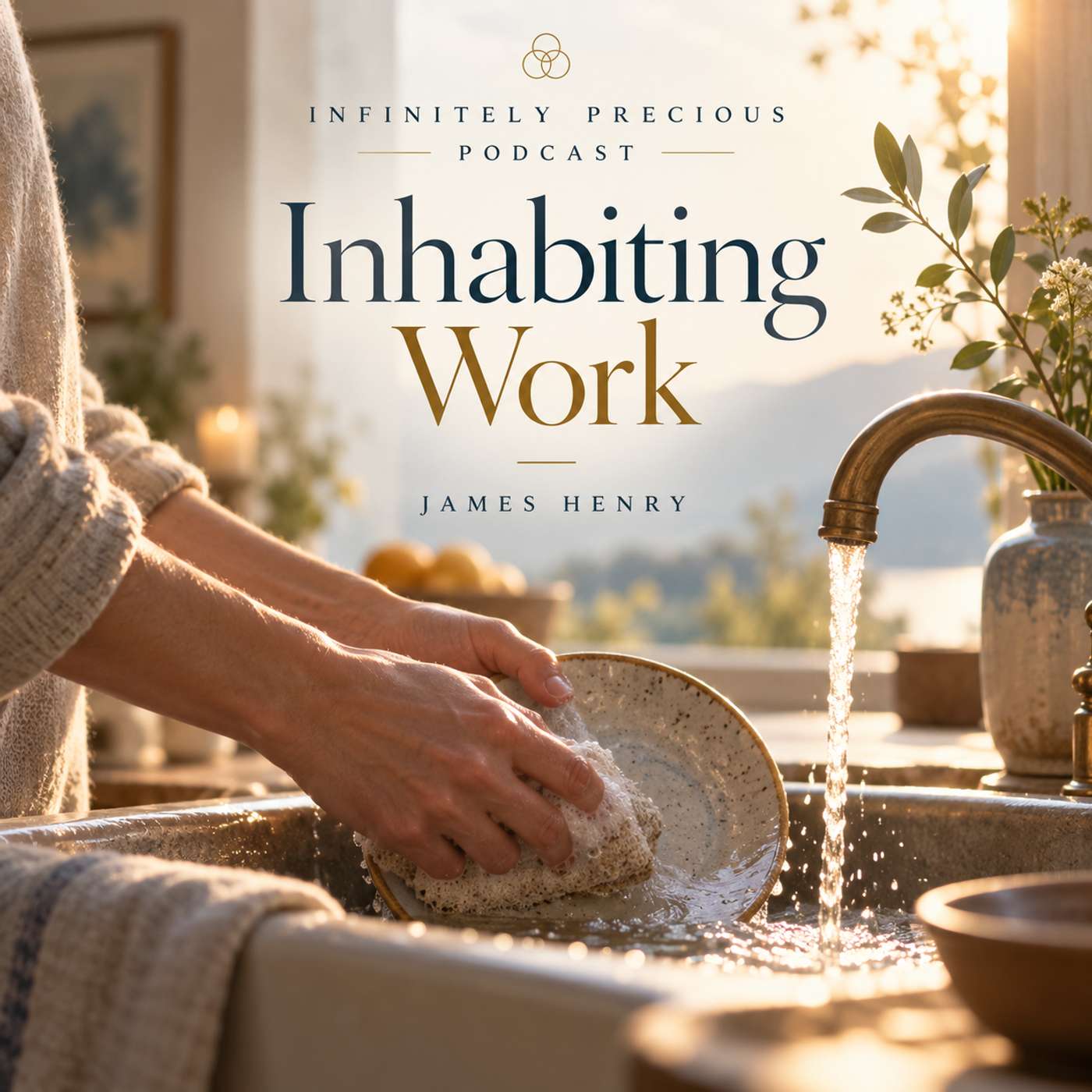
Infinitely Precious · James Henry
What if the work you do, paid or unpaid, is an expression of your inner life rather than a measure of your worth? In this episode of the Infinitely Precious podcast, James Henry turns the Inhabiting series outward. After episodes on inhabiting the body, pain, grief, and your own preciousness, he asks how we inhabit the places where we meet the world. James widens the meaning of work beyond a paycheck or career. Washing dishes, vacuuming, walking to your job, talking with a neighbor, and answering the phone are all ways we engage the world. The episode looks at the trap of tying self-worth to performance, using examples like a podcast episode that suddenly draws 300 listens or a sermon that doesn't land. It also names the opposite danger, rushing through tasks as a means to the next thing and never being fully present. James offers simple, doable practices for mindful, present work. He describes washing a dish by hand, sweeping a floor, or taking a call without carrying yesterday's irritation into it, all without self-judgment. He also tells an honest story about re-recording this very episode because he wasn't present the first time. If you struggle with burnout, people-pleasing, perfectionism, or the pressure to be productive, this reflection offers a gentler way of working. You can bring your whole self to what you do and still be infinitely precious and unconditionally loved for the gift you already are. In This Episode Why the Infinitely Precious podcast's "Inhabiting" series now turns from the inner life outward Redefining work beyond your job: dishes, vacuuming, walking, driving, and talking with neighbors Work as an expression of your inner self, not a measure of your worth How one episode's download spike (and its later drop) can tempt us to equate results with value Why a bad sermon or an imperfect lesson doesn't make you worthless The danger of complacency and treating tasks as hurdles to get to the next thing How to practice being present while washing dishes, vacuuming, or sweeping Carrying irritation into a phone call, and how to keep it from coloring your conversations Why James re-recorded this episode, and how to learn from not showing up without self-criticism A simple invitation to inhabit the small tasks of your day The closing reminder that whether you inhabit your work fully or not, you are always infinitely precious and unconditionally loved ★ Support this podcast ★
Intro: Welcome to the Infinitely Precious podcast produced by Infinitely Precious LLC. Your host is James Henry. Remember, you are infinitely precious and unconditionally loved for the gift you already are. James: Hello, beloved. It's me, James. It's good to be with you today here on the Infinitely Precious podcast. I want to thank you for being my companion on this journey and letting me be yours. The Infinitely Precious podcast has just crossed over recently 100 episodes. And so your support and listening has made a difference. So thanks for being a part of this. Feel free to share it with others if you so desire and find it helpful. Today I thought I would talk to you continuing in the Inhabiting series. Now the first episodes about inhabiting what I've been talking about have really been about the inner life. It's about inhabiting the space in which we are inhabiting our bodies, inhabiting being precious as we are, inhabiting the pain with which we struggle, inhabiting grief. And now we're turning outward. We are focusing on what about how do we inhabit the spaces where we contact the rest of the world. We're certainly part of the rest of the world but when we let our inner self be reflected in the way we interact with the environment, with other people. So today I thought I would start with what it looks like to inhabit work. I want to start by saying that when I say the word work, if you're anything like me, it might bring to mind that thing you do which earns money and pays your bills. When someone asks me about my work, I automatically imagine that they're asking me, what do you do for a living? And what is your career? What is your occupation? Your vocation? And of course, I'm a pastor. That is the work that I do. But I want to stretch us a little bit today in our understanding of what work is because I think work is more than the way we earn a living. Work is the way we engage the world around us. So, let's you know, it is work to wash dishes. It is work to vacuum the floor. You don't get any compensation for it. Maybe you get a pat on the back, particularly if you don't do it very often. Work is the walk we take on our way to work. It might be the way that we drive. It's how we talk to our neighbors. Work is where we show up outside of ourselves in places, in environments where we find ourselves, whether we're doing so for pay or not. When I also want to stretch, when I think about work, I want you to also the challenge is if work expression of my inner self, then do I begin to equate myself and my value, my worth with all those kinds of work, whether I'm compensated for it or if all those things is my worth based on how well I wash the dishes is my worth. And I want to break that. I want to break that connection because work is an expression of the inner life. It's an expression of who we are, but it is not a measure of our worth. I express who I am as a person, as a pastor for instance. When I am preaching, teaching, writing, listening, I'm expressing I bring it to what might be considered a role or a profession but my expression of it is unique to me. I bring that inner life of mine to bear in the way I do all those things I just mentioned, plus some other things. So, yes, that's work. But this is also work for me. And it's something I do for free. These podcasts thus far and you know, as far as I can see, I do this work because it's an expression of myself. And I believe putting a positive voice into the world, an expression of my own positive voice into the world might make a difference. And so, that kind of work while uncompensated is an opportunity for me to express myself, but it's not a measure of me. If I have one episode and I had one episode, you know, somewhere around the 20s or 30s when I was talking about something about ordinary, the sacred ordinary that got 300 downloads and listens. And it was like a big jump from a normal week of ten, twenty, 30. And so it would be easy for me to think, wow, that was valuable. What I do is valuable. But then when it dropped back, you know, couple of weeks later to the usual tentwentythirty, is that saying I am not valuable? Am I degrading my worth? If I have a bad sermon on a Sunday or I'm teaching a lesson and it's not quite all it could have been, does that mean I am worthless? And the answer is no. So, it becomes very dangerous sometimes for us to talk about work because sometimes we think work measures our value. And whether it's that by which we're compensated or that which we just do as part of being alive, none of that measures our value because we're always infinitely precious. We're always unconditionally loved. It's not a measure of our worth. There's also a danger in work that we become complacent. You know, we fall into a pattern of what work is, and we don't really fully show up to inhabit the space. And see, this is where I begin to get to that inhabiting our work. We do it as a way, sometimes we're doing one work in our life, perhaps the kind that we don't get paid for. We do it as a way to get to the next thing. So, I want to watch television tonight, but there are dishes to wash and it's my job to wash them. So, I rush through washing the dishes without even noticing whether they're truly clean or not. And rush on to the next thing rather than be fully inhabiting work means that I show up where I am. That when I'm washing dishes, I'm washing dishes. Here I am. I'm inhabiting that space of washing the dish. When I'm walking to work, I'm inhabiting each step and the nature in which I find myself walking. When a neighbor stops to talk to me or I stop to talk to them, I'm not rushing on to the next place I need to be. I am with that neighbor. I'm inhabiting that space. When I'm doing this podcast, I'm inhabiting this space. The funny thing about inhabiting this space of the podcast is I needed to record this a second time. I recorded it yesterday afternoon and it was clear to me when I listened to it, I was not inhabiting the work. I allowed myself to go into different places. That's okay. This happens to us all. This is not an opportunity to beat myself up because of it. But the recognition that I didn't show up was an opportunity for me to learn that I would need to record the podcast again and do it in such a way that I really inhabited the space or else talking about inhabiting work would have been an empty invitation. And I don't want it to be an empty invitation. I want it to be an invitation to really be where we are. And to see that each way that we bring ourselves into encountering the world outside is an opportunity to express that inner work. Now, if we're really honest with ourselves, sometimes the way we express ourselves in work comes out in the ways with what we're ways that are reflective of what we're struggling with on the inside. Perhaps I have been irritated by a series of things that have happened before my phone rings. I look at the phone, I pick it up and I answer it and there's just an edge to my voice that has to do with the irritation I'm carrying from somewhere else. I'm no longer inhabiting the phone call, I'm inhabiting a feeling that I carried with me and didn't let go from before. We bring to expression from within ourselves what's going on. So, being aware of what's going on inside of ourselves and what wants to emerge into places sometimes that it doesn't belong. There are places for me to process my irritation, anger, joy, and every feeling and perception in between. There are places for that. But perhaps it's not in a conversation when my mom calls or when my wife calls or my children are on the phone or someone I care about needs to talk to me. I need to find ways to be present in that conversation to truly inhabit it without letting it be colored by something I brought from somewhere else. Inhabiting work is recognizing that as I come into the world, this which I'm doing, whether it be the podcast or preaching or talking to a neighbor, are all expressions of my inner life. And that's where sort of the rubber hits the road. Inhabiting work is an invitation for us to be present in each moment that we're there. So, where does this come out and how do we practice inhabiting the work of our lives? Well, I want to invite you to begin in a simple place. And I think it is a fairly simple place. If you wash your dishes and you do it by hand, And if you're anything like me, there are some things I just put in the dishwasher and it does it for me. My dishwasher is such that I have to sort of wash them before I put them in or else they don't turn out clean. But there are certain pans and pots that are not meant to be put in the dishwasher. All of our knives, the sharp ones are not meant to be put in the dishwasher, it says very clearly. So, they require being washed by hand. Am I present with each dish as I wash it? I'm not expecting the dish to talk to me or anything, but can I do this washing of this dish and be in it and be fully present in it as I'm washing it? You know, wash it to the glory of God, if you will, to this moment that I'm in. Because if I can practice inhabiting the space of washing my dish or drinking the glass of water or talking to my neighbor, then I can make a difference. So, the simple things in your life, the things that you do sometimes without thinking, like brushing your teeth, washing your dishes, taking a shower, vacuuming the floor. What would it be like if when you were vacuuming the floor you were really present in it, not just letting your mind wander wherever it goes, but be present in paying attention to the patterns perhaps that you vacuum. Not with a bent towards judging yourself for covering the whole floor or missing some spots, but just an opportunity to be present as the vacuum moves forward, it comes back or the broom, if you're sweeping, goes forward and comes back and how you move with intentionality. You're in that presence. You're in that moment. You're inhabiting the work that you're doing. You're being fully there. Practice the little things for as long as you are there. Be there, be present, inhabit your space. And remember, whether you inhabit your space or not, whether you inhabit the work that you're doing as your inner life comes in contact with the outer world of which you're a part, in the way you're talking to someone, in the way you're writing a document, in the way you're washing a dish or driving your car. Be attentive to those moments and as much as possible. But know whether you can fully inhabit your work or not, it's not about judging yourself and that whether you can or you can't, you are always infinitely precious and unconditionally loved for the gift you already are inhabiting or not. So as we begin to turn our outlook outward and we began with work, think of ways that you encounter and can inhabit the space in which you live. You are precious. Thanks for joining me today. If this has been helpful or interesting, I encourage you to share it. If you'd like to respond, you can always write me at james infinitelyprecious dot org. Thanks so much for joining me. I hope you will have a good day.