
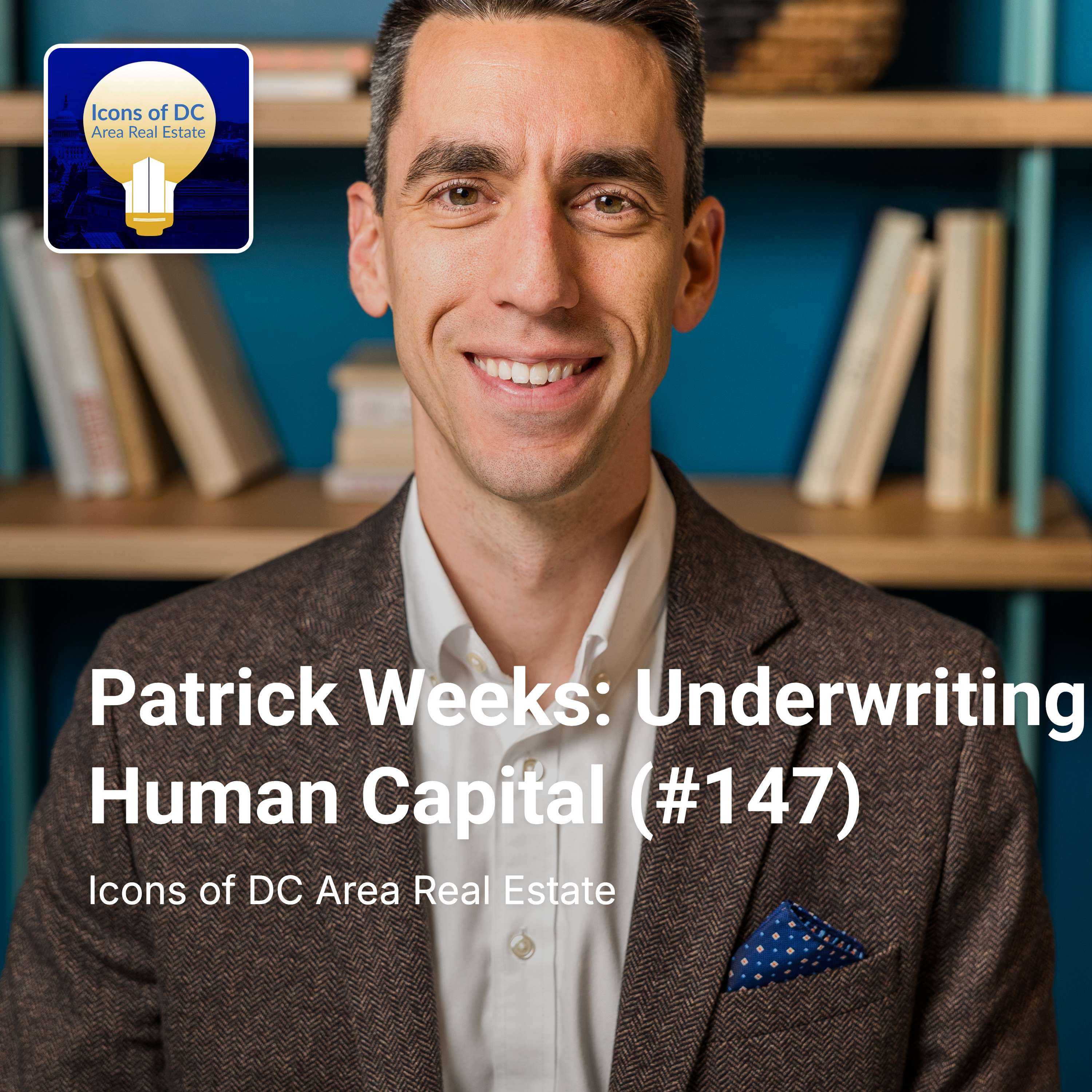
Icons of DC Area Real Estate · John Coe
Bio Patrick "Paddy" Weeks is co-author of The New Science of Hiring and VP of Operations at Tribunus Health. His career spans Marine Corps advisor teams in Afghanistan, Big Four consulting at Ernst & Young, and launching Sonder's DC market from Series B to 45 global markets and 2,000 employees. A Grove City College graduate and UVA Darden MBA, Patrick has spent five years synthesizing academic research on hiring into a practical framework for business leaders. The Blank Sheet of Paper Problem [2:58–7:00] Finance, operations, and economics are taught as sciences — but hiring is treated as art. Patrick's MBA sparked the question: where is the science of selection? That gap launched a years-long research obsession and ultimately, the book. From Midwest to Marine Corps [8:08–18:30] A soul-crushing Wall Street internship sent Patrick toward the Marines. Leading 20-man advisor teams through 125 convoys in Afghanistan taught him that pedigree matters far less than performance — a lesson that shaped every hire he'd ever make. Military to Civilian – The Career Jungle Gym [18:31–23:49] The transition from machine gun convoys to an E&Y cubicle was jarring. Patrick shares why he views careers less as ladders and more as jungle gyms — and how the GI Bill, a Darden MBA, and strategic "attribute swapping" helped him find his fit. Scaling Sonder – The Rocket Ship [31:21–40:55] As Sonder's first DC hire, Patrick scaled from 200 to 2,000 employees across 45 markets. He reveals what broke first (processes, always), what he hired for (high agency, low ego), and how a non-traditional banking hire became one of his best decisions. The Firing That Scarred Him [47:13–50:32] Patrick opens his book with his worst professional moment: terminating a new hire just three weeks in. He ignored his gut, deferred to group consensus, and paid the price. It became the catalyst for learning the actual science of selection. Proactive Personality & The Hustle Metric [1:02:45–1:10:16] For brokerage, BD, and PM roles, Conscientiousness is overrated. Proactive Personality — testable in a four-minute questionnaire — is the real predictor of who takes initiative without being told. Patrick explains why it's the moneyball metric real estate firms are missing. Time Kills Deals — In Hiring Too [1:18:47–1:25:44] Every day a process drags, you lose ~10% of your candidate pool. Decision accuracy tops out after 3–5 interviews. The "meet all the partners" gauntlet isn't rigor — it's diffused accountability. Integrity Testing, Simulations & AI Risks [1:10:42–1:18:21] Integrity testing delivers up to 4,000% ROI for on-site and PM roles. Work simulations outperform polished interviews. And training AI on past hiring data? You're just automating old biases — with new legal liability attached. Resources: The New Science of Hiring by Patrick Weeks & Joy Giles | thenewscienceofhiring.com Connect: LinkedIn – Patrick Weeks Notable Quotes: "I learned one of the hardest lessons in leadership:...
0:00Speaker AForeign.
0:09Speaker B: Hi, I'm John Ko and welcome to icons of D.C. area real estate, a one on one interview show featuring the backgrounds, career trajectories and insights of the top luminaries in the Washington D.C. area Real estate market. The purpose of the show was to explore their journeys, how they got started, the pivotal moments that shaped their careers and the lessons they've learned along the way. We also dive into their current work, industry trends and some fascinating behind the scenes stories that bring unique perspective to our industry. Commercial Real Estate welcome to another episode of Icons of DCRE Real Estate. In commercial real estate, we obsess over data, scrutinizing cap rates, absorption and comps with mathematical precision. Yet when it comes to our most critical investment, our human capital, many leaders abandon analytics at the conference room door and rely entirely on gut feel or hiring people who remind them of themselves. Today we're joined by Patrick Patty Weeks to help us change that. Patrick's diverse career spans from leading US market Marine Corps advisor teams in Afghanistan to navigating Big Four consulting in New York to launching the Washington D.C. market for the tech enabled hospitality unicorn Sonder. He is currently the Vice President of Operations for Tribuna's Health and the co author of the upcoming book New Science of Hiring. In this episode, Patrick dismantles traditional intuition based hiring and explains how to replace it with rigorous research backed strategies. We discussed the statistical difference between rule following and actual hustle in brokerage roles, the staggering ROI of integrity testing for property management teams, and why our industry's golden rule, Time Kills Deals applies just as much to losing top talent and as it does to closing a property deal. If you want to start underwriting your people with the same scientific discipline you apply to your real estate assets, this conversation is for you. Let's dive in.
2:31Speaker ASo Patrick Patty Weeks, welcome to icons at D.C. area real estate. Thank you for joining me today.
2:37Speaker CThrilled to be here. Good to see you again John.
2:39Speaker AIt's been a while. Thank you so much. What are you now focused on since stepping away from Sonder DC operation? How are you spending your time professionally and intellectually and what problems are most interesting to you at this stage?
2:58Speaker CSure, and thanks for having me. So right now, you know, for my day job I'm Vice President of Operations for Tribunis Health, which is a 50 person boutique healthcare consulting group and you know, very similar to a lot of other roles I've had focusing on kind of operations, leadership and the transferable skills there. So I tend to bounce around a little bit between industries, but the Roles really rhyme, generally speaking. And then, you know, part of why we're talking today is outside of work. I've been basically obsessed with how to do hiring well and how to do predictive interviewing and what is the actual science and research back techniques for hiring well and building a good team, building a good culture. So for honestly, more than the last probably five years, I've gotten so obsessed with this that it's essentially resulted in me surveying all the scientific research and literature I could find on the topic. And we'll be publishing a book here this spring, boiling it all down, called the New Science of Hiring, which is kind of aimed at taking all that information and packaging it up practically for your business hiring manager, recruiter, startup hiring manager so they can take it and put it into practice.
4:17Speaker ASo you're now writing, advising and coaching leaders on hiring and team design. Why does talent selection feel like the highest leverage problem to work right now on now, especially across capital intensive industries like real estate for instance?
4:35Speaker CThat's a good question. Although I would think that if you ask pretty much any leader across kind of real estate businesses, you know, what's the most important part of your business or your what you're doing, they would say it's the people. And it's almost trite nowadays to say I think people first, people are what make us good. And you know, it is true. Everything is downstream from all the decisions made, the capital allocations, processes, built, branding, someone's doing it. You know, AI isn't really running whole companies yet. But one thing that got me basically started going down this path years ago, kind of pebble in my shoe was when I was in my MBA studies, one of our professors kind of broke down this whole strategy for multiple hours and taught us this class and at the end talked about a little bit of hiring or people development strategy. And I was just blown away by his insights and structure he had. And then he made an offhanded comment, you guys will just end up doing whatever Google and Amazon does. And back in my day we just copied whatever IBM did. And it's like a record scratch moment for me because IBM can't imagine going into my boss's office and being like, I got this great process from IBM, let's just copy it. Absolutely. What we would do with Google and Amazon though, I thought maybe I'm gonna stick to my grandpa's company. And so it led to this moment where I was thinking, wait, all these other things that I'm learning in these classes, finance, economics, accounting, there's kind of A science to it. When you think about the activity of hiring, interviewing, onboarding employees, it's the lifeblood of every business. But where's the science of it? Why aren't I learning that? And that was really the question that sent me down this rabbit hole of trying to figure out, is there even a science to hiring? And obviously there's some art as well. You can instinctively realize that. But that's what sent me down the path of, huh. Different organizations do this, different ways are. Have we proven some ways are good, some ways are not as good. And that's.
6:54Speaker AWell, there's. Years later, there is a whole science of human relations and HR departments and personnel. And then now, you know, I, I use Gallup strength finder to estimate, you know, what people's strengths are, which is statistical. And they have a lot of data.
7:13Speaker CSo.
7:14Speaker AAnd I'm in the career coaching business as well.
7:17Speaker CRight.
7:18Speaker AWhich I've advised people. So I look at, you know, as much data as I can find about people before I sit down with them so that they can think about their career plans and what they're doing. But I try to get lots of different perspectives on that. And so your science, what you're creating, will be very interesting and hopefully helpful to my career going with my coaching practice going forward.
7:43Speaker CI'm hoping.
7:44Speaker AI haven't read the book yet, but I'm eager to do that when, when it comes out. So before we get into the. All those details.