
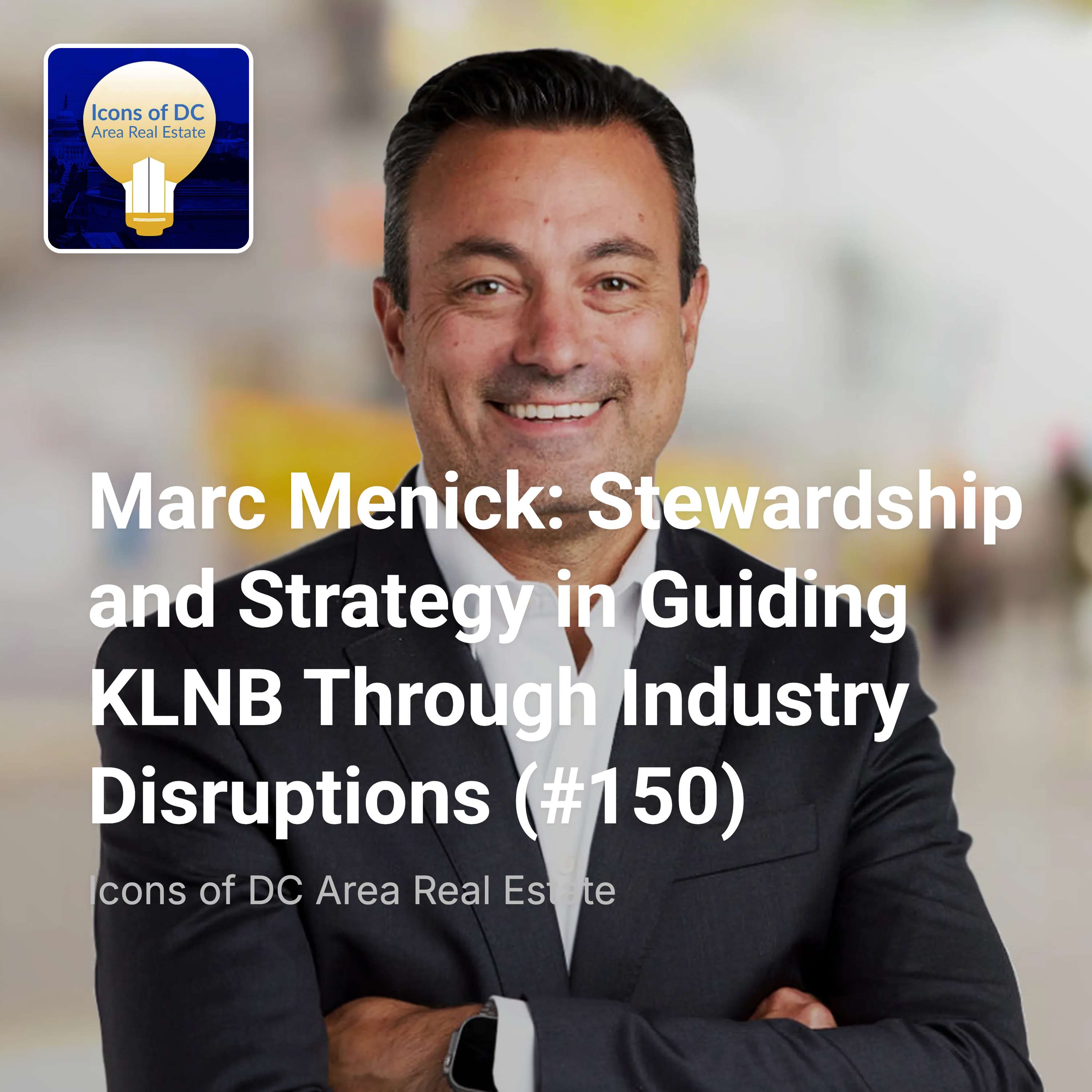
Icons of DC Area Real Estate · John Coe
Bio Marc Menick is President and COO of KLNB, a leading partner-owned CRE firm in DC. He spent nearly 20 years as a key Peterson Companies executive, helping shape developments like National Harbor and Downtown Silver Spring, before becoming KLNB's first non-broker President in 2017. Host: John Coe. Key Discussion Points Origins and Educational Foundation [2:04-7:16] Started in private wealth management at 23; found it impersonal and was drawn to CRE after watching friends work directly with small business owners. Broke in via Jay Donegan, Grant Ehat, and Taylor Chess, landing at The Peterson Companies. Maryland built independence and relationships; Johns Hopkins gave the technical grounding (DCF modeling) for credibility. The Peterson Companies and the Developer's Perspective [7:17-29:09] Nearly 20 years (1998-2017) under Milt Peterson, Tom Maskey, Taylor Chess, and Bill Smith during the region's biggest growth era. Ran retail leasing for National Harbor through the 2008 crisis, rebuilding the merchandising plan after major brands backed out. Key lesson from Maskey: retail is entertainment; communities, not developers, decide what a place becomes. Peterson's own rule: stay out of talented people's way, but send a clear message - "figuratively" - when needed. The Leap to KLNB and Leadership Style [29:10-40:07] Left Peterson in 2017 for an "entrepreneurial itch"; KLNB's true partnership model and growth playbook, not management itself, was the draw. Biggest surprise: stepping out of day-to-day deals to support 110 brokers across a dozen disciplines. Leadership style: build trust by caring, let friction resolve itself rather than micromanage talented salespeople. Navigating Disruptions: Markets, AI, and a Cyberattack [40:08-57:28] Reads the market by "walking the halls" - broker sentiment beats lagging headlines. Diversified into industrial, data centers, healthcare, and government; credits Kevin Goller for spotting Loudoun County's data-center boom early. Leaning hard into AI for marketing and analysis - it won't eliminate CRE jobs, but will replace people who don't use it. Toughest test: the 2022 ransomware attack. Refused to pay, rebuilt systems overnight, absorbed real cost rather than fund the criminals. Retail Prognosis: Clicks-to-Bricks [57:30-1:08:39] Debunks the "retail apocalypse" - digital-native brands (Warby Parker, UNTUCKit) need stores to scale and manage returns. IKEA is the gold standard of experiential retail - a "board game" that fully immerses shoppers. Grocery-anchored neighborhood centers stay durable: close to home, and a form of everyday entertainment. The Future of Downtown D.C. [1:08:40-1:12:38] Optimistic on downtown's comeback: Georgetown, the Wharf, and Navy Yard thriving; COVID-depressed Golden Triangle/Dupont offices converting to residential. Expects a 24-hour, mixed-use downtown, not the old 9-to-5 commuter pattern. Sees retail shrinkage and Metro fare evasion slowly improving as...
0:00Speaker AForeign.
0:09Speaker BHi, I'm John Ko and welcome to icons of D.C. area real estate, a one on one interview show featuring the backgrounds, career trajectories and insights of the top luminaries in the Washington D.C. area Real estate market. The purpose of the show was to explore their journeys, how they got started, the pivotal moments that shaped their careers and the lessons they've learned along the way. We also dive into their current work, industry trends, and some fascinating behind the scenes stories that bring unique perspective to our industry. Commercial Real Estate thank you for joining me for another episode of icons of D.C. area real estate. My guest for today's show is Mark Menick, who is president and CEO of klnb. Drawing from his two decade foundation as the executive at the Peterson Companies, Menek brings a unique developer's perspective to regional brokerage leadership. In this conversation, he unpacks the critical market shifts defining the commercial real estate industry today. During the clicks to bricks evolution of digital brands embracing physical storefronts, the growing convergence of retail and industrial sectors, and his optimistic outlook for the transformation of Downtown Washington D.C. beyond Marketing Market trends. Manek's leadership philosophy deeply embodies bodies stewardship alignment with career coaching. He fundamentally views his role as being a steward of his partner's equity and KLNB's highly collaborative culture. He pairs this protective stewardship with a passion for career coaching and talent development. Recognizing that the next generation of brokers requires a map and a guide, menek actively champions KLNB's rigorous internship and mentorship programs to shape emerging professionals. Throughout the interview, he offers invaluable career coaching advice for young practitioners. He be relentless, curious, prioritize immediate follow through, and above all, get into the office to build the irreplaceable in person relationships that truly drive the business. So without further ado, here is our insightful conversation with Mark Minick. So, Mark Minick, welcome to Icons at DCRE Real Estate.
2:46Speaker AThank you for joining me today.
2:48Speaker CThank you John. Pleasure to be here. Thank you for having me.
2:51Speaker AThat's great. So before we discuss klnb, let's start at the beginning.
2:56Speaker BWhat first attracted you to commercial real
2:58Speaker Aestate and when did you realize this was the industry where you wanted to build a career?
3:03Speaker CI don't think that happened until later. I didn't grow up with a passion growing up saying, hey, I want to, I want to be in commercial real estate. Nobody in my family worked in commercial real estate like a lot of people in this business. So I think I was just, you know, I was blessed to have been brought up by parents that instilled a really strong work ethic in me. And I always had to do chores around the house, which led to having to have a job and did everything under the sun, from laying flagstone patios to working at the local gas station to sell, selling lemonade in Camden Yards, which, you know, like led to the real jobs, quote, unquote, real jobs of my first real job out of school was working in the private wealth space for a small boutique investment firm called Washington Investment Corp. In Georgetown, 1010 Wisconsin Ave. First job out of college where I realized that work wasn't personal enough for me. It's funny to say that because I think ultimately if you make it through the those first few years in that business, it becomes one of the ultimate personal businesses out there, actually managing somebody's wealth management, wealth management, it becomes extremely personal. But when you're 23 years old, it's a really tough business to break into. And here it was. I had all these friends in this thing called commercial real estate. They were out on the streets showing space, going to lunches, making an impact with small business owners immediately as a 23, 24 year old individual. And I said, hmm, that looks really interesting to me. And I got really curious about it. And growing up in this area, all you got to do is talk to a couple friends and family and you realize how many people are in this business. And I became attracted to it sort of by chance that way and decided to get out of what I was doing and get into commercial real estate.
4:48Speaker ADid you grow up in the Washington area?
4:49Speaker CI did. I grew up my first few years until I was about 10 years old. I lived in Prince George's county and Upper Marlboro, Maryland. And then my parents moved my sister and I to Montgomery county, where I still live, about five miles from the house that they moved us to. And so I got really curious about commercial real estate at that point, started talking to some friends and family that were in the business and just got really lucky from there, ultimately meeting a few people. First couple of people I met in the business, Jay Donegan, Grant Ehat. Oh sure, Bob Schwanger, Grant, or excuse me, Jay Donegan, introduced me to a gentleman by the name of Taylor Chest. Of course, because Grant was small enough that he really didn't have any opportunities to bring somebody on. And he said, you should meet a friend of mine named Taylor. And if you know Taylor, it takes a little while to break into him. And I was relentless about calling him and calling him back. And eventually he gave me an audience took a little liking to me, introduced me to a couple other people at Peterson, and eventually got an opportunity to start there. Extremely lucky.
6:04Speaker ABoth Grant and Taylor have been podcast guests, as you well know.
6:08Speaker CI do know that I really enjoyed both of them, and I especially enjoyed John and Taylor, of course, together, because they told a lot of stories that I had some front row seats, too.
6:17Speaker ALet's go back a little further. Looking back on your education at the University of Maryland and later at NYU Shack Institute, what lessons from those years still influence how you think about the real estate today?
6:31Speaker CIt was Maryland and then the Johns Hopkins program.
6:33Speaker AOkay.