
Icons of DC Area Real Estate · John Coe
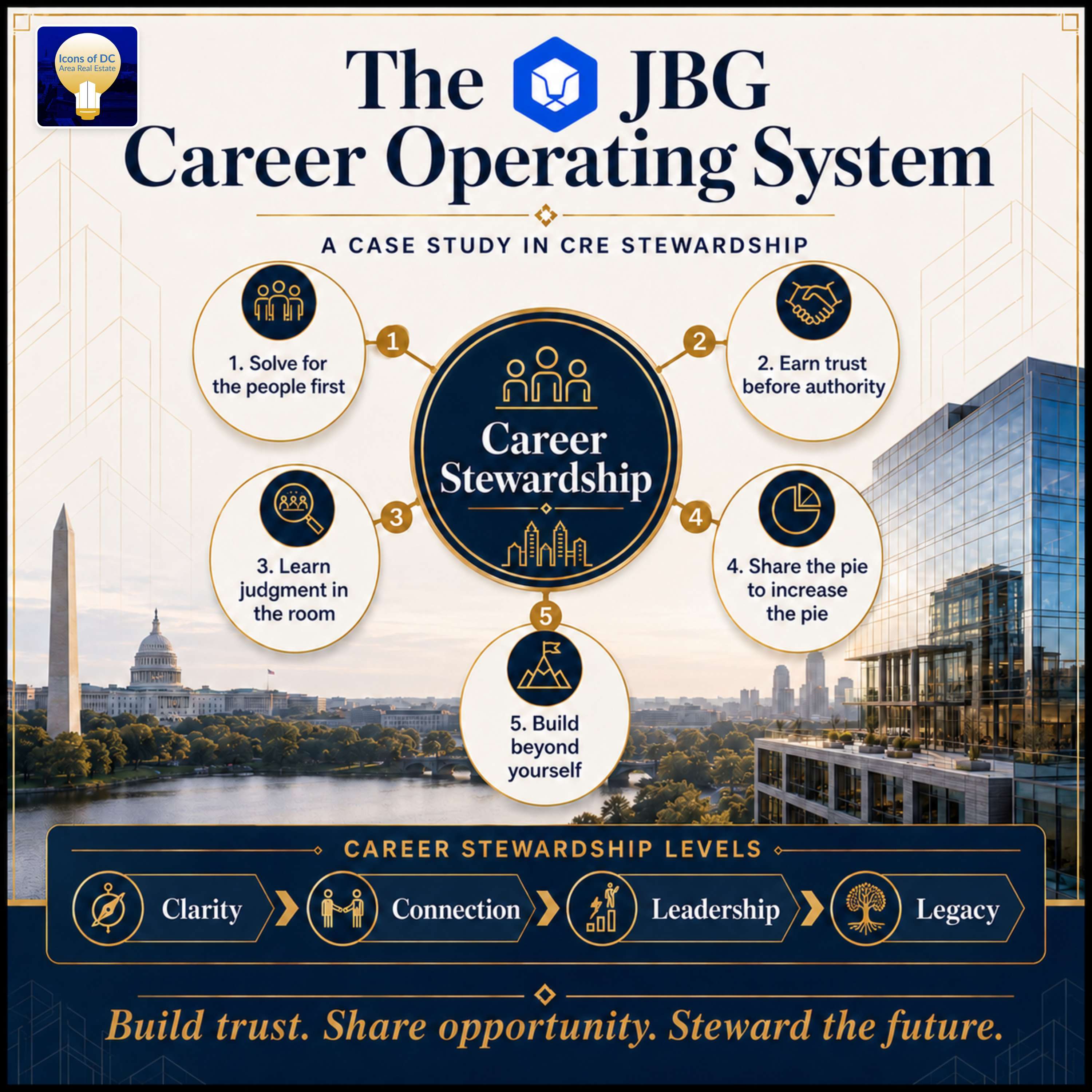
Bio This special compilation episode departs from the usual one-on-one format. Host John C. Coe draws on past interviews with leaders connected to JBG and JBG Smith — Matt Kelly (CEO, JBG Smith), Todd Rich (Declaration Partners), Moina Banerjee (CFO, JBG Smith), Evan Regan Levine, A.J. Jackson (Washington Housing Initiative / LEO Impact Capital), and Grant Ehat (JBG co-founder) — to reverse-engineer what he calls the "JBG Career Operating System": five principles mapped to four levels of career stewardship — clarity, connection, leadership, legacy. The thesis: enduring CRE careers aren't built by chasing opportunity, but by cultivating the judgment, trust, and generosity required to build something that outlasts you. Key Discussion Points Introduction & Framework [00:00-4:19] Coe frames a real estate career not as opportunities to extract value from, but as a practice of stewardship — asking whether professionals are intentionally designing their careers or simply reacting to what comes their way. Principle 1: Solve for the People First [4:19-10:35] Matt Kelly recalls his father's advice and a formative early-career experience at Goldman Sachs — watching an ailing VP spend his final months at the office — that convinced him colleagues matter more than prestige. How JBG's senior leaders gave young talent real room to run instead of hoarding opportunity. Principle 2: Earn Trust Before Authority [10:39-19:46] Todd Rich on stewarding other people's capital and JBG's "minority rule" culture, where one partner's unresolved concern could stop a deal. Moina Banerjee traces her path from acquisitions to CFO and shares her billboard message on attitude, inspired by a framed Charles Swindoll quote on a mentor's office wall. Principle 3: Learn Judgment in the Room [19:46-31:52] Evan Regan Levine on what he learned watching senior leaders vehemently disagree, with respect, inside investment committee meetings. A.J. Jackson shares a personal account of decision-making at GSA in Lower Manhattan on 9/11, with "no playbook and no one else to ask." Principle 4: Share the Pie to Increase the Pie [31:57-38:50] Grant Ehat on trusting instincts on people, valuing character and loyalty in hiring decisions made alongside JBG co-founders Jim and Rob, and why cultures that develop young talent compound it rather than lose it. Principle 5: Build Beyond Yourself [38:50-44:55] Evan Regan Levine on National Landing and the intersection of communication, analytics, and design in shaping real places. A.J. Jackson on deploying private capital at scale to preserve affordable workforce housing as neighborhoods improve. Synthesis & Billboard Messages [44:55-50:06] Coe ties the five principles into one arc — clarity, connection, leadership, legacy — closing with guest billboard messages: Matt Kelly, "Be kind to one another." Todd Rich, "Have fun." Moina Banerjee, "Fortune favors the brave." A.J. Jackson, "Stronger together." Evan Regan Levine, "The future is built here."...
0:00Speaker AForeign.
0:09Speaker BHi, I'm John Ko and welcome to Icons of DC Area Real Estate, a one on one interview show featuring the backgrounds, career trajectories and insights of the top luminaries in the Washington D.C. area Real estate market. The purpose of the show was to explore their journeys, how they got started, the pivotal moments that shaped their careers, and the lessons they've learned along the way. We also dive into their current work, industry trends, and some fascinating behind the scenes stories that bring unique perspective to our industry. Commercial Real Estate welcome to a special episode of icons of D.C. area real estate. This is John Coe. Today's episode is a little different. Rather than focusing on one guest, I want to use several past conversations to examine one of the most influential real estate cultures in the Washington D.C. area. The JBG companies. Now JBG Smith but this is not simply a company history. It is a lesson in stewardship. In a world where professional success is often measured by what we extract from our careers, the JBG story suggests something else that the ultimate metric of a career is what we leave behind in people, in place, and in the strength of the system we pass on. In my CRE Career Stewardship Advisory Work, I often ask young professionals a simple but uncomfortable question. Are you intentionally designing your career or are you simply reacting to opportunities? That question sits at the center of this episode. Because when I look back across my interviews with leaders connected to JBG and JBG Smith, Matt Kelly, Moyna Banerjee, Todd Rich, Grant Ehat, AJ Jackson, and Evan Reagan Levine, I see something deeper than a successful real estate platform. I see a pattern. I see a culture that formed people. I see a way of thinking about capital, people, judgment, opportunity and place. I see what I would call the JBG Career Operating System. It was not written as a manual. It was not a formal curriculum. It was not reduced to a slogan. But across these interviews, five operating principles keep appearing. 1. Solve for the people first. 2. Earn trust before authority.
3:05Speaker A3.
3:06Speaker BEarn judgment in the room.
3:08Speaker C4.
3:10Speaker BShare the pie to increase the pie. 5. Build beyond yourself. Those five principles align closely with the four levels of career stewardship that I use in my advisory work. Clarity, connection, Leadership and legacy. So today I want to examine JBG not simply as a legendary firm, but as a living case study in how real estate careers mature. Because the lesson of JBG is not that every young professional should try to build the next jbg. The lesson is more immediate. The lesson is that a meaningful career is not built by chasing every opportunity. It is built by developing judgment, earning trust, choosing the right people, helping others grow, and eventually doing work that outlasts your own ambition. That is stewardship principle number one, Solve for the people first. Career stewardship level one, clarity. The first operating principle is this. Solve for the people first. That phrase comes directly from my interview with Matt Kelly, CEO of JBG Smith. Matt recalled advice from his father. Solve for the people first. That is deceptively simple phrase. It could sound like ordinary parental advice, but in Matt's career, it became a serious filter. Early in his professional life, Matt had a formative experience at Goldman Sachs. What's the Goldman culture like? What was it that you knew after two weeks you weren't going to fit there long term?
5:11Speaker D: It wasn't really about the culture of Goldman. It was, you know, and maybe this is just a function of having grown up in a Midwestern household where my parents were around a lot. But I remember sitting in a cubicle, I was looking into an office, and there was a vice president who was occupying that office. And the guy I remember distinctly, he was losing his hair because he was going through chemotherapy for cancer treatment. He had three young kids at home. And I was there all night, right, all the time, because I was drowning in information and I had to learn, I had to figure out how to do this stuff. And so everything was taking me a very long time. This was my second week on the training program. And this guy was also there until all hours of the night. And I just thought to myself, gosh, at the time I thought, vice president. That's a really sad. Sounds like a really senior role. I didn't quite realize that there were a lot of levels above that still, although I figured it out soon enough. But I just remember thinking, this guy has cancer. And this is 1996, when getting cancer then is a little different than it is today. And I just thought, wow, this guy could be dead soon. And he may be spending the majority of his final hours here at the office looking at me. That's not the. That's not a. That's not the kind of world I want to live in. It really gave me a pretty strong sense that, you know, this wasn't the lifestyle I wanted. And, you know, it's. Look it. It's not as though I haven't been through and experienced and still experience times of very hard work and late hours and all that. But the other thing that it made me realize was that, you know, in any job where you're inclined to work hard or where you have to work hard or where you want to work hard, really better? Well, very much like, if not love, the people next to you that you're doing it with.
7:17Speaker BThat is not an argument against ambition. It is an argument for conscious ambition. Young professionals often assume that the first test of a career is prestige. Can I get into the best firm? Can I work on the biggest deals? Can I build the most impressive resume? Can I be around the most sophisticated capital? Those questions are not irrelevant, but they are incomplete. The deeper question is, what kind of person will this environment cause me to become? That is the career stewardship level of clarity. Clarity is not merely knowing what job you want. It is knowing what kind of people, work incentives and culture will shape your judgment. Matt said that JBG was the place where the promises made to him actually came true. That line matters. A lot of young professionals are sold a story when they join a firm. They are told they will be mentored. They are told they will be given responsibility. They are told they will grow. But the real question is whether the culture actually behaves that way. When opportunity arrives at jbg, Matt saw senior leaders who gave young people room to run. They did not simply use young talent as production capacity. They gave them exposure. They trusted them. They let them grow into responsibility. And the insight behind that was powerful. Sharing the pie would increase the pie. That is one of the most important career lessons in this entire episode. Scarcity based cultures protect opportunity. Stewardship cultures multiply opportunity. A scarcity culture says, protect your turf. Do not let young, younger people get too close to the client. Do not give away too much authority. Make sure you remain indispensable. A stewardship culture says, if we develop people well, the enterprise become much larger than any one person. That was the first major JBG lesson. Solve for the people first. For a young professional, that means you should not merely ask, where can I get the best job? You should ask, where can I become the kind of professional I respect? Who will model judgment for me? Who will tell me the truth? Who will give me responsibility before I am fully comfortable? Who will allow me to grow without needing me to remain small? Those are career architecture questions. They are not soft questions. They are strategic questions. Because your first serious professional environment does more than pay you, it forms you. So Principle 1 of the JBG Career Operating System is choose the people, incentives and culture that will shape your judgment. That is clarity. Principle 2 Earn trust before authority Career stewardship Level 2 connection the second operating principle is Earn trust before authority. Real estate is a capital business, but capital is ultimately a Trust business money does not simply move towards spreadsheets. It moves towards judgment. It moves towards credibility. It moves toward people who have proven they can be trusted when conditions change. Todd Rich captured this in my interview with him when he spoke about the tremendous responsibility of managing other people's capital. That phrase deserves to be slowed down. Other people's capital. That may mean institutional investors, it may mean families, it may mean pensioners, it may mean shareholders, it may even mean partners who have trusted you with a meaningful portion of their future. Capital is never just capital. It carries obligation. And the more responsibility you receive in a real estate career, the more you understand that the job is not simply to win, but the job is to be worthy of trust. Todd's post JBG career at Declaration Partners also reflects this principle. A family office investment context allows for patience, selectivity, and flexibility. It does not require forcing a deep deal simply to destroy deploy capital. That is a very mature investing insight. If a deal comes around that just
12:28Speaker Ascreaming, you're going to take a hard look at it. But if the people that bring it
12:33Speaker Bto you, you're wondering about, you might
12:35Speaker Asay, well, we'll buy it, but we're not going to be with you guys.
12:40Speaker EDavid Swensen, who's the legendary head of the Yale Investment office and one of the anchor investors of jbg, at least back when we were a private firm, has a wonderful sentiment he expresses in his book, but I always liked it better when he said it in person, which is that the best legal documents cannot protect you from a bad partner, but the best partner can protect you from the worst legal documents. And what I think he really meant was that people matter is that having a trusted partner, someone who you believe has your best interest at heart and who will think things through ethically and honorably, is far more important than any one deal or any one legal structure. And so I think the point that you made is entirely valid. And you know, this is a people business still, you know, and we care about those relationships. We care about our reputation and the
13:27Speaker Areputation of those we invest in.
13:28Speaker BThe immature professional wants to be seen doing deals. The mature professional wants to be right about risk. That distinction matters especially in commercial real estate, where markets can reward aggressiveness for a while and then punish undisciplined ambition very quickly. JBDG's historic culture had a similar discipline. The founders, Don Brown, Joel Gildenhorn and Ben Jacobs, understood the responsibility of using other people's money. The firm developed a culture where if one partner could not get comfortable with a deal, the firm would walk away. Think about that. In many firms, the dominant voice wins. The rainmaker wins. The most forceful personality wins. The person with the strongest conviction pushes the deal through. But a minority rule culture says something different. It says if one trusted partner sees a risk we cannot resolve, we stop. That is not bureaucracy. That is capital stewardship. As for a young professional, this is a major career stewardship lesson level two is connection. But connection does not mean networking in the shallow sense. It does not mean collecting business cards or LinkedIn connections. Connection means becoming trustworthy. It means becoming known for reliability, judgment, discretion, preparation, and follow through. It means people begin to say, I want her in the room. I trust his numbers. She tells the truth. He does not overstate his case. She knows what she knows, and she knows what she does not know. He can be trusted with a client. She can be trusted with capital. That is how authority begins. Authority is not seized first, it is granted later. Molina Banerjee's career illustrates this beautifully. Her path at JBG Smith moved through multiple disciplines. Acquisitions, asset management, capital markets, investor relations, and ultimately the CFO role. That kind of career does not develop by accident. It develops because a professional keeps becoming useful in more consequential ways. In my interview with Moyna, she discussed capital allocation, nav per share, share repurchases, asset sales, funding, caution, and the discipline of making decisions in the public markets. But she also spoke about qualities that are less visible on a spreadsheet. Authenticity, intellectual curiosity, willingness to dig in, and collaboration. These traits matter because public company stewardship requires more than intelligence. It requires temperament. It requires resilience. It requires the ability to operate under scrutiny. If you could post a statement on a billboard on the Capital Beltway from
16:58Speaker CMillions to Sea, what would it say?