
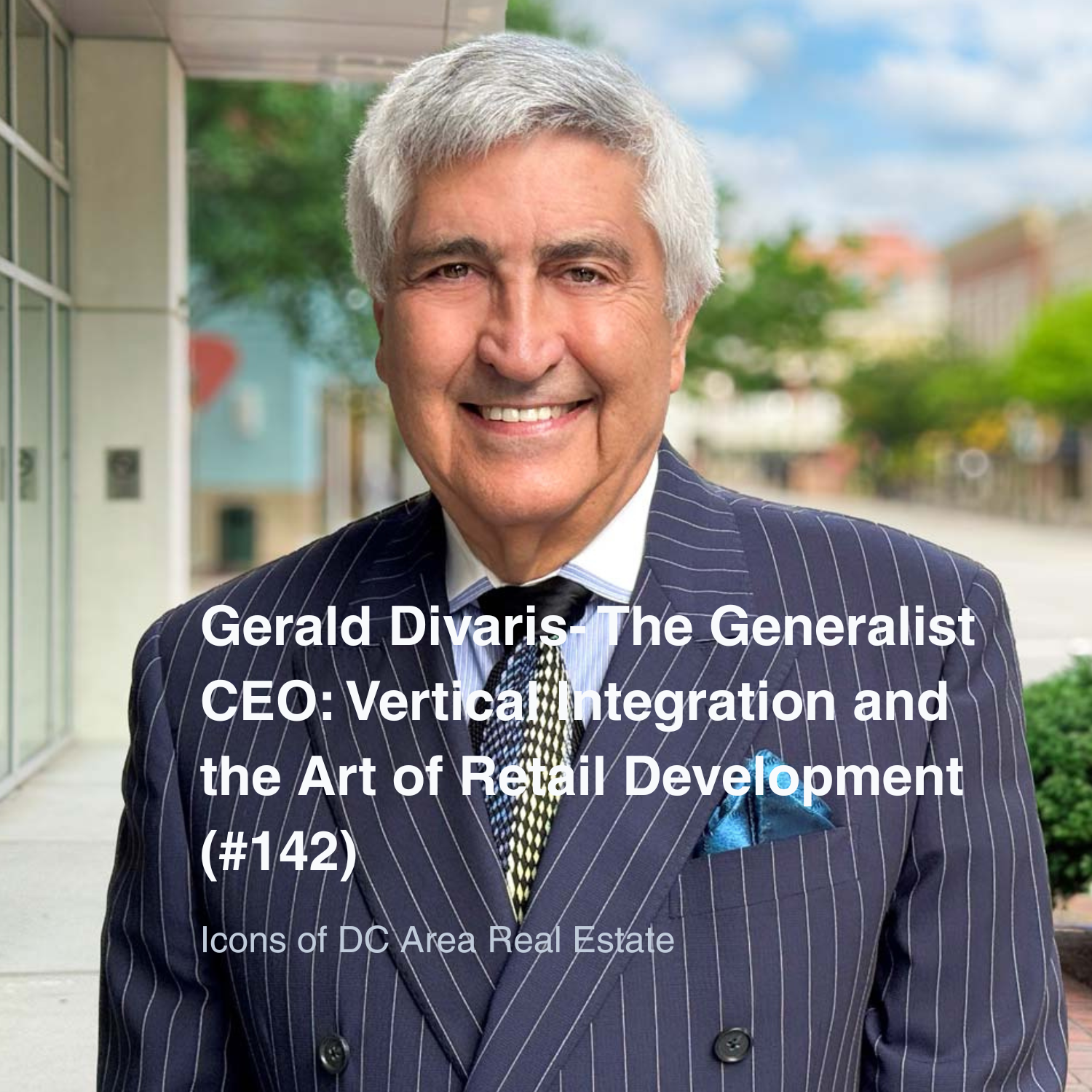
Icons of DC Area Real Estate · John Coe
Gerald Divaris is Chairman and CEO of the Divaris Group, a vertically integrated commercial real estate enterprise. Co-founded Divaris Real Estate (DRE) in Cape Town, South Africa (1974), relocating to Virginia Beach (1981). DRE manages 40M+ sq ft across 15-16 U.S. cities. Visionary behind Town Center of Virginia Beach. Inducted into Hampton Roads Business Hall of Fame (2024). Company Strategy and Structure Primary Focus [3:25] CEO responsibilities center on exceeding client expectations, ensuring cohesive teamwork embodying company ethos, and platform growth. National Operations [4:20] Maintains standards across 15-16 cities through personal CEO visits (monthly/bi-monthly) and "Principal in Charge" in each office embodying firm philosophy. Employee Model [6:24] Unlike industry peers, DRE agents are salaried/on draw vs. independent contractors, ensuring clients receive controllable service rather than commission-driven behavior [7:50]. Vertical Integration [8:55] Retail deeply engrained from family retailer background. Development's longer lead time/higher risk suits stable employee model. Retail is "glue" in mixed-use developments, providing street-level vibrancy attracting office/residential tenants. Realty Resources Network [12:09] Provides national platform of best-in-class local brokerages for seamless nationwide service. Smaller engaged networks led by "deal junkies" [17:23] outperform large publicly-traded firms with heavy infrastructure costs. Management [19:32] "Overbalanced on corporate infrastructure" using salaried professional managers, freeing deal-makers to "lead by example." Origins and Generalist Philosophy African Origins [22:14] Born in Rhodesia (now Zimbabwe), moved business to Virginia Beach 1981. Smaller South African economy created "generalist" approach [24:22] across product types—essential for mixed-use development. Retail Family Background [27:21] Greek merchant family from Cephalonia [28:44] owned department stores, liquor stores, groceries. Started working age 10 [30:01], learning customer assessment and merchandising strategy. Art of Retail [32:45] Store deployment is art, not science. Placemaking engages all human senses—family's florist shops used tuberose scent near door [37:28] to pull customers inside. Experiential retail critical [42:23]—Barnes & Noble survived Amazon through "storytelling" and reading experiences. III. Town Center of Virginia Beach Opportunity [45:24] Virginia Beach: largest Virginia city by population but lacked CBD. Strong economy, tourism, minimal national broker competition. "Rough diamond" with suburban sprawl needing heart and soul. Military Economy [50:40] Hampton Roads houses NATO headquarters, major cyber command, world's largest naval base. Demographics underreported 28% [59:41] due to "hidden economy"—young military retirees with full pensions, free medical, VA loans not counted in salary reports. Mixed-Use Success [55:31] Town Center became city's "heart and...
0:00Speaker AForeign.
0:09Speaker BHi, I'm John Ko and welcome to icons of D.C. area real estate, a one on one interview show featuring the backgrounds, career trajectories and insights of the top luminaries in the Washington D.C. area Real estate market. The purpose of the show was to explore their journeys, how they got started, the pivotal moments that shaped their careers, and the lessons they've learned along the way. We also dive into their current work, industry trends and some fascinating behind the scenes stories that bring unique perspective to our industry. Commercial Real Estate thank you for joining me for another episode of icons of D.C. area real estate. I am honored to speak with Joe Gerald Devares, Chairman and CEO of the Devarus Group on today's episode. Gerald Devares is the leading one of the largest and most highly regarded commercial real estate enterprises on the East Coast. His firm, Devares Real Estate, which he co founded in 1974 in South Africa, is celebrating 50 years of business achievements, earning his induction into the Hampton Roads Business hall of fame in 2024. The Navarros group is a fully vertically integrated, full service commercial real estate company that manages and leases approximately 40 million square feet of prime office, retail and industrial space nationwide. The Firm employs over 200 people and maintains offices in 15 or 16 cities across the United States. Mr. Devaros, who moved the company's US operations from South Africa to Virginia Virginia Beach, Virginia in 1981, heads DaVaris Retail Leasing Division and its development services arm nationally. He is renowned for his visionary work, particularly championing the Town center of Virginia Beach, a mixed use project that serves as a model for successful public private partnerships. He's also a founder and board member of Realty Resources, a national network of independent retail real estate brokers. The firm's focus on strategic growth is evident in its expansion program, which included recent acquisitions like the McGarry Group and notably a strategic expansion in the greater Washington, D.C. area in May 2024. By adding new experienced agents, this move is consistent with the company's national growth strategy and focused attention on the Mid Atlantic region. Known for his dedication to hard work and commitment to community support, Mr. DeBarris will be sharing his insights on market trends, the evolution of retail, including omnichannel strategies, and the future of real estate development in the region. Without further ado, please join me with.
3:06Speaker AGerald Devares as Chairman and CEO of Devarus Group, which now manages and leases approximately 40 million square feet of office, retail and industrial space nationwide. What are the primary strategic responsibilities that consume multiple focus today?
3:25Speaker CGerald I would say that from my perspective the most important Thing is to service the clients that we've now brought under our umbrella and make sure that they are being transferred, treated in the manner that they expected when they signed up. Thereafter, of course, we want to make sure that the teamwork of the folks that are working with us is cohesive and is embodied in the overall ethos that we have created for serving our clients. And I guess the third thing is to try and continue to grow the platform because that's the ultimate objective.
4:04Speaker AOkay. Your firm, Devarus Real Estate, operates offices in 15 or 16 cities across the United States. How do you maintain consistent standards and implement corporate vision across such a geographically expansive organization?
4:20Speaker CWell, I guess the one thing that we do is I try to travel to these offices, if not every month, every other month, particularly those that are far away, it takes a little longer because I like to be able to see the folks that are working with us and interact with them. And then also for those months that we don't travel, we use Zoom, as we talked about earlier, or teams. Either one of those vehicles are used pretty extensively. And then the other thing is we have a principal in charge of each office. That principal, we call them a principal. There might be a broker in charge or whatever, but they are the principals and, and they should be embodying the philosophy, the objectives, the goals, the strategic objectives of the company as a whole. And we rely on them to ensure that they are carrying the message on a day to day basis.
5:12Speaker ADid you model your firm after another one or who have you emulated a little bit as far as other firms? Out of curiosity?
5:21Speaker CI haven't really. As you know, I only worked for one company in my life for two years after I left college. So.
5:28Speaker AOkay.
5:29Speaker CDidn't have really any former experience in the, in the business that I'm in. But the company that I worked for was a large institutional, in fact the largest mining company in the world. And they had a real estate arm and I was involved in the real estate arm. So that was all the basis under which I, and I guess they had. They were very much organized along a formulaic process. And that was something that was drilled into me just in the two years that I was there. So I used the same kind of thought process rather than a specific formula.
6:07Speaker AI'm just curious, as you've grown as a company, have you met, sat down or through industry groups like ICSC and other groups, met with other firms that, oh, I really like what you're doing, maybe I'll help, maybe I'll try to do some of that.
6:24Speaker CMyself, well, Rotary sources clearly is a, is a great platform for us for working out best practices, learning others what they do and for us imparting what we do. And that has been a pretty good kind of channel for us to learn what is typical in the industry. We are a little bit different to most other firms because our agents are all employees. We really don't do a lot of independent contract. We do have some that are independent contractors but typically in this business most of the agents are independent contractors. So that creates a little bit of a different process. So there's a lot more supervision on our side, a lot more involvement. Maybe, maybe that is reflective of the principal arrangement, the principal having his team, having his committees, his groups, which you can't really do. Under independent contractor. Under independent director you have, you really have a very, very thin line between what you're allowed to do and what you can't do.
7:36Speaker ASo basically their culture is more team based and much more corporate structure as opposed to being independent contractors organization where every man and, or man or woman to himself basically.
7:50Speaker CThat's correct. And to some extent we did that because we really wanted our clients to feel they're being served by a salaried or, or, or, or employee that we could control as opposed to somebody who just eats what he can kill, which is really what independent contractor is doing. He, he's out there saying to himself, well if I'm not gonna, I'm not gonna spend months on this job if I, I may get nowhere or it's, it's too small for me to be involved with it, whatever.
8:21Speaker ARight.