
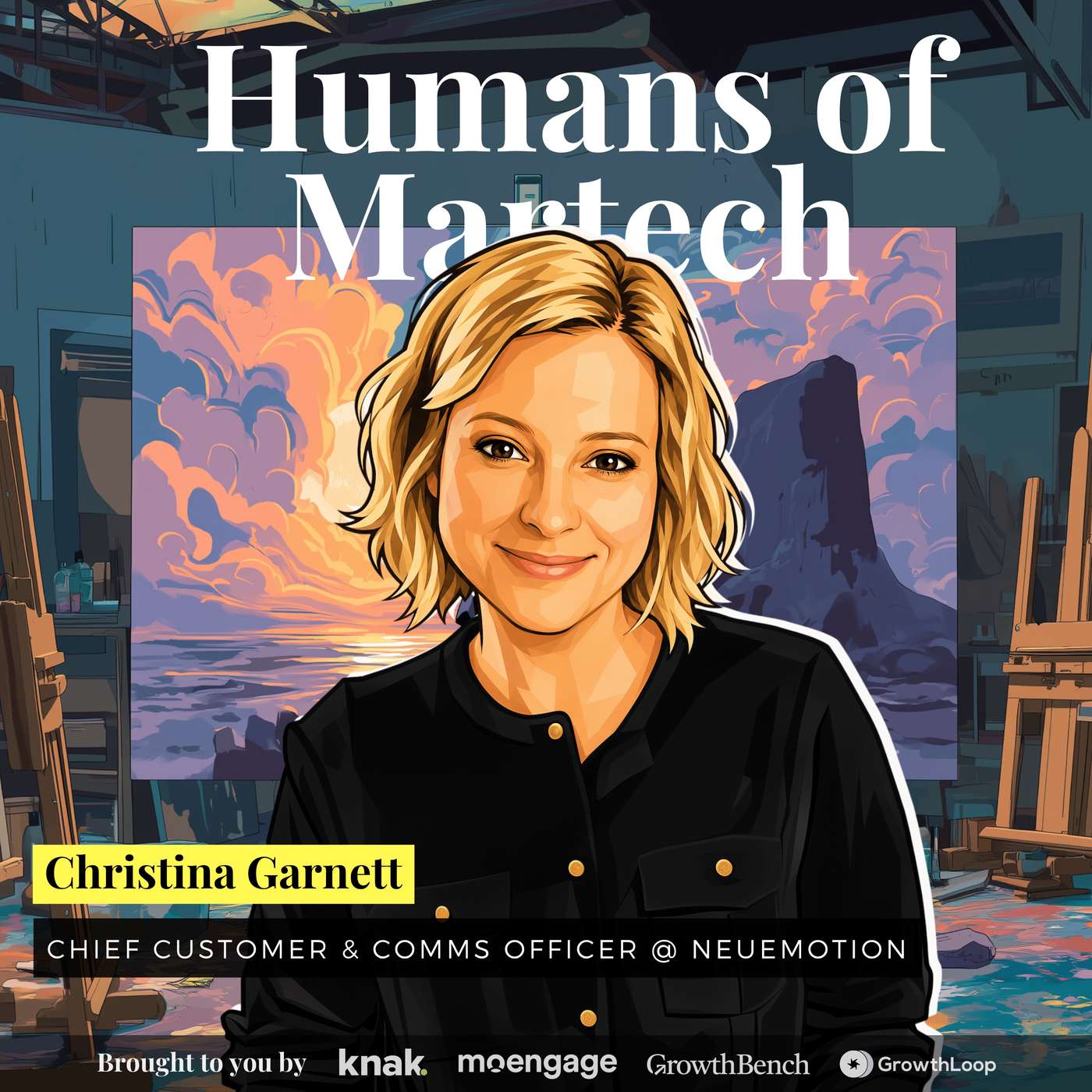
Humans of Martech · Phil Gamache
What's up everyone, today we have the pleasure of sitting down with Christina Garnett, Fractional Chief Customer and Communications Officer at Neuemotion. (00:00) - audio-Christina (01:19) - In This Episode (05:37) - Why Your Tech Stack Cannot Fix Siloed Customer Teams (11:10) - Why Getting the Name Right No Longer Counts as Personalization (18:08) - Why A/B Testing Programs Ignore Qualitative Customer Data (24:14) - How Brands Build Core Memories Customers Cannot Buy (29:55) - How B2B Brands Build Core Memories Without a Budget (35:46) - What to Do When Transactional, Behavioral and Feedback Data Disagree (42:12) - Why Spotify Wrapped Works and What Gen AI Took Away (49:17) - Why Personalization Feels Predatory Even When You Have Consent (53:58) - Where Influence Ends and Manipulation Starts in Marketing (58:57) - Why Audiences Are Going Back to the Humanities in the AI Era Summary: Christina spent 5 years teaching math before she ever wrote a subject line, and it shows in how ruthlessly she takes apart the personalization playbook. Getting someone's first name right used to be impressive and now it just proves you didn't get fired, which leaves marketers chasing hooks and tricks while customers quietly learn to read the pattern. She makes the case for core memories a brand cannot buy, walks through what actually happened when Spotify Wrapped got the AI treatment, and introduces earned context, the idea that having someone's data and having the right to use it are 2 completely different things. Along the way she calls CX and brand the same job, refuses to bet her life on NPS, and explains why the B2B move nobody is making costs almost nothing. If you have ever shipped a perfectly segmented campaign that landed with a thud, this one will tell you why.About Christina Garnett Christina Garnett is a fractional Chief Customer and Communications Officer at Neuemotion and the founder and principal at Pocket CCO, where she builds customer trust systems for agencies and SaaS companies. She's the author of Transforming Customer-Brand Relationships, which won the Independent Press Award and the International Impact Book Award and was a Foreword INDIES finalist, and she's currently writing a second book built on the Customer Trust Equation she created. Before going independent she built customer advocacy at HubSpot, growing the HubFans program from 0 to 37,000 members and more than 4,000 active advocates, and she led social and customer strategy at global scale through ICUC. She's a contributing writer at Campaign US, was previously a byline at Adweek, and she started her career as a teacher. Why Your Tech Stack Cannot Fix Siloed Customer Teams Every few years a software category shows up promising to end the silo problem. The CRM was going to do it. Then the customer data platform. Then the customer 360, the composable stack, and whatever the warehouse-native vendors are calling it this quarter. Marketing, support, social, and CX all get...
[00:01:19] Phil: What's up, everyone? Today, we have the pleasure of sitting down with Christina Garnett, Fractional Chief Customer and Communications Officer at Neuemotion. Christina is the author of Transforming Customer Brand Relationships, and before she went independent, she built HubSpot's HubFans advocacy program from zero to 37,000 members. In this conversation, we explore why your tech stack can't fix silo customer data, why getting the name right no longer counts as personalization, why A/B testing programs ignore qualitative customer data, how brands can build core memories that customers can't buy, and where influence ends and manipulation starts in marketing. All that and a bunch more stuff after a quick word from two of our awesome partners Christina, thank you so much for your time today. I'm super excited to chat [00:04:06] Christina: I love the show. I'm excited to dive in. Let's go [00:04:09] Phil: Awesome. SoI just finished reading your book, and we were just chatting about, like, how do I pick one part in the book? And I've got, like, a bunch of, like, sections highlighted, and I was, taking notes with, like, pen. I was like, "Oh, this is a cool part 'cause people are in this part of the audience, but this is a really cool part 'cause people are in that part of the audience." So there's a bunch of different ways we could have taken the conversation today. but I wanted to get us started with your teacher point of view. I don't talk to too many marketers on the podcast where they started their professional careers as teachers. But, I discovered this by, looking at your LinkedIn. On LinkedIn you say it's still the best way to describe how you think. You never lost that instinct to, like, make things make sense and find the right words in the room and meet people where they are. this whole idea of teaching is really cool because you have to have a differentiated way of teaching something. There's not one singular pitch that's gonna work to everyone. I think that really jumps out in your book a lot. It's this, theme of, the teacher's instinct, if you will. It's kind of applied throughout the book here. so there's, three main ideas in the book that I wanted to kinda cover, three chapters. one of them is the power of the customer, personalization and engagement, and building loyalty at scale. And we'll also get to chat about, the second book that you're writing right now, which is a bit more about that third one and the connection with data. but why don't we start with just, like... Talk to us about what made you decide, [00:05:37] 1 - Why Your Tech Stack Cannot Fix Siloed Customer Teams --- [00:05:37] Phil: this had to be a book versus a framework or a course. Like, y- you have that teacher mindset. Like, why did you pick a book, and who did you picture reading it, when you were writing it? [00:05:48] Christina: Yeah, I think we all wind up writing the books that we wish already existed. I think you wind up looking for that book everywhere, and it's never there. for me, I-- my... I was the multi-passionate polymath before we had, like, the portfolio career kind of concept that's kind of pervasive now. I was an English major in college, taught math for five years, and then dis- was told by my husband very early on when we were dating that I should go into marketing because I would fix ads. I would know exactly... Like, I would naturally deconstruct and then be like, "Well, if you tweaked this, or if you added that, if you didn't have that music..." Like, I would just fix things. And so I went in and just took every course I could find, read every book I could read, like, did all the things. And for me, it really does come down to that teacher perspective. I am a firm believer that no one knows it all, but there are different POVs for everything. One of the best experiences I had as a teacher was I taught at a school that was specifically for kids with learning differences, and through that, you have to do the Orton-Gillingham method, which is a way of teaching specifically for students, so it goes from short-term to long-term memory. We'd call that brand recall. And so, like, all of these things kind of follow you. It becomes, like, this invisible string that kind of runs through my entire career. And so for me, I've, I've sat at a lot of the tables that these different teams are a part of. I've, I've been a social listening strategist, I've been a social media creator, I've been a social media strategist, I've done support, I've done CX, I've done community and advocacy. I've talked way too much on Twitter and LinkedIn. I've done all the things. But I find that those teams never talk to each other the way that they should. They-- We-- A lot of brands will think that their tech stack is supposed to marry those teams together, and that's gonna solve the problem, and it never does. And so a lot of my work is, and I hope it comes across in the book, is that there is no singular person who is solving CX, because no singular person is the only one that touches the customer. Even if support is the only one that talks to the customer, your UX team is touching the customer if, even if they don't realize it. Your legal team and the fine print is touching the customer, whether or not they wanna realize it or not. And so there's all these moving pieces that actually build the customer tr- the brand relationship, and we need to look at that before we realize what's happening. 'Cause a lot of brands are really good at one or two things, but because they haven't married those departments and create a really seamless experience across, you have brands that are really good at social, but their sales team is mean. Or the social team is non-existent, but their community team is killing it. Like, it's, it's all over the place when you need this team sport mentality. And so the first part of the book is all those moving pieces about what it actually takes to build a relationship. The second part is I firmly believe community is the silo killer. That's what's gonna actually get those people together so that we can fix things. And the third part of the book is, okay, what happens when things happen that you had no way of seeing? There's a brand crisis. Maybe you're a beloved brand, but you just got acquired by somebody that people don't like. Or AI comes in and throws everything into the air, and you gotta, you gotta rebuild everything. Like, we're all kind of in that now. So what does that look like? And how do we, how do we rebuild these connections and make people feel safe and transparently so while we're doing all this? [00:09:16] Phil: I love it. Yeah, I think there's so much overlap obviously with the customer experience and marketing and the whole go-to-market motion. I've always had a soft spot for customer experience. I had like a long stint of my career as a life cycle marketer, and people think like, " Oh, email marketing, you just do email marketing." But I love to explain it internally as we are the internal empathy barometer for the customer. Like, we know inherently, like what are the jobs to be done? What are the problems they're trying to solve? Like, why do they find us online? We talk to them, we listen, and we like read a bunch of research so that we can know what is valuable content for them at certain parts of their journey. How can we add value to them? So it's all customer experience really. It's, it's all about the customer, like why else are we doing what we're doing? and my favorite part of your book is chapter five. As a former life cycle marketer, like I said, this idea of data makes things really accurate. how to segment users, who is more likely to respond to this or to that, but creativity is really what makes everything matter. You can have the best email that's the best segmented to the right audience, but if it's the same email that you're getting from all the other brands and there's something lacking, it's not authentic, it's not creative, like it's, it's just not gonna resonate the same way. So your main thesis in this book is that like personalization and customer data without creativity leaves you with something super mechanical, but it's emotionally flat. the flip side of that is that creativity without customer intelligence, all that customer data that we're collecting, it leaves you with something attractive, but potentially irrelevant. So you need both, but you talk a lot about in your book and in your upcoming book also about ethical delivery. Like how do we bring in ethics to this whole like topic of data and creativity? So I wanted to ask you, like just digging into your thoughts around this chapter, do you think that MarTech has made [00:11:10] 2 - Why Getting the Name Right No Longer Counts as Personalization --- [00:11:10] Phil: personalization accuracy so cheap, so easy, that by accident it's made creativity look like it's this optional ch- thing for marketers to do now? [00:11:21] Christina: 100%. [00:11:22] Phil: Yeah. [00:11:22] Christina: 100%. We have, we have kind of that Jurassic Park meme with Jeff Goldblum saying like, "Your scientists spent all this time thinking that they, like, focused on, like, if they could, they didn't think if they should." We are inside that meme for multiple reasons, but we are living inside that meme where it's a lot of we could so we can versus should we? And so what we've done is we've-- we have to, we have to look at humans and realize that conditioning is a thing. And so all this technology that we've done, all these things, you have conditioned your customers and your audience to perceive certain things. There's a reason why someone who has never worked in the MarTech world at all gets sick after seeing the same like, "Oops, we made a mistake on our Black Friday sale. We're gonna extend it." Like, there's a reason why the fourth or fifth email subject line that hits their inbox like that, and you're just like, "Y'all are not serious. Like, do better." That person does not have an MBA. That person does not, like, that person has not deconstructed ad campaigns, but human conditioning is real, and they can see patterns, and they can see what you're doing. And so I think what we've done is we have automated so many things. We have personalized everything that we could, that what that's done is it's created a pattern that anyone outside the marketing and advertising world can notice pretty quickly. And so for some, it becomes table stakes, where it's like what was create a smart contact so that you could put the first name and just do an email, like do a spreadsheet and all the emails be correct. [00:12:54] Phil: Mm-hmm. [00:12:54] Christina: was mind-blowing about 10 years ago. Now, con- congrats on not getting fired for, like, for doing the least ? Like, it's, it's table stakes now. Getting the name right is table stakes, and so that no longer reads as personalization to people. That reads as, "You should know. You should have my name right." It doesn't feel special anymore, and because we've done that. We have, we have pushed that forward where that's what we're looking for, and so what we wind up doing is we keep looking for the next tip or trick. [00:13:28] Phil: Mm-hmm. [00:13:29] Christina: the thing that kills me is I hate watching videos, and the whole thing is, "You need a new hook." And I'm like No. You need to become a storyteller. What a hook does is it's a part of a, of the storytelling mythos of like how you tell something. It's, it's a dark and stormy night. It's once upon a time. It's like... But we've deconstructed it into, this is the magic, this is the trick, this is the thing, when honestly what I continue to see over and over again is that at the end of the day, we are humans. How do humans behave? How do humans operate? These humans are not operating in a vacuum. You need to understand behavioral psychology, and you need to understand sociology. How are things existing within this, like, greater world that they're a part of? It's not the hook. It's that they-- you've primed someone that they're gonna hear a story. There's a reason why it's like, "Put a finger down." That hook doesn't work because put a finger down is like a magical sequence of words. It's you've primed me for like, "Ooh, I'm about to hear something really salacious, [00:14:39] Phil: Right [00:14:39] Christina: and now I know what I'm doing." Like, that's what you're doing. And so what we've done is I think we've, we've tried to reinvent the wheel so many times when we really just need to go back to basics. Like, we really just need to go back to, like, nailing the basics, because there's people who will say, "We did an entire drip campaign. Everything's personalized." But they can never get in touch with a human. If they have a problem, it's they're, they're put in another queue. Like, it is no excuse for not taking care of them. It's just another campaign. It's just another drip campaign. It's just another workflow. It's just another automation. It's great when it's paired with, "I can get to a real human if there's an issue. I can get to something. There's, there's something here." But it is not a replacement for care, and I think that's what we've done, is we've kind of said like, "Well, it's personalized. They don't need a human. I made them feel warm and fuzzy." And I'm like, "But did you? But did you?" And then you have to think about where that data comes from. So like, what is the data you're utilizing to personalize? Because for some people, depending on what data you give me, that's gonna be really weird. Like, for example, we've all had the situation where we'll talk to someone, and then like two days later we'll get an ad for that product that we said out loud that we never typed. Like, that's personalization. Technically, that's targeting. You've, you've personalized that targeting approach for me, and at first it's like, "Huh, that's, that's really interesting. I wonder why that happened." The 10th time it happens, you're wearing like the cutest tinfoil hat that you've, like, made for yourself. [00:16:17] Phil: Yeah. [00:16:18] Christina: But it feels predatory because it is that, like, unethical thing, and we've all experienced it, and marketers know this. We see it 'cause we kind of know how the sausage is made. But then when it happens to you, it's like, "Yeah, that's kinda creepy. Not a big fan." [00:16:34] Phil: feels invasive 'cause you didn't opt in or it wasn't explicit. You didn't know that it was a thing that was happening. I love your answer, Christina. I also love your shout-out for like if you're gonna do a personalized drip email campaign, like make it easy to respond to an actual human there. It's just like email marketing as a whole. I've struggled so many times in my in-house career fighting with IT teams on not having an at no reply email on the campaigns that we do, and it's funny that we have a CS expert here because it's always like one of my biggest allies into convincing we change this and have an actual real human inbox, not like a no reply, do not reply that gets sent to nowhere. I love your shout-out there. Something else that folks listening to right now are gonna find interesting. So you talk about in this section in your book A/B testing when it comes to like creative, and folks usually put those two things in different boxes, like quantitative data, statistical significance, knowing if something is like moving something by a certain percentage point, and then you have that whole like creativity and qualitative data and user feedback and all that stuff. And it's usually like fighting the two a-against each other. And the A/B testing section that you have in your book says that testing should inform the creative, but it shouldn't reduce every creative to a short-term click-focused thing. And so I wanted to ask you, I was reading this and I was like, I'd love to ask Christina, how do you [00:18:08] 3 - Why A/B Testing Programs Ignore Qualitative Customer Data --- [00:18:08] Phil: keep a testing program from taking all that like creative energy that it was meant to sharpen in the first place? Walk us through that. [00:18:17] Christina: You have to have a sense of risk. I find that the brands that tend to focus too much on quantitative, it comes from a place of risk aversion. They are so, like... And I think we see that today with brands who, there's a whole talk of like brands jump on all the trends. There's a reason why they do that. They may not even understand why they're doing it, but the reason is that is the safest risk they can take. Everyone's jumping on this fun thing, so this is a way for us to, A, signal that we're cool and we're paying attention, but also we would never do this if it wasn't trending. And so that comes from a place of risk aversion. I find that if you are really data-focused and you're not looking at the qualitative at all, it's because you don't want nuance. You don't want someone to tell you like, "I absolutely love your brand, but here's what I would fix." There's a, there's, there's... That is probably at the heart of so much lack of data and action. You'll do an NPS, you'll send it out, and unless someone's suing you or like defaming you online, that negative comment just kind of disappears. Like I saw it in a deck once and I never saw it again. And it's because you don't wanna have to look at the stuff that you don't like. You are risk-averse. And so I find that when you look at... I love qualitative data. I- it makes sense that I'm an English major, so qualitative, but math teacher, quantitative, that I see, I s- they are, they are equally as important to me. You need both. And so for me, I find that if you just focus on the data and you don't have it be informed by any sentiment, voice of the customer or anything qualitative at all, what you are doing is you are putting creativity in a box. And what happens when you put creativity in a box? It stops being creative or it breaks the box and you have to f- and then you have like a mutiny on your hands. [00:20:09] Phil: Right [00:20:09] Christina: you, wind up having to make allowances for creative when creativity doesn't... Like saying like y- y- you can, you can color through the lines on this one, but you can't like on that one. You have to be like really strict on that one. I think that becomes a real issue and I think that's why create- creativity and just like, if you look at the brand campaigns now, Super Bowl is a great example. Super Bowl ads are not what they could be because of risk aversion if you have a celebrity that's really popular that everyone knows by name, they're gonna be more likely to remember that commercial, and you're gonna get brand recall. Great. Let's hire somebody and give them millions of dollars. Does it have anything to do with brand? No, but let's make sure that they're in the thing. It's, it's all coming from a place of risk aversion, so you have to understand, like, where is that risk aversion coming from? Is it because you're an established brand and you don't wanna do anything new? Is it 'cause you're a new brand and you're trying to grow, and you don't think you have the opportunity to take those risks or to see where you're going? But I find that's where A/B testing gets to be fun because it creates an experiment, and I think the best brands are experimenting. I think the best thinkers are always experimenting. So think of A/B testing as not this all, like end-all be-all. Think of it as a way to, this is how we can experiment. This is how we can play in very small places to see where we could go bigger. And if you think of A/B testing from a place of experimentation and play, then I think that's gonna create more opportunities for brands to really kind of showcase and be more differentiated, to be more thoughtful, to h- to hold more, like, mental space because they've, they've really gone out there [00:21:44] Phil: Yeah, it's so cool to hear you say, like, in the same topic, creativity and A/B testing. So you talk to a lot of folks that are, like, data science and, like, data analytics folks, and the whole topic of A/B testing is all about tiny iterative changes on one thing. Like, you can't change everything in this campaign. If we're gonna run a test, it needs to be well-designed, and that means only changing one thing in that one email, 'cause if we change too many things, we don't know w- what [00:22:12] Christina: it was [00:22:13] Phil: that, like, caused it But I love your flip on that and saying that, like, yeah, sure, like, there's a place and a room for that, like, in a bigger company when there's, like a bunch of emails going out, and you're, like, doing a test to see if changing something in that one email, and you wanna, like, keep it consistent. But from a higher level standpoint, like, this risk aversion topic doesn't become as much of a thing when you're just like, "What are all these, like, big bets that we can take?" And A/B testing can still be this way of diversifying your risk or minimizing it by doing this one smaller test in this one geo based on our idea. And then if it does pretty well, then we multiply it and we kinda grow it. but I love how you call, recall, like memory recall in your last answer a bunch of times there. It's, it's a thing that, like, pops up in your book a lot. I love your section about core memories. Data and creativity, creating core memories is the w- one of the chapters', subtitles, and i- it's the one I remember the most 'cause, like, I'm a big, movie buff myself, and, like, one of my favorite is Inside Out. And you're basically, like, in that chapter bringing readers through this journey where y- where we go from the movie Inside Out, and you're explaining it. such an amazing movie. Like, I can't wait to watch it with my daughter one day. she's only, she's only three and a half, so a bit too young for all the emotion in that, in that book. But then you're like... You're taking readers and you're expanding on this idea of an autobiographical memory, like these long-lasting memories that humans have, and it's a real thing that, like, makes up our sense of self and h- how we find a way to, like, you decide on how we're doing certain things because of, like, who we are. y- throughout this whole thing in this chapter, you find a way to apply that to brands and to marketing. So the... couple of questions here. The first one I had is, like, just letting you unpack that whole i- idea a little bit. Like, I... For the folks that didn't read the book like me, [00:24:14] 4 - How Brands Build Core Memories Customers Cannot Buy --- [00:24:14] Phil: what does a core memory look like when a brand is building one, maybe like a client or past in-house role, when they're doing this on purpose? Like, it doesn't happen by mistake. And how do it works? Like, walk us through that. [00:24:27] Christina: Best example right now, so I love Chewy, so I'm not gonna, I'm not gonna talk about Chewy on this one because I could talk about Chewy... I could use Chewy for every example. if you're on Instagram or TikTok and you follow ESPN does this really cool thing where they'll go to the nosebleed seats, and they'll find someone, and they'll give them tickets to, like, go near the field, and they usually pick someone who has a child, which is incredibly smart. But they'll... What they'll do is they'll go up to them and be like, "Hey, I'm so and so. Do you like your seats? Would you like to have, like... Would it be cooler if you had, like, a better view?" Or something to that effect. Like, they're basically baiting them into seeing what they do, and then they give them seats closer. Sometimes it's like they get to be on the field. Sometimes they get to meet the team. Sometimes it's just, like, just really close seats, whatever it is, and it's like football games, ba- like baseball games, all that sort of thing. And so what you see, and then they follow and have a couple moments with the people that once they've moved on and once they're able to see, maybe they've got some souvenirs and some merch and stuff like that. And it works because that is something that is gonna be emotionally tied to that brand. So that person, the next time there's a horrible delay, or they can't get into their ESPN app, or they can't do whatever, they're gonna remember, "I had this once in a lifetime core memory, something that's never gonna leave me for the rest of my life." And so the brands that... Brands want attention, but brands need to be thinking differently. Anyone can get attention. Train wrecks get attention, car crashes, attention, flooding, attention. But for you to transform someone's life so that they cannot wait to talk about how you were a part of them and how they have this memory because of you, something that is not purchasable, something that only you could give them, is something that they're gonna l- they're gonna think about for the rest of their life. And so now, you as a brand, you have more than recall. You have your fingerprints on their life. When they are talking to their children and their grandchildren about like, "Hey, I got to go to that game one time," they're gonna mention your brand. That is more important than a Super Bowl ad. That is more important than, like, any of these things. Although, speaking of Super Bowl, Bad Bunny, the c- the couple that got married At the Super Bowl, they had jokingly invited Bad Bunny to their wedding thinking like, "There's no way he's gonna do anything." And instead, his team called them and were like, "Hey, we can't go to your wedding, but we're doing a thing if you are interested." Like core memory. Not only did you get married, you got married while Bad Bunny's singing, and it also happened to be at the Super Bowl. Like something only Bad Bunny could give you, core memory. It's those things that you could not... Like think about what could your brand give to somebody that you could, they could never buy, [00:27:23] Phil: Hmm. [00:27:23] Christina: like could not purchase. It's priceless. That is how a brand becomes a part of someone's living memory, their autobiographical memory, so that w- they can't wait to talk about you. You are a part of their life now. You are, you are seminal to who they are as a person. You can't pay for that. That is, that is, that is bigger than any ad anywhere. It's priceless [00:29:50] Phil: So for a lot of folks listening, maybe they're in like B2B and they're just like, "Christina, there's [00:29:55] 5 - How B2B Brands Build Core Memories Without a Budget --- [00:29:59] Phil: nothing that I sell in my little SaaS product that is gonna like dramatically change someone's [00:30:01] Christina: it is [00:30:02] Phil: What examples do you have there? 'Cause like in the book you talk about like reserving in product store with like an email, a note in the box, like personalizing packaging. What other timeless examples do you have for folks maybe on the B2B side? [00:30:16] Christina: On the B2B side, so I have a few. So when I was at HubSpot, I created the Inbound Correspondence Program, which is a way for us to invite our top advocates and top customer fans to come to Inbounds and to be, like, treated like influencers. We're gonna-- You're gonna create content, you're gonna share it from your perspective, you're gonna be able to do all these things. And two of the people wound up... We wound up getting them to be the main stage host of Inbound, something that only we could give. So that becomes something. another example of that is, and what I think all B2B brands could be doing now, is there's a lot of people that are being laid off. There's a lot of people that are losing their jobs. There's a lot of, like, your customer fans that are no longer seen as customer fans because they've been laid off from that job. What if you are the B2B brand that has a specific group within your community that's specifically for people who've been laid off and are looking for work? Now you're creating a peer network of people who, even though they, in this moment in time, are not in a position to help and champion your brand because they are not-- they don't have a position right now, you get to be the person that shows that, "Hey, we know that you can't champion us right now because you're not technically working, but we wanna be a part of helping you. We wanna be a part of upscaling you, of giving you support, of giving you resources, of giving you peers that you can commiserate with." If you already have a community in your B2B space, that's free. Just create a thing and be like, "Hey, we're creating a space for, like, you can share jobs within this thing. You can share resources. If there's free certifications that you're seeing, if there's whatever." Community winds up being the thing that a lot of people think about resources in ter- in terms of cost, but you always wind up paying something. But if you don't have the budget for something, you do have time, and you do have access. So is there an opportunity for access? That's huge. Like, maybe you have a layoff thing and you have like, "Hey, once a month our head of HR is gonna come in here and they can talk about the trends they're seeing. [00:32:17] Phil: Mm-hmm. [00:32:18] Christina: They can talk about the skills that they're looking for people to hire." That's an hour of your HR person's time, and the community's already there. And so then you get to be a part of, "Hey, because I was a part of this community, I was able to get a job." [00:32:36] Phil: Yeah. Core memory [00:32:38] Christina: core memory. That doesn't take a lot of money. It just takes a couple time, like thoughtful time energy used in certain ways. And now that person, if you beco- if you are the brand that helps someone get a job They are gonna yell your name at every single vendor meeting. They're gonna talk to procurement longer than anyone else and be like, "They had my back. They helped me when I couldn't help them. I'm gonna be, I'm gonna be in, I'm gonna be in Pavilion. I'm gonna be in closed communities. I'm gonna be everywhere saying their name." Priceless. Core memory. Yeah, B2B you really can. You just gotta think like, "How can I help the, these people? If I wanted someone to be a fan of us, what would make them be a fan of us?" And I feel like we don't get there. We just think surprise and delight. No. go back. You got, you gotta get the basics done first. What would transform someone's life? And right now, with so many people that have lost their jobs, helping people find work, priceless. Huge core memory. Huge core memory potential [00:33:41] Phil: Yeah, especially in this job market right now too. Like I hear... I-your example is so cool because I... W-when someone, new listener subscribes to, the podcast on LinkedIn, I reach out, I thank them for following, and usually I'll ask folks like, " What keeps you up at night right now? I'm planning content for next summer, next year, whatever. What keeps you up at night?" And a lot of people at the start of the year were just like, "What do you mean what keeps me up at night? Like, I'm not working on anything 'cause I'm unemployed right now. Like, read the room." Like, just kept hearing that from folks over and over again, and I was like... It felt a little bit silly to be talking about customer data platforms or just like multi-touch attribution when most of the listeners or a good chunk of listeners were out of work or like were unhappy or laid off or whatever. so Mike Owes and I just did this like big series, on just like the job hunt right now, the market. Like, we shared a bunch of tips, and we had some folks that like recently were laid off so y- they could commiserate live on the show. I started like, shouting out people that were really cool and out of a job in the newsletter, so I helped one person find a job. So it's like there's so many ways to just like dig into those people's shoes. Like, I know it's like this like lame way of saying it like, "Oh, think about your customer's shoes, like live in their shoes," but it's so true and like you can't really live their empathy unless like you take time to get to know these people. you talk about a lot of different things, in your book and like I read a bunch of like fiction and nonfiction and, I don't always love the fiction reads because it's always like super high level. It's like thought leadership, and there's a place for that. I have some episodes, a lot of content is thought leadership. but I love how you also are able to balance like conversations and pockets of interviews with all these experts and real tangible examples from their careers, but then you also have like a bunch of tactical elements in a bunch of your book. And this chapter that we dove really deep into ends up talking about something super tactical that a lot of folks listening are gonna find interesting. So there's like [00:35:46] 6 - What to Do When Transactional, Behavioral and Feedback Data Disagree --- [00:35:46] Phil: three kinds of data that you talk about. one of them is transactional, behavioral, and then feedback. And people that work in marketing data deal with all three of these types of data. like transactional obviously tells you like what they purchased or who they've been at a certain point in that customer journey based on that behavioral data. the behavioral side of it tells you like how they interacted, like what they're doing right now, what they did yesterday, the new segment that they're part of right now. Feedback tells you something a little bit different. Like it colors in those lines. It tells you like how they interpret some of these things. And so the argument that you bring up in that section in your book is those three types of data are really only useful when they're well integrated together because that's what tells you what to do next or like what to make sense of that data. So as I was reading that There's like one question that popped up in my head, and something I've dealt with in-house is what do you do when they all kind of disagree? Like they all tell you a little bit of a different story, and then you're trying to decide what to do with that data, and you're not sure which one wins. like should personalization be built around who someone is or around what they're trying to get done right now? What are your thoughts, there? Just like love to hear you jam on that. [00:37:05] Christina: Yeah, no, I think that's a really great question. usually they disagree because there is a motivation for that, for one of them to be incorrect. [00:37:14] Phil: Mm-hmm. [00:37:15] Christina: So, for example, you could have feedback... Let's say I have an advocate that absolutely loves us, but they've had a really bad experience, and so their transactional and behavioral data tells me one thing, but their feedback doesn't tell me the same thing. I'm thinking, does this person have psychological safety? Because their transactional behavioral data could tell me that they are very unhappy with us, that they are not getting what they need, that they're having a lot of challenges, but their feedback could be like, "Everything's fine. It's okay. It's good." And so I think that's a perfect time for customer interview. I think it's time to go deeper instead of assume or to think like, maybe we don't have the whole story. I think you have the story. I think you have an unreliable narrator And the only way to break through an unreliable narrator is to have a voi- is to have a, an interview with them to figure out why it's unreliable. So, for example, I've had advocates who've had a bad experience, but they never wanna tell me that because they're fearful, "If I tell Christina that I'm not happy, then she's not gonna give me opportunities. She's gonna think I'm a bad advocate." So they become an unreliable narrator because it is in their best interest to act like things are fine when the data tells me it's not. And so that is a huge opportunity for me to say like, "Hey, so and so, saw this. Just wanted to check and make sure everything's fine. I know you said things are good, but I just wanted to like... just to like... This is a safe place. Is there anything I can do?" And what that winds up happening is once you provide that psychological safety, then they tell you the things that they were afraid to tell you because now you've made it clear like, "No. You still get opportunities. I'm not gonna break up with you because, like, you tell me you're mad. Like, we're fine. We're fine, but I need to know. I can't fix it if I don't know what's going on." And then they kind of like-- And then you have everything, and so then the data matches. But I... It usually is because you have either a lack of feedback because they don't think you're gonna listen. Like a lot of the people who-- Like I have a very love-hate relationship with NPS. I think it has, I think it serves a great purpose, but I think the data is never a full enough picture for it to be something that you can like bet your life on it. I would never bet my life on NPS. So there's a lot of people who are gonna churn, and they're not in the NPS at all because they've already given up. Like, "Why do I need to spend five minutes and fill out this survey? You're not gonna look at it. You're not gonna do anything I wanna fix. You're not gonna say anything. What is the point?" And so a lot of the people who you need the feedback from the most, that you can see from the data they're unhappy 'cause they churn, they leave, maybe they talk on a, on a third-party site about how horrible you are, but would never say it to your face, all of that, it's because you don't have the full picture. And so I find that's when you need to be as close to the customer as possible. You need to be doing social listening. You need to be doing all these things, 'cause I find that a lot of this work is because it lives in different parts of the, of the brand world, they don't talk to each other. So there would be things where, like for me, support and social media teams need to always be connected. They need to significantly be connected because usually they're seeing the exact same things. It's just support is seeing it from like a very like internal support, closed off space. Social, it's a wild kingdom out there, and it's just like I'm yelling at everybody. Whoever sees it, sees it. So they're seeing a lot of the same stories, but they're not talking to each other. And if they're not talking to each other, that's a problem. CX and brand, I would argue, this is my hot take, CX and brand is the same job [00:40:46] Phil: Hmm. [00:40:47] Christina: If you ask a brand person to describe what brand is and you ask a CX person to describe what CX is, they will say the same thing. Because it is. It's, it's how the per- it's how people feel about you. It's the emotionality. It's what con- comes to mind when you see that logo or you think about that product or service. It's, it's why you would pick them over something else. It's, if you look at the answer for what is brand and what is CX, there's so much overlap. But those brand, they never talk to each other. [00:41:14] Phil: Hmm. [00:41:15] Christina: talk to each other. Yeah. It's wild [00:41:17] Phil: Yeah, such a cool point. I struggle honestly with like getting the true real definition of brand because like what isn't brand is easier to define, [00:41:28] Christina: I agree [00:41:29] Phil: in the marketing context. 'Cause like everything that's customer-facing, that's public and plus a bunch of other stuff that's internal, like is brand. Like your perception in a person's mind, like it's, it's brand. So like what the heck isn't brand And it's like, all yeah, sure, like the product person building product and like changing the UI and talking to customers, like is he doing branding? Like who in the company isn't doing branding? And so anyways, I don't wanna go down that... [00:41:57] Christina: It's a slippery slope, but it's, it's true though. [00:42:00] Phil: Yeah. It's a slippery slope. I did wanna let you chat about, the Wrapped campaign from Spotify. You mentioned that in your book, a couple times, once for sure that I remember. I was writing it down. [00:42:12] 7 - Why Spotify Wrapped Works and What Gen AI Took Away --- [00:42:12] Phil: It's become this like gold standard for personalization When people think of how do you do a really good campaign? How do you use someone's data in a, in a r- the right way, in a positive way? Spotify Wrapped comes up. your chapter kind of unpacks it, at the end. I think it's at end of chapter five. But you've got like listening history, visual creative, identity, social distribution, personalized product, and a community event at once all at the same time. Everyone's familiar with like the Spotify Wrapped. Now a bunch of brands do their own version of Wrapped, and it's like a little bit cringe, but, a lot of people try to do it. but then in 2024, a couple years ago, Wrapped went heavy on gen AI, including AI hosts, and they were reading people their own stats, and it dropped on top genres, and like users called it lazy. Adweek covered Spotify, walking it back for 2025 and making it way more human. Like, "We listened. We know it was a bit cringe with gen AI." I wanted to let you like unpack that a little bit more for folks. like nobody said the stats were wrong, the data wasn't like great. The complaint was that like the campaign lacked soul. Like it went from being something personal, you're using our data, to now it's like all gen AI-ified. what are your thoughts there? Like how does a team catch that before the internet does? What are your thoughts there? [00:43:36] Christina: Yeah. So I love Spotify Wrapped. I think it's a genius moment to showcase that data can be so tied into, like, social identity and to how we express ourselves. If you think about, like, there's so many things that exist for no other reason than for, like, the psychological need of this is my, this is my cheat code. So, like, if I tell, if I sh- when I share my Spotify Wrapped, I am not just sharing, like, this is what I listen to. This is a TLDR of who I am. This is, this is my favorite book. This is my Hogwarts house. This is my Myers-Brigg. This is my... Like, it's a way for you to self-identify. And so Spotify, because it is music, and music is, if nothing more than a celebration of creativity, we have these emotional moments. We have these ties. You can look at your Spotify Wrapped and tell, like, especially when it does it by month, and you're like, "Ooh, March, I was going through it." Like, I was listening to all of this versus here, and I was like, "Apparently, I was in a better head space." Like, s- music t- can tell you so much about yourself. And so when you have a celebration of that, and you have something that reads that back to you, it's a way of, it's a very un-cringey, unpredatory way of saying, "This is who you are based on how you used our product." And then people wanna share that because it is a way for us to share who we are, because let's be honest, we're all a little bit narcissist. Like, social media exists because we wanna be seen and heard. If we didn't have that innate need to be seen and heard, no one's doing podcasts, no one's doing video content, like, no one's online talking about their "Spider-Man" review. Like, that all exists because we want to be seen and heard, like, point blank. So when you have something that either feels sloppy and not indicative of who we are, or worse, it feels like a mechanical version of that, then what it does is it strips the emotionality, it strips the humanity from it, and what once felt like this is me is like, this could not be less like me. Like, what do you mean? And because music is so clearly... I mean, if you look at Spotify now and just, like, AI music and all this other stuff, like, I can't get through a week without someone talking about AI music they found on Spotify or found on YouTube or found on somewhere else. So I think if you look at data, if you look at AI, if you look at anything, I think if you look at from the con-consumer perspective, where there is emotion, we want humans And so music is so deeply human. It is the human spark personified. And so I don't want AI to be a part of my storytelling of who I am as a person in my Spotify Wrapped because it negates what made it special. And I think that's what happened, is I think that it negated the emotionality and the human spark of it all, and they're like, "Ooh, I don't like this at all." Like, that's not it. And as soon as they got back to the heart of it, they were fine [00:46:34] Phil: Yeah, such a good breakdown of it. it reminded me of a conversation I was having with my dad the other night. Like, he started getting ads from, this, like, podcasting tool that allows you to turn yourself into a digital avatar, and this tool is basically claiming that, like, the future of podcasting is just gonna be, like, AI avatars interviewing AI avatars, and he was asking me my thoughts on that. He's like, "Do you think one day you're just gonna be... Like, you're gonna be instructing the, an AI version of yourself online, having interviews with, like, another AI version?" And I was like, "Dad, my show's called Humans of MarTech." Like [00:47:15] Christina: I am allergic to this [00:47:18] Phil: yeah, like, this is the anti-concept of what I'm doing, the whole point of the show, and even though sometimes, like, I do feel this like hypocrisy using AI in my show, like when I repurpose the newsletter and the blog post, a lot of it is, like, using AI tools, but I think I'm okay with it because I'm telling a human story enhanced by speed with AI. Like, it's still human at the end of it. like, the questions are enhanced with AI. Like, the research is done with AI, but, like, I'm still the human asking that. Like, there's follow-up questions and live interview dialogue that doesn't come from AI, and so removing the 100% of the humans out of there, it's just like, I don't know. Maybe at some point we'll get there, but it's gonna have to be called, like, Robots of MarTech or something like that. [00:48:07] Christina: No, it kind of gives me, going back to like Pixar, I love Wall-E. It's one of my favorite movies. And I just think Wall-E's over there just listening to Hello Dolly. He's just watching Hello Dolly. He's fine. He's not watching robot movies. He's, he's watching Hello Dolly. [00:48:22] Phil: man, I love Wall-E. we actually showed it to my daughter, a three-and-a-half-year-old, for the first time, and I was so excited. It's my f- like, my favorite Pixar movie, favorite, like, t- top 10, like, all-time movie, even not just Pixar, and she was just, like, half interested. Like, I think it was just, like, a little too early for her, and I was just, like, so sad. But our dog is named Eva off of [00:48:45] Christina: Aw, that's really sweet. Aw [00:48:49] Phil: all right, so Spotify Wrapped thing. I do wanna let you plug your second book. We were chatting before we pressed record. the Spotify Wrapped thing, kind of really cool transition here because, you were talking in your second book about using data in a way that is valuable, and I think the Spotify Wrapped campaign is a really good example of that. talk... Yeah, just riff on that a little bit here. Like, talk to us about the second book, this idea of, like [00:49:17] 8 - Why Personalization Feels Predatory Even When You Have Consent --- [00:49:17] Phil: data as an identity versus using data for predatory purposes when you're a brand. yeah, go for it [00:49:24] Christina: Yeah, absolutely. So my second book is on the customer trust equation that I've created that really kind of breaks down how do we build trust. I think we all can agree that trust is important, but I need us to move past that, like, soundbite in a panel to say that trust is important, like, but how? And so one of the things that I think that we need to talk about data and data privacy when it comes to trust, and especially as everything's kind of being, like, tapped into AI and all of these other systems, and for me, it's something that I call earned context. So, for example, you could have a lot of data on me, either from brokers or because I've given you consent or whatever that is, but if you don't have the earned context for it, you haven't-- you don't have the relationship with me that means that it warrants you to have that data, that when you give that data back to me or I see that data used somewhere, it immediately comes across as predatory. It comes across as, encroaching on my rights, even if it was fine by, like, fine print. And so I think we've moved past the idea of you have your data instead into, yeah, you have the data, but do you have the earned context? Do you have the relationship with me in order to use that data? Because that is going to... Like, the fine print alone will prevent you from me suing you, but it will not prevent me from being angry about it, from leaving, from telling everyone else on the planet not to use you. Like, that is not covered in the fine print. And so a lot of when we're thinking about how data usage is happening and how c- how that's working with customer data and how that's working with personalization, we need to look and see, like, how are we getting the data? Where is it coming from? What is the context for how we're using it? Did we earn that context? Because right now, I see over and over again, anytime there's, like... I cannot even explain how many, like, AI CX tools are in my DMs trying to get me to, like, promote them or endorse them or all these other things, and my first response is usually, "Well, how are you scaling human contact? How are you replacing the human in a way so that they don't lose the human or it doesn't feel like they've lost a human?" And nine times out of 10, it's, "Well, we personalize everything." And I just need to scream from the rooftops that personalization is not connection. [00:51:42] Phil: Mm-hmm. [00:51:43] Christina: They are not the same. And so, that's basically its own chapter in the second book. It's like, what is personalization actually, and how do we look at data in order to inform personalization in a way that feels like, "Oh, you see me," instead of like, " Oh, you are stalking me." Because there's a fine line. There's a very fine line for people. [00:52:03] Phil: Yeah, so true. Such a fine line. O-one of my favorite episodes, that I did a couple years ago now is with a privacy expert, and the whole episode is just about, like, data minimization. Like, in MarTech, we all live in this world where it's like, "Let's just collect all of the data. What are we gonna use this for? I don't know. Like, maybe at some point we'll use it for something. Let's just, like, collect it, let's store it. Like, we'll put it in the privacy policy that, like, maybe we'll delete it at some point or whatever, but, like, we'll use it for something at some point. Like, we'll figure out a way to personalize stuff out of it." And data minimization, like, totally flips that and has this, like, idea of, like, what is the bare minimum that you need right now or in the next, like, six to 12 months, and what are you actually gonna do with that data? And is it really groundbreaking, and is it really gonna help you in your efforts and your goals? And if it's not, and if you don't need it in the next six to 12 months, like, don't track it. Like, what is, what is the worst thing that can happen if you don't track something? And then you get into the whole conversation about third-party tags on a website and piggyback tags on top of those third-party ones. We had an episode about, like, legal privacy and data policies not matching what the banner is actually saying. So I love that, like, marketers are thinking more about this more and more, especially the US. Like, US has been so slow to catch up to Europe and Canada when it comes to a lot of these things. But, I, yeah, really looking forward to the second book there. I know there's a second topic that is kinda related to this that you wanted to get into. what are the lines that, like, as a marketer, like, I'm sure you feel this, like, tension sometimes, like, you wanna, like, drive sales and conversion rate optimization, and we don't exist, we don't have jobs if we don't drive revenue for the company, even though we do care about the customer and the experience and all that stuff. But there's some really cool topics in chapter one, that, and, like, I was on the fence about doing the whole episode just about this stuff here, so I love that y-you wanted to talk about this. [00:53:58] 9 - Where Influence Ends and Manipulation Starts in Marketing --- [00:54:05] Phil: but in chapter one you go into, like, behavioral science, neuromarketing, eye tracking, biometric, emotion, memory reward, like, sensory cues, blah, bunch of stuff there. And this whole idea of scarcity and urgency comes up here, and this is, like, a tactic that a lot of marketers love to use, especially in, like, D2C. but the thread across this whole section is that there's, there's some techniques in marketing and tactics that shouldn't undermine long-term trust. And I'm picturing a CEO reading about, like, low stock counters or, like, a countdown timer that improves, like, conversion rate o-optimization by X and wanting to launch one even though there's not, like, real data behind how many things are left in stock or whatever. Where's this line, Christina, between, like, influence and manipulation in a way that an operator could, like, actually apply? What are your thoughts there? [00:54:49] Christina: Yeah, no. So I love this and I like to call it Machiavellian marketing because it really is like the ends justify the means. And so I think that there is a... We see this a lot in marketing, we see this a lot in tactics where there was like a base email that came out, I think it was like late last year, where they did like a fraud alert as the subject line to get people to open it. And it's like that's, that's against canned spam laws, but whatever. Like maybe check up on this. but, or there are rage bait campaigns where they know they're gonna say something that's going to like specifically anger people. I have a big problem with that because I think it's very easy to manipulate people for rage bait and for attention, and I think that the attention economy has really skewed all of our mechanics and all the work that we're doing because everything is a tactic for attention. And so everyone's thinking short-term gains. Everyone's thinking, "Well, we got this many views and this many people talking about us." And what we've done is we've, we've turned the adage of like, "Well, as long as they're talking about us," like that's become the new success. So there's no accountability, there's no negativity. It's, "Well, everyone's talking about us, so it's okay." And I just, I need to reverse that level. Like if that is the definition of success, I don't want it because I find that it is diply- deeply manipulative. It also shows a contempt for your audience that you're basically conditioning them to act feral and be mean and cruel. And I think that, I think that CEOs and brands in general understand behavioral psychology, and they understand that you can use it for good. I think that the World Cup and like all that we saw there, and like Artemis too, like there's been some monocultural moments that have happened this year that have showcased that you can get just as viral and just as much attention and just as much as brand recall for really positive moments. [00:56:45] Phil: Mm-hmm. [00:56:46] Christina: And so I just wanna shake them and be like, "You can use this for good," because how rage bait works, and rage bait works the same way that like goodwill works. Like you can do... You can, you can use positive content and helping people and making the world a better place. You can use that for attention, but you'd rather use negativity and rage bait in order to instill clicks. Like I pick on "Rolling Stone" all the time, because if "Rolling Stone" doesn't... Of like top 100 vocalist, like, but Celine Dion isn't there, or like Chris Cornell is number 40, and it's just like, I know w- WatchMojo's the same way. WatchMojo's great, but there's always at least one thing that like, there's no way you thought that's where it should be placed, but it's because you will keep watching and you will rage. And so I, it's It's a problem for me. It's like what they were doing with the monkeys at "28 Days Later," where they infected them with rage, and they're there just to be angry and mean and cruel. And that is what we are doing, is we have, we have said, "I want your attention at all costs, and if it's the angry version of you that I get that talks about me, then that's the side that I will take." And I think that it's devolved us quite significantly. I think that it's why we've deviated so much from marketing principles. I think it's why so many customers are... We're seeing a lack of trust across the board, not just brands, but, like, across every single sector. I think we continue to see it, and it's like, I don't wanna see that anymore. It's why we don't wanna doomscroll. It's why we wanna get off social. It's, it's all of that. It's we've, we've manipulated the worst feelings out of us, and I don't wanna see it anymore. No more dark patterns, as they say in UX. Like, no more dark patterns. No more of that [00:58:24] Phil: Yeah, I love that we got a chance to end on this 'cause, yeah, I'm sure you talk about this in your second book also, but it is chapter one in your book, and y- you start off so strong. And, I really enjoyed reading the book. Christina, I also enjoyed you coming on and letting me pick your brain about different sections of the book. I got one last question for you. you're obviously a fractional chief customer officer. You're an author, a trust theorist, a community builder, former teacher, as we've learned today. but you're also a big movie buff, an avid reader. You're a mother of two. One question we ask everyone is: [00:58:57] 10 - Why Audiences Are Going Back to the Humanities in the AI Era --- [00:58:57] Phil: how do you decide what deserves your energy at any given moment, and what's your personal system for staying aligned with what actually makes you happy? [00:59:05] Christina: That's a really good question. right now I watched "Spider-Man" like everyone else did: "Brand New Day." I think that kind of encapsulates what I'm looking for in the world, is I'm looking for hope, I'm looking for responsibility. I'm looking for a hero that is vulnerable and has issues and has sadness and loneliness like the rest of us. but I think that movie's doing well, not only because Spider-Man beloved, and he absolutely should be, and Tom Holland is in- absurdly talented. But I think that encapsulates what we're looking for, is I think if you look at the box office, we want the odyssey. We want a man who's going through it, but he's gonna make it home, and he's gonna fight the people who were bad that shouldn't have been in his house. You're gonna go see "Spider-Man" after that, and you're going to celebrate a guy who was just literally going through it and hope that, hope that he wins and he finds himself in the end. And so for me, it comes down to I am a big fan of the canon. I love reading. I love, I love the hero's story, and I-- going back to, like, the voice of the customer and the storytelling is a huge thing. I think right now with AI and everything else, we are going back to the humanities. We are going back to our stories. We are going back to what makes us human, and I think if you look at the box office, if you look at the books that are, that are selling right now, if you look at the TV shows that people are watching, people want something to believe in. They want to see people that are human, that are flawed, that are trying to get through their day, that are trying to make the world a better place. I think that we-- I think there's signals everywhere that we want a better world [01:00:41] Phil: Yeah. Lo- love the answer. Such a cool answer. my wife and I, as I told you before we started recording, are watching the old Spider-Mans with Tom, so excited to check out the new one. But yeah, [01:00:53] Christina: so good. You'll love it [01:00:55] Phil: Yeah, no, appreciate you coming on, Christina. This is a really fun blast. A pleasure speaking with you. And, yeah, we'll link out to your book, and excited to hear when the second one is dropping, and excited to read that one also. Thank you so much for joining us today. [01:01:09] Christina: It was awesome. Thank you so much