
Humans of Martech · Phil Gamache
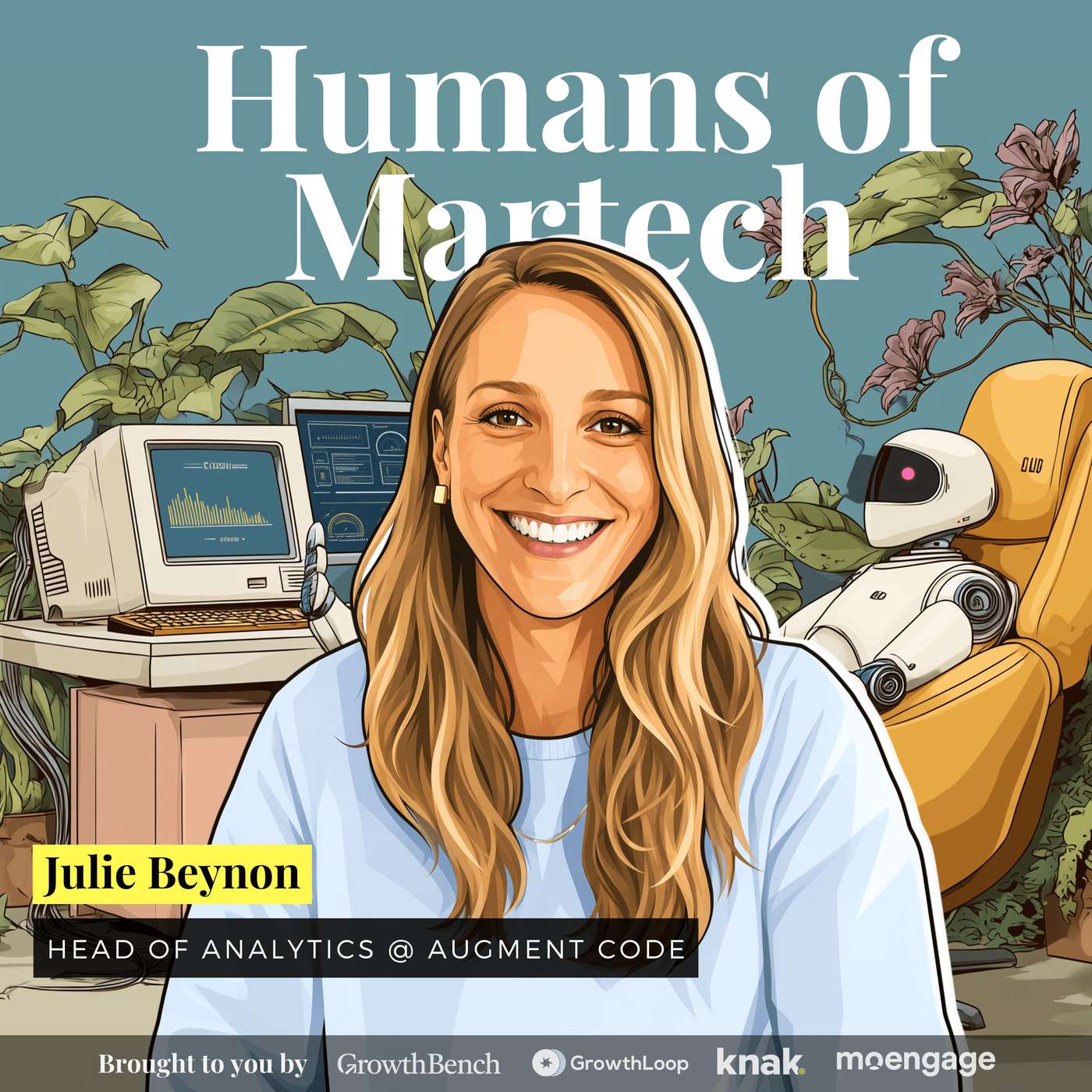
What's up everyone, today we have the pleasure of sitting down with Julie Beynon, Head of Analytics at Augment Code. (00:00) - Intro (01:07) - In This Episode (04:13) - Breaking Into Data Without A Computer Science Background (06:05) - Why AI Made Building Cheap But Maintenance Expensive (09:25) - How To Push Back On AI Projects Without Killing Momentum (12:28) - Building AI Agents That Multiply A Two Person Data Team (16:29) - When Not To Reach For AI At Work (22:23) - Running A Lean Data Team As A Force Multiplier (27:28) - The Spreadsheet Test For Keeping Your Data Stack Simple (31:49) - How To Prove The Value Of Invisible Data Work (39:14) - Why Data Analytics Is Becoming GTM Operations (41:47) - What Part Of The Data Analyst Job AI Is Replacing (47:15) - The Data Skills AI Can't Replace (52:07) - How To Decide What Deserves Your Energy Summary: Julie Beynon came into data sideways from content marketing, got cut down to 2 words by a CEO, and turned that into a 15-year career running lean data teams. In this episode she breaks down how she cloned her best analyst into an AI agent named JimBot, why she pushes back on AI projects without ever saying no, and how she gets companies to fund the invisible foundation work nobody claps for. She makes the case that AI knocked down the SQL wall, so the real bottleneck moved to the data model underneath, and that simple is now the hardest skill in the room. There's a spreadsheet test, a team of 2 that runs like 10, and a surprisingly hopeful take on AI making us more human. Stick around for the part where she explains why the boring option takes the most nerve.About Julie Beynon Julie Beynon is the Head of Analytics at Augment Code, an AI coding assistant company, where she runs a lean data team and builds AI agents that let the whole company self-serve trusted answers. She's spent roughly 15 years in data and go-to-market analytics, previously leading data at Census and analytics at Clearbit, with earlier stops at Customer.io and other startups. She's self-taught and came into data sideways from content marketing, with no computer science background. Alongside the day job she writes a series of short essays on data, AI, and the discipline of knowing when not to reach for a tool. Breaking Into Data Without A Computer Science Background Most people assume the path into data analytics runs through a computer science degree or at least a few years buried in SQL. Julie's route looked nothing like that. She started as a content marketer, and by her own account she was bad at it. Her CEO once edited a piece of her writing down to 2 words. That kind of feedback breaks a lot of people. It did the opposite for her. Getting cut down that hard built a habit of raising her hand for whatever nobody else wanted to do, and the thing nobody wanted to touch was data. The real turn came at Customer.io, where a new tool called dbt showed up and someone offered to train her on it. She figured saying yes...
[00:00:00] Julie: For us to get the data in dbt, get it in our semantic layer, get it modeled correctly, get it optimized, all of that, this JimBot is like this junior analytics engineer that just gets that in and works with the brain, follows the rules. And so I just have to say, "Hey, add this data," right into a Slack message, and it builds me an entire PR for this data, runs it, tests it. [00:00:20] We have JimBot and then we have Mimi, which is my analyst that I've created. I don't have to do ad hoc questions. We have our company now self-serving data, actually off the dbt models, off of all of that logic that we maintain. We keep that house really, really clean, and we're tweaking it kind of hourly. [00:00:35] Our team now can self-serve off of the best data, the best context that we can give them. [00:01:07] In This Episode --- [00:01:07] Phil: What's up, everyone? Today, we have the pleasure of sitting down with Julie Beynon, head of analytics at Augment Code. She's led data at Census, Clearbit, Customer.io, and she's completely self-taught, having come at data sideways from content marketing. [00:01:21] In this conversation, we explore why AI made building cheap but maintenance expensive, building AI agents that multiply a two-person data team, how to prove the value of invisible data work, and why data analytics is quickly becoming GTM operations. [00:01:38] All that and a bunch more stuff after a quick word from two of our awesome partners. [00:01:41] [Partner break] [00:03:46] Phil: Julie, thank you so much for returning back to the podcast. You are one of the few OG guests. You were actually on episode 17, and this is gonna be episode, like, 230-something, so 220 episodes five years later. Nothing has really changed in the world, right? Same as usual? [00:04:04] Julie: Same, same. I'm coming back here just to make my mom proud, so I'm excited to be back. [00:04:10] Phil: I love it. All right. Let's do it. [00:04:13] 1 - Breaking Into Data Without A Computer Science Background --- [00:04:14] Phil: I was trying to figure out topics for today, and I was listening through the transcript of your episode when you came on. So many things that have changed. But something we didn't really cover five years ago is your origin story, and I think it's really cool, maybe underrated, for the path that your career kind of went into. [00:04:21] You actually came at data sideways. It wasn't a computer science background or analytics background. You were content first, mostly in startup land. And honestly, I think that's what probably makes you really good at the business side of marketing data, marketing analytics. You said that your way in data was that nobody else on the team wanted to touch specific types of data, and that was the entry point for you. [00:05:00] Walk me through that moment that maybe was that door for marketing data for you. [00:05:07] Julie: Yeah, the origin story really, I think I might have mentioned this last time, was that I was writing content and the CEO only left the words "and" and "the." And I actually had dinner with him not that long ago, and I told him that story and he's like, "Yeah." [00:05:20] But I think it just came from that experience, was at that job of not being good and raising my hand and doing something else, and so that muscle developed. And it really took a turn at Customer.io where there was this opportunity to use this new product called dbt, and we had somebody willing to train me, and I thought, "Well, this would be silly." [00:05:45] And that's when I realized, oh my goodness, what power I have just yielded. I can turn this raw data into something that I can use. Oh my goodness, right? And so I think it was just the muscle had been developed from failures before, and then the opportunity presented itself. [00:06:05] 2 - Why AI Made Building Cheap But Maintenance Expensive --- [00:06:05] Phil: Very cool. Nice list of cool brand names, startups on your resume. A lot of them became household names, and you were part of their early rise and journeys there. You're at a cool AI native startup right now, and when I reached out to invite you back on the show, we were kind of bouncing ideas on what to talk about, so many things we could talk about. [00:06:28] But you actually shared that you started doing some writing, which is amazing. I've had the pleasure of reading through, I think there's like 11 short essays up on your site. Having read through all of them, I want to encourage you to keep finding the time to do this, not just selfishly for me, interviewing you and getting the download of your thoughts here. [00:06:50] But everyone that's in marketing or data, I think your thoughts here are really cool. There's one thing that I really love about some of the essays that you wrote. The whole lens for you is that you're at an AI native startup, and you're hands-on with this stuff every day. [00:07:08] I'm sure you're using the product internally, kind of dogfooding or whatever. But you also have this really cool, clear voice on when to reach for AI tools, when to leave them alone and flex your actual human brain. To me, that's kind of the whole point of what we're living through right now, humans and martech and AI tech. [00:07:27] The people best at this area are the ones with the judgment to know the difference. When do we reach for AI? When do we flex our own brains? So how did you build that instinct for when AI is the right tool, when it isn't? Maybe we can start there. [00:07:41] Julie: Yeah. I think it started back maybe five years ago. I wrote a post called Build versus Buy, and I think AI has just accelerated the ability to build. But the principle still exists there, right? It's really fun to build. It is not fun to maintain. It's not fun to continue. Once you've gotten over the excitement of building, there is this component of maintenance, which is equally as important for the company to be successful with whatever it is you're building. [00:08:10] And so if it's not mission-critical, you tend... The first bit is easy to build, and then you're not gonna maintain it, and so that's when I push back. [00:08:21] I push back to the team of, "Great, it's fun. It's easy to build, but who's maintaining this? Who's owning this? In six months from now when sales comes and asks me about this number from this dashboard that you built, are you gonna answer it? Am I gonna answer it?" [00:08:34] What about when there's data drift? And so it's really easy to spin up that really cool dashboard. It's really easy to spin up that cool workflow. But when it breaks in six months, we're actually worse off. And so it's thinking through that, past that kind of dopamine hit of building, and what is actually... [00:08:56] Is this mission-critical? Are we gonna get value? Is there a tool that is gonna cost less per month than the tokens it costs to build it? Because that is a reality. You can spend $1,000 on a tool that costs $5 a month. Cool, right? The ROI isn't actually there, and so you have to think about all these things of, is it mission-critical? [00:09:19] Who's owning it? Who's maintaining it? And is it actually cost-effective? Because there is a cost to AI. [00:09:25] 3 - How To Push Back On AI Projects Without Killing Momentum --- [00:09:25] Phil: Yeah, not just tokens, the maintenance and the tech debt that kind of builds up there. I feel like the folks in marketing ops and RevOps are super well-positioned for situations like this because we have been the folks in teams that have had to say no many times in our careers. And it's just the bane of existence for martech folks, right? [00:09:48] A new tool comes up, everyone has shiny object syndrome, "We have to do this, we have to do that," and you have to constantly remind people, "Yo, we have these two things that do something very similar. We're already spending money here. We're focusing on this. We can't distract ourselves all the time." [00:10:03] So we've been saying no already. But I'm curious to ask you, with all this AI stuff and people wanting to build, you don't wanna discourage people and tell people no, don't flex your muscles, don't go learn how to do this yourself and build this yourself. So you actually wrote about how to do that kindly, and pushing back without killing anyone's energy. [00:10:24] How do you actually pull that off in the room with AI now, being the considered voice without becoming the person who says no to everything? 'Cause I feel like that's the reputation that a lot of ops people get sometimes. [00:10:36] Julie: Yeah, I try not to say no to everything. But I think there's a layer with data also that you have to be a bit... You have to protect it, right? You have a duty on the data side to protect the data. And so you do have to consider those security issues as well. [00:10:54] I think recently, actually, there's a really great example. We had one of our engineers build up a proof of concept dashboard for one of our new products, and it's great, and it works well. And instead of saying, "I don't want you to continue building that," it's like, "Okay, this is an amazing starting pad for me to go now productize this," right? [00:11:16] And so I let them run with the first pass of it to get their thoughts out, and AI helped productize it and visualize it for them in a way. And then when it came to the decision of how to make it sustainable, I'm like, "Okay, I can take this now. You've done great work." And so it's sometimes letting people go a couple steps so you can see what they're thinking, and then you can decide, "Okay, actually I can take this on now. I have a tool that does this for half the cost, or I have a workflow." [00:11:41] And so there is a little bit of watching them go where they wanna go instead of saying no immediately. I'm like, "Okay, show me what it is you're thinking," and then working off of that. And it actually was one of the most productive data cycles for me because the engineer knew every data point. [00:12:04] He knew how it was tracked. He knew everything about it. So instead of me having to sit in a meeting and take that from his brain, I just took that from his code. And then I just turned around a stable dashboard that's maintained in our BI tool that has all the observability, has all the role-based access control, but with the context from his brain. [00:12:24] So that cycle actually worked quite well for us. [00:12:28] 4 - Building AI Agents That Multiply A Two Person Data Team --- [00:12:28] Phil: That's super cool. Do you have another example? We talked about when not to reach for AI, the whole maintenance aspect to this. What's something AI has made really better for you in your own work that when you think about it, you're just like, "I'm never giving that back. I'm never flexing my own muscle and doing this manually." What are the things that come to mind first? [00:12:52] Julie: So much. So we are now a team of two, right? We have an analytics engineer, and I've always thought, "I just wanna hire more of this specific Jim." And so I just wanna hire 100 Jims. And with AI, Jim created this expert, and we've aptly named it JimBot. And so now we have this sort of junior analytics engineer with Jim's brain and Jim's logic. [00:13:16] And so we can now, as this data's coming in, 'cause our engineering team is working significantly faster, right? And so for us to get the data in dbt, get it in our semantic layer, get it modeled correctly, get it optimized, all of that, we have to be working, there's like 10X of them compared to us. [00:13:33] And so this JimBot is like this junior analytics engineer that just gets that in and works with the brain, follows the rules. And so I don't have to think about what Jim set up. I just have to say, "Hey, add this data," right into a Slack message, and it builds me an entire PR for this data, runs it, tests it. [00:13:53] Great. I couldn't live without it. I don't have to go into dbt. I don't write any code anywhere. And so that means that our AI analyst, which I've created, so we have JimBot and then we have Mimi, which is my analyst that I've created, has the way I think about structuring data questions, right? [00:14:12] And it has all of the context that I have. It has all the skills. And so whenever anybody calls Mimi in Slack, I don't have to do ad hoc questions, which was a lot of our time was spent stopping your work, looking at the question, addressing the question, auditing the question, and then going back in. [00:14:31] So I couldn't live without that AI analyst that does the triage for us, 'cause a lot of the questions are pretty straightforward. And we have our company now self-serving data, actually off the dbt models, off of all of that logic that we maintain. We keep that house really, really clean, and we're tweaking it kind of hourly. [00:14:52] Our team now can self-serve off of the best data, the best context that we can give them. So I couldn't live without that. I don't want to have to go back and answer an ad hoc question ever again. [00:15:05] Phil: I love it. Let's dig into the build for both of those agents. When I chat with folks about the build story for some of the agents that they have, it's interesting that sometimes there's commonalities in tools and how they came together. But the area in which they are built, whether it's at the semantic layer where they live, or local hosted, it's all built on Claude Code. [00:15:29] Sometimes it's actually Cursor. They're all Cursor agents. Sometimes it's in the warehouse. Sometimes it's the AI decisioning layer. Sometimes it's the execution platform. Where does that live for you? Talk to me about the build. Maybe it's different for Mimi and JimBot. [00:15:46] Julie: Yeah. So I have always been a proponent of dogfooding where you work, and so Augment Code has a tool called Cosmos. And so Cosmos is that ability. It's that kind of unified layer that allows us to build out these workflows, these experts. It has access to all of our code, and so it is that cross-departmental context engine where I can build a... [00:16:09] I can build this analyst that our CEO uses, and he didn't even know it existed because the system is so integrated that it just pointed him to it. And so yeah, it's dogfooding Cosmos and building these experts off of it that have all of the code base, have all of the context, have all of those skills. [00:16:29] 5 - When Not To Reach For AI At Work --- [00:16:29] Phil: Very cool. So this is actually one of my favorite articles that you wrote. You caught yourself reaching for AI to write an SQL filter that you've written 100-plus times before, and instead of calling it efficient, you called it a problem. You stopped yourself in that moment, and I do the same thing on the content ops production side of things. [00:16:53] And I never think twice about it. But your article, maybe pause and reflect on the pipeline and the automation that I have there. Why did you flag that as a problem in the moment? Walk me through it. [00:17:08] Julie: Do you want the honest answer? So Hex started charging for their AI agent, and I had gotten kinda lazy, and I had asked it to do things that would've taken me less time to write. And so there became a cost to that. There became a cost to my laziness. And so then it started to reflect on, okay, these are things I know how to do. [00:17:31] These are things I know how to do better than the agent. Instead of having to prompt it twice to do the thing that I know is where X equals Y, I'm writing this sentence prompt to get it to do where X equals Y, and it's missing... So it's like I pride myself on being efficient, but I was... And lazy smart, but I was actually just being lazy lazy in that moment. [00:17:54] And I felt like I was losing the muscle and the instinct of when to just go to your skills. And so I did start to, again, the thing was that they started charging us for it, and so you had to start reflecting on what's necessary. But it was a good moment in time for me to think about, okay, what have I just sort of put into AI that would've taken me less time, and I would've been able to think about it differently. [00:18:20] Phil: Yeah, I struggle with that a lot too. Especially in the early components of automating something or handing something off to AI, there is this huge learning curve, or process curve, between you and AI. It's not just flipping the switch and this AI agent is gonna take over the whole PR creation process for you. [00:18:42] There's the context feeding and trial and error back and forth, and so there's a lot of time before you actually save that time, if you're even able to automate it and get it to a spot where you feel less of a burden from it. But the rule that you wrote in your article is basically, "If I already know how to do this, just do it, no prompt." [00:19:06] Why would I have to figure that out again? But that works because you've got those reps in the bank, right? 15-plus years in your career, and the boring work kind of built that intuition, exactly like the stuff that AI does for you now. I'm curious to ask you, how do you think about not the junior analyst, but maybe the analyst who's earlier in their career, like Julie 10 years ago, who never had to do those reps and is now using JimBot or Mimi to do a lot of those things, and they're skipping those reps and they're not building that muscle. What are your thoughts there? [00:19:50] Julie: I think about that a lot. I had a teammate who I would've considered Julie from 10 years ago, and what I tried to focus on was the elements of truly understanding the problem, right? 'Cause once you truly understand the problem, then the hard skills are not as important. The SQL, sure, if writing the SQL filter is quicker with AI versus you doing it, no worries. [00:20:17] That's okay. You don't need to have those reps in. But what you need to understand deeply is the problem. I think what I see sometimes with junior is they'll just throw the question immediately to AI, and so it's that muscle of, I need to understand this problem. I need to be the operator of this machine. [00:20:34] I need to understand where things are. I need to understand where to point it. I need to understand what questions to ask. I need to understand what wrong is. I need to understand what right sort of looks like. And so that's what I would say to anyone who's kind of junior, is get the muscles of understanding the problem and understanding why you're doing it and what good looks like, and then you can really direct AI in an efficient way. [00:20:55] 'Cause if you don't understand any of that, then you're just consistently prompting it and then hoping. And QA is never going to go away. There is that sort of initial phase of designing it, understanding the problem, and then there's the final phase of QA, which is a muscle. [00:21:15] And so something that I like to do is I like to throw my work to somebody who's junior and say, "Can you QA my work for me?" And get them to have that muscle. So it's not just me QA-ing their work. I need you to have the muscle to QA because you need to know what wrong looks like. That is a much more important thing now than ever, is you need to know what wrong looks like, and you need to understand the problem. [00:21:36] Phil: Yeah, that's a really cool flip on my question there, understanding the problem and sending them work that is still valuable in a sense, but different completely in this AI era or whatever. The other thing that comes up a lot in this realm of topic with folks on the show is there's this worry that comes up a lot with folks that talk about companies leaning on tools and AI instead of mentoring those junior folks. [00:22:03] Maybe sending them work and helping them understand the problem. It is part of mentoring there, but you also said that your team is super small and nimble. There's two people on the data team. As a leader, what do you build into a team so that people keep developing that muscle? [00:22:23] 6 - Running A Lean Data Team As A Force Multiplier --- [00:22:23] Julie: Actually, a fun fact is the team at Augment was at 1.4. That was the biggest team I've ever run. And so I think I've always leaned on being a lean data person, and I've had budget, and I've had approval for having bigger teams. So it's always been for me how to make the data team a multiplier, and so that is the way that I try and get the team to think about stuff. [00:22:49] We're not a service center. We are a multiplier. And when we become a service center, we've lost a lot of our value. And so it's like, how do we multiply ourselves so that we don't need to grow at the rate that the company grows? How do we multiply our work? And even when we talked last, Census and Hightouch had just come out in the world, and so there was an ability to multiply my work by putting the data in the tools like Salesforce and Marketo, and have the sales and marketing team. [00:23:18] And so the mentorship is really about what do you want your outcome to be, and how do you achieve that, and what kind of work is gonna get you there? And sometimes you have to do the admin work. You just have to answer the question 'cause you gotta. But for the most part, it's how do you build work that is going to make you 2X, 3X more productive, or the people around you. [00:23:40] And so that's more the ideology than necessarily the full, deep mentorship. [00:23:48] [Partner break] [00:25:52] Phil: How do you break that stigma of being the team that is the service center and is instead the multiplier? How do you break that stigma in the real world when employees are like, "Yeah, yeah, cool Julie, you're multiplying our efforts, but can you do those three things for us, please? We need those three dashboards, and then we can talk about how we can multiply our impacts together. [00:26:13] But please, please do those three things." And it just compounds and it never kinda stops. How do you break that stigma? [00:26:20] Julie: Oh, man. So I would say my first maybe six, seven months at Augment Code, I was a service center. I was operating as that because there was a need to get the foundations in place to get the data. And so because the foundations weren't in place, I couldn't multiply. [00:26:38] It was hard to push back because there wasn't anything built. And usually I'd say in the first year or so, if you are building the data team from scratch, you are building out foundations while also flying. And so you are gonna have to build that dashboard, that report, and be the quote unquote service center. [00:26:55] But the goal long term is to build towards the multiplier. And so as long as I have that vision in my head, I'm okay with people thinking I'm a service center for a little bit and getting that initial value, because you have to start somewhere. There is value derived from getting someone their answer. [00:27:12] And so if you think about building that out, that's the first logical stepping stone that you can do, and you get them an answer and they see value, and then you can start to build what you know you're building in the background while you're answering those one-off questions. [00:27:28] 7 - The Spreadsheet Test For Keeping Your Data Stack Simple --- [00:27:28] Phil: Very cool. One thing that jumped out in one of your essays was this idea that simple is the harder skill here in this AI era, and it's something even pre-AI that I empathize with a lot. We look at Scott Brinker's martech landscape, and right away you just feel this overwhelming sense of unease with all the options and the noise surrounding the different ways to do something. [00:27:55] But in that article, you wrote, "The best data people are the ones who know what to leave out," the tools and things that aren't necessary, all that noise. And I feel like today it's easier than ever to say, "Bro, I fixed our broken pipeline with a custom-built Kafka to Airbyte to BigQuery to dbt to Dagster pipeline that kills schema drift," blah, blah, blah. [00:28:17] I think it takes real confidence to do what you did and instead say, "Dude, I just fixed it with a simple Google Sheet." Tell me about a time that that boring, simple option was the right call and it kinda took a bit of nerve to choose it. [00:28:34] Julie: An interesting question. I do love a Google Sheet. Anyone who's worked with me knows I love a Google Sheet. [00:28:47] Gosh, I have a great answer for a time where it's never had to be a pushback. And maybe that's a function of where I've worked, that explaining that adding a third or fourth layer to your data pipeline is not a good idea is usually all I have to say to a team. And again, I run a very lean data team, so I'm usually the one that gets to make that decision, and I'm the one that pays the price. [00:29:14] And so I haven't had to do a ton of pushback in that case. [00:29:20] Phil: In this spreadsheet test, you wrote that, could a spreadsheet handle this for now, before you go buy something or you encourage someone to go build that thing? But I think when I was reading that, the devil's advocate play there is, AI builds the impressive version of this in an afternoon. [00:29:42] Maybe not the maintenance piece of it like we talked about before already, but like you said, the build got a lot cheaper with AI. Talk about why this whole flip on simplifying stuff, and this whole idea that maintenance didn't really get cheaper, and how you weigh that trade between adding more stuff, more complexity, versus, yo, let's just do this in a spreadsheet for now. [00:30:08] Julie: Yeah, I think it comes down to really understanding the problem. So if you understand what the problem is, then the solution becomes a lot easier. And AI has turned on the volume for how fast we can go, AI's just turned it up to 100, right? And I see a lot of people going, "I built Y. Oh my gosh, look how cool this is. I built this Y." [00:30:26] And someone's like, "I built this other version of Y, and I built this other version of Y." I'm like, "Yeah, but we needed X," right? And so when you stay focused on what you need, then you don't need a pipeline to Google Sheet. You need what is those five things in the Google Sheet, right? [00:30:43] And so the Y becomes this cool thing that you can build, but you shouldn't. And so it's more important now than ever to stay hyper-focused because we can all do anything. You can build anything. You can build every version of Y, and I think a lot of companies are experiencing where they have six people building Y 2.0 and they're all... [00:31:06] One's green, one's red, but they're all kind of the same thing. And so they're wondering why they're not getting those productivity gains from AI that they're expecting. But it's because each individual may feel more productive, but as a whole, we've just done the same thing six times. [00:31:22] And so focus and simplicity keep your team going in the right direction. "Okay, what is this? Does this line up with the goal? Great. This is cool." Now, I would be a liar if I said I didn't occasionally build a Y just because it's fun. But for the most part I'm trying to stick to what is X? [00:31:39] What does the company need? How do we focus on that? And then sometimes I might add a little splash to it, but it's the X, not the version of Y. [00:31:49] 8 - How To Prove The Value Of Invisible Data Work --- [00:31:49] Phil: I love it. I think that there's two things that have come up a lot as this through line in your episode today. You need to understand the problem and the why, and you called back to this, not being a service center really is only possible once you have the foundations in place, and sometimes until that happens, you are kind of a service center a little bit. [00:32:15] And I wanted to ask you a question about that, 'cause you wrote that the foundational work is this whole game now. But when I was reading that, the thing I struggle with, the foundation work, and maybe AI's changed that for data quality stuff specifically, but it doesn't demo well, and it's hard to prove the value of it. [00:32:34] You can't screenshot an ontology on a board slide. It's kind of like the eternal RevOps and data team problem, and I think you're better at solving that than most. You clearly were able to get the foundation pieces in place at a small startup with the size of team that you have. [00:32:53] How do you make that invisible work visible? How do you get a company to value it before something breaks, and how were you able to convince folks to let you work on the foundation pieces in the middle of them asking for 17 dashboards that you probably still had to make time for? [00:33:11] Julie: Yeah, getting the budget I think was easy for this company. If you work at a company that just digests data all the time, then they see the value in it. And so it was easy to build the team here. And I think the way we've thought about it has changed over the course of the year. The structure and how we thought about the team has so rapidly changed, what we are and who we are. [00:33:36] And I remember I built a lead score, or a score, this really cool thing that I just kind of built in my free time, and I was like, "Oh, that's cool. That's neat." But I couldn't seem to get the adoption of it. And so the foundations that we're building are kind of similar. [00:33:53] We're building really cool stuff and people weren't buying in back then, but we created a bridge. We had the foundation, and AI has allowed us to create this bridge into our foundations in a way that translates it. And so they may not understand why the AI analyst is giving them the right answer, or why their new data is so correctly modeled and they can now do it in Hex, but they understand that they can. [00:34:21] And they understand, the feedback we get is, "Oh, it's getting better." It's 'cause we're constantly tweaking the foundation. And so before it was like I had to do enablement, I had to teach people how to use it. I had to market and sell and market myself in ways so that they could understand why I was putting time and energy into this work, and that's how you got more time and more allowance to do that. [00:34:44] Now we just hyper-focus on building good foundation and building a solid bridge, and then when someone came to us, showing them the bridge and just continually showing them the bridge, and the bridge was well enough built that they could get in, and they could answer their questions. [00:35:00] And so that's part of that Mimi AI analyst, all of that is our way into the work, which allows us to get more buy-in to continue building the foundations 'cause they're getting what they need from us. [00:35:13] Phil: So the bridge is like a chat box in that sense, or interacting with something, allowing them to ask questions and they see the output, they get their answers, and that's the essential output of that. They feel confident in it because they were able to get answers. They know it works. [00:35:30] Julie: Yeah. I monitor every single one of the questions that get in to make sure that it's not wrong. So we've added observability into our experts. I can see everything that's queried. It doesn't answer questions it's not supposed to, anything PII or sensitive. [00:35:44] It's locked in. And it has a confidence score, and so they're able to get these answers and then I'll come in just to... Especially when trying to build adoption, I'll come in and go, "Yep, that's right." And so then they got this AI analyst and I'm just constantly saying, "Yep, that's right. Yep, that's right." [00:36:01] And so it's that building of the trust. Whereas historically, I think if it's marketing ops, if you had a lead score, a new PQA, you'd pick a couple people. You'd really get them to learn it. You'd show their success, and then you'd train and you'd onboard and you have documentation. [00:36:19] Now all of that enablement is inside of AI, the training and the skills. We have an auto redirect when anybody asks a question inside of our unified system, that it goes right to my analyst so that all data questions get... No one needs to know it exists. You could be a new hire on day one. You don't need to know it exists. [00:36:36] And so we've built a lot of those constant selling and marketing that you had to do of all this really cool stuff, these Ferraris that you built. We removed that. And so I think that's how you get, that is how it's just quicker selling. [00:36:54] Historically you had to do it manually, now we do it with AI and it sells our products for us. [00:36:58] Phil: Very cool. Can you talk a bit about the journey? I know you joined not too long ago, and there's a ton of work that I'm sure you got off the bat already, but what did some of those foundational pieces work? What did you have to do tool-wise, data process-wise, to get to that bridge to even enable folks to use the dogfooding platform to answer some of those questions? Walk us through that journey a little bit. [00:37:28] Julie: Yeah. So I came in and I brought in the tools I love. I've been using dbt now for 10 years, so brought that in for transformation. Been using Census now for quite some time, like a reverse ETL. So tooling to me, when used correctly, is your first multiplier effect, right? [00:37:48] It's your first place to get there. And so it was just bringing in what tables do we need. The first thing I always look at is revenue. If you don't have your revenue numbers right, don't worry about doing anything else. So getting our revenue numbers was mission critical month one. [00:38:06] Making sure that's all modeled, making sure that we know what's going on, and then understanding what does success look like for this team, and this team, and this team. And so you start modeling that in and building those foundations as you're getting asked the questions. [00:38:20] So it's a bit easier when you keep getting asked the same question. You know what needs to be put into the foundation. And that is just one of those cyclical things of, "Oh, I keep getting asked about this. This is really important. Why is it really important? Let me go talk to the people. Okay, let's go add that in." [00:38:33] And so that was the first three to six months of building, was getting the systems in place. Luckily, I've added those to many companies, so it just was kind of flip of the switch type thing. And then the hard part is understanding what the business needs, how the business operates. [00:38:53] I'm new to BigQuery, so also learning that. Every time you go to a new company and they have a different data warehouse, you feel like a beginner again. You're going in and going, "Okay, how do I find X? How do I do this?" So there was a bit of a learning curve also for me of just what their existing systems were and how I play nicely with those. [00:39:14] 9 - Why Data Analytics Is Becoming GTM Operations --- [00:39:14] Phil: Very cool. I appreciate you sharing that. I wanted to spend a bit of time talking about what the job becomes, and maybe we can start by defining the job in this case here, 'cause there's a bunch of different types of folks who listen to the show. Like I was telling you before we started recording, it's the marketing ops people, the RevOps people that work across marketing and sales and operations. [00:39:36] Some of the folks are systems. Some of the folks are more on training and enablement, but everyone is playing with tools. A lot of them have to deal with data questions. There's a lot of data analysts who listen to the show who work with marketers, not serve marketers, multiply marketers' outputs. [00:39:54] I find your work really interesting because you've been in startups your whole career, but let's say if we were to put Julie in the enterprise world at a big company. There's 17 different titles, or job functions, that I could see you thrive in. Some of those are GTM systems, GTM ops. [00:40:18] There's the whole data team. You could play a bunch of different roles on the data team, but there's the revenue operations also. Have you thought a bit about what your role means at a bigger company when someone talks to you like, "Oh, what do you do?" And you start naming the things you're doing, and they're just like, "What do you not do, Julie? You're at a startup. You got your hands dirty everywhere." But maybe help us understand how you explain that role externally. [00:40:47] Julie: That's a really great question. I think in a dream world, as soon as you said GTM engineer, GTM ops, I love that. That's where I feel like I am now. And once we start becoming a multiplier, that's the type of work that I think does really multiply the data team, even though maybe our source or our tooling's a bit different, it's the same concept as GTM ops. [00:41:10] How do I build ways in which we can move faster and we can get more leads, or get more answers, right? And so I really tow the line of operations, and I do tend to gravitate towards GTM just 'cause that's where I started. And so it is a GTM operational piece, where if I had a list of items to do, GTM ops category would be at the top, and that's where I spend my time, and that's where I am starting to move my energy and time now. [00:41:47] 10 - What Part Of The Data Analyst Job AI Is Replacing --- [00:41:47] Phil: Nice. Okay, cool. That is helpful to ground this next question here, because I feel like the marketing data analyst role is probably just a line item on the long list of things that you do for the company. In bigger orgs, it's a dedicated full function role, and those folks today, or in the past at least, were building dashboards. [00:42:11] They're the ones that lived in Looker, maybe they were product analysts and they lived in Amplitude and they were building dashboards and answering questions in service tickets or whatever. Darrell and I had an episode where we made the case that the data analyst whose whole job today is just building dashboards, taking new dashboard request tickets, bringing them to life, sending them out, getting feedback on them, and rinse and repeat. [00:42:37] We made the case that these folks were in trouble in a sense, because it's way easier to build dashboards and visualizations today. It's way easier to convert normal human questions into actual SQL queries. You tend to frame the change less as something is dead and more of, there's a shift. [00:42:57] And I wanna get this right with you here. So help me draw the line. What part of the data analyst job is really going away, in your opinion? And what's the part that gets more valuable with AI? [00:43:15] Julie: Yeah, I probably have a skewed opinion 'cause the parts of being a data analyst that I hated are what are going away, so I find it exciting. And I think of myself as a data analyst, I'm like, "Oh, those ad hoc questions, those building dashboards, I couldn't spend time there." [00:43:32] I think if somebody is kind of thinking about that, yeah, I do think those tasks, I can build a dashboard now with four or five prompts, and it is a morning task with my coffee. But where the value comes in, and where I think the junior analyst, what I can think of, here's the problem and I can understand in a couple seconds 'cause I've seen it before, that's the muscle they need to get stronger. [00:43:57] 'Cause you can build a dashboard that doesn't do what you need it to do. And so where the analyst is gonna get stronger is really understanding how to communicate effectively and story tell with data, and how to keep the team hyper-focused. And again, it's saying, "No, you can put 100... Now I can build a dashboard with 100 metrics." That's never been the right answer. [00:44:25] Gatekeeper's the wrong word. You're almost like a project manager. You're like the data product manager of the storytelling, of the insights, of what's important. Your job is more about talking to the stakeholders and trying to really get their process versus taking their requests, right? [00:44:42] You now need to step into their lane a little bit and understand what their business is and what they're doing, and why they're... What they think of as success, so that you can build that thing in four or five prompts while your coffee's brewing. But you give them something that's truly valuable versus a dashboard that took you six months to build that doesn't really answer the questions. [00:45:01] And so AI makes us able, if you really take the time to go and figure out what good looks like, what data is needed, what's gonna have somebody refreshing that dashboard daily because it's so helpful to their job, that's where AI's gonna make you an incredible analyst 'cause you can spend more time doing the right stuff. [00:45:22] Phil: You said that there's only two people on the team right now, but let's say things get crazy and you get a couple extra headcounts going into next year. 'Cause I did have this hiring question for you related to this. Maybe not just the analyst role today. Let's say you get to pick what that headcount is. [00:45:42] But with things like SQL and creating dashboards a lot easier, like you just mentioned what good looks like, what's the signal in that interview process where you think someone has the judgment that the tools can't give them, or the ability to know what is good, the ability to understand the problems? What are your thoughts there? [00:46:05] Julie: The questions they ask tell you a lot, right? How curious they are, because those are the questions that they're gonna be sitting in front of the stakeholders, the exec team, they're gonna be asking those questions. So that's an important piece of the puzzle. Also, just willingness. I don't know what this role would look like in six months, so I need somebody that has a willingness to go broad and deep depending on where we need them, and that utility player, especially as things are changing. [00:46:31] Hard set skills and a really tight focus is great in bigger orgs, but in a company that is moving as quickly as AI is, we're moving with this wave. And so for me to promise anything of what the role would look like in six months is not ideal. So I'm looking for somebody that has an openness, a willingness to learn, has sort of a resourcefulness, right? [00:46:53] 'Cause there's gotta be a level where they're able to go and just figure it out. It's the things I've always looked for, actually. I just test a little less hard for the hard skills. But I still do. I still want someone to know what they're doing technically, but it's less of a percentage in the weighting. [00:47:15] 11 - The Data Skills AI Can't Replace --- [00:47:15] Phil: You said we don't know what the role's gonna look like in six months, and my question was five years out, looking into the future in five years. So maybe it's looking into the future in six months. Let's say AI's done a lot of the stuff that is going to do a lot of the data analyst role that we're talking about right now, if not already. [00:47:38] But my question is, what does good look like for the person, the human in the seat, once the tools and the stack are commoditized? What are they great at that nobody can take, no AI, no tool can take? What are your thoughts there? [00:47:56] Julie: Yeah. I think marketing ops, RevOps, data, lives in this sort of we see everything, and you can see problems before they happen. And I think by freeing your time up from not doing all of the real specific building, you can start to catch the problems before they become problems. [00:48:19] And the problems that exist, no matter how much AI is there, there's still gonna be communication issues. And so the person that's great at this is seeing all the data come in, seeing all the problems come in, and is sort of that holder of... One thing I'm trying to do is set up processes for how we communicate, and catching those issues of, "Oh, Ange has questions about this sales dashboard." [00:48:45] Okay, what is it that Ange doesn't know about this sales dashboard? How do we communicate? How do we train that? It's not a data problem, but it lands in data land because the questions are coming to you about the sales dashboard, and then it's reflecting on sales. And so I think success looks like somebody that kind of weaves the company in a little bit tighter together, right? [00:49:08] Through processes and through data, because now you have time. The problems we already saw, all of us had seen these problems. We all saw them happening, and you're just like, "It's not really totally my problem, so I won't jump into it because I'm not fully there." It's like, okay, now I have some time to start thinking about solutions to these problems that are causing these operational inefficiencies, that are causing this friction, that are causing whatever it is that's happening. [00:49:34] So it's that person that has the whole suite of all of their data and their tools and is tying it all together in a nice, tight kind of process or communication or whatever it is the problem is. It's vague. Management's vague because the problems can be broad, but now you see all of them, and you can act on them, or at least advise on them. [00:49:53] Phil: Yeah, such a good point. RevOps, marketing ops, we see a lot of stuff, and even though sometimes we're lost in the tools and heads down, there's questions from all different stakeholders. I spent a lot of my time in lifecycle marketing when I was at WordPress, product engagement, lifecycle marketing, and the role was almost just stakeholder management, and dealing with the eng team, the product team, the data team, the martech team, and you're like... [00:50:21] You're just trying to negotiate and battle politics and stuff like that, and you're not working in the tech as much. But it's so true that you see data from everywhere, and you get questions from a bunch of different places. What's something kind of related to this that you think that AI, or data, that you wish more people in our world understood? What's the thing that's underrated right now that you want someone to know, that maybe is listening and they're just not as deep in this world as you? [00:50:56] Julie: I think AI has the opportunity to make us more human. I have a silly example yesterday. I was at the gym, and I got a question, and I was like, "Oh." Normally, I would've had to drive back from the gym, and I would've had to go and answer it 'cause it was kinda time-sensitive. AI has allowed me to get that answer, validate it, and go back to working on the gym and focusing on what's important to me. [00:51:19] And so I felt, I was like, "Okay, this is..." I see my life getting easier with AI, and I see myself with more time with things that matter, as we let the work that we didn't love, the more time to spend with family and friends, and not be as tied to our computers. [00:51:40] That was just a recent example, and I felt like, "Okay, I can see more of this happening in my life, and I get more time to just be a human." [00:51:50] Phil: That's a cool example. The other way to answer those questions faster, and not disrupt your workout, is to delete Slack off your phone. That's a non-AI tip for folks. I know not always possible when you're in startup land. [00:52:07] 12 - How To Decide What Deserves Your Energy --- [00:52:07] Phil: Related to that, we end every episode on this happiness human role. And usually for returning guests, I go and I look at the last answer, but funny enough, you were early enough in the podcast journey that we weren't asking this to people yet. So you're a returning guest. This is the first time I get to ask you this. [00:52:13] You're obviously a marketing data leader. We talked about all the different roles that you would have at a bigger company, GTM ops, go-to-market, marketing ops, blah, blah, blah. But you're also an avid gardener, former Toronto downtown city slicker, and upcoming puppy mom. One question we ask everyone on the show is, how do you decide what deserves your energy at any given moment, and what's your personal system for staying aligned with what actually makes you happy? [00:52:54] Julie: If you would have asked me this when I was on the show before, it would've probably been a weekend trip to Martinique. I say the things that are keeping me happy, as I get older, it's the simple things. It's doing what I say I'll do, right? It's being as close to the person that I wanna be, and the energy is... [00:53:18] It not so much gives me energy. It doesn't take away energy. You're not fighting yourself of, "Oh, I'm a healthy person, but yet I'm not going to the gym," right? Those types of drifts of who we are and how we're behaving. So doing what you say you're gonna do is one of those things that gives me a ton of energy now, mostly because it just doesn't take away the energy fighting it. [00:53:39] And I'd like to think the person that I wanna be is a fun, happy person, and so those things tend to be fun and happy, and I'm making life easier for future me. So yeah. It's very boring, very simple. It's just doing the things you say you're gonna do. [00:53:56] Phil: I love it. And maybe one of those things is to keep doing essential oils and get rid of those water snakes in the new place that you were telling me about before we hit record. [00:54:07] Julie: You know, I've checked that dock a few times, no snakes. So anyone that wants to laugh at my essential oil snake repellent... [00:54:17] Phil: Maybe the puppy that's on the way is gonna be a big fan of hunting for snakes. I don't know if they're venomous. You're in Toronto. I don't think they are. They're just annoying, right? [00:54:25] Julie: They're just a lifelong fear. People like spiders. I'm terrified of snakes, so it's one of those things. [00:54:35] Phil: I love it. Julie, really appreciate your time. This was super fun. Thank you for coming back on. You're such a breath of fresh air, and always have a blast chatting with you. Really appreciate you coming back on. [00:54:47] Julie: Yeah, this was fun. I'm really happy to be back.